



Community hub
Recent from talks
Contribute something
Nothing was collected or created yet.
Momentum map
View on WikipediaIn mathematics, specifically in symplectic geometry, the momentum map (or, by false etymology, moment map[1]) is a tool associated with a Hamiltonian action of a Lie group on a symplectic manifold, used to construct conserved quantities for the action. The momentum map generalizes the classical notions of linear and angular momentum. It is an essential ingredient in various constructions of symplectic manifolds, including symplectic (Marsden–Weinstein) quotients, discussed below, and symplectic cuts and sums.
Formal definition
[edit]Let be a manifold with symplectic form . Suppose that a Lie group acts on via symplectomorphisms (that is, the action of each in preserves ). Let be the Lie algebra of , its dual, and



the pairing between the two. Any in induces a vector field on describing the infinitesimal action of . To be precise, at a point in the vector is


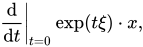
where is the exponential map and denotes the -action on .[2] Let denote the contraction of this vector field with . Because acts by symplectomorphisms, it follows that is closed (for all in ).


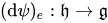
Suppose that is not just closed but also exact, so that for some function . If this holds, then one may choose the to make the map linear. A momentum map for the -action on is a map such that
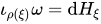
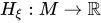



for all in . Here is the function from to defined by . The momentum map is uniquely defined up to an additive constant of integration (on each connected component).



An -action on a symplectic manifold is called Hamiltonian if it is symplectic and if there exists a momentum map.
A momentum map is often also required to be -equivariant, where acts on via the coadjoint action, and sometimes this requirement is included in the definition of a Hamiltonian group action. If the group is compact or semisimple, then the constant of integration can always be chosen to make the momentum map coadjoint equivariant. However, in general the coadjoint action must be modified to make the map equivariant (this is the case for example for the Euclidean group). The modification is by a 1-cocycle on the group with values in , as first described by Souriau (1970).
Examples of momentum maps
[edit]In the case of a Hamiltonian action of the circle , the Lie algebra dual is naturally identified with , and the momentum map is simply the Hamiltonian function that generates the circle action.

Another classical case occurs when is the cotangent bundle of and is the Euclidean group generated by rotations and translations. That is, is a six-dimensional group, the semidirect product of and . The six components of the momentum map are then the three angular momenta and the three linear momenta.


Let be a smooth manifold and let be its cotangent bundle, with projection map . Let denote the tautological 1-form on . Suppose acts on . The induced action of on the symplectic manifold , given by for is Hamiltonian with momentum map for all . Here denotes the contraction of the vector field , the infinitesimal action of , with the 1-form .









The facts mentioned below may be used to generate more examples of momentum maps.
Some facts about momentum maps
[edit]Let be Lie groups with Lie algebras , respectively.


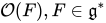
- Let be a coadjoint orbit. Then there exists a unique symplectic structure on such that inclusion map is a momentum map.
- Let act on a symplectic manifold with a momentum map for the action, and be a Lie group homomorphism, inducing an action of on . Then the action of on is also Hamiltonian, with momentum map given by , where is the dual map to ( denotes the identity element of ). A case of special interest is when is a Lie subgroup of and is the inclusion map.
- Let be a Hamiltonian -manifold and a Hamiltonian -manifold. Then the natural action of on is Hamiltonian, with momentum map the direct sum of the two momentum maps and . Here , where denotes the projection map.
- Let be a Hamiltonian -manifold, and a submanifold of invariant under such that the restriction of the symplectic form on to is non-degenerate. This imparts a symplectic structure to in a natural way. Then the action of on is also Hamiltonian, with momentum map the composition of the inclusion map with 's momentum map.













Connection to Noether's Theorem
[edit]Noether's theorem admits a particularly elegant formulation in terms of momentum maps. A brief summary of the relevant objects in this section: let symplectic manifold be the phase space of a Hamiltonian system with Hamiltonian . Each point in represents a state of the system, and its time evolution is governed by where is the Hamiltonian vector field corresponding to the Hamiltonian ; that is, . Time evolution of functions can be readily shown to be given by the Poisson bracket .


Now, Noether's theorem states that if the Hamiltonian is invariant under the (symplectomorphic) group action with infinitesimal generator as defined above, the corresponding momentum map will be a constant of motion. Proving this is simple: one simply differentiates the invariance condition with respect to to get


Example: Conservation of Angular Momentum
[edit]Consider the classical Kepler problem. Here, the phase is the cotangent bundle of the plane. In Cartesian coordinates, It is easy to see that the Hamiltonian is invariant under circular rotations of the plane. As mentioned earlier, the momentum map for the action on a cotangent bundle induced by an action on the base manifold is . To compute this, we first note that is given in coordinates by . Since there are no or terms in , we actually only need to compute the part of lying in the base manifold , which is: Contracting this with yields , and applying Noether's theorem tells us that this quantity, the angular momentum, is conserved throughout the course of the motion. This is equivalent to Kepler's second law.


Symplectic quotients
[edit]Suppose that the action of a Lie group on the symplectic manifold is Hamiltonian, as defined above, with equivariant momentum map . From the Hamiltonian condition, it follows that is invariant under .

Assume now that acts freely and properly on . It follows that is a regular value of , so and its quotient are both smooth manifolds. The quotient inherits a symplectic form from ; that is, there is a unique symplectic form on the quotient whose pullback to equals the restriction of to . Thus, the quotient is a symplectic manifold, called the Marsden–Weinstein quotient, after (Marsden & Weinstein 1974), symplectic quotient, or symplectic reduction of by and is denoted . Its dimension equals the dimension of minus twice the dimension of .


More generally, if G does not act freely (but still properly), then (Sjamaar & Lerman 1991) showed that is a stratified symplectic space, i.e. a stratified space with compatible symplectic structures on the strata.

Flat connections on a surface
[edit]The space of connections on the trivial bundle on a surface carries an infinite dimensional symplectic form


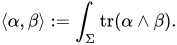
The gauge group acts on connections by conjugation . Identify via the integration pairing. Then the map



![{\displaystyle \mu :\Omega ^{1}(\Sigma ,{\mathfrak {g}})\rightarrow \Omega ^{2}(\Sigma ,{\mathfrak {g}}),\qquad A\;\mapsto \;F:=\mathrm {d} A+{\frac {1}{2}}[A\wedge A]}](https://wikimedia.org/api/rest_v1/media/math/render/svg/dcd849a045e2cf5ccc652d94756d2623e3ec78d0)
that sends a connection to its curvature is a moment map for the action of the gauge group on connections. In particular the moduli space of flat connections modulo gauge equivalence is given by symplectic reduction.

See also
[edit]Notes
[edit]- ^ Moment map is a misnomer and physically incorrect. It is an erroneous translation of the French notion application moment. See this mathoverflow question for the history of the name.
- ^ The vector field ρ(ξ) is called sometimes the Killing vector field relative to the action of the one-parameter subgroup generated by ξ. See, for instance, (Choquet-Bruhat & DeWitt-Morette 1977)
References
[edit]- J.-M. Souriau, Structure des systèmes dynamiques, Maîtrises de mathématiques, Dunod, Paris, 1970. ISSN 0750-2435.
- S. K. Donaldson and P. B. Kronheimer, The Geometry of Four-Manifolds, Oxford Science Publications, 1990. ISBN 0-19-850269-9.
- Dusa McDuff and Dietmar Salamon, Introduction to Symplectic Topology, Oxford Science Publications, 1998. ISBN 0-19-850451-9.
- Choquet-Bruhat, Yvonne; DeWitt-Morette, Cécile (1977), Analysis, Manifolds and Physics, Amsterdam: Elsevier, ISBN 978-0-7204-0494-4
- Ortega, Juan-Pablo; Ratiu, Tudor S. (2004). Momentum maps and Hamiltonian reduction. Progress in Mathematics. Vol. 222. Birkhauser Boston. ISBN 0-8176-4307-9.
- Audin, Michèle (2004), Torus actions on symplectic manifolds, Progress in Mathematics, vol. 93 (Second revised ed.), Birkhäuser, ISBN 3-7643-2176-8
- Guillemin, Victor; Sternberg, Shlomo (1990), Symplectic techniques in physics (Second ed.), Cambridge University Press, ISBN 0-521-38990-9
- Woodward, Chris (2010), Moment maps and geometric invariant theory, Les cours du CIRM, vol. 1, EUDML, pp. 55–98, arXiv:0912.1132, Bibcode:2009arXiv0912.1132W
- Bruguières, Alain (1987), "Propriétés de convexité de l'application moment" (PDF), Astérisque, Séminaire Bourbaki, 145–146: 63–87
- Marsden, Jerrold; Weinstein, Alan (1974), "Reduction of symplectic manifolds with symmetry", Reports on Mathematical Physics, 5 (1): 121–130, Bibcode:1974RpMP....5..121M, doi:10.1016/0034-4877(74)90021-4
- Sjamaar, Reyer; Lerman, Eugene (1991), "Stratified symplectic spaces and reduction", Annals of Mathematics, 134 (2): 375–422, doi:10.2307/2944350, JSTOR 2944350