


Community hub
Recent from talks
Contribute something
Nothing was collected or created yet.
Moscow Exchange
View on Wikipedia
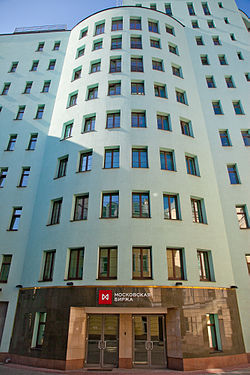
The Moscow Exchange (MOEX; Russian: Московская биржа, romanized: Moskovskaya birzha, IPA: [mɐˈskofskəjə ˈbʲirʐə]) is the largest exchange in Russia, operating trading markets in equities, bonds, derivatives, the foreign exchange market, money markets, and precious metals. The Moscow Exchange also operates Russia's central securities depository, the National Settlement Depository (NSD), and the country's largest clearing service provider, the National Clearing Centre.[3] The exchange was formed in 2011 in a merger of the Moscow Interbank Currency Exchange and the Russian Trading System.
Key Information


At the end of 2023, the total trading volume on MOEX platforms reached 1.3 quadrillion rubles (about $14 trillion).[4][5]
History
[edit]The Moscow Exchange was established on 19 December 2011 by merging the two largest Moscow-based exchanges, the Moscow Interbank Currency Exchange (MICEX) and the Russian Trading System (RTS), hence the name "Moscow Exchange MICEX-RTS".[6] Both organisations had been formed in the 1990s and were leading Russian exchanges for two decades with their MICEX Index and the RTS Index. The merger created a single entity[6] to support Russia's plans to turn Moscow into an international financial centre.[7]
The exchange completed an initial public offering on 15 February 2013, raising 15 billion ₽ (approximately US$500 million).[8] The offering, at the time the largest ever held exclusively in Moscow, was more than twice oversubscribed and drew demand from institutional investors globally. The exchange's shares were included in the MSCI Russia Index in November 2013.[9] In July 2014 the Central Bank of Russia, the largest shareholder of the exchange, completed the public sale of shares representing nearly 12% of the exchange.[10] A Russian federal law requires[needs update] the Central Bank to fully sell its stake in the exchange by 1 January 2016.[11] In October 2018, Moscow Exchange launched the trading of deliverable gold futures on its Derivatives Market.[12] Gold are delivered through precious metals market spot section.[12]
On 24 February 2022, following the start of the Russian invasion of Ukraine, the Moscow Exchange suspended trading until further notice.[13] On 27 February, TASS reported that foreign clients were banned from selling any securities, effective immediately.[14][15]
On 4 March, the exchange was suspended from the World Federation of Exchanges.[16][17]
On 18 March it was announced that trading in OFZ bonds should be resumed on 21 March.[18] On 23 March, it was announced that trading of 33 ruble securities would resume on 24 March for residents of Russia, but that foreign investors were being restricted to repo deals and deals with derivative instruments. It was also announced that the act of short selling would be banned.[19] On 26 March, it was announced that limited trading would be expanded to all stocks in a shortened four-hour session on 28 March.[20] In August 2022, the bourse still hadn't fully returned to normal operations.[21] It remains unclear if, and if so when, normal operations did or will resume.[needs update]
The exchange was also targeted as part of international sanctions against Russia.[22] On May 5, the United Kingdom revoked the exchange's status as a UK "recognized stock exchange", thereby depriving securities traded on the exchange of certain UK tax reliefs.[23]
Management
[edit]The Executive Board consists of five members:
- Yury Denisov,[24] CEO since 2019 and a past supervisory board member[25]
- Andrey Selyuk, chief financial officer since 2022[26]
- Andrey Burilov, chief information officer since 2020,[27]
- Igor Marich, Managing Director of Sales & Business Development and a 20-year veteran of Moscow Exchange,[28]
- Dmitry Shcheglov, chief operating officer, a veteran of Moscow Exchange and its predecessor MICEX.
For 2020-2021 the board consisted of the following members:[29]
- Oleg Vyugin (chairman), an economist and former head of the Russian financial markets regulator[30]
- Andrey Golikov, board member at National Clearing Centre
- Maria Gordon, a former emerging markets portfolio manager at Goldman Sachs and PIMCO
- Valery Goreglyad, chief auditor of the Bank of Russia
- Bella Zlatkis, deputy chairman of the management board at Sberbank and former deputy finance minister of Russia
- Vadim Kulik, deputy president of VTB Bank[31]
- Maxim Krasnykh, global chief operating officer at Gett[32]
- Paul Bodart, former CEO of BNY Mellon Europe[33]
- Ramon Adarraga, former executive chairman of Bolsas y Mercados Españoles Market Data[34]
- Alexander Izosimov, former CEO of Vympelcom
- Oskar Hartmann, co-founder of Fast Lane Ventures and a board member of Alfa-Bank[35]
Shareholders
[edit]Moscow Exchange's shares are publicly traded under the ticker MOEX. As of December 2021 approximately 63% of shares were in the free float, while the following held blocks of shares: Central Bank of Russia (11.75%),[36] Sberbank (9.9%), Vnesheconombank (8.4%), European Bank for Reconstruction and Development (6.1%) and US asset management firm Capital Research and Management Company,[37] which manages more than $1.3 trillion globally in retirement assets.[38] In total, US investors owned 36.8% of the shares of Moscow Exchange, and UK investors owned 10.1%.[37] Additionally, 360,000 Russian retail investors owned MOEX shares.[39]
Trading markets
[edit]Equity & Bond Market
[edit]The Equity & Bond Market is a key platform for Russian businesses to raise capital and for domestic and international investors to access equity and debt investment opportunities. It is the main trading venue for Russian stocks as well as government, municipal, and corporate bonds. In 2013–2014, 16 companies placed stock via Moscow Exchange, raising a total of approximately RUB 200 bln. On the fixed income side, more than 400 bond issues were placed, raising more than RUB 3.4 trillion for issuers.
Moscow Exchange includes shares of many of Russia's largest companies, including Gazprom, Sberbank, Rosneft, Lukoil and VTB.[40]
Global investment banks began to provide their clients with DMA to the Russian market in 2013.[41] As a result of regulatory changes, the international central securities depositories Euroclear Bank and Clearstream Banking SA offered clearance and settlement services for Russian stocks and bonds.[42]
In addition, Moscow Exchange focused on further developing the domestic investor base. The number of individuals with brokerage accounts on Moscow Exchange reached 17 million as of January 2022, which represented 11% of Russia's population.[43]
Foreign Exchange and money market
[edit]The Bank of Russia uses the Exchange's infrastructure to implement monetary policy and provide liquidity to the market through repo transactions and FX swap transactions. For its domestic and international clients, including banks and corporates, Moscow Exchange offers products to manage liquidity and FX exposure. It is the centre of pricing for RUB and offers many RUB currency pairs, with tight spreads based on a transparent order book.[44]
All transactions (spot and swap) on the FX market are centrally cleared by National Clearing Centre. In September 2014, average daily trading volume across all currency pairs was US$22.4 bln.[45]
While RUB/USD and RUB/EUR were the most traded currency pairs in 2014, Moscow Exchange also promoted trading in other currencies. In particular the RUB/CNY pair was well received by the market[46] and trading in the GBP and HKD were launched in late 2014.[47]
Derivatives market
[edit]Moscow Exchange as of 2014 was one of the 10 largest exchange platforms for derivatives trading globally.[48] The Derivatives Market facilitates trading of options contracts on, as well as futures contracts on indices, shares of both Russian and foreign companies, currency pairs, precious metals, energy and agricultural products.[49]
Futures on the RTS Index ranked sixth among the world's most actively traded derivatives on stock market indices according to data from the Futures Industry Association as of June 2014. Futures contracts on the U.S. dollar-Russian ruble were ranked first on 2014 in global liquidity, according to the Futures Industry Association.[50]
As of October 2014, 58 types of futures and 18 types of options were traded on the Exchange.[51]
Commodities markets
[edit]Precious metals trading
[edit]Moscow Exchange introduced spot trading in gold and silver in 2013. It has postponed a launch of trade in platinum and palladium by end of October or early November 2014 in order to do additional testing of the trading and clearing system.[52]
Grain trading
[edit]National Mercantile Exchange is Russia's platform for spot grain trading, as well as in deliverable futures on agricultural products. Since 2002, National Mercantile Exchange has been the platform by which the Russian state executes interventions in the grain market.[53]
Post-trade services, subsidiaries National Settlement Depository and National Clearing Centre
[edit]Moscow Exchange subsidiary National Settlement Depository (NSD) was granted status as Russia's Central Securities Depository in 2012. Subsequently, Euroclear Bank and Clearstream Banking SA opened accounts with the NSD, allowing international investors access to Russian bonds and equities, and giving Russian issuers access to non-Russian investors.[54]
In the wake of the 2022 Russian invasion of Ukraine, NSD blocked and froze all securities held in Euroclear's account at NSD, on March 1, 2022.[55] NSD also froze payments on securities of Russian issuers from being made to non-Russian individuals and entities.[37] On March 18, 2022, NSD's accounts at Euroclear and Clearstream (which together held €50tn of assets on behalf of investors) were blocked and frozen.[56][57] In March 2022, the European Central Securities Depositories Association (ECSDA) suspended NSD from membership in the association.[58][57] In addition, the European Union added NSD to its extended sanctions list, blocking NSD's accounts in euros and in Euroclear and Clearstream and making it impossible to service forex-denominated bonds issued by Russia and Russian companies, and the NSD suspended transactions in euros.[59]
Another Moscow Exchange subsidiary, National Clearing Centre (NCC), is Russia's largest clearing center and is the Central Counterparty (CCP) across all Moscow Exchange markets.[citation needed] In reaction to the 2022 Russian invasion of Ukraine, the European Association of CCP Clearing Houses (EACH) suspended National Clearing Centre from EACH membership.[57]
See also
[edit]

- Russian Trading System Stock Exchange historic, merged 2011
- Moscow Interbank Currency Exchange historic, merged 2011
- Moscow International Business Center, a commercial district in Moscow
References
[edit]- ^ "Instruments". Moscow Exchange. Retrieved 26 August 2017.
- ^ "tradinghours". tradinghours.com. Retrieved 26 March 2022.
- ^ "Moscow Exchange". Moscow Exchange.
- ^ "Московская биржа подвела итоги торгов в декабре 2023 года". Moscow Exchange (in Russian). 10 January 2024.
- ^ "Moscow Exchange announces results for the full year 2023". Moscow Exchange. 26 February 2024.
- ^ a b "Micex and RTS merger creates Russian Exchange powerhouse". newswire.ca. 19 December 2011. Archived from the original on 5 November 2014. Retrieved 20 December 2011.
- ^ "Russia's Micex and RTS set to complete merger". Financial Times.
- ^ "Themes of the week - Moscow Exchange". Kommersant. 18 February 2013.
- ^ "LSR Group, Inter RAO, TMK Tumble on MSCI Deletion: Moscow Mover, Ksenia Galouchko". 8 November 2013.
- ^ "Russian Stocks Stagnate, but Moscow Exchange Shares Soar". Institutional Investor. 9 July 2014.
- ^ "Russian central bank decides to sell Moscow Exchange shares". Reuters. 1 July 2014. Archived from the original on 30 March 2019. Retrieved 27 August 2014.
- ^ a b "Moscow Exchange launches gold futures with physical delivery". LeapRate. 10 October 2018. Retrieved 11 October 2018.
- ^ "Moscow Stock Exchange Suspends Trading After Russia Attacks Ukraine". Wall Street Journal. 24 February 2022. Retrieved 27 February 2022.
- ^ BNO News [@BNONews] (27 February 2022). "BREAKING: Russia bans foreign clients from selling their securities, effective immediately - TASS" (Tweet). Retrieved 27 February 2022 – via Twitter.
- ^ "Russian c.bank orders block on foreign clients' bids to sell Russian securities - document". Reuters. 27 February 2022. Retrieved 27 February 2022.
- ^ "Moscow Exchange Suspended From Global Trade Group". Wall Street Journal. 4 March 2022. Retrieved 4 March 2022.
- ^ "Russian Stock Market Suspended From World Federation of Exchanges". Newsweek. 4 March 2022. Retrieved 4 March 2022.
- ^ "Moscow Exchange To Resume Trading Of Government Bonds On Monday". the deep dive. 19 March 2022. Retrieved 19 March 2022.
- ^ "Foreigners banned from selling Russian stocks as market set for limited reopening". Reuters. 23 March 2022. Retrieved 23 March 2022.
- ^ "Moscow Exchange to Expand Limited Trading to All Stocks Monday". Bloomberg. 26 March 2022.
- ^ "Moscow Exchange plans to resume evening stock trading in September". Reuters. 25 August 2022. Retrieved 9 January 2025.
- ^ "European exchanges body votes to exclude Moscow Exchange". Reuters. 2 March 2022.
- ^ "Britain Revokes Recognized Status Of Moscow Stock Exchange In Blow To Russian Investment". RFE/RL. 5 May 2022.
- ^ "Management". Moscow Exchange. Retrieved 4 March 2014.
- ^ "Moscow Exchange names new CEO to oversee growth plans". Reuters. 16 April 2019. Retrieved 9 June 2020.
- ^ "BRIEF-Moscow Exchange names Andrey Selyuk new CFO". Reuters. 9 December 2021. Retrieved 25 January 2022.
- ^ "MOEX Appoints Andrey Burilov as Chief Information Officer". Finance Magnates. 1 June 2020. Retrieved 9 June 2020.
- ^ "Igor Marich, Managing Director of Money and FX Markets, Moscow Exchange". Moscow Exchange. Retrieved 9 June 2020.
- ^ "Moscow Exchange". Moscow Exchange. Retrieved 10 June 2020.
- ^ "BRIEF-Moscow Exchange: Oleg Vyugin Named Chairman of the Supervisory Board". Reuters. 26 April 2018. Retrieved 10 June 2020.
- ^ "Vadim Kulik elected Deputy President and Chairman of VTB Bank". www.vtb.com. Retrieved 10 June 2020.
- ^ "Maxim Krasnykh". Moscow Exchange. Retrieved 10 June 2020.
- ^ "Wim Hautekiet to Succeed Paul Bodart as CEO of BNY Mellon Europe". Global Custodian – The Leading quarterly magazine covering the international securities services industry. Retrieved 10 June 2020.
- ^ "BME Reorganizes Data, IT Divisions". WatersTechnology.com. 17 January 2017. Retrieved 10 June 2020.
- ^ "Oskar Hartmann". Alfa Bank. Retrieved 10 June 2020.
- ^ "On OJSC Moscow Exchange shares selling price". Bank of Russia. 2 July 2014.
- ^ a b c "Shareholder Structure". moex.com. Retrieved 26 January 2022.
- ^ "Employer-Sponsored Retirement Plans". capitalgroup.com. Retrieved 26 January 2022.
- ^ "moex.com". moex.com. Retrieved 26 January 2022.
- ^ "Constituents — Moscow Exchange | Indices". 20 March 2017. Archived from the original on 20 March 2017. Retrieved 6 October 2021.
{{cite web}}: CS1 maint: bot: original URL status unknown (link) - ^ "Global banks battle Russian brokers for equties trading". Financial News. 5 September 2013.
- ^ "Russia Stocks Erase Gain on Poroshenko Warning as Sistema slides". Bloomberg. 18 September 2014.
- ^ "Moscow Exchange". Moscow Exchange.
- ^ "About the FX Market". Moscow Exchange.
- ^ "Moscow Exchange September Forex turnover jumps 10% MoM and 28.1% YoY". Leap Rate. 10 January 2014.
- ^ "Chinese yuan trading volume up 60% in September on Moscow Exchange". Financial. 4 October 2014.
- ^ "Moscow Exchange Looks Beyond Sanctions With New Contracts". Archived from the original on 17 February 2015. Retrieved 17 February 2015.
- ^ "World Federation of Exchanges - Monthly Reports". Archived from the original on 17 August 2014.
- ^ "Инструменты срочного рынка". Московская Биржа.
- ^ "Trading Volume". Futures Industry. 16 September 2014.
- ^ "Moscow Exchange". Moscow Exchange.
- ^ "Moscow Exchange launches trading in precious metals". Moscow Exchange. 21 October 2013.
- ^ "National Mercantile Exchange". Archived from the original on 12 December 2013. Retrieved 6 December 2013.
- ^ "Project "South Stream" cannot be stopped, said the head of Gazprom Invest". Business-Tass. 3 December 2013.
- ^ "NSD fully open to dialogue with Euroclear, Clearstream, no blocks on its part - MOEX". interfax.com.
- ^ Stafford, Philip; Stubbington, Tommy; Smith, Robert (28 March 2022). "Banks stuck in legal tangle over Russian corporate bond payments". Financial Times.
- ^ a b c Currie, Bob. "ECSDA suspends NSD from membership". Securities Finance Times.
- ^ Lomax, Jenna. "DTCC blocks Russian securities from Bank of Russia". Securities Finance Times.
- ^ "Depository Russia planned to service Eurobonds halts euro transactions". Reuters. 3 June 2022.
External links
[edit]


Moscow Exchange
View on GrokipediaHistory
Pre-Merger Foundations
The Moscow Interbank Currency Exchange (MICEX) emerged amid the perestroika-era reforms of the late Soviet period, which introduced limited market mechanisms to address economic stagnation. Initial currency auctions began in November 1989, organized by the USSR's Foreign Trade and Investment Bank to facilitate controlled foreign exchange transactions outside the state monopoly. These auctions marked an early shift from centralized allocation to rudimentary market pricing for hard currencies, driven by the need to support imports amid declining oil revenues and growing external debt. Formal incorporation of MICEX as a non-governmental organization occurred on May 18, 1992, establishing it as Russia's primary interbank forex market with 140 founding members, primarily banks, focused on ruble-denominated trades against foreign currencies.[12] Parallel to MICEX's development, the Russian Trading System (RTS) was founded in 1995 to organize equity trading, consolidating fragmented regional over-the-counter (OTC) networks into a centralized electronic platform. Launched on July 10, 1995, RTS introduced real-time, screen-based trading via its Classica system, enabling continuous matching of buy and sell orders for shares in privatized enterprises. This innovation addressed the opacity and inefficiency of prior informal dealer markets, where trades relied on telephone negotiations and lacked standardized pricing or clearing. By September 1, 1995, RTS debuted its flagship RTS Index, a dollar-denominated benchmark tracking 50 leading stocks, providing investors with a verifiable measure of market performance amid post-privatization volatility.[13][14] These nascent platforms faced severe tests from macroeconomic turbulence, including hyperinflation peaking at over 2,500% annually in 1992, which eroded ruble value and deterred capital formation by rendering nominal gains illusory. The 1998 financial crisis exacerbated vulnerabilities, with Russia's default on domestic debt, a 70% ruble devaluation, and widespread bank failures halting trading and exposing weak infrastructure like inadequate settlement systems and regulatory oversight. MICEX's forex focus aided initial ruble stabilization efforts by channeling interbank liquidity and establishing reference rates, transitioning ad hoc OTC dealings toward organized auctions that improved transparency and reduced counterparty risks. RTS, meanwhile, weathered equity market collapses but demonstrated resilience through electronic safeguards, laying groundwork for formalized rules over bilateral bargains.[15][16]Formation and Early Development
The Moscow Exchange was established on December 19, 2011, through the merger of the Moscow Interbank Currency Exchange (MICEX), founded in 1992 as Russia's primary currency trading venue, and the Russian Trading System (RTS), established in 1995 for equity and derivatives trading.[17][18] This consolidation created Open Joint-Stock Company Moscow Exchange MICEX-RTS, initially valued at approximately $4.5 billion, with the aim of centralizing trading operations to enhance market efficiency by reducing fragmentation and improving liquidity through a single platform for equities, bonds, currencies, and derivatives.[19] The merger aligned with government efforts to strengthen Moscow's role as a regional financial hub, combining MICEX's dominance in fixed-income and FX markets with RTS's expertise in derivatives.[20] Following the merger, the exchange pursued operational unification, rebranding from MICEX-RTS to Moscow Exchange in 2012 to simplify its identity and reflect the integrated structure.[19] By 2013, it launched unified trading sessions and platforms, including the completion of an initial public offering on its own system in February, which raised $500 million and marked the full migration to centralized clearing and settlement via the National Settlement Depository.[21] This integration streamlined cross-asset trading, enabling seamless execution across markets and reducing operational silos that had previously divided liquidity.[22] Post-merger consolidation drove measurable growth in trading activity, with total volumes across all markets rising 24% year-over-year to RUB 369.7 trillion in 2012 and an additional 22% to RUB 449.4 trillion in 2013, reflecting enhanced participant access and reduced transaction costs from centralized efficiency.[23][24] Daily turnovers benefited from this unification, as fragmented pre-merger trading gave way to concentrated order books, boosting overall market depth without relying on external liquidity injections. Regulatory efforts during this period included aligning operations under the Federal Financial Markets Service (FFMS), with oversight transferring to the Central Bank of Russia in September 2013, which centralized supervision and imposed stricter risk management standards to support the exchange's stability.[25][26]Expansion Phase
During the period from 2015 to 2021, the Moscow Exchange underwent significant expansion, characterized by surging trading volumes driven by retail investor participation and institutional activity, alongside enhancements in market infrastructure and product diversity. Total trading volumes across key markets, including equities and money markets, approached record highs in 2021, with the equities segment reflecting broader market maturation through increased liquidity and turnover.[27] This growth was underpinned by a retail investor boom, with individual accounts multiplying and contributing to elevated equity trading activity.[28] The equities market capitalization reached RUB 62.82 trillion (USD 841.85 billion) by December 31, 2021, approaching equivalent levels to major emerging market peers and signaling peak pre-disruption scale.[27] Concurrently, the exchange expanded its offerings with the introduction of Russian-law exchange-traded funds (ETFs) in 2018, which by 2020 had attracted over half a million domestic investors and broadened access to diversified asset classes.[29] High-frequency trading support, bolstered by infrastructure initiatives from the early 2010s onward, facilitated deeper liquidity, with HFT accounting for 35-57% of trades by the late 2010s.[30][31] Technological advancements, including refined settlement processes aligned with T+2 cycles established earlier, enabled handling of elevated volumes without systemic disruptions.[32] Cross-border access was enhanced through listings of global depositary receipts (GDRs) for Russian issuers, allowing seamless trading of international instruments and attracting foreign capital, which by mid-2021 comprised over 80% of free-float shares in listed companies.[33] These developments collectively positioned the exchange as a maturing hub for multi-asset trading, with annual fee and commission revenues reflecting sustained operational scale.[28]Post-2022 Geopolitical Adaptations
Following the escalation of the Ukraine conflict in February 2022, the Moscow Exchange (MOEX) suspended trading across its equity and bond markets on February 28, 2022, in response to heightened volatility and capital outflows, with a gradual resumption starting March 21 for Russian government bonds and select liquid shares, expanding to broader equities by March 24.[34] This halt, the longest in MOEX history, lasted over three weeks for most segments and was accompanied by restrictions barring non-residents from selling securities effective February 27, effectively curtailing foreign investor participation and reducing average daily trading volumes in shares to RUB 645 million.[35][36] Trading in foreign securities faced additional pressures amid SWIFT exclusions for Russian banks and secondary sanctions, leading to suspensions and subsequent delistings of non-resident issuers unable to maintain compliance or liquidity; for instance, specific foreign securities like HollyFrontier Corporation ordinary shares were removed from MOEX Level 3 listing on March 18, 2022, due to upstream delistings on their primary exchanges.[37] Overall, non-resident access to equity and bond markets ceased, prompting a moratorium from the Bank of Russia until January 1, 2023, on delisting shares of foreign issuers to stabilize listings, though many such instruments saw effective withdrawal as trading volumes in foreign-linked assets plummeted 41.3% year-over-year to RUB 17.6 trillion.[38][34] To mitigate sanction-induced disruptions in cross-border payments, MOEX pivoted toward ruble-denominated settlements for domestic and select international trades, while expanding Chinese yuan (CNY) trading pairs; CNY/RUB volumes surged 128-fold in 2022, with the yuan's share in MOEX forex turnover rising from 3% pre-crisis levels to dominate post-2022 activity, reaching 54% by May 2024 amid increased bilateral trade with China.[34][39] This adaptation included launching yuan-denominated bond trading, with 25 such instruments from 13 issuers outstanding by end-2023 valued at approximately RUB 0.9 trillion, reflecting a broader de-dollarization strategy evidenced by tripled yuan trading volumes to RUB 34.15 trillion in the following year.[40][41] By early 2025, MOEX had adapted further by resuming and expanding pre-market sessions alongside additional weekend trading, including futures market sessions starting August 9, 2025, and working Saturdays like November 1, to accommodate shifted investor patterns and boost liquidity in adapted volumes as reported in annual disclosures.[42][43] In September 2025, equity trading hours were extended to 17 hours daily (6:50 to 23:50 MSK) from late in the month, unifying opening times with bond markets to streamline operations and enhance accessibility amid ongoing geopolitical constraints.[44][45]Governance and Ownership
Management and Leadership
Yury Denisov has served as Chairman of the Executive Board (CEO equivalent) of Moscow Exchange since April 27, 2020, following his appointment to lead strategic growth initiatives after Alexander Afanasiev's departure.[46][47] Denisov was re-elected to the role on October 27, 2021, for a term extending through 2025, bringing prior experience from senior positions in Russian banking, including at Sberbank, where he focused on operational efficiency and market expansion.[48] Under his leadership, the exchange emphasized technological upgrades and risk-resilient infrastructure, including enhancements to trading platforms amid volatile geopolitical conditions. The Supervisory Board, responsible for high-level oversight, has been chaired by Sergey Shvetsov since June 7, 2022; Shvetsov, a former First Deputy Chairman of the Central Bank of Russia, contributes regulatory and monetary policy expertise to board deliberations.[47] Other key members include Aleksandr Izosimov, with a background in international corporate leadership from roles like CEO of VimpelCom, providing insights into cross-border finance, and Valery Goreglyad, offering deep knowledge of domestic banking operations.[47] The board's composition blends financial sector veterans and tech-oriented executives, supporting decisions on strategic adaptations such as platform digitization and contingency planning for market disruptions. In response to Western sanctions intensified after February 2022, Denisov and the Executive Board pivoted toward domestic-centric operations, suspending trading in U.S. dollars and euros on March 1, 2022, to mitigate liquidity risks and comply with capital controls, while accelerating development of ruble-denominated and yuan-based instruments.[49] By 2024, this included expanding yuan clearing volumes and fostering alternative settlement mechanisms to sustain trading volumes, which reportedly stabilized at elevated levels through reliance on non-sanctioned currencies and commodities segments.[50] Earlier, under Afanasiev's tenure from the 2011 MICEX-RTS merger until 2019, leadership integrated legacy systems into a unified platform, achieving consolidated trading volumes exceeding 50 trillion rubles annually by mid-decade and establishing centralized clearing protocols.[51] The Board's Risk Management and Audit Committees guide decision-making on operational resilience, approving annual risk appetite frameworks and conducting audits aligned with CPMI-IOSCO principles for financial market infrastructures.[52] These bodies evaluate threats like currency volatility and counterparty defaults, informing executive actions such as stress-testing protocols implemented post-2022 to ensure clearing house solvency amid sanction-induced asset freezes.[53] Such processes prioritize empirical scenario modeling over speculative adjustments, maintaining exchange stability without external liquidity dependencies.Shareholders and Ownership Structure
As of December 31, 2024, the Moscow Exchange (MOEX) maintains a dispersed ownership structure with no controlling shareholder, characterized by a free float of 64% and a total of 532,564 registered shareholders.[54] The share capital consists of 2,276,401,458 ordinary shares, with no preferred shares or instruments granting disproportionate control.[54] Disclosure of detailed ownership data has been limited since October 2024 to mitigate risks from international sanctions, though the company reports no shareholders holding stakes exceeding 5% beyond those previously disclosed.[54][55] The Bank of Russia holds a minor stake as both shareholder and primary regulator, exerting indirect influence through oversight rather than ownership dominance, following its divestment of an 11% position in July 2014 to broaden the investor base.[56][54] The ownership evolved from the 2012 initial public offering (IPO), which raised approximately $500 million at an offering price of 55 rubles per share, establishing a significant public float and valuing the exchange at around $4.6 billion.[57][58] Pre-2022, foreign investors—particularly from the United States (up to 36.8%) and United Kingdom (around 10%)—held substantial portions, reflecting integration with global markets. Post-2022 sanctions prompted divestments and trading suspensions on Western exchanges, yet domestic retail participation grew, with over 360,000 Russian individual investors by early 2022, contributing to sustained dispersion amid reduced foreign exposure. This structure limits concentrated private control while highlighting regulatory-state interplay, as the absence of a majority holder aligns incentives with broad market participants but subjects operations to Central Bank directives.[54] MOEX's dividend policy mandates a minimum payout of 50% of consolidated IFRS net profit annually, with the Supervisory Board recommending record dividends of 26.11 rubles per share for 2024—equivalent to 75% of net profit and totaling 59.4 billion rubles—pending approval at the April 4, 2025, Annual General Meeting.[54] This exceeds the prior year's 17.35 rubles per share (65% payout).[54] No share buyback programs were executed in 2024.[54] Minority shareholder protections are embedded in MOEX's Corporate Governance Code, which mandates equal treatment in corporate actions and transparent disclosures in Russian and English, with mechanisms like absentee voting and the ability for holders of at least 2% of voting shares to nominate Supervisory Board candidates.[54] The company reports no instances of minority rights abuse.[54] However, broader Russian market dynamics, including 2025 Central Bank rulings criticizing state seizures of assets in other firms (e.g., UGC) for violating minority buyout obligations, underscore tensions between private protections and potential interventions, though MOEX's structure has not faced such direct challenges.[59][60]Regulatory Framework
The Moscow Exchange (MOEX) is primarily supervised by the Central Bank of Russia (Bank of Russia), which exercises regulatory oversight over financial market participants, including stock exchanges, to ensure compliance with federal laws and prudential standards.[61] This supervision encompasses monitoring trading activities, enforcing disclosure requirements, and addressing violations through mandatory instructions when federal laws or regulatory acts are breached.[25] The core legal basis for MOEX's operations is Federal Law No. 39-FZ "On the Securities Market," enacted on April 22, 1996, which delineates the principles of securities issuance, trading organization, and professional participant licensing while prohibiting manipulative practices such as insider trading and market abuse.[62] Under this law, MOEX, as a trading organizer, must maintain participant registers, implement anti-manipulation controls, and adhere to capital adequacy rules for brokers and dealers to mitigate systemic risks.[25] The Bank of Russia further enforces these through ongoing inspections and risk-based supervision tailored to exchange activities.[63] MOEX's financial reporting aligns with International Financial Reporting Standards (IFRS), applied to its consolidated statements since the early 2010s as part of Russia's convergence with global norms for public interest entities.[64] Specified reports, including those on trading and participant activities, undergo mandatory independent audits to verify accuracy and compliance, with the exchange selecting auditors periodically under its external audit policy.[25][65] Complementing state regulation, MOEX interacts with self-regulatory organizations (SROs) like the National Finance Association (NFA) and the National Association of Securities Market Participants (NAUFOR), which establish binding professional standards, ethical codes, and compliance monitoring for members while remaining subject to Bank of Russia approval and oversight.[66][25] These SROs facilitate industry self-governance, such as through MOEX's council, which includes SRO representatives to align exchange rules with market-wide practices.[67]Trading Markets
Equity and Bond Markets
The equity segment of the Moscow Exchange lists shares of over 220 domestic companies as of mid-2025, reflecting a post-sanctions pivot toward Russian issuers after the delisting of many foreign securities in 2022.[68] The MOEX Russia Index, comprising the 50 most liquid blue-chip stocks weighted by free-float market capitalization, functions as the key performance benchmark and traded around 2,555 points on October 24, 2025.[69] Trading liquidity is supported by high domestic participation, with 2024 equity volumes expanding 43.1% year-over-year amid restricted access to international listings.[70] Equity trading operates in an extended schedule introduced in September 2025, enabling 17 hours of daily activity from 6:50 to 23:50 Moscow time across morning (pre-open auction from 6:50 to 9:50), continuous main session, and evening sessions (19:00 to 23:50).[44] Opening auctions utilize limit and iceberg orders to establish indicative prices, while closing auctions (lasting 0-30 seconds randomly) accept limit-on-close and market-on-close orders for final pricing, alongside standard limit and market orders in continuous trading.[71][72] The bond market emphasizes domestic corporate and government issues, with placements totaling RUB 8.4 trillion in 2024 through multiple series, underscoring reliance on Russian entities following sanctions that curtailed foreign-denominated trades.[73] Secondary bond volumes surged 73.5% in early 2025, driven by turnover in ruble-settled OFZ treasury bonds (up 77.9%) and other domestic debt, enhancing liquidity via extended hours aligned with equities (15 hours daily for bonds).[2] Trading mechanisms mirror equities, featuring auctions and negotiated deals for over 500 instruments, with post-2022 adaptations prioritizing non-sanctioned, locally focused issuances.[74]Foreign Exchange and Money Markets
The Moscow Exchange's Foreign Exchange (FX) market primarily trades spot and forward contracts in ruble-denominated currency pairs, with settlements handled through the National Clearing Centre. Trading occurs during continuous sessions and auctions, focusing on pairs such as RUB/CNY, RUB/TRY, and RUB/BYN following geopolitical shifts. In June 2024, the exchange suspended all trading and settlements in US dollars and euros effective June 13, due to new US sanctions targeting the platform's FX operations, prompting a rapid reorientation toward non-Western currencies.[74][75] Post-suspension, the Chinese yuan emerged as the dominant foreign currency, accounting for 46% of total currency turnover on the exchange in 2024, as reported by the Bank of Russia. CNY trading volumes surged threefold to 34.2 trillion rubles in 2023 from the prior year, reflecting increased RUB/CNY pair activity amid ruble centralization—where most FX transactions now involve the ruble against a narrower set of partners. Average daily FX transaction numbers rose alongside overall market growth, with total exchange turnover reaching 1.49 trillion rubles in 2024, up 14% year-over-year, though FX-specific volumes adapted to exclude USD and EUR pairs.[76][77][78] The Money Market complements FX operations by enabling short-term liquidity provision through repurchase agreements (repos) and interbank lending instruments, cleared via central counterparty mechanisms. The Central Bank of Russia conducts fixed-rate repo auctions on the platform to implement monetary policy, including standing facilities for liquidity absorption and injection, with transactions often collateralized by ruble-denominated securities. Inter-dealer repos support USD-denominated activity where permissible, but post-2022 adaptations emphasized ruble-based instruments to mitigate sanction risks, maintaining auction-based access for participants.[79][80][81]Derivatives Market
The Moscow Exchange's Derivatives Market operates as a centralized platform for futures and options trading, enabling participants to hedge risks and speculate on price movements in underlying assets such as indices, individual equities, foreign currencies, and commodities. Launched as part of the exchange's multi-asset ecosystem, it processes millions of contracts daily. Prior to the main session starting at 10:00 a.m., an Opening Auction (pre-open session) is conducted to establish the opening price. During the collection period from 08:50:00 to a random time between 08:59:01 and 08:59:50 MSK, only limit orders and iceberg orders are permitted, with the full quantity of iceberg orders participating; market, fill-or-kill, immediate-or-cancel, book-or-cancel, and negotiated orders are prohibited. Modifications and cancellations are allowed during collection but not thereafter. The opening price maximizes traded volume and minimizes supply-demand imbalance, with ties resolved by market pressure (higher price for demand surplus, lower for supply surplus) or proximity to the last trade price. Compatible orders—bids at or above and offers at or below the opening price—are executed at that single price, prioritizing volume over strict price-time priority. Unexecuted orders carry over to the main session. This auction applies uniformly to all futures contracts, including silver futures, without unique rules. Trading occurs electronically from 10:00 a.m. to 11:50 p.m. Moscow time on weekdays.[82][83][84] Prominent products include futures and options on the MOEX Russia Index, which tracks the performance of Russia's largest blue-chip companies, alongside sector-specific index futures covering Oil & Gas, Metals & Mining, Financials, and Consumer & Retail sectors. Commodity derivatives feature futures on Brent crude oil, light sweet crude oil, natural gas, wheat index, and precious metals like gold and silver, providing exposure to global and domestic price fluctuations without physical delivery in most cases.[85][86][87] Trading activity expanded in 2024-2025, with derivatives market volumes rising 34.5% in the second quarter of 2025 year-over-year, reflecting sustained demand for hedging amid economic volatility and currency controls. This growth persisted despite U.S. sanctions in June 2024 that suspended spot trading in U.S. dollars and euros, prompting shifts toward ruble-denominated and alternative FX derivatives. To bolster liquidity, the exchange introduced weekend trading for futures contracts starting August 9, 2025, allowing sessions on Saturdays from 10:00 a.m. to 6:59 p.m. Moscow time.[88][89][90] Risk management employs daily mark-to-market valuation, where variation margins are calculated based on closing settlement prices to adjust positions for intraday gains or losses, supplemented by initial margins calibrated to cover 99% of potential adverse moves over a two-day horizon. Expiry mechanisms vary by contract: index futures typically settle on the third Wednesday of the contract month via cash adjustment to the underlying index level, while commodity futures may roll over or converge to spot prices near delivery months.[91][92][93] These derivatives link directly to the exchange's spot markets through shared underlyings, such as equities and indices traded on the Equities Market, facilitating arbitrage and integrated hedging strategies that align futures pricing with cash market dynamics.[94]Commodities Markets
The Moscow Exchange's commodities markets encompass trading in precious metals, grains, and energy products through spot, futures, and options contracts, primarily via its Derivatives Market and affiliated platforms like the National Commodity Exchange. These markets integrate Russia's resource-based economy by providing hedging and price discovery mechanisms for exporters and domestic participants, with a shift toward ruble-denominated instruments and localized settlement following Western sanctions imposed after February 2022.[83][86] Precious metals trading includes spot sections for gold and silver, alongside deliverable futures contracts that enable physical delivery, and settled futures denominated in rubles or U.S. dollars prior to broader currency restrictions. Perpetual gold futures were introduced in July 2023 to offer continuous exposure without expiry, complementing benchmark ties to international prices like the London Bullion Market while adapting to sanctions-induced isolation from global clearing systems. Trading volumes in precious metals have exhibited volatility but growth in select periods, with commodity derivative contracts overall rising 29.1% in the first quarter of 2025 amid domestic demand.[95][96][2] Grain trading occurs electronically through index futures, such as the CPT Novorossiysk Russian Wheat Index Futures, which track delivery prices at key Black Sea ports and support Russia's role as a leading wheat exporter. These instruments facilitate risk management for agricultural producers and traders via the Derivatives Market, with spot trading handled through group entities like the National Mercantile Exchange for physical grains. Post-sanctions adaptations emphasize electronic platforms to bolster export logistics and counter global supply chain disruptions, aligning with proposals for expanded BRICS-level grain exchanges though implementation remains nascent as of 2025.[97] Energy derivatives feature futures-style options on light sweet crude oil and natural gas, enabling speculation and hedging tied to domestic production and export dynamics. Following sanctions curtailing access to international benchmarks like Brent crude, these contracts have pivoted to reflect Urals crude pricing and ruble settlements, prioritizing Russian energy firms' needs over foreign participation. In the second quarter of 2025, derivatives volumes shifted from commodities toward indices, indicating a maturing domestic focus amid restricted cross-border flows.[86][8] Aggregate commodities volumes underscore integration with Russia's export-oriented sectors, comprising a portion of the Derivatives Market's total turnover—reaching RUB 53.2 trillion (USD 523.4 billion) for 2024 overall—though specific commodity shares declined in mix during early 2025 due to heightened equity and FX activity. This reflects causal pressures from sanctions, which reduced foreign investor exposure while amplifying reliance on local liquidity for metals (key to mining outputs), grains (agricultural staples), and energy (oil and gas revenues funding state budgets).[70][8]Clearing and Post-Trade Services
National Clearing Centre
The National Clearing Centre (NCC), established on May 26, 2006, as a subsidiary within the Moscow Exchange Group, operates as the primary central counterparty (CCP) for clearing trades in derivatives, equities, and other segments on the exchange.[98] Initially functioning as Bank National Clearing Centre, it transitioned to a dedicated CCP status, interposing itself in transactions to assume counterparty obligations and mitigate bilateral risks inherent in direct trading.[99] This structure replaced original buyer-seller exposures with obligations to NCC, enhancing systemic stability through centralized risk bearing.[100] NCC's core risk mitigation relies on the novation process, executed immediately post-trade, whereby it becomes the buyer to every seller and seller to every buyer, legally guaranteeing performance regardless of original party solvency.[101] To cover potential defaults, NCC mandates contributions to market-specific default funds—four in total for foreign exchange and precious metals, securities, derivatives, and other categories—serving as mutualized resources to absorb losses before accessing NCC's own skin-in-the-game capital.[102] Complementary measures include daily stress testing of member portfolios against historical and hypothetical extreme scenarios, real-time collateral valuation, and position limits to prevent excessive concentration risks.[103] Following the 2022 geopolitical disruptions, which induced sharp volatility in Russian markets, NCC enhanced its framework by introducing provisional elevated risk parameters, such as increased initial margins and volatility buffers, calibrated via advanced modeling to capture tail risks.[104] These adaptations allowed dynamic recalibration; for instance, as volatility subsided, NCC outlined phased reductions in parameters for FX, precious metals, securities, and derivatives markets, ensuring proportionality while maintaining coverage ratios above regulatory minima.[105] NCC's practices conform to key international CCP benchmarks, including the CPMI-IOSCO Principles for Financial Market Infrastructures (PFMI), which parallel EMIR's emphasis on robust collateral management, default waterfalls, and recovery planning, though adapted to Russian regulatory oversight by the Central Bank.[106] This alignment underscores NCC's focus on counterparty protection over settlement execution, with audited compliance verifying resilience under varied stress conditions.[103]National Settlement Depository
The National Settlement Depository (NSD) functions as Russia's central securities depository (CSD), providing safekeeping for securities and executing delivery-versus-payment (DVP) mechanisms to ensure simultaneous exchange of securities and cash in post-trade settlements.[107] As the designated CSD under Russian federal law, NSD maintains the central registry for ownership rights, servicing the entirety of federal loan obligations (OFZ) and Central Bank bonds, as well as over 99% of exchange-traded corporate and regional bonds.[108] It processes settlements for Moscow Exchange trades on a T+2 cycle, where equities and other securities are transferred electronically in its books upon confirmation from the National Clearing Centre.[109] NSD's custody operations emphasize asset immobilization for bonds, whereby physical bond certificates are held centrally while beneficial ownership is recorded electronically for participants, reducing handling risks and enabling efficient transfers.[110] For equities, NSD supports full dematerialization, with no physical certificates issued; all ownership is maintained in dematerialized electronic form through its registry, facilitating seamless post-trade flows without the need for certificate delivery.[110] In 2023, NSD serviced 24.6 thousand securities issues in custody, encompassing both domestic and international instruments, underscoring its dominance in Russia's securities safekeeping infrastructure.[110] Prior to Western sanctions, NSD maintained correspondent relationships with international central securities depositories and custodians, supporting cross-border settlement links and foreign investor access to Russian assets via global networks.[111] These ties enabled efficient handling of international securities and nominee accounts for non-resident investors.[111] However, following the imposition of sanctions—including an EU asset freeze on NSD effective June 3, 2022, and subsequent U.S. and U.K. blocking measures—NSD implemented adaptations such as freezing sanctioned foreign-held assets to comply with restrictions, while Russian authorities later amended share recordation rules in 2024 to exclude NSD from custody chains for shares owned by investors in designated "unfriendly" jurisdictions, routing such holdings directly to registrars to mitigate sanction-related disruptions.[112][113]Technological and Risk Management Infrastructure
The Moscow Exchange employs a suite of trading interfaces and protocols to facilitate efficient order execution and market data dissemination, including native APIs such as ASTS Bridge and Plaza II, alongside standard FIX and FAST protocols.[114] These systems support direct market access (DMA) with low-latency capabilities, enabling high-frequency trading (HFT) activities that constitute 35% to 57% of total trading volume on the exchange.[31] [115] Participants can access real-time market data feeds via the Market Data API and FAST protocol, with options for co-location to minimize execution delays.[116] For over-the-counter (OTC) trading in foreign exchange and precious metals, the exchange utilizes the NTPro platform, which enhances speed by reducing latency and rejection rates compared to prior systems.[117] Specialized terminals like MOEX Trade SE provide ergonomic tools for equities trading, integrating real-time data, advanced analytics, and optimized order placement.[118] Derivatives trading occurs via the SPECTRA system, supporting access across multiple asset classes.[119] Risk management at the Moscow Exchange centers on a central counterparty (CCP) framework operated by the National Clearing Centre (NCC), incorporating initial margin requirements calculated via a proprietary Value-at-Risk (VaR)-like model at a 99% confidence level.[120] This model assesses open positions daily, factoring in market risk rates, concentration limits, and technical parameters that are recalibrated regularly to reflect volatility.[121] Additional safeguards include contributions to the defaulter's guarantee fund and dedicated CCP capital, alongside default management procedures to mitigate counterparty failures.[100] Margin calls are triggered based on these calculations to ensure collateral adequacy, with intraday adjustments for derivatives to cover potential losses.[122] To curb excessive volatility, the exchange implements circuit breakers that temporarily suspend trading upon detection of sharp price movements, allowing market participants time to reassess positions.[123] These mechanisms, combined with price variation limits for futures contracts, help maintain orderly markets without overlapping into clearing-specific processes.[124] Cybersecurity infrastructure features comprehensive policies designed to shield trading systems from threats, including DDoS attacks and unauthorized access, fostering a secure environment for participants.[125] However, the exchange faced a significant cyber disruption in February 2022, attributed to external attacks amid geopolitical tensions, which temporarily halted operations but was resolved without long-term systemic compromise.[126] Ongoing measures emphasize infrastructure resilience, though specific post-incident enhancements remain tied to broader operational adaptations rather than publicly detailed technological overhauls.[125]Economic Role and Performance
Key Financial Metrics and Indices
In 2024, Moscow Exchange generated significant revenue growth from trading fees, with fee and commission income from the equities market rising 44.7% year-over-year, supported by a 43.1% increase in trading volumes.[70] The bond market contributed notably, with fees up 24.3% amid elevated activity in government and corporate securities.[54] Overall operating income for the year reflected these trends, though exact consolidated figures emphasized the platform's role in domestic capital markets post-sanctions.[70] Into 2025, financial metrics showed mixed results. First-quarter operating income fell to RUB 28.6 billion from RUB 34.0 billion in the prior year's first quarter, reflecting broader market pressures.[2] However, second-quarter bond market fees surged 77.7%, driven by a 64.1% rise in trading volumes excluding overnight bonds, highlighting resilience in fixed-income segments.[8] Year-to-date through September, total trading volumes across markets reached substantial levels, with September alone at RUB 162.7 trillion, including equities and derivatives activity, though equities segments experienced YTD declines compared to 2024 peaks due to reduced foreign inflows.[127] Bond volumes rebounded strongly, exceeding prior-year levels in key months.[8] The MOEX Russia Index, comprising major Russian blue-chip stocks and serving as the exchange's primary benchmark, exhibited volatility in 2025. It dropped to 2,226.65 by May 28, reflecting a 5.07% year-to-date decline amid geopolitical tensions and sanctions.[128] The index later fluctuated, sinking toward year-to-date lows of 2,540 on October 14 before partial recovery to 2,570 by October 24.[129][130] These levels remain below pre-sanctions peaks exceeding 3,800 in early 2022, with trading suspended briefly post-invasion contributing to the divergence from historical highs.[131]| Segment | 2024 Key Metric | 2025 YTD Trend (as of Q2) |
|---|---|---|
| Equities | Volumes +43.1%; Fees +44.7% | Declines in trading activity vs. 2024[70] |
| Bonds | Volumes growth; Fees +24.3% | Volumes +64.1%; Fees +77.7% (Q2)[8] |
| Total Volumes | Elevated domestic focus | September: RUB 162.7 trln; YTD mixed with bond rebounds[127] |