
.jpg/250px-Beursplein_5_(cropped_and_edited).jpg)


.jpg/2000px-Beursplein_5_(cropped_and_edited).jpg)
Community hub
0 subscribers8 pages, 0 posts
Recent from talks
All channels
Be the first to start a discussion here.
Be the first to start a discussion here.
Be the first to start a discussion here.
Be the first to start a discussion here.
Contribute something
Welcome to the community hub built to collect knowledge and have discussions related to Euronext.
Nothing was collected or created yet.
Euronext
View on Wikipediafrom Wikipedia
Euronext N.V. (short for European New Exchange Technology)[7] is a European bourse that provides trading and post-trade services for a range of financial instruments. It is registered in Amsterdam but its operational headquarters are located in Paris.[8] It operates major stock exchanges in seven countries: France (Euronext Paris), the Netherlands (Euronext Amsterdam), Belgium (Euronext Brussels), Ireland (Euronext Dublin), Portugal (Euronext Lisbon), Italy (Borsa Italiana) and Norway (Euronext Oslo Børs). The present-day Euronext was spun off from the Intercontinental Exchange (ICE) in 2014,[9] shortly after ICE's acquisition of NYSE Euronext the year before.
Key Information


.jpg)
Traded assets include regulated equities, exchange-traded funds (ETF), warrants and certificates, bonds, derivatives, commodities, foreign exchange as well as indices. As of March 2025, Euronext operated nearly 1,800 listed issuers with a market capitalization of approximately €6.3 trillion.[10]
Euronext is the largest center for debt and funds listings in the world, and provides technology and managed services to third parties. In addition to its main regulated market, it operates Euronext Growth and Euronext Access, providing access to listing for small and medium-sized enterprises. Euronext Paris accounts for more than 80% of Euronext’s total market cap. It also plays a key role in commodities trading, offering markets for power through Nord Pool and for fish through Fish Pool, alongside other agricultural commodities such as milling wheat and rapeseed.
Post-trade services include clearing performed by Euronext's multi-asset clearing house, Euronext Clearing, headquartered in Rome, as well as custody and settlement performed by Euronext's central securities depository (CSD), Euronext Securities.
Euronext traces its origins back to some of the world's oldest bourses, formed in the Low Countries' shifting trade centres, Bruges, Antwerp and Amsterdam in 1285, 1485 and 1602, respectively, as well as to the foundation of the Paris Bourse in 1724. In its present form, Euronext was established in September 2000 through the merger of the bourses in Amsterdam, Brussels and Paris. The goal was to create a single, integrated, and liquid market for securities trading across Europe. Since its inception, Euronext has continued to expand, and now operates stock exchanges in several European countries, including France, the Netherlands, Belgium, Portugal, Ireland, and Norway. Its creation was followed by the introduction of the single currency and harmonisation of financial markets.
In August 2023, the company formed EuroCTP as a joint venture with 13 other bourses, in an effort to provide a consolidated tape for the European Union, as part of the Capital Markets Union proposed by the European Commission.
History
[edit]Background: Exchange companies that merged into Euronext
[edit]-
 Beurs van Berlage in Amsterdam, now an events venue
 -
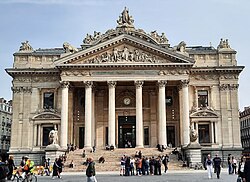 Former building of the Brussels Stock Exchange in Brussels
 -
 The Palais Brongniart in Paris, now an events venue
 -
 Stock exchange building in Dublin
 -
 Stock exchange building in Oslo
 -


.jpg)


2000–2007: Founding merger and early acquisitions
[edit]
In 1998, the London Stock Exchange and Deutsche Börse announced their intention of forming an alliance to fend off competition from the United States, and take advantage from the European Union's (EU) single currency and harmonisation of financial markets.[11] In April 1999 the stock exchanges in Paris, Zurich, Madrid, Brussels, Amsterdam, and Milan signed a memorandum of understanding in Madrid, which formalised plans to include these bourses as well.
Ultimately, only three decided to proceed, and on 22 September 2000 Euronext was formed following a merger of the Amsterdam Stock Exchange,[12] Brussels Stock Exchange, and Paris Bourse.[1][2][3][4]
In 2001, Euronext became a listed company itself after completing its initial public offering.[13][14]
In December 2001, Euronext acquired the shares of the London International Financial Futures and Options Exchange (LIFFE), forming Euronext.LIFFE.[15]
In 2002, the group merged with the Portuguese stock exchange Bolsa de Valores de Lisboa e Porto (BVLP), renamed Euronext Lisbon.[3]
In 2003, Euronext cash products were integrated onto a single platform (NSC).[16]
In 2004, Euronext derivatives products were integrated onto LIFFE CONNECT.
In 2005, Euronext introduced Alternext as a market segment to help finance small and mid-class companies in the Eurozone.
2007–2014: Merger with the New York Stock Exchange and acquisition by Intercontinental Exchange
[edit]

Due to apparent moves by NASDAQ to acquire the London Stock Exchange[18] or Euronext itself,[19] NYSE Group, owner of the New York Stock Exchange (NYSE), offered €8 billion (US$10.2b) in cash and shares for Euronext on 22 May 2006, outbidding a rival offer for the European Stock exchange operator from Deutsche Börse, the German stock market.[20] Contrary to statements that it would not raise its bid, on 23 May 2006, Deutsche Börse unveiled a merger bid for Euronext, valuing the pan-European exchange at €8.6 billion (US$11b), €600 million over NYSE Group's initial bid.[21] Despite this, NYSE Group and Euronext penned a merger agreement, subject to shareholder vote and regulatory approval. The initial regulatory response by SEC chief Christopher Cox (who was coordinating heavily with European counterparts) was positive, with an expected approval by the end of 2007.[22]
Deutsche Börse dropped out of the bidding for Euronext on 15 November 2006, removing the last major hurdle for the NYSE Euronext transaction. A run-up of NYSE Group's stock price in late 2006 made the offering far more attractive to Euronext's shareholders.[23] On 19 December 2006, Euronext shareholders approved the transaction with 98.2% of the vote. Only 1.8% voted in favour of the Deutsche Börse offer. Jean-François Théodore, the chief executive officer of Euronext, stated that they expected the transaction to close within three or four months.[24] Some of the regulatory agencies with jurisdiction over the merger had already given approval. NYSE Group shareholders gave their approval on 20 December 2006.[25] The merger was completed on 4 April 2007, forming NYSE Euronext.
The new firm, NYSE Euronext, was headquartered in New York City, with European operations and its trading platform run out of Paris. Then-NYSE CEO John Thain, who was to head NYSE Euronext, intended to use the combination to form the world's first global stock market, with continuous trading of stocks and derivatives over a 21-hour time span. In addition, the two exchanges hoped to add Borsa Italiana (the Milan stock exchange) into the grouping.
In 2008 and 2009 Deutsche Börse made two unsuccessful attempts to merge with NYSE Euronext. Both attempts did not enter into advanced steps of merger.[26][27] In 2011, Deutsche Börse and NYSE Euronext confirmed that they were in advanced merger talks. Such a merger would create the largest exchange in history.[28] The deal was approved by shareholders of NYSE Euronext on 7 July 2011,[22] and Deutsche Börse on 15 July 2011[29] and won the antitrust approved by the US regulators on 22 December 2011.[30] On 1 February 2012, the deal was blocked by European Commission on the grounds that the new company would have resulted in a quasi-monopoly in the area of European financial derivatives traded globally on exchanges.[31][32] Deutsche Börse unsuccessfully appealed this decision.[33][34]
In 2012, Euronext announced the creation of Euronext London to offer listing facilities in the UK. As such, Euronext received in June 2014 Recognized Investment Exchange (RIE) status from Britain's Financial Conduct Authority.[35]
On 20 December 2012, the boards of directors of both Intercontinental Exchange (ICE) and the NYSE Euronext approved an $8 billion acquisition of NYSE Euronext. Under the terms shareholders of NYSE would receive either $33.12 in cash for each share or .2581 IntercontinentalExchange Inc. shares, or a combination of $11.27 in cash per share plus .1703 shares of stock.[36] The acquisition is subject to regulator approval, though since the operations of ICE and NYSE have little in common—ICE is largely devoted to trading commodities, as opposed to NYSE's business of trading stocks and securities—the deal is not expected to be blocked.[37] ICE said that after the deal closed it would sell the Euronext portion of the company, including stock exchanges in Amsterdam, Brussels, Lisbon and Paris.[38] The deal went through and Euronext is a sister division to NYSE and part of ICE. ICE CEO Jeffrey Sprecher would continue in that position at the combined company, while NYSE CEO Duncan Niederauer would serve as president.[37] The future of the New York Stock Exchange's historic trading floor under ICE has not been announced. ICE closed the high profile and historic trading floors of its other earlier acquisitions, the International Petroleum Exchange and the New York Board of Trade in New York.[39]
In May 2013, Euronext established Enternext as a subsidiary to help small and medium-size enterprises (SMEs) listed on Euronext outline and apply a strategy most suited to support their growth.[40][41]
The ICE's deal was approved by the shareholders of NYSE Euronext and Intercontinental Exchange on 3 June 2013.[42][43][44] The European Commission approved the acquisition on 24 June 2013[45] and on 15 August 2013 the US regulator, SEC, granted approval of the acquisition.[46][47][48] European regulators and ministries of Finance of the participating countries approved the deal and on 13 November 2013 the acquisition was completed.[49][50]
2014–present: Spin-off from ICE and subsequent development
[edit] View source data.
The composition of the Reference Shareholders as of 30 April 2024 is as follows:[51]
- Dutch ABN AMRO (0.52%)
- French Deposits and Consignments Fund (8.04%)
- Italian CDP Equity (8.04%)
- Belgium-based Euroclear Group (5.63%)
- Italian Intesa Sanpaolo (1.54%)
- Belgian Federal Holding and Investment Company (5.31%)
Part of ICE's deal to acquire NYSE Euronext was a spin-off for Euronext, which was considered a positive element for European stakeholders.[49] After a complex series of operations, this occurred on 20 June 2014, through an initial public offering (IPO).[52] The former Euronext.LIFFE was retained by ICE and renamed ICE Futures Europe. In order to stabilise Euronext, a consortium of eleven investors decided to invest in the company as "reference shareholders". These investors owned 33.36% of Euronext's capital and have a 3 years lockup period: Euroclear, BNP Paribas, BNP Paribas Fortis, Société Générale, Caisse des Dépôts, BPI France, ABN Amro, ASR, Banco Espírito Santo, Banco BPI and Belgian holding public company Belgian Federal Holding and Investment Company (SFPI/FPIM).[53] They have 3 board seats.
In June 2014, EnterNext launched two initiatives to boost SME equity research and support the technology sector. EnterNext partnered with Morningstar to increase equity research focusing on mid-size companies, especially in the telecommunications, media and technology (TMT) sector.
On 22 September 2014, Euronext announced a partnership with DEGIRO[54] regarding the distribution of retail services of Euronext. Upon publishing the third quarter results for 2014, the partnership was seen as a plan for Euronext to compete more effectively on the Dutch retail segment.[55]
In May 2017, Alternext was renamed to Euronext Growth.[56]
On 14 August 2017, Euronext announced the completion of its acquisition of FastMatch, a currency trading platform.[57]
On 27 March 2018, Euronext announced the completion of its acquisition of the Irish Stock Exchange,[58] rebranded as Euronext Dublin, to expand its reach into the debt and funds markets.
On 18 June 2019, Euronext announced the completion of its acquisition of the Oslo Stock Exchange.[59]
On 5 December 2019, Euronext announced that it would acquire 66% of the European power exchange Nord Pool.[60][61] The acquisition was completed on 15 January 2020.[62]
On 23 April 2020, Euronext announced that it would acquire ca. 70% of the Danish Central Securities Depository, VP Securities.[63] The acquisition was completed on 4 August 2020.[64]
On 18 September 2020, as part of regulatory remedies to see through its $27 billion purchase of data provider Refinitiv, the London Stock Exchange Group (LSEG) entered into exclusive talks to sell the Italian Bourse (formally 100% of London Stock Exchange Group Holdings Italia S.p.A.), situated in Milan, to Euronext.[65][66] As part of the deal, CDP Equity, 100% owned by Cassa Depositi e Prestiti, and Intesa Sanpaolo would become Euronext reference shareholders.[67]
In April 2021, Euronext completed the acquisition of the Borsa Italiana Group for €4.4 billion, enhancing its leadership in the European financial markets. This acquisition integrated the Milan Stock Exchange (Borsa Italiana) and its subsidiary MTS, a leader in fixed income markets, into Euronext. As of 2024, Euronext has further consolidated its market position through technological advancements, partnerships, and sustainability initiatives.
On 23 August 2023, Euronext formed EuroCTP as a joint venture with 13 other bourses, in an effort to provide a consolidated tape for the European Union, as part of the Capital Markets Union proposed by the European Commission.
In November 2024, Euronext announced a new three-year strategic plan titled "Innovate for Growth 2027", aimed at accelerating revenue growth through innovation and business diversification. The plan focuses on three main priorities:
- Growth in non-volume-related activities: expansion of post-trade services, data solutions, and technology services, which currently account for 60% of total revenues.
- Expansion in fixed income, currencies, and commodities (FICC) markets: enhancing trading and clearing capabilities, with a particular focus on the energy market through Nord Pool.
- Leadership in equity trading: strengthening Euronext's dominant position in equity markets and becoming the leading ETF market in Europe.
The strategic plan reaffirms Euronext's commitment to sustainability and ESG by setting a Net Zero target for 2027. It also states a target of an annual revenue and income growth of over 5%, with capital expenditure (CAPEX) estimated between 4% and 6% of total revenues. In addition, Euronext announced a share buyback program of up to €300 million, set to be completed within a maximum of 12 months starting in November 2024.[68]
On 1 July 2025, Euronext announced that it submitted a takeover offer in order to acquire Athens Stock Exchange.[69] Discussions focused on a potential all-share deal valued at approximately $470 million.[70] On 6 October 2025, Euronext announced the launch of the voluntary exchange offer for all ATHEX shares[71]
Operations
[edit]Trading services
[edit]Equity
[edit]
Listing of Euro Stoxx 50 companies as of 2021:[72]
- Euronext: 28 (56.0%)
- Deutsche Börse (FWB/Xetra): 12 (23.0%)
- SIX: 6 (12.0%)
- Other (9.00%)


Euronext operates its main regulated market, as well two types of multilateral trading facilities (MTFs) providing access to listing for small and medium-sized enterprises (SMEs), titled Euronext Growth and Euronext Access.
Euronext maintains a single order book at its proprietary market platform Optiq.[73]
| Topology | EU regulated | Multilateral trading facilities | ||
|---|---|---|---|---|
| Market | Euronext | Euronext Growth | Euronext Access | |
| Number of issuers | 776 | 229 | 180 | |
| Avg. valuation at initial public offering (€m) |
Size | 278.1 | 22.8 | 0.1 |
| Market cap. | 5,514 | 97 | 51 | |
| Availability at listing venues (operating market identifier code) | ||||
| Amsterdam |  XAMS XAMS
|

|
| |
| Brussels | XBRU
|
ALXB
|
MLXB
| |
| Lisbon | XLIS
|
ALXL
|
ENXL
| |
| Dublin | XMSM
|
XESM
|
| |
| Milan | XMIL
|
EXGM
|
| |
| Oslo | XOSL
|
MERK
|
| |
| Paris | XPAR
|
ALXP
|
XMLI
| |
Euronext manages various country (national), as well as pan-European regional and sector and strategy indices.[75]
| Name | Symbol | Trading Currency |
|---|---|---|
| European | ||
 Euronext 100 Euronext 100 |
N100 | EUR |
| National | ||
 AEX AEX |
AEX | EUR |
 BEL 20 BEL 20 |
BEL20 | EUR |
 CAC 40 CAC 40 |
PX1 | EUR |
 ISEQ 20 ISEQ 20 |
ISEQ20 | EUR |
 FTSE MIB FTSE MIB |
MIB | EUR |
 PSI 20 PSI 20 |
PSI20 | EUR |
 OBX 25 OBX 25 |
OBX | NOK |
Foreign exchange
[edit]Euronext FX is a global foreign exchange trading platform, known as FastMatch until 2019.
Commodities
[edit]Euronext offers trading in a number of physical commodities such as Electric power (Nord Pool), salmon futures (Fish Pool), milling wheat, rapeseed, corn, durum wheat, and wood pellets.
Derivatives
[edit]Euronext operates derivatives markets.
Debt and funds listings
[edit]Euronext is the largest centre for debt and funds listings in the world.
Exchange-traded funds
[edit]Euronext's product range also includes exchange-traded funds.
Warrants and certificates
[edit]Bonds
[edit]Post-trade services
[edit]Central securities depository
[edit]Euronext provides custody and settlement services through its central securities depository (CSD), Euronext Securities, based on Euronext's ownership of previous national CSDs in Denmark, Italy, Norway and Portugal.
Clearing
[edit]Between 2016 and 2019 Euronext owned a 20% share in European Central Counterparty N.V. (EuroCCP).[76][77]
As of December 2019, Euronext owns an 11.1% share in LCH SA.
As part of its acquisition of the Italian Bourse in 2021, Euronext obtained the multi-asset clearing house Cassa di Compensazione e Garanzia S.p.A. (CC&G). CC&G was renamed Euronext Clearing.
Corporate services
[edit]Euronext Corporate Services (ECS) is a wholly owned subsidiary of Euronext. Founded in 2016, ECS provides solutions and services to more than 4,000 organisations, ranging from corporates to the public sector.
It has acquired a number of companies, including Company Webcast (webcasting)[citation needed], iBabs (board portal),[78] InsiderLog (compliance software)[citation needed].
Financial information
[edit]| Year[79] | Revenue | EBITDA | Net result |
|---|---|---|---|
| 2014 | €458,5 | €225,4 | €118,2 |
| 2015 | €518,5 | €283,8 | €172,7 |
| 2016 | €496,4 | €283,9 | €197,0 |
| 2017 | €532,3 | €297,8 | €241,3 |
| 2018 | €615,0 | €354,3 | €216,0 |
| 2019 | €679,1 | €399,4 | €222,0 |
| 2020 | €884,3 | €520,0 | €315,5 |
| 2021 | €1298,7 | €752,8 | €413,3 |
| 2022 | €1418,8 | €861,6 | €437,8 |
| 2023 | €1474,7 | €864,7 | €555,3 |
See also
[edit]- Bourse of Antwerp, the world's first financial exchange
- Economy of the European Union
- Euroclear
- List of European stock exchanges
- List of stock exchanges
References
[edit]- ^ a b Kingdom of the Netherlands-Netherlands: Detailed Assessment of Standards and Codes (Report). Staff Country Reports. Washington, D.C.: International Monetary Fund. 29 September 2004. p. 136. IFM Country Report No 04/310. Archived from the original on 11 January 2023. Retrieved 27 December 2013.
- ^ a b Yutaka, Kurihara; Sadayoshi, Takaya; Nobuyoshi, Yamori (2006). Global Information Technology and Competitive Financial Alliances. Idea Group Inc. (IGI). p. 137. ISBN 9781591408833.
- ^ a b c Fabozzi, Frank J., ed. (2008). "Handbook of Finance, Financial Markets and Instruments". Handbook of Finance. Vol. 1. John Wiley & Sons. p. 143. ISBN 9780470391075. Archived from the original on 11 January 2023. Retrieved 27 December 2013.
- ^ a b Théodore, Jean-François (22 September 2000). "Birth of Euronext: Speech from Jean-François Théodore, Chairman and Chief Executive Officer of Euronext". Paris Europlace. Archived from the original on 12 March 2016. Retrieved 27 December 2013.
- ^ "Euronext nominates Santander's Boujnah as new CEO". Financial Times. 10 September 2015. Archived from the original on 3 February 2018. Retrieved 7 July 2017.
- ^ "Euronext Financial Report 2024" (PDF).
- ^ Kraaijeveld, Kees (5 May 2000). "iX, ieks of ai-iks?". de Volkskrant. Retrieved 2 August 2020.
- ^ "Euronext va s'installer à la Défense en 2015". Le Figaro. Archived from the original on 11 January 2023. Retrieved 24 August 2019.
- ^ Chad Bray (27 May 2014). "IntercontinentalExchange Set to Spin Off Euronext". New York Times. Archived from the original on 16 June 2022. Retrieved 25 August 2014.
- ^ "Equities - Stocks - Shares | Euronext Markets". live.euronext.com. Retrieved 24 October 2025.
- ^ "Pan-European Bourse in the Works". Wired. Archived from the original on 23 January 2022. Retrieved 17 January 2022.
- ^ "Amsterdam Stock Exchange". NYSE Euronext. Archived from the original on 7 April 2014. Retrieved 27 March 2014.
- ^ Pownall, Grace; Maria Vulcheva; Xue Wang (1 March 2013), Creation and Segmentation of the Euronext Stock Exchange and Listed Firms' Liquidity and Accounting Quality: Empirical Evidence, p. 7, archived from the original on 7 April 2014, retrieved 4 April 2014
- ^ "Euronext – FXCM". FXCM Insights. 4 May 2016. Archived from the original on 20 December 2018. Retrieved 15 June 2017.
- ^ "InterContinental Exchange Acquires Yellow Jacket Software to Expand its Electronic Trading of OTC Derivatives". Wall Street & Technology. 25 March 2008. Retrieved 19 June 2025.
- ^ "Log in". Euronext. Archived from the original on 11 July 2021. Retrieved 11 July 2021.
- ^ Montgomery, Angus (15 May 2012). "Interbrand rebrands NYSE Euronext". Archived from the original on 28 September 2020. Retrieved 28 September 2020.
- ^ MacDonald, A.; Manuel, G. (12 December 2006). "Nasdaq Formally Launches Bid for London Stock Exchange". The Wall Street Journal. Archived from the original on 24 March 2021. Retrieved 3 August 2017.
- ^ "Euronext". FXCM UK. 4 May 2016. Archived from the original on 21 October 2020. Retrieved 19 October 2020.
- ^ "NYSE and Euronext 'set to merge'". BBC News. 21 May 2006. Archived from the original on 24 January 2009. Retrieved 22 May 2006.
- ^ "Deutsche Boerse outbids NYSE for Euronext merger". BBC News. 23 May 2006. Archived from the original on 1 December 2020. Retrieved 23 May 2006.
- ^ a b Lucchetti, Aaron; Macdonald, Alistair; Scannell, Kara (2 June 2006). "NYSE, Euronext Set Plan to Form A Markets Giant". The Wall Street Journal. Archived from the original on 24 March 2021. Retrieved 2 June 2006.
- ^ Taylor, Edward; Lucchetti, Aaron; Macdonald, Alistair (15 November 2006). "Deutsche Börse Is Exiting Euronext Chase". The Wall Street Journal. Archived from the original on 24 March 2021. Retrieved 15 November 2006.
- ^ Lucchetti, Aaron; Macdonald, Alistair (19 December 2006). "Euronext Shareholders Approve Acquisition by NYSE". The Wall Street Journal. Archived from the original on 24 March 2021. Retrieved 19 December 2006.
- ^ "Big Board Holders Back Euronext Deal". The New York Times. 21 December 2006. Archived from the original on 5 November 2012. Retrieved 21 December 2006.
- ^ Grant, Jeremy (6 December 2008). "Deutsche Börse pitches merger with NYSE Euronext". Financial Times. London. Archived from the original on 10 December 2022. Retrieved 9 December 2008.
- ^ Bunge, Jacob; Launder, William; Lucchetti, Aaron (10 February 2011). "NYSE, Deutsche Börse Talk Tie-Up as Competition Intensifies". The Wall Street Journal. Chicago: Lex Fenwick. ISSN 0099-9660. Archived from the original on 3 February 2018. Retrieved 27 December 2013.
- ^ Waller, Martin (8 December 2008). "Talks to create world's biggest exchange". Times Online. London. Archived from the original on 12 June 2011. Retrieved 9 December 2008.
- ^ Bunge, Jacob (15 July 2011). "Deutsche Börse Wins 82% Backing for NYSE Deal". The Wall Street Journal. Chicago: Lex Fenwick. Archived from the original on 13 March 2016. Retrieved 27 December 2013.
- ^ Bartz, Diane (11 December 2011). "Deutsche Boerse, NYSE deal wins U.S. approval". Reuters. Washington D.C. Archived from the original on 22 June 2021. Retrieved 27 December 2013.
- ^ "Mergers: Commission blocks proposed merger between Deutsche Börse and NYSE Euronext" (Press release). European Commission. 1 February 2012. Archived from the original on 28 December 2013. Retrieved 27 December 2013.
- ^ "NYSE Euronext merger with Deutsche Boerse blocked by EU". BBC News. 1 February 2012. Archived from the original on 25 September 2015. Retrieved 27 December 2013.
- ^ "Deutsche Borse To Appeal EU Veto Of NYSE Euronext". International Business Times. 20 March 2012. Archived from the original on 7 November 2014. Retrieved 15 October 2014.
- ^ Fairless, Tom (9 March 2015). "EU Rejects Deutsche Börse Appeal Against Blocked Merger With NYSE-Euronext". The Wall Street Journal. Archived from the original on 24 March 2021. Retrieved 6 January 2016.
- ^ "Euronext UK secures RIE status". FTSE Global Markets. 4 June 2014. Archived from the original on 31 March 2020. Retrieved 15 October 2014.
- ^ "IntercontinentalExchange to buy NYSE for $8.2B". Associated Press. 20 December 2012. Archived from the original on 4 November 2013. Retrieved 25 August 2014 – via CBS News.
- ^ a b "Upstart Market Operator Clinches $8.2 Billion Deal for N.Y.S.E." The New York Times. 20 December 2012. Archived from the original on 24 December 2012. Retrieved 20 December 2012.
- ^ "NYSE agrees to be sold to rival ICE for $8bn". BBC News Online. 20 December 2012. Archived from the original on 20 December 2012. Retrieved 20 December 2012.
- ^ Popper, Nathaniel (19 January 2013). "Jeffrey Sprecher's Improbable Path to Buying the N.Y.S.E". The New York Times. Archived from the original on 8 October 2020. Retrieved 5 October 2020.
- ^ "Enternext". Europeanequities.nyx. Archived from the original on 7 April 2014. Retrieved 27 March 2014.
- ^ "EnterNext, la Bourse des PME, devra convaincre". Le Monde.fr. 24 May 2014. Archived from the original on 28 October 2014. Retrieved 15 October 2014.
- ^ Pisani, Bob (3 June 2013). "NYSE Euronext Shareholders Approve ICE Merger". CNBC. Archived from the original on 24 March 2021. Retrieved 27 December 2013.
- ^ "NYSE Euronext Shareholders Approve Acquisition by IntercontinentalExchange" (Press release). New York: NYSE Euronext. 3 June 2013. Archived from the original on 28 December 2013. Retrieved 27 December 2013.
- ^ "IntercontinentalExchange Stockholders Approve Acquisition of NYSE Euronext" (Press release). Atlanta: ICE Intercontinental Exchange. 3 June 2013. Archived from the original on 28 December 2013. Retrieved 27 December 2013.
- ^ "Mergers: Commission approves acquisition of NYSE Euronext by InterContinental Exchange" (Press release). Brussels: European Commission. 24 June 2013. Archived from the original on 10 July 2019. Retrieved 27 December 2013.
- ^ "Self-Regulatory Organizations; New York Stock Exchange LLC; NYSE MKT LLC; NYSE Arca, Inc.; Order Granting Approval of Proposed Rule Change Relating to a Corporate Transaction in which NYSE Euronext Will Become a Wholly-Owned Subsidiary of IntercontinentalExchange Group, Inc" (PDF) (Press release). Securities and Exchange Commission (SEC). 15 August 2013. Archived (PDF) from the original on 8 April 2021. Retrieved 27 December 2013.
- ^ Bunge, Jacob (16 August 2013). "SEC Approves ICE-NYSE Deal". The Wall Street Journal. Chicago: Lex Fenwick. Archived from the original on 13 March 2016. Retrieved 27 December 2013.
- ^ Lynch, Sarah N.; McCrank, John (16 August 2013). McCormick, Gerald E.; Wallace, John (eds.). "SEC approves ICE's planned takeover of NYSE". Reuters. Archived from the original on 24 March 2021. Retrieved 27 December 2013.
- ^ a b "IntercontinentalExchange Completes Acquisition of NYSE Euronext" (Press release). ICE Intercontinental Exchange. 13 November 2013. Archived from the original on 28 December 2013. Retrieved 27 December 2013.
- ^ "ICE buys NYSE-Euronext. The end of the street". The Economist. Vol. 2013, no. 16 November. New York: London, The Economist Newspaper Ltd. 16 November 2013. ISSN 0013-0613. Archived from the original on 23 December 2013. Retrieved 27 December 2013.
- ^ "Capital & Shareholding | Euronext N.V." www.euronext.com.
- ^ "Euronext Detaches From ICE Through $1.2 Billion IPO". Bloomberg. 20 June 2014. Archived from the original on 21 October 2014. Retrieved 6 March 2017.
- ^ "ICE to sell third of Euronext to institutions in pan-European IPO". Financial Times. 27 May 2014. Archived from the original on 11 January 2023. Retrieved 15 October 2014.
- ^ "Euronext to Partner with Degiro on Dutch Retail Investor Services". 22 September 2014. Archived from the original on 11 November 2014. Retrieved 1 April 2016.
- ^ "Euronext Publishes Third Quarter 2014 Results". Reuters. 6 November 2014. Archived from the original on 12 April 2016.
- ^ "Euronext modernises its markets to support growth of european companies | Euronext". www.euronext.com. Archived from the original on 19 December 2018. Retrieved 18 December 2018.
- ^ "Euronext closes acquisition of FastMatch". Euronext. Archived from the original on 18 June 2021. Retrieved 28 September 2020.
- ^ "Euronext completes the acquisition of the Irish Stock Exchange". Euronext. Archived from the original on 23 January 2021. Retrieved 28 September 2020.
- ^ https://www.euronext.com/fr/oslo-bors-vps-joins-euronext [dead link]
- ^ "Euronext to acquire control of Nord Pool, a leading physical power market in Europe, reinforcing Oslo as Euronext's hub in the Nordics". Euronext. Archived from the original on 24 September 2020. Retrieved 21 September 2020.
- ^ "Nord Pool welcomes new owner". www.nordpoolgroup.com. Archived from the original on 29 September 2020. Retrieved 21 September 2020.
- ^ "Euronext completes acquisition of Nord Pool". www.nordpoolgroup.com. Archived from the original on 24 March 2021. Retrieved 21 September 2020.
- ^ "Euronext strengthens its post-trade business with the acquisition of VP Securities, the Danish Central Securities Depository". Euronext. Archived from the original on 31 October 2020. Retrieved 21 September 2020.
- ^ "Euronext Completes the Acquisition of VP Securities". Euronext. Archived from the original on 22 September 2020. Retrieved 21 September 2020.
- ^ "LSE expected to approve Borsa sale to Euronext on Thursday – sources". Reuters. 8 October 2020. Archived from the original on 24 March 2021. Retrieved 11 July 2021 – via www.reuters.com.
- ^ Jones, Huw (18 September 2020). "LSE engages Euronext in exclusive Borsa Italiana talks". www.businessinsider.com. Reuters. Archived from the original on 20 August 2021. Retrieved 20 August 2021.
- ^ "Euronext and CDP Equity confirm exclusive talks with LSEG to acquire Borsa Italiana". Euronext. Archived from the original on 18 June 2021. Retrieved 28 September 2020.
- ^ "Euronext announces its new strategic plan "Innovate for Growth 2027"". euronext.com.
- ^ Newsroom (1 July 2025). "Euronext submits offer for full takeover of Athens Stock Exchange | eKathimerini.com". www.ekathimerini.com. Retrieved 30 July 2025.
{{cite web}}:|last=has generic name (help) - ^ "Euronext in talks to buy Athens Stock Exchange for $470 million". Reuters. 1 July 2025. Retrieved 30 July 2025.
- ^ "Euronext announces the launch of the voluntary exchange offer for all ATHEX shares". Euronext. 6 October 2025. Retrieved 8 October 2025.
- ^ "Euronext on track to complete its Borsa Italiana purchase by June". The Irish Times. Archived from the original on 11 January 2023. Retrieved 25 January 2022.
- ^ "Tech Solutions for Exchanges and Venue Operators". Euronext. Archived from the original on 25 January 2022. Retrieved 25 January 2022.
- ^ "Choosing a Market". Euronext. Archived from the original on 29 September 2020. Retrieved 11 October 2020.
- ^ a b Euronext. "Index Directory Euronext". Archived from the original on 12 April 2017. Retrieved 29 April 2017.
- ^ "Euronext closes acquisition of a 20% stake in EuroCCP". Euronext. Archived from the original on 26 May 2021. Retrieved 26 May 2021.
- ^ "Euronext announces binding agreement to sell its 20% minority stake in EuroCCP". Euronext. Archived from the original on 28 June 2021. Retrieved 28 June 2021.
- ^ "Embracing Tomorrow Together: iBabs' Full Integration with Euronext". iBabs. 3 March 2021. Archived from the original on 18 March 2024. Retrieved 3 March 2024.
- ^ "Financial reports". Euronext. Archived from the original on 11 October 2020. Retrieved 11 October 2020.
External links
[edit]
- Official website

 Media related to Euronext at Wikimedia Commons


| Markets | |||||
|---|---|---|---|---|---|
| National listing venues | |||||
| Indices |
| ||||
| Joint ventures | |||||


CAC Next 20 companies of France (as of 1 October 2023[update]) | |
|---|---|

| International | |
|---|---|
| National | |
| Other | |
Euronext
View on Grokipediafrom Grokipedia
Euronext N.V. is a pan-European stock exchange and market infrastructure operator that manages regulated equity, fixed income, and derivatives markets across seven countries: the Netherlands (Amsterdam), Belgium (Brussels), France (Paris), Portugal (Lisbon), Ireland (Dublin), Italy (Milan), and Norway (Oslo).[1] Formed on September 22, 2000, through the merger of the Amsterdam, Brussels, and Paris stock exchanges, it has grown into Europe's leading platform for listing and trading securities, serving nearly 1,900 issuers with a total market capitalization of approximately €6.5 trillion as of September 2025.[2][3] Headquartered in Amsterdam, Euronext provides integrated services including trading via a single order book, clearing, settlement, and data dissemination, connecting European economies to global capital markets while emphasizing liquidity and efficiency in sectors like energy, shipping, and seafood.[4][5] Euronext's expansion includes acquisitions such as the Lisbon Stock Exchange in 2002, the Irish Stock Exchange in 2018 (rebranded Euronext Dublin), Borsa Italiana in 2021, and Oslo Børs in 2019, consolidating fragmented markets into a unified infrastructure that enhances cross-border access for investors and issuers.[2] This structure has positioned it as the largest equity market in continental Europe and a key hub for debt and funds listings, with notable achievements including over 50 new listings in 2025 alone and recognition as the world's best exchange for its role in capital formation.[3][6] While primarily focused on regulated markets, it also operates growth segments like Euronext Growth for smaller companies, supporting innovation without compromising on transparency and investor protection standards.[7]
History
Predecessor Exchanges and Early Foundations
The Amsterdam Stock Exchange, founded in 1602, originated with the issuance of shares by the Dutch East India Company (VOC), marking the establishment of the world's first formal stock exchange dedicated to trading company securities.[8] This innovation arose from the need to finance long-distance trade expeditions, enabling public participation through share ownership and secondary market trading on an organized platform.[9] Over centuries, it evolved into a central hub for equities and bonds, housed in structures like the Beurs van Berlage built in 1903, reflecting Amsterdam's role as a global trading pioneer.[10] The Paris Bourse was officially established in 1724 under the reign of [Louis XV](/page/Louis XV), initially as a regulated venue for trading commodities and government securities amid growing financial activity in France.[11] Government oversight shaped its microstructure, distinguishing it from private-led exchanges, with operations later centralized in the Palais Brongniart completed in 1826 to accommodate open-outcry trading.[12] By the 19th century, it had become a key European market for state bonds and industrial shares, adapting through regulatory reforms to handle expanding volumes.[13] The Brussels Stock Exchange was created in 1801 by Napoleonic decree, formalizing trading activities in Belgium's emerging financial center to support public debt issuance and commercial ventures.[14] It developed alongside industrial growth, with its neoclassical building designed by Léon Suys in the 1870s symbolizing institutional maturity, though trading persisted through periods of political upheaval.[15] These exchanges—Amsterdam, Paris, and Brussels—operated as sovereign national markets for nearly two centuries, fostering distinct legal frameworks and investor bases before their 2000 consolidation into Euronext.[16]Formation Through Merger (2000–2006)
Euronext N.V. was formed on 22 September 2000 via the merger of the Amsterdam Exchanges (AEX), the Brussels Stock Exchange (BXS), and the Paris Bourse (SBF).[17][18] This tripartite integration marked the creation of Europe's inaugural fully operational cross-border stock exchange, designed to pool liquidity across the three markets, streamline trading through shared technology platforms, and position the entity as a stronger competitor to dominant global venues like the London Stock Exchange and the New York Stock Exchange.[19][20] The merger preserved national regulatory frameworks while introducing unified systems for order matching and settlement, with Euronext headquartered in Paris and Amsterdam serving as a secondary base.[21] In early 2002, Euronext extended its footprint by merging with the Bolsa de Valores de Lisboa e Porto (BVLP), the Portuguese stock exchange, with shareholder approval finalized on 31 January and operational integration completed shortly thereafter to establish Euronext Lisbon.[22][23] This acquisition incorporated Portugal's equity and derivatives markets into the Euronext framework, providing Portuguese traders access to pan-European clearing and settlement infrastructures while expanding Euronext's geographic reach to four countries.[24] Concurrently, in 2002, Euronext acquired the London International Financial Futures Exchange (LIFFE), a leading derivatives venue, which enhanced its offerings in futures and options contracts, particularly in interest rates and commodities, despite LIFFE remaining UK-regulated.[25][26] These moves diversified Euronext's product scope beyond cash equities, fostering synergies between spot and derivatives trading across borders.[27] Throughout 2003–2006, Euronext consolidated its operations by migrating all markets to a single electronic trading platform, UTP (Universal Trading Platform), launched progressively from 2004, which improved execution speeds and reduced latency compared to legacy systems.[28] The exchange also introduced benchmarks like the Euronext 100 index in 2002, comprising the largest blue-chip stocks from its markets to attract index-linked investment products.[20] By late 2006, amid competitive pressures including unsolicited bids from Nasdaq and Deutsche Börse, Euronext's board pursued strategic discussions that culminated in a planned transatlantic alliance, though full execution fell outside this period; the entity then managed approximately 1,300 listed companies with a combined market capitalization exceeding €2.5 trillion.[29][30] Empirical analyses of the mergers indicated liquidity improvements primarily for larger firms with international exposure, though smaller domestic issuers experienced mixed outcomes due to fragmented order flow.[28]NYSE Integration and ICE Period (2007–2013)
In April 2007, Euronext merged with NYSE Group, Inc., forming NYSE Euronext, the world's first transatlantic exchange operator. The combination, valued at approximately $14 billion, integrated Euronext's cash equity markets in Amsterdam, Paris, Brussels, and Lisbon with the New York Stock Exchange, creating a group handling trading across multiple currencies and time zones.[31][32] The merger aimed to achieve operational synergies through shared technology and cross-listing opportunities, though separate regulatory frameworks limited full unification of trading platforms.[21] During the integration phase, NYSE Euronext expanded its offerings, including derivatives and fixed-income products, while navigating the 2008 financial crisis, which boosted trading volumes—U.S. cash equities averaged 2.6 billion shares daily in 2007, up 16 percent. Euronext's European venues maintained distinct operations but benefited from NYSE's hybrid electronic-floor model influences and global visibility for listings. In 2011, NYSE Euronext attempted a merger with Deutsche Börse AG, valued at around $9.7 billion, to consolidate European derivatives dominance, but the European Commission blocked it on February 1, 2012, citing excessive market power in interest rate derivatives despite proposed remedies.[33][34][35] The ICE period began with IntercontinentalExchange, Inc. (ICE) announcing its acquisition of NYSE Euronext on December 20, 2012, in a $11 billion stock-and-cash deal emphasizing complementary futures and data services. NYSE Euronext shareholders approved the transaction on June 3, 2013, with over 90 percent support, following regulatory clearances including U.S. antitrust divestitures. The acquisition closed on November 13, 2013, integrating NYSE Euronext's operations into ICE, which retained the NYSE brand while planning to divest Euronext to preserve European market structure.[36][37][38] This shift marked the end of NYSE Euronext's independent era, driven by strategic needs for scale amid rising competition from electronic platforms.[39]Post-ICE Independence and Expansions (2014–2023)
In June 2014, Euronext regained full independence from Intercontinental Exchange (ICE) through an initial public offering (IPO) priced at €20 per share, raising approximately €845 million ($1.2 billion) by selling 42.2 million shares.[40][27] This spin-off followed ICE's 2013 acquisition of NYSE Euronext, where ICE retained the New York Stock Exchange and LIFFE derivatives business while divesting Euronext to refocus on non-equities operations.[25] Post-IPO, Euronext N.V. listed its shares across its own markets in Amsterdam, Brussels, Lisbon, and Paris, establishing a "federal" model emphasizing local market integration with pan-European infrastructure.[2] Euronext pursued geographic and product expansions to consolidate its position in European capital markets. On March 27, 2018, it completed the acquisition of the Irish Stock Exchange (ISE) for €137 million, renaming it Euronext Dublin and gaining a key venue for debt and fund listings amid post-Brexit shifts in financial services.[41][42] In 2019, after outbidding Nasdaq Inc. in a contested offer, Euronext acquired Oslo Børs VPS Holding ASA for NOK 145 per share (approximately €660 million enterprise value), integrating the Norwegian exchange and its central securities depository (CSD) to enter Nordic equities and post-trade services.[43][44] Further post-trade strengthening occurred in 2020 with the August 4 completion of VP Securities A/S acquisition (Denmark's CSD) for an undisclosed amount, adding €2.2 trillion in assets under custody and enhancing Nordic clearing capabilities.[45] The period's largest deal was the April 29, 2021, acquisition of Borsa Italiana Group from London Stock Exchange Group for €4.444 billion, incorporating Milan's equities, derivatives (IDEM), and fixed-income (MTS) platforms, plus Monte Titoli CSD, to capture 15% of European listed derivatives volume.[46] These moves diversified revenue beyond core equities, with post-trade and data services growing to represent over 40% of total income by 2023.[2] By late 2023, Euronext operated seven exchanges and four CSDs, handling about 25% of European equity trading volume, while expanding clearing via Euronext Clearing to cover cash equities in Belgium, France, Ireland, Italy, the Netherlands, and Portugal.[47][2] This era emphasized regulatory-compliant consolidation amid fragmented EU markets, though integrations faced scrutiny over competition and national interests, as seen in the Borsa Italiana deal's EU conditional approval.[48]Recent Strategic Developments (2024–Present)
In November 2024, Euronext announced its three-year strategic plan, "Innovate for Growth 2027," which aims to achieve average annual revenue and adjusted EBITDA growth exceeding 5% through innovations in trading platforms, post-trade services, and data analytics, while leveraging its pan-European footprint.[49][50] A key component includes the launch of the first phase of the Repo Expansion Initiative, focusing on enhancing repurchase agreement markets to support liquidity in European fixed-income trading.[51] Throughout 2024, Euronext completed the integration of Borsa Italiana's financial derivatives onto its Optiq trading platform, improving trading efficiency and capacity across its exchanges, which contributed to record clearing volumes at Euronext Clearing, including 104 million financial derivatives lots (up 89% year-on-year) and 470 million equity contracts (up 183%).[3][52] In August 2024, Euronext partnered with Nord Pool to launch a Nordic and Baltic power futures market, addressing rising demand for energy derivatives amid regional electrification trends.[53] In September 2024, Euronext acquired Substantive Research, a London-based provider of investment research data, to bolster its analytics and data services offerings.[27] This was followed in March 2025 by the acquisition of Admincontrol, a Nordic SaaS provider for corporate governance solutions, expanding Euronext's technology services beyond core exchange operations.[54] Early 2025 saw Euronext sign a binding agreement in January to acquire Nasdaq's Nordic power futures business, further strengthening its commodities and energy derivatives segment in Northern Europe, subject to regulatory approvals.[55] In July 2025, Euronext submitted a voluntary share exchange offer to acquire all outstanding shares of Hellenic Exchanges (ATHEX), aiming to integrate the Athens market and extend its Mediterranean presence.[56] These moves align with the "Innovate for Growth 2027" emphasis on diversification and inorganic expansion to counterbalance cyclical trading revenues.[57]Corporate Structure and Governance
Ownership and Leadership
Euronext N.V. operates under a two-tier corporate governance structure consisting of a Managing Board and a Supervisory Board, as stipulated by Dutch law.[58] The company is publicly traded on its own exchanges in Amsterdam, Brussels, Lisbon, and Paris, with shares listed under the ticker ENX.[59] Ownership is dispersed among institutional investors, with a group of Reference Shareholders holding a significant stake to ensure strategic stability through a shareholders' agreement. As of August 5, 2025, Reference Shareholders collectively own 24.06% of the share capital, including Caisse des Dépôts et Consignations (France) at approximately 8.04%, CDP Equity (Italy) at 8.04%, SFPI/FPIM (Belgium) at 5.31%, and Euroclear at around 5.63%.[59][60] Free float accounts for 75.44%, with treasury shares at 0.38% and employee holdings at 0.12%.[59] Among institutional free-float holders, BlackRock holds 3.96% and Vanguard 3.66%.[61] This structure balances public market accountability with anchored long-term ownership from national and financial institutions tied to Euronext's founding markets. The Managing Board, responsible for day-to-day operations and strategy execution, is chaired by Stéphane Boujnah, who has served as CEO and Chairman since May 2015.[62] Boujnah, previously Head of Strategy and Business Development at Deutsche Börse, oversees a team including Isabel Ucha, CEO of Euronext Lisbon and a Managing Board member since 2021.[63] The Supervisory Board provides oversight, appoints the Managing Board, and ensures alignment with shareholder interests; it comprises independent members such as Chair Piero Novelli, alongside Dick Sluimers, Muriel De Lathouwer, Padraic O'Connor, Nathalie Rachou, Fedra Ribeiro, and Francesca Scaglia.[64] This board composition emphasizes expertise in finance, regulation, and international markets, with terms structured for rotation to maintain independence.[58]Regulatory Oversight and Compliance Framework
Euronext N.V., as a Dutch public limited liability company headquartered in Amsterdam, is subject to prudential supervision by De Nederlandsche Bank (DNB) and conduct-of-business supervision by the Netherlands Authority for the Financial Markets (AFM).[65] These authorities oversee the group's overall operations, including risk management and market integrity, under Dutch financial laws and EU directives.[66] Euronext's trading venues in multiple jurisdictions fall under the oversight of local national competent authorities, which coordinate through the Euronext College of Regulators via a Memorandum of Understanding to harmonize supervision on cross-cutting issues such as listing requirements, prospectus approvals, ongoing issuer obligations, takeover bids, and major shareholding disclosures.[67] The following table outlines the primary regulatory bodies for each market:| Market | Regulatory Authority(ies) |
|---|---|
| Amsterdam | De Nederlandsche Bank (DNB), Netherlands Authority for the Financial Markets (AFM) |
| Brussels | Financial Services and Markets Authority (FSMA), Belgian National Bank (BNB) |
| Dublin | Central Bank of Ireland |
| Lisbon | Portuguese Securities Market Commission (CMVM), Banco de Portugal |
| Milan | Commissione Nazionale per le Società e la Borsa (CONSOB) |
| Oslo | Finanstilsynet (Financial Supervisory Authority of Norway) |
| Paris | Autorité des Marchés Financiers (AMF), Autorité de Contrôle Prudentiel (ACP), Ministry of Economics and Finance |
Market Operations
Primary Trading Venues and Instruments
Euronext operates primary regulated trading venues across seven European countries: Amsterdam in the Netherlands, Brussels in Belgium, Dublin in Ireland, Lisbon in Portugal, Milan in Italy, Oslo in Norway, and Paris in France. These venues form the core of Euronext's pan-European exchange infrastructure, supporting cross-border liquidity and unified market access.[5][70] Equities constitute the primary instrument traded on these markets, facilitated by Euronext's Single Order Book system, which integrates orders from all venues for efficient price discovery and execution. As of September 2025, Euronext's regulated exchanges collectively host over 1,700 listed issuers, representing a market capitalization exceeding €6 trillion.[5][71] Derivatives form another major category, with Euronext serving as a leading venue for futures and options on indices such as the CAC 40, AEX, and BEL 20, alongside commodity derivatives. Additional instruments include exchange-traded funds (ETFs), bonds, warrants, certificates, and spot foreign exchange through Euronext FX, all cleared and settled via integrated post-trade services.[5][72] The Optiq trading platform underpins operations across these venues and instruments, delivering high-capacity, low-latency execution while ensuring regulatory compliance and market resilience.[5]Equities and Listings
Euronext operates regulated equity markets and multilateral trading facilities across its venues in Amsterdam, Brussels, Dublin, Lisbon, Milan, Oslo, and Paris, enabling companies to list and trade shares such as ordinary and preference stocks.[1] As of September 2025, these exchanges host over 1,700 listed issuers with equities available for trading, providing access to a pan-European investor base and liquidity pools.[73] Listings span large-cap firms in sectors like luxury goods, energy, and shipping to smaller growth-oriented enterprises, with Euronext serving as the primary European venue for tech company initial public offerings and listings.[74] Equity listings occur primarily through the Euronext Regulated Markets, which require compliance with EU prospectus regulations, ongoing disclosure obligations, and minimum free float and market capitalization thresholds. These markets feature segmented compartments harmonized across venues, categorized by company size: for instance, Compartment A targets issuers with market capitalizations exceeding €1 billion, while lower compartments accommodate mid- and small-caps with adjusted liquidity criteria.[7] For smaller and medium-sized enterprises (SMEs), Euronext Growth offers a dedicated multilateral trading facility with lighter admission standards, faster listing timelines, and reduced reporting requirements compared to regulated markets, facilitating access to equity financing without full prospectus approval in many cases.[72] Companies can pursue various listing pathways, including initial public offerings (IPOs) to raise new capital via public share sales, direct listings that admit existing shares to trading without fundraising, private placements limited to qualified investors for quicker execution, and dual listings for entities already public on other exchanges to gain European exposure through streamlined processes.[75] These options support diverse issuer needs, from established multinationals cross-listing for visibility to emerging firms in high-growth sectors like clean tech and biotech, with Euronext emphasizing efficient admission supported by local regulatory frameworks in each host country.[75]Derivatives, Commodities, and Fixed Income
Euronext operates derivatives markets primarily through its Paris venue, offering futures and options on equity indices such as the CAC 40, AEX, BEL 20, PSI, ISEQ, and OBX, alongside single-stock futures and options on equities from Dutch, French, and Belgian markets, with recent expansions to German, Irish, Portuguese, Italian, and Norwegian underlyings; these options are regulated under MiFID II.[76][77] These contracts include dividend derivatives, with over 300 single-stock dividend futures available, enabling hedging against dividend risks unique to Euronext listings.[78] Certain equity index futures and options are CFTC-approved for direct trading from the United States, facilitating cross-Atlantic access.[79] Commodity derivatives on Euronext focus on agricultural products traded via the MATIF segment in Paris, including futures and options on milling wheat, rapeseed (colza), corn, and European rapeseed meal, designed for price risk management in volatile markets.[80] Additional contracts cover wholesale power, salmon, and feed wheat, with physical delivery options for commodities like milling wheat to designated warehouses.[81] These instruments support transparent hedging in a regulated environment, with trading hours aligned to European sessions and wholesale facilities for large professional trades.[82] Fixed income activities encompass secondary trading and listing of bonds across Euronext venues, with over 57,000 bonds listed, including government, corporate, convertible, and medium-term notes.[83] In February 2025, Euronext announced expansion into fixed income derivatives, launching cash-settled mini futures on major European government bonds such as French OATs, German Bunds, and Italian BTPs in September 2025, marking the first such innovation for accessible retail and institutional hedging of sovereign debt yields.[84][85] These derivatives complement Euronext's bond markets in Amsterdam, Brussels, Lisbon, Milan, Paris, and Oslo, providing efficient listing and trading for debt instruments.[86]Foreign Exchange and Other Services
Euronext FX operates as an electronic communication network (ECN) providing trading in spot foreign exchange, precious metals, and non-deliverable forwards (NDFs) via its Singapore-based subsidiary, Euronext Markets Singapore.[87] Powered by FastMatch technology, it connects participants to deep liquidity pools across major currency pairs, emphasizing low-latency execution and institutional-grade access.[88] In 2025, Euronext FX achieved recognition as the world's best FX ECN, driven by double-digit revenue growth in the first and second quarters amid heightened trading volumes.[89] The platform supports real-time trading data dissemination through products like EURONEXT FX TAPE, which streams last trade information—including date, time, currency pair, volume-weighted average price (VWAP), and aggregated size—updated every 500 milliseconds across supported instruments.[88] Complementary data services, such as FX Flow, deliver hourly and daily trading records for 108 currency pairs, including historical datasets dating back to platform inception, aiding market participants in liquidity analysis and strategy development.[90] Beyond FX, Euronext extends trading services to funds and exchange-traded products via Euronext Fund Services, enabling primary and secondary market access for UCITS-compliant funds and ETFs across its venues.[91] A multi-currency listing and trading framework allows ETFs to be quoted and executed in up to 20 global currencies under a single ISIN, mitigating FX conversion costs and broadening investor reach without altering underlying asset denomination.[92] These services integrate with Euronext's core infrastructure to support diversified order routing, including tools like RiskGuard for pre-trade risk controls, enhancing operational efficiency for non-equity and non-derivatives instruments.[91]Post-Trade Infrastructure
Euronext's post-trade infrastructure encompasses clearing, settlement, and custody services designed to mitigate risks and ensure efficient transaction finality across its markets. Clearing is handled by Euronext Clearing, a multi-asset clearing house headquartered in Rome, which acts as the central counterparty by becoming the buyer to every seller and the seller to every buyer, thereby guaranteeing settlement and eliminating bilateral counterparty risk.[93][94] This infrastructure supports trades in equities, ETFs, structured products, warrants, bonds, and derivatives on Euronext venues in Amsterdam, Brussels, Lisbon, Milan, Oslo, and Paris.[95][96] Euronext Clearing applies risk management methodologies tailored to asset classes, including initial margin calculations, stress testing, and collateral requirements for equities, fixed income, equity derivatives, soft commodities, and power derivatives. Collateral management has been enhanced through partnerships, such as with Clearstream in June 2025, to expand repo clearing and optimize liquidity via integrated systems for triparty collateral services. Operations include daily reconciliation, position management, and publication of transaction data, with default management procedures to handle member failures.[97][98][99] Settlement and custody are provided by Euronext Securities, a network of central securities depositories (CSDs) operating in Denmark, Italy, Norway, and Portugal, which facilitates the transfer of securities and cash, often in coordination with national central banks for final cash settlement. These CSDs support multi-currency settlement and harmonized processes for issuance, safekeeping, and corporate actions across Nordic and Southern European markets.[100][101][102] In March 2025, Euronext announced plans to consolidate equity trade settlement for its Amsterdam, Brussels, and Paris markets under Euronext Securities by September 2026, transitioning from Euroclear France, Netherlands, and Belgium to create a unified European post-trade model. This shift aims to reduce fragmentation, streamline operations for clients, and improve liquidity by enabling consolidated settlement and custody in a single infrastructure, though it has prompted alternative CSD applications from competitors like Clearstream to maintain choice.[103][104][105]Economic Role and Performance
Contribution to European Capital Formation
Euronext serves as a primary platform for European companies to access equity capital through initial public offerings (IPOs), follow-on offerings, and secondary listings, enabling firms to fund expansion, innovation, and operations. In 2024, Euronext maintained its position as Europe's leading equity listing venue, hosting numerous admissions that supported capital raising for both large corporations and small- to medium-sized enterprises (SMEs). For instance, its IPOready program, which prepares companies for public markets, has facilitated over 30 listings since inception, collectively raising more than €1.6 billion in equity capital as of June 2025.[106] [107] This activity underscores Euronext's role in channeling investor funds into the real economy, particularly in sectors like technology and renewables, where listings provide liquidity and visibility to attract institutional and retail investors across its federated markets. In the debt markets, Euronext has emerged as the world's largest listing venue, significantly bolstering European capital formation through bond issuances. The platform listed over 14,700 new bonds in 2024 alone—an all-time record—mobilizing more than €3.5 trillion in fresh capital from issuers including governments, supranationals, and corporates.[107] This volume reflects Euronext's infrastructure for efficient debt placement, with listings drawn from over 110 countries, thereby integrating European markets with global fixed-income investors and reducing funding costs for issuers via standardized processes and broad access. Such debt capital has financed infrastructure projects, corporate refinancing, and public sector needs, contributing to economic stability amid varying interest rate environments. By pooling liquidity across its venues in Amsterdam, Brussels, Dublin, Lisbon, Milan, Oslo, and Paris, Euronext enhances market depth and efficiency, which in turn lowers the cost of capital for European entities compared to fragmented national exchanges. This federal structure supports cross-border capital flows, with total bond listings exceeding 55,000 as of recent years, fostering a unified European market that competes with larger global hubs like New York or London.[107] Initiatives like the European Common Prospectus, launched in April 2025, further streamline regulatory hurdles for multi-country listings, aiming to accelerate IPO activity and integrate capital markets under EU frameworks.[108] Overall, these mechanisms have positioned Euronext as a cornerstone of continental Europe's financing ecosystem, though its impact remains constrained by competition from non-EU exchanges and regulatory fragmentation.Liquidity, Volume Trends, and Market Efficiency
Euronext maintains robust liquidity across its cash equity markets, characterized by tight bid-ask spreads and substantial order book depth. In France, the primary trading venue, Euronext recorded an average quoted spread of 3.5 basis points, narrower than competitors such as Cboe at 4.6 basis points and Aquis at higher levels, reflecting competitive liquidity provision.[109] The exchange's Liquidity Provider Programme incentivizes market makers to post continuous quotes, covering equities on regulated markets, Euronext Growth, and Access segments, which supports consistent depth around the best bid and offer (BBO).[110] Recent analyses indicate improving liquidity metrics, with average spreads narrowing from 5.8 basis points to 4.5 basis points and liquidity around BBO increasing by an average of €8.2 thousand per instrument.[111] Trading volumes on Euronext have exhibited upward trends in recent years, particularly amid heightened market volatility. Average daily cash trading volumes reached €13.8 billion in Q1 2025, a 31.8% increase from Q1 2024, driven by exceptional volatility in European equities.[112] In Q2 2025, volumes stood at €13.4 billion, marking an all-time record for the quarter and contributing to overall revenue growth of 12.8%.[113] Full-year 2024 volumes laid a foundation for this surge, with January 2025 already up 4.5% year-over-year, while fixed income, currencies, and commodities (FICC) segments saw record activity boosting diversified liquidity.[114][115] These trends align with broader European market dynamics, where turnover rose over 30% year-over-year into 2025, averaging €13 billion daily.[116] Market efficiency on Euronext benefits from these liquidity and volume dynamics, as evidenced by empirical studies on informational integration post-mergers. The 2000 Euronext formation, merging Amsterdam, Brussels, and Paris exchanges, enhanced weak-form efficiency by reducing serial correlation in returns and improving price discovery through consolidated order books.[117] Narrow spreads and high volumes facilitate rapid incorporation of information, minimizing inefficiencies; for instance, time-weighted liquidity around BBO supports orderly markets resistant to large shocks.[118] Euronext's ongoing market quality research, including post-2024 U.S. election analyses, confirms sustained efficiency in global equity segments, with low spreads and resilient depth outperforming fragmented alternatives.[119] However, periods of inefficiency persist in select indexes due to fractal dynamics in returns, though overall pan-European integration mitigates these via diversified participant access.[120]Financial Metrics and Revenue Diversification
In 2024, Euronext reported total revenue and income of €1,626.9 million, marking a 10.3% increase from €1,474.7 million in 2023, driven by organic growth in non-volume-related segments and higher trading activity.[121] Adjusted EBITDA rose 16.4% to €1,006.0 million, achieving a margin of 61.9%, while net income attributable to shareholders increased 15.7% to €620.7 million.[121] These figures reflect Euronext's strategic emphasis on cost discipline and revenue expansion beyond core equities trading, with adjusted earnings per share climbing 19.6% to €6.59.[121] Early 2025 performance sustained this momentum, with Q1 revenue reaching a record €458.5 million, up 14.1% year-over-year, followed by Q2 revenue of €465.8 million, a 12.8% increase, for combined H1 revenue of approximately €924.3 million.[112] [122] Non-volume-related revenue constituted 57-58% of total revenue in these quarters, covering over 160% of underlying operating expenses excluding depreciation and amortization, underscoring resilience amid fluctuating trading volumes.[112] [122] Euronext's revenue diversification mitigates dependence on volume-sensitive equities trading, with post-trade services forming the largest segment at 25.5% of 2024 revenue (€414.7 million, up 12.0%), split between clearing (€144.3 million) and custody/settlement (€270.5 million).[121] Listing fees contributed 14.3% (€231.9 million, up 5.1%), supported by 53 new equity listings raising €3.9 billion and over 55,000 debt instruments.[121] Market data services, increasingly subscription-based, accounted for 14.9% (€241.7 million, up 7.5%), serving approximately 260,000 screens across 120 countries with a 6% rise in retail clients.[121]| Revenue Segment (2024) | Amount (€ million) | % of Total | YoY Change (%) |
|---|---|---|---|
| Post-Trade | 414.7 | 25.5 | +12.0 |
| Spot Trading (Cash) | 284.0 | 17.5 | +7.0 |
| Market Data | 241.7 | 14.9 | +7.5 |
| Listing | 231.9 | 14.3 | +5.1 |
| Other (incl. NTI) | 58.9 | 3.6 | +23.2 |
| Technology | 106.2 | 6.5 | -3.4 |
| Total | 1,626.9 | 100 | +10.3 |