Hubbry Logo
Moshe LionMoshe LionMain
Open search
Moshe Lion
Community hub
Moshe Lion
logo
8 pages, 0 posts
0 subscribers
Be the first to start a discussion here.
Moshe Lion
Moshe Lion
from Wikipedia

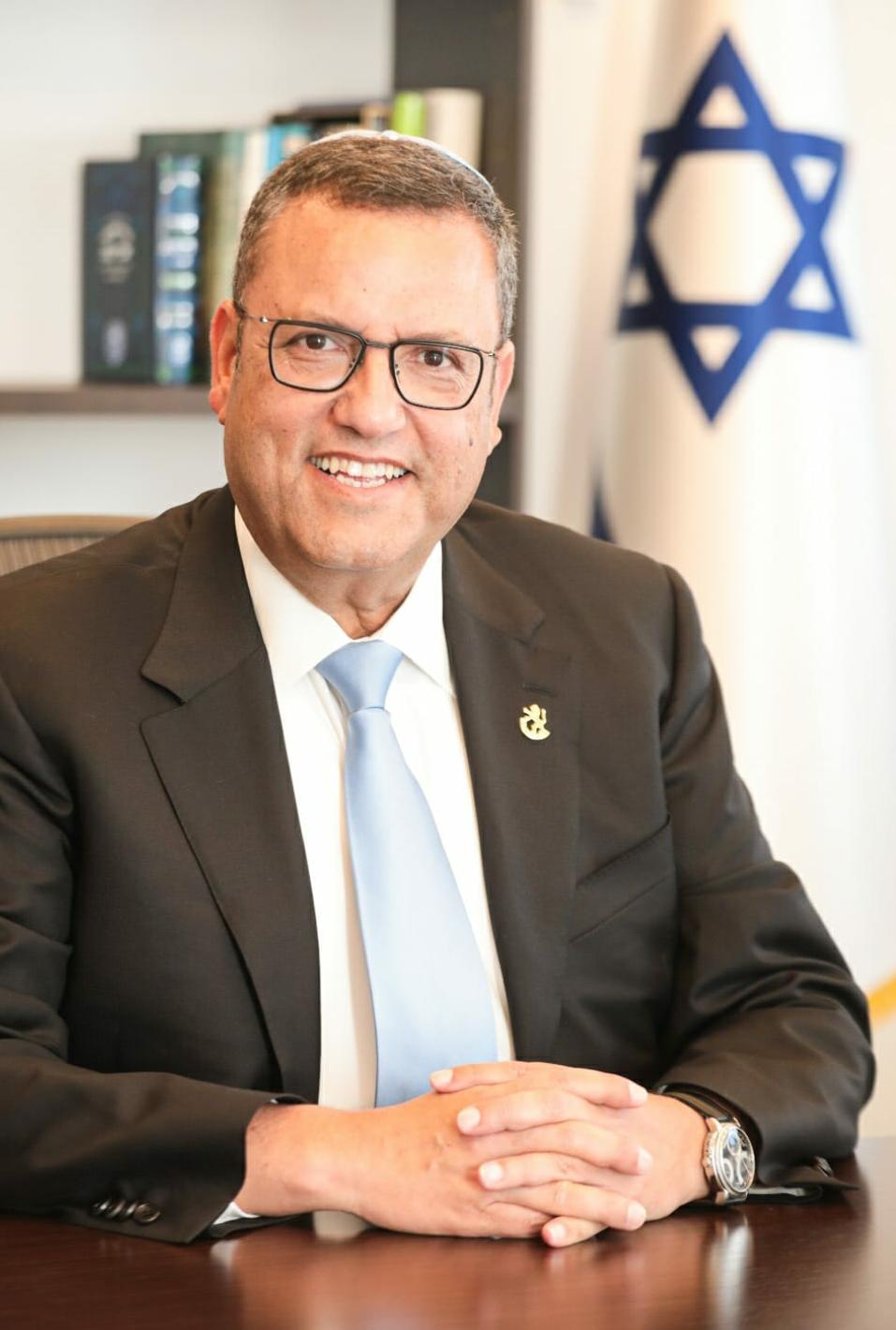
Moshe Lion, or Moshe Leon (Hebrew: משה ליאון, born 6 October 1961), is an Israeli politician who is currently the Mayor of Jerusalem. He previously served as a member of the Jerusalem City Council, director-general of the Prime Minister's Office, Chairman of the Israel Railways, and head of the Jerusalem Development Authority.

Key Information

Lion is the first mayor of Jerusalem of Sephardi descent.

Early life

[edit]

Moshe Lion was born in the Florentin neighborhood of Tel Aviv, Israel, and attended Zeitlin High School [he]. His father's family comes from Thessaloniki, while his mother has roots in Aden.[1] As a child, he moved with his family to Givatayim. Lion served in the Israel Defence Forces, where he was assigned to the military chaplaincy and sang with the IDF rabbinical choir.[3] He occasionally still leads synagogue services.[4] Lion graduated with a BA in economics and accounting from Bar-Ilan University, and interned in the office of Avigdor Yitzhaki, receiving his CPA in 1990. His brother, Dr. Nissim Lion, is a lecturer in the Department of Sociology and Anthropology at Bar-Ilan University.

Professional career

[edit]

In 1991, Lion founded Yitzhaki & Co., together with Avigdor Yitzhaki and two other partners.[5] Among his clients was the Likud movement, which he advised following their economic losses after losing the 1992 Knesset elections. He retired in 2017.

In July 2014, he was appointed chairman of the board of directors of the Mayanei Hayeshua Medical Center in Bnei Brak.[6]

Public career

[edit]

In 1996, Lion was appointed managing director of the Prime Minister's Office of Benjamin Netanyahu, also becoming his economic adviser, serving in those roles till 1999.[7]

From 2003–2006, he was appointed chairman of the Israel Railways after having previously worked with the Ports and Railways Authority. Lion finished his term in 2006, after his term was not extended.[8]

In 2008, he was appointed chairman of the Jerusalem Development Authority.[9] Under his tenure, the First Station train complex in Jerusalem was completed.

Political career

[edit]

Lion was chosen to help negotiate the forming of a government coalition following the Israeli elections of 2013, in the aftermath of which the Likud and Yisrael Beitenu parties joined together.

In 2013, Lion ran for Mayor of Jerusalem, receiving 45% of the vote, but lost to Nir Barkat.[10] The Likud party under his leadership received one mandate, and he became a member of the Jerusalem City Council on its behalf.[11]

In August 2015, Lion joined the municipal coalition and the faction of Mayor Nir Barkat.[12] As part of the coalition agreement signed between the two, he began to serve as a member of the city administration, and as the holder of the community management portfolio.[13]

On 25 March 2018, Lion announced his intention to run for Mayor of Jerusalem in the 2018 Jerusalem mayoral election. During the campaign, Lion stated that he opposed the Netanyahu government's plan, put forward by Jerusalem Affairs Minister and campaign challenger Ze'ev Elkin, to erect a barrier dividing East Jerusalem from the rest of the city.[14]

Despite his broad Haredi political support, a coalition of Hasidic and extremist-Haredi Jerusalem Faction leaders declined to endorse Lion, citing his close ties to politician Avigdor Lieberman. Lieberman advanced legislation to draft Haredis into the army, making Lion more likely to "secularize" Jerusalem, according to the Hasidic coalition.[15][16]

In the six-candidate general election held on 30 October 2018, Lion garnered 33% of the vote, while fellow Jerusalem city councilman Ofer Berkovitch finished in second place, with 29%.[17] This earned them spots in a run-off election scheduled two weeks later,[18] because according to election laws, candidates in municipal races must gain at least 40% of the vote in order to win.[19] On 13 November, Lion won the run-off election with 50.85% of the vote, to Berkovitch's 49.15%,[20] thereby becoming the first mayor of Jerusalem of Sephardi descent.[21]

Lion was re-elected in the 2024 Jerusalem municipal election with a landslide victory, garnering 81.5% of the vote.[22]

References

[edit]
Revisions and contributorsEdit on WikipediaRead on Wikipedia
from Grokipedia
Moshe Lion (Hebrew: משה ליאון; born October 6, 1961) is an Israeli and civil servant serving as the since November 2018, the first of Sephardi descent to hold the position. A by training, Lion founded the accounting firm Yitzhaki & Co. in 1991 and later chaired public entities including (2003–2006) and the Jerusalem Development Authority (2008). Prior to his mayoralty, Lion held senior roles in national government, notably as managing director of the Prime Minister's Office under from 1996 to 1999, where he also advised on economic matters. He entered municipal as a member and ran unsuccessfully for in 2013, securing 45% of the vote against incumbent . In 2018, Lion won a closely contested runoff against Ofer Berkovitch with 50.85% of the vote, a margin of 3,765 votes, aided by support from ultra-Orthodox parties despite his prior criticisms of Haredi leadership on issues like military draft exemptions. He was reelected in 2024, maintaining a coalition bridging secular, religious, and ultra-Orthodox factions. As mayor, Lion has prioritized infrastructure improvements, particularly in , including road and sewer overhauls, school reforms aiming for 50% Israeli-run institutions within five years, and initiatives that have enhanced urban cleanliness. His administration emphasizes unity across Jerusalem's diverse demographics—Arabs, ultra-Orthodox, and secular residents—through dialogue and targeted development, such as completing the First Station entertainment district. While praised for resourcefulness and broad alliances, Lion has faced political rivalries, including with former rivals like Barkat and tensions over coalition dynamics with Haredi groups.

Early life and education

Family background and upbringing

Moshe Lion was born on October 6, 1961, in , a suburb east of . His father hailed from the Sephardic Jewish community of , , immigrating to in 1935 as an infant with his own father, prior to the escalation of in . Lion's mother originated from the Yemenite Jewish community, with family roots tracing to in present-day . Lion's family relocated to during his early childhood, where he spent much of his formative years in this middle-class Israeli suburb characterized by its proximity to and its diverse Jewish immigrant population. He attended high school in adjacent , reflecting the interconnected urban fabric of the region that shaped his early environment. Limited public details exist on specific familial influences or socioeconomic dynamics of his household, though his parents' distinct diasporic origins—Sephardic Greek and Yemenite—typify the mosaic of Jewish immigration waves that bolstered Israel's post-independence society.

Formal education and early influences

Lion earned a Bachelor of Arts degree in economics and accounting from Bar-Ilan University. He subsequently interned at the accounting office of Avigdor Yitzhaki, through which he obtained his Certified Public Accountant (CPA) certification in 1990. Lion's early influences were shaped by his Sephardi heritage and religious upbringing. His father's family originated from Thessaloniki, Greece, where his grandfather had briefly settled in Jerusalem before relocating amid pre-Holocaust migrations, instilling a familial affinity for the city. His mother's roots trace to Aden, Yemen, contributing to his traditionalist outlook within Israel's national religious community. During his mandatory military service in the Israel Defense Forces, Lion served in the military chaplaincy, performing as a cantor with the IDF rabbinical choir, which reinforced his ongoing involvement in synagogue services. This period highlighted his early religious commitments, as he occasionally continues to lead services today. Professionally, Yitzhaki emerged as a key early mentor, with Lion co-founding the Yitzhaki & Co. accounting firm in 1991 alongside him and two partners, marking his initial foray into business leadership. These experiences, combined with his academic training at the religiously oriented , laid the groundwork for his administrative expertise while embedding values of fiscal discipline and communal service.

Professional career

Accounting and business roles

Lion earned a bachelor's degree in economics and accounting from Bar-Ilan University and obtained his certified public accountant (CPA) certification in 1990 following an internship in the office of accountant Avigdor Yitzhaki. In the early 1990s, he joined the accounting firm Yitzhaki & Co., whose clients included the Likud party. By 1991, Lion had established and managed Yitzhaki & Co. as a key figure, developing it into a prominent accounting and consulting firm that contributed to his financial success. He served as managing partner, overseeing operations focused on financial auditing, tax advisory, and business consulting services for corporate and political entities. The firm's growth under his leadership positioned him as a seasoned professional in Israel's private sector before transitioning to public roles. Lion maintained active involvement in the firm until around 2013, when he relocated to Jerusalem and ceased daily operations to pursue political activities, though he retained ownership interests. His business acumen from these roles emphasized practical financial management and client relations, often with right-leaning organizations, informing his later administrative approaches.

Executive positions in state-owned enterprises

Prior to his appointment as chairman of , Lion worked with the Ports and Railways Authority, a government body overseeing infrastructure development and operations in transportation sectors. This experience positioned him for executive leadership in state-controlled entities focused on national infrastructure. From 2003 to 2006, Lion served as chairman of , the state-owned corporation managing Israel's passenger and freight rail network. In this role, he oversaw strategic operations during a period of modernization efforts for the underutilized rail system, though specific performance metrics or reforms directly attributable to his tenure are not widely documented in public records. He completed his term in 2006, transitioning back to accounting activities before later public roles.

Public administration roles

Leadership at Israel Railways

Moshe Lion served as chairman of from 2003 to 2006, having previously worked with the Ports and Railways Authority. His appointment coincided with the establishment of as an independent government-owned corporation in 2003, separating it from its prior integration within the authority. Under Lion's leadership, the company pursued network expansion amid broader national efforts to revitalize rail infrastructure through initiatives like the "Railway 2000" program, which aimed to enhance competitiveness against road transport. In December 2004, Lion announced plans for a NIS 7.5 billion investment to develop rail lines in the region, focusing on extending connectivity to southern areas. Passenger traffic reflected growing utilization, with Israel Railways projecting 23 million riders in 2004 as part of a five-year plan targeting 54.2 million by 2008, supported by upgrades and increased capacity. completed his term in 2006, transitioning to subsequent public administration roles.

Directorship of Jerusalem Development Authority

In 2008, Moshe Lion was appointed chairman of the Jerusalem Development Authority (JDA), a joint entity of the Israeli government and tasked with economic promotion and urban development in the city. He succeeded Moshe Goldstein, who had led the authority for the prior three years. Lion's tenure lasted until 2013, during which he oversaw initiatives to revitalize underutilized infrastructure amid a modest initial budget of tens of millions of shekels. A key accomplishment under Lion's leadership was the completion of the First Station complex, transforming a disused Ottoman-era station into a vibrant and commercial hub featuring shops, restaurants, and cultural venues. This project enhanced Jerusalem's tourism appeal and local economy by repurposing historical assets for public use, drawing visitors to the city's southwestern entrance. The initiative aligned with broader JDA goals of fostering growth in non-residential sectors, though specific financial outcomes or employment figures from the period remain undocumented in primary government reports. Lion's directorship emphasized practical without major controversies, focusing on executable projects amid fiscal constraints. By 2013, the role positioned him as a candidate for , highlighting his administrative experience in state-linked enterprises.

Political entry and affiliations

Jerusalem City Council tenure

Moshe Lion was elected to the Jerusalem City Council in the October 2013 municipal elections alongside his unsuccessful bid for mayor, in which he garnered 45% of the vote against incumbent . Despite early speculation that he might forgo the council seat following the mayoral defeat, Lion was sworn in on November 21, 2013. Throughout his tenure from 2013 to 2018, Lion initially operated in opposition to Barkat's administration but subsequently aligned with the mayor's faction, reflecting a pragmatic shift in his political positioning within the . This period marked his entry into elected local governance, building on prior administrative experience, amid Jerusalem's complex demographic and ideological divides. His council service concluded upon his victory in the November 2018 mayoral runoff, where he assumed office in December.

Key political alliances and party ties

Lion's political career has been characterized by strategic alliances with right-wing and ultra-Orthodox factions rather than formal membership in a single national party. In his 2013 bid for Jerusalem mayor, he received support from segments of the -Yisrael Beytenu bloc and several Haredi groups, though official endorsement was withheld amid loyalty to incumbent . Following the election loss, Lion joined Barkat's city council coalition on August 24, 2015, to advance municipal priorities. For the 2018 municipal elections, Lion headed the Yerushalayim Shelanu list, securing pivotal endorsements from Haredi spiritual leaders of and on September 20, 2018, which helped consolidate ultra-Orthodox voter support and propelled his runoff victory. After taking office, Yerushalayim Shelanu merged with on December 11, 2018, aligning his local operation more closely with the national right-wing party despite his independent mayoral stance. These ties persisted into the 2024 elections, where Lion's landslide re-election on February 27 enabled a coalition encompassing the entire 48-seat city council, with ultra-Orthodox parties— and —gaining control of key committees like finance and planning on April 17, 2024, reflecting sustained Haredi influence in his governance. This pattern underscores Lion's approach of bridging secular right-wing elements with Haredi interests to maintain broad-based municipal power, avoiding rigid partisan labels.

Mayoral campaigns

2013 election attempt

In July 2013, Moshe Lion, formerly the director-general of the Prime Minister's Office, announced his candidacy for , positioning himself as a focused on efficient management and resident-oriented governance. He entered the race as a relative outsider to local politics, leveraging his administrative experience in state enterprises and public sector roles. Lion's campaign received support from prominent right-wing figures, including Yisrael Beytenu leader and Shas head , who endorsed him amid efforts to challenge incumbent Nir Barkat's re-election bid. However, he faced internal divisions within circles, where some party members in Jerusalem preferred Barkat and publicly stated that the party had not officially endorsed Lion. The contest highlighted tensions between Barkat's secular, tech-oriented incumbency and Lion's appeal to more traditional and right-leaning voters, with debates focusing on urban development, , and municipal efficiency. The election occurred on October 22, 2013, amid historically low of approximately 43% nationwide, which Barkat had warned could favor Lion by mobilizing core supporters. Despite this, Barkat secured re-election with 51.1% of the vote to Lion's 45.3%, in a tight race that underscored Jerusalem's divided electorate but affirmed the incumbent's hold. Lion's list performed poorly in council elections, gaining only one seat, reflecting limited broader appeal beyond his personal candidacy. Following the defeat, Lion was sworn in as a member of the City Council on , , fulfilling a commitment to continue despite the mayoral loss. This outcome marked his initial foray into electoral politics, establishing a foundation for future campaigns while exposing challenges in unifying diverse factions in the capital.

2018 election victory

The 2018 Jerusalem mayoral election proceeded to a runoff on November 13 after no candidate achieved the necessary threshold in the first round on 30. Moshe Lion, a city council member backed by ultra-Orthodox parties such as and , as well as endorsements from incumbent mayor and , competed against Ofer Berkovitch, who garnered support from secular and moderate voters. Lion secured victory in the runoff with 51.5% of the votes compared to Berkovitch's 48.5%, prevailing by a narrow margin of 3,765 votes once provisional ballots from soldiers and other groups were tallied. This outcome hinged on robust turnout from ultra-Orthodox communities, reflecting their strategic alignment with Lion despite his non-Haredi background. Berkovitch initially refused to concede, alleging voting irregularities and noting that some soldiers' ballots remained uncounted, though declared victory early on November 14. The election highlighted divisions between religious and secular factions in , with Lion's win viewed as a boost for ultra-Orthodox influence in city governance.

2024 re-election landslide

The 2024 Jerusalem municipal election for mayor was held on February 27, 2024, following a postponement from the original November 2023 date due to the ongoing Israel-Hamas war that began with the October 7, 2023, attacks. Incumbent Mayor Moshe Lion faced primary challenger Yossi Havilio, a secular candidate backed by centrist and left-leaning groups seeking to counter Lion's alliances with religious parties. Lion secured a decisive outright without needing a runoff, capturing 81.5% of the votes against Havilio's 18.5%, with all ballots counted. This margin reflected strong consolidated support from Haredi (ultra-Orthodox) communities and right-wing voters, who turned out despite national hovering around 49.5%, influenced by fatigue and security concerns. Lion's re-election extended his term for another five years, bolstering his position amid the city's religiously diverse electorate, where Arab participation remained negligible at under 5% of eligible voters. The landslide outcome underscored Lion's incumbency advantage and policy focus on security, infrastructure, and accommodation of religious sectors, which resonated in a polarized post-October 7 environment prioritizing stability over ideological shifts. Havilio's campaign emphasized secular governance and but failed to mobilize sufficient opposition, highlighting fractures in Jerusalem's non-religious voting blocs.

Mayoral governance

Infrastructure and urban development initiatives

During Moshe Lion's tenure as mayor, prioritized programs to address shortages and revitalize aging neighborhoods, approving over 7,700 new units in the year prior to July 2025, more than double the previous annual average. These efforts included streamlined permitting processes, which facilitated 3,044 units via in 2024 and an additional 7,850 units by mid-2025. Lion described as a "vital pillar of the housing revolution," aiming to demolish and rebuild substandard structures into higher-density developments, such as a project replacing 581 apartments with 2,265 new units. Specific initiatives encompassed approvals for high-rise towers in older areas like Katamonim and Kiryat Yovel, yielding 850 new apartments across 3.5 dunams and increasing density from 64 to 224 units with 20% designated for smaller affordable options. The Master Plan advanced reconstruction, including replacing the Talpiot Mall with towers up to 37 stories, while the "Rooftop" plan over the Begin Highway sought to integrate disparate city sections and add thousands of units. Overall, these projects contributed to plans for nearly 500 of 18 stories or more, potentially adding 60,000 units, with Lion targeting 40,000 apartments by 2030 and up to 100,000 units in total. In transportation , the administration invested in upgrades and expansions spanning 75 kilometers of tracks, integrating new and millions of square meters of commercial space along routes to reduce congestion. This included ongoing enhancements to existing lines and preparations for congestion charges upon completion to incentivize public transit use. Road received parallel for expansions, supporting broader connectivity amid the building surge. These measures aligned with Lion's goal of attracting population growth through improved , jobs, and mobility options.

Economic and social integration efforts

Under Mayor 's administration, significant efforts have focused on economically integrating Jerusalem's residents by expanding opportunities in eastern neighborhoods, as part of a broader strategy to reduce disparities between east and . In January 2025, the approved the Wadi Joz Business Complex plan, initiated by Lion, which aims to create thousands of jobs through commercial and industrial development in an -majority area, aligning with the government's five-year plan to bridge socioeconomic gaps. Similarly, in August 2023, the Israeli government endorsed a NIS 3.2 billion development package for eastern , emphasizing infrastructure upgrades, health and welfare reforms, and targeted job creation programs to foster economic participation among residents. Social integration initiatives have emphasized equitable access to across diverse communities, including , Haredim, and new immigrants. Lion's policies have extended sanitation, road repairs, enhancements, and welfare support to eastern neighborhoods, with Arab residents included in COVID-19 vaccination drives and benevolence programs during the . To integrate olim (immigrants) socially and economically, the has promoted settlement incentives and job placement, noting their contributions to the city's as of May 2023. These measures, coupled with urban renewal projects generating high-quality employment zones attracting Israeli and international firms, aim to build a unified while addressing demographic challenges like low Arab labor participation rates, though critics argue political autonomy demands persist alongside service improvements. Lion has also pursued cross-community projects to enhance social cohesion, such as infrastructure investments benefiting both Jewish and Arab areas, with hundreds of millions of shekels allocated as of March 2024 to support shared and transportation systems. For Haredi integration, policies prioritize job growth in sectors like and services, alongside housing and transport expansions to accommodate population needs without segregating communities. Overall, these initiatives reflect Lion's emphasis on pragmatic service delivery over ideological divides, aiming to position Jerusalem as an inclusive economic hub.

Security and holy sites management

During his tenure as mayor, Moshe Lion has prioritized bolstering Jerusalem's security apparatus through enhanced collaboration with , particularly in response to heightened threats following the , 2023, attacks. He has overseen investments in security infrastructure, including a multi-year municipal plan allocating approximately 120 million shekels to safety measures aimed at increasing police presence and across the city, with a focus on both Jewish and Arab neighborhoods. Lion has publicly identified Palestinian incitement to as a core strategic threat, arguing it transforms impressionable youth into perpetrators and necessitates proactive municipal countermeasures alongside national efforts. Post-October 7, Lion coordinated rapid municipal responses to and crises, including on-site assessments with advisors to ensure continuity of amid reservist call-ups and labor shortages. He urged senior rabbis to publicly condemn of Arab workers in , framing such acts as halakhically prohibited and detrimental to urban stability, thereby aiming to preserve economic functionality without compromising vigilance. In managing Jerusalem's holy sites, Lion has adhered to the established status quo on the , coordinating with national security officials and religious authorities to prevent escalations. In August 2024, at the behest of security agencies, he facilitated messages from prominent Jerusalem rabbis—disseminated in Hebrew and —reaffirming the on Jewish ascents and prayers at the site due to ritual impurity concerns and risks of Muslim backlash, amid tensions from ministerial visits advocating change. This approach aligns with longstanding Israeli policy granting the Jordanian administrative oversight while allowing non-prayer Jewish visits under police escort, though Lion's interventions underscore municipal efforts to de-escalate via rabbinic consensus rather than unilateral shifts. Regarding the Western Wall, Lion expressed opposition in May 2020 to permitting non-Orthodox mixed-gender prayer in the main plaza, stating that such arrangements should not occur at the site managed by Orthodox authorities, reflecting his deference to traditional halakhic governance over pluralistic reforms. Overall, his holy sites strategy emphasizes coordination with national bodies and religious stakeholders to maintain access and order, prioritizing conflict avoidance amid Jerusalem's multi-faith sensitivities.

Political positions and ideology

Stance on Haredi community issues

Moshe Lion has cultivated strong ties with Jerusalem's Haredi community, securing endorsements from major factions like during his 2018 mayoral campaign, though some Hasidic and Litvish groups withheld support due to his non-Haredi background and perceived insufficient orthodoxy. These alliances were reportedly linked to national political deals, including a 2018 arrangement where then-Defense Minister promised Haredi leaders softened military enlistment criteria in exchange for electoral backing, as Lion acknowledged in a recorded . On exemptions, Lion has aligned with Haredi preferences for limited or adjusted , reflecting his role in facilitating compromises that ease enforcement against students while navigating broader Israeli debates on equitable burden-sharing. He has opposed measures that isolate Haredi neighborhoods, such as proposed closures during the 2020 outbreak to curb virus transmission linked to dense community gatherings, prioritizing communal access over strict segregation. In education and workforce integration, Lion supports models that blend religious observance with professional training, praising institutions like the Jerusalem College of Technology for enabling Haredi men and women to earn degrees in fields like without diluting , which he views as key to and reducing welfare dependency. He has mediated disputes, such as 2025 negotiations ensuring Sephardic Haredi girls' access to Ashkenazi seminaries, facilitating school openings amid core curricula controversies. Regarding Shabbat observance, Lion upholds the prohibition on municipal public bus services, stating explicitly that "there will be no transport on Shabbat" to respect religious sensitivities, while advancing light rail expansions that operate within halachic guidelines and alleviate secular traffic pressures. This stance has drawn secular pushback for initiatives like free Shabbat minibuses, which face opposition from Orthodox council members in his coalitions, underscoring his balancing act between Haredi demands and city-wide functionality. His approach yields Haredi influence in governance, with ultra-Orthodox parties heading key committees post-2024 elections, yet earns secular approval for perceived moderation amid rising demographic pressures.

Approach to Arab-Israeli relations in Jerusalem

As , Moshe Lion has emphasized extending and investments to East 's Arab neighborhoods, aiming to bridge longstanding disparities and encourage civic participation among the city's approximately 40% Arab . Since taking office in 2018, he has prioritized matching budgets for eastern areas to those in the west, funding projects such as hundreds of new school classrooms, cultural centers, sports facilities including soccer fields and courts, and a state-of-the-art . These efforts seek practical unification rather than political concessions, with Lion pledging billions for overhauling roads and sewers to address decades of neglect. A core initiative involves tackling , which Lion views as a barrier to orderly development; in neighborhoods like Isawiya, he implemented a six-month freeze on demolitions starting in early 2020, coupled with efforts to issue permits where feasible, as a pilot expandable citywide upon success. He has also pushed economic integration through employment centers and hi-tech office spaces in , targeting 10,000 jobs to boost participation, particularly among women, and reduce incentives for unrest. In education, Lion aims to expand Israeli Ministry of Education-run schools in from 7% to 50% within five years, countering Palestinian Authority curriculum influence and fostering loyalty to municipal systems. Community engagement includes direct outreach, such as visits to injured residents and invitations to Arab parents and principals, exemplified by constructing a in Isawiya amid security operations. On security, Lion maintains close coordination with police, supporting operations to ensure calm—such as uninterrupted schooling during raids in Isawiya—while upholding Israeli sovereignty over holy sites and the city. Following the October 7, 2023, attack, he intensified collaboration with security forces and publicly urged rabbis to condemn harassment of Arab workers, emphasizing economic coexistence to prevent escalation. Despite these measures, challenges persist due to low Arab —stemming from a since 1967—and preferences for Palestinian Authority services, with some residents demanding political autonomy over enhanced welfare. Tensions flared in riots, including rock-throwing at Lion's vehicle in , underscoring limits to service-based pacification absent broader resolution. Lion attributes partial non-cooperation to external influences but continues prioritizing empirical improvements to incentivize residency benefits and deter violence.

Alignment with national right-wing policies

Moshe Lion has maintained close professional and political ties to Israel's right-wing leadership, particularly , having served as managing director of the and economic adviser during Netanyahu's first term from 1996 to 1999. This background facilitated his alignment with Likud-endorsed policies, including during his mayoral campaign where he positioned himself as the right-wing candidate against challenger , receiving endorsements from outgoing mayor and broad support from nationalist factions. Lion's governance reflects national right-wing priorities on Jerusalem's undivided sovereignty, as evidenced by his advocacy for expanding housing construction across the city, including in eastern neighborhoods like Givat Hamatos, a site designated for settlement development that advances Israeli claims over disputed territories. In policy execution, Lion has coordinated with the national government on infrastructure projects that bolster Jerusalem's , such as the 2025 joint visit with Netanyahu to the Mamilla Pool site, emphasizing historical intertwined with modern development to reinforce Jewish continuity and national identity. He has opposed initiatives perceived as concessions, predicting the lifting of U.S.-imposed restrictions on settlement plans following meetings with American officials, which aligns with right-wing resistance to international pressures on construction in areas claimed by . Lion's 2024 re-election, amid gains by ultra-Orthodox and far-right members, positioned him to govern with a favoring hawkish stances on and , including enhanced policing and barriers against Palestinian encroachments. Critics from left-leaning perspectives have noted Lion's prioritization of settlement-aligned building—pledging up to 100,000 new units—over Palestinian neighborhood approvals, such as shelving the al-Addassah plan in 2023 despite local advocacy, framing this as perpetuating Israeli control in . However, Lion defends these actions as sovereign necessities for a unified city, echoing national right-wing doctrine that rejects partition and prioritizes Jewish demographic majorities, as articulated in his public statements on comprehensive urban expansion. His approach avoids formal far-right labeling but consistently supports Netanyahu's on core issues like countering and preserving holy sites under exclusive Israeli administration.

Controversies and criticisms

Election integrity allegations

In the November 13, 2018, runoff for mayor, Moshe Lion defeated challenger Ofer Berkovitch with 51.46% of the vote (approximately 129,982 votes) to Berkovitch's 48.54% (approximately 122,805 votes), a of less than 3 percentage points in a contest drawing over 252,000 voters. Berkovitch, a secular backed by centrist and modern Orthodox voters, initially refused to concede, alleging "many irregularities" in the voting process, including delays in counting absentee ballots from soldiers and potential manipulations favoring Lion's ultra-Orthodox supporters. These claims echoed broader campaign-era reports of suspected fraud in , such as unauthorized voter mobilization efforts, though police investigations into municipal election irregularities nationwide that year focused primarily on other cities like and Petah Tikvah, with no substantiated evidence emerging in sufficient to overturn results. The Central Elections Committee certified Lion's victory without alteration, and he was inaugurated on November 19, 2018, amid ongoing disputes from Berkovitch's camp that centered on turnout disparities in Haredi neighborhoods but lacked forensic proof of systemic impacting the outcome. Critics, including some secular activists, attributed Berkovitch's narrow loss to Lion's strategic alliances with ultra-Orthodox parties and higher mobilization in religious communities, rather than illicit interference, as reached about 52% overall, with stronger participation in Haredi areas. No formal legal challenges succeeded in invalidating the election, distinguishing it from rare instances elsewhere in where courts annulled results due to proven or ballot stuffing, such as in years prior. Lion's February 27, 2024, re-election, where he secured over 60% of the vote in a against multiple challengers amid low turnout of around 50% influenced by the ongoing Gaza war, drew no comparable public allegations of integrity issues from opponents or observers. Police reported isolated fraud arrests nationwide during that cycle, such as in for bribery attempts, but Jerusalem's process proceeded without noted disruptions or post-election disputes tied to Lion's campaign.

Governance and coalition challenges

Following his narrow victory in the , , runoff , Moshe Lion assembled a broad municipal encompassing most city council factions, excluding the secular Hitorerut Yerushalayim led by Ofer Berkovitch, which had garnered 29% of the vote but refused to join. This arrangement secured Lion's governance amid Jerusalem's fragmented politics, where Haredi parties held significant sway due to their , but it sowed early tensions with secular representatives who criticized the exclusion as sidelining moderate voices. The 2024 municipal elections, held on February 27 amid the ongoing Gaza war, amplified coalition dynamics when Haredi factions—Shas, Agudat Yisrael, and Degel HaTorah—collectively secured 16 of the council's 31 seats, marking their first outright majority in the city's history. Lion responded by forming a wall-to-wall coalition incorporating all factions, the first such unity government since Teddy Kollek's tenure ended in 1993, ostensibly to foster stability in a city divided by religious, ethnic, and socioeconomic lines. However, this pact allocated control of the municipality's most influential committees—finance, property taxes, and local planning and building—to Haredi representatives, prompting secular council members like Yosi Havilio to decry the power concentration as undermining balanced governance. Secular critics, including Havilio's Yerushalayim Plus faction, expressed concerns over potential policy skews favoring Haredi priorities, such as expanded funding and housing developments in ultra-Orthodox neighborhoods, at the expense of secular infrastructure like public transport on or cultural venues. To mitigate disputes, Lion brokered a compromise granting Havilio a rotating seat on the regional planning committee for half the term, while appointing Eldad Rabinowitz of the party—a faction linked to settler group —to a key subcommittee, which drew accusations of conflicts of interest from opponents wary of settlement expansion influences. These arrangements highlighted ongoing frictions in sustaining cohesion, as the Haredi majority's demographic growth—driven by higher birth rates—intensified demands for , fueling fears among non-Haredi residents of a "secular exodus" and eroding the city's pluralistic fabric. Compounding these religious-secular divides, the absence of representation posed a structural challenge, with Palestinian residents—comprising about 40% of Jerusalem's population—continuing their longstanding of municipal elections, resulting in zero council seats for Arab lists despite their eligibility since 1967. Lion's coalitions have thus operated without input from this demographic, limiting responsiveness to east Jerusalem's needs and exacerbating governance gaps in service delivery, such as and , where Haredi-focused budgets have been prioritized. Critics from secular and centrist quarters argue this reliance on Haredi support constrains Lion's autonomy, as evidenced by past election dependencies on ultra-Orthodox endorsements that nearly fractured in over rabbinical disputes. Overall, these imperatives reflect Jerusalem's inherent fragmentation, where Lion's pragmatic inclusivity has stabilized rule but at the cost of persistent critiques over equitable power-sharing.

References

Add your contribution
Related Hubs
User Avatar
No comments yet.