


Community hub
Recent from talks
Contribute something
Nothing was collected or created yet.
Mayfly
View on Wikipedia
| Mayfly Temporal range:
| |
|---|---|

| |
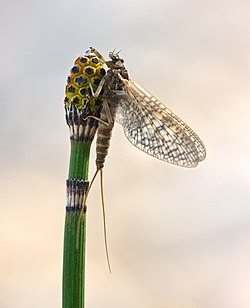
| Rhithrogena germanica, the fly fisherman's "March brown mayfly" | |
Scientific classification 
| |
| Kingdom: | Animalia |
| Phylum: | Arthropoda |
| Class: | Insecta |
| Subclass: | Pterygota |
| Infraclass: | Palaeoptera |
| Superorder: | Ephemeropteroidea Rohdendorf, 1968 |
| Order: | Ephemeroptera Hyatt & Arms, 1890 |
| Suborders and families | |
Mayflies (also known as shadflies or fishflies in Canada and the upper Midwestern United States, as Canadian soldiers in the American Great Lakes region,[2] and as up-winged flies in the United Kingdom) are aquatic insects belonging to the order Ephemeroptera. This order is part of an ancient group of insects termed the Palaeoptera, which also contains dragonflies and damselflies. Over 3,000 species of mayfly are known worldwide, grouped into over 400 genera in 42 families.
Mayflies have ancestral traits that were probably present in the first flying insects, such as long tails and wings that do not fold flat over the abdomen. Their immature stages are aquatic fresh water forms (called "naiads" or "nymphs"), whose presence indicates a clean, unpolluted and highly oxygenated aquatic environment. They are unique among insect orders in having a fully winged terrestrial preadult stage, the subimago, which moults into a sexually mature adult, the imago.
Mayflies "hatch" (emerge as adults) from spring to autumn, not necessarily in May, in enormous numbers. Some hatches attract tourists. Fly fishermen make use of mayfly hatches by choosing artificial fishing flies that resemble them. One of the most famous English mayflies is Rhithrogena germanica, the fisherman's "March brown mayfly".[3]
The brief lives of mayfly adults have been noted by naturalists and encyclopaedists since Aristotle and Pliny the Elder in classical antiquity. The German engraver Albrecht Dürer included a mayfly in his 1495 engraving The Holy Family with the Mayfly to suggest a link between heaven and earth. The English poet George Crabbe compared the brief life of a daily newspaper with that of a mayfly in the satirical poem "The Newspaper" (1785), both being known as "ephemera".
Description
[edit]Nymph
[edit]


.jpeg)
Immature mayflies are aquatic and are referred to as nymphs or naiads. In contrast to their short lives as adults, they may live for several years in the water. They have an elongated, cylindrical or somewhat flattened body that passes through a number of instars (stages), moulting and increasing in size each time. When ready to emerge from the water, nymphs vary in length, depending on species, from 3 to 30 mm (0.12 to 1.18 in).[4] The head has a tough outer covering of sclerotin, often with various hard ridges and projections; it points either forwards or downwards, with the mouth at the front. There are two large compound eyes, three ocelli (simple eyes) and a pair of antennae of variable lengths, set between or in front of the eyes. The mouthparts are designed for chewing and consist of a flap-like labrum, a pair of strong mandibles, a pair of maxillae, a membranous hypopharynx and a labium.[5]
The thorax consists of three segments – the hindmost two, the mesothorax and metathorax, being fused. Each segment bears a pair of legs which usually terminate in a single claw. The legs are robust and often clad in bristles, hairs or spines. Wing pads develop on the mesothorax, and in some species, hindwing pads develop on the metathorax.[5]
The abdomen consists of ten segments, some of which may be obscured by a large pair of operculate gills, a thoracic shield (expanded part of the prothorax) or the developing wing pads. In most taxa up to seven pairs of gills arise from the top or sides of the abdomen, but in some species they are under the abdomen, and in a very few species the gills are instead located on the coxae of the legs, or the bases of the maxillae. The abdomen terminates in slender thread-like projections, consisting of a pair of cerci, with or without a third central caudal filament.[5]
Subimago
[edit]
The final moult of the nymph is not to the full adult form, but to a winged stage called a subimago that physically resembles the adult, but which is usually sexually immature and duller in colour. The subimago, or dun,[6] often has partially cloudy wings fringed with minute hairs known as microtrichia; its eyes, legs and genitalia are not fully developed. Females of some mayflies (subfamily Palingeniinae) do not moult from a subimago state into an adult stage and are sexually mature while appearing like a subimago with microtrichia on the wing membrane. Oligoneuriine mayflies form another exception in retaining microtrichia on their wings but not on their bodies. Subimagos are generally poor fliers, have shorter appendages, and typically lack the colour patterns used to attract mates. In males of Ephoron leukon, the subimagos have forelegs that are short and compressed, with accordion like folds, and expands to more than double its length after moulting.[7] After a period, usually lasting one or two days but in some species only a few minutes, the subimago moults to the full adult form, making mayflies the only insects where a winged form undergoes a further moult.[4]
Imago
[edit]
Adult mayflies, or imagos, are relatively primitive in structure, exhibiting traits that were probably present in the first flying insects. These include long tails and wings that do not fold flat over the abdomen.[8] Mayflies are delicate-looking insects with one or two pairs of membranous, triangular wings, which are extensively covered with veins. At rest, the wings are held upright, like those of a butterfly. The hind wings are much smaller than the forewings and may be vestigial or absent. The second segment of the thorax, which bears the forewings, is enlarged to hold the main flight muscles. Adults have short, flexible antennae, large compound eyes, three ocelli and non-functional mouthparts. In most species, the males' eyes are large and the front legs unusually long, for use in locating and grasping females during the mid-air mating. In the males of some families, there are two large cylindrical "turban" eyes (also known as turbanate or turbinate eyes) that face upwards in addition to the lateral eyes.[9] They are capable of detecting ultraviolet light and are thought to be used during courtship to detect females flying above them.[10] In some species all the legs are functionless, apart from the front pair in males. The abdomen is long and roughly cylindrical, with ten segments and two or three long cerci (tail-like appendages) at the tip. Like Entognatha, Archaeognatha and Zygentoma, the spiracles on the abdomen do not have closing muscles.[11][12] Uniquely among insects, mayflies possess paired genitalia, with the male having two aedeagi (penis-like organs) and the female two gonopores (sexual openings).[1][4]
Biology
[edit]Reproduction and life cycle
[edit]Mayflies are hemimetabolous (they have "incomplete metamorphosis"). They are unique among insects in that they moult one more time after acquiring functional wings;[13] this last-but-one winged (alate) instar usually lives a very short time and is known as a subimago, or to fly fishermen as a dun. Mayflies at the subimago stage are a favourite food of many fish, and many fishing flies are modelled to resemble them. The subimago stage does not survive for long, rarely for more than 24 hours. In some species, it may last for just a few minutes, while the mayflies in the family Palingeniidae have sexually mature subimagos and no true adult form at all.[1]
Often, all the individuals in a population mature at once (a hatch), and for a day or two in the spring or autumn, mayflies are extremely abundant, dancing around each other in large groups, or resting on every available surface.[4] In many species the emergence is synchronised with dawn or dusk, and light intensity seems to be an important cue for emergence, but other factors may also be involved. Baetis intercalaris, for example, usually emerges just after sunset in July and August, but in one year, a large hatch was observed at midday in June. The soft-bodied subimagos are very attractive to predators. Synchronous emergence is probably an adaptive strategy that reduces the individual's risk of being eaten.[14] The lifespan of an adult mayfly is very short, varying with the species. The primary function of the adult is reproduction; adults do not feed and have only vestigial mouthparts, while their digestive systems are filled with air.[13] Dolania americana has the shortest adult lifespan of any mayfly: the adult females of the species live for less than five minutes.[15]

Male adults may patrol individually, but most congregate in swarms a few metres above water with clear open sky above it, and perform a nuptial or courtship dance. Each insect has a characteristic up-and-down pattern of movement; strong wingbeats propel it upwards and forwards with the tail sloping down; when it stops moving its wings, it falls passively with the abdomen tilted upwards. Females fly into these swarms, and mating takes place in the air. A rising male clasps the thorax of a female from below using his front legs bent upwards, and inseminates her. Copulation may last just a few seconds, but occasionally a pair remains in tandem and flutters to the ground.[16] Males may spend the night in vegetation and return to their dance the following day. Although they do not feed, some briefly touch the surface to drink a little water before flying off.[16]
Females typically lay between four hundred and three thousand eggs. The eggs are often dropped onto the surface of the water; sometimes the female deposits them by dipping the tip of her abdomen into the water during flight, releasing a small batch of eggs each time, or deposits them in bulk while standing next to the water. In a few species, the female submerges and places the eggs among plants or in crevices underwater, but in general, they sink to the bottom. The incubation time is variable, depending at least in part on temperature, and may be anything from a few days to nearly a year. Eggs can go into a quiet dormant phase or diapause.[17] The larval growth rate is also temperature-dependent, as is the number of moults. At anywhere between ten and fifty, these post-embryonic moults are more numerous in mayflies than in most other insect orders. The nymphal stage of mayflies may last from several months to several years, depending on species and environmental conditions.[5]
Around half of all mayfly species whose reproductive biology has been described are parthenogenetic (able to asexually reproduce), including both partially and exclusively parthenogenetic populations and species.[18]
Many species breed in moving water, where there is a tendency for the eggs and nymphs to get washed downstream. To counteract this, females may fly upriver before depositing their eggs. For example, the female Tisza mayfly, the largest European species with a length of 12 cm (4.7 in), flies up to 3 kilometres (2 mi) upstream before depositing eggs on the water surface. These sink to the bottom and hatch after 45 days, the nymphs burrowing their way into the sediment where they spend two or three years before hatching into subimagos.[19]
When ready to emerge, several different strategies are used. In some species, the transformation of the nymph occurs underwater and the subimago swims to the surface and launches itself into the air.[4] In other species, the nymph rises to the surface, bursts out of its skin, remains quiescent for a minute or two resting on the exuviae (cast skin) and then flies upwards, and in some, the nymph climbs out of the water before transforming.[20]
Ecology
[edit]
Nymphs live primarily in streams under rocks, in decaying vegetation or in sediments. Few species live in lakes, but they are among the most prolific. For example, the emergence of one species of Hexagenia was recorded on Doppler weather radar by the shoreline of Lake Erie in 2003.[21] In the nymphs of most mayfly species, the paddle-like gills do not function as respiratory surfaces because sufficient oxygen is absorbed through the integument, instead serving to create a respiratory current. However, in low-oxygen environments such as the mud at the bottom of ponds in which Ephemera vulgata burrows, the filamentous gills act as true accessory respiratory organs and are used in gaseous exchange.[22]
In most species, the nymphs are herbivores or detritivores, feeding on algae, diatoms or detritus, but in a few species, they are predators of chironomid and other small insect larvae and nymphs.[23][24] Nymphs of Povilla burrow into submerged wood and can be a problem for boat owners in Africa and southeast Asia.[25] Some are able to shift from one feeding group to another as they grow, thus enabling them to utilise a variety of food resources. They process a great quantity of organic matter as nymphs and transfer a lot of phosphates and nitrates to terrestrial environments when they emerge from the water, thus helping to remove pollutants from aqueous systems.[5] Along with caddisfly larvae and gastropod molluscs, the grazing of mayfly nymphs has a significant impact on the primary producers, the plants and algae, on the bed of streams and rivers.[26]
The nymphs are eaten by a wide range of predators and form an important part of the aquatic food chain. Fish are among the main predators, picking nymphs off the bottom or ingesting them in the water column, and feeding on emerging nymphs and adults on the water surface. Carnivorous stonefly, caddisfly, alderfly and dragonfly larvae feed on bottom-dwelling mayfly nymphs, as do aquatic beetles, leeches, crayfish and amphibians.[25]: 886 Besides the direct mortality caused by these predators, the behaviour of their potential prey is also affected, with the nymphs' growth rate being slowed by the need to hide rather than feed.[26] The nymphs are highly susceptible to pollution and can be useful in the biomonitoring of water bodies.[4] Once they have emerged, large numbers are preyed on by birds, bats and by other insects, such as Rhamphomyia longicauda.[5]
Mayfly nymphs may serve as hosts for parasites such as nematodes and trematodes. Some of these affect the nymphs' behaviour in such a way that they become more likely to be predated.[27][28] Other nematodes turn adult male mayflies into quasi-females which haunt the edges of streams, enabling the parasites to break their way out into the aqueous environment they need to complete their life cycles.[29] The nymphs can also serve as intermediate hosts for the horsehair worm Paragordius varius, which causes its definitive host, a grasshopper, to jump into water and drown.[30]
Effects on ecosystem functioning
[edit]Mayflies are involved in both primary production and bioturbation. A study in laboratory simulated streams revealed that the mayfly genus Centroptilum increased the export of periphyton,[31] thus indirectly affecting primary production positively, which is an essential process for ecosystems. The mayfly can also reallocate and alter the nutrient availability in aquatic habitats through the process of bioturbation. By burrowing in the bottom of lakes and redistributing nutrients, mayflies indirectly regulate phytoplankton and epibenthic primary production.[32] Once burrowing to the bottom of the lake, mayfly nymphs begin to billow their respiratory gills. This motion creates current that carries food particles through the burrow and allows the nymph to filter feed. Other mayfly nymphs possess elaborate filter feeding mechanisms like that of the genus Isonychia. The nymph have forelegs that contain long bristle-like structures that have two rows of hairs. Interlocking hairs form the filter by which the insect traps food particles. The action of filter feeding has a small impact on water purification but an even larger impact on the convergence of small particulate matter into matter of a more complex form that goes on to benefit consumers later in the food chain.[33]
Distribution
[edit]Mayflies are distributed all over the world in clean freshwater habitats,[34] though absent from Antarctica.[35] They tend to be absent from oceanic islands or represented by one or two species that have dispersed from nearby mainland. Female mayflies may be dispersed by wind, and eggs may be transferred by adhesion to the legs of waterbirds.[36] The greatest generic diversity is found in the Neotropical realm, while the Holarctic has a smaller number of genera but a high degree of speciation. Some thirteen families are restricted to a single bioregion.[37] The main families have some general habitat preferences: the Baetidae favour warm water; the Heptageniidae live under stones and prefer fast-flowing water; and the relatively large Ephemeridae make burrows in sandy lake or river beds.[34]
Conservation
[edit]The nymph is the dominant life history stage of the mayfly. Different insect species vary in their tolerance to water pollution, but in general, the larval stages of mayflies, stoneflies (Plecoptera) and caddis flies (Trichoptera) are susceptible to a number of pollutants including sewage, pesticides and industrial effluent. In general, mayflies are particularly sensitive to acidification, but tolerances vary, and certain species are exceptionally tolerant to heavy metal contamination and to low pH levels. Ephemerellidae are among the most tolerant groups and Siphlonuridae and Caenidae the least. The adverse effects on the insects of pollution may be either lethal or sub-lethal, in the latter case resulting in altered enzyme function, poor growth, changed behaviour or lack of reproductive success. As important parts of the food chain, pollution can cause knock-on effects to other organisms; a dearth of herbivorous nymphs can cause overgrowth of algae, and a scarcity of predacious nymphs can result in an over-abundance of their prey species.[38] Fish that feed on mayfly nymphs that have bioaccumulated heavy metals are themselves at risk.[39] Adult female mayflies find water by detecting the polarization of reflected light. They are easily fooled by other polished surfaces which can act as traps for swarming mayflies.[10]
The threat to mayflies applies also to their eggs. "Modest levels" of pollution in rivers in England are sufficient to kill 80% of mayfly eggs, which are as vulnerable to pollutants as other life-cycle stages; numbers of the blue-winged olive mayfly (Baetis) have fallen dramatically, almost to none in some rivers. The major pollutants thought to be responsible are fine sediment and phosphate from agriculture and sewage.[40]
The status of many species of mayflies is unknown because they are known from only the original collection data. Four North American species are believed to be extinct. Among these, Pentagenia robusta was originally collected from the Ohio River near Cincinnati, but this species has not been seen since its original collection in the 1800s. Ephemera compar is known from a single specimen, collected from the "foothills of Colorado" in 1873, but despite intensive surveys of the Colorado mayflies reported in 1984, it has not been rediscovered.[41]
The International Union for Conservation of Nature (IUCN) red list of threatened species includes one mayfly: Tasmanophlebia lacuscoerulei, the large blue lake mayfly, which is a native of Australia and is listed as endangered because its alpine habitat is vulnerable to climate change.[42]
Taxonomy and phylogeny
[edit]
Ephemeroptera was defined by Alpheus Hyatt and Jennie Maria Arms Sheldon in 1890–1.[43][44] The taxonomy of the Ephemeroptera was reworked by George F. Edmunds and Jay R Traver, starting in 1954.[45][46] Traver contributed to the 1935 work The Biology of Mayflies,[47] and has been called "the first Ephemeroptera specialist in North America".[48]
As of 2012, over 3,000 species of mayfly in 42 families and over 400 genera are known worldwide,[49][50] including about 630 species in North America.[51] Mayflies are an ancient group of winged (pterygote) insects. Putative fossil stem group representatives (e.g. Syntonopteroidea-like Lithoneura lameerrei) are already known from the late Carboniferous.[52] The name Ephemeroptera is from the Greek ἐφήμερος, ephemeros "short-lived" (literally "lasting a day", cf. English "ephemeral"), and πτερόν, pteron, "wing", referring to the brief lifespan of adults. The English common name is for the insect's emergence in or around the month of May in the UK.[53] The name shadfly is from the Atlantic fish the shad, which runs up American East Coast rivers at the same time as many mayflies emerge.[54][55]
From the Permian, numerous stem group representatives of mayflies are known, which are often lumped into a separate taxon Permoplectoptera (e.g. including Protereisma permianum in the Protereismatidae,[52] and Misthodotidae). The larvae of Permoplectoptera still had nine pairs of abdominal gills, and the adults still had long hindwings. Maybe the fossil family Cretereismatidae from the Lower Cretaceous Crato Formation of Brazil also belongs as the last offshoot to Permoplectoptera. The Crato outcrops otherwise yielded fossil specimens of modern mayfly families or the extinct (but modern) family Hexagenitidae. However, from the same locality the strange larvae and adults of the extinct family Mickoleitiidae (order Coxoplectoptera) have been described,[56] which represents the fossil sister group of modern mayflies, even though they had very peculiar adaptations such as raptorial forelegs.
The oldest mayfly inclusion in amber is Cretoneta zherichini (Leptophlebiidae) from the Lower Cretaceous of Siberia. In the much younger Baltic amber numerous inclusions of several modern families of mayflies have been found (Ephemeridae, Potamanthidae, Leptophlebiidae, Ametropodidae, Siphlonuridae, Isonychiidae, Heptageniidae, and Ephemerellidae).[57] The modern genus Neoephemera is represented in the fossil record by the Ypresian[58] species N. antiqua from Washington state.[59]
Grimaldi and Engel, reviewing the phylogeny in 2005, commented that many cladistic studies had been made with no stability in Ephemeroptera suborders and infraorders; the traditional division into Schistonota and Pannota was wrong because Pannota is derived from the Schistonota.[52] The phylogeny of the Ephemeroptera was first studied using molecular analysis by Ogden and Whiting in 2005. They recovered the Baetidae as sister to the other clades.[60] Mayfly phylogeny was further studied using morphological and molecular analyses by Ogden and others in 2009. They found that the Asian genus Siphluriscus was sister to all other mayflies. Some existing lineages such as Ephemeroidea, and families such as Ameletopsidae, were found not to be monophyletic, through convergence among nymphal features.[61]
The following traditional classification, with two suborders Pannota and Schistonota, was introduced in 1979 by W. P. McCafferty and George F. Edmunds.[62] The list is based on Peters and Campbell (1991), in Insects of Australia.[63]
|
Suborder Pannota
|
Suborder Schistonota |
|
Phylogeny
[edit]After[18]
| ||||||||||||||||||||||||||||||||||||||||||||||||||||
In human culture
[edit]In art
[edit]The Dutch Golden Age author Augerius Clutius (Outgert Cluyt) illustrated some mayflies in his 1634 De Hemerobio ("On the Mayfly"), the earliest book written on the group. Maerten de Vos similarly illustrated a mayfly in his 1587 depiction of the fifth day of creation, amongst an assortment of fish and water birds.[64][65]
In 1495 Albrecht Dürer included a mayfly in his engraving The Holy Family with the Mayfly.[66] The critics Larry Silver and Pamela H. Smith argue that the image provides "an explicit link between heaven and earth ... to suggest a cosmic resonance between sacred and profane, celestial and terrestrial, macrocosm and microcosm."[67]
|
![Mayflies drawn by Augerius Clutius[a] in De Hemerobio, 1634](https://en.wikipedia.org/wiki/File:Clutius_1634_De_Hemerobio_mayflies.jpg)

.jpg)


In literature
[edit]The Ancient Greek biologist and philosopher Aristotle wrote in his History of Animals that
Bloodless and many footed animals, whether furnished with wings or feet, move with more than four points of motion; as, for instance, the dayfly (ephemeron) moves with four feet and four wings: and, I may observe in passing, this creature is exceptional not only in regard to the duration of its existence, whence it receives its name, but also because though a quadruped it has wings also.[68][b]
The Ancient Roman encyclopaedist Pliny the Elder described the mayfly as the "hemerobius" in his Natural History:
The River Bug on the Black Sea at midsummer brings down some thin membranes that look like berries out of which burst a four-legged caterpillar in the manner of the creature mentioned above, but it does not live beyond one day, owing to which it is called the hemerobius.[70]
The Roman lawyer Cicero wrote philosophically of them in his Tusculan Disputations:
Artistotle saith there is a kind of insect near the river Hypanis, which runs from a certain part of Europe into the Pontus, whose life consists but of one day; those that die at the eighth hour die in full age; those who die when the sun sets are very old, especially when the days are at the longest. Compare our longest life with eternity, and we shall be found almost as short-lived as those little animals.[71]
In his 1789 book The Natural History and Antiquities of Selborne, Gilbert White described in the entry for "June 10th, 1771" how
Myriads of May-flies appear for the first time on the Alresford stream. The air was crowded with them, and the surface of the water covered. Large trouts sucked them in as they lay struggling on the surface of the stream, unable to rise till their wings were dried ... Their motions are very peculiar, up and down for so many yards almost in a perpendicular line.[72]
The mayfly has come to symbolise the transitoriness and brevity of life.[73] The English poet George Crabbe, known to have been interested in insects,[74] compared the brief life of a newspaper with that of mayflies, both being known as "Ephemera",[75] things that live for a day:[76]
In shoals the hours their constant numbers bring
Like insects waking to th' advancing spring;
Which take their rise from grubs obscene that lie
In shallow pools, or thence ascend the sky:
Such are these base ephemeras, so born
To die before the next revolving morn.
— George Crabbe, "The Newspaper", 1785
The theme of brief life is echoed in the artist Douglas Florian's 1998 poem, "The Mayfly".[77] The American Poet Laureate Richard Wilbur's 2005 poem "Mayflies" includes the lines "I saw from unseen pools a mist of flies, In their quadrillions rise, And animate a ragged patch of glow, With sudden glittering".[78]
Another literary reference to mayflies is seen in The Epic of Gilgamesh, one of the earliest surviving great works of literature. The briefness of Gilgamesh's life is compared to that of the adult mayfly.[79] In Szeged, Hungary, mayflies are celebrated in a monument near the Belvárosi bridge, the work of local sculptor Pal Farkas, depicting the courtship dance of mayflies.[80] The American playwright David Ives wrote a short comedic play, Time Flies, in 2001, as to what two mayflies might discuss during their one day of existence.[81]
In fly fishing
[edit]
Mayflies are the primary source of models for artificial flies, hooks tied with coloured materials such as threads and feathers, used in fly fishing.[4] These are based on different life-cycle stages of mayflies. For example, the flies known as "emergers" in North America are designed by fly fishermen to resemble subimago mayflies, and are intended to lure freshwater trout.[82] In 1983, Patrick McCafferty recorded that artificial flies had been based on 36 genera of North American mayfly, from a total of 63 western species and 103 eastern/central species. A large number of these species have common names among fly fishermen, who need to develop a substantial knowledge of mayfly "habitat, distribution, seasonality, morphology and behavior" in order to match precisely the look and movements of the insects that the local trout are expecting.[4]
Izaak Walton describes the use of mayflies for catching trout in his 1653 book The Compleat Angler; for example, he names the "Green-drake" for use as a natural fly, and "duns" (mayfly subimagos) as artificial flies. These include for example the "Great Dun" and the "Great Blue Dun" in February; the "Whitish Dun" in March; the "Whirling Dun" and the "Yellow Dun" in April; the "Green-drake", the "Little Yellow May-Fly" and the "Grey-Drake" in May; and the "Black-Blue Dun" in July.[83] Nymph or "wet fly" fishing was restored to popularity on the chalk streams of England by G. E. M. Skues with his 1910 book Minor Tactics of the Chalk Stream. In the book, Skues discusses the use of duns to catch trout.[84][85][86] The March brown is "probably the most famous of all British mayflies", having been copied by anglers to catch trout for over 500 years.[87][3]
Some English public houses beside trout streams such as the River Test in Hampshire are named "The Mayfly".[88][89][90]
As a spectacle
[edit]The hatch of the giant mayfly Palingenia longicauda on the Tisza and Maros Rivers in Hungary and Serbia, known as "Tisza blooming", is a tourist attraction.[91] The 2014 hatch of the large black-brown mayfly Hexagenia bilineata on the Mississippi River in the US was imaged on weather radar; the swarm flew up to 760 m (2,500 feet) above the ground near La Crosse, Wisconsin, creating a radar signature that resembled a "significant rain storm", and the mass of dead insects covering roads, cars and buildings caused a "slimy mess".[92]
During the weekend of 13–14 June 2015, a large swarm of mayflies caused several vehicular accidents on the Columbia–Wrightsville Bridge, carrying Pennsylvania Route 462 across the Susquehanna River between Columbia and Wrightsville, Pennsylvania. The bridge had to be closed to traffic twice during that period due to impaired visibility and obstructions posed by piles of dead insects.[93]
As food
[edit]Mayflies are consumed in several cultures and are estimated to contain the most raw protein content of any edible insect by dry weight. In Malawi, kungu, a paste of mayflies (Caenis kungu) and mosquitoes is made into a cake for eating. Adult mayflies are collected and eaten in many parts of China and Japan. Near Lake Victoria, Povilla mayflies are collected, dried and preserved for use in food preparations.[94]
As a name for ships and aircraft
[edit]
"Mayfly" was the crew's nickname for His Majesty's Airship No. 1, an aerial scout airship built by Vickers but wrecked by strong winds in 1911 before her trial flights.[95]
Two vessels of the Royal Navy were named HMS Mayfly: a torpedo boat launched in January 1907,[96] and a Fly-class river gunboat constructed in sections at Yarrow in 1915.[97]
The Seddon Mayfly, which was constructed in 1908, was an aircraft that was unsuccessful in early flight. The first aircraft designed by a woman, Lillian Bland, was titled the Bland Mayfly.[79]
Other human uses
[edit]In pre-1950s France, "chute de manne" was obtained by pressing mayflies into cakes and using them as bird food and fishbait.[25] From an economic standpoint, mayflies also provide fisheries with an excellent diet for fish.[79] Mayflies could find uses in the biomedical, pharmaceutical, and cosmetic industries. Their exoskeleton contains chitin, which has applications in these industries.[79]
Research on genome expression in the mayfly Cloeon dipterum, has provided ideas on the evolution of the insect wing and giving support to the so-called gill theory which suggests that the ancestral insect wing may have evolved from larval gills of aquatic insects like mayflies.[98]
Mayfly larvae do not survive in polluted aquatic habitats and, thus, have been chosen as bioindicators, markers of water quality in ecological assessments.[99]
In marketing, Nike produced a line of running shoes in 2003 titled "Mayfly". The shoes were designed with a wing venation pattern like the mayfly and were also said to have a finite lifetime.[79] The telecommunication company Vodafone featured mayflies in a 2006 branding campaign, telling consumers to "make the most of now".[79]
Notes
[edit]- ^ Clutius is the latinised form of Outgert Cluyt (1578–1636).
- ^ Mayflies such as Hexagenia use 4 legs for walking; the male's front pair are specialised as claspers to hold the female during the mating flight. Aristotle also describes the mayfly in History of Animals, 552b.[69]
References
[edit]- ^ a b c Hoell, H. V.; Doyen, J. T.; Purcell, A. H. (1998). Introduction to Insect Biology and Diversity (2nd ed.). Oxford University Press. pp. 320, 345–348. ISBN 978-0-19-510033-4.
- ^ Galbincea, Barb (18 June 2014). "Canadian soldiers invade Rocky River (photo gallery)". cleveland.com. Retrieved 11 October 2022.
- ^ a b McCully, C.B. (2000). "March Brown". The Language of Fly-Fishing. Taylor & Francis. pp. 125–126. ISBN 978-1-57958-275-3.
- ^ a b c d e f g h McCafferty, W. Patrick (1983). "Mayflies". Aquatic Entomology: The Fishermen's and Ecologists' Illustrated Guide to Insects and Their Relatives. Jones & Bartlett. pp. 91–123. ISBN 978-0-86720-017-1.
- ^ a b c d e f Domínguez, Eduardo (2006). Ephemeroptera de América Del Sur. Pensoft Publishers. pp. 17–24. ISBN 978-954-642-259-0.
- ^ "Subimago". Britannica.com.
- ^ Edmunds, George F.; McCafferty, W. P. (1988). "The Mayfly Subimago". Annual Review of Entomology. 33 (1): 509–527. doi:10.1146/annurev.en.33.010188.002453. ISSN 0066-4170.
- ^ Thomas, Jessica A.; Trueman, John W. H.; Rambaut, Andrew; Welch, John J. (2013). "Relaxed phylogenetics and the Palaeoptera problem: resolving deep ancestral splits in the insect phylogeny". Systematic Biology. 62 (2): 285–297. doi:10.1093/sysbio/sys093. PMID 23220768.
- ^ Burghause, Frank (1981). "The structure of the double eyes of Baetis and the uniform eyes of Ecdyonurus (Ephemeroptera)". Zoomorphology. 98: 17–34. doi:10.1007/BF00310318. S2CID 36002849.
- ^ a b Horváth, Gábor; Varju, Dezsö (2004). Polarized Light in Animal Vision: Polarization Patterns in Nature. Springer. pp. 238–239.
- ^ Insect Morphology and Phylogeny (page 101)
- ^ Proceedings of the 1st Dresden Meeting on Insect Phylogeny: "Phylogenetic Relationships within the Insect Orders". (Dresden, September 19-21, 2003) (page 7)
- ^ a b Lancaster, Jill; Downes, Barbara J. (2013). Aquatic Entomology. Oxford University Press. pp. 9–10. ISBN 978-0-19-957322-6.
- ^ Flannagan, John F.; Marshall, K. Eric (2012). Advances in Ephemeroptera Biology. Springer Science & Business Media. p. 293. ISBN 978-1-4613-3066-0.
- ^ Welch, Craig H. (1998). "Chapter 37: Shortest Reproductive Life". Book of Insect Records. University of Florida. Archived from the original on 2015-07-30.
- ^ a b Spieth, Herman T. (1940). "Studies on the biology of the Ephemeroptera. II. The nuptial flight". Journal of the New York Entomological Society. 48 (4): 379–390. JSTOR 25004879.
- ^ Clifford, Hugh F. (1982). "Life cycles of mayflies (Ephemeroptera), with special reference to voltinism" (PDF). Quaestiones Entomologicae. 18: 15–90.
- ^ a b Liegeois, Maud; Sartori, Michel; Schwander, Tanja (2021-03-12). Orive, Maria (ed.). "Extremely Widespread Parthenogenesis and a Trade-Off Between Alternative Forms of Reproduction in Mayflies (Ephemeroptera)". Journal of Heredity. 112 (1): 45–57. doi:10.1093/jhered/esaa027. ISSN 0022-1503. PMC 7953839. PMID 32918457.
- ^ Robinson, William H. (2005). Urban Insects and Arachnids: A Handbook of Urban Entomology. Cambridge University Press. p. 192. ISBN 978-1-139-44347-0.
- ^ Berner, Lewis; Pescador, Manuel L. (1988). The Mayflies of Florida. University Press of Florida. p. 108. ISBN 978-0-8130-0845-5.
- ^ "Return of the mayfly: an indicator of an improving habitat" (PDF). Pennsylvania Sea Grant. 2003. Archived from the original (PDF) on 27 September 2007. Retrieved 30 May 2015.
- ^ Wingfield, C. A. (1939). "The function of the gills of mayfly nymphs from different habitats" (PDF). Journal of Experimental Biology. 16 (3): 363–373. doi:10.1242/jeb.16.3.363. ISSN 1477-9145.
- ^ Gattolliat, Jean-Luc; Sartori, Michel (2000). "Guloptiloides: an Extraordinary New Carnivorous Genus of Baetidae (Ephemeroptera)". Aquatic Insects. 22 (2): 148–159. doi:10.1076/0165-0424(200004)22:2;1-p;ft148. S2CID 86012067.
- ^ McCafferty, W. P.; Provonsha, A. V. (1986). "Comparative mouthpart morphology and evolution of the carnivorous heptageniidae (Ephemeroptera)". Aquatic Insects. 8 (2): 83–89. doi:10.1080/01650428609361236.
- ^ a b c Sartori, Michel; Brittain, John E. (2014). "Order Ephemeroptera". In Thorp, James H.; Rogers, D. Christopher (eds.). Thorp and Covich's Freshwater Invertebrates. Vol. 1: Ecology and General Biology (4th ed.). Academic Press. pp. 873–891. doi:10.1016/B978-0-12-385026-3.00034-6. ISBN 978-0-12-385026-3 – via Google Books.
- ^ a b Hauer, F. Richard; Lamberti, Gary A. (2011). Methods in Stream Ecology. Academic Press. pp. 538, 561. ISBN 978-0-08-054743-5.
- ^ Vance, Sarah A.; Peckarsky, Barbara L. (1997). "The effect of mermithid parasitism on predation of nymphal Baetis bicaudatus (Ephemeroptera) by invertebrates". Oecologia. 110 (1): 147–152. Bibcode:1997Oecol.110..147V. doi:10.1007/s004420050143. PMID 28307463. S2CID 1164123.
- ^ Williams, J. K.; Townsend, C. R.; Poulin, Robert (2001). "Mermithid nematode infections and drift in the mayfly Deleatidium spp. (Ephemeroptera)". Journal of Parasitology. 87 (5): 1225–1227. doi:10.1645/0022-3395(2001)087[1225:MNIADI]2.0.CO;2. PMID 11695410. S2CID 24933760.
- ^ Zimmer, Carl (2003). Parasite Rex: Inside the Bizarre World of Nature's Most Dangerous Creatures. Arrow. pp. 84–86. ISBN 978-0-09-945799-2.
- ^ Goater, Timothy M.; Goater, Cameron P.; Esch, Gerald W. (2013). Parasitism: The Diversity and Ecology of Animal Parasites. Cambridge University Press. p. 248. ISBN 978-1-107-64961-3.
- ^ Lamberti, Gary A.; Ashkenas, Linda R.; Gregory, Stan V.; Steinman, Alan D. (1987-06-01). "Effects of Three Herbivores on Periphyton Communities in Laboratory Streams". Journal of the North American Benthological Society. 6 (2): 92–104. doi:10.2307/1467219. ISSN 0887-3593. JSTOR 1467219. S2CID 54578281.
- ^ Bachteram, André M.; Mazurek, Kerry A.; Ciborowsk, Jan J. H. (2005-01-01). "Sediment Suspension by Burrowing Mayflies (Hexagenia spp., Ephemeroptera: Ephemeridae)". Journal of Great Lakes Research. Lake Erie Trophic Status Collaborative Study. 31 (Supplement 2): 208–222. doi:10.1016/S0380-1330(05)70315-4.
- ^ Merritt, Richard W.; Wallace, J. Bruce (April 1981). "Filter-feeding Insects" (PDF). Scientific American. 244 (4): 132–136, 141–142, 144. Bibcode:1981SciAm.244d.132M. doi:10.1038/scientificamerican0481-132. Archived from the original (PDF) on 2010-06-12. Retrieved 2017-01-08.
- ^ a b "Ephemeroptera". General Entomology. University of North Carolina. Archived from the original on 9 January 2017. Retrieved 10 July 2015.
- ^ Riffenburgh, Beau (2007). Encyclopedia of the Antarctic. Taylor & Francis. p. 531. ISBN 978-0-415-97024-2.
- ^ Edmunds Jr., George F. (1972). "Biogeography and Evolution of Ephemeroptera". Annual Review of Entomology. 17: 21–42. doi:10.1146/annurev.en.17.010172.000321.
- ^ Barber-James, Helen M.; Gattolliat, Jean-Luc; Sartori, Michel; Hubbard, Michael D. (2008). "Global diversity of mayflies (Ephemeroptera, Insecta) in freshwater". Freshwater Animal Diversity Assessment. Developments in Hydrobiology. Vol. 198. pp. 339–350. doi:10.1007/978-1-4020-8259-7_37. ISBN 978-1-4020-8258-0.
- ^ Capinera, John L. (2008). Encyclopedia of Entomology. Springer Science+Business Media. pp. 4158–4165. ISBN 978-1-4020-6242-1.
- ^ Di Giulio, Richard T.; Hinton, David E. (2008). The Toxicology of Fishes. CRC Press. p. 794. ISBN 978-0-203-64729-5.
- ^ Carrington, Damian (11 January 2018). "Insect declines: new alarm over mayfly is 'tip of iceberg', warn experts". The Guardian. Retrieved 11 January 2018.
- ^ Edmunds, G. F. Jr.; McCafferty, W. P. (1984). "Ephemera compar: an obscure Colorado burrowing mayfly (Ephemeroptera: Ephemeridae)" (PDF). Entomological News. 95: 186–188.
- ^ Suter, P. (2014). "Tasmanophlebi lacuscoerulei". IUCN Red List of Threatened Species. 2014 e.T40728A21425993. doi:10.2305/IUCN.UK.2014-1.RLTS.T40728A21425993.en.
- ^ Hyatt, Alpheus; Arms, Jennie Maria (1890). Guides for Science-Teaching, No. VIII. Insecta. Boston: D. C. Heath & Co. Publishers.
- ^ Hyatt, Alpheus; Arms, Jennie Maria (1891). "A novel diagrammatic representation of the orders of insects". Psyche: A Journal of Entomology. 6 (177): 11–13.
- ^ Edmunds, G. F. Jr.; Traver, J. R (1954). "An outline of a reclassification of the Ephemeroptera". Proceedings of the Entomological Society of Washington (56): 236–240.
- ^ Edmunds, G. F. Jr.; Traver, J. R (1954). "The classification of the Ephemeroptera. I. Ephemeroidea: Behningiidae". Annual Review of the Entomological Sociwety of America (52): 43–51.
- ^ Needham, James G.; Traver, Jay R; Hsu, Yin-chi (1935). The Biology of Mayflies with a Systematic Account of North American Species. Ithaca, New York: Comstock. pp. 759, color frontispiece, monochrome illustrations, diagrams. OCLC 814047.
- ^ Peters, William L.; Peters, Janice (May 5, 1975). "Eatonia [Jay R Traver Obituary Issue]". Eatonia (20): 1.
- ^ Bauernfeind, Ernst; Soldan, Tomas (2012). The Mayflies of Europe (Ephemeroptera). Brill Publishers. p. 35. ISBN 978-90-04-26088-7.
- ^ Barber-James, Helen M.; Gattolliat, Jean-Luc; Sartori, Michel; Hubbard, Michael D. (2008). "Global diversity of mayflies (Ephemeroptera, Insecta) in freshwater". Hydrobiologia. 595: 339–350. doi:10.1007/s10750-007-9028-y. S2CID 29423209.
- ^ "CSIRO page for Ephemeroptera". Retrieved 2 August 2015.
- ^ a b c Grimaldi, David; Engel, Michael S. (2005). Evolution of the Insects. Cambridge University Press. pp. 162–165. ISBN 978-0-521-82149-0.
- ^ "Mayfly". Cited to Chambers's Twentieth Century Dictionary. Retrieved 10 July 2015.
- ^ "Shad (n.)". Online Etymology Dictionary. Retrieved 10 July 2015.
- ^ Mertz, Leslie (1 June 2015). "How to Survive a Massive Mayfly Swarm". Entomology Today. Retrieved 7 March 2018.
Regional colloquialisms include fishflies, shadflies, and a slew of other names that aren't fit to print.
- ^ Staniczek, A. H.; Bechly, G.; Godunko, R.J. (2011). "Coxoplectoptera, a new fossil order of Palaeoptera (Arthropoda: Insecta), with comments on the phylogeny of the stem group of mayflies (Ephemeroptera)". Insect Systematics & Evolution. 42 (2): 101–138. doi:10.1163/187631211X578406.
- ^ Poinar, G. O. Jr. (1992). Life in Amber. Stanford University Press. p. 97. ISBN 978-0-8047-2001-4.
- ^ Makarkin, V. N.; Archibald, S. B. (2009). "A new genus and first Cenozoic fossil record of moth lacewings (Neuroptera: Ithonidae) from the Early Eocene of North America" (PDF). Zootaxa. 2063: 55–63. doi:10.11646/zootaxa.2063.1.3. S2CID 13922025.
- ^ Sinitshenkova, N. D. (1999). "A new mayfly species of the extant genus Neoephemera from the Eocene of North America (Insecta: Ephemerida = Ephemeroptera: Neoephemeridae)" (PDF). Paleontological Journal. 33 (4): 403–405.
- ^ Ogden, T. H.; Whiting, M. F. (2005). "Phylogeny of Ephemeroptera (mayflies) based on molecular evidence". Molecular Phylogenetics and Evolution. 37 (3): 625–643. doi:10.1016/j.ympev.2005.08.008. PMID 16214375.
- ^ Ogden, T. H.; Gattolliat, J. L.; Sartori, M.; Staniczek, A. H.; Soldán, T.; Whiting, M. F. (2009). "Towards a new paradigm in mayfly phylogeny (Ephemeroptera): combined analysis of morphological and molecular data". Systematic Entomology. 34 (4): 616–634. doi:10.1111/j.1365-3113.2009.00488.x. S2CID 40414249.
- ^ McCafferty, W. P.; Edmunds, George F. (1979). "The Higher Classification of the Ephemeroptera and Its Evolutionary Basis" (PDF). Annals of the Entomological Society of America (72): 5–12.
- ^ "Ephemoptera: Mayflies". The Tree of Life Web Project. 2002. Archived from the original on 29 June 2009. Retrieved 1 June 2015.
- ^ Jorink, Eric (2010). Reading the Book of Nature in the Dutch Golden Age, 1575–1715. Brill. p. 200. ISBN 978-90-04-18671-2.
- ^ Enenkel, K.A.E. (2014). Zoology in Early Modern Culture: Intersections of Science, Theology, Philology, and Political and Religious Education. Brill. p. 366. ISBN 978-90-04-27917-9.
- ^ "The Holy Family with the Mayfly 1495/1496". National Gallery of Art. Retrieved 14 March 2015.
- ^ Smith, Pamela; Findlen, Paula (2013). Merchants and Marvels: Commerce, Science, and Art in Early Modern Europe. Taylor & Francis. p. 31. ISBN 978-1-135-30035-7.
- ^ Aristotle. History of Animals. p. 490 a–b.
- ^ Scarborough, John (1992). Medical and Biological Terminologies: Classical Origins. University of Oklahoma Press. p. 91. ISBN 978-0-8061-3029-3.
- ^ Pliny the Elder (1947) [79]. Natural History. Vol. III. Translated by Rackham, H. William Heinemann. p. 507. (NH Book XI. XLIII)
- ^ Marcus Tullius Cicero (1886). Tusculan Disputations. Translated by Andrew Preston Peabody. Little, Brown and Company.
- ^ White, Gilbert (1837). The Natural History and Antiquities of Selborne. Printed for J. and A. Arch. p. 469.
- ^ Kreiger, Georgia (2 August 2012). "Mayfly". Hippocampus Magazine. Retrieved 14 March 2015.
- ^ Pollard, Arthur (2003). George Crabbe: The Critical Heritage. Routledge. pp. 409–410. ISBN 978-1-134-78243-7.
- ^ "Ephemera". The Free Dictionary. Retrieved 14 March 2015.
- ^ Crabbe, George (March 2004). The Village and the Newspaper by George Crabbe. Gutenberg.org. Retrieved 14 March 2015.
- ^ Florian, Douglas. "The Mayfly". The Poetry Foundation. Retrieved 2 June 2015.
- ^ Wilbur, Richard. "Mayflies". Poetry Archive. Retrieved 2 June 2015.
- ^ a b c d e f Macadam, Craig R.; Stockan, Jenni A. (2015). "More than just fish food: ecosystem services provided by freshwater insects". Ecological Entomology. 40: 113–123. doi:10.1111/een.12245. ISSN 1365-2311. S2CID 84112363.
- ^ Wennemann, L.; Sipos, P.; Wright, L. C. (2004-04-01). "The Mayfly Monument and the Moth of Freedom". American Entomologist. 50 (2): 87–89. doi:10.1093/ae/50.2.87. ISSN 1046-2821.
- ^ Ives, David (2001). Time Flies and Other Short Plays. Grove Press. ISBN 978-0-8021-3758-6.
- ^ Hughes, Dave (1999). "Mayfly Emergers". Trout Flies – The tier's reference. Stackpole Books. pp. 170–186. ISBN 978-0-8117-1601-7.
- ^ Walton, Izaak (1875). The Complete Angler or The Contemplative Man's Recreation. Chatto & Windus. pp. 241, 253–262.
- ^ Walker, C. F. (1956). The Angling Letters of G.E.M. Skues. A & C Black.
- ^ Hills, John Waller (1921). A History of Fly Fishing for Trout. Phillip Allan & Co. pp. 132–133.
- ^ Skues, G. E. M. (1914). Minor Tactics of the Chalk Stream and Kindred Studies (2nd ed.). London: A & C Black. p. 8ff.
It has been advanced as an argument against the use of the wet fly, that duns and the other small insects which drift down upon the surface of a stream are never seen by the fish under water, and that a wet fly is therefore an unnatural object, especially if winged. "Never " is a big word, and I venture to think the case is overstated. I have watched an eddy with little swirling whirlpools in it for an hour together, and again and again I have seen little groups of flies caught in one or other of the whirls, sucked under and thrown scatterwise through the water.
- ^ "March brown mayfly". Buglife.org. Retrieved 4 August 2015.
- ^ Miller, Wendy (14 August 2009). "Hampshire Pub Guide: The Mayfly in Fullerton". The Telegraph. Archived from the original on 2022-01-12. Retrieved 30 May 2015.
- ^ "The Mayfly, Chilbolton". Beer in the Evening. Retrieved 30 May 2015.
- ^ "Mayfly, Chilbolton, Wherwell, Hampshire". The Good Pub Guide. Retrieved 30 May 2015.
- ^ "Europe's largest mayfly". Riverfly. Teifi Rivers Invertebrate Monitors. 5 April 2011. Archived from the original on 25 March 2016. Retrieved 10 January 2013.
- ^ Grenoble, Ryan (23 July 2014). "This year's mayfly hatch was so big it showed up on radar and caused a car wreck". Huffington Post. Retrieved 30 May 2015.
- ^ "Why mayflies swarmed Columbia-Wrightsville bridge". 2015-06-15.
- ^ Grant, Peter M. (2001). "Mayflies as food" (PDF). In Dominguez, E. (ed.). Trends in Research in Ephemeroptera and Plecoptera. Kluwer. pp. 107–124. doi:10.1007/978-1-4615-1257-8_14. ISBN 978-1-4613-5465-9.
- ^ "Popular Mechanics". Popular Mechanics. Hearst Magazines: 773. December 1911. ISSN 0032-4558.
- ^ Randall, Ian (1997). Conway's All the World's Fighting Ships 1906–1921. Conway Maritime Press. p. 72. ISBN 978-0-851-77245-5.
- ^ Colledge, J. J.; Warlow, Ben (2006) [1969]. Ships of the Royal Navy: The Complete Record of All Fighting Ships of the Royal Navy from the 15th Century to the Present (Rev. ed.). London: Chatham Publishing. p. 106. ISBN 978-1-86176-281-8. OCLC 67375475.
- ^ Almudi, Isabel; Vizueta, Joel; Wyatt, Christopher D.R.; de Mendoza, Alex; Marlétaz, Ferdinand; Firbas, Panos N.; et al. (2020). "Genomic adaptations to aquatic and aerial life in mayflies and the origin of insect wings". Nature Communications. 11 (1): 2631. Bibcode:2020NatCo..11.2631A. doi:10.1038/s41467-020-16284-8. ISSN 2041-1723. PMC 7250882. PMID 32457347.
- ^ Arimoro, Francis Ofurum; Muller, Wilhelmine J. (2009). "Mayfly (Insecta: Ephemeroptera) community structure as an indicator of the ecological status of a stream in the Niger Delta area of Nigeria". Environmental Monitoring and Assessment. 166 (1–4): 581–594. doi:10.1007/s10661-009-1025-3. PMID 19543701. S2CID 11317354.
External links
[edit] Data related to Ephemeroptera at Wikispecies
 Media related to Ephemeroptera at Wikimedia Commons
- Info about Ephemeroptera Archived 2009-06-29 at the Wayback Machine on Tree of Life
- Mayfly Central hosted by Purdue University


| |||||||||||||||
| |||||||||||||||
| |||||||||||||||


| Aspects of insects in culture |
| ||||||||||||||
|---|---|---|---|---|---|---|---|---|---|---|---|---|---|---|---|
| Pioneers |
| ||||||||||||||
| Concerns | |||||||||||||||
| Categories, templates | |||||||||||||||
| International | |
|---|---|
| National | |
| Other | |
