


Community hub
Recent from talks
Contribute something
Nothing was collected or created yet.
Muonio
View on Wikipedia
 | You can help expand this article with text translated from the corresponding article in Finnish. (January 2022) Click [show] for important translation instructions.
|
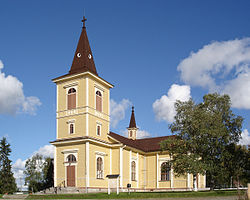
Muonio (previously called Muonionniska; Northern Sami: Muoná) is a municipality of Finland. The town is located in fell-region of far northern Finland above the Arctic Circle on the country's western border with Sweden, the Muonio River. It lies within the area of the former Lappi (Lapland) province in the Fell Lapland subregion.[5] The next closest Finnish municipalities are Enontekiö to the north, Kittilä on the east, and Kolari to the south. Southwest of the town, a road bridge crosses the Muonio River, across the river, in Sweden, lies the nearby hamlet of Muoniovaara ("Muonio hill") in northern Pajala Municipality in Norrbotten County.
Key Information


The area has been occupied by humans for at least 10,000 years; their arrival is thought to have coincided with deglaciation at the end of the Younger Dryas. They likely arrived from the south or east, since the Scandinavian Mountains rise 2,100 metres on the west, and over 1,300 metres to the north - both form a significant barrier to migration. Remains of eight dwellings from the Middle Stone Age have been excavated on the shore of Lake Akajarvi (fifteen miles from the center of the present-day village).[6]
Prior to the historical period (c.1500 AD) archeological findings in the area are consistent with those known to be of Sámi peoples. Muonio (then called Muonionniska) first appears in written records in the mid-1500s in records of fishing-rights claims and disputes between Sámi indigenes and Finnish pioneer-hunters and fishermen.[7]
The municipality today has a population of 2,321 (30 June 2025)[2] and covers an area of 2,039.97 square kilometres (787.64 sq mi) of which 133.91 km2 (51.70 sq mi) is water.[1] The population density is 1.22 inhabitants per square kilometre (3.2/sq mi). The municipality is unilingually Finnish, unlike many towns on the Finland–Sweden border.
Muonio is good base for exploring the many things to do in the area;[8] it offers a variety of accommodations and commercial supply establishments and is on the E8 highway which goes north to Kilpisjärvi.[9] International air flights and train service terminate at Kittilä; local bus service connects to Muonio. Other busses will take you to Rovaniemi, Helsinki, or even to Tromsø, Norway.[10] Pallas-Yllästunturi National Park is nearby and offers year-round activities.[11]
Muonio is known as the municipality with the longest snow season in Finland. For that reason its vocational college has a top ski class that attracts aspiring cross-country ski champions from all over Finland. The "midnight sun" is above the horizon from 27 May to 17 July (52 days), and the period with continuous daylight is during this time. The period of continuous night, polar night, lasts from 10 December to 2 January (24 days).
The nearest airport to Muonio is Kittilä Airport, located 74 km (46 mi) south east of the town. Rovaniemi Airport is also at reasonable distance which is located 233 km (145 mi) south east of Muonio.
Villages
[edit]The villages in Muonio include:
- Ylimuonio
- Kangosjärvi
- Kätkäsuvanto
- Kihlanki
- Särkijärvi
Politics
[edit] | This section needs to be updated. (May 2024) |
Results of the 2011 Finnish parliamentary election in Muonio:
- Centre Party 27.5%
- National Coalition Party 23.2%
- True Finns 16.4%
- Social Democratic Party 15.9%
- Left Alliance 9.8%
- Green League 3.0%
- Christian Democrats 2.4%
- Swedish People's Party 1.5%
- Other parties 0.3%
Climate
[edit]| Climate data for Muonio (1991-2020 normals, extremes 1959-10/2013 in Alamuonio, 10/2013-present in Oustajärvi) | |||||||||||||
|---|---|---|---|---|---|---|---|---|---|---|---|---|---|
| Month | Jan | Feb | Mar | Apr | May | Jun | Jul | Aug | Sep | Oct | Nov | Dec | Year |
| Record high °C (°F) | 6.7 (44.1) |
7.1 (44.8) |
10.0 (50.0) |
16.9 (62.4) |
28.4 (83.1) |
30.5 (86.9) |
30.8 (87.4) |
29.3 (84.7) |
22.4 (72.3) |
14.3 (57.7) |
9.2 (48.6) |
6.2 (43.2) |
30.8 (87.4) |
| Mean maximum °C (°F) | 0.9 (33.6) |
1.7 (35.1) |
5.4 (41.7) |
10.7 (51.3) |
20.1 (68.2) |
24.4 (75.9) |
25.6 (78.1) |
23.8 (74.8) |
17.5 (63.5) |
9.4 (48.9) |
2.7 (36.9) |
2.2 (36.0) |
27.0 (80.6) |
| Mean daily maximum °C (°F) | −9.0 (15.8) |
−8.5 (16.7) |
−2.4 (27.7) |
3.5 (38.3) |
9.9 (49.8) |
16.0 (60.8) |
19.2 (66.6) |
16.6 (61.9) |
10.5 (50.9) |
2.1 (35.8) |
−4.1 (24.6) |
−6.9 (19.6) |
3.9 (39.0) |
| Daily mean °C (°F) | −13.7 (7.3) |
−13.2 (8.2) |
−7.8 (18.0) |
−1.4 (29.5) |
5.1 (41.2) |
11.2 (52.2) |
14.3 (57.7) |
11.8 (53.2) |
6.4 (43.5) |
−1.0 (30.2) |
−7.4 (18.7) |
−11.1 (12.0) |
−0.6 (31.0) |
| Mean daily minimum °C (°F) | −18.1 (−0.6) |
−17.5 (0.5) |
−13.1 (8.4) |
−6.3 (20.7) |
0.4 (32.7) |
6.5 (43.7) |
9.7 (49.5) |
7.3 (45.1) |
2.7 (36.9) |
−4.0 (24.8) |
−10.9 (12.4) |
−15.3 (4.5) |
−4.9 (23.2) |
| Mean minimum °C (°F) | −33.9 (−29.0) |
−32.8 (−27.0) |
−28.1 (−18.6) |
−19.3 (−2.7) |
−6.7 (19.9) |
0.3 (32.5) |
3.4 (38.1) |
−1.1 (30.0) |
−5.3 (22.5) |
−16.8 (1.8) |
−25.1 (−13.2) |
−29.9 (−21.8) |
−36.2 (−33.2) |
| Record low °C (°F) | −46.2 (−51.2) |
−45.1 (−49.2) |
−40.8 (−41.4) |
−31.2 (−24.2) |
−18.3 (−0.9) |
−3.7 (25.3) |
−1.4 (29.5) |
−5.7 (21.7) |
−14.0 (6.8) |
−28.1 (−18.6) |
−36.4 (−33.5) |
−41.9 (−43.4) |
−46.2 (−51.2) |
| Average precipitation mm (inches) | 32 (1.3) |
27 (1.1) |
26 (1.0) |
28 (1.1) |
41 (1.6) |
66 (2.6) |
75 (3.0) |
69 (2.7) |
50 (2.0) |
43 (1.7) |
39 (1.5) |
35 (1.4) |
532 (20.9) |
| Average precipitation days (≥ 1.0 mm) | 9 | 9 | 7 | 7 | 8 | 11 | 12 | 11 | 9 | 9 | 10 | 11 | 113 |
| Average relative humidity (%) (daily average) | 85 | 84 | 78 | 72 | 66 | 65 | 71 | 78 | 83 | 89 | 90 | 87 | 79 |
| Source 1: FMI[12][13] | |||||||||||||
| Source 2: Record highs and lows 1959- present[14] | |||||||||||||
See also
[edit]References
[edit]- ^ a b "Area of Finnish Municipalities 1.1.2018" (PDF). National Land Survey of Finland. Retrieved 30 January 2018.
- ^ a b c "Population increased most in Uusimaa in January to June 2025". Population structure. Statistics Finland. 24 July 2025. ISSN 1797-5395. Retrieved 24 July 2025.
- ^ "Population according to age (1-year) and sex by area and the regional division of each statistical reference year, 2003–2020". StatFin. Statistics Finland. Retrieved 2 May 2021.
- ^ a b "Luettelo kuntien ja seurakuntien tuloveroprosenteista vuonna 2023". Tax Administration of Finland. 14 November 2022. Retrieved 7 May 2023.
- ^ "New regional administration model abolishes provinces in 2010". Helsingin Sanomat International Edition. Sanoma Corporation. 31 December 2009. Archived from the original on 13 December 2011. Retrieved 1 January 2010.
{{cite web}}: Check|archiveurl=value (help) - ^ Siv Rasmussen (January 2008). "Vellikaara Vettasia: Muonion ja Äkäslompolon alueen saamen historia (History of the Sámi of Muonio and the Äkäslompolo Region)" (PDF). Retrieved 12 August 2024.
- ^ "Information about Muonio".
- ^ Muonio Travel Guide
- ^ Kilpisjärvi Travel Guide
- ^ "Discover Muonio -". 25 May 2020.
- ^ "Pallas-Yllästunturi National Park".
- ^ "Lämpötilatilastot". Finnish Meteorological Institute. Retrieved 28 July 2025.
- ^ "Sadetilastot". Finnish Meteorological Institute. Retrieved 28 July 2025.
- ^ "FMI open data". FMI. Retrieved 28 July 2025.
External links
[edit] Media related to Muonio at Wikimedia Commons
 Muonio travel guide from Wikivoyage
- Municipality of Muonio – Official website
- Information on Muonio's ski resorts and the Lapland super pass


| Municipalities |  | |
|---|---|---|
| Former municipalities | ||
| International | |
|---|---|
| Geographic | |

Muonio
View on GrokipediaMuonio is a municipality in the Lapland region of northern Finland, situated along the Muonionjoki River which forms part of the border with Sweden.[1] The area covers 2,039.97 square kilometers, predominantly land, with a population of approximately 2,325 residents as of late 2023, yielding a density of 1.22 inhabitants per square kilometer.[1][2] This sparse settlement reflects its remote Arctic location, where extreme seasonal variations include polar night and midnight sun, and the surrounding Pallas-Yllästunturi National Park dominates the landscape, integrating wilderness into everyday existence.[1]
Geography
Location and Borders
Muonio is a municipality in the western part of Finland's Lapland region, positioned at approximately 68° N latitude and 24° E longitude, placing it north of the Arctic Circle.[3][4] The area lies within the Torne River valley system, where the Muonionjoki serves as a primary waterway.[5] Its western boundary forms part of the international border with Sweden, defined along the course of the Muonionjoki river, facilitating connectivity via bridges such as the one linking to Muodoslompolo in Sweden.[3] Domestically, Muonio adjoins Enontekiö municipality to the north, Kittilä to the east, and Kolari to the south.[5] The municipality is immediately adjacent to Pallas-Yllästunturi National Park, enhancing its frontier character.[3] Transportation infrastructure includes the European route E8 (Finnish national road 21), which traverses Muonio northward along the border area toward Enontekiö and connects southward to Kolari.[3] This positioning underscores Muonio's status as a remote border municipality in Finland's northern periphery.[5]
Landscape and Natural Features
Muonio's terrain encompasses rolling fells, dense taiga forests dominated by pine, spruce, and birch, and elevated subarctic tundra habitats characteristic of the Fennoscandian subarctic zone. The municipality includes over 20 distinct fells, with elevations varying from low river valleys at around 250-300 meters above sea level to higher summits surpassing 400 meters, exemplified by Äkäskero's peak at 528 meters.[6][7][8] The Muonionjoki River, measuring 230 kilometers in length, constitutes a primary hydrological feature, flowing as Europe's longest unregulated river and delineating the municipality's western boundary with Sweden as a tributary of the Tornio River system. This waterway supports natural salmon migrations, contributing to the region's ecological connectivity between boreal forests and subarctic aquatic environments.[9][10] Ecological diversity manifests in extensive aapa mires, esker ridges, and open fell heaths, fostering habitats for taiga-associated species such as lichens, dwarf shrubs, and northern-limit flora and fauna within the Pallas-Yllästunturi landscape. Muonio's position beneath the auroral oval enhances its natural visibility for geomagnetic phenomena, with unobstructed fell tops and valleys providing prime observational zones amid minimal light interference.[11][9][12]Demographics
Population Trends
As of the 2024 estimate, Muonio's population stands at 2,313 residents, reflecting the small scale typical of remote northern Finnish municipalities.[13] This figure has shown modest stability, with an annual change of 0.17% from 2020 to 2024, amid broader regional patterns of low natural increase offset by net migration.[13] The population density remains extremely low at 1.21 inhabitants per square kilometer across the municipality's 1,906 square kilometers of land area, underscoring its vast, sparsely settled character.[13] Demographic trends indicate an aging population, with a high proportion of elderly residents driven by persistently low birth rates—common in rural Finland where fertility falls below replacement levels—and selective out-migration of younger cohorts to urban centers for education and employment.[14] Lapland as a whole has experienced population decline over the past two decades, primarily through inter-regional outflows, though Muonio has seen occasional short-term gains from inbound migration tied to seasonal opportunities.[14] The median age exceeds 47 years, contributing to a skewed age structure where working-age groups (15–64) form the plurality but face contraction pressures.[15] Settlement patterns concentrate residents in the municipal center near the Muonio River bridge, where the village of Muonio accounts for over half the total population within just 4.74 square kilometers, yielding a local density of approximately 244 inhabitants per square kilometer.[16] This urban-rural divide highlights limited dispersal, with peripheral areas remaining nearly uninhabited year-round, though temporary influxes from tourism-related workers introduce seasonal fluctuations not captured in permanent residency counts.[16]Ethnic and Cultural Composition
Muonio's residents are overwhelmingly ethnic Finns, exceeding 95% of the population, alongside a small indigenous Sámi minority concentrated in reindeer herding activities.[13] The municipality's total population stood at approximately 2,300 as of late 2023, with linguistic data serving as the primary official indicator of composition due to Finland's lack of direct ethnic censuses.[17] In 2024, mother-tongue speakers included 2,179 Finnish, 14 Swedish, and 13 Sámi, underscoring the Finnish linguistic dominance.[13] The Sámi population, part of the broader Finnic-Ugric indigenous group numbering around 10,000 across Finland, maintains cultural continuity in Muonio through the local Sámi community and its dedicated reindeer herding grounds.[18][19] Reindeer husbandry, practiced by both Sámi and Finnish herders in the region, ties Sámi identity to fell-based livelihoods, though not all Sámi speakers or ethnic Sámi actively herd.[20] Finnish is the sole official language in Muonio, classified as unilingual, unlike bilingual areas nearer the Swedish border; Sámi holds co-official status only within designated homeland municipalities (Enontekiö, Inari, Utsjoki), but cultural and language rights extend municipality-wide under Finnish law. Demographic stability persists among Sámi herding families, with no evidenced decline, yet generational transitions show diversification: many younger individuals supplement or shift from herding to tourism-related roles, such as guiding or cooperative operations, amid seasonal labor inflows for winter tourism.[21] Foreign-language speakers remain minimal, under 5%, primarily from EU migration for short-term work, preserving the Finnish-majority cultural framework while integrating limited external influences.[13] This composition reflects empirical integration patterns, with Sámi cultural retention evident in localized practices rather than widespread assimilation pressures.[20]History
Indigenous Sami Period
Archaeological evidence from sacred sites in Muonio, including reindeer and fish bones alongside sieidi (Sámi offering stones), attests to indigenous Sami occupation predating the historical period, with continuity from prehistoric hunter-gatherer practices in northern Fennoscandia.[22][23] These finds align with broader Sámi material culture in Lapland, characterized by seasonal exploitation of forest and fell resources rather than fixed habitations, reflecting adaptive mobility in response to environmental pressures like long winters and sparse vegetation.[24] Reindeer domestication marked a pivotal shift in Sami economies around the 8th-9th centuries CE, transitioning from primarily wild herd hunting to managed pastoralism, as indicated by early accounts from Norwegian traveler Ohthere (circa 890 CE) describing Sámi use of decoys and milk-bearing animals, corroborated by later zooarchaeological patterns in Lapland.[25][26] In the Muonio area, part of the expansive Sápmi cultural zone spanning modern Finland, Sweden, Norway, and Russia, this enabled transhumant cycles of migration for grazing, hunting, and fishing, sustaining small kin-based groups without reliance on agriculture or permanent structures.[27] Oral traditions preserved knowledge of these routes, emphasizing practical herding techniques over territorial permanence. Early interactions included trade in furs, ivory, and hides with Scandinavian merchants, documented in Viking Age sagas and archaeological exchanges at border sites, fostering economic interdependence while maintaining Sami autonomy in forest territories.[28] The first explicit written references to Muonio's environs as Forest Sami lands—distinguished by woodland-adapted herding from mountain variants—emerge in 15th-16th century Swedish tax and administrative records, noting nomadic groups under loose crown oversight prior to intensive Finnish influx.[29] These portrayals underscore a resilient, low-density population centered on reindeer cycles, unencumbered by state-imposed sedentism.Finnish Settlement and Modernization
Finnish settlers began colonizing the Muonio region in the late 16th and early 17th centuries, driven by Swedish crown initiatives to expand taxable land and harness forestry resources in sparsely populated Lapland. The relocation of the Lapland border (Lapinraja) southward to Sonkamuotka in 1584 opened the Muonionjokilaakso valley for agrarian settlement, previously reserved for Sámi use. Early pioneers included Olli Ollinpoika Tulkki around 1575 and Tapani Klaunpoika Ähkynen, who established the first tax-paying homestead in 1617 at the mouth of the Utkujoki River, reflecting policies that incentivized clearance of forests for farming and tar production to support naval needs.[30][31] The Lappmark Proclamation of 1673 further accelerated influx by granting tax privileges for up to 30 years to Finnish and Swedish settlers, enabling establishment of chapel villages along the Muonio River by the late 17th century, as seen in parallel developments across the border. These policies causally linked economic imperatives—such as increasing crown revenues from untapped northern forests—with demographic shifts, displacing traditional Sámi nomadic patterns through competition for grazing and hunting grounds. By this period, rudimentary infrastructure like tax houses supported a growing settler presence focused on subsistence agriculture and resource extraction.[32][33] In the 19th century, the 1809 Treaty of Fredrikshamn formalized the border along the Muonio River, partitioning previously integrated communities between Russian Finland and Sweden, which prompted intensified local development on the Finnish side including agricultural clearance and river-based logging booms for timber export. Settlers expanded farmland amid rising demand for wood, floating logs down the Muonio to southern mills, a practice fueled by industrialization and the 1647 Forest Ordinance's legacy of regulated exploitation. The construction of Muonio Church in 1822 symbolized modernization, followed by elevation to independent parish status in 1853, with church records documenting steady population increases driven by these economic activities.[34][35][36]20th Century Developments
During the Lapland War (1944–1945), German forces retreating northward implemented a scorched-earth policy, demolishing two-thirds of Muonio's buildings and leaving the local church in ruins amid widespread fires.[37][38] Finnish troops pursued the Germans to Muonio by late 1944, but the municipality suffered thorough destruction as retreating units torched structures to deny resources to advancing forces.[39] This devastation, while severe locally, reflected the broader German withdrawal tactics across Lapland, where Finnish resilience was evident in coordinated military responses that limited prolonged occupation compared to Soviet advances in eastern Finland during prior phases of the conflict. Post-war reconstruction from 1945 onward relied on state-directed subsidies and labor mobilization, enabling Muonio and other Lapland communities to rebuild housing, bridges, and essential infrastructure amid national efforts to restore northern settlements.[40] These initiatives, part of Finland's broader recovery program, prioritized rapid repopulation and stabilization in sparsely settled areas, with Muonio benefiting from centralized planning that integrated local needs into wartime compensation frameworks.[41] From the 1950s to the 1970s, infrastructure modernization accelerated in Muonio through national electrification campaigns and road expansions, connecting the municipality to broader networks including precursors to the E8 highway along the Swedish border.[42] By the early 1970s, Finland's public road system had achieved modern standards nationwide, facilitating vehicular access to remote Lapland locales like Muonio and supporting shifts in transport-dependent livelihoods such as reindeer herding.[42] Electrification, advancing rapidly post-1950, extended power grids to rural northern areas, enabling mechanized agriculture and household improvements amid Finland's industrial growth averaging 4.9% GDP annually from 1950 to 1973.[43] In the 1980s and 1990s, Muonio's economy transitioned from agrarian bases toward services, mirroring national welfare state expansions that reduced reliance on farming through subsidies and public sector growth in peripheral regions.[44] This structural shift, driven by Finland's integration into European markets and declining agricultural viability in subarctic conditions, positioned Muonio for emerging tourism while preserving traditional elements under state-supported modernization.[43]Economy
Traditional Livelihoods
Reindeer herding formed the cornerstone of traditional livelihoods in Muonio, particularly among the indigenous Sámi and later Finnish settlers who adopted the practice from the 1700s onward. The Muonio reindeer herding cooperative, part of the larger Pallastunturi marking district, supports 127 herders managing a maximum of 6,000 animals across its 2,670 km² area in the northern boreal zone.[45][46] This activity involved seasonal migrations, calving, and roundups, with herds providing meat, hides, and transport essential for survival in the subarctic environment, though output remained modest due to harsh winters and predation risks.[47] State subsidies have historically underpinned the economic viability of herding, with payments such as €28.5 per reindeer in the winter population helping offset operational costs that include motorized herding and feed supplementation.[48] These supports, comprising around 18% of gross profits in Finnish reindeer operations, reflect the sector's reliance on public funding amid low market returns from meat and byproducts, which sustain fewer than 1,000 full-time livelihoods nationwide while preserving Sámi cultural practices against climate-induced variability like ice-bound pastures.[49][50] Supplementary pursuits included small-scale forestry, yielding timber from boreal stands but sparking disputes over land use with herders, and limited agriculture constrained by short growing seasons.[51] Hunting of game like ptarmigan and elk, alongside river fishing for salmon and grayling in the Muonio River—which demarcates the Finland-Sweden border—provided additional sustenance, with fishing rights regulated by bilateral treaties dating to at least 1972 ensuring shared access across frontier waters.[52] These activities complemented herding without dominating the economy, emphasizing subsistence over commercial scale in pre-industrial Muonio.[53]Tourism and Modern Industries
Tourism constitutes a significant portion of Muonio's contemporary economy, leveraging the municipality's location within the Arctic Circle and its access to unspoiled natural landscapes. Primary attractions include aurora borealis observation, particularly during the polar night from late November to mid-January, as well as summer hiking and fishing in the Pallas-Yllästunturi National Park, which spans over 1,000 square kilometers and features fells rising to 809 meters at Taivaskero. Winter sports enthusiasts engage in cross-country skiing on extensive trail networks, with conditions supporting up to 200 kilometers of groomed paths annually.[54][55] The proximity of Muonio to Levi Ski Resort, situated about 50 kilometers southeast in Kittilä, facilitates spillover effects, allowing residents and visitors to access 43 kilometers of downhill slopes and 28 lifts without extensive local infrastructure development. This adjacency supports day trips and contributes to seasonal economic activity, though Muonio maintains a focus on low-impact, nature-based tourism rather than mass-resort models. Growth in international visitors has accelerated since the early 2000s, driven by improved air connectivity via Kittilä Airport, 70 kilometers away, which handled over 500,000 passengers in 2019 before pandemic disruptions.[56][57] Beyond tourism, modern industries emphasize specialized services exploiting Muonio's extreme climate. Cold-weather testing facilities, such as the Lapland Proving Ground, provide dedicated tracks and services for international automotive manufacturers to evaluate vehicles, tires, and components in temperatures routinely dropping below -30°C and on snow- and ice-covered surfaces. Established operations here cater to powertrain, braking, and automated driving assessments, with year-round access supported by logistic hubs.[58][59] Forestry remains a foundational activity, with sustainable timber harvesting from Scots pine-dominated stands contributing to regional exports; Lapland's thinning operations account for about 43% of marketable timber, though Muonio's volumes are modest compared to southern Finland. Mining potentials exist regionally, informed by precedents like the Kaunisvaara iron ore operations across the Swedish border, which influence local reindeer herding but involve no major active extractions within Muonio itself. These sectors underscore a shift toward high-value, climate-adapted services over resource-intensive extraction.[60][61]Government and Politics
Municipal Administration
The municipal council of Muonio, comprising 21 elected members serving four-year terms, holds the highest decision-making authority on local policies, budget approval, and strategic planning.[62] The council appoints a municipal board of seven members, including personal deputies, to oversee executive implementation, while the mayor—Laura Enbuska-Mäki as of 2022—directs daily administration and reports to the board.[63] Elections for the current council occurred in April 2025, with the body convening its inaugural session on June 9, 2025, reflecting standard Finnish municipal cycles amid persistently low voter turnout typical of rural areas, often below 50% due to geographic isolation and demographic sparsity.[64][65] Fiscal operations emphasize efficiency given Muonio's sparse population of approximately 2,300 residents spread over 2,039 square kilometers, resulting in high per-capita service costs. The 2023 financial statement reported a surplus of 590,000 euros, with annual operating surplus covering 218% of depreciations, yet revenues heavily depend on state transfers exceeding 60% of the budget to offset a shrinking local tax base from outmigration and limited industry.[66] Expenditures prioritized essential services like education and infrastructure maintenance, underscoring challenges in sustaining autonomy without central support. The municipal strategy for 2025, adopted on June 13, 2022, prioritizes resilience through economic diversification, including tourism and sustainable resource use, to mitigate fiscal vulnerabilities in this remote setting.[67] Administrative coordination with the Lapland region handles broader planning, such as zoning and environmental permits, via the regional state administrative agency (ELY Centre) and Lapland's regional council, ensuring alignment with national frameworks while preserving local input on land-use decisions critical to the municipality's vast undeveloped areas.[68] This structure supports efficient governance tailored to low-density realities, avoiding overlap with specialized bodies.[69]Regional and Sami Governance
The Finnish Sámediggi, established in 1972 as an independent advisory body for the Sámi people, represents regional interests including those in Muonio through elected delegates, primarily supervising Sami rights in land use and livelihoods without formal authority over reindeer herding operations. In practice, it participates in consultations on policies affecting herding districts, such as proposed land developments, but lacks veto power, with decisions resting on national administrative processes informed by empirical assessments of cultural and economic impacts. Reindeer herding in Muonio falls under the jurisdiction of the Muonion Paliskunta, one of Finland's 56 herding cooperatives established to administer grazing rights and husbandry practices as per the Reindeer Husbandry Act of 1990, which codifies free seasonal grazing across designated areas regardless of private or public land ownership.[70] [71] These cooperatives, led by district chiefs, allocate permits based on herd sizes—totaling around 200,000–220,000 reindeer annually in Finland's northern districts—and resolve internal disputes via cooperative assemblies, escalating conflicts over grazing encroachments to administrative courts for adjudication grounded in statutory quotas and environmental data.[72] [73] Muonio's border location along the Torne River with Sweden amplifies cross-border Sami governance through the Sámi Council, a cooperative forum since 1956 promoting joint advocacy on herding migration routes and shared resource management without supranational enforcement.[74] In protected areas like nearby wilderness reserves, pragmatic co-management integrates herding via site-specific impact evaluations, allowing migratory access while mitigating ecological pressures through monitored zoning, as evidenced in Lapland's nature management frameworks that prioritize data-driven accommodations over prescriptive restrictions.Culture and Society
Sami Heritage and Traditions
Reindeer herding remains a core Sami practice in Muonio, centered in the local herding district spanning 2,670 km² of boreal terrain, where families manage migratory cycles including spring calving in forested areas, summer grazing on higher grounds, autumn slaughtering, and winter pasturing under snow cover. These cycles dictate annual rhythms, with herders using lassos for marking calves and rounding herds, adaptations honed over generations for survival in subarctic conditions.[47] The Muonio district exemplifies small-scale, family-based operations typical of Finnish Sami herding, distinct from larger nomadic systems elsewhere.[61] Joik, the traditional Sami vocal improvisation evoking persons, animals, or landscapes without fixed lyrics or accompaniment, features in Muonio's cultural demonstrations, such as evening gatherings in kota huts where performers recount personal or natural motifs through throaty, melodic chants.[75] Duodji handicrafts, involving practical items like horn-handled knives, woven bands, and leather pouches crafted from reindeer materials, sustain everyday utility and ritual use, with techniques passed via observation rather than formal instruction.[76] Preservation occurs through sites like Torassieppi Reindeer Farm, Finland's oldest continuously operated farm since the 19th century, displaying artifacts such as herding tools and household goods in its Lapinkartano exhibit, offering direct engagement with herders on seasonal routines.[77] Pakasaivo gorge lake functions as a verified ancient assembly and offering site, where Sami historically deposited items to spirits, underscoring continuity in sacred topography.[78] Youth participation in herding has waned, constrained by schooling mandates conflicting with migrations and slaughter seasons, though tourism at venues like Torassieppi sustains demonstrations and offsets attrition by funding community efforts.[79][80]Local Customs and Events
Local customs in Muonio reflect the community's adaptation to the Arctic environment, emphasizing seasonal self-reliance and Lutheran parish traditions. Residents participate in communal preparations for winter, such as stockpiling firewood and monitoring river ice formation for safe travel and fishing, practices rooted in historical necessity for survival in remote northern conditions.[81] The Lutheran Church of Muonio, established as a parish center, anchors many traditions, including confirmation ceremonies, harvest thanksgivings, and holiday observances like Christmas Eve services, which foster social cohesion in the small population of around 2,300.[82] Annual events highlight community gatherings and seasonal transitions. The Muonio Festival, held in June, features cultural performances, local food stalls, and family activities in the town center, drawing participants to celebrate the midnight sun period.[83] Winter events include Christmas markets (Joulumyyjäiset) on November 29, where vendors sell handmade crafts and seasonal treats, reinforcing holiday customs.[84] Sports-oriented gatherings, such as the Lapponia Ski Week in April, involve cross-country skiing races across local fells, attracting hundreds of participants and promoting endurance in subzero conditions.[85] Hunting and ice fishing serve as communal rites tied to natural cycles. Autumn moose and small game hunting seasons, regulated under national quotas, involve organized group hunts that build cooperation among locals, with participation rates high in rural Lapland municipalities like Muonio. Winter ice fishing on the Muonio River, peaking from January to March when ice thickness exceeds 50 cm, draws community members for shared outings, often combining angling with social firesides. Volunteer fire brigades exemplify rural autonomy, with Muonio's units responding to over 20 incidents annually, primarily wildfires and accidents, relying on trained locals for rapid intervention in vast, low-density areas. Recent additions to the cultural calendar, aligned with the 2022-2025 cultural education plan, incorporate sports tourism events like FIS ski competitions at Olos in November, enhancing community engagement through spectator sports and youth programs.[86][84]Climate and Environment
Climatic Characteristics
Muonio exhibits a subarctic climate (Köppen Dfc), marked by prolonged cold winters, brief mild summers, and significant seasonal temperature contrasts due to its northern latitude of approximately 68°N.[87] Annual mean temperatures average around -1.5°C, with monthly averages ranging from -14°C in January to 12°C in July; record lows reach -40°C in winter, while summer highs occasionally exceed 25°C.[88] Precipitation totals approximately 670 mm per year, with roughly 50% falling as snow during the extended winter period from October to April, and the remainder primarily as summer rainfall concentrated in July and August.[89] The region's high latitude results in extreme photoperiod variations: a polar night (kaamos) persists for over 50 days from late November to mid-January, when the sun remains below the horizon, yielding twilight maxima of about 1-2 hours daily.[90] This is counterbalanced by a midnight sun period of roughly 50 days from late May to mid-July, during which the sun circles the sky without setting, providing continuous daylight.[90] Auroral activity is frequent in Muonio, with the aurora borealis observable on three out of four nights in northern Lapland during the dark winter months, per statistical analyses from the Finnish Meteorological Institute's observation network.[91] Visibility peaks between September and March under clear skies, influenced by geomagnetic activity rather than local weather alone. Local meteorological records, derived from the Muonio station and nearby Pallas observatories operated by the Finnish Meteorological Institute since the 1950s, document consistent subarctic patterns with interannual variability in temperature and snowfall, reflecting historical norms without deviations exceeding observed natural fluctuations in the dataset.[92]Environmental Management and Challenges
Environmental management in Muonio emphasizes balancing protected natural areas with sustainable resource use, including forestry and emerging mineral exploration. The Pallas-Yllästunturi National Park, encompassing parts of Muonio within its 1,020 km² expanse, safeguards fell landscapes, old-growth forests, and biodiversity hotspots, restricting development to preserve ecological integrity. Finnish legislation mandates consultations with Sami reindeer herding communities for land-use decisions affecting traditional pastures, though administrative approvals have proceeded amid protests, as evidenced in regional forest disputes where herders contested logging permits on winter grazing grounds.[51] Forestry operations, a primary land use outside protected zones, generate economic value through timber harvest but disrupt reindeer migration and lichen-rich winter pastures essential for herding. In Muonio-specific conflicts documented since the early 2000s, herders argued that clear-cutting fragmented habitats, reducing available forage, while forestry proponents highlighted regulated practices under Finland's Forest Act to mitigate impacts via selective logging and replanting.[93] Empirical assessments indicate that cumulative forestry effects, combined with herding pressures, contribute to lichen volume declines, with remote sensing data showing forage quality reductions in northern Finnish ranges.[94] Potential mining activities, drawing from regional precedents like the Kaunisvaara iron ore mine across the border in Sweden, pose similar tensions by fragmenting grazing lands and introducing dust or infrastructure barriers that disturb herds. The mine's operations since 2012 have demonstrably obstructed reindeer movements and caused land-use displacement for the Muonio herding district, prompting calls for impact assessments under EU environmental directives.[61] In Muonio, untapped mineral deposits, including cobalt and gold prospects in central Lapland, offer job creation potential—aligning with regional strategies to bolster mining ecosystems—but require empirical evaluation against herding viability, where subsidies support a declining traditional economy amid overgrazing-induced lichen depletion exacerbated by warming trends.[14][95][96] Muonio maintains exceptionally clean air, with monitoring at the Pallas site recording among the world's lowest particulate levels, corroborated by consistent good air quality indices free from industrial pollution.[97] This baseline supports ecosystem resilience but underscores challenges in scaling development without compromising atmospheric purity, as cross-border mining emissions could introduce particulates affecting lichen health and herder livelihoods.[98]Infrastructure and Accessibility
Transportation Networks
Muonio's transportation infrastructure is dominated by road networks, reflecting its remote location in northern Lapland. The municipality is traversed by Finnish national road 21 (Muoniontie), which provides essential connectivity north to Enontekiö and the Norwegian border at Kilpisjärvi—continuing as European route E8 toward Tromsø—and south to Kolari and Tornio, linking to Swedish roads E4 and E10 for access to Pajala and beyond.[99] This route facilitates cross-border travel along the Muonio River valley, with bridge crossings enabling seamless vehicular movement into Sweden under the Schengen Agreement, which Finland joined in 2001.[100] There is no railway within Muonio; the nearest station is in Kolari, approximately 55 km south, connected by regional trains from Rovaniemi, with onward bus services covering the remaining distance in about one hour.[101] Air access is limited to Kittilä Airport, situated 75 km southeast, which handles seasonal flights primarily from Helsinki and offers bus or taxi transfers taking around 60 minutes.[102] Finland's NATO accession on April 4, 2023, followed by Sweden's in March 2024, has reinforced bilateral security ties but introduced no substantive changes to civilian border protocols with Sweden, maintaining fluid crossings for trade and commuting.[103] In winter, an extensive network of over 200 km of maintained snowmobile trails supplements road access, serving critical roles in reindeer herding logistics and off-road mobility across snow-covered terrain.[104] No regular river ferries operate on the Muonio River for passenger or freight transport.[105]Public Services and Development
Muonio operates a single comprehensive school that provides basic education from grades 1 through 9, emphasizing a positive value base and commitment from staff, parents, and students to foster student development.[106] The school serves the municipality's population of 2,325 residents, integrating local environmental awareness into its curriculum.[1] Complementing education, the Muonio Health Center offers primary care services, operating weekdays from 8:00 to 16:00 with shared evening coverage from neighboring facilities until 21:00, addressing routine and urgent needs for the community.[107] Infrastructure enhancements include the expansion of fiber optic broadband networks, with providers like Valokuitunen connecting homes to open-access fiber infrastructure as of 2023, supporting high-speed internet essential for remote work in this rural setting.[108] These developments align with broader efforts to mitigate isolation in northern Finland by enabling digital connectivity for employment and services. Public services face strains from demographic shifts, including an aging population and youth out-migration common in Lapland's sparse communities, which reduce the workforce available for service delivery and increase per-capita demands on health and social supports.[109] To counter this, development strategies prioritize sustainable tourism, with Muonio implementing the Sustainable Travel Finland program to promote resource preservation, waste reduction, and energy efficiency while fostering economic growth through eco-friendly infrastructure investments.[110] Emergency services are managed by the Muonio Fire Station under Lapland's Rescue Services, handling incidents via the national 112 line and preparing for region-specific risks such as harsh winters and potential avalanches in the surrounding fells through coordinated training and equipment.[111] These adaptations ensure resilience in extreme conditions, balancing local capacities with regional support to maintain service efficiency.References
- https://commons.wikimedia.org/wiki/File:Muonio_Church_corrected.jpg