Hubbry Logo
Myanmar Standard TimeMyanmar Standard TimeMain
Open search
Myanmar Standard Time
Community hub
Myanmar Standard Time
logo
8 pages, 0 posts
0 subscribers
Be the first to start a discussion here.
Myanmar Standard Time
from Wikipedia

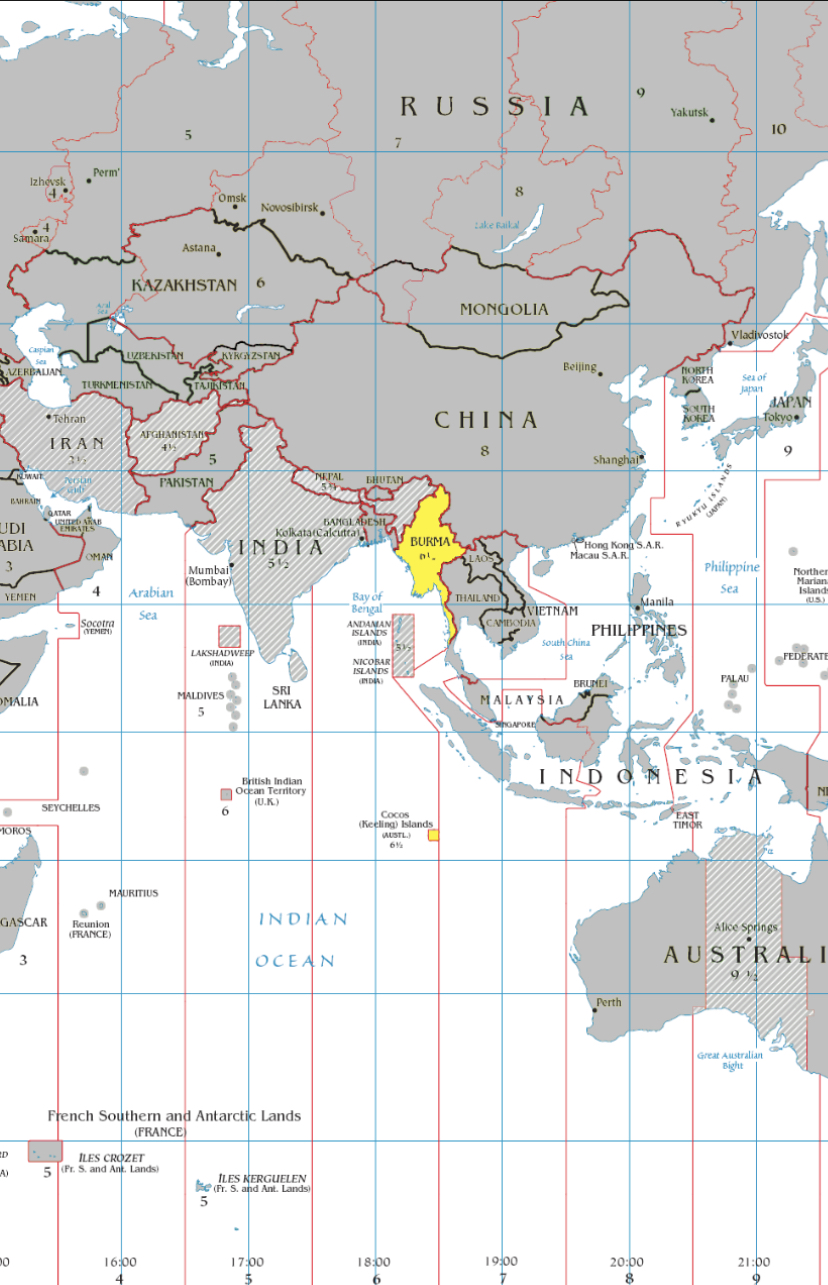
Myanmar Standard Time (Burmese: မြန်မာ စံတော်ချိန်, [mjəmà sàɰ̃dɔ̀dʑèiɰ̃]), formerly Burma Standard Time (BST), is the standard time in Myanmar, 6.5 hours ahead of UTC. Myanmar Standard Time (MMT) is calculated on the basis of 97°30′E longitude.[1] MMT is used all year round, as Myanmar does not observe daylight saving time.[2][3]

Key Information

History

[edit]
The Alanpya "Signal" Pagoda in Rangoon/Yangon in 1855. The time ball attached to the top of the pagoda by the British is visible.[4]

Pre-colonial period

[edit]

Myanmar did not have a standard time before the British colonial period. Each region kept its own local mean time, according to the Burmese calendar rules: sunrise, noon, sunset and midnight.[note 1] The day was divided into eight 3-hour segments called baho (ဗဟို), or sixty 24-minute segments called nayi (နာရီ). Although the calendar consists of time units down to the millisecond level, the popular usage never extended beyond baho and at most nayi measurements; a gong was struck every nayi while a drum (စည်) and a large bell (ခေါင်းလောင်း) were struck to mark every baho.[5]

Type Time Burmese name Description
Day 1 o'clock နံနက် တစ်ချက်တီး midway between sunrise and midday
2 o'clock နေ့ နှစ်ချက်တီး noon (midday)
3 o'clock နေ့ သုံးချက်တီး midway between noon and sunset
4 o'clock နေ့ လေးချက်တီး sunset
Night 1 o'clock ည တစ်ချက်တီး midway between sunset and midnight
2 o'clock ည နှစ်ချက်တီး midnight
3 o'clock ည သုံးချက်တီး midway between midnight and sunrise
4 o'clock နံနက် လေးချက်တီး sunrise

Colonial period

[edit]
Burma at 6:30 ahead of the GMT on this 1928 world map of time zones

The use of a common time began in British Burma in the late 19th century. The first confirmed mention of Rangoon Mean Time (RMT) at GMT+6:24:40[note 2] being in use was in 1892,[6] a year before the country's first time ball observatory[note 3] was opened in Rangoon (Yangon) on 1 October 1893.[7][8] However, the use of RMT as the common time, at least in some sectors, most probably started earlier. (The country's first rail service, between Rangoon and Prome (Pyay), began on 2 May 1877,[9] and the non-authoritative IANA time zone database says RMT was introduced in 1880.[10]) On 1 July 1905,[11][12] a new standard time called Burma Standard Time (BST) at GMT+6:30—set to the longitude 97° 30' E, and 5 minutes and 20 seconds ahead of RMT—was first adopted by the Railways and Telegraph administrations.[11][13] Although the rest of the country came to adopt BST, RMT continued to be used in the city of Rangoon at least to 1927.[note 4] By 1930, however, BST apparently had been adopted in Rangoon as well.[note 5]

The standard time was changed to Japan Standard Time (JST) during the Japanese occupation of the country (1942–1945) in World War II.[14]

After independence

[edit]

The standard time was reverted to GMT+6:30 after the war.[14] It has remained ever since, even after the country's independence in 1948. The only change has been its name in English; the official English name has been changed to Myanmar Standard Time[1] presumably since 1989 when the country's name in English was changed from Burma to Myanmar.[15] The country does not observe a daylight saving time.[2]

Timeline of common times

[edit]
Name Period Offset from UTC Notes
Rangoon Mean Time 2 May 1877? – 30 June 1905 UTC+6:24:40 Standard time for British Burma from at least 1892 to 30 June 1905. Continued to be used in Rangoon (Yangon) at least to 1927[16] perhaps until 1929.[17]
Burma Standard Time 1 July 1905 – 30 April 1942 UTC+6:30:00 First adopted by Railways and Telegraph offices in 1905.[11][13] The October 2021 IANA database says it was introduced in 1920[14] but does not provide a source.
Japan Standard Time 1 May 1942 – 2 May 1945 UTC+09:00:00 Standard time during the Japanese occupation
Burma/Myanmar Standard Time 3 May 1945 – present UTC+06:30:00

IANA time zone database

[edit]

The IANA time zone database contains one time zone named Asia/Yangon[18] for Myanmar[14]

Country Code Coordinates Time Zone Comments UTC offset UTC DST offset
MM 16°47′44″N 96°09′02″E / 16.79543°N 96.15051°E / 16.79543; 96.15051 Asia/Yangon Asia/Rangoon +06:30

Notes

[edit]

References

[edit]

Bibliography

[edit]
Revisions and contributorsEdit on WikipediaRead on Wikipedia
from Grokipedia
Myanmar Standard Time (MMT) is the official used throughout the , defined as 6 hours and 30 minutes ahead of (UTC+06:30). This half-hour offset distinguishes it from most neighboring countries, which typically use whole-hour deviations from UTC, and it applies uniformly across the nation's diverse regions without observance of . MMT serves as the standard for civil, commercial, and governmental activities in , ensuring synchronized operations in a country spanning approximately 676,578 square kilometers. MMT has been in use since 1945, following a temporary change during , and has remained unchanged through Myanmar's independence in 1948 and the name change to "Myanmar" in 1989. This offset approximates mean solar time for the meridian near , Myanmar's largest city and economic hub.

History

Pre-colonial period

In pre-colonial , timekeeping lacked a unified national standard, with communities in various regions and cities independently determining through solar observations, such as noting the sun's position at midday to establish daily divisions. This decentralized approach reflected the absence of synchronized systems, where each locality adjusted its temporal practices based on immediate environmental cues rather than a centralized authority. Daily time was segmented according to the traditional , dividing the civil day into eight baho, each equivalent to a 3-hour period, or alternatively into sixty nayi, each lasting 24 minutes, with one baho comprising 7.5 nayi. These units were announced acoustically to the public, primarily through the striking of gongs, drums, and bells from royal palaces, monasteries, or watchtowers, ensuring communal awareness without reliance on individual devices. For instance, the baho-si, or great drum, was sounded at sunrise with a sequence of gongs—starting with one stroke and increasing to four at subsequent 3-hour intervals—totaling 110 strokes over the day to mark the progression of baho. Timekeepers, known as nayi asu, were appointed in royal courts to oversee these announcements, maintaining rhythm tied to natural daylight cycles. This system was deeply embedded in cultural and practical life, intertwining temporal measurement with religious rituals and agricultural rhythms, as announcements from monasteries often aligned with Buddhist prayer times and seasonal farming activities like paddy sowing or . Without mechanical clocks or widespread horological instruments, reliance on audible signals and solar cues fostered a fluid, community-oriented perception of time, emphasizing cyclical patterns over precise uniformity. The introduction of standardized time during the colonial era later supplanted these local practices with a uniform system based on Rangoon Mean Time.

Colonial period

During the British colonial period, standardized time in began with the adoption of Rangoon Mean Time (RMT), based on the mean at the Rangoon meridian (approximately 96°10'E ), equivalent to UTC+6:24:40. The first references to RMT appear around 1877–1892, marking the initial efforts to establish a common time reference amid expanding colonial infrastructure like railways and telegraphs. To aid maritime synchronization, a observatory opened in Rangoon on October 1, 1893, dropping a ball daily at local mean noon for ships in the harbor. On July 1, 1905, Burma transitioned to Burma Standard Time (BST) at UTC+6:30, aligned to the 97°30'E meridian and approximately 5 minutes 20 seconds ahead of RMT, primarily to coordinate railway and telegraph operations across the colony. This standard, promoted by the British administration as part of broader Indian subcontinent time reforms, gradually extended to government offices, businesses, and public life nationwide by the early 20th century. The uniformity of BST was disrupted during under Japanese occupation, from May 1, 1942, to May 2, 1945, when imposed (JST) at UTC+9:00 to synchronize military and administrative activities with across occupied territories. This shift advanced local clocks by 2 hours 30 minutes, facilitating wartime logistics but causing practical challenges for the population accustomed to the earlier offset.

After

Following the Japanese surrender in , Myanmar reverted to its pre-occupation time standard of UTC+6:30, known as Burma Standard Time (BST), effective May 3, 1945, when clocks were adjusted backward by 2 hours and 30 minutes from the Japanese-imposed UTC+9:00. This reversion occurred immediately after the end of the occupation and was maintained without interruption through the country's from British rule on January 4, 1948. The UTC+6:30 offset remained unchanged post-independence, reflecting administrative continuity in timekeeping practices established during the colonial era but stabilized after the wartime disruptions. In 1989, coinciding with the military government's official renaming of the country from Burma to Myanmar, the time zone's English designation was updated from Burma Standard Time to Myanmar Standard Time (MMT), though the offset and operational details stayed the same. This nominal change aligned the time standard with the updated national nomenclature adopted by the State Law and Order Restoration Council. Since the 1945 reversion, Myanmar has consistently refrained from observing (DST), with no clock adjustments implemented in the subsequent decades. This policy stems from the country's , where daylight hours show minimal seasonal variation—typically around 11 to 13 hours year-round—reducing the rationale for seasonal time shifts, alongside a for administrative stability in a region prone to political transitions. As a result, MMT operates as a fixed standard year-round, facilitating consistent scheduling for transportation, , and international coordination.

Time Standards and Changes

Timeline of offsets

The time zone offsets in Myanmar have undergone several changes since the late 19th century, primarily driven by colonial administration, infrastructure development, and wartime occupations. These transitions reflect alignments with mean solar time, standardized railway and telegraph systems, and geopolitical influences.
PeriodOffsetNameNotes
~1877 – June 30, 1905UTC+06:24:40Rangoon Mean TimeBased on the local mean solar time at the Rangoon observatory meridian (96°10' E); used as the standard for British Burma, particularly in Rangoon, until adoption of a uniform standard for railways and telegraphs.
July 1, 1905 – April 30, 1942UTC+06:30Burma Standard TimeIntroduced as a uniform standard time aligned to 97°30' E longitude for better coordination of railway and telegraph networks across British India and Burma; 5 minutes and 20 seconds ahead of Rangoon Mean Time.
May 1, 1942 – May 2, 1945UTC+09:00Japan Standard TimeImposed during Japanese military occupation to synchronize with Japan's time zone for operational purposes across occupied territories in Southeast Asia.
May 3, 1945 – presentUTC+06:30Myanmar Standard Time (formerly Burma Standard Time)Reverted to the pre-occupation offset immediately upon liberation; no widespread public clock adjustments were required or noted, as the change was enacted without delay; the name updated in 1989 following the country's official renaming from Burma to Myanmar.
Since 1945, has maintained UTC+06:30 as its permanent without further offsets or implementations.

Name and nomenclature evolution

The nomenclature for 's has evolved in tandem with the region's political and administrative history, beginning with a focus on local and transitioning to standardized national designations. Prior to 1905, the time standard in the area now known as was designated as Rangoon Mean Time (RMT), which was based on the mean at the meridian of Rangoon (present-day ), approximately 6 hours and 25 minutes ahead of . This local meridian-based system reflected the colonial emphasis on port-city operations under British rule, where Rangoon served as the primary administrative and commercial hub. In 1905, coinciding with the broader standardization of time across British India and its territories, the name shifted to Burma Standard Time (BST), set at a uniform offset aligned with the 97°30' E and approximately 5 minutes and 20 seconds ahead of RMT. This change facilitated and administrative efficiency during the British colonial period and persisted through 's in 1948 into the early post-colonial era. The abbreviation BST—or occasionally BMT for Burma Mean Time—was commonly used in international and technical contexts during this period. The nomenclature underwent another transformation following the 1989 renaming of the country from to by the State Law and Order Restoration Council (SLORC), the then in power. This led to the adoption of Myanmar Standard Time (MMT) as the designation, with the MMT becoming standardized in global , including . The shift in name had no effect on the underlying time offset but aligned the standard with the regime's broader efforts to revise colonial-era terminology, influencing entries in international systems like the IANA .

Technical Details

UTC offset and basis

Myanmar Standard Time (MMT) is the official for , defined as 6 hours and 30 minutes ahead of (UTC+06:30). This offset places clocks 6.5 hours ahead of UTC year-round. The geographical basis for MMT is derived from the meridian at 97°30′E , which approximates the central of near . Time zones are theoretically calculated by dividing by 15° per hour of difference from the , as the rotates 360° in 24 hours. Thus, 97.5°E corresponds to 97.5÷15=6.597.5 \div 15 = 6.5 hours ahead of UTC, establishing the half-hour offset unique to . Unlike many time zones that adjust for daylight saving time (DST), MMT remains fixed throughout the year with no seasonal shifts. The conversion equation is straightforward: Local Time=UTC+6:30\text{Local Time} = \text{UTC} + 6:30 This ensures consistent timekeeping across the country without biannual clock changes.

IANA time zone database

In the IANA time zone database, commonly known as tz or zoneinfo, Myanmar Standard Time is represented by the primary identifier "Asia/Yangon", named after the city of , which served as Myanmar's capital until 2006. This identifier is used in zone files to denote the for the entire country, reflecting its uniform application across . The database associates "Asia/Yangon" with coordinates 16°47′N 96°10′E, corresponding to a representative location in , and specifies a fixed UTC offset of +06:30 with no daylight saving time rules or transitions since 1945. The zone file entry details historical offsets, starting from local mean time (LMT) of UTC+06:24:40 until 1880, transitioning to Burma Time (UTC+06:24:40) until 1920, then to UTC+06:30 until May 1942, a wartime advance to UTC+09:00 until May 3, 1945, and reverting to the current UTC+06:30 thereafter. A backward compatibility link exists from the deprecated "Asia/Rangoon" to "Asia/Yangon". This representation supports accurate time computations in POSIX-compliant systems, calendar applications, and APIs for handling timestamps, ensuring conversions account for Myanmar's half-hour offset without DST adjustments. The identifier "Asia/" was established as canonical in the tzdb 2016g release, renaming the prior "Asia/Rangoon" while maintaining the link for legacy compatibility; the zone has remained stable since, with no projected future changes.

Current Usage

Geographical coverage

Myanmar Standard Time (MMT) is applied uniformly across the entire territory of , including all seven states and seven divisions on the mainland, outlying islands in the such as the , and remote inland areas, without any sub-national or regional time zones. This nationwide uniformity is enforced by the Myanmar government under its administrative framework, with the standard designated based on the 97°30′E meridian to ensure consistent timekeeping throughout the Union of Myanmar. Synchronization of clocks and schedules is achieved through state-managed national broadcasting services, including radio and television transmissions, as well as mobile network operators that align with the official standard. There are no exceptions or variations in the application of MMT within Myanmar's borders; even peripheral and border regions maintain strict adherence to the time standard, upholding the fixed UTC+6:30 offset across all territories.

Relations to neighboring time zones

Myanmar Standard Time (MMT, UTC+6:30) is one hour ahead of India Standard Time (IST, UTC+5:30), resulting in a one-hour time difference that influences cross-border commerce and transportation, including rail links between Myanmar and India's northeastern states such as Manipur. Relative to (BST, UTC+6:00), MMT leads by 30 minutes, a discrepancy that affects bilateral economic exchanges and coordination on shared issues like movements along their border. MMT lags 30 minutes behind Thailand's Indochina Time (ICT, UTC+7:00), which complicates scheduling, international telephone communications, and regional coordination within , where 's offset often requires adjusted start times for meetings and events. With Standard Time (CST, UTC+8:00), MMT is 1 hour and 30 minutes behind, impacting cross-border trade logistics and diplomatic engagements between the two nations. The half-hour offset of MMT sets it apart from the predominantly hour-based time zones of its neighbors, contributing to scheduling challenges in , travel, and regional forums by necessitating custom adjustments for synchronization.

References

Add your contribution
Related Hubs
User Avatar
No comments yet.