Hubbry Logo
Coco IslandsCoco IslandsMain
Open search
Coco Islands
Community hub
Coco Islands
logo
8 pages, 0 posts
0 subscribers
Be the first to start a discussion here.
Coco Islands
Coco Islands
from Wikipedia

The Coco Islands (Burmese: ကိုကိုးကျွန်း) are a small group of islands in the northeastern Bay of Bengal. They are part of the Yangon Region of Myanmar since 1937. The islands are located 414 km (257 mi) south of the city of Yangon. Coco Island group consists of five islands: four on the Great Coco Reef and one on the Little Coco Reef. To the north of this island group lies Preparis Island, belonging to Myanmar. To the south lies the Landfall Island, belonging to India.

Key Information

History

[edit]

The islands were on the ancient trade route between India, Burma, and Southeast Asia and were regularly visited by ships.[2] In the 16th century, Portuguese sailors named the islands after the Portuguese word for coconut, coco.[citation needed] The East India Company took over the islands in the 18th century, later becoming part of the British Raj. The Coco Islands provided food, mainly coconuts, to a penal colony at Port Blair on South Andaman Island; the colony was established in 1858 to hold prisoners from the Indian Rebellion of 1857.[3]

The islands were leased to the Jadwet family in the 1860s, who built a lighthouse on Table Island.[4] The islands were deemed too remote to administer from India after it took many weeks for the Chief Commissioner at Port Blair to learn of a murder at the lighthouse in 1877. Control was transferred to British Burma by 1882. The islands were commercially leased starting in 1878, but attempts to develop it over the next 60 years failed.[5]

Burma retained the islands when it became a crown colony in 1937.[6] Japan occupied the islands from 1942 to 1945 during the Second World War.[7]

Postcolonial history

[edit]

Burma became independent in 1948 with control over the Coco Islands.[8] A penal colony was founded on Great Coco Island in January 1959 by Ne Win's government for political prisoners. After Ne Win’s 1962 coup d'état, it developed a reputation as a Burmese "Devil’s Island". Three inmate hunger strikes from 1969 to 1971 led to the prison's closure in December 1971. Afterward, the facilities were transferred to the Burmese Navy.[8]

In 1998, Indian Defence Minister George Fernandes claimed that China leased the islands in 1994; no supporting evidence had emerged by 2008.[9]

Geography

[edit]

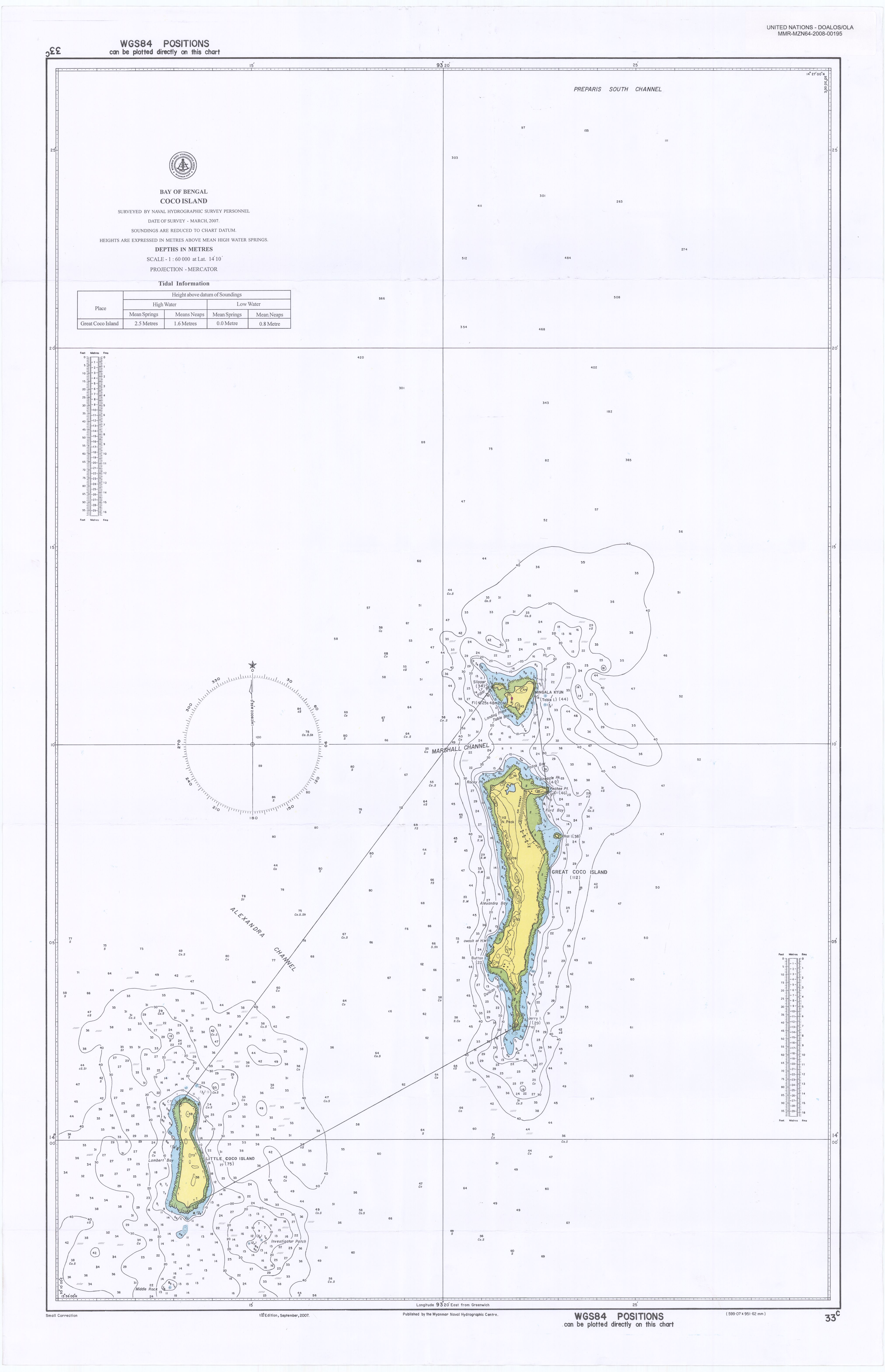
The Bay of Bengal lies to the west of the islands. The Andaman Sea lies to the east. The Burmese mainland is 250 kilometres (155 mi) to the north. The island of Preparis lies 77 km (48 mi) to the north-northeast of the Coco Islands.[10] The Coco Islands consist of three main islands, namely Great Coco Island and the smaller Little Coco Island, separated by the Alexandra Channel, as well as Table Island, a third small island located near Great Coco Island.[11]

Geographically, they are a part of the Andaman Islands archipelago, most of which belongs to India. They are separated from Landfall Island, the northernmost island in the Indian part of the archipelago, by the 20 kilometres (12 mi) wide Coco Channel.[4]

Great Coco reef

[edit]

This reef has four islands. From north to south those are Slipper Island, Table Island, Great Coco Island, and Jerry Island.

Great Coco Island

[edit]

The Coco Islands consist of three main islands: Great Coco Island and the smaller Little Coco Island are separated by the Alexandra Channel. A third small island located near Great Coco Island is Table Island.

Great Coco Island (14°07′00″N 93°22′03″E / 14.11667°N 93.36750°E / 14.11667; 93.36750) is 10.4 km (6.5 mi) long and 2 km (1.2 mi) wide. Many green turtles nest on the beaches of the Island. A series of research programs on marine turtle conservation has been conducted by Myanmar's Ministry of Livestock, Fisheries, and Rural Development. Data collection on tissue samples of green turtles for population genetic and tagging studies was conducted at Great Coco Island in March and April, 2006. Previously, Great Coco Island had never been surveyed for marine turtle conservation due to its remote location. The survey found an estimated 150 sea turtles nesting along with 95,000 hatchlings and juveniles.[citation needed]

Table Island

[edit]

The axe-head-shaped Table Island is located 2.5 km (1.6 mi) to the north of Great Coco Island. The island is 1.6 km (1.0 mi) long and 1.2 km (0.7 mi) wide. The island previously housed a lighthouse in its southwestern portion, but it is now uninhabited.[11] The lighthouse was built in 1867, with a focal plane of 59 m.[12] It has a lantern and gallery, painted with red and white horizontal bands. Two 1-story brick keeper's houses and other light station buildings lie around the lighthouse.

The island is accessible by boat. One of the former island keepers was brutally murdered by his boss.

Slipper Island

[edit]

Slipper Island is a 0.4 km (0.2 mi) long narrow islet located off the northwestern point of Table Island, separated from it by a 0.2 km (0.1 mi) narrow channel.[10]

Jerry Island

[edit]

Jerry Island is a 1.1 km (0.7 mi) long and 0.2 km (0.12 mi) wide islet located off the southern point of Great Coco Island, which can be reached from the Great Coco Island just by walking on the sandbar connecting these two islands.

Little Coco Reef

[edit]

This reef has only one island.

Little Coco Island

[edit]

Little Coco Island lies 16 km (9.9 mi) to the southwest of Great Coco Island. It is 5 km (3.1 mi) long from north to south and 1.2 km (0.75 mi) wide from east to west. This island is on a separate reef, and the rest of the four islands (including Table Island) are on the same reef as Coco Island. This is the southernmost Island belonging to Myanmar in the Andaman and Nicobar Sea, the next island to the south is Landfall Island belonging to India.

General information

[edit]
Island Location Features Area (km2) Population
Great Coco Island 14°06′00″N 93°21′54″E / 14.10°N 93.365°E / 14.10; 93.365 Airport, coconut groves 14.57 1000+
Little Coco Island 13°59′17″N 93°13′30″E / 13.988°N 93.225°E / 13.988; 93.225 Coconut groves 4.44 150[citation needed]
Table Island 14°11′06″N 93°21′54″E / 14.185°N 93.365°E / 14.185; 93.365 Lighthouse 1.28 0
Slipper Island 14°11′24″N 93°21′25″E / 14.19°N 93.357°E / 14.19; 93.357 0.08 0
Rat Island 14°07′41″N 93°22′55″E / 14.128°N 93.382°E / 14.128; 93.382 0.015 0
Binnacle Rock 14°09′00″N 93°22′19″E / 14.15°N 93.372°E / 14.15; 93.372 0.011 0
Jerry Island 14°03′00″N 93°21′54″E / 14.05°N 93.365°E / 14.05; 93.365 0.14 0
Coco Islands (Total) 20.53 1350+
[edit]

Demography

[edit]

There are more than 200 houses on Great Coco Island, and its total population is around a thousand people. A large water catchment reservoir can support the island's population.[13]

There is a naval base on the islands, which belongs to the 28th unit of the Myanmar Navy. It is home to some 200 soldiers and their families.

Climate

[edit]

The Coco Islands have a tropical monsoon climate (Köppen climate classification Am). Temperatures are very warm throughout the year. There is a winter dry season from December to March. There is a summer wet season from April to November. Heavy rain has been known in September, such as 761 millimetres (30.0 in) of rain.

Climate data for Coco Islands (1991–2020)
Month Jan Feb Mar Apr May Jun Jul Aug Sep Oct Nov Dec Year
Mean daily maximum °C (°F) 30.7
(87.3)
31.1
(88.0)
31.9
(89.4)
33.4
(92.1)
32.8
(91.0)
31.1
(88.0)
30.6
(87.1)
30.3
(86.5)
30.5
(86.9)
31.5
(88.7)
32.0
(89.6)
31.2
(88.2)
31.4
(88.5)
Daily mean °C (°F) 25.7
(78.3)
25.6
(78.1)
26.6
(79.9)
28.4
(83.1)
28.8
(83.8)
27.7
(81.9)
27.2
(81.0)
27.0
(80.6)
26.9
(80.4)
27.4
(81.3)
27.5
(81.5)
26.6
(79.9)
27.1
(80.8)
Mean daily minimum °C (°F) 20.8
(69.4)
20.1
(68.2)
21.3
(70.3)
23.4
(74.1)
24.7
(76.5)
24.3
(75.7)
23.7
(74.7)
23.7
(74.7)
23.4
(74.1)
23.2
(73.8)
23.0
(73.4)
21.9
(71.4)
23.9
(75.0)
Average precipitation mm (inches) 21.6
(0.85)
1.0
(0.04)
13.4
(0.53)
39.9
(1.57)
238.8
(9.40)
454.4
(17.89)
466.1
(18.35)
463.1
(18.23)
426.4
(16.79)
193.3
(7.61)
135.1
(5.32)
30.6
(1.20)
2,483.7
(97.78)
Average precipitation days (≥ 1.0 mm) 0.8 0.1 0.8 2.4 11.9 19.8 20.9 20.3 19.3 13.8 6.9 1.6 118.5
Source: World Meteorological Organization[14][15]

Administration

[edit]

The island belongs to the township of Cocokyun. The township had a corruption scandal in the Myanmar general election of 2015.[16] Ballots were filled in Yangon without being shipped, resulting in a high turnout and police investigation.[17][18]

Transportation

[edit]

The 1,800-metre (5,900 ft) Coco Island Airport (ICAO code: VYCI) is at the north of Great Coco Island. It follows the north–south axis near the island's village. The airport was recently renovated.[19]

Military

[edit]

In 1992, a Japanese news service reported that China was helping upgrade the base on Great Coco Island. Through the 1990s and 2000s, journalists and academics expanded the claims to China having a major signals intelligence base, seemingly part of the so-called "string of pearls", that monitored Indian activity. In 1998, George Fernandes also claimed China intended to build a major naval base on the islands; India was the only country to publicly "confirm" that the Chinese base existed. No supporting evidence appears through 2008. China and Burma denied the base's existence. In 1998, the United States reported that there was no significant Chinese activity. In 2005, India retracted its position; this followed an Indian inspection of the islands at Burma's invitation.[9]

In 2014, Air Marshal P. K. Roy, commander-in-chief of India's Andaman and Nicobar Command, stated that "China has been developing a runway for civilian purposes.[20][21] There are no reports of the presence of Chinese per se. The situation is not alarming". He added that there were only some civilian infrastructural developments, which were not a threat to India.[22]

Satellite images from Maxar Technologies, taken in January 2023, revealed upgrades to Coco Island Airport. These included a longer 2,300-metre runway, a radar tower, and two new hangars. It appears that the installation is run by the Tatmadaw or Myanmar military with no visible Chinese military presence.[23]

Flora and fauna

[edit]

The islands offer the opportunity to see rare reptiles, birds, and mammals that are unique to the Coco Islands.[24]

See also

[edit]

References

[edit]

Sources

[edit]
[edit]
Revisions and contributorsEdit on WikipediaRead on Wikipedia
from Grokipedia
The Coco Islands are a small archipelago in the northeastern , administered by as part of Cocokyun in the . The group consists of Great Coco Island, the largest at approximately 11 kilometers in length, Little Coco Island to the south, and smaller islets including Table, , and Jerry Islands. Situated about 414 kilometers south of and roughly 40 kilometers north of India's across the Coco Channel, the islands feature tropical forested terrain and limited civilian population of around 1,000, primarily supporting military activities. Under British rule, the islands were incorporated into in 1882 and remained Burmese territory following Burma's separation from in 1937 and independence in 1948, with no subsequent transfer of . Post-independence, established a on Great Coco in 1959, later abandoned, and developed the islands into a key military outpost featuring a , a 2,300-meter , stations, and support . Their proximity to vital sea lanes and India's strategic Andaman command underscores their geopolitical significance, though maintains exclusive control amid regional security dynamics.

History

British colonial administration (19th–20th century)

The Coco Islands fell under British colonial oversight in the 19th century as an adjunct to British India's maritime domain in the , primarily valued for their coconut groves that supplied provisions to the penal settlement on the . Administrative control was initially exercised from Calcutta, with the islands functioning as a remote outpost rather than a settled territory; by mid-century, a had been established on Table Island to aid . In 1882, jurisdiction over the sparsely inhabited —comprising Great Coco, Little Coco, Table, and smaller islets—was formally transferred from private lessees to the government of British Burma, reflecting the consolidation of peripheral holdings under provincial administration. Under British Burma, the islands saw minimal infrastructural development beyond the lighthouse and occasional extraction, maintaining their role as a navigational and resource appendage with no permanent or significant . The , prominent Burmese traders, held a for economic exploitation, including processing, reportedly from the onward and renewed into the early , though remained nominal due to the islands' isolation. In 1937, as was detached from to become a distinct under direct British rule, the Coco Islands unequivocally remained within Burmese administrative bounds, unaffected by the partition. Throughout the early 20th century, British administration emphasized strategic oversight amid rising regional tensions, particularly during when the islands' proximity to Allied supply routes prompted temporary surveillance enhancements, though no major fortifications were erected. Post-1945, with Burma's push toward independence, colonial control waned, culminating in the islands' seamless incorporation into the new Burmese state in 1948 without contest.

Post-independence developments under Myanmar (1948–present)

Following Burma's independence from Britain on January 4, 1948, the Coco Islands remained under the control of the newly formed Union of Burma as an integral part of its territory, administered initially as part of Hanthawaddy District in what is now Yangon Region. The islands saw limited civilian development, with focus shifting toward security and penal functions amid the country's internal insurgencies. In 1958, during the brief military caretaker government preceding Ne Win's coup, political prisoners were deported to Great Coco Island, establishing it as a remote detention site. A formal was founded there in January 1959 under Ne Win's administration, housing dissidents and criminals until its closure in the early 1970s; by 1969, an airfield had been constructed to support logistics. This period reflected Burma's strategy of isolating threats in peripheral territories, with the islands' strategic position in the enhancing their utility for surveillance over maritime routes. Under subsequent military rule, the (Myanmar Armed Forces) developed Great Coco Island into a and naval outpost, including and communication facilities to monitor shipping and regional navies. The islands' administration was formalized as Cocokyun Township within Region's Southern District, with a small primarily comprising , their families, and support staff—totaling around 1,119 residents as of 2019. Post-2021 military coup, revealed accelerated expansion on Great Coco, including extension of the airstrip from approximately 900 meters to over 2,300 meters by early 2023, addition of aircraft hangars, ammunition storage bunkers, and potential radar domes. These upgrades, attributed to the junta, have heightened regional concerns over enhanced capabilities near India's , though Myanmar officials have denied any foreign military presence, including Chinese, on the islands. No evidence confirms operational foreign bases, with constructions appearing directed by Myanmar's military amid its reliance on external alliances for survival.

Use as a penal colony

The Great Coco Island was utilized as a by Myanmar's military between 1958 and 1960, primarily to detain political prisoners isolated from the mainland. In 1959, General , heading the interim military administration, formally established the facility to suppress opposition, with prisoners later receiving life sentences following the coup for resisting the emerging socialist regime. An expansion occurred in February 1969, drawing inspiration from Indonesia's Buru Island model of self-sufficient labor; approximately 200 inmates, mostly communists and leftists, were transported there for tasks such as harvesting and development. Over 230 prisoners were held in total across its operations, enduring severe conditions including inadequate food and shelter that prompted organized resistance. Multiple hunger strikes marked the colony's decline, beginning with a seven-day in , followed by longer actions lasting 40 and 53 days, culminating in at least eight inmate deaths by 1971; authorities reportedly burned some bodies to conceal evidence. The facility was shuttered in December 1971, with survivors repatriated to mainland prisons, though physical remnants of the camp endure near the island's southern causeway.

Geography

Location and physical characteristics

The Coco Islands constitute a small in the northeastern , administered as part of Myanmar's . Positioned approximately 414 kilometers south of and 300 kilometers south of the Myanmar mainland, the islands lie at coordinates around 14°05′N 93°18′E. They are situated roughly 55 kilometers north of India's , forming a strategic point between Myanmar and international waters in the . Geologically, the Coco Islands represent a northern extension of the Andaman and Nicobar island chain and are linked to the submerged continuation of Myanmar's (Rakhine) mountain range into the sea. The comprises five islands, with Great Coco Island as the principal and largest landmass, alongside Little Coco Island to the southwest and minor islets including Table, Slipper, and Jerry. The total land area spans about 20.5 square kilometers, with Great Coco extending roughly 10 kilometers in length. Physical features include low to moderate elevations, reaching a maximum of approximately 112 meters on Great Coco Island, supporting limited vegetation and facilitating military installations at higher points such as a site at 102 meters above . The islands' terrain is characterized by coastal plains and hilly interiors, typical of and tectonic formations in the region, though detailed geological surveys remain sparse due to restricted access.

Major islands and reefs

The Coco Islands consist of five islands grouped across two principal reefs in the northeastern Bay of Bengal: the Great Coco Reef and the Little Coco Reef. The Great Coco Reef, the larger formation, encompasses four islands from north to south: Slipper Island, Table Island, Great Coco Island, and Jerry Island. These islands are primarily coral-based, surrounded by fringing and barrier reefs typical of the Andaman shelf ecosystem. Great Coco Island, the largest and most prominent, measures approximately 11 kilometers in length and serves as the central landmass of the group. Table Island lies about 2.5 kilometers north of Great Coco, spanning 1.6 kilometers in length and 1.2 kilometers in width; it features a constructed in 1867. Slipper Island and the smaller Jerry Island flank the reef's extremities, contributing to the archipelago's compact cluster. Little Coco Island, situated on its separate reef approximately 15 kilometers southwest of Great Coco across the Alexandra Channel, stands as the southernmost island in Myanmar's territory. The reefs encircling these islands support ecosystems, including diverse hard and soft species, though dense vegetation and restrictions limit detailed ecological surveys. Sandy beaches and tropical foliage characterize the shorelines, with the reefs providing natural barriers against open ocean swells.

Climate and environmental conditions

The Coco Islands exhibit a with consistently high s and humidity. The mean annual averages 27.1 °C (80.8 °F), with minimal seasonal variation typical of equatorial environments. Annual reaches approximately 2,836 mm (111.7 in), distributed unevenly across months averaging 236 mm (9.3 in), though the driest period occurs in with only 4 mm (0.2 in). This pattern reflects a pronounced from May to , driven by southwest monsoons, contrasted by a relatively drier interval from December to . Vegetation on the islands primarily consists of tropical lowland forests and coastal mangroves, supporting limited terrestrial due to the small land area and isolation. Surrounding marine environments host fringing reefs and diverse algal communities, with documented surveys recording at least 12 species in adjacent waters. These ecosystems contribute to regional biodiversity hotspots in the northern , though comprehensive inventories remain sparse owing to restricted access. Key environmental pressures stem from military infrastructure expansions, including runway extensions and facility constructions observed since the early 2020s, which risk , , and sedimentation into coastal zones. Broader threats aligned with Myanmar's coastal patterns include potential introduction via human activity and climate-induced stressors such as rising sea levels and intensified cyclones, though site-specific data on degradation rates is limited. Conservation efforts are minimal, with no designated protected areas encompassing the islands, exacerbating vulnerability to anthropogenic disturbances.

Administration and governance

Current administrative status

The Coco Islands constitute the Cocokyun within Myanmar's , a status established since the islands' administrative alignment in under British colonial reorganization and retained post-independence. This township also includes to the south, forming a rural, sparsely populated administrative unit focused primarily on maritime oversight rather than civilian development. Governance falls under the Yangon Region's administrative framework, overseen by the Myanmar military's since the 2021 , with local authority exercised through military-appointed officials due to the islands' strategic naval significance. The township's population, estimated at 1,284 residents in the 2024 , consists mainly of military personnel, their families, and limited civilian support staff, reflecting minimal civilian infrastructure and heavy reliance on mainland supply lines from , approximately 414 kilometers north. ![Flag of Yangon Region][center]

Sovereignty disputes and historical claims

The sovereignty of the Coco Islands remains undisputed, with continuous administration by since the nation's independence on January 4, 1948. The islands were formally incorporated into British 's jurisdiction following the separation of from British on April 1, 1937, under the provisions of the Government of Burma Act 1935, which designated a distinct encompassing the Coco group. Prior to this division, British authorities had administered the islands variably, including leases to Burmese families for agricultural purposes as early as 1882, reflecting their alignment with Burmese colonial territories rather than core Indian holdings. Claims in certain Indian political and media outlets that Prime Minister "gifted" the islands to in the or failed to assert an Indian entitlement during post-independence boundary discussions are not supported by declassified records or diplomatic archives, which affirm the islands' pre-existing Burmese status post-1937. These narratives, propagated notably by opposition figures and nationalist commentators, often conflate geographic proximity to India's —approximately 40 kilometers (25 miles) south—with historical ownership, overlooking the 1937 legal transfer. has never formally advanced a territorial claim to the Coco Islands against , and bilateral relations have focused instead on delimitations elsewhere, such as the 1987 agreement on the India-Myanmar land border excluding the islands. During , Japanese forces occupied the islands from 1942 until their recapture by British and Indian troops in 1945, but this wartime control did not impact the underlying Burmese administrative framework. designates the Coco Islands as part of , with no recorded challenges to this status from neighboring states or international bodies.

Demographics and society

Population composition

The population of Cocokyun Township, encompassing the Coco Islands, stood at 1,284 according to Myanmar's 2024 census provisional figures. This small resident base, concentrated mainly on Great Coco Island, comprises fewer than 1,000 individuals as of late 2025, predominantly military families affiliated with the Navy's 28th Tactical Operations Command and government staff supporting island operations. Civilian activities are limited to subsistence farming and basic services, with no significant urban settlements or diverse migrant communities reported. Ethnically, the inhabitants are overwhelmingly Bamar (Burman), aligning with the dominant group in and the Myanmar armed forces, which draw the majority of its personnel from this ethnicity despite formal recruitment across recognized groups. Limited data on minorities exists due to the township's isolation and military focus, though non-Bamar elements may include personnel from ethnic armed forces integrations or support roles, reflecting broader composition patterns. No indigenous populations predate colonial-era Burmese settlement, with historical records indicating leasing to Burmese families for cultivation since the 1880s.

Settlements and human activity

Great Coco Island serves as the primary location for human settlement in the Coco Islands archipelago, accommodating the vast majority of the resident population. This island hosts over 2,000 civilians, many of whom are linked to military operations and participate in subsistence farming to support local needs. In contrast, Little Coco Island, Table Island, and the surrounding reefs lack permanent settlements and are described as desolate, with no significant civilian presence or ongoing human activity beyond occasional military oversight. Human activity remains minimal and geared toward military sustainment rather than broader development. Residents on Great Coco Island rely on basic infrastructure, including water catchment systems for freshwater supply, to maintain a self-sufficient amid the islands' remote isolation. and limited supplement military provisions, though the overall scale is constrained by the harsh environmental conditions and logistical challenges of the location. No formal villages or urban centers exist; instead, habitation consists of scattered housing clusters integrated with defense facilities.

Military and strategic significance

Military infrastructure and recent constructions

Great Coco Island maintains a longstanding outpost equipped with a radar station and an airstrip capable of supporting and helicopters. The facility has historically facilitated surveillance operations in the , with infrastructure including communication antennas and basic barracks dating back to at least the . Satellite imagery analyzed in early 2023 by documented significant expansions on Great Coco Island, including lengthening of the airstrip to approximately 1,000 meters, construction of new aircraft hangars, additional barracks for personnel, and possible radar domes. These developments, observed between 2021 and 2023, also encompassed helipads and enhanced docking facilities at the island's piers, enabling potential deployment of unmanned aerial vehicles or platforms. Similar upgrades appeared on Little Coco Island, featuring new structures suggestive of storage or operational buildings, though on a smaller scale. By October 2025, military personnel continued land-clearing and construction of a connecting Great Coco Island to adjacent Jerry Island, aimed at improving logistical access and potentially expanding operational footprint. Analysts attribute these projects to the junta's efforts to bolster remote outposts amid internal instability, though the scale raises questions about external given 's limited resources. No public confirmation exists of foreign personnel presence, with officials denying Chinese operational involvement despite Beijing's economic ties in the region.

Geopolitical concerns and international viewpoints

The Coco Islands' strategic location in the northern , approximately 50 kilometers north of India's , has heightened geopolitical tensions, primarily due to fears of enhanced capabilities threatening Indian . Indian security analysts express concern that facilities on the islands could enable monitoring of naval movements, missile tests from the Andaman and Nicobar tri-service command, and operations in vital sea lanes leading to the . Persistent allegations suggest Chinese involvement in developing (SIGINT) infrastructure on Great Coco Island since the , potentially as part of Beijing's broader maritime strategy to project power into the . Satellite from 2023 revealed extensive construction, including radar domes, hangars, and port expansions, fueling speculation of a dual-use capable of tracking Indian assets. However, has denied establishing any posts, asserting that reported activities pertain solely to Myanmar's sovereign developments. Myanmar's has countered these claims by assuring of no foreign military presence, with official statements in October 2025 emphasizing that infrastructure upgrades serve national defense needs amid internal insurgencies and border threats, not external partnerships. views the islands as integral to its tri-service command structure for securing northern maritime approaches. Internationally, the situation reflects wider rivalries, with perceiving the Coco Islands as a potential node in China's "" encirclement strategy, prompting enhanced bilateral engagements with to mitigate risks. Japan shares apprehensions over disruptions to regional stability and , advocating for transparent development. Analysts note that while evidence of direct Chinese operational control remains circumstantial, the opacity of 's junta exacerbates distrust among neighbors reliant on trade routes.

Indian security perspectives and responses

The Coco Islands, situated approximately 30 miles north of India's , are perceived by Indian security analysts as a potential vulnerability in maritime defense, given their oversight of critical sea lanes in the and proximity to India's tri-service theater command at . This positioning enables hypothetical of Indian naval movements and electronic intelligence gathering on regional assets, amplifying concerns amid Myanmar's deepening military ties with . Indian apprehensions intensified following reports of extensive construction on Great Coco Island, including facilities and runways, interpreted as possible enablers for foreign operations despite Myanmar's denials. On October 10, 2025, Myanmar's junta assured of no Chinese personnel or activities on the islands, echoing similar pledges dating back to 2005 when Indian officials toured the site. However, skepticism persists due to unverified expansions and Myanmar's refusal, as of October 14, 2025, to permit an inspection, which Indian officials view as a red flag for Andaman security. In response, has pursued diplomatic channels to extract transparency from while bolstering indigenous countermeasures, such as augmenting surveillance and rapid-response assets in the to mitigate any emergent threats from enhanced monitoring capabilities on the Coco Islands. These efforts align with broader strategies to counterbalance China's regional naval expansion, including joint exercises and infrastructure upgrades in the Andaman and Nicobar chain. Indian defense assessments emphasize that unchecked developments could compromise the strategic depth of the Andaman archipelago, pivotal for projecting power toward the Malacca Strait.

Economy and infrastructure

Limited economic activities

The Coco Islands host negligible economic activity, confined largely to subsistence fishing by a small population of residents, primarily and their families, amid otherwise uninhabited . This reflects the islands' remote location in the and their overriding military orientation, which restricts civilian enterprise and commercial exploitation. Historically, during British colonial rule in the , the islands supplied food supplies and coconuts to passing ships and nearby Andaman prisons, marking an early non-military utility tied to basic resource extraction. Post-independence, briefly operated a on Great Coco Island from 1959 until its closure in the early 1970s due to protests, with inmates potentially engaged in rudimentary labor, though no sustained economic output emerged. Contemporary assessments highlight untapped around the islands, including documented in surveys, yet large-scale or remains absent owing to logistical barriers, limited beyond needs, and prohibitions on access to certain areas. No evidence exists of , , , or ; any minor livelihood enhancements, such as upgrades enabling occasional vessel docking, serve strategic rather than developmental ends. The absence of commercial viability underscores the islands' dependence on mainland for essentials, with economic relevance overshadowed by geopolitical functions.

Transportation and logistics

The transportation infrastructure of the Coco Islands is rudimentary and predominantly military-oriented, reflecting their strategic isolation in the northern and minimal civilian presence. No public roads, railways, or scheduled passenger services exist, with focused on sustaining naval and air facilities rather than economic or activities. Access for non-military personnel is highly restricted, requiring special permissions from Myanmar's authorities, and no commercial ferry or shipping routes connect the islands to the mainland or regional ports. Air transport centers on Coco Island Airport (ICAO: VYCI), situated on Great Coco Island, which features a single extended to 2,300 meters by early 2023, sufficient for heavy transport such as the or Boeing C-17. Accompanying developments include widened runway surfaces, two new hangars for storage, and improved support like a linking facilities. Originally handling limited civilian operations, the airport has transitioned fully to military use, barring public flights and serving primarily for troop rotations, equipment delivery, and surveillance operations. Maritime logistics depend on a basic harbor and expanded pier on Great Coco Island, upgraded with a larger docking facility visible in from 2023 onward, capable of accommodating supply vessels up to several thousand tons displacement. These assets facilitate periodic resupply convoys from Myanmar's coastal bases, such as those in the Delta region, transporting fuel, provisions, and construction materials essential for stations and needs. No dedicated commercial port operates, and civilian vessel traffic is prohibited, underscoring the islands' role in defense sustainment over trade.

Flora, fauna, and ecology

Biodiversity overview

The Coco Islands, situated in the northeastern , feature tropical island ecosystems with fringing coral reefs and forested terrestrial habitats that support a mix of regional and endemic species. These islands fall within the Endemic Bird Area, hosting two restricted-range bird species endemic to the Andaman archipelago: the brown coucal (Centropus andamanensis) and the Andaman drongo (Dicrurus andamanensis). The Moscos Islands Wildlife Sanctuary, encompassing parts of the Coco group and established in 1927, protects 49.18 square kilometers of habitat for waterbirds, barking deer (Muntiacus muntjak), and sambar (Rusa unicolor). Invertebrate diversity includes the globally threatened Andaman crow butterfly (Euploea andamanensis), endemic to the Andaman region and present on the islands. Marine biodiversity is notable around Great Coco Island, where fringing reefs sustain corals, seagrasses, and 12 identified seaweed species; a 2020 survey documented 67 coastal specimens encompassing marine vertebrates, , seaweeds, seagrasses, and corals. The Coco Islands are designated a high-priority Key Biodiversity Area in Myanmar's conservation framework, reflecting their role in preserving Andaman Sea endemism amid broader national efforts covering 5.6% of land under protection as of 2010. Limited accessibility has constrained comprehensive surveys, but available data underscore the islands' ecological significance within Myanmar's marine and island biodiversity hotspots.

Environmental threats and conservation

The Coco Islands, encompassing ecosystems such as the Tanintharyi Island Rainforest and coastal mudflats, face threats from sea-level rise, which exacerbates and inundation risks along Myanmar's coastline, potentially displacing fragile habitats supporting migratory shorebirds and invertebrates. development, including expansions and potential , contributes to in the Vulnerable to Critically Endangered Tanintharyi Island Rainforest, where unregulated activities like logging and have degraded lowland forests hosting 305 plant species across 91 families. from naval and commercial shipping, including oil spills and waste discharge, endangers fringing reefs and marine around the islands, while risks depleting resources in surrounding waters that sustain endemic species. Conservation efforts for the Coco Islands remain limited, with no dedicated status despite their inclusion as a high-priority site in Myanmar's investment visions and marine assessments. The islands' ecosystems, including coastal mudflats classified as Least Concern but only 5.64% protected nationally, benefit indirectly from broader initiatives like expanding marine to cover 15% of reefs under the National Strategy and , though enforcement is challenged by remoteness and geopolitical priorities. Recommendations emphasize community-based management and enhanced mapping to address data deficiencies in dune forests and savannas, but military control restricts ecological monitoring and restoration.

References

Add your contribution
Related Hubs
User Avatar
No comments yet.