Hubbry Logo
NandaoNandaoMain
Open search
Nandao
Community hub
Nandao
logo
8 pages, 0 posts
0 subscribers
Be the first to start a discussion here.
Nandao
Nandao
from Wikipedia

Nandao
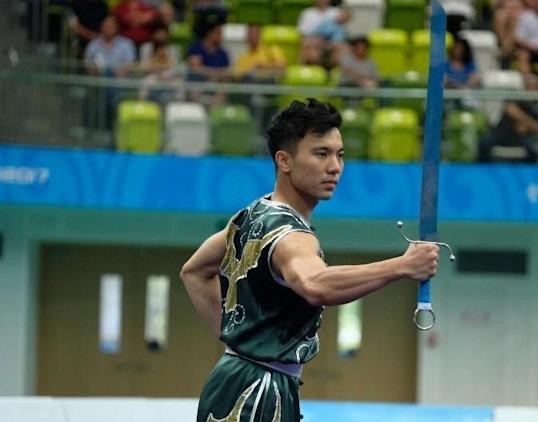
Leung Cheuk Hei wielding a nandao
Also known asSouthern Broadsword
Southern Sabre
FocusWeapon striking, kicking, jumping
Country of origin China
Date of formation1992
CreatorChinese Wushu Association
ParenthoodDaoshu, Nanquan, other Southern Chinese Martial Arts
Related artsNanquan, Nangun
Olympic sportWushu Taolu
Nandao
Chinese南刀
Literal meaningsouthern broadsword
Transcriptions
Standard Mandarin
Hanyu Pinyinnándāo
Yue: Cantonese
Jyutpingnaam4 dou1
IPA[nȁːmtóu]

A Nandao (Chinese: 南刀; pinyin: Nán dāo) is a kind of dao, or single-edged sword, that is used in contemporary wushu taolu.[1] Ratified for use by the International Wushu Federation in 1992, it has gained widespread popularity worldwide and has become one of the main events at wushu competitions.

History

[edit]

Creation

[edit]

In the 1980s with the development of modern wushu taolu, professors of the Chinese Wushu Association wanted to find a sword or short weapon that would compliment the empty-hand style of nanquan.[2] Among the candidates for consideration were the nine-ring sword, the butterfly sword, the dadao, and the Ghost-head sword, but they were all deemed impractical. During the construction of a compulsory nangun routine, professor Wang Peikun met with Zhou Susheng, coach of the Guangxi Wushu Team to discuss the creation of a new type of sword, the nandao. They found a sword-maker to create prototype nandao sword which were given to the coaches.[2]

Wang and Zhou discussed creating a routine for nandao. After meeting with Beijing Wushu Team coach Xue Yi and Hubei Wushu Team coach Yuan Linlin, Beijing team members Ka Li Abdul and Xu Yi were tasked to draft a routine.[2] After revisions and practice of the new techniques, a demonstration video of the first compulsory routine was filmed with Ka Li as the performer.

Spread and international use

[edit]

In 1992, the International Wushu Federation ratified the use of nandao (along with nangun) in international competition.[2] Nandao made its elite-level debut at the 1999 World Wushu Championships in Hong Kong where Ho Ro Bin and Huang Chunni were the first world champions in the event. In 2000, nandao debuted at the Asian Wushu Championships, in 2001 at the SEA Games, and in 2002 at the Asian Games. Starting with the 2008 Beijing Wushu Tournament, nandao in some major multi-sport events started to be only contested by women due to limits in medals quota.[3]

From 1999 to 2004, nandao events in international competitions used the first compulsory routine performed by Ka Li in 1992. With the 2005 IWUF rules revision, the three-score system was introduced and athletes were required to choreograph their own optional routines. In 2012, a new nandao compulsory routine was created as part of the IWUF Third Set of Compulsory Routines. This routine has been only used at the World Junior Wushu Championships since 2013 and at other junior-level competitions worldwide but not at the adult level.

Scoring and rules

[edit]

Apparatus

[edit]

Nandao swords have a blade the shape of a butterfly sword but longer, an s-guard with allows a reverse grip, and handle length to accommodate single and double wielding grip.[2] In the most recent IWUF rules revision for international competition, the top of the nandao blade should be no shorter than a competitor's jaw if being held with the left hand close to the body.[4]

Routines

[edit]

As of the 2024 IWUF rules, nandao routines must be between 1 minute 20 seconds to 1 minute 35 seconds in length.[4] Nandao routines are also required to have the following techniques:[4]

Sword techniques

[edit]
  • Chán Tóu (缠头) — Broadsword twining
  • Guǒ Nǎo (裹脑) — Wrapping with the Broadsword
  • Pī Dāo (劈刀) — Broadsword Chop
  • Mǒ Dāo (抹刀) — Broadsword Slicing
  • Gé Dāo (格刀) — Broadsword Parry
  • Jié Dāo (截刀) — Broadsword Intercept
  • Sǎo Dāo (扫刀) — Broadsword Sweeping
  • Jiǎn Wàn Huā Dāo ( 剪腕花刀) — Broadsword Figure 8

Stances

[edit]
  • Gōng Bù (弓步) — Bow Stance
  • Mǎ Bù (马步) — Horse Stance
  • Pū Bù (仆步) — Crouching Stance
  • Xū Bù (虚步) — Empty Stance
  • Dié Bù (蝶步) — Butterfly Stance
  • Qí Lóng Bù (骑龙步) — Dragon Riding Stance

Footwork

[edit]
  • Qílín Bù (麒麟步) — Kirin steps

Leg technique

[edit]
  • Héng Dīng Tuǐ (横钉腿) — Horizontal nail kick

Scoring criteria

[edit]

Nandao adheres to the same deduction content (A score) and degree of difficulty content and connections (C score) as nanquan and nangun.[4] This three-score system has been in place since the 2005 IWUF rules revision. Only the techniques Chán Tóu (缠头) and Guǒ Nǎo (裹脑) have deduction content (code 62).

References

[edit]
Revisions and contributorsEdit on WikipediaRead on Wikipedia
from Grokipedia
Nandao (南刀), commonly known as the southern broadsword, is a employed in contemporary wushu taolu routines, particularly those derived from southern traditions south of the River. It features a distinctive with a flattened-triangle , an S-shaped guard, and a ring pommel, emphasizing powerful, short strikes, low stances, and intricate hand techniques over acrobatic movements. Developed in the late to represent southern styles in standardized wushu competitions, nandao draws from lineages such as Hong Quan, Li Quan, Liu Quan, Mo Quan, Cai Quan, Wu Zu Quan, and Yong Chun Quan, incorporating elements like the and willow leaf dao for a fierce and stable performance style. Ratified for international use by the (IWUF) in 1992, it serves as a counterpart to the northern broadsword (beidao), differing in its straight, non-curved blade, heavier weight requiring two-handed grips, and focus on vocal articulation to convey power and spirit. In IWUF-sanctioned events, nandao routines are performed in an 8-meter by 14-meter arena, lasting at least 1 minute 20 seconds for seniors and incorporating a minimum of eight compulsory broadsword techniques—such as chán tóu (coil head), guǒ nǎo (wrap head), and sǎo dāo (sweep saber)—alongside four key stances like gōng bù (bow stance) and mǎ bù (horse stance). The weapon must meet strict specifications: when held vertically in the left hand with the tip upward, it reaches no lower than the performer's jaw, typically weighing 445–500 grams with a blade length of around 48–50 cm. Performers wear standardized attire, including a collarless top with short sleeves for women (sleeveless for men), lantern pants, and a soft sash, judged on movement quality (5.0 points), overall performance (3.0 points), and difficulty (2.0 points), with deductions for errors in execution or compulsory elements. Nandao taolu has become a staple in global wushu championships, showcasing athletes' precision, stability, and explosive power, and contributing to the sport's emphasis on both cultural preservation and athletic excellence.

Introduction

Definition and characteristics

The nandao is a southern-style broadsword employed in contemporary wushu taolu routines, emphasizing powerful, direct techniques rooted in southern Chinese martial arts traditions. As part of the optional events in international competitions, it features a straight, single-edged blade designed primarily for chopping, slicing, and thrusting actions, distinguishing it from the more fluid, double-edged sword used for precise stabbing and cutting. The term "nandao" derives from "nan" (southern) and "dao" (broadsword), reflecting its origins in the dynamic, low-stance movements of nanquan styles. Developed in the late 20th century and ratified by the (IWUF) in 1992, nandao represents southern styles in standardized competitions as a counterpart to the northern broadsword (daoshu). Key physical characteristics include a straight approximately 48-60 cm long with a broad, pointed tip, an overall length of around 80-90 cm, and a weight typically ranging from 445-500 grams to facilitate rapid manipulations. The apparatus features an S-shaped guard to protect the hand and produce characteristic clanging sounds during performance, a wooden or wrapped handle for secure grip, and a pommel often adorned with a red tassel for aesthetic balance and visual flair in routines. All nandao used in sanctioned events must conform to (IWUF) standards, verified by a holding test where the tip reaches no lower than the lower jaw when held vertically in the left hand.

Role in modern wushu

In contemporary wushu, nandao is an optional weapon routine event in taolu competitions sanctioned by the (IWUF), alongside other weapons such as daoshu (northern broadsword), jianshu (straight sword), and gunshu (staff) for men's and women's events. This positions nandao as a core event in international tournaments, where athletes perform choreographed routines in an 8-meter by 14-meter arena, evaluated on movement quality, overall performance, and . Its inclusion promotes the taolu discipline's emphasis on agility, coordination, and artistic expression through fluid, precise sword manipulations integrated with dynamic body positioning. Training with nandao significantly enhances physical attributes essential to wushu practice, particularly upper body strength via repetitive powerful arm strikes, precision in intricate hand techniques, and rhythmic timing supported by vocal articulations during forms. Regular practice also fosters overall coordination, balance, speed, stamina, and flexibility, contributing to well-rounded athletic development in taolu athletes. These benefits extend beyond competition, aiding in the holistic improvement of practitioners' motor skills and endurance. Culturally, nandao embodies the heritage of southern Chinese martial arts, drawing from styles such as Hong Gar and , and is showcased in global performances at events like the to preserve and promote these traditions. By highlighting low stances, stable footing, and fierce, short-range techniques, it represents the tactical essence of southern fighting methods on the international stage, bridging historical roots with modern competitive wushu.

Historical development

Origins in traditional Chinese martial arts

The modern nandao draws inspiration from techniques and weapons in traditional that emerged during the Ming (1368–1644) and Qing (1644–1912) dynasties, particularly southern styles such as Hung Gar and , which adapted various dao designs—including shorter variants like the hudiedao (butterfly swords)—for civilian self-defense and military training in regions like and . These forms evolved from heavier chopping sabers, such as the liuyedao (willow leaf saber) used in Ming-era regional conflicts and cavalry units, which were later simplified for closer-range martial arts practice in southern schools emphasizing compact, powerful strikes. References to dao forms appear in 19th-century practices within southern academies and temple traditions, including Wing Chun's baat jam dao (eight cutting swords) sets documented in Qing-era lineages associated with and martial communities. Amid the Republican-era reforms starting in the early , dao practice shifted from battlefield-oriented toward structured, performative demonstrations to foster national fitness, influencing the later standardization of nandao in modern wushu.

Evolution into competitive sport

Following the establishment of the in 1949, the Chinese Wushu Association was founded in 1958 to systematize and promote nationwide, integrating southern-style forms into official training curricula as part of efforts to modernize and standardize practices for and sport. In the 1980s, the Chinese Wushu Association developed nandao as a short weapon to represent southern styles in competitions, which was ratified for international use by the (IWUF) in 1992. This post-revolution initiative emphasized uniform routines and techniques, transforming regional practices into a structured discipline accessible through state-sponsored programs. Wushu gained international visibility at the in , where it contributed to the sport's formal recognition; the IWUF was formed during these Games on October 3, 1990, further propelling its global adoption, with nandao incorporated into standardized competitive taolu events following its 1992 ratification. The inaugural in 1991, held in , featured southern routines such as nanquan and established benchmarks for international judging. Subsequent milestones solidified nandao's status, including its showcase in the 2008 Wushu Tournament—an exhibition parallel to the Summer Olympics—that highlighted high-level performances and advanced its case for full Olympic recognition. Ongoing advocacy by the IWUF and Chinese authorities continues to push for nandao's inclusion in the Olympic program, emphasizing its athletic rigor and cultural significance to broaden wushu's global appeal.

Equipment specifications

Blade and handle design

The nandao blade is single-edged and straight, constructed from flexible or galvanized to enable whipping actions and produce audible popping sounds during use. Typical blade lengths for IWUF competition standards are 48 to 50 cm, ensuring suitability for performers while maintaining lightness for speed. The measures approximately 20-25 cm in and is commonly made of or , often wrapped in cord or provided with an optional grip tape for secure hold during intricate maneuvers. It incorporates an S-shaped metal guard to the hand and a ring pommel that contributes to overall balance. A or braided is traditionally attached to the pommel, enhancing visual appeal in performances and assisting with momentum in rotational techniques. The design emphasizes ergonomic balance, with of located near the guard—typically 15-20 cm from it—to support rapid spins and flourishes essential to wushu routines.

Standardization for competitions

The standardization of nandao equipment for competitions is regulated by the (IWUF) to promote fairness, safety, and consistency across sanctioned wushu taolu events. According to IWUF guidelines (as of 2019), when held vertically in the left hand with the tip upward, the tip must reach no lower than the performer's ; the weapon typically weighs 445–500 grams. Blades must be flexible for techniques like wrapping and sweeping, with no sharp edges permitted to ensure safety. These standards ensure the weapon's durability during high-speed manipulations while maintaining its characteristic flexibility. Limited variations are allowed to personalize equipment without compromising uniformity, such as optional engravings on the handle or non-reflective colors on non-functional parts, but core dimensions—including blade shape and guard design—align with IWUF rules. Prior to competition, all nandao are subject to rigorous processes conducted by IWUF-appointed officials during athlete roll-call, typically 40 minutes before the event start; non-compliant gear results in immediate disqualification to uphold the integrity of the performance. These protocols, enforced at events like the , help maintain high standards and minimize disputes over equipment advantages.

Performance techniques

Sword manipulation methods

In nandao practice, basic grips form the foundation for effective blade control and technique execution. The forward grip, with the thumb positioned along the flat of the blade, enables precise thrusts and downward chops while maintaining balance. The reverse grip, facilitated by the sword's S-shaped guard, positions the blade edge outward for hooking and wrapping motions, allowing for defensive deflections. A two-handed grip, often applied over the forward hold, generates additional power for sweeping strikes and heavy chops, leveraging the weapon's weight for momentum. Core manipulation techniques emphasize dynamic wrist actions to manipulate the broad, single-edged blade. Flourishes such as the figure-8 spin (Jiǎn Wàn Huā Dāo) involve circular wrist rotations to create continuous blade arcs, enhancing visual flow and control. Thrusts consist of straight, extended pokes using the blade tip in a forward grip, targeting precise points with minimal body commitment. Chops (Pī Dāo) deliver forceful downward hacks from overhead positions, often two-handed for impact, while blocks incorporate parrying (Gé Dāo) and intercepting (Jié Dāo) motions to redirect imaginary opponents. Additional methods include twining (Chán Tóu) for coiling the blade around threats, slicing (Mǒ Dāo) with lateral draws, and sweeping (Sǎo Dāo) low arcs to cover ground. These techniques, requiring at least eight variations in competitive routines, prioritize bold, steady execution to convey power. Transitions between manipulations demand seamless grip switches and wrist flexibility to sustain momentum without pausing. Practitioners shift from forward to reverse grips mid-flourish, using the S-guard for secure pivots, ensuring the blade remains under constant control. This fluidity, honed through repetitive drills, allows integration with stances like the bow or horse for balanced routines. Safety in nandao manipulation is inherent to its design and protocols, minimizing self-injury risks. The prominent S-guard shields the hand during reverse grips and close-quarters blocks, preventing blade slippage onto the wielder. Techniques stress controlled , with deductions in competitions for uncontrolled spins or drops that could lead to accidents, promoting gradual progression from slow forms to full speed.

Integration with body movements

In nandao, synchronization principles center on aligning sword arcs with torso rotations and leg drives to achieve balance and amplify power generation. This holistic coordination allows the practitioner's body momentum to propel the blade's path, ensuring fluid transitions and explosive force without disrupting equilibrium. The (IWUF) underscores this harmony between body and weapon as essential for unified, spirited performances in taolu routines. Stance integration plays a pivotal role in nandao execution, with specific postures tailored to enhance technique efficacy. The low (mǎbù) establishes a stable foundation for chops, rooting the lower body to channel upward force into downward blade strikes while maintaining postural integrity. Conversely, the cat stance or empty stance (xūbù) supports agile thrusts by permitting rapid weight shifts and precise directional control, ideal for evasive or penetrating actions. IWUF rules mandate inclusion of at least six primary stances—bow (gōngbù), (mǎbù), crouching (pūbù), empty (xūbù), (dié bù), and dragon-riding (qí lóng bù)—to demonstrate this integrated stability and mobility. Footwork patterns in nandao are designed to complement blade dynamics, fostering seamless body-weapon unity. Circular stepping synchronizes with spinning blade paths, utilizing rotational and turns to extend reach and generate for sweeps and twirls. Linear advances, by contrast, pair with direct attacks, employing forward leg drives to build linear momentum and close distances efficiently. IWUF technical standards emphasize precise, controlled footwork to underpin these patterns, ensuring low, stable positioning that bolsters overall power output, and require inclusion of Qí Lín Bù (kirin step). Leg technique fusion elevates nandao's expressiveness by timing lower-body actions with upper-body for dynamic contrasts. For example, a horizontal nail kick (héng dīng tuǐ) is coordinated with a sweeping motion, where the leg's explosive extension contrasts the blade's horizontal arc to heighten visual and kinetic impact. While nandao routines limit acrobatic legwork to prioritize arm-dominant strikes, these selective integrations draw from nanquan foundations to infuse vitality and rhythm, as outlined in IWUF guidelines for southern-style taolu, requiring one leg technique: Héng Dīng Tuǐ.

Competition format

Routine structures

Nandao taolu routines in international competitions follow a structured format governed by the (IWUF), typically lasting between 1 minute 20 seconds and 1 minute 35 seconds for adult optional routines, with compulsory forms requiring a minimum of 1 minute 20 seconds. Junior and children's categories have shorter durations, ranging from 1 minute 10 seconds to 1 minute 25 seconds for optional routines and a minimum of 1 minute 10 seconds for compulsory ones. These time limits ensure a balance between technical demonstration and performance flow, allowing athletes to showcase precision without excessive prolongation. The routine begins with an opening palm-and-fist , followed by a sequence of 20-30 interconnected techniques that integrate broadsword manipulations with body movements, culminating in a closing flourish and . Core components include at least eight prescribed broadsword techniques—such as Chán Tóu Dāo (twining head), Guǒ Nǎo Dāo (wrapping head), Pī Dāo (chopping blade), and Jiǎn Wàn Huā Dāo (figure-eight blade)—alongside six stances (e.g., Gōng Bù bow stance, Qí Lóng Bù dragon-riding stance), one footwork pattern like Qí Lín Bù (kirin steps), and one leg technique such as Héng Dīng Tuǐ (horizontal nail kick). Within this framework, routines incorporate 8-10 difficulty movements, including aerial spins, high jumps, and complex weapon flourishes, to highlight athletic prowess and technical innovation. Compulsory routines adhere to fixed national forms established by the IWUF, such as the third-generation international compulsory Nandao, which prescribes exact sequences to standardize and promote foundational skills. In contrast, optional routines permit athlete-designed that incorporates personal flair, music , and extended durations, provided they include the mandatory technical elements to qualify for evaluation. This duality allows compulsory events to emphasize uniformity and precision, while optional formats reward creativity and artistic expression. Event divisions under IWUF guidelines separate competitions by gender into men's and women's categories, with individual performances as the primary format, though group routines are also contested in select events. Age categories further segment participants into adults (18 years and older), youth (15-17 years), juniors (12-14 years), and children (11 years and under), ensuring age-appropriate challenges and development progression. These divisions facilitate fair competition across diverse skill levels and demographics.

Judging and scoring standards

In official (IWUF) competitions, Nandao performances are evaluated using a total score of 10.000 points, comprising scores from three distinct judging panels that assess difficulty, execution, and overall performance. This system, outlined in the IWUF Wushu Taolu Competition Rules and Judging Methods, applies to both compulsory and optional Nandao routines, with electronic scoring systems used to average judges' inputs and minimize bias. The difficulty component, worth up to 2.000 points and handled by Panel C (three judges), evaluates the complexity of techniques and connections, such as aerial maneuvers or jumps. For instance, an A-grade aerial technique like a 360° tornado kick earns 0.200 points, while higher-grade C techniques can award up to 0.400 points, with a maximum of 1.400 points for individual techniques and 0.600 for connections between them. Panel C confirms executed elements against pre-registered , requiring at least two judges' agreement for validity, and awards bonus points (0.100–0.200) for innovative techniques not in the standard catalog. Execution, the largest portion at 5.000 points and scored by Panel A (three judges), focuses on the precision and quality of movements, starting from a perfect score with deductions for faults. Deductions range from 0.100 points for minor errors like insufficient extension in a twining technique to 0.300 points for major faults such as weapon drops or loss of balance, with penalties accumulating per occurrence (e.g., 0.100 per out-of-bounds step). Incomplete techniques or non-compliance with Nandao-specific requirements, such as failing to execute one of the eight mandatory broadsword methods (e.g., chopping or circling), result in 0.200-point deductions per missing element. Overall performance, valued at 3.000 points and assessed by Panel B (five judges), judges the artistry, rhythm, and harmony of the routine, using a "three classes and nine levels" scale from 3.000 (superior) to 1.010 (inferior). Criteria emphasize fluid integration of body movements with the , musical (if used), and stylistic expression characteristic of southern broadsword forms. The head oversees the process, deducting additional points for timing violations (e.g., 0.100 for up to two seconds over/under the 1:20 minimum duration) or non-conformance, while a routine verifies compliance before scoring. Final scores are calculated by averaging the middle three values from each panel to ensure fairness by the respective panels, consisting of 3 judges for execution, 5 for overall performance, and 3 for difficulty, under the oversight of a head and routine .

References

Add your contribution
Related Hubs
User Avatar
No comments yet.