


Community hub
Recent from talks
Contribute something to knowledge base
Content stats: 0 posts, 0 articles, 1 media, 0 notes
Members stats: 0 subscribers, 0 contributors, 0 moderators, 0 supporters
Subscribers
Supporters
Contributors
Moderators
Hub AI
Electric charge AI simulator
(@Electric charge_simulator)
Hub AI
Electric charge AI simulator
(@Electric charge_simulator)
Electric charge
Electric charge (symbol q, sometimes Q) is a physical property of matter that causes it to experience a force when placed in an electromagnetic field. Electric charge can be positive or negative. Like charges repel each other and unlike charges attract each other. An object with no net charge is referred to as electrically neutral. Early knowledge of how charged substances interact is now called classical electrodynamics, and is still accurate for problems that do not require consideration of quantum effects.
In an isolated system, the total charge stays the same - the amount of positive charge minus the amount of negative charge does not change over time. Electric charge is carried by subatomic particles. In ordinary matter, negative charge is carried by electrons, and positive charge is carried by the protons in the nuclei of atoms. If there are more electrons than protons in a piece of matter, it will have a negative charge, if there are fewer it will have a positive charge, and if there are equal numbers it will be neutral. Charge is quantized: it comes in integer multiples of individual small units called the elementary charge, e, about 1.602×10⁻¹⁹ C, which is the smallest charge that can exist freely. Particles called quarks have smaller charges, multiples of 1/3e, but they are found only combined in particles that have a charge that is an integer multiple of e. In the Standard Model, charge is an absolutely conserved quantum number. The proton has a charge of +e, and the electron has a charge of −e.
Today, a negative charge is defined as the charge carried by an electron and a positive charge is that carried by a proton. Before these particles were discovered, a positive charge was defined by Benjamin Franklin as the charge acquired by a glass rod when it is rubbed with a silk cloth.
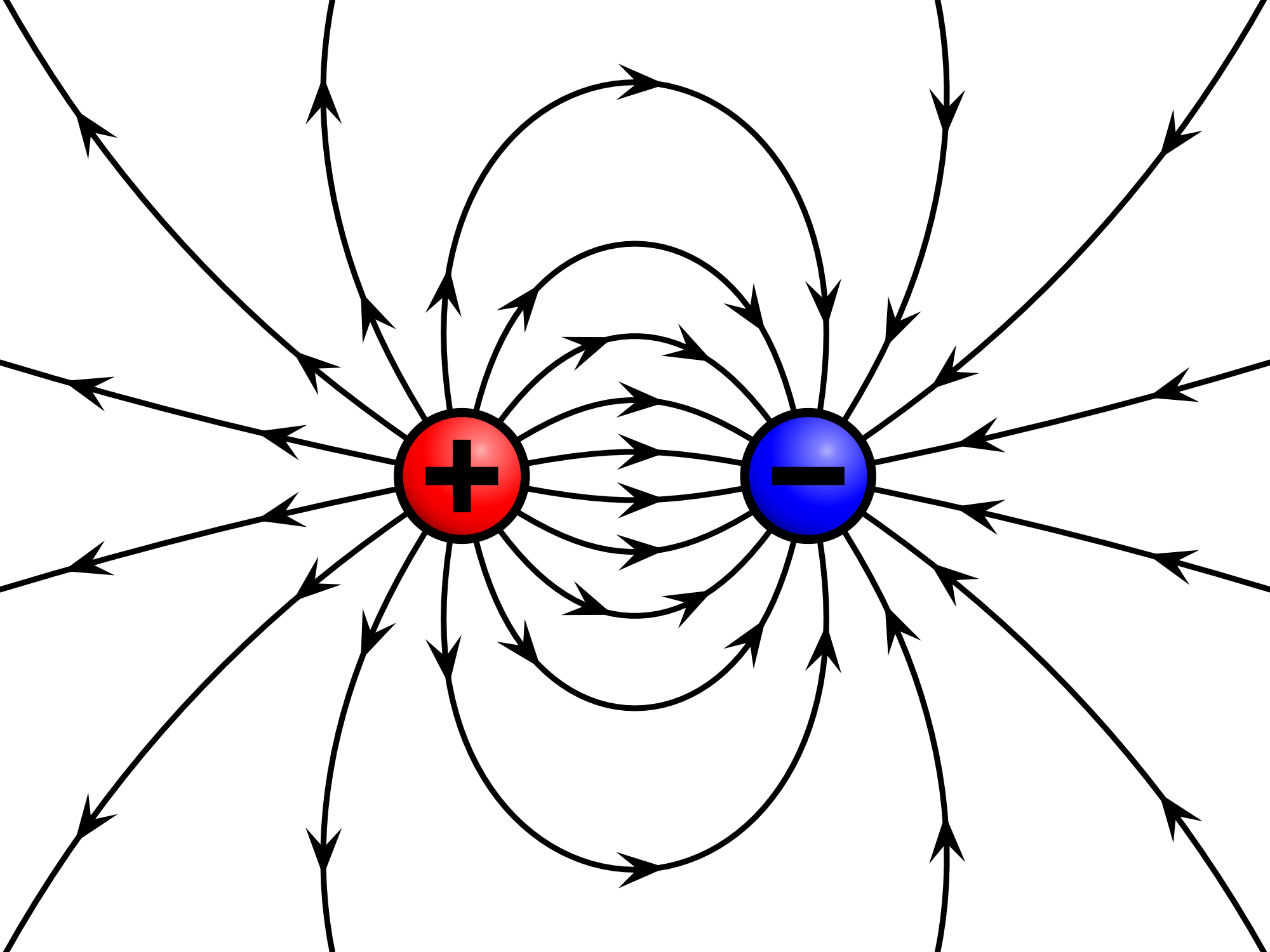
Electric charges produce electric fields. A moving charge also produces a magnetic field. The interaction of electric charges with an electromagnetic field (a combination of an electric and a magnetic field) is the source of the electromagnetic (or Lorentz) force, which is one of the four fundamental interactions in physics. The study of photon-mediated interactions among charged particles is called quantum electrodynamics.
The SI derived unit of electric charge is the coulomb (C) named after French physicist Charles-Augustin de Coulomb. In electrical engineering it is also common to use the ampere-hour (A⋅h). In physics and chemistry it is common to use the elementary charge (e) as a unit. Chemistry also uses the Faraday constant, which is the charge of one mole of elementary charges.
Charge is the fundamental property of matter that exhibits electrostatic attraction or repulsion in the presence of other matter with charge. Electric charge is a characteristic property of many subatomic particles. The charges of free-standing particles are integer multiples of the elementary charge e; we say that electric charge is quantized. Michael Faraday, in his electrolysis experiments, was the first to note the discrete nature of electric charge. Robert Millikan's oil drop experiment demonstrated this fact directly, and measured the elementary charge. It has been discovered that one type of particle, quarks, have fractional charges of either −1/3 or +2/3, but it is believed they always occur in multiples of integral charge; free-standing quarks have never been observed.
By convention, the charge of an electron is negative, −e, while that of a proton is positive, +e. Charged particles whose charges have the same sign repel one another, and particles whose charges have different signs attract. Coulomb's law quantifies the electrostatic force between two particles by asserting that the force is proportional to the product of their charges, and inversely proportional to the square of the distance between them. The charge of an antiparticle equals that of the corresponding particle, but with opposite sign.
The electric charge of a macroscopic object is the sum of the electric charges of the particles that it is made up of. This charge is often small, because matter is made of atoms, and atoms typically have equal numbers of protons and electrons, in which case their charges cancel out, yielding a net charge of zero, thus making the atom neutral.
Electric charge
Electric charge (symbol q, sometimes Q) is a physical property of matter that causes it to experience a force when placed in an electromagnetic field. Electric charge can be positive or negative. Like charges repel each other and unlike charges attract each other. An object with no net charge is referred to as electrically neutral. Early knowledge of how charged substances interact is now called classical electrodynamics, and is still accurate for problems that do not require consideration of quantum effects.
In an isolated system, the total charge stays the same - the amount of positive charge minus the amount of negative charge does not change over time. Electric charge is carried by subatomic particles. In ordinary matter, negative charge is carried by electrons, and positive charge is carried by the protons in the nuclei of atoms. If there are more electrons than protons in a piece of matter, it will have a negative charge, if there are fewer it will have a positive charge, and if there are equal numbers it will be neutral. Charge is quantized: it comes in integer multiples of individual small units called the elementary charge, e, about 1.602×10⁻¹⁹ C, which is the smallest charge that can exist freely. Particles called quarks have smaller charges, multiples of 1/3e, but they are found only combined in particles that have a charge that is an integer multiple of e. In the Standard Model, charge is an absolutely conserved quantum number. The proton has a charge of +e, and the electron has a charge of −e.
Today, a negative charge is defined as the charge carried by an electron and a positive charge is that carried by a proton. Before these particles were discovered, a positive charge was defined by Benjamin Franklin as the charge acquired by a glass rod when it is rubbed with a silk cloth.
Electric charges produce electric fields. A moving charge also produces a magnetic field. The interaction of electric charges with an electromagnetic field (a combination of an electric and a magnetic field) is the source of the electromagnetic (or Lorentz) force, which is one of the four fundamental interactions in physics. The study of photon-mediated interactions among charged particles is called quantum electrodynamics.
The SI derived unit of electric charge is the coulomb (C) named after French physicist Charles-Augustin de Coulomb. In electrical engineering it is also common to use the ampere-hour (A⋅h). In physics and chemistry it is common to use the elementary charge (e) as a unit. Chemistry also uses the Faraday constant, which is the charge of one mole of elementary charges.
Charge is the fundamental property of matter that exhibits electrostatic attraction or repulsion in the presence of other matter with charge. Electric charge is a characteristic property of many subatomic particles. The charges of free-standing particles are integer multiples of the elementary charge e; we say that electric charge is quantized. Michael Faraday, in his electrolysis experiments, was the first to note the discrete nature of electric charge. Robert Millikan's oil drop experiment demonstrated this fact directly, and measured the elementary charge. It has been discovered that one type of particle, quarks, have fractional charges of either −1/3 or +2/3, but it is believed they always occur in multiples of integral charge; free-standing quarks have never been observed.
By convention, the charge of an electron is negative, −e, while that of a proton is positive, +e. Charged particles whose charges have the same sign repel one another, and particles whose charges have different signs attract. Coulomb's law quantifies the electrostatic force between two particles by asserting that the force is proportional to the product of their charges, and inversely proportional to the square of the distance between them. The charge of an antiparticle equals that of the corresponding particle, but with opposite sign.
The electric charge of a macroscopic object is the sum of the electric charges of the particles that it is made up of. This charge is often small, because matter is made of atoms, and atoms typically have equal numbers of protons and electrons, in which case their charges cancel out, yielding a net charge of zero, thus making the atom neutral.
Recent media
Recent media