


Community hub
Recent from talks
Contribute something
Nothing was collected or created yet.
Neutral-density filter
View on Wikipedia | This article needs additional citations for verification. (June 2015) |


In photography and optics, a neutral-density filter, or ND filter, is a filter that reduces or modifies the intensity of all wavelengths, or colors, of light equally, giving no changes in hue of color rendition. It can be a colorless (clear) or grey filter, and is denoted by Wratten number 96. The purpose of a standard photographic neutral-density filter is to reduce the amount of light entering the lens. Doing so allows the photographer to select combinations of aperture, exposure time and sensor sensitivity that would otherwise produce overexposed pictures. This is done to achieve effects such as a shallower depth of field or motion blur of a subject in a wider range of situations and atmospheric conditions.
For example, one might wish to photograph a waterfall at a slow shutter speed to create a deliberate motion-blur effect. The photographer might determine that to obtain the desired effect, a shutter speed of ten seconds was needed. On a very bright day, there might be so much light that even at minimal film speed and a minimal aperture, the ten-second shutter speed would let in too much light, and the photo would be overexposed. In this situation, applying an appropriate neutral-density filter is the equivalent of stopping down one or more additional stops, allowing the slower shutter speed and the desired motion-blur effect.
Mechanism
[edit]The term "neutral-density filter" refers to any filter that blocks a range of wavelengths evenly, so mechanisms and constructions vary. Reflective ND filters use thin coatings to reflect light. The coatings vary in composition, often consisting of metal ions, and can be specialized for use-case and spectrum. Absorptive filters change the composition of the glass itself, and may include an anti-reflective coating.[1][2]
For an ND filter with optical density d, the fraction of the optical power transmitted through the filter can be calculated as

where I is the intensity after the filter, and I0 is the incident intensity.[3]
Uses
[edit] |

The use of an ND filter allows the photographer to use a larger aperture that is at or below the diffraction limit, which varies depending on the size of the sensory medium (film or digital) and for many cameras is between f/8 and f/11, with smaller sensory medium sizes needing larger-sized apertures, and larger ones able to use smaller apertures. ND filters can also be used to reduce the depth of field of an image (by allowing the use of a larger aperture) where otherwise not possible due to a maximal shutter speed limit.
Instead of reducing the aperture to limit light, the photographer can add a ND filter to limit light, and can then set the shutter speed according to the particular motion desired (blur of water movement, for example) and the aperture set as needed (small aperture for maximal sharpness or large aperture for narrow depth of field (subject in focus and background out of focus)). Using a digital camera, the photographer can see the image right away and choose the best ND filter to use for the scene being captured by first knowing the best aperture to use for maximal sharpness desired. The shutter speed would be selected by finding the desired blur from subject movement. The camera would be set up for these in manual mode, and then the overall exposure adjusted darker by adjusting either aperture or shutter speed, noting the number of stops needed to bring the exposure to that which is desired. That offset would then be the amount of stops needed in the ND filter to use for that scene.

Examples of this use include:
- Blurring water motion (e.g. waterfalls, rivers, oceans).
- Reducing depth of field in very bright light (e.g. daylight).
- When using a flash on a camera with a focal-plane shutter, exposure time is limited to the maximal speed (often 1/250th of a second, at best), at which the entire film or sensor is exposed to light at one instant. Without an ND filter, this can result in the need to use f/8 or higher.
- Using a wider aperture to stay below the diffraction limit.
- Reduce the visibility of moving objects.
- Add motion blur to subjects.
- Extended time exposures
Neutral-density filters are used to control exposure with photographic catadioptric lenses, since the use of a traditional iris diaphragm increases the ratio of the central obstruction found in those systems, leading to poor performance.
ND filters find applications in several high-precision laser experiments because the power of a laser cannot be adjusted without changing other properties of the laser light (e.g. collimation of the beam). Moreover, most lasers have a minimal power setting at which they can be operated. To achieve the desired light attenuation, one or more neutral-density filters can be placed in the path of the beam.
Large telescopes can cause the Moon and planets to become too bright and lose contrast. A neutral-density filter can increase the contrast and cut down the brightness, making these objects easier to view.
Varieties
[edit] |
A graduated ND filter is similar, except that the intensity varies across the surface of the filter. This is useful when one region of the image is bright and the rest is not, as in a picture of a sunset.
The transition area, or edge, is available in different variations (soft, hard, attenuator). The most common is a soft edge and provides a smooth transition from the ND side and the clear side. Hard-edge filters have a sharp transition from ND to clear, and the attenuator edge changes gradually over most of the filter, so the transition is less noticeable.
Another type of ND filter configuration is the ND-filter wheel. It consists of two perforated glass disks that have progressively denser coating applied around the perforation on the face of each disk. When the two disks are counter-rotated in front of each other, they gradually and evenly go from 100% transmission to 0% transmission. These are used on catadioptric telescopes mentioned above and in any system that is required to work at 100% of its aperture (usually because the system is required to work at its maximal angular resolution).
In practice, ND filters are not perfect, as they do not reduce the intensity of all wavelengths equally. This can sometimes create color casts in recorded images, particularly with inexpensive filters. More significantly, most ND filters are only specified over the visible region of the spectrum and do not proportionally block all wavelengths of ultraviolet or infrared radiation. This can be dangerous if using ND filters to view sources (such as the Sun or white-hot metal or glass), which emit intense invisible radiation, since the eye may be damaged even though the source does not look bright when viewed through the filter. Special filters must be used if such sources are to be safely viewed.
An inexpensive, homemade alternative to professional ND filters can be made from a piece of welder's glass. Depending on the rating of the welder's glass, this can have the effect of a 10-stop filter.
Variable neutral-density filter
[edit]One main disadvantage of neutral-density filters is that different shooting situations often require a variety of filters, which can become quite expensive. For example, using screw-on filters requires a separate set for each lens diameter, though inexpensive step-up rings can minimize this requirement.
To address this issue, some manufacturers have developed variable ND filters. These filters consist of two polarizing filters, with at least one being rotatable. The rear filter blocks light in one plane, while the front filter can be adjusted. As the front filter rotates, it cuts down the amount of light reaching the camera sensor, allowing for nearly infinite control over light levels.
The advantage of this approach is reduced bulk and expenses, but one drawback is a loss of image quality caused by both using two elements together and by combining two polarizing filters.
Extreme ND filters
[edit]To create ethereal looking landscapes and seascapes with extremely blurred water or other motion, the use of multiple stacked ND filters might be required. This has, as in the case of variable NDs, the effect of reducing image quality. To counter this, some manufacturers have produced high-quality extreme ND filters. Typically these are rated at a 10-stop reduction, allowing very slow shutter speeds even in relatively bright conditions.
Ratings
[edit]In photography, ND filters are quantified by their optical density or equivalently their f-stop reduction. In microscopy, the transmittance value is sometimes used. In astronomy, the fractional transmittance is sometimes used (eclipses).
| Notation | Lens area opening, as fraction of the complete lens | f-stop reduction (approx.) | ANSI shade (approx.)[4] | Fractional transmittance | ||||
|---|---|---|---|---|---|---|---|---|
| Optical density | ND1number | ND.number | NDnumber | |||||
| 0.0 | 1 | 0 | — | 100% | 1 | |||
| 0.3 | ND 101 | ND 0.3 | ND2 | 1/2 | 1 | 1.7 | 50% | 0.5 |
| 0.6 | ND 102 | ND 0.6 | ND4 | 1/4 | 2 | 2.4 | 25% | 0.25 |
| 0.9 | ND 103 | ND 0.9 | ND8 | 1/8 | 3 | 3.11 | 12.5% | 0.125 |
| 1.0 | ND 1.0 | ND10 | 1/10 | ≈ 3+1⁄3 | 3.33 | 10 % | 0.10 | |
| 1.2 | ND 104 | ND 1.2 | ND16 | 1/16 | 4 | 3.81 | 6.25% | 0.0625 |
| 1.5 | ND 105 | ND 1.5 | ND32 | 1/32 | 5 | 4.51 | 3.125% | 0.03125 |
| 1.8 | ND 106 | ND 1.8 | ND64 | 1/64 | 6 | 5.21 | 1.563% | 0.015625 |
| 2.0 | ND 2.0 | ND100 | 1/100 | ≈ 6+2⁄3 | 5.67 | 1% | 0.01 | |
| 2.1 | ND 107 | ND 2.1 | ND128 | 1/128 | 7 | 5.92 | 0.781% | 0.0078125 |
| 2.4 | ND 108 | ND 2.4 | ND256 | 1/256 | 8 | 6.62 | 0.391% | 0.00390625 |
| 2.6 | ND400 | 1/400 | ≈ 8+2⁄3 | 7.07 | 0.25% | 0.0025 | ||
| 2.7 | ND 109 | ND 2.7 | ND512 | 1/512 | 9 | 7.32 | 0.195% | 0.001953125 |
| 3.0 | ND 110 | ND 3.0 | ND1024 (also called ND1000) | 1/1024 | 10 | 8.00 | 0.1% | 0.001 |
| 3.3 | ND 111 | ND 3.3 | ND2048 | 1/2048 | 11 | 8.72 | 0.049% | 0.00048828125 |
| 3.6 | ND 112 | ND 3.6 | ND4096 | 1/4096 | 12 | 9.45 | 0.024% | 0.000244140625 |
| 3.8 | ND 3.8 | ND6310 | 1/6310 | ≈ 12+2⁄3 | 9.86 | 0.016% | 0.000158489319246 | |
| 3.9 | ND 113 | ND 3.9 | ND8192 | 1/8192 | 13 | 10.15 | 0.012% | 0.0001220703125 |
| 4.0 | ND 4.0 | ND10000 | 1/10000 | ≈ 13+1⁄3 | 10.33 | 0.01% | 0.0001 | |
| 5.0 | ND 5.0 | ND100000 | 1/100000 | ≈ 16+2⁄3 | 12.67 | 0.001% | 0.00001 | |
- Note: Hoya, B+W, Cokin use code ND2 or ND2x, etc.; Lee, Tiffen use code 0.3ND, etc.; Leica uses code 1×, 4×, 8×, etc.[5]
- Note: ND 3.8 is the correct value for solar CCD exposure without risk of electronic damage.[citation needed]
- Note: ND 5.0 is the minimum for direct eye solar observation without damage of retina. A further check must be performed for the particular filter used, checking on the spectrogram that also UV and IR are mitigated with the same value.[citation needed]
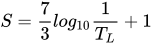
- Note: ANSI shades are defined by standard as ranges with central values. They are here approximated using the equation from ANSI Z87.1, , which bases luminous transmittance () on CIE Illuminant A; ANSI shade numbers have much lower limits for ultraviolet transmittance.[4]

References
[edit]- ^ "Understanding Neutral Density Filters". Edmund Optics. Retrieved 8 February 2025.
- ^ "ND Filters - Andover Corporation". Andover Corporation.
- ^ Hanke, Rudolph (1979). Filter-Faszination (in German). Monheim/Bayern. p. 70. ISBN 3-88324-991-2.
{{cite book}}: CS1 maint: location missing publisher (link) - ^ a b American National Standards Institute; American Society of Safety Engineers (2003). "ANSI Z87.1-2003: Practice for Occupational and Educational Eye and Face Protection, 29".
- ^ "CAMERA LENS FILTERS". Retrieved June 12, 2014.
External links
[edit]
- Neutral Density Filter Calculation Chart
- Neutral Density Filters and Graduated ND Filters
- What do ND filters do, and what do they NOT do?
- Neutral Density Filters: What are they & when to use them ? Archived 2017-06-13 at the Wayback Machine
- Neutral Density Filter FAQ at Digital Grin Photography Forum Archived 2016-03-07 at the Wayback Machine
| National | |
|---|---|
| Other | |

Neutral-density filter
View on GrokipediaFundamentals
Definition and Purpose
A neutral-density filter is an optical component designed to uniformly reduce the intensity of light across the visible spectrum without introducing color distortion or altering the relative spectral distribution.[1] This attenuation occurs evenly for all wavelengths, ensuring that the filter maintains color neutrality while decreasing overall light transmission to a desired level.[5][6] The primary purpose of a neutral-density filter is to provide photographers and optical engineers with greater control over exposure in high-light conditions, allowing for creative adjustments that would otherwise be impossible due to overexposure risks.[3] By reducing incoming light, these filters enable the use of wider apertures to achieve shallow depth of field or longer shutter speeds to capture motion blur effects, such as rendering flowing water as silky textures in waterfalls.[2] They also permit lower ISO settings to minimize noise while preserving image quality, thereby preventing overexposure and supporting artistic expression without compromising technical performance.[1][7] In practical terms, neutral-density filters are commonly employed in photography to handle bright outdoor scenes, like seascapes where extended exposures can smooth wave movements into ethereal patterns.[2] In broader optics applications, they manage intense light sources by attenuating beam power to safe or optimal levels for sensors and detectors, facilitating precise experimentation without spectral bias.[4] This foundational role in light control underscores their versatility across visual and scientific domains.Mechanism of Action
Neutral-density filters operate through two primary mechanisms: absorptive and reflective. In absorptive filters, light is attenuated by embedding dyes or pigments into a glass or resin substrate, where photons are absorbed and converted into heat, reducing the intensity without significantly altering the light's direction.[8] Reflective filters, conversely, employ multi-layer metallic or dielectric coatings on a substrate to reflect a portion of the incident light away from the transmission path, allowing the remainder to pass through.[1] The physics of attenuation in these filters relies on achieving a uniform reduction in light intensity across the visible spectrum to maintain color balance, meaning the relative intensities of different wavelengths remain proportional to the incident light. This neutrality is ideal for preserving the original color rendition, as the filter's transmission spectrum is designed to be spectrally flat within its operational range. However, low-quality filters may exhibit imperfections such as slight color casts due to non-uniform absorption or reflection across wavelengths, or uneven transmission that can lead to variations in density across the filter surface.[1][8][9] The degree of attenuation is quantified by optical density , defined as , where is the fractional transmittance (a value between 0 and 1). This logarithmic relationship arises from the fundamental nature of light attenuation in optics, where each unit of optical density corresponds to a tenfold reduction in intensity. Consequently, the fractional transmittance is given by ; for example, an optical density of 2.0 results in , or 1% transmission.[8][1][10] Performance is influenced by wavelength dependency, as ideal neutrality holds only within a specified spectral band; absorptive filters, for instance, may show reduced effectiveness beyond 650 nm due to material limitations, while some designs exhibit UV or IR leakage where transmission increases outside the visible range.[8][1]Types and Varieties
Fixed Neutral-Density Filters
Fixed neutral-density filters feature a solid, uniform density across their entire surface, ensuring consistent light reduction without variation in attenuation. These filters are typically available in circular formats that screw directly onto the front of camera lenses or in square/rectangular formats designed for insertion into filter holders, allowing compatibility with various lens sizes and systems. This design provides predictable performance in scenarios requiring stable exposure control, such as long-exposure photography or maintaining consistent aperture settings.[3][11] The primary materials for fixed neutral-density filters include optical-grade glass or resin substrates, which are selected for their clarity and durability. Absorptive types incorporate embedded dyes or metallic oxides within the glass to absorb light evenly across wavelengths, while reflective types use thin metallic coatings, such as inconel or chromium, applied to the surface to redirect light. Manufacturing involves precise processes: for absorptive filters, molten glass is mixed with attenuating agents before being cast, ground, and polished; reflective filters employ physical vapor deposition (PVD) or sputtering in vacuum chambers to deposit uniform metallic layers. These methods ensure minimal spectral deviation and high optical quality.[12][1] Common strengths for fixed neutral-density filters range from light attenuation, such as ND2 (reducing light by 1 stop) to ND8 (3 stops), suitable for moderate exposure adjustments, to heavier options like ND100 (6-7 stops) or ND1000 (10 stops) for extreme light reduction in bright conditions. These fixed densities allow photographers and cinematographers to select a specific filter for consistent results without adjustment.[1][13] Advantages of fixed neutral-density filters include their high optical quality, with no moving parts to introduce mechanical issues or color shifts, resulting in minimal distortion and excellent image fidelity. Absorptive variants offer true color neutrality and resistance to environmental damage, while reflective types provide lightweight construction and precise wavelength control, making them ideal for demanding applications like scientific imaging. Overall, their simplicity and reliability establish them as the baseline for uniform light attenuation needs.[12][14]Variable Neutral-Density Filters
Variable neutral-density filters, also known as adjustable or VND filters, are designed using two polarizing elements, typically linear or circular polarizers, mounted in a rotatable frame that allows the user to vary the light transmission by adjusting their relative orientation.[15] When the polarizers are aligned parallel, maximum light passes through; rotating them toward a crossed position progressively reduces transmission, achieving densities equivalent to 1 to 8 stops of light reduction depending on the model.[16] This mechanism exploits the principle of polarization, where the second polarizer blocks components of light oscillating in unwanted directions, providing variable attenuation without altering the spectral balance in ideal conditions.[17] However, the crossed polarizer design introduces limitations, particularly at extreme settings where color shifts—such as a warm or cool cast—can occur due to uneven attenuation across wavelengths.[18] Additionally, vignetting may appear on wide-angle lenses, especially beyond 5-6 stops, as the angled light rays interact unevenly with the filter edges.[19] Common implementations include circular screw-on filters optimized for video applications, where manual rotation enables quick adjustments during shoots, and electronic variants that employ liquid crystal displays (LCD) to electrically control polarization and density without mechanical parts.[20] For instance, systems like Panavision's LCND use liquid crystal technology to modulate transmittance from ND 0.3 to 1.8 electronically, offering precise, repeatable control.[21] These filters provide significant flexibility for dynamic lighting conditions, allowing cinematographers to maintain consistent exposure settings like shutter speed and aperture without swapping filters, which is particularly advantageous in fast-paced environments. In contrast to fixed neutral-density filters, variables reduce the need for multiple accessories, though they often come at a higher cost and may compromise perfect color neutrality compared to static glass options.[22] A practical example is their use in run-and-gun cinematography, where operators can dial in exposure adjustments on the fly during documentaries or event filming to achieve cinematic motion blur without interrupting the workflow.[23]Specialized Variants
Graduated neutral density (ND) filters feature a partial coverage design with a gradient transition from clear to opaque, allowing photographers to balance exposure in high-contrast scenes such as bright skies over darker foregrounds like land or sea horizons.[3] These filters are available in hard-edge variants, which provide an abrupt transition suitable for sharp horizons, and soft-edge variants, which offer a gradual blend ideal for uneven landscapes.[24] By positioning the darker portion over the brighter area, they equalize light intensity without affecting the overall color balance, preserving details in both highlights and shadows.[25] Extreme ND filters, often rated at 10 or more stops of light reduction (e.g., ND1000 for 10 stops), enable ultra-long exposures in bright conditions, such as 10-second shots during daylight to capture motion blur in water or clouds.[26] These high-density filters, like the LEE Big Stopper, reduce light transmission by a factor of 1000 or greater, facilitating creative effects in landscape photography while maintaining wide apertures for shallow depth of field.[27] Variants exceeding 15 stops, such as the LEE Super Stopper, support even longer exposures but require precise metering to avoid overexposure.[27] Other specialized variants include ND filter wheels, which consist of rotating discs or carousels housing multiple filters for telescopes, allowing seamless switching between ND levels and other types during astrophotography sessions without removing the camera.[28] Infrared (IR) and ultraviolet (UV)-specific ND filters are engineered for extended spectral ranges, with UV-NIR models covering 190 nm to 1.7 μm and IR models from 2 μm to 14 μm, ensuring uniform attenuation in scientific applications like spectroscopy or thermal imaging.[29][30] In catadioptric lens systems, such as mirror telephoto lenses, ND filters are integrated to control exposure due to the fixed aperture design, often placed at the rear to adjust light without altering depth of field.[31] Unique challenges with these variants include safety concerns, as standard ND filters do not sufficiently block ultraviolet (UV) and infrared (IR) radiation, making them unsuitable for direct solar viewing without certified solar-specific certifications that meet ISO 12312-2 standards.[32] Extreme high-density filters can introduce color casts, particularly greenish or magenta tints, due to uneven spectral transmission in dense materials, which worsens with stacking or prolonged use.[33] Additionally, the bulk of high-density glass constructions increases weight and may cause vignetting in wide-angle setups.[3]Ratings and Specifications
Optical Density and Transmittance
Optical density (OD), also known as absorbance, quantifies the attenuation of light by a neutral-density (ND) filter and is defined on a logarithmic scale as , where is the transmittance fraction.[34][35] This metric indicates the filter's ability to reduce light intensity, with higher OD values corresponding to greater attenuation; for instance, an OD of 3.0 results in a transmittance of 0.001, or 0.1% of the incident light passing through.[35] Transmittance is calculated as the ratio of the output light intensity to the input light intensity , expressed as .[34] In practical terms, this represents the fraction of light transmitted by the filter; for example, an ND8 filter has a transmittance of 0.125, allowing 12.5% of the incident light to pass.[36] Ideally, ND filters exhibit uniform transmittance across the visible spectrum from 400 to 700 nm to maintain color neutrality, but real-world filters may show slight variations due to wavelength-dependent material properties.[5] The following table lists common ND filter designations with their corresponding optical densities and transmittance values:| ND Designation | Optical Density (OD) | Transmittance (T, %) |
|---|---|---|
| ND2 | 0.3 | 50 |
| ND4 | 0.6 | 25 |
| ND8 | 0.9 | 12.5 |
| ND64 | 1.8 | 1.6 |
| ND1000 | 3.0 | 0.1 |
Filter Strength Measurement
The strength of a neutral-density (ND) filter is most practically assessed in photography through the concept of stop reduction, where each stop corresponds to halving the amount of light transmitted to the sensor.[3] For example, an ND4 filter reduces light by a factor of 4, equivalent to 2 stops, while an ND64 filter achieves a 6-stop reduction by allowing only 1/64 of the light through.[37] This system aligns directly with camera exposure adjustments, making it intuitive for users to compensate by extending shutter speed, widening aperture, or increasing ISO by the corresponding number of stops.[3] To convert between optical density (OD) and stops, the formula stops ≈ OD × 3.32 is used, derived from the logarithmic relationship where one stop halves light intensity (a factor of 2) and OD is base-10 logarithmic.[38] Photographers often compare filter strengths using multiple systems: ND numbers (e.g., ND8 for 1/8 transmission), OD values (e.g., 0.9), and percentage transmittance (e.g., 12.5%).[38] The ND number and stops are favored for their simplicity in exposure calculations, whereas OD provides precise scientific measurement but requires conversion for practical use; percentage transmittance, while straightforward, can be less intuitive for halving-based adjustments.[3]| System | Example (3 Stops) | Description | Pros | Cons |
|---|---|---|---|---|
| ND Number | ND8 | Fraction of light transmitted (1/8) | Easy to stack (multiply factors) | Less direct tie to exposure settings |
| Optical Density | 0.9 | -log₁₀(transmittance) | Precise for manufacturing and testing | Requires math for photographic use |
| % Transmittance | 12.5% | Light passing through as percentage | Simple visual concept | Ignores logarithmic exposure scales |
Applications and Uses
In Photography and Cinematography
In photography, neutral-density (ND) filters enable long exposures to capture motion blur effects, such as silky waterfalls or streaking clouds, by reducing light intake in bright conditions.[42] For instance, a 10-stop ND filter can extend shutter speeds from 1/60 second to 15 seconds, transforming static scenes into dynamic ones with blurred cloud movement over landscapes.[42] This technique is particularly useful for creative landscape work, where tripods provide essential stability during these extended exposures to prevent camera shake.[42] ND filters also allow photographers to maintain wide apertures in harsh daylight, preserving shallow depth of field for pronounced bokeh while avoiding overexposure.[43] By blocking excess light, they permit settings like f/2.8 without raising ISO or narrowing the aperture, which would otherwise compromise the blurred background effect in portraits or macro shots.[43] In cinematography, ND filters are vital for sustaining consistent frame rates and shutter speeds in bright environments, ensuring natural motion blur without sacrificing creative control.[43] For 24 frames per second footage, they facilitate a 1/50-second shutter speed to mimic film-like motion, while enabling wide apertures for shallow depth of field that isolates subjects effectively.[43] Variable ND filters prove especially practical during dynamic shoots, adjusting exposure on the fly to maintain uniformity as lighting changes with camera movement.[43] Common techniques include stacking multiple ND filters to achieve higher densities beyond single-filter limits, such as combining a 6-stop and 10-stop for extreme light reduction in midday scenes.[44] Paired with tripods, this method supports precise long exposures, though care must be taken to minimize light leaks between stacked elements.[44] In modern applications, ND filters enhance drone photography by controlling exposure in intense sunlight, allowing ND16 or ND32 strengths to achieve balanced shutter speeds for smooth aerial footage without washed-out highlights.[45] For smartphones, clip-on ND filters provide portable solutions for videography and photography, enabling variable density (e.g., ND2-32) to capture professional-grade motion blur or bokeh on devices like iPhones during outdoor shoots.[46] Challenges in these fields include flare from filter coatings, which can introduce unwanted light artifacts, particularly with uncoated or low-quality NDs under direct sun; multi-coated versions mitigate this by reducing reflections.[44] Additionally, stacking filters may exacerbate flare if not properly sealed, necessitating lens hoods or gaskets for optimal results.[44]In Scientific and Optical Instruments
In scientific and optical instruments, neutral-density (ND) filters play a crucial role in managing light intensity to enable precise measurements and observations without altering the spectral composition of the light source. These filters attenuate incoming light uniformly across wavelengths, preventing detector saturation and allowing for controlled exposure in high-precision setups such as telescopes, spectrometers, and microscopes.[1] In astronomy, ND filters are employed in telescopes to reduce glare and enhance contrast during observations of bright celestial objects like the Moon and planets. For instance, an ND 0.3 filter, which transmits about 50% of light, is suitable for small telescopes under 80 mm aperture when viewing a crescent Moon, minimizing overwhelming brightness while preserving detail.[47] In larger observatories, such as the Gemini facility, ND filters are integrated into focal plane units to avoid saturation from bright targets, ensuring accurate imaging data collection.[48] For solar observation, specialized neutral-density solar filters with optical densities of 5.0 or greater (attenuating light by a factor of 100,000) are used as front-mounted filters on telescopes to safely reduce the Sun's intense radiance, certified to block harmful UV and IR radiation in compliance with standards like ISO 12312-2; they are not standalone protective measures for direct viewing.[49][50] In laser systems and spectroscopy, ND filters attenuate beam intensity evenly without introducing spectral distortions, which is essential for maintaining the integrity of experimental data in techniques like interferometry and power metering. These filters reduce laser power by orders of magnitude— for example, stacking multiple ND filters can achieve attenuations suitable for safe handling of high-energy beams— while preserving beam profile and wavelength characteristics.[5][51] In spectroscopic applications, high-optical-density (OD) ND filters, such as those with OD ≥5.0, are used in Fourier-transform infrared (FT-IR) spectrometers to measure transmittance of intense sources accurately, enabling characterization of ultra-thin filters for infrared systems.[52][53] For microscopy, ND filters control illumination levels to prevent sensor overload and facilitate optimal sample visualization, particularly in photomicrography where uniform light reduction avoids color shifts. A neutral-density filter reduces incoming light intensity across all wavelengths by a specified factor, such as ND 0.5 for 50% transmission, allowing precise exposure adjustments without altering lamp voltage.[54][55] In projectors used for optical instrumentation, ND filters similarly manage output brightness to maintain contrast and prevent glare in controlled environments, such as calibration setups, by uniformly attenuating light without affecting color balance.[56] In catadioptric systems like Schmidt-Cassegrain telescopes, ND filters help balance light paths by reducing intensity in the converging beam, improving image quality for planetary and lunar observations without introducing aberrations.[57] These compact designs benefit from ND filters threaded into the eyepiece or barrel to cut glare, as seen in 1.25-inch formats that transmit 13% of light for enhanced clarity on bright objects.[58] In medical endoscopes, ND filters are incorporated into imaging systems to regulate light for tissue examination, often in fluorescence setups where they separate emission signals from background coherence while attenuating overall intensity.[59] For example, in optical coherence tomography-laser-induced fluorescence (OCT-LIF) endoscopes, ND filters adjust source power to protect detectors during in vivo procedures.[60] Safety considerations are paramount when using ND filters with high-intensity sources like lasers; certified filters from reputable manufacturers, such as those compliant with laser safety standards (e.g., ANSI Z136), must be selected to ensure they withstand beam power without degradation or scattering hazardous reflections.[61][52] Reflective ND designs are preferred for laser applications due to their non-absorptive nature, minimizing heat buildup and enabling safe attenuation in precision instruments.[62]History and Development
Early Development
The development of neutral-density (ND) filters originated in the early 20th century, driven by the needs of emerging cinematography during the silent film era. In 1929, Edwin Land invented neutral density filters while developing sheet polarizers. Eastman Kodak played a pivotal role, acquiring the filter-making company of Frederick Wratten and C.E.K. Mees in 1912 and continuing production of gelatin-based ND filters under the Wratten system. These early filters, such as the No. 96 neutral density variant, were designed to reduce light intensity uniformly without altering color rendition, allowing filmmakers to control exposure in varying lighting conditions for black-and-white silent films.[63][64][65] Key milestones in the 1920s included the introduction of glass-dyed ND filters by optical firms, offering greater durability compared to fragile gelatin sheets. For instance, Kodak's 1928 launch of Kodacolor, an early amateur color motion picture film, incorporated neutral-density filters to adjust exposure in bright outdoor scenes, marking a significant step in their integration with color processes.[66] Initial ND filters relied on dyed gelatin emulsions suspended between glass plates for light absorption, providing precise density control but prone to limitations like dye fading from prolonged light exposure or environmental degradation. Basic glass absorption methods emerged as alternatives in the interwar period, using metallic or dyed coatings to achieve similar neutral attenuation. Companies such as Tiffen, founded in 1938 by Sol Tiffen and later expanded by his brothers, contributed to standardizing these designs through improved manufacturing, laying groundwork for more reliable optical quality in the late 1930s.[67][68] The evolution of early ND filters was largely propelled by Hollywood's growing demand for consistent lighting in the transition to early color films.Modern Advancements
In the 1990s, advancements in neutral-density filter technology focused on material innovations, particularly the adoption of multi-layer dielectric coatings, which improved color neutrality and durability over traditional metallic films by distributing light attenuation across thin dielectric layers without introducing significant spectral shifts or heat buildup.[69] These coatings, often comprising dozens of alternating high- and low-index layers, achieved optical densities up to 4.0 while maintaining broadband performance from visible to near-infrared wavelengths, enabling more reliable use in professional optics.[70] Concurrently, resin-based composites emerged as lightweight alternatives to glass, offering densities from 0.1 to 3.0 with thicknesses as low as 1.5 mm and facilitating easier handling in field applications.[71] The digital era of the 2010s saw the rise of variable neutral-density filters, which addressed the limitations of fixed-density models in adapting to digital sensors' dynamic range constraints, allowing photographers to maintain shallow depth of field in bright conditions without overexposing highlights. Early electro-optic variants, leveraging liquid crystal technology for electronically tunable attenuation, providing seamless adjustment from 1 to 7 stops without mechanical parts, though initial implementations were limited by response times and voltage requirements.[72] This integration proved essential for digital cinematography, where sensors like CMOS required precise light control to avoid clipping in high-contrast scenes.[61] From the 2010s to 2025, nano-coatings improved filter surfaces with hydrophobic and anti-reflective layers, enhancing longevity in harsh environments while preserving transmittance neutrality. Affordable smartphone adapters, such as magnetic mounts compatible with 58-67 mm threads, democratized ND use for mobile videography, enabling 2-5 stop reductions on devices like iPhone models to simulate cinematic motion blur. Apps for ND filter selection, including calculator tools that simulate exposure times based on filter stacks up to 5 units, further streamlined workflows, though AI integration remains emerging for real-time recommendations tied to scene analysis.[73][74][75] Expansions in application included ND filters in VR/AR optics, where they reduce eye strain by limiting luminance in immersive displays without altering spectral balance.[76] In high-speed scientific imaging, variable NDs control pulse energy while avoiding sensor saturation.[77] Environmental concerns have driven sustainable material shifts, with manufacturers exploring recycled resins to respond to demands for eco-friendly optics.[78] Key companies like Hoya advanced extreme densities with the HD MKII series, achieving 10-stop (ND1000) reductions via ACCU-ND technology that neutralizes infrared shifts for digital sensors.[2] B+W (Schneider Kreuznach) innovated with MRC Nano coatings on ND 800-series filters, offering up to 13-stop attenuation (ND8000) and scratch resistance exceeding 7H hardness.[79] Lee Filters contributed through the Super Stopper, delivering 15-stop densities (ND100000) for ultra-long exposures while maintaining color fidelity across the visible spectrum.[80][81]References
- https://camera-wiki.org/wiki/Mirror_lens