


Community hub
Recent from talks
Contribute something
Nothing was collected or created yet.
Nikon 1 series
View on Wikipedia

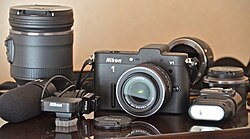
The Nikon 1 series is a line of mirrorless interchangeable lens cameras from Nikon, originally announced on 21 September 2011.[1] The cameras utilized Nikon 1-mount lenses, and featured 1" CX format sensors. The FT-1 adapter was available, which allowed Nikon 1 users to mount nearly all Nikon F-mount lenses, with significant limitations on non-autofocus lenses and autofocus lenses without an internal focusing motor.
Nikon discontinued the Nikon 1 series in July 2018[2] and launched the mirrorless -series cameras later that year, using full-frame sensors and a new Nikon Z-mount line of lenses. The Nikon Z7 and Nikon Z6 were the first two models. As of 2024, the Nikon Z-series also has largely replaced Nikon's D-series DSLRs with APS-C and full-frame sensors.

Cameras
[edit]The series included the Nikon 1 V1, J1, J2,[3] and S1 with a 10-megapixel image sensor, the V2, J3, S2 and AW1 with a 14-megapixel image sensor and further increased autofocus speed to 15 frames per second (fps),[4] and the 1 V3, J4 with a new 18-megapixel image sensor, further increased autofocus speed to 20 fps, 120 fps HD slow-motion at 1280 x 720 and 1080/60p.[5] The J5 model added a 20.8MP sensor in 2015 and kept most other technical specifications the same as the J4 model.
At the time of announcement, Nikon claimed that the cameras featured the world's fastest autofocus, with 10 fps—even during videos—based on hybrid autofocus (phase detection/contrast-detect AF with AF-assist illuminator), as well as the world's fastest continuous shooting speed (60 fps) among all cameras with interchangeable lenses.[6] Slow-motion movies can be captured in up to 1200 fps with reduced resolution. Its inbuilt intervalometer enables time-lapse photography.
| Name | Image | Release | Res. (MP) | Video | EVF | Mech.[a] | Elec.[b] | ISO | Wi-Fi | W×H×D | Wgt. | Notes |
|---|---|---|---|---|---|---|---|---|---|---|---|---|
| V Series – advanced cameras with EVFs | ||||||||||||
| V1 | 
|
Sep 21, 2011 | 10.1 (3:2, 3872×2592) | 1080(60i/30p), 720(60p) |  Yes, 1440k-dot Yes, 1440k-dot
|
Yes |
Yes |
100–3200 |  No No
|
113×76×43.5 mm (4.4×3.0×1.7 in) | 383 g (13.5 oz) | [7][8] |
| V2 | .jpg)
|
Oct 24, 2012 | 14.2 (3:2, 4608×3072) | 1080(60i/30p), 720(60p/30p) | Yes, 1440k-dot
|
Yes |
Yes |
160–6400 | WU-1b | 107.8×81.6×45.9 mm (4.2×3.2×1.8 in) | 337 g (11.9 oz) | [9][10] |
| V3 | 
|
Mar 13, 2014 | 18.4 (3:2, 5232×3488) | 1080(60p/30p), 720(60p/30p) | Opt., 1440k-dot | Yes |
Yes |
160–12800 | Yes
|
110.9×65.0×33.2 mm (4.4×2.6×1.3 in) | 324 g (11.4 oz) | [11][12] |
| AW Series – all-weather camera | ||||||||||||
| AW1 | 
|
Sep 19, 2013 | 14.2 (3:2, 4608×3072) | 1080(60i/30p), 720(60p/30p) | No
|
No |
Yes |
160–6400 | WU-1b | 113.3×71.5×37.5 mm (4.5×2.8×1.5 in) | 356 g (12.6 oz) | [13][14] |
| J Series – for enthusiasts | ||||||||||||
| J1 | 
|
Sep 21, 2011 | 10.1 (3:2, 3872×2592) | 1080(60i/30p), 720(60p) | No
|
No |
Yes |
100–3200 | No
|
106.0×61.0×29.8 mm (4.2×2.4×1.2 in) | 277 g (9.8 oz) | [15][16] |
| J2 | 
|
Aug 9, 2012 | 10.1 (3:2, 3872×2592) | 1080(60i/30p), 720(60p) | No
|
No |
Yes |
100–3200 | No
|
106.0×61.0×29.8 mm (4.2×2.4×1.2 in) | 280 g (9.9 oz) | [17][18] |
| J3 |
|
Jan 8, 2013 | 14.2 (3:2, 4608×3072) | 1080(60i/30p), 720(60p/30p) | No
|
No |
Yes |
160–6400 | WU-1b | 101.0×60.5×28.8 mm (4.0×2.4×1.1 in) | 244 g (8.6 oz) | [19][20] |
| J4 |
|
Apr 10, 2014 | 18.4 (3:2, 5232×3488) | 1080(60p/30p), 720(60p/30p) | No
|
No |
Yes |
200–12800 | Yes
|
99.5×60.0×28.5 mm (3.9×2.4×1.1 in) | 232 g (8.2 oz) | [21][22] |
| J5 | 
|
Apr 2, 2015 | 20.8 (3:2, 5568×3712) | 1080(60p/30p), 720(60p/30p) | No
|
No |
Yes |
160–12800 | Yes
|
98.3×59.7×31.5 mm (3.9×2.4×1.2 in) | 265 g (9.3 oz) | [23][24] |
| S Series – introduction to interchangeable lenses | ||||||||||||
| S1 | 
|
Jan 8, 2013 | 10.1 (3:2, 3872×2592) | 1080(60i/30p), 720(60p/30p) | No
|
No |
Yes |
100–6400 | WU-1b | 102.0×60.5×29.7 mm (4.0×2.4×1.2 in) | 240 g (8.5 oz) | [25][20] |
| S2 | 
|
May 14, 2014 | 14.2 (3:2, 4592×3072) | 1080(60p/30p), 720(60p/30p) | No
|
No |
Yes |
200–12800 | WU-1a | 101.0×60.8×29.4 mm (4.0×2.4×1.2 in) | 230 g (8.1 oz) | [26][27] |
New technologies
[edit]- Nikon CX format with 2.7 times crop factor.[28] Although the image sensor area of 13.2 x 8.8mm is about half of the Micro Four Thirds system and a quarter of the Nikon DX format, it delivers a good performance for this small size,[29] comparable to older Four-Thirds sensors like Olympus E-5, Olympus PEN E-P3, Panasonic Lumix DMC-G3[30] or older DSLRs like Nikon D40.[31][32] The smaller sensor considerably increases the depth of field compared to a 35mm FX camera at the same angle of view and f-number.
- CMOS image sensor with integrated 73 phase detection sensors providing hybrid autofocus with both phase detection and 135-point contrast detect AF delivering what Nikon claimed to be fastest commercially available autofocus.[33][34]


- Nikon 1-mount and F-mount adapter FT1 enabling the use of all F-mount lenses especially with integrated autofocus motor. The FT1 adapter mounts and meters with all AI-P, AF, AF-S, D and G lenses and compatibles providing autofocus with all lenses with integrated autofocus motor.[35] It further mounts Pre-AI, AI, AI-S and E lenses without metering as well as lenses which jut out the F-mount (needing mirror lock-up on cameras with mirror). Although not recommended,[36] it is used with teleconverters for extreme telephotos.[37][38]
- Lenses featuring Rear Focusing (RF) system with reduced moving masses and world's fastest extremely quiet Voice Coil motors (VCM) or Stepping (STM) motors to speed-up autofocus.
- 3-Speed silent Power-Drive motor zoom in the Nikkor VR 10-100mm f/4.5-5.6 PD-Zoom optimized for shooting HD movies.[39]
- Nikon 1 Nikkor VR 10-100mm f/4.5-5.6 PD-Zoom integrates many technologies: 21 elements including 1 High Refractive Index (HRI, >2), 3 Extra-low Dispersion (ED) and 2 aspherical lenses,[40] Super Integrated Coating (SIC), internal focusing (IF) with world's fastest quiet Voice Coil motor, 3-speed silent PD-Zoom, Vibration Reduction (VR II), retractable lens mechanism and 7 rounded diaphragm blades.[41][42] Together with the Canon EF 28-300mm lens it is the only current superzoom with 20 elements or more.
- Fast electronic shutter (1/16 000) or additional electronically controlled mechanical focal-plane shutter.
- The V1 incorporates a 'multi accessory port' currently used for dedicated 1 Series flash and GPS units as well as AS-N1000 cold shoe adapter for mounting the ME-1 stereo microphone.
- High-speed dual multi-core image-processing pipelines with 600 megapixels per second speed: Expeed 3.[43]
- Smart Photo Selector Mode enables selection of the best candidates out of a high-speed sequence.[44]
- Advanced High-definition video recording allows uninterrupted filming while capturing high-resolution photos.
- Firmware updates of the Nikon 1 lenses are possible.
Other technologies
[edit]- As in all Nikon DSLRs with CMOS sensors, it integrates an active D-Lighting system, automatic correction of lateral chromatic aberration and vignetting.
- Autofocus modes include 3D subject-tracking, 41 points auto-area, manual focus and others.
- Built-in time-lapse photography intervalometer
Lens system
[edit]
Nikon developed an entirely new system of lenses and the Nikon 1-mount lens mount for the Nikon 1 series. These lenses are only compatible with 1-mount cameras. Nikon has not debuted a new lens mount since the F mount that routine users of the Nikon D series are accustomed to. Although the F-mount adapter FT1 enables the use of all F-mount compatible lenses, these lenses are meant to be portable and compact.[45] There are 13 Nikkor lenses specifically built to fit the Nikon 1-mount in addition to several manual focus lenses from Samyang.
- 1 Nikkor 10mm f/2.8[45]
- 1 Nikkor AW 10mm f/2.8
- 1 Nikkor 18.5mm f/1.8
- 1 Nikkor 32mm f/1.2
- 1 Nikkor VR 6.7-13mm f/3.5-5.6 [46]
- 1 Nikkor VR 10-30mm f/3.5-5.6[45]
- 1 Nikkor VR 10-30mm f/3.5-5.6 PD-Zoom
- 1 Nikkor VR 10-100mm f/4.5-5.6 PD-Zoom[47]
- 1 Nikkor VR 10-100mm f/4.0-5.6
- 1 Nikkor 11–27.5mm f/3.5-5.6
- 1 Nikkor VR 30-110mm f/3.8-5.6[47]
- 1 Nikkor VR 70-300mm f/4.5-5.6
| Focal length | 35mm EFL and equivalent aperture | Angle of view | Design | Features | Filter size | |||||
|---|---|---|---|---|---|---|---|---|---|---|
| Aperture | Const.[c] | Size[d] | Weight | VR[e] | Blades[f] | Min. focus[g] | ||||
| 6.7–13mm[49] | 18–35mm f/9.5-15 | 100–63° | f/3.5–5.6 to 16 | 11e/7g | 56.5×46 mm (2.22×1.81 in) |
125 g (4.4 oz) |
Yes | 7 | 0.25 m (0.82 ft) |
52mm |
| 10mm[50] | 27mm f/7.7 | 77° | f/2.8 to 11 | 6e/5g | 55.5×22 mm (2.19×0.87 in) |
77 g (2.7 oz) |
No | 7 | 0.2 m (0.66 ft) |
40.5mm |
| AW 10mm[h][51] | 6e/5g | 61×30 mm (2.4×1.2 in) |
118 g (4.2 oz) |
No | ||||||
| 10–30mm[52] | 27–81mm f/9.5-15 | 77–29°40' | f/3.5–5.6 to 16 | 12e/9g | 57.5×42 mm (2.26×1.65 in) |
115 g (4.1 oz) |
Yes | 7 | 0.2 m (0.66 ft) |
40.5mm |
| 10–30mm PD[i][53] | 9e/7g | 58×28 mm (2.3×1.1 in) |
85 g (3.0 oz) |
Yes | none | |||||
| 10–100mm[54] | 27–270mm f/10.8-15 | 77–9°10' | f/4–5.6 to 16 | 19e/12g | 60.5×70.5 mm (2.38×2.78 in) |
298 g (10.5 oz) |
Yes | 7 | 0.35–1.0 m (1.1–3.3 ft) (depending on focal length) |
55mm |
| 10–100mm PD[i][55] | f/4.5–5.6 to 16 | 21e/14g | 77×95 mm (3.0×3.7 in) |
530 g (19 oz) |
Yes | 7 | 0.3–0.85 m (0.98–2.79 ft) (depending on focal length) |
72mm | ||
| 11–27.5mm[56] | 30–74mm f/9.5-15 | 72–32°20' | f/3.5–5.6 to 16 | 8e/6g | 57.5×31 mm (2.26×1.22 in) |
83 g (2.9 oz) |
No | 7 | 0.3 m (0.98 ft) |
40.5mm |
| AW 11–27.5mm[h][57] | 63×56.5 mm (2.48×2.22 in) |
182 g (6.4 oz) |
No | |||||||
| 18.5mm[58] | 50mm f/4.9 | 46°40 | f/1.8 to 16 | 8e/6g | 56×36 mm (2.2×1.4 in) |
70 g (2.5 oz) |
No | 7 | 0.2 m (0.66 ft) |
40.5mm |
| 30–110mm[59] | 81–297mm f/10.3-15 | 29°40'–8°20' | f/3.8–5.6 to 16 | 18e/12g | 60×61 mm (2.4×2.4 in) |
180 g (6.3 oz) |
Yes | 7 | 1.0 m (3.3 ft) |
40.5mm |
| 32mm[60] | 86mm f/3.2 | 28° | f/1.2 to 16 | 9e/7g | 65.5×47 mm (2.58×1.85 in) |
235 g (8.3 oz) |
No | 7 | 0.45 m (1.5 ft) |
52mm |
| 70–300mm[61] | 189–810mm f/12.2-15 | 13–3° | f/4.5–5.6 to 16 | 16e/10g | 73×108 mm (2.9×4.3 in) |
550 g (19 oz) |
Yes | 7 | 1.0–1.6 m (3.3–5.2 ft) (depends on focal length) |
62mm |
Accessories
[edit]Nikon presented at PDN PhotoPlus International Conference + Expo 2011 many forthcoming lenses, LED video and macro lights and video kits.[62] With the 1 series cameras having a non-standard hot shoe, the SB-N5 flashgun, which drew power from the camera itself, was made available.[63] Every lens shown at the 2011 PDN PhotoPlus trade show but the macro lens of unknown focal length were eventually released before the system was discontinued.
| Name | Camera(s) | Bounce | Guide Number[j] | Duration[k] | Covers | W×H×D | Wgt. | Notes |
|---|---|---|---|---|---|---|---|---|
| SB-N5 | V-series | Yes 0–90° (V) / ±180° (H) |
8.5 m (28 ft) | 1⁄4000s | ? | 50×70.5×40.5 mm (2.0×2.8×1.6 in) | 70 g (2.5 oz) | [64] |
| SB-N7 | V-series | Yes 0–120° (V) |
18 m (59 ft) | 1⁄1650s | 10 mm (6.7 mm with adapter) | 57.4×68.4×62.3 mm (2.3×2.7×2.5 in) | 115 g (4.1 oz) | [65] |
| SB-N10 | AW1 | No |
28 m (92 ft) | ? | 80° (120° with adapter) | 87×133×140 mm (3.4×5.2×5.5 in) | 627 g (22.1 oz) | Waterproof to 100 m (330 ft)[66] |
| LD-1000 | Any with tripod socket | No |
65/130 lux | ? | ±55°(V) × ±72°(H) | 31.7×95.0×38.5 mm (1.2×3.7×1.5 in) | 180 g (6.3 oz) | [67] |
| Name | Camera(s) | Lens(es) | Max. depth | W×H×D | Wgt. | Notes |
|---|---|---|---|---|---|---|
| WP-N1 | J1, J2 | 10–30mm | 40 m (130 ft) | 156.4×123.5×140.5 mm (6.2×4.9×5.5 in) | 790 g (28 oz) | [68] |
| WP-N2 | J3, S1 | 10–30mm | 40 m (130 ft) | 156×116×128 mm (6.1×4.6×5.0 in) | 750 g (26 oz) | [69] |
| WP-N3 | J4, S2 | 10–30mm, 11–27.5mm | 45 m (148 ft) | 156.4×115.8×113.0 mm (6.2×4.6×4.4 in) | 735 g (25.9 oz) | [70] |
Other accessories
[edit]- FT1
- This lens adapter allows many Nikon F-mount lenses to be used with a Nikon 1 series camera; the J5 has additional restrictions on compatibility. Autofocus is supported with AF-S lenses, and VR lenses support image stabilization. AF lenses without an internal motor are supported in manual focus mode, with a focus indicator available, and AI-type manual focus lenses are supported with limitations on metering and autoexposure modes.[71]
- GP-N100
- This GPS unit, designed for the Nikon 1 V-series cameras (V1/V2/V3), draws its power from the body and writes the current position to the file EXIF after the location has been acquired.[72]
- N1-CL1
- This single-element diopter attaches to lenses with a 40.5 mm filter thread and shortens the minimum focus distance. With the 10–30 mm lens, the minimum focus distance is 0.09 m (3.5 in), and with the 30–110 mm, the minimum focus distance is 0.24 m (9.4 in).[73]
- WU-1a and WU-1b
- These wireless adapters allow the user to download images directly from the camera to a smartphone or tablet connected wirelessly through 802.11b or 802.11g using WPA2-PSK security. It also allows the connected phone/tablet to act as a remote shutter release with some mode limitations. The 1a is compatible with the S2 along with some Nikon D-series DSLRs and advanced Coolpix cameras; the 1b is compatible with the AW1, J3, S1, and V2 in addition to the D600 and D610 DSLRs.[74]
Reception
[edit]Independent reviews[75][76][77] and image comparisons at all ISO speeds in JPEG[32] and additionally Raw[78] are available. Both of the initially released 1 series cameras were criticized for having DSLR-like prices.[79] DxO Labs awarded the J1 sensor an overall score of 56.[29][31]
Notes
[edit]- ^ Mechanical shutter, speeds from 30–1⁄4000s in 1⁄3EV steps; flash sync at 1⁄250s.
- ^ Electronic shutter, speeds from 30–1⁄16000s in 1⁄3EV steps; flash sync at 1⁄60s.
- ^ Lens construction, elements / groups, with special features including:[48]
- A: number of aspherical elements
- ED: number of "extra-low dispersion" elements
- HRI: number of "high refractive index" elements
- ^ Listed as maximum diameter × length
- ^ "Vibration reduction" (moving-element type optical image stabilization)
- ^ Number of diaphragm blades
- ^ Minimum focusing distance
- ^ a b For Nikon 1 AW1 camera only
- ^ a b "Power Driven" zoom (motorized zoom feature)
- ^ At ISO 100
- ^ At full power
See also
[edit]References
[edit]- ^ Nikon announces new Nikon 1 compact system camera range with two cameras, lenses and accessories Whatdigitalcamera
- ^ "Nikon Inc confirms the Nikon 1 system is officially discontinued".
- ^ Horaczek, Stan (September 21, 2011). "New Gear: Nikon J1 and V1 Interchangeable Lens Cameras". Bonnier Corp. Retrieved September 22, 2011.
- ^ Nikon announces 1 V2 - a more photographer-friendly, 14MP 1 series camera Dpreview
- ^ Nikon 1 V3 offers improved AF system and faster continuous shooting DPreview
- ^ Nikon announces Nikon 1 system with V1 small sensor mirrorless camera Dpreview
- ^ "Nikon 1 V1: Specifications". Nikon Imaging. Archived from the original on March 15, 2018.
- ^ "Nikon announces Nikon 1 system with V1 small sensor mirrorless camera". Digital Photography Review. September 21, 2011. Retrieved 19 July 2025.
- ^ "Nikon 1 V2: Specifications". Nikon Imaging. Archived from the original on April 1, 2018.
- ^ "Nikon announces 1 V2 - a more photographer-friendly, 14MP 1 series camera". Digital Photography Review. October 24, 2012. Retrieved 19 July 2025.
- ^ "Nikon 1 V3: Specifications". Nikon Imaging. Archived from the original on March 26, 2018.
- ^ "Nikon 1 V3 offers improved AF system and faster continuous shooting". Digital Photography Review. March 13, 2014. Retrieved 19 July 2025.
- ^ "Nikon 1 AW1: Specifications". Nikon Imaging. Archived from the original on March 26, 2018.
- ^ "Nikon 1 AW1 is world's first rugged, waterproof digital mirrorless". Digital Photography Review. September 19, 2013. Retrieved 19 July 2025.
- ^ "Nikon 1 J1: Specifications". Nikon Imaging. Archived from the original on March 26, 2018.
- ^ "Nikon unveils J1 small sensor mirrorless camera as part of Nikon 1 system". Digital Photography Review. September 21, 2011. Retrieved 19 July 2025.
- ^ "Nikon 1 J2: Specifications". Nikon Imaging. Archived from the original on April 5, 2018.
- ^ "Nikon 1 J2 mirrorless camera refreshes 1 System's consumer model". Digital Photography Review. August 9, 2012. Retrieved 19 July 2025.
- ^ "Nikon 1 J3: Specifications". Nikon Imaging. Archived from the original on June 8, 2018.
- ^ a b "Nikon launches 1 S1 and 1 J3 1-system mirrorless camera and 1 Nikkor lenses". Digital Photography Review. January 8, 2013. Retrieved 19 July 2025.
- ^ "Nikon 1 J4: Specifications". Nikon Imaging. Archived from the original on April 12, 2018.
- ^ "Nikon 1 J4 sports new sensor, improved AF system, and Wi-Fi". Digital Photography Review. April 10, 2014. Retrieved 19 July 2025.
- ^ "Nikon 1 J5: Specifications". Nikon Imaging. Archived from the original on May 2, 2018.
- ^ "Nikon 1 J5 offers 20.8MP BSI sensor and revamped look". Digital Photography Review. April 2, 2015. Retrieved 19 July 2025.
- ^ "Nikon 1 S1: Specifications". Nikon Imaging. Archived from the original on March 26, 2018.
- ^ "Nikon 1 S2: Specifications". Nikon Imaging. Archived from the original on January 23, 2018.
- ^ "Nikon launches S2 1-system mirrorless camera". Digital Photography Review. May 14, 2014. Retrieved 19 July 2025.
- ^ Nikon 1 Cameras: CX Format Image Sensor Nikon USA
- ^ a b Nikon 1 series: The tests Dxomark
- ^ Nikon 1 J1 vs Olympus PEN EP3 vs Panasonic GF3 Dxomark
- ^ a b Camera Sensor Ratings Archived 2012-03-21 at the Wayback Machine DxOMark
- ^ a b Imaging-resource: Sample images Comparometer Imaging-resource
- ^ Nikon Unveils Interchangeable Lens Camera System PCMag
- ^ Nikon 1 System First Impressions Dpreview
- ^ That New AF-S ED-IF G VR PC DC DX Nikkor is a What? Archived 2010-12-13 at the Wayback Machine Thom Hogan
- ^ Nikon Mount Adapter FT1 Compatible Lens List Archived 2012-02-06 at the Wayback Machine Nikon
- ^ "Nikon V1 + FT1 Mount Adapter + 400mm f/2.8 + Teleconverter TC 2.0 Experimental". Archived from the original on 2012-02-28. Retrieved 2012-02-16.
- ^ Nikon 1 V1 and FT1 on Nikon AF-S 600mm f/4 VR lens + TC-14EII teleconverter
- ^ 1 Nikkor VR 10-100mm PD-Zoom Lens Preview Cameradebate
- ^ Nikon 10-100mm f/4.5-5.6 VR Lens Patent Could Be For New Nikon Mirrorless System Photographybay
- ^ Nikon 1 NIKKOR VR 10-100mm f/4.5-5.6 PD-ZOOM Nikon USA
- ^ Nikon 1 Nikkor VR 10-100mm f/4.5-5.6 PD-Zoom Dpreview
- ^ Nikon EXPEED 3 Archived 2012-04-05 at the Wayback Machine Nikon USA
- ^ Nikon 1 Cameras Smart Photo Selector Mode Nikon USA
- ^ a b c "Nikon 1 J1 Product Brochure" (PDF). Nikon Corporation. p. 30. Retrieved 4 March 2012.
- ^ "1 NIKKOR 6.7-13mm f/3.5-5.6 VR | 6.7-13mm lens for Nikon 1 cameras".
- ^ a b "Nikon 1 J1 Product Brochure" (PDF). Nikon Corporation. Retrieved 4 March 2012.
- ^ "NIKKOR Lens Glossary". Nikon. Retrieved 28 May 2017.
- ^ "1 NIKKOR VR 6.7-13mm f/3.5-5.6". Nikon. Retrieved 28 May 2017.
- ^ "1 NIKKOR 10mm f/2.8". Nikon. Retrieved 28 May 2017.
- ^ "1 NIKKOR AW 10mm f/2.8". Nikon. Retrieved 28 May 2017.
- ^ "1 NIKKOR VR 10-30mm f/3.5-5.6". Nikon. Retrieved 28 May 2017.
- ^ "1 NIKKOR VR 10-30mm f/3.5-5.6 PD-ZOOM". Nikon. Retrieved 28 May 2017.
- ^ "1 NIKKOR VR 10-100mm f/4-5.6". Nikon. Retrieved 28 May 2017.
- ^ "1 NIKKOR VR 10-100mm f/4.5-5.6 PD-ZOOM". Nikon. Retrieved 28 May 2017.
- ^ "1 NIKKOR 11-27.5mm f/3.5-5.6". Nikon. Retrieved 28 May 2017.
- ^ "1 NIKKOR AW 11-27.5mm f/3.5-5.6". Nikon. Retrieved 28 May 2017.
- ^ "1 NIKKOR 18.5mm f/1.8". Nikon. Retrieved 28 May 2017.
- ^ "1 NIKKOR VR 30-110mm f/3.8-5.6". Nikon. Retrieved 28 May 2017.
- ^ "1 NIKKOR 32mm f/1.2". Nikon. Retrieved 28 May 2017.
- ^ "1 NIKKOR VR 70-300mm f/4.5-5.6". Nikon. Retrieved 28 May 2017.
- ^ PDN PhotoPlus show recap Nikonrumors
- ^ "Speedlight SB-N5 2016 Speedlights Discontinued".
- ^ "Speedlight SB-N5: Specifications". Nikon Imaging. Archived from the original on April 5, 2018.
- ^ "Speedlight SB-N7: Specifications". Nikon Imaging. Archived from the original on April 5, 2018.
- ^ "Speedlight SB-N10: Specifications". Nikon Imaging. Archived from the original on March 12, 2018.
- ^ "LED light LD-1000: Specifications". Nikon Imaging. Archived from the original on October 23, 2015.
- ^ "Waterproof Case WP-N1: Specifications". Nikon Imaging. Archived from the original on March 24, 2018.
- ^ "Waterproof Case WP-N2: Specifications". Nikon Imaging. Archived from the original on March 16, 2018.
- ^ "Waterproof Case WP-N3: Specifications". Nikon Imaging. Archived from the original on May 3, 2018.
- ^ "Mount Adapter FT1". Nikon Imaging. Archived from the original on March 15, 2018.
- ^ "GPS Unit GP-N100". Nikon Imaging. Archived from the original on March 18, 2018.
- ^ "N1-CL1 Close-up Lens 40.5mm". Nikon Imaging. Archived from the original on September 5, 2015.
- ^ "WU-1a / WU-1b Wireless Mobile Adapter". Nikon Imaging. Archived from the original on March 28, 2018.
- ^ Nikonlinks: Nikon 1 Series review links Nikonlinks
- ^ Nikon 1 J1 review summary Dcviews
- ^ Nikon 1 V1 review summary Dcviews
- ^ Nikon 1 V1 review: Studio scene comparison (Raw) Dpreview
- ^ DPreview: Nikon 1 V1 / J1 Review
External links
[edit]
Nikon 1 series
View on GrokipediaHistory
Development and Announcement
Nikon developed the 1 series as a compact interchangeable-lens camera system to bridge the gap between point-and-shoot cameras and digital single-lens reflex (DSLR) models, prioritizing portability and speed to enable users to capture fleeting moments in daily life. The series represented Nikon's first venture into the mirrorless category, introducing a dedicated brand that fused advanced optics with digital innovation for seamless stills and video integration. Announced on September 21, 2011, the Nikon 1 lineup aimed to redefine imaging expression by offering high-performance tools in a lightweight package suitable for connected lifestyles.[6][7] The initial launch centered on two models: the entry-level Nikon 1 J1, geared toward beginners with its simple controls and built-in flash, and the more advanced Nikon 1 V1, equipped with a high-resolution electronic viewfinder for precise composition. Both cameras were bundled with starter lens kits featuring the 1 NIKKOR VR 10-30mm f/3.5-5.6 zoom (equivalent to 27-81mm on full-frame) for everyday shooting and the 30-110mm f/3.8-5.6 VR telephoto zoom (81-297mm equivalent) for extended reach, emphasizing versatility in a compact ecosystem.[6] Central to the development was a focus on superior speed and portability, achieved through the innovative CX-format sensor—a 1-inch (13.2 x 8.8 mm) CMOS design with a 2.7x crop factor that balanced image quality with a small footprint. This sensor, paired with Nikon's EXPEED 3 image processor, delivered groundbreaking performance, including the fastest autofocus speed available at launch and continuous shooting rates up to 10 fps with tracking or 60 fps in full-resolution mode. The system's hybrid autofocus, blending on-sensor phase-detection with contrast-detection, further enhanced reliability across varied conditions.[6][7] At launch, pricing targeted accessible entry into mirrorless photography, with the J1 offered at $549.95 body-only (or $649.95 with kit lens) and the V1 at $799.95 body-only, positioning the series as a premium yet approachable alternative to bulkier DSLRs.[7]Production Timeline and Discontinuation
The Nikon 1 series began with the launch of the J1 and V1 models in 2011, marking the introduction of Nikon's compact mirrorless system. Announced on September 21, 2011, and released on October 20, 2011, these initial cameras featured a 10.1-megapixel CX-format CMOS sensor and the EXPEED 3 processor.[6] In 2012, Nikon expanded the lineup with the J2, announced on August 9, 2012, and available from September, which retained the 10.1-megapixel sensor but added improvements in continuous shooting. The V2 followed, announced on October 24, 2012, introducing a 14.2-megapixel sensor for enhanced resolution.[8][9] The series saw further diversification in 2013 and 2014. The J3 and S1 were announced on January 8, 2013, and released in February 2013, with the J3 equipped with a 14.2-megapixel sensor and EXPEED 3A processor, while the S1 used a 10.1-megapixel sensor with the same processor, both for better low-light performance. The AW1, the first waterproof model in the series, was announced on September 19, 2013, and released in October 2013, also using the 14.2-megapixel sensor. In 2014, the V3 arrived on March 13 with an 18.4-megapixel sensor and the upgraded EXPEED 4A processor, enabling 20 frames-per-second shooting. The J4, announced April 10, 2014, shared the same sensor and processor while introducing built-in Wi-Fi connectivity. The S2, announced May 14, 2014, followed with the 14.2-megapixel sensor but added Wi-Fi for wireless image transfer.[10][11][12][13][14] By 2015, the J5 was announced on April 2, featuring a 20.8-megapixel backside-illuminated CMOS sensor and EXPEED 5A processor for superior image quality and 20 frames-per-second burst shooting, along with integrated Wi-Fi and NFC. In 2016, Nikon announced the DL series of premium compact cameras as a potential evolution or complement to the Nikon 1 system, but the project was canceled on February 13, 2017, due to profitability concerns amid rising development costs. No further Nikon 1 models were released after the J5.[15][16] Nikon officially discontinued the Nikon 1 series in July 2018, with Nikon Inc. confirming that the cameras, lenses, and accessories were no longer in production. This decision coincided with the closure of Nikon's Imaging (China) Co., Ltd. factory on October 30, 2017, which had assembled the series; the shutdown was attributed to the shrinking compact camera market driven by smartphone competition. Post-discontinuation, Nikon provided firmware updates for select models through 2017, such as version 1.01 for the J5, but support tapered off by 2018 with no new updates issued thereafter. Repairs remained available through Nikon's service centers until the end of standard warranties, typically one year from purchase with optional extensions up to five years, after which out-of-warranty service became limited following the program's restructuring in early 2020.[5][17][18][19][20]Design and Technologies
Sensor and Image Processing
The Nikon 1 series employs the proprietary CX-format CMOS image sensor, sized at 13.2 × 8.8 mm, which corresponds to a 1-inch type format and yields a crop factor of 2.7× relative to 35mm full-frame equivalents.[21] This compact sensor design balances portability with imaging performance, enabling the system's hallmark high-speed capabilities while maintaining a relatively shallow depth of field compared to smaller sensor formats.[4] Early models, including the J1 and V1, incorporate a 10.1-megapixel resolution sensor optimized for rapid readout.[22] The S1 retains the 10.1-megapixel sensor of these earlier models. Subsequent iterations advanced resolution progressively: the V2, J3, and AW1 utilize 14.2-megapixel sensors; the S2 adopts the 14.2-megapixel sensor used in the J3, V2, and AW1; the V3 and J4 feature 18.5-megapixel sensors; and the J5 introduces a 20.8-megapixel backside-illuminated (BSI) CMOS sensor, which improves light gathering efficiency and reduces readout noise.[23][24][15] The BSI architecture in the J5 represents the pinnacle of sensor evolution in the series, enhancing overall sensitivity without increasing physical size.[25] Image processing is handled by Nikon's EXPEED engine variants, beginning with EXPEED 3 in the inaugural J1 and V1 models to support ultra-fast 60 fps continuous shooting.[4] Later processors—EXPEED 3A in the V2, J3, S1, AW1, and S2; EXPEED 4A in the J4 and V3; and EXPEED 5A in the J5—refine noise handling, color reproduction, and high-ISO performance, with native ISO sensitivity ranges evolving from 100-3200 in early models to 160-12800 in later models like the J5.[23][24][26][15] In terms of output characteristics, the CX sensors deliver solid dynamic range for their class—around 11-12 EV at base ISO in later models—facilitating balanced exposures in varied lighting, though low-light noise becomes prominent above ISO 1600 due to the sensor's small pixel pitch.[27][28] Models from the J3 onward omit the optical low-pass filter, promoting sharper fine details at the potential cost of moiré in repetitive patterns.[29] File formats include JPEG in fine, normal, and basic compression levels for immediate use, alongside 12-bit compressed NEF RAW files from the J2 and subsequent models (with uncompressed RAW available on earlier J1 and V1), enabling extensive tonal and color adjustments in post-production.[30][22][31]Autofocus and Shutter System
The Nikon 1 series featured an innovative hybrid autofocus system that integrated on-sensor phase-detection autofocus (PDAF) with contrast-detection autofocus (CDAF), allowing seamless switching between methods for optimal speed and accuracy in various lighting conditions. In the inaugural J1 and V1 models, this system employed 73 PDAF points covering the central area of the frame and 135 CDAF points across the sensor, enabling rapid focus acquisition that Nikon claimed as the world's fastest at launch, with an exceptionally short shooting time lag. This hybrid approach prioritized PDAF for quick initial locking in bright light while falling back to CDAF for finer adjustments or low-light scenarios, significantly outperforming contemporary mirrorless cameras in focus speed. Subsequent models enhanced continuous autofocus (AF-C) performance, expanding to 171 densely packed CDAF points and 105 PDAF points in the V3, providing broader coverage and improved subject tracking for moving subjects. Face-priority AF, which detects and prioritizes human faces in the scene, was introduced starting with the J3, aiding portrait and group photography by automatically selecting focus points on detected faces. These advancements ensured reliable performance during high-speed sequences, with the system maintaining focus across a wide area even as subjects moved erratically. The shutter system combined mechanical and electronic options to support the series' emphasis on speed and silence. Electronic shutters in the V1 and V2 achieved maximum speeds of 1/16,000 second, far exceeding the mechanical shutter's 1/4,000-second limit and enabling precise exposure control in bright conditions without neutral density filters. The V-series included a fully silent electronic shutter mode, ideal for wildlife or event photography where noise could disturb subjects. Additionally, electronic front-curtain shutter implementation in models like the V2 reduced vibration and shutter shock, minimizing blur in handheld shots by eliminating the initial mechanical curtain movement. Burst shooting modes leveraged this hybrid AF and shutter design for exceptional capture rates. The J1 and V1 offered up to 60 fps at full 10.1-megapixel resolution (with a slight crop for electronic readout), allowing photographers to freeze fast action like sports or wildlife in extended sequences of 40+ frames. The V3 elevated this to 120 fps bursts at reduced resolution, further emphasizing the system's prowess in high-speed stills photography.Video Capabilities and Special Modes
The Nikon 1 series introduced video recording capabilities starting with the initial J1 and V1 models, which supported Full HD 1080p video at 60i frame rates using H.264 compression in MOV format.[32] Later models like the V2 maintained similar specifications but added 1080p/30p options, while the V3 upgraded to 1080p/60p with non-interpolated frame rates for smoother playback.[33] The series also featured high-speed slow-motion recording, capturing clips at 400 fps (640x240 resolution) and 1200 fps (320x120 resolution) with a 1-megapixel crop, enabling dramatic super-slow-motion effects when played back at standard rates like 24 or 30 fps.[34] These slow-motion modes were available across most models, though limited to short bursts of about 1-2 seconds due to the cropped sensor readout.[35] The planned DL series, intended as an evolution of the Nikon 1 lineup with 1-inch sensors, was set to introduce 4K UHD video at 30p alongside Full HD at 120 fps and 720p at 240 fps, but the entire line was canceled in 2017 before release due to development delays and profitability concerns.[36][37] In the released models, continuous autofocus functioned during video recording via the hybrid AF system, allowing tracking of subjects without interruption.[38] Special modes in the Nikon 1 series emphasized creative automation, including Motion Snapshot, which combined a still image with approximately 1.6 seconds of slow-motion video footage (at 60 fps) captured before and after the shutter release, producing a whimsical hybrid clip.[39] Smart Photo Selector automatically burst up to 20 consecutive shots (or 15 in smaller models like the S1) and selected the best five based on sharpness, subject detection, and expression analysis for quick review.[40] Easy Panorama mode enabled in-camera stitching of multiple frames into wide-angle panoramas (up to 4800x1080 pixels horizontally or vertically) by panning the camera along on-screen guides, simplifying landscape capture without post-processing.[41] Audio recording utilized built-in stereo microphones across the series for synchronized sound in video modes.[42] External microphone input was available on V-series models (V1, V2, and V3) via a 3.5mm jack or accessory shoe compatibility with the Nikon ME-1 stereo mic, enhancing audio quality while reducing autofocus noise.[43] However, no headphone monitoring jack was provided on any model, limiting real-time audio checks during recording.[44] Video functionality had notable limitations, particularly in early models where manual exposure controls (shutter speed, aperture, ISO) were unavailable, restricting users to auto settings only.[45] The V3 introduced full manual video controls, but the compact design led to overheating after about 20 minutes of continuous recording in all models, necessitating breaks to cool the sensor and processor.[46][44]Camera Models
J Series
The J series comprises the entry-level models in the Nikon 1 mirrorless camera lineup, targeting beginners seeking a step up from point-and-shoot compacts through compact, lightweight designs with intuitive controls and shared core technologies like the 1-inch CX-format sensor and hybrid autofocus system. These cameras prioritize portability and everyday usability, featuring fixed or tilting LCD screens without an electronic viewfinder, and emphasize features such as high-speed shooting and creative modes to make advanced photography accessible. Released between 2011 and 2015, the series includes five models that progressively improved resolution, connectivity, and display quality while maintaining a body weight under 300 grams for easy handling. All J series models were discontinued along with the Nikon 1 system in July 2018.[5] The inaugural model, the Nikon 1 J1, launched on September 21, 2011, introduced the series with a 10.1-megapixel CX-format CMOS sensor capable of 10 frames per second continuous shooting with autofocus tracking or up to 60 fps with focus locked. It featured a 3-inch, 460,000-dot fixed TFT LCD monitor and a built-in pop-up flash with a guide number of 5 (m/ISO 100), but lacked an accessory hot shoe. Weighing approximately 234 grams including battery and memory card but excluding lens, the J1 measured 106 x 61 x 30 mm, making it highly pocketable for casual users. Key creative tools included Motion Snapshot mode, which combined a still image with a short slow-motion video clip, and Smart Photo Selector for automatic best-shot capture from a burst.[6][47] Succeeding it, the Nikon 1 J2 arrived in August 2012 with the same 10.1-megapixel sensor and shooting speeds, but upgraded to a higher-resolution 3-inch, 921,000-dot LCD for improved image review and composition. It retained the built-in flash and compact dimensions (106 x 61 x 30 mm, 238 grams body only), while adding eight creative picture controls and support for still-image capture during Full HD video recording. An optional GPS capability was available via the GP-N100 GPS unit, allowing geotagging for travel photographers. The J2 continued to appeal to novices with simplified modes and compatibility with the growing 1 Nikkor lens ecosystem.[8] The Nikon 1 J3, announced on January 8, 2013, advanced the series with a 14.2-megapixel CX-format CMOS sensor, enabling 15 fps continuous shooting with AF tracking or 60 fps fixed focus, alongside ISO sensitivity up to 6400 for better low-light performance. It shared the 3-inch, 921,000-dot fixed LCD and built-in flash of its predecessor, in a slightly slimmer body (101 x 60.5 x 28.8 mm, 232 grams with battery). New features like Slow View mode allowed users to preview slow-motion effects on the LCD before capture, enhancing creative experimentation for entry-level users. Wireless connectivity was possible via the optional WU-1b adapter, facilitating image transfer to smartphones.[10] Building on this, the Nikon 1 J4 debuted in April 2014 with an 18.4-megapixel sensor without an optical low-pass filter for sharper details, supporting up to 20 fps full-resolution bursts. It introduced built-in Wi-Fi for seamless sharing and remote control via the Nikon Wireless Mobile Utility app, paired with a 3-inch, 1.04-million-dot vari-angle touch LCD—though fixed in orientation for most uses. The body remained ultralight at 232 grams with battery, with a built-in flash but no hot shoe, and unique Slow View functionality for real-time slow-motion review at up to 1200 fps equivalent. This model solidified the series' focus on connectivity and speed for social-sharing enthusiasts.[48] The final entry, the Nikon 1 J5, released in April 2015, featured a higher 20.8-megapixel CX-format CMOS sensor and EXPEED 5A processor for enhanced image quality and 4K UHD video at 15p alongside Full HD at 60p. It offered a 3-inch, 1.04-million-dot tilting touch LCD that flipped 180 degrees for selfies, built-in Wi-Fi with NFC for quick pairing, and the same Slow View mode as the J4. Weighing 265 grams with battery, it included a built-in flash and an accessory hot shoe for optional external units or the optional electronic viewfinder. Available in multiple colors, the J5 targeted creative beginners with interval timer shooting and 20 fps bursts, wrapping up the series' evolution toward more versatile consumer tools.[48]V Series
The Nikon 1 V series represents the advanced tier of the Nikon 1 mirrorless camera lineup, designed for enthusiasts seeking electronic viewfinder (EVF) capabilities in a compact form factor. Introduced as the flagship option alongside the entry-level J series, the V models emphasized hybrid photo and video shooting with enhanced ergonomics and customization, targeting users who required precise composition through an integrated EVF without the bulk of traditional DSLRs. All V series cameras utilized the Nikon 1 mount and shared core technologies like the hybrid autofocus system, but distinguished themselves with built-in or optional EVFs and magnesium alloy construction in early models for durability.[6] The inaugural model, the Nikon 1 V1, launched in September 2011, featured a 10.1-megapixel CX-format CMOS sensor and an integrated OLED EVF with 1.44 million dots for 100% frame coverage. Its magnesium alloy body measured approximately 113 x 76 x 43.5 mm and weighed 294 g (body only), providing a solid yet lightweight build suitable for on-the-go shooting. Key features included a 3.0-inch fixed LCD with 921,000 dots, 10 fps continuous shooting with autofocus tracking, and support for full-HD video at 60i, all powered by the EXPEED 2 processor. The V1 also introduced the multi-accessory port, allowing attachment of optional items like the SB-N1 speedlight or external GPS units.[6] Succeeding the V1, the Nikon 1 V2 arrived in October 2012 with upgrades to a 14.2-megapixel CX-format CMOS sensor and the EXPEED 3A processor, enabling improved low-light performance up to ISO 6400 and a native ISO range starting at 160. The body retained a magnesium alloy construction for robustness, now with dimensions of 107.8 x 81.6 x 45.9 mm and a weight of 278 g (body only), incorporating a more pronounced grip and a built-in pop-up flash absent in the V1. It maintained the 1.44 million-dot EVF but added a 3.0-inch fixed LCD with 921,000 dots, alongside unique modes like Slow View for timing shots and enhanced 15 fps burst shooting with AF. The V2 continued support for the multi-accessory port and expanded wireless connectivity options via adapters.[9] The Nikon 1 V3, released in March 2014, marked the series' evolution toward greater versatility with an 18.4-megapixel CX-format CMOS sensor lacking an optical low-pass filter and the EXPEED 4A processor for sharper images and faster processing. Unlike its predecessors, the V3 adopted a more compact polycarbonate body measuring 111 x 65 x 33.5 mm and weighing just 205 g (body only), though an optional magnesium alloy grip (GR-N1010) could be added for improved handling. It featured a 3.0-inch vari-angle touchscreen LCD with 1.037 million dots for intuitive touch AF and controls, paired with an optional 2.36 million-dot EVF (DF-N1000) via the multi-accessory port. Standout capabilities included 20 fps continuous shooting with AF/AE tracking (up to 40 frames) and built-in Wi-Fi for seamless sharing, positioning it as a tool for hybrid shooters blending stills and 1080/60p video. The V3 offered three customizable function buttons for quick access to settings, enhancing its appeal to advanced users. Production of the V3 concluded around 2015, with the entire Nikon 1 series discontinued in 2018.[49][5]S Series and AW1
The Nikon 1 S series consists of ultra-compact interchangeable-lens cameras designed for casual and travel photography, emphasizing portability and ease of use. The S1, released in January 2013, features a 10.1-megapixel 1-inch CMOS sensor in a pocketable rangefinder-style body measuring 102 x 61 x 30 mm and weighing 197 g (body only).[10] Lacking a hot shoe or electronic viewfinder, the S1 prioritizes a minimalist design suitable for everyday carry, with a built-in flash and support for high-speed continuous shooting up to 60 frames per second.[50] The S2, introduced in May 2014, builds on this foundation with a higher-resolution 14.2-megapixel 1-inch CMOS sensor and optional Wi-Fi connectivity via the WU-1a adapter for wireless image transfer and remote control.[14][51] Slightly refined at 101 x 61 x 29 mm and 190 g (body only), it maintains the S series' fixed-lens-like body profile without a hot shoe, making it ideal for lifestyle photographers seeking a lightweight option under 200 grams for spontaneous shots, including enhanced panorama modes for expansive scenes.[52][51] Complementing the S series is the Nikon 1 AW1, launched in September 2013 as the world's first waterproof interchangeable-lens camera, targeting adventure and outdoor enthusiasts.[11] Equipped with a 14.2-megapixel 1-inch CMOS sensor, it weighs 356 g including battery and memory card in a rugged, sealed body that is waterproof to 15 meters (IPX8 equivalent), shockproof from 2 meters, and freezeproof to -10°C.[53] Integrated GPS, electronic compass, altimeter, and depth gauge enable location tagging and environmental data logging, while specialized underwater modes—such as Standard, Scuba, and Close-up—optimize white balance and focus for submerged shooting.[11] The AW1 retains compatibility with the full Nikon 1 lens ecosystem, including dedicated waterproof 1 NIKKOR AW lenses, positioning it as a versatile tool for niche applications like snorkeling or skiing without sacrificing mirrorless flexibility.[11]Lens System
Native 1 Nikkor Lenses
The Nikon 1 series is supported by a dedicated lineup of 1 NIKKOR lenses optimized for the CX-format sensor's 2.7x crop factor, resulting in compact designs that prioritize portability without sacrificing optical quality. By the system's discontinuation in 2018, Nikon had released a total of 13 native lenses, spanning focal lengths equivalent to approximately 18mm to 810mm in 35mm full-frame terms to accommodate diverse shooting scenarios from wide-angle landscapes to distant wildlife. Most zoom lenses incorporate Vibration Reduction (VR) for image stabilization, while the primes rely on fast apertures for handheld versatility; several zooms also include a power-drive (PD) mechanism for silent, servo-controlled operation ideal for video.[54][55] These lenses leverage the small sensor size to achieve reduced physical dimensions and lighter weights compared to full-frame equivalents, often using aspherical elements and special glass to minimize aberrations while maintaining high resolution across the frame. The PD-Zoom variants, in particular, enable precise speed control during filming, enhancing the system's hybrid photo-video capabilities.[56][57] Representative examples from the prime and zoom categories illustrate the range's versatility:| Lens Name | Focal Length (35mm equiv.) | Aperture | Key Features |
|---|---|---|---|
| 1 NIKKOR 10mm f/2.8 | 27mm | f/2.8 | Pancake design for ultra-compact wide-angle shooting; ideal for architecture and interiors. |
| 1 NIKKOR 18.5mm f/1.8 | 50mm | f/1.8 | Normal prime with bright aperture for low-light portraits and street photography. |
| 1 NIKKOR 32mm f/1.2 | 86mm | f/1.2 | Fast portrait lens delivering creamy bokeh and sharp subject rendering. |
| 1 NIKKOR 11-27.5mm f/3.5-5.6 | 30-74mm | f/3.5-5.6 | Compact standard zoom for everyday scenes; lightweight and non-VR for casual use.[54] |
| 1 NIKKOR VR 10-30mm f/3.5-5.6 PD-Zoom | 27-81mm | f/3.5-5.6 | Collapsible kit zoom with VR and PD for everyday versatility and video smoothness. |
| 1 NIKKOR VR 30-110mm f/3.8-5.6 | 81-297mm | f/3.8-5.6 | Telephoto zoom with VR for sports and portraits; compact when retracted.[58] |
| 1 NIKKOR VR 70-300mm f/4.5-5.6 | 189-810mm | f/4.5-5.6 | Super-telephoto with VR for wildlife and action; extends reach significantly. |
| 1 NIKKOR VR 10-100mm f/4.5-5.6 PD-Zoom | 27-270mm | f/4.5-5.6 | All-in-one superzoom with VR and PD for travel; covers wide to tele without swapping.[59] |