Hubbry Logo
Chromatic aberrationChromatic aberrationMain
Open search
Chromatic aberration
Community hub
Chromatic aberration
logo
8 pages, 0 posts
0 subscribers
Be the first to start a discussion here.
Chromatic aberration
from Wikipedia
Focal length of lens varies with the color of light
Photographic example showing a high quality lens (top) compared to a lower quality one exhibiting transverse chromatic aberration (seen as a blur and a rainbow edge in areas of contrast)

In optics, chromatic aberration (CA), also called chromatic distortion, color aberration, color fringing, or purple fringing, is a failure of a lens to focus all colors to the same point.[1][2] It is caused by dispersion: the refractive index of the lens elements varies with the wavelength of light. The refractive index of most transparent materials decreases with increasing wavelength.[3] Since the focal length of a lens depends on the refractive index, this variation in refractive index affects focusing.[4] Since the focal length of the lens varies with the color of the light, different colors of light are brought to focus at different distances from the lens or with different levels of magnification. Chromatic aberration manifests itself as "fringes" of color along boundaries that separate dark and bright parts of the image.

Types

[edit]
Comparison of an ideal image of a ring (1) and ones with only axial (2) and only transverse (3) chromatic aberration

There are two types of chromatic aberration: axial (longitudinal), and transverse (lateral). Axial aberration occurs when different wavelengths of light are focused at different distances from the lens (focus shift). Longitudinal aberration is typical at long focal lengths. Transverse aberration occurs when different wavelengths are focused at different positions in the focal plane, because the magnification and/or distortion of the lens also varies with wavelength. Transverse aberration is typical at short focal lengths. The ambiguous acronym LCA is sometimes used for either longitudinal or lateral chromatic aberration.[3]

The two types of chromatic aberration have different characteristics, and may occur together. Axial CA occurs throughout the image and is specified by optical engineers, optometrists, and vision scientists in diopters.[5] It can be reduced by stopping down, which increases depth of field so that though the different wavelengths focus at different distances, they are still in acceptable focus. Transverse chromatic aberration (TCA) does not occur on the optical axis of an optical system (which is typically the center of the image) and increases away from the optical axis. It is not affected by stopping down since it is caused by the different magnification of the lens with each color of light.

In digital sensors, axial CA results in the red and blue planes being defocused (assuming that the green plane is in focus), which is relatively difficult to remedy in post-processing, while transverse CA results in the red, green, and blue planes being at different magnifications (magnification changing along radii, as in geometric distortion), and can be corrected by radially scaling the planes appropriately so they line up.

Minimization

[edit]
Graph show degree of correction by different lenses and lens systems
Chromatic correction of visible and near infrared wavelengths. Horizontal axis shows degree of aberration, 0 is no aberration. Lenses: 1: simple, 2: achromatic doublet, 3: apochromatic and 4: superachromat.

In the earliest uses of lenses, chromatic aberration was reduced by increasing the focal length of the lens where possible. For example, this could result in extremely long telescopes such as the very long aerial telescopes of the 17th century. Isaac Newton's theories about white light being composed of a spectrum of colors led him to the conclusion that uneven refraction of light caused chromatic aberration (leading him to build the first reflecting telescope, his Newtonian telescope, in 1668.[6])

Modern telescopes, as well as other catoptric and catadioptric systems, continue to use mirrors, which have no chromatic aberration.

There exists a point called the circle of least confusion, where chromatic aberration can be minimized.[7] It can be further minimized by using an achromatic lens or achromat, in which materials with differing dispersion are assembled together to form a compound lens. The most common type is an achromatic doublet, with elements made of crown and flint glass. This perfectly corrects the aberration at two wavelengths and reduces the amount of chromatic aberration over a range of nearby wavelengths. By combining more than two lenses of different composition, the degree of correction can be further increased, as seen in an apochromatic lens or apochromat, which provides perfect correction at three wavelengths. In general, correcting at three wavelengths will make the error on other wavelengths quite small, but an achromat made with low dispersion glass may still provide better correction than an apochromat made with more conventional glass.[8]

Many types of glass have been developed to reduce chromatic aberration. These are low dispersion glass, most notably, glasses containing fluorite.[9] These hybridized glasses have a very low level of optical dispersion; only two compiled lenses made of these substances can yield a high level of correction.[10]

The use of achromats was an important step in the development of optical microscopes and telescopes.

An alternative to achromatic doublets is the use of diffractive optical elements. Diffractive optical elements are able to generate arbitrary complex wave fronts from a sample of optical material which is essentially flat.[11] Diffractive optical elements have negative dispersion characteristics, complementary to the positive Abbe numbers of optical glasses and plastics. Specifically, in the visible part of the spectrum diffractives have a negative Abbe number of −3.5. Diffractive optical elements can be fabricated using diamond turning techniques.[12]

Telephoto lenses using diffractive elements to minimize chromatic aberration are commercially available from Canon and Nikon for interchangeable-lens cameras; these include 800 mm f/6.3, 500 mm f/5.6, and 300 mm f/4 models by Nikon (branded as "phase fresnel" or PF), and 800 mm f/11, 600 mm f/11, and 400 mm f/4 models by Canon (branded as "diffractive optics" or DO). They produce sharp images with reduced chromatic aberration at a lower weight and size than traditional optics of similar specifications and are generally well-regarded by wildlife photographers.[13]

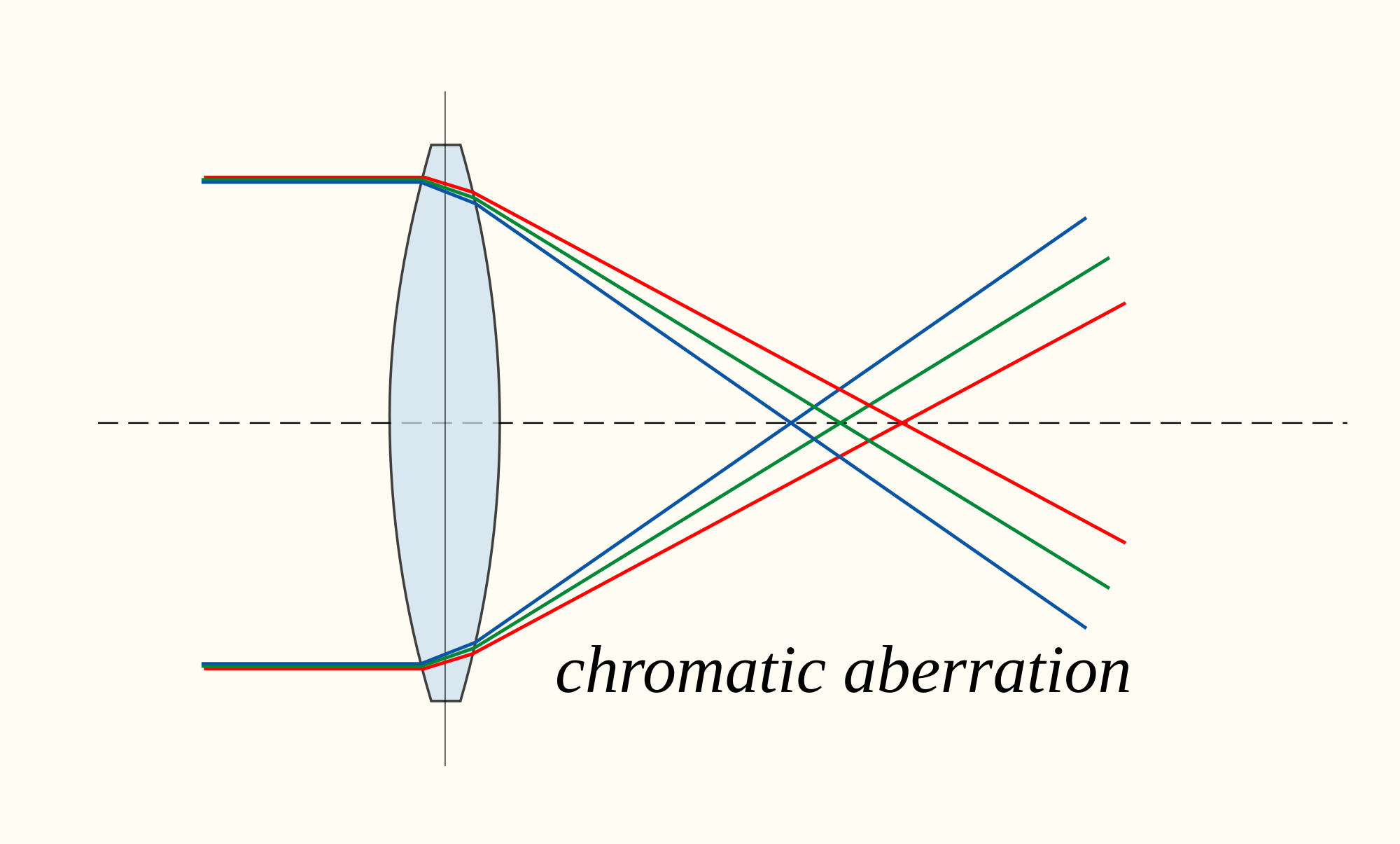
Chromatic aberration of a single lens causes different wavelengths of light to have differing focal lengths.
Diffractive optical element with complementary dispersion properties to that of glass can be used to correct for color aberration
Diffractive optical element with complementary dispersion properties to that of glass can be used to correct for color aberration.
For an achromatic doublet, visible wavelengths have approximately the same focal length.

Mathematics of chromatic aberration minimization

[edit]

For a doublet consisting of two thin lenses in contact, the Abbe number of the lens materials is used to calculate the correct focal length of the lenses to ensure correction of chromatic aberration.[14] If the focal lengths of the two lenses for light at the yellow Fraunhofer D-line (589.2 nm) are f1 and f2, then best correction occurs for the condition: where V1 and V2 are the Abbe numbers of the materials of the first and second lenses, respectively. Since Abbe numbers are positive, one of the focal lengths must be negative, i.e., a diverging lens, for the condition to be met.

The overall focal length of the doublet f is given by the standard formula for thin lenses in contact: and the above condition ensures this will be the focal length of the doublet for light at the blue and red Fraunhofer F and C lines (486.1 nm and 656.3 nm respectively). The focal length for light at other visible wavelengths will be similar but not exactly equal to this.

Chromatic aberration is used during a duochrome eye test to ensure that a correct lens power has been selected. The patient is confronted with red and green images and asked which is sharper. If the prescription is right, then the cornea, lens and prescribed lens will focus the red and green wavelengths just in front, and behind the retina, appearing of equal sharpness. If the lens is too powerful or weak, then one will focus on the retina, and the other will be much more blurred in comparison.[15]

Image processing to reduce the appearance of lateral chromatic aberration

[edit]

In some circumstances, it is possible to correct some of the effects of chromatic aberration in digital post-processing. However, in real-world circumstances, chromatic aberration results in permanent loss of some image detail. Detailed knowledge of the optical system used to produce the image can allow for some useful correction.[16][page needed] In an ideal situation, post-processing to remove or correct lateral chromatic aberration would involve scaling the fringed color channels, or subtracting some of a scaled versions of the fringed channels, so that all channels spatially overlap each other correctly in the final image.[17]

As chromatic aberration is complex (due to its relationship to focal length, etc.) some camera manufacturers employ lens-specific chromatic aberration appearance minimization techniques. Almost every major camera manufacturer enables some form of chromatic aberration correction, both in-camera and via their proprietary software. Third-party software tools such as PTLens are also capable of performing complex chromatic aberration appearance minimization with their large database of cameras and lenses.

In reality, even theoretically perfect post-processing based chromatic aberration reduction-removal-correction systems do not increase image detail as well as a lens that is optically well-corrected for chromatic aberration would for the following reasons:

  • Rescaling is only applicable to lateral chromatic aberration but there is also longitudinal chromatic aberration
  • Rescaling individual color channels result in a loss of resolution from the original image
  • Most camera sensors only capture a few and discrete (e.g., RGB) color channels but chromatic aberration is not discrete and occurs across the light spectrum
  • The dyes used in the digital camera sensors for capturing color are not very efficient so cross-channel color contamination is unavoidable and causes, for example, the chromatic aberration in the red channel to also be blended into the green channel along with any green chromatic aberration.

The above are closely related to the specific scene that is captured so no amount of programming and knowledge of the capturing equipment (e.g., camera and lens data) can overcome these limitations.

Photography

[edit]

The term "purple fringing" is commonly used in photography, although not all purple fringing can be attributed to chromatic aberration. Similar colored fringing around highlights may also be caused by lens flare. Colored fringing around highlights or dark regions may be due to the receptors for different colors having differing dynamic range or sensitivity – therefore preserving detail in one or two color channels, while "blowing out" or failing to register, in the other channel or channels. On digital cameras, the particular demosaicing algorithm is likely to affect the apparent degree of this problem. Another cause of this fringing is chromatic aberration in the very small microlenses used to collect more light for each CCD pixel; since these lenses are tuned to correctly focus green light, the incorrect focusing of red and blue results in purple fringing around highlights. This is a uniform problem across the frame, and is more of a problem in CCDs with a very small pixel pitch such as those used in compact cameras. Some cameras, such as the Panasonic Lumix series and newer Nikon and Sony DSLRs, feature a processing step specifically designed to remove it.

On photographs taken using a digital camera, very small highlights may frequently appear to have chromatic aberration where in fact the effect is because the highlight image is too small to stimulate all three color pixels, and so is recorded with an incorrect color. This may not occur with all types of digital camera sensor. Again, the de-mosaicing algorithm may affect the apparent degree of the problem.

Black-and-white photography

[edit]

Chromatic aberration also affects black-and-white photography. Although there are no colors in the photograph, chromatic aberration will blur the image. It can be reduced by using a narrow-band color filter, or by converting a single color channel to black and white. This will, however, require longer exposure (and change the resulting image). (This is only true with panchromatic black-and-white film, since orthochromatic film is already sensitive to only a limited spectrum.)

Electron microscopy

[edit]

Chromatic aberration also affects electron microscopy, although instead of different colors having different focal points, different electron energies may have different focal points.[18]

See also

[edit]

References

[edit]
[edit]
Revisions and contributorsEdit on WikipediaRead on Wikipedia
from Grokipedia
Chromatic aberration is an optical distortion that occurs when a lens fails to focus all wavelengths of to the same point, producing color fringing and reduced sharpness in images. This phenomenon arises from the dispersion of in lens materials, where the refractive index varies with wavelength, causing shorter wavelengths (such as violet) to refract more than longer ones (such as ). As a result, different colors focus at distinct distances, leading to blurred or multicolored edges in the . Chromatic aberration is classified into two primary types: axial (longitudinal) chromatic aberration, which shifts the focal point along the for different colors, and lateral (transverse) chromatic aberration, which causes variations in and image position across the field of view. Axial chromatic aberration produces a rainbow-like blur in the out-of-focus regions, while lateral chromatic aberration manifests as color fringes, particularly at the periphery of the image, due to the prismatic effect at the lens edges. To correct chromatic aberration, optical systems often use achromatic lenses, which combine a converging lens made of low-dispersion glass with a diverging lens of high-dispersion to balance the wavelength-dependent and minimize color separation. For even greater precision, apochromatic lenses incorporate additional elements to reduce residual chromatic errors, including the secondary spectrum. Recent innovations, such as nanostructured metasurfaces, enable broadband correction of chromatic aberrations across the when integrated with conventional lenses.

Fundamentals

Definition and Principles

Chromatic aberration is an that occurs when a lens fails to focus all wavelengths of to the same point, leading to color fringing and reduced image sharpness. This failure arises because different colors of , which correspond to different wavelengths, are refracted by varying amounts when passing through the lens, resulting in blurred or colored edges in the image. The underlying principle stems from the dispersion of light in refractive materials, where the of the glass or medium changes with . Shorter s, such as blue light, experience a higher and thus bend more sharply than longer wavelengths like red light, causing them to converge at different focal points. This wavelength-dependent is a fundamental property of transparent materials and is quantified by the variation in the across the . Isaac Newton first systematically described chromatic aberration in his 1672 letter to the Royal Society, "A letter containing his new theory about and colours," where he demonstrated through prism experiments how white disperses into a , revealing the limitations of refracting lenses in telescopes. His observations highlighted that this aberration prevents perfect focusing in simple lenses, motivating his later development of reflecting telescopes to circumvent the issue. Visually, chromatic aberration manifests as colored halos or fringes around high-contrast edges in images, such as purple or green outlines on objects against bright backgrounds, degrading overall clarity and color . These effects are particularly noticeable in uncorrected optical systems, where the misalignment of focal planes for different colors produces a rainbow-like blurring at the periphery of the field of view.

Physical Causes

Chromatic aberration arises primarily from the variation of the of optical materials with the of , a phenomenon known as dispersion. In transparent materials like , the refractive index n(λ)n(\lambda) decreases as the λ\lambda increases in the , causing shorter wavelengths (e.g., blue light) to refract more strongly than longer wavelengths (e.g., red light). This wavelength-dependent , governed by n1sinθ1=n2sinθ2n_1 \sin \theta_1 = n_2 \sin \theta_2, results in different colors focusing at distinct points when passing through a lens, leading to blurred or fringed images. The dispersive behavior of materials is quantitatively described by empirical formulas such as , which models the as a function of :
n(λ)=A+Bλ2+Cλ4,n(\lambda) = A + \frac{B}{\lambda^2} + \frac{C}{\lambda^4},
where AA, BB, and CC are material-specific constants, and higher-order terms like C/λ4C/\lambda^4 account for finer variations in the visible range. This equation captures normal dispersion, where nn is higher for shorter wavelengths, explaining why polychromatic light separates into colors upon refraction. Developed in 1836, Cauchy's formula provides a foundational for predicting how dispersion affects optical performance in lenses.
In the paraxial approximation, which assumes small angles of incidence and ray heights much smaller than the lens radii (valid for rays near the ), the lensmaker's formula for the ff of a simplifies to 1f=(n1)(1R11R2)\frac{1}{f} = (n - 1) \left( \frac{1}{R_1} - \frac{1}{R_2} \right), where R1R_1 and R2R_2 are the surface radii of . Since n=n(λ)n = n(\lambda), the varies with : shorter wavelengths yield shorter s due to higher nn, while longer wavelengths focus farther. Spherical lens shapes exacerbate this through applied at curved interfaces, where the local angle of incidence varies across the surface, amplifying the wavelength-dependent bending for off-axis rays even in the paraxial regime. A key metric for quantifying material dispersion is the VdV_d, defined as Vd=nd1nFnCV_d = \frac{n_d - 1}{n_F - n_C}, where ndn_d, nFn_F, and nCn_C are the refractive indices at the helium d-line (587.6 nm), F-line (486.1 nm), and C-line (656.3 nm), respectively. This dimensionless parameter measures the degree of dispersion relative to the mean index; higher VdV_d values (e.g., >50 for crown glasses) indicate low dispersion and reduced chromatic effects, while lower values (e.g., <50 for flint glasses) signify stronger dispersion and greater aberration potential. The thus serves as a critical selector for lens materials to minimize wavelength-dependent focusing errors.

Types

Longitudinal Chromatic Aberration

Longitudinal chromatic aberration, also referred to as axial chromatic aberration, is the where the of an optical lens varies with the of , causing different colors to focus at distinct points along the . This occurs because the of glass and other lens materials decreases with increasing due to dispersion, resulting in shorter wavelengths like blue light (higher ) having a shorter and focusing closer to the lens than longer wavelengths like red . For example, in an uncorrected lens, violet and blue light converge nearer to the lens, while red focuses farther away, preventing all components from forming a single sharp . The primary effect of longitudinal chromatic aberration is a longitudinal shift in focus planes, leading to blurred s where the intended focal color is sharp, but adjacent colors exhibit defocus blur, often appearing as colored fringes or halos around high-contrast edges. This blur is particularly evident in wide- lenses, where the larger amplifies the circle of confusion for out-of-focus s, making the aberration more visually prominent despite the inherent focal shift being independent of . In practice, focusing on a (mid-spectrum) may yield a greenish tint to the , with or yellowish edges on details, as and components remain out of focus. The extent of this aberration is measured by the focal shift Δf = f_blue - f_red, where f denotes the paraxial for each ; since f_blue is shorter than f_red, Δf is negative, and the quantifies the axial separation. In simple convex lenses, the aberration is severe, with the difference in paraxial focal lengths between key Fraunhofer spectral lines—such as the C line (656.3 nm), yellow d line (587.6 nm), and F line (486.1 nm)—typically amounting to about 1.5% of the lens's nominal . For a 1000 mm singlet lens, this translates to a roughly 15 mm separation between the C and F foci, highlighting the challenge in without correction.

Lateral Chromatic Aberration

Lateral chromatic aberration, also referred to as transverse chromatic aberration, arises when different wavelengths of produce images of varying sizes in the focal plane due to wavelength-dependent variations in lens magnification. This results in color fringing around high-contrast boundaries, often appearing as magenta borders on one side and on the other, particularly noticeable in the peripheral regions of the image field. The phenomenon stems from chromatic dispersion in optical materials, where the changes with wavelength, causing off-axis rays of different colors to refract differently and form unequally scaled images. The effects of lateral chromatic aberration include a chromatic version of geometric distortions, such as barrel or warping accompanied by color separation, which degrades image sharpness and fidelity especially away from the . Unlike axial variations, this aberration affects the transverse positioning across the entire field, becoming more severe with increasing field angle as oblique incidence amplifies the magnification mismatch between components. In practice, it leads to rainbow-like spreads for point sources off-axis, reducing overall contrast and introducing unwanted color artifacts in the image. Mathematically, lateral chromatic aberration is characterized by the variation of transverse with , expressed as m(λ)=hhm(\lambda) = \frac{h'}{h}, where hh is the object height and h(λ)h'(\lambda) is the wavelength-dependent image height. This dependence originates from the f(λ)f(\lambda) varying with λ\lambda, typically following the lensmaker's formula 1f=(n(λ)1)(1R11R2)\frac{1}{f} = (n(\lambda) - 1) \left( \frac{1}{R_1} - \frac{1}{R_2} \right), leading to a differential image size Δh=h[blue](/page/Blue)hred\Delta h = h'_{\text{[blue](/page/Blue)}} - h'_{\text{red}} for short and long wavelengths. The magnitude is often quantified using the chromatic difference of magnification, proportional to the dispersion as measured by the Vd=nd1nFnCV_d = \frac{n_d - 1}{n_F - n_C}, where ndn_d, nFn_F, and nCn_C are refractive indices at specific spectral lines. This aberration is particularly prevalent in complex lens designs like zoom lenses and wide-angle objectives, where achieving broadband achromatism across a large field is difficult, resulting in visible fringing that can quantify up to several pixels in uncorrected systems. For instance, in wide-field imaging, the off-axis color shifts combine with field curvature to exacerbate edge distortions, highlighting the need for specialized glass selections to minimize the effect.

Optical Correction Methods

Lens Design Techniques

Lens design techniques for reducing chromatic aberration primarily rely on combining lens elements with complementary dispersive properties to balance the varying focal lengths of different wavelengths. The foundational approach, the achromatic doublet, was invented by British lawyer and amateur optician Chester Moor Hall around 1733, who paired a biconvex lens of low-dispersion crown glass with a biconcave lens of high-dispersion to achieve for two wavelengths, such as and violet, by counteracting the longitudinal shift in focus. This cemented or air-spaced configuration minimizes the primary chromatic aberration by ensuring that the dispersive powers of the glasses produce equal but opposite effects on the light rays, resulting in a single focal point for the targeted spectrum. To address residual chromatic errors beyond two wavelengths, apochromatic lenses extend this principle by incorporating additional elements or specialized materials, correcting for three wavelengths—typically red, green, and blue—thus further reducing secondary spectrum blur. Developed in the late , notably by in 1886 at , these designs often use low-dispersion (calcium fluoride) crowns combined with high-dispersion flints or glasses to exploit anomalous partial dispersion properties, where the glasses deviate from standard dispersion curves to cancel aberrations more effectively. , introduced in the mid-20th century through advancements in optical glass manufacturing, feature exceptionally low dispersion (Abbe numbers exceeding 90) and have become staples in high-performance apochromats, enabling sharper images in applications like . More complex configurations, such as triplets and quadruplets, build on these doublets by adding extra elements to tackle both longitudinal and lateral chromatic aberrations while maintaining compactness. The , patented in 1893 by , uses three air-spaced lenses—typically two positive crowns flanking a central negative flint—to correct chromatic differences alongside , with material selection optimizing the dispersion balance for performance. Quadruplet designs further refine this by incorporating four elements, often including extra-low dispersion (ED) glasses like Ohara's FPL series, to suppress color fringing across wider fields. Additionally, aspheric surfaces in modern triplets or apochromats reduce residual chromatic contributions indirectly by minimizing interactions, allowing thinner lenses with overall better color fidelity without increasing element count.

Mathematical Modeling of Minimization

In third-order optical theory, chromatic aberrations are quantified using Seidel coefficients that capture the wavelength-dependent deviations in ray paths. The longitudinal chromatic aberration is described by the Seidel coefficient SIS_I, which measures the axial shift in focus position across different wavelengths for on-axis rays. This coefficient arises from the variation in refractive index with wavelength and is expressed as SI=hiuidnidλS_I = \sum h_i u_i' \frac{dn_i}{d\lambda}, where hih_i and uiu_i' are the paraxial ray height and angle at surface ii, and dnidλ\frac{dn_i}{d\lambda} is the dispersion of the material. Minimizing SIS_I to zero corrects the primary axial color for a reference wavelength pair. Similarly, the lateral chromatic aberration, or transverse color, is governed by the coefficient SIIIS_{III}, which quantifies the magnification difference for off-axis points across wavelengths, given by SIII=yiyˉiuidnidλS_{III} = \sum y_i \bar{y}_i u_i' \frac{dn_i}{d\lambda}, with yiy_i and yˉi\bar{y}_i representing field and pupil coordinates. Setting SIII=0S_{III} = 0 alongside SI=0S_I = 0 ensures balanced color correction in multi-element systems. For basic two-element achromats, the condition for minimizing longitudinal chromatic aberration involves balancing the dispersions of the constituent lenses. Consider a crown-flint doublet where the first lens has focal length f1f_1 and dispersion (dndλ)1\left( \frac{dn}{d\lambda} \right)_1, and the second has f2f_2 and (dndλ)2\left( \frac{dn}{d\lambda} \right)_2. The achromatization condition is (dndλ)1f1+(dndλ)2f2=0\frac{ \left( \frac{dn}{d\lambda} \right)_1 }{f_1} + \frac{ \left( \frac{dn}{d\lambda} \right)_2 }{f_2} = 0, which ensures that the focal shifts due to wavelength changes cancel for two selected wavelengths, typically in the . This derives from differentiating the lens power with respect to wavelength and setting the total chromatic variation to zero. Lateral chromatic aberration in such systems requires additional constraints, often addressed through field-dependent terms in higher-order analysis./02%3A_Lens_and_Mirror_Calculations/2.10%3A_Designing_an_Achromatic_Doublet) Paraxial ray tracing provides the foundational equations for modeling wavelength-dependent behavior in lens systems. In the paraxial , rays are traced using yy and uu, with transfer equations between surfaces: yj+1=yj+djujy_{j+1} = y_j + d_j u_j for and nj+1uj+1=njuj+yjnj+1njRjn_{j+1} u_{j+1} = n_j u_j + y_j \frac{n_{j+1} - n_j}{R_j}, where djd_j is thickness, RjR_j radius, and nj=nj(λ)n_j = n_j(\lambda) the index. The of a thin symmetric lens exhibits explicit wavelength dependence via the lensmaker's formula: f(λ)=R2(n(λ)1)f(\lambda) = \frac{R}{2(n(\lambda) - 1)}, highlighting how dispersion dndλ\frac{dn}{d\lambda} causes focal shift Δff2dndλΔλ\Delta f \approx -f^2 \frac{dn}{d\lambda} \Delta \lambda. These equations allow computation of chromatic focal variations by evaluating traces at multiple wavelengths, such as F (486 nm), d (589 nm), and C (656 nm) lines./02%3A_Geometric_Optics_and_Image_Formation/2.05%3A_Thin_Lenses) In modern lens design, optimization minimizes chromatic aberrations through merit functions that quantify performance across the . A common merit function is the root-mean-square spot radius, averaged over field points and wavelengths: MF=w,θ(rspot,w,θ2)1/2MF = \sum_{w,\theta} \left( r_{spot,w,\theta}^2 \right)^{1/2}, where ww indexes wavelengths and θ\theta field angles; minimization via damped least-squares algorithms adjusts variables like curvatures and glasses to reduce variance in image quality metrics. For chromatic control, the function weights terms for axial and lateral color, targeting near-zero Seidel sums while constraining overall power. This approach, implemented in software like CODE V, enables correction by iterating over dispersion data for candidate materials.

Digital and Post-Processing Correction

Image Processing Algorithms

Image processing algorithms for correcting chromatic aberration in digital images typically begin with detection methods that identify color fringing artifacts caused by wavelength-dependent focal shifts. Edge analysis techniques detect these fringes by examining discontinuities in color channels at high-contrast boundaries, where , , and components misalign due to lateral chromatic aberration. For instance, algorithms compute the displacement between color edges using or phase difference metrics to quantify the aberration strength. Gradient-based algorithms further identify wavelength mismatches by comparing magnitude and direction of intensity gradients across color channels; regions with inconsistent gradients indicate aberration-induced blurring or shifting. These methods are particularly effective for automatic detection without requiring prior lens calibration. Once detected, correction algorithms apply targeted transformations to realign or sharpen the affected channels. Deconvolution methods use wavelength-specific point spread functions (PSFs) derived from the lens characteristics or estimated from image gradients to reverse the blur in each color plane; for example, non-blind deconvolution with cross-channel regularization minimizes color artifacts by leveraging correlations between channels during iterative restoration. Polynomial models address lateral scaling by fitting radial distortion parameters to each color channel, typically using low-order polynomials (e.g., quadratic or cubic) to compute per-pixel magnification factors that warp the red and blue planes relative to the green reference. These approaches restore alignment but rely on accurate PSF or model estimation for optimal results. Specific techniques enhance these core algorithms for practical implementation. Adobe's lens profile correction employs pre-calibrated distortion maps, generated from chart-based measurements, to apply channel-specific warping that compensates for both tangential and radial components of lateral chromatic aberration. transforms separate color artifacts by decomposing the image into multi-resolution subbands, where aberration-induced fringes appear as inter-channel inconsistencies in high-frequency components; thresholding or fusion across wavelet coefficients then reconstructs a corrected image while preserving details. These methods are widely adopted in software pipelines for their efficiency and adaptability to various lenses. Despite their effectiveness, these algorithms have inherent limitations. Digital corrections cannot recover resolution lost to optical blur in severe cases, as amplifies noise without perfect PSF knowledge. They perform best on lateral chromatic aberration, where simple rescaling suffices, but struggle with longitudinal types, which require complex depth-dependent adjustments beyond standard post-processing capabilities.

Software and Tools for Reduction

Post-processing software such as includes the Lens Correction filter, which addresses chromatic aberration by adjusting red and blue fringe sliders to realign color channels and reduce color fringing. Similarly, employs profile-based auto-correction, leveraging manufacturer-provided lens profiles embedded in the software's database to automatically detect and mitigate chromatic aberration during RAW or JPEG editing workflows. These profiles, derived from extensive testing of specific lens models, enable one-click application of corrections tailored to the optical characteristics of the equipment used. Modern digital cameras from manufacturers like Canon and Nikon incorporate in-camera JPEG processing to reduce chromatic aberration directly during image capture. For instance, Canon DSLRs and mirrorless cameras since the early apply lens aberration correction in real-time, using pre-loaded aberration maps for compatible lenses to adjust outputs while leaving RAW files untouched. Nikon bodies, starting with models like the D3 and D300 from 2007 onward, automatically perform lateral chromatic aberration corrections in through firmware algorithms that shift color channels based on lens data. This in-camera approach minimizes the need for post-processing in standard shooting scenarios, particularly for photographers prioritizing quick turnaround. Open-source alternatives provide accessible options for manual chromatic aberration reduction. features dedicated modules like the Chromatic Aberrations tool, which allows users to interactively adjust parameters for red, green, and blue channel shifts on non-RAW images, and the Raw Chromatic Aberrations module for sensor RAW files. In , plugins such as GIMP3-Fix-CA enable targeted correction of color fringing by analyzing and aligning RGB layers, suitable for users seeking free, customizable post-processing without . Integration of lens profiles into RAW file metadata streamlines automated correction across editing pipelines. Many camera systems, including those from Nikon and Canon, embed lens-specific profiles in RAW metadata during capture, allowing software like Lightroom or to read this data and apply precise chromatic aberration adjustments without manual intervention. This metadata-driven method ensures consistency in corrections, drawing from manufacturer-calibrated data to handle both longitudinal and lateral aberrations effectively.

Applications and Impacts

In Photography

In photography, chromatic aberration manifests as color fringing, typically red or purple edges, along boundaries in high-contrast scenes, such as tree branches against a bright sky, where different wavelengths of light fail to converge at the same focal point. This effect is particularly noticeable toward the edges of the image frame and is more pronounced in telephoto and wide-angle lenses due to their optical designs, which exacerbate lateral color dispersion across the sensor. Photographers manage chromatic aberration by stopping down the lens aperture, which reduces longitudinal chromatic aberration by increasing and minimizing focus shifts between colors, often requiring one or two stops from the widest setting. In , post-processing software provides effective correction for residual fringing through targeted adjustments. The impact of chromatic aberration on black-and-white photography is minimal, as monochrome imaging uses a single panchromatic emulsion layer sensitive to the full visible spectrum, avoiding color separation and thus visible fringing, though slight blurring from focus inconsistencies may occur. Historically, black-and-white films were preferred for their superior sharpness and resolving power—up to 100 lines per millimeter—bypassing the diffusion and quality reductions in multilayer color emulsions. In modern cameras, multi-element lens designs incorporating aspheric surfaces significantly reduce chromatic aberration by correcting wavelength-dependent distortions with fewer components, enabling compact systems with improved image quality across the field. Digital correction tools can further refine these in post-processing if needed.

In Microscopy and Telescopes

In microscopy, chromatic aberration poses significant challenges, particularly in low-magnification objectives where longer focal lengths exacerbate color fringing and focus shifts across wavelengths, degrading clarity for detailed specimen . This issue is especially pronounced in biological , where multi-wavelength illumination reveals blurred edges and reduced resolution in samples like stained tissues or fluorescently labeled cells, limiting the ability to discern fine cellular structures. The severity of these effects can be quantified through the , a measure of optical performance that drops notably due to wavefront distortions from chromatic dispersion, significantly reducing peak intensity and effective resolution in uncorrected systems. Recent 2025 innovations include achromatic diffractive lenses overcoming chromatic issues in compact and computational for enhanced of thick biological samples. To mitigate this, plan-apochromatic objectives have become standard in high-precision , providing superior chromatic correction for three primary colors (, , and ) while also compensating for field curvature to achieve a flat across the entire . These objectives employ multi-element designs with low-dispersion glasses, enabling sharp, color-accurate imaging essential for quantitative biological studies. In telescopes, chromatic aberration similarly limits refractor designs, as varying focal lengths for different wavelengths cause color halos around bright objects like stars, compromising contrast and detail in astronomical observations. This limitation prompted a historical shift toward reflecting telescopes, exemplified by Isaac Newton's 1668 invention, which used mirrors instead of lenses to entirely bypass chromatic issues while maintaining compact form factors for larger apertures. In astronomical imaging, uncorrected chromatic aberration degrades the , spreading point sources into diffuse, lower-contrast images that hinder detection of faint celestial features. Advancements in include the introduction of -based objectives in the late , with significant refinements in the 1940s for applications, where synthetic elements reduced dispersion and enabled clearer multi-color imaging of biological specimens. For telescopes, apochromatic emerged as a key improvement in the , incorporating extra-low dispersion glass to minimize residual chromatic errors from the eyepiece itself, enhancing color fidelity in visual and photographic observations of deep-sky objects.

In Electron Microscopy

In electron microscopy, chromatic aberration manifests similarly to its optical counterpart in light microscopy, where of varying are focused at different points by , resulting in blurred images, particularly in transmission electron microscopes (TEM). This effect arises primarily from the non-monochromatic nature of the electron beam, with energy spreads originating from the electron source—such as field emission guns exhibiting spreads of about 0.5–1 eV—or from interactions within the sample, which can broaden the energy distribution to several eV. The ff of a is proportional to the electron EE (or accelerating voltage VV, since E=eVE = eV), leading to defocus for off-energy electrons and an aberration disk that degrades image contrast and resolution. Correction strategies for chromatic aberration in electron microscopy focus on either reducing the beam's energy spread through monochromation or designing lens systems with energy-independent focusing properties. Energy monochromation is commonly achieved using omega filters, which are magnetic sector devices that spatially separate electrons by energy and select a narrow bandwidth (e.g., 0.1–0.3 eV), thereby minimizing the input ΔE/E\Delta E / E to the imaging lens and reducing the chromatic aberration coefficient CcC_c. Sextupole magnets are employed in advanced designs to provide focusing and correction of higher-order aberrations during energy selection, enabling sub-eV energy resolution in modern TEM systems. Achromatic magnetic lenses, often constructed as combined electrostatic-magnetic quadrupoles, compensate for energy-dependent focal shifts by superimposing fields that make the overall energy-insensitive, effectively lowering CcC_c without narrowing the beam energy. The impact of uncorrected chromatic aberration is significant, limiting TEM resolution to approximately 0.1–0.2 nm at typical accelerating voltages of 200 kV due to the aberration disk size scaling with Cc(ΔE/E)C_c \cdot (\Delta E / E), where CcC_c is on the order of 1–2 mm for standard objective lenses. This constraint has historically bottlenecked high-resolution imaging of atomic structures and materials, but advancements in correction techniques since the —building on early theoretical work like Scherzer's theorem and initial quadrupole-based designs—have enabled sub-0.1 nm resolutions by integrating these correctors into commercial instruments, revolutionizing applications in and . As of 2025, advancements include automated for aberration correction in and chromatic correctors for cryo-EM, enhancing resolution in biological imaging.

In Eyeglasses

In eyeglasses, chromatic aberration—specifically lateral (transverse) chromatic aberration—causes color fringing around objects, particularly when viewed through the periphery of the lens or with higher prescriptions. This manifests as blue edges on one side and orange or yellow on the other, resulting from lens materials dispersing light wavelengths differently, with blue light refracting more strongly than red or orange light, producing a prismatic effect at the lens edges. The effect is more noticeable in thick lenses, high-index materials, or polycarbonate lenses, which often have lower Abbe values leading to greater dispersion and wider color fringes. Higher prescription powers further increase the aberration due to greater prismatic deviation away from the optical center.

References

Add your contribution
Related Hubs
User Avatar
No comments yet.