Hubbry Logo
Norwegian dialectsNorwegian dialectsMain
Open search
Norwegian dialects
Community hub
Norwegian dialects
logo
8 pages, 0 posts
0 subscribers
Be the first to start a discussion here.
Norwegian dialects
Norwegian dialects
from Wikipedia

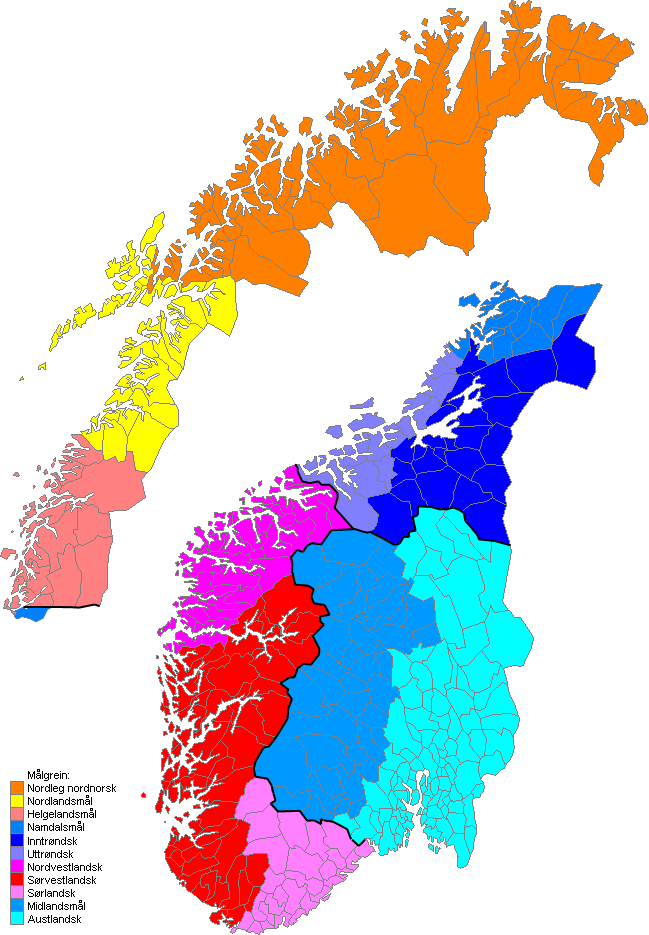
The map shows the division of the Norwegian dialects within the main groups.[image reference needed]

Norwegian dialects (dialekter/ar) are commonly divided into four main groups, 'Northern Norwegian' (nordnorsk), 'Central Norwegian' (trøndersk), 'Western Norwegian' (vestlandsk), and 'Eastern Norwegian' (østnorsk). Sometimes 'Midland Norwegian' (midlandsmål) and/or 'South Norwegian' (sørlandsk) are considered fifth or sixth groups.[1]

The dialects are generally mutually intelligible, but differ significantly with regard to accent, grammar, syntax, and vocabulary. If not accustomed to a particular dialect, even a native Norwegian speaker may have difficulty understanding it. Dialects can be as local as farm clusters, but many linguists note an ongoing regionalization, diminishing, or even elimination of local variations.[1]

Spoken Norwegian typically does not exactly follow the written languages Bokmål and Nynorsk or the more conservative Riksmål and Høgnorsk, except in parts of Finnmark (where the original Sami population learned Norwegian as a second language). Rather, most people speak in their own local dialect. There is no "standard" spoken Norwegian.

Dialect groups

[edit]

Dialect branches

[edit]

Evolution

[edit]

Owing to geography and climate, Norwegian communities were often isolated from each other until the early 20th century. As a result, local dialects had a tendency to be influenced by each other in singular ways while developing their own idiosyncrasies. Oppdal Municipality, for example, has characteristics in common with coastal dialects to the west, the dialects of northern Gudbrandsdalen to the south, and other dialects in Sør-Trøndelag from the north. The linguist Einar Haugen documented the particulars of the Oppdal dialect, and the writer Inge Krokann used it as a literary device. Other transitional dialects include the dialects of Romsdal and Arendal.

On the other hand, newly industrialized communities near sources of hydroelectric power have developed dialects consistent with the region but in many ways unique. Studies in such places as Høyanger, Odda, Tyssedal, Rjukan, Notodden, Sauda, and others show that koineization has effected the formation of new dialects in these areas.

Similarly, in the early 20th century a dialect closely approximating standard Bokmål arose in and around railway stations. This was known as stasjonsspråk ("station language") and may have contributed to changes in dialect around these centers.

Social dynamics

[edit]

Until the 20th century, upward social mobility in a city like Oslo could in some cases require conforming speech to standard Riksmål. Studies show that even today, speakers of rural dialects may tend to change their usage in formal settings to approximate the formal written language. This has led to various countercultural movements ranging from the adoption of traditional forms of Oslo dialects among political radicals in Oslo, to movements preserving local dialects. There is widespread and growing acceptance that Norwegian linguistic diversity is worth preserving.

The trend today is a regionalisation of the dialects causing smaller dialectal traits to disappear and rural dialects to merge with their nearest larger dialectal variety.

There is no standard dialect for the Norwegian language as a whole, and all dialects are by now mutually intelligible. Hence, widely different dialects are used frequently and alongside each other, in almost every aspect of society. Criticism of a dialect may be considered criticism of someone's personal identity and place of upbringing, and is considered impolite. Not using one's proper dialect would be bordering on awkward in many situations, as it may signal a wish to take on an identity or a background which one does not have. Dialects are also an area from which to derive humour both in professional and household situations.

Distinctions

[edit]

There are many ways to distinguish among Norwegian dialects. These criteria are drawn from the work Vårt Eget Språk/Talemålet (1987) by Egil Børre Johnsen. These criteria generally provide the analytical means for identifying most dialects, though most Norwegians rely on experience to tell them apart.

Grammars and syntax

[edit]

Infinitive forms

[edit]

One of the most important differences among dialects is which ending, if any, verbs have in the infinitive form. In Old Norwegian, most verbs had an infinitive ending (-a), and likewise in a modern Norwegian dialect, most of the verbs of the dialect either have or would have had an infinitive ending. There are five varieties of the infinitive ending in Norwegian dialects, constituting two groups:

One ending (western dialects)

  • Infinitive ending with -a, e.g., å vera, å bita, common in southwestern Norway, including the areas surrounding Bergen (although not in the city of Bergen itself) and Stavanger (city)
  • Infinitive ending with -e, e.g., å være, å bite, common in Troms, Finnmark, areas of Sogn og Fjordane and Møre og Romsdal, southern counties, and a few other areas.
  • Apocopic infinitive, where no vowel is added to the infinitive form, e.g., å vær, å bit, common in certain areas of Nordland

Two different endings (eastern dialects)

  • Split infinitive, in which some verbs end with -a while others end with -e; e.g. å væra versus å bite, common in Eastern Norway
  • Split infinitive, with apocope, e.g., å væra (værra/vårrå/varra) versus å bit, common in some areas in Sør-Trøndelag and Nord-Trøndelag

The split distribution of endings is related to the syllable length of the verb in Old Norse. "Short-syllable" (kortstava) verbs in Norse kept their endings. The "long-syllable" (langstava) verbs lost their (unstressed) endings or had them converted to -e.

Dative case

[edit]

The original Germanic contextual difference between the dative and accusative cases, standardized in modern German and Icelandic, has degenerated in spoken Danish and Swedish, a tendency which spread to Bokmål too. Ivar Aasen treated the dative case in detail in his work, Norsk Grammatik (1848), and use of Norwegian dative as a living grammatical case can be found in a few of the earliest Landsmål texts. However, the dative case has never been part of official Landsmål/Nynorsk.

It is, however, present in some spoken dialects north of Oslo, Romsdal, and south and northeast of Trondheim. The grammatical phenomenon is highly threatened in the mentioned areas, while most speakers of conservative varieties have been highly influenced by the national standard languages, using only the traditional accusative word form in both cases. Often, though not always, the difference in meaning between the dative and accusative word forms can thus be lost, requiring the speaker to add more words to specify what was actually meant, to avoid potential loss of information.

Future tense

[edit]

There are regional variations in the use of future tense, for example, "He is going to travel.":

Han kommer/kjem til å reise.
Han blir å reise.
Han blir reisan.
Han skal reise.

Syntax

[edit]

Syntax can vary greatly between dialects, and the tense is important for the listener to get the meaning. For instance, a question can be formed without the traditional "asking-words" (how, where, what, who..)

For example, the sentence Hvor mye er klokken? (in Bokmål), Kor mykje er klokka? (in Nynorsk), literally: "How much is the clock?" i.e. "What time is it?" can be put in, among others, the following forms:

E klokka mykje? (Is the clock much?) (stress is on "the clock")
E a mytti, klokka? (Is it much, the clock?) (stress on "is")
Ka e klokka? (literally: "What is the clock?")
Ka klokka e? (literally: What the clock is?), or, using another word for clock, Ke ure' e?
Å er 'o? (literally: What is she?).

Pronunciation of vowels

[edit]

Diphthongization of monophthongs

[edit]

Old Norse had the diphthongs /au/, /ei/, and /øy/, but the Norwegian spoken in the area around Setesdal has shifted two of the traditional diphthongs and innovated four more from long vowels, and, in some cases, also short vowels.[2]

Old Norse Modern Norwegian
Setesdal[3]
[ei] [ai][2]
[øy] [oy][2]
[iː] [ei][2]
[yː] [uy]
[uː] [eu]
[oː] [ou][2]

West Norwegian dialects have also innovated new diphthongs. In Midtre[clarification needed] you can find the following:

Old Norse Modern Norwegian
Midtre
[aː] [au]
[oː] [ou]
[uː] [eʉ]

Monophthongization of diphthongs

[edit]

The Old Norse diphthongs /au/, /ei/, and /øy/ have experienced monophthongization in certain dialects of modern Norwegian.

Old Norse Modern Norwegian
Urban East Some dialects
[ei] [æɪ] [e ~ eː]
[øy] [œʏ] ~ øː]
[au] [æʉ] ~ øː]

This shift originated in Old East Norse, which is reflected in the fact that Swedish and Danish overwhelmingly exhibit this change. Monophthongization in Norway ends on the coast west of Trondheim and extends southeast in a triangle into central Sweden. Some Norwegian dialects, east of Molde, for example, have lost only /ei/ and /øy/.

Leveling

[edit]

(Jamning/Jevning in Norwegian) This is a phenomenon in which the root vowel and end vowel in a word approximate each other. For example, the old Norse viku has become våkkå or vukku in certain dialects. There are two varieties in Norwegian dialects – one in which the two vowels become identical, the other where they are only similar. Leveling exists only in inland areas in Southern Norway, and areas around Trondheim.

Vowel shift in strong verbs

[edit]

In all but Oslo and coastal areas just south of the capital, the present tense of certain verbs take on a new vowel (umlaut), e.g., å fare becomes fer (in Oslo, it becomes farer).

Pronunciation of consonants

[edit]

Eliminating /r/ in the plural indefinite form

[edit]

In some areas, the /r/ is not pronounced in all or some words in their plural indefinite form. There are four categories:

  • The /r/ is retained – most of Eastern Norway, the South-Eastern coast, and across to areas north and east of Stavanger.
  • The /r/ disappears altogether – Southern tip of Norway, coastal areas north of Bergen, and inland almost to Trondheim.
  • The /r/ is retained in certain words but not in others – coastal areas around Trondheim, and most of Northern Norway
  • The /r/ is retained in certain words and in weak feminine nouns, but not in others – one coast area in Nordland.

Phonetic realization of /r/

[edit]

Most dialects realize /r/ as the alveolar tap [ɾ] or alveolar trill [r]. However, for the last 200 years the uvular approximant [ʁ] has been gaining ground in Western and Southern Norwegian dialects, with Kristiansand, Stavanger, and Bergen as centers. The uvular R has also been adopted in aspiring patricians in and around Oslo, to the point that it was for some time fashionable to "import" governesses from the Kristiansand area. In certain regions, such as Oslo, the flap has become realized as a retroflex flap (generally called "thick L") /ɽ/, which exists only in Norway, a few regions in Sweden, and in completely unrelated languages. The sound coexists with other retroflexions in Norwegian dialects. In some areas it also applies to words that end with "rd," for example with gard (farm) being pronounced /ɡɑːɽ/. The uvular R has gained less acceptance in eastern regions, and linguists speculate that dialects that use retroflexes have a "natural defense" against uvular R and thus will not adopt it. However, the dialect of Arendal retains the retroflexes, while featuring the uvular R in remaining positions, e.g. rart [ʁɑːʈ].[citation needed]

In large parts of Northern Norway, especially in the northern parts of Nordland county and southern parts of Troms county, as well as several parts of Finnmark county, another variant is still common: the voiced post-alveolar sibilant fricative /ʒ/. In front of voiceless consonants, the realisation of this R is unvoiced as well, to /ʃ/. Thus, where one in the southern and Trøndelag dialects will get /sp̬ar̥k/ or /sp̬aʀk/ or /sp̬aʁ̥k/, in areas realising voiced R as /ʒ/, one will get /spaʃːk/.

Palatalization

[edit]

In areas north of an isogloss running between Oslo and Bergen, palatalization occurs for the n (IPA [nʲ]), l ([lʲ]), t ([tʲ]) and d ([dʲ]) sounds in varying degrees. Areas just south and southwest of Trondheim palatalize both the main and subordinate syllable in words (e.g., [kɑlʲːɑnʲ]), but other areas only palatalize the main syllable ([bɑlʲ]).

Voicing of plosives

[edit]

Voiceless stops (/p, t, k/) have become voiced ([b, d, ɡ]) intervocalically after long vowels (/ˈfløːdə/, /ˈkɑːɡə/ vs. /ˈfløːtə/, /ˈkɑːkə/) on the extreme southern coast of Norway, including Kristiansand, Mandal and Stavanger. The same phenomenon appears in Sør-Trøndelag[in which areas? The whole county?] and one area in Nordland.

Segmentation

[edit]

The geminate /ll/ in southwestern Norway has become [dl], while just east in southcentral Norwegian the final [l] is lost, leaving [d]. The same sequence has been palatalized in Northern Norway, leaving the palatal lateral [ʎ].

Assimilation

[edit]

The second consonant in the consonant clusters /nd/, /ld/, and /nɡ/ has assimilated to the first across most of Norway, leaving [n], [l], and [ŋ] respectively. Western Norway, though not in Bergen, retains the /ld/ cluster. In Northern Norway this same cluster is realized as the palatal lateral [ʎ].

Consonant shift in conjugation of masculine nouns

[edit]

Although used less frequently, a subtle shift takes place in conjugating a masculine noun from indefinitive to definitive, e.g., from bekk to bekkjen ([becːen], [becçen], [beçːen] or [be:t͡ʃen]). This is found in rural dialects along the coast from Farsund Municipality to the border between Troms and Finnmark.

The kj - sj merger

[edit]

Many people, especially in the younger generation, have lost the differentiation between the /ç/ (written ⟨kj⟩) and /ʂ/ (written ⟨sj⟩) sounds, realizing both as [ʂ]. This is by many considered to be a normal development in language change (although as most language changes, the older generation and more conservative language users often lament the degradation of the language). The functional load is relatively low, and as often happens, similar sounds with low functional loads merge.

Tonemes and intonation

[edit]

There are great differences between the intonation systems of different Norwegian dialects.

Vocabulary

[edit]

First person pronoun, nominative plural

[edit]

Three variations of the first person plural nominative pronoun exist in Norwegian dialects:

  • Vi, (pronounced /viː/), common in parts of Eastern Norway, most of Northern Norway, coastal areas close to Trondheim, and one sliver of Western Norway
  • Me, or mi, in Southern and most of Western Norway, areas inland of Trondheim, and a few smaller areas
  • Oss, common in areas of Sør-Trøndelag, Gudbrandsdalen, Nordmøre and parts of Sunnmøre.

First person pronoun, nominative singular

[edit]

There is considerable variety in the way the first person singular nominative pronoun is pronounced in Norwegian dialects. They appear to fall into three groups, within which there are also variations:

  • E(g) and æ(i)(g), in which the hard 'g' may or may not be included. This is common in most of Southern and Western Norway, Trøndelag, and most of Northern Norway. In some areas of Western Norway, it is common to say ej.
  • I (pronounced /iː/), in a few areas in Western Norway (Romsdal/Molde) and Snåsa in Trøndelag
  • [je(ː)], jè [jɛ(ː)], or jei [jɛi(ː)], in areas around Oslo, and north along the Swedish border, almost to Trondheim, as well as one region in Troms

Personal pronouns

[edit]
Regions I You He She It We You (pl.) They
Bokmål Jeg Du Han Hun Det Vi Dere De, dem
Nynorsk Eg Du Han Ho Det Vi, me De, dykk, dokker Dei
South Eastern Norway Jæ, jé, jè, jei Du, ru, u, dø Han, hæn, hænnom, hannem Hun, ho, hu, ha, a, henne, henner De Vi, ve, mø, oss, øss, æss, vårs Dere, dø, de, di, døkk, dår(e), dør(e) Dem, rem, 'rdem, em, døm, dom, di
Most of Western and Southern Norway Eg, e, æ, æg, æi, æig, jei, ej, i Du, dø, døø, døh Han, an, ha'an Hun, ho, hu, hau, hon, u De, da, d' Vi, me, mi, mø, åss Dere, då(k)ke, dåkkar, dåkk, de, derr, dåkki, dikko(n), deke, deko, De, dei, dæ, di, di'i
Trøndelag and most of Northern Norway Æ, æg, i, eig, jæ, e, eg Du, dæ, dø, u, dæ'æ Han, hanj, hin, hån Hun, hu, ho, a De, da, dæ, e, denj, ta Vi, åss, oss, åkke, me, mi Dåkk, dåkke, dåkker, dåkkæ, dere, ere, dykk, di Dei, dem, dæm, 'em, di, r'ej, dåm

Possessive pronouns

[edit]
Regions My Your His Her Its Our Your (pl.) Their
Bokmål Min, mi, mitt Din, di, ditt Hans Hennes dens, dets Vår Deres Deres
Nynorsk Min, mi, mitt Din, di, ditt Hans Hennar Rarely used. When used: dess Vår Dykkar Deira
South Eastern Norway Min, mi, mitt, mø Din, di, ditt Hans, hannes, hanns, hass Hennes, henners, hun sin, hos, hinnes Dets, det sitt Vårs, vørs, vår, 'år, våres Deres, døres, Dems, demmes, demma, demses, dem sitt, dommes, doms, døms
Most of Western and Southern Norway Min, mi, mitt Din, di, ditt Hans, hannes, hannas, høns, hønnes, ans Hennes,hons, hos, hosses, høvs, haus, hennar, hen(n)as, nas nonexistent or dens, dets Vår, 'år, våres, våras, åkkas, åkka, aokan(s) Deres, dokkas, dokkar(s), dåkas, dekan, dekans Demmes, dies, dis, deisa, deis, daus, døvs, deira,

deira(n)s

Trøndelag and most of Northern Norway Min, mi, mitt, mæjn, mett Din, di, ditt, dij, dej'j Hans, hannjes, hanses, hannes, hanner, hånner Hennes, hennjes, hunnes, henna, hennar, huns Dets, det sitt, dess Vår, våkke, vår', våres, vårres Deres, dokkers, dokkes, 'eras Dems, demma, dæres, dæmmes, dæmmers, deira

The word "not"

[edit]

The Norwegian word for the English not exists in these main categories:

ikke [ikːə] – Oslo, Kristiansand, Bergen, Ålesund, most of Finnmark, Vestfold and lowland parts of Telemark, and some cities in Nordland.
ikkje [içːə/iːt͡ʃə] – most of Southern, Northern, Western Norway and high-land parts of Telemark.
ittj [itʲː] – Trøndelag
ikkj [içː] - parts of Salten District, Nordland
itte [iːtə] or ittje [itʲːə] – areas north of Oslo, along the Swedish border
inte [intə], ente [entə] or ette [etːə] – Mostly along the Swedish border south of Oslo in Østfold
kje/e'kje
isje/itsje

Examples of the sentence "I am not hungry," in Norwegian:

ikke: Jeg er ikke sulten. (Bokmål)
ikkje: Eg er ikkje svolten. (Nynorsk)
ikkje: I e ikkje sulten. (Romsdal)
ittj: Æ e ittj sopin. (Trøndelag)
ikkj: E e ikkj sulten. (Salten)
ke: Æ e ke sulten. (Narvik)
ente: Je er'nte sulten. (Hærland)

Interrogative words

[edit]

Some common interrogative words take on forms such as:

Regions who what where which how why when
Bokmål hvem hva hvor hvilken, hvilket, hvilke hvordan, hvorledes, åssen hvorfor når
Nynorsk kven kva kor, kvar kva for ein/ei/eit korleis, korso kvifor, korfor når, kva tid
South Eastern Norway hvem, åkke, åkkjen, høkken, håkke hva, å da, å, hø da, hå, hæ, hær hvor, hvorhen, å hen, å henner, hen, hørt, hærre, håppæs, hæppæs hvilken, hvilke, åkken, åssen, hvem, hva slags, hø slags, hæsse, håssen. håleis, hådan hvordan, åssen, høssen, hæsse hvorfor, åffer, å for, høffer, hæffer ti, å ti, når, hærnér
Most of Western Norway kven, ken, kin, kem, kim kva, ka, ke, kæ, kå kor, kest, korhen/korhenne, hen kva, ka, kvaslags, kaslags, kasla, kallas, kalla, kass, kvafor, kafor, kaforein, keslags, kæslags, koffø en kordan, korsn, korleis, karleis, koss, koss(e)n korfor, koffor, kvifor, kafor, keffår, koffø når, ti, kati, korti, koti, kå ti
Trøndelag and most of Northern Norway kæm, kem, kånn, kenn ka, ke, kve, ker kor, korhæn/korhænne, ker, karre, kehænn kolles, koss, korsn, kossn, kasla, kass, kafor, kafør, kåfår, kersn, kess, kafla kolles, koss, kess, korsn, kossn, kordan, korran, kelles korfor, kafor, kafør, koffer, koffør, koffår, kåffår, keffer når, ner, nå, når ti, ka ti, katti, kåtti

See also

[edit]

References

[edit]

Sources

[edit]
  • Jahr, Ernst Håkon (1990) Den Store dialektboka (Oslo: Novus) ISBN 8270991678
  • Kristoffersen, Gjert (2000) The Phonology of Norwegian (Oxford University Press) ISBN 978-0-19-823765-5
  • Vanvik, Arne (1979) Norsk fonetikk (Oslo: Universitetet i Oslo) ISBN 82-990584-0-6

Further reading

[edit]
[edit]
Revisions and contributorsEdit on WikipediaRead on Wikipedia
from Grokipedia
Norwegian dialects comprise the diverse spoken varieties of the , a North Germanic tongue closely related to Danish and Swedish, featuring pronounced regional differences in , morphology, , and shaped by Norway's rugged and historical isolation of rural communities. These dialects developed from substrates during centuries of peripheral Danish governance from 1380 to 1814, which limited linguistic and allowed local forms to persist among the populace while urban elites adopted Danish-influenced speech. classify them into major branches—typically , Central, and North Norwegian, with occasional subdivisions for and Midland—based on isoglosses marking innovations like , reductions, and pitch accent patterns. Although forming a continuum of comparable to that among Scandinavian languages, certain peripheral varieties, such as those in northern regions, may challenge comprehension for speakers of urban Norwegian standards due to lexical and prosodic divergences. Distinctively, Norwegian dialects retain strong societal prestige, with speakers employing them unapologetically in , , and , resisting convergence toward written standards like or —a phenomenon rarer in other European dialect-rich nations where supralocal norms often supplant local speech.

Classification

Main dialect groups

Norwegian dialects are commonly classified into four main groups: Eastern Norwegian (østnorsk or østlandsk), Western Norwegian (vestnorsk or vestlandsk), Central Norwegian (trøndersk), and Northern Norwegian (nordnorsk). This quadripartite division, refined in mid-20th-century linguistic studies following Ivar Aasen's tripartite model of North, West, and East, delineates areas of shared phonological and morphological innovations separated by key isoglosses, such as those for and retroflex consonants. Eastern Norwegian (Østnorsk) dialects prevail in southeastern , including Østlandet and the region, home to roughly 2.8 million speakers. These varieties align closely with orthography, featuring pronunciations that retain 'hv' as [ʋ], monophthongization in some diphthongs, and a tendency to merge feminine nouns into a common gender form, contributing to a standardized urban sound. Western Norwegian (Vestnorsk) occupies the western coastal areas, centered on and comprising about 15% of Norway's population. Strongly linked to , these dialects preserve extensive —dropping unstressed syllables—and exhibit verb forms replacing '-er' with '-a', alongside archaic retentions like distinct pitch accents. Central Norwegian (Trøndersk) is concentrated in the province around . Marked by accelerated speech rhythms, consonant (e.g., /l/ to [ll]), and 'hv' realized as , it displays transitional traits between eastern and western groups, including unique interrogative particles. Northern Norwegian (Nordnorsk) encompasses the northern regions above the , such as the Islands, with approximately 500,000 speakers across 43,000 square miles. Distinguished by melodic intonation patterns, systematic 'hv' to 'k' shifts (e.g., hvor to kor), prevalent use of the vowel [æ], and expressive , these dialects reflect isolation-driven conservatism.

Dialect continua and subgroups

Norwegian dialects form a , with gradual linguistic variations across geographical regions influenced by historical isolation due to fjords, mountains, and a coastline spanning over 1,770 kilometers, leading to accumulative differences rather than sharp boundaries between varieties. This continuum is evident in the Scandinavian branch of , where adjacent dialects remain mutually intelligible, but distant ones show greater divergence in , morphology, and . Traditional classifications, however, impose subgroups based on bundles of isoglosses—lines marking feature transitions—to delineate main areas, despite the underlying continuity, as proposed in early works like Ivar Aasen's 1848 division into three primary branches: North Norwegian, West Norwegian, and East Norwegian. The predominant modern classification recognizes four main dialect groups: Eastern Norwegian (Østnorsk), Western Norwegian (Vestnorsk), Central Norwegian (Trøndersk), and Northern Norwegian (Nordnorsk). Eastern Norwegian, spoken in and surrounding eastern regions, features crisp articulation with open vowels and distinct "hv-" sounds, encompassing subgroups like urban Østlandsk and rural inland variants. Western Norwegian, prevalent along the west coast including , is marked by strong consonants, a uvular "r" (skarre-r), and infinitive endings in -a, with subgroups distinguishing coastal from inland forms such as those in the Førde area. Central Norwegian, centered in around , exhibits a rhythmic intonation, , and unique pronouns like "æ" for "I," forming a transitional zone between east and west. Northern Norwegian covers the northern counties, characterized by lowered front vowels and "k-" for "hv-," with significant internal variation due to sparse population and isolation. Subgroups within these continua often reflect finer geographic or feature-based distinctions, as in Olav Sandøy's typology of 12 categories linked to 26 areas, emphasizing traits like (loss of unstressed syllables) or vowel balance. Alternative schemes vary; for instance, some linguists like Martin Ross in 1905 grouped Northern dialects under Western Norwegian, creating a binary east-west divide, while others like Magne Skjekkeland in 1997 retained two groups but added subgroups such as Midlandsk and Sørlandsk for southern transitions. These classifications highlight that while continua preclude rigid categorization, subgroupings aid in mapping shared innovations from , with southern showing particularly fluid boundaries.

Historical evolution

Origins in Old and Middle Norwegian

, spanning approximately 1150 to 1350, represented the initial stage of the Norwegian language's divergence from , the common North Germanic tongue spoken across during the . As a West Norse variety, exhibited relative uniformity in its written form, preserved in legal texts, sagas, and religious manuscripts, yet regional spoken differences already existed due to geographic isolation in Norway's fjords and mountainous terrain. These early oral variations laid the groundwork for later dialects, with evidence from and early codices indicating phonetic and lexical distinctions between eastern and western regions. The onset of Middle Norwegian around 1350, triggered by the Black Death's devastation in 1349 which halved Norway's population and disrupted scribal traditions, accelerated dialectal fragmentation. Literacy declined sharply, leading to the erosion of complex inflectional systems inherited from —such as the loss of neuter gender in some areas and simplification of verb conjugations—while spoken forms persisted in rural communities. Isolated valleys fostered independent evolution, preserving archaic features like (word-final syllable loss) in western dialects, as opposed to more innovative eastern ones influenced by proximity to Swedish. This period, extending to about 1536, saw Norwegian's written standard wane without full replacement by Danish until later unions, allowing local vernaculars to solidify into proto-dialects. By the late Middle Norwegian phase, these spoken varieties demonstrated causal links to modern dialect groups: for instance, retention of Old Norse diphthongs in urban East Norwegian contrasted with monophthongization in rural West Norwegian, reflecting substrate continuity amid reduced centralized authority. Empirical analysis of surviving charters and folk traditions confirms that Norway's —deep fjords and high plateaus—imposed barriers to linguistic leveling, promoting over convergence, unlike flatter Danish terrains. Thus, contemporary Norwegian dialects trace their phonological and morphological cores directly to these pre-union spoken norms, undistorted by later efforts.

Post-Union developments and 19th-century reforms

Following the dissolution of the union in 1814 and Norway's subsequent with , the remained Danish, while spoken dialects—utilized by approximately 95% of the —persisted as the primary forms, having evolved over centuries of relative isolation due to the country's rugged topography. These dialects exhibited significant regional variation, with rural varieties preserving features closer to and less Danish influence compared to urban elite speech, which had adopted Danish-inflected koiné elements. The political independence fostered a national romantic movement that elevated dialects as symbols of authentic Norwegian heritage, prompting scholarly efforts to document and systematize them amid growing literacy and . A pivotal development was the work of linguist , who from 1842 conducted extensive field research across rural , focusing on western and central dialects minimally affected by Danish. In 1848, Aasen published Det norske Folkesprogs Grammatik, a synthesizing common structural patterns from these dialects, followed by Ordbog over det norske Folkesprog in 1850, a comprehensive of folk speech vocabulary. Aasen posited that 's dialects collectively formed a distinct , independent of Danish or Swedish, providing a foundation for Landsmål—a new written standard derived from rural vernaculars to counter Danish dominance. This documentation not only preserved dialectal diversity but also initiated mid-19th-century classifications of dialect groups based on phonological and morphological traits. Parallel to Aasen's rural focus, Knud Knudsen promoted reforms to the Dano-Norwegian written norm (), advocating alignment with the spoken urban koiné of educated classes, particularly East Norwegian forms, through gradual adjustments in , , and to reflect native . Knudsen's principles, emphasizing "cultivated everyday speech" over pure Danish, laid groundwork for later official changes, indirectly validating dialectal speech patterns by prioritizing empirical spoken usage over imported norms. Throughout the century, rural dialects experienced minimal leveling or convergence, sustained by geographic barriers and limited mobility, while urban varieties showed slight homogenization among elites; these reforms spurred awareness of dialects' role in forging a unified Norwegian linguistic identity without substantially altering spoken practices.

20th-century stabilization and divergence

In the early , following Norway's independence from in 1905, language planning emphasized the integration of spoken dialect features into written standards to foster national linguistic unity, with reforms like the 1907 Bokmål orthographic changes and the 1917 shared spelling agreement drawing directly from rural and urban vernaculars to reduce foreign influences and stabilize dialect-derived forms. These efforts, coupled with parliamentary mandates through the mid-century affirming dialects as the foundation for linguistic evolution, prevented widespread suppression of spoken varieties and promoted their endurance in education and public discourse without imposing a unified oral norm. Dialect stabilization was further reinforced by the absence of a prescribed spoken standard, enabling greater dialect retention across contexts than in most European nations, where typically erodes local speech; in , policies tolerated and even elevated dialect use in media, such as Norwegian Broadcasting Corporation programming from onward, preserving regional phonological and morphological traits amid rising . Rural dialects, in particular, maintained archaic elements like preserved distinctions and inflectional patterns, resisting full convergence with urban speech due to geographic isolation and cultural prestige. Concurrently, divergence emerged through regional leveling processes driven by 20th-century and , which diminished hyper-local farm-cluster variations while amplifying distinctions between consolidated regional (e.g., eastern vs. western groups) and emergent urban koines, such as early stasjonsspråk varieties near transportation hubs that blended local traits with Bokmål-like features for . This koineization, evident by mid-century in expanding cities like , reduced intra-regional micro-differences but heightened inter-regional contrasts, as media exposure and labor mobility reinforced stable yet differentiated blocs rather than uniform national speech. By the late 20th century, these dynamics resulted in a landscape where rural preservation contrasted with urban adaptation, sustaining overall vitality without eroding core diversity.

Linguistic features

Phonological variations

Norwegian dialects exhibit substantial phonological diversity, encompassing variations in inventories, vowel realizations, and prosodic features such as pitch accent. phoneme counts differ markedly, ranging from 17 in some varieties to over 25 in others, reflecting regional processes like palatalization and retroflex assimilation. Vowel systems, while sharing a core of nine monophthongs, diverge in quality, preservation, and historical shifts. Consonantal differences include the realization of /r/, which is uvular [ʁ] in urban southeastern dialects but typically an alveolar trill or tap [ɾ] elsewhere. Retroflex consonants [ʈ ɖ ɳ ʂ] emerge in eastern varieties through a post-lexical process assimilating alveolar obstruents and nasals following /ɾ/, as in gård [ˈɡɔːɖ] 'farm'; this applies nearly obligatorily to /t d n/ but optionally to /s/, with rates influenced by onset complexity (e.g., 78% for /st-/ versus 44% for /sV-/). Palatalization of long alveolar consonants, such as /tː/ to [cː], characterizes certain urban southeastern features. Vowel phonology shows eastern dialects favoring monophthongization, as in /ei/ > [eː], alongside vowel balance and potential mergers like /æ/ with /e/ before /r/. Western varieties retain diphthongs and exhibit diphthongization of long monophthongs (e.g., /aː/ > [aʊ]). Northern dialects lack vowel balance, feature consistent monophthongal long vowels without diphthongization except before clusters, and display (unstressed vowel deletion). A long back-vowel affects many dialects, with /uː/ centralizing to [ʉː], /oː/ raising to [uː], and /ɔː/ to [oː], though incomplete in areas like . Suprasegmentally, most dialects use a lexical pitch accent system with two tonemes contrasting in disyllabic words, such as anden 'the duck' versus 'the spirit'. Eastern realizations feature level high or low pitches on the stressed , while western and northern "high-pitch" dialects show accent 1 with sustained high pitch and accent 2 with an initial low followed by high. Dialect-specific tonal melodies vary, with eastern varieties displaying higher final boundary tones compared to some western patterns.

Morphological and syntactic differences

Norwegian dialects exhibit notable morphological variation, particularly in the noun gender system, where most retain a three-gender distinction (masculine, feminine, neuter) unlike the two-gender systems (common, neuter) predominant in urban standards influenced by . The feminine gender is declining across dialects, with younger speakers in locations such as and showing near-complete loss of the indefinite determiner ei, while definite suffixes like -a persist more stably (>90% usage in most areas). Retention is stronger in northern and southwestern dialects, such as and , where richer morphological marking—including distinct plural suffixes and stem vowels—supports feminine forms even among children. Remnants of case morphology, especially dative , survive in central and northwestern dialects (e.g., , ), often after prepositions or with indirect objects, as in bor oppe i åsa ("live up in the hillside") or ga hestom vann ("gave the horses water"). These features are rarer with or adjectives and absent in eastern urban varieties, reflecting incomplete loss of case systems. morphology varies regionally in tense forms; for instance, of "go" appears as gikk in eastern dialects versus gjekk in western ones, tied to strong retention. Syntactically, dialects largely adhere to verb-second (V2) word order in main clauses, a Germanic inheritance, but diverge in wh-questions. Standard varieties (NOR-1) enforce V2 universally, placing the finite verb second after the wh-element. Northern dialects like Tromsø (NOR-2) relax V2 with short wh-words, conditioning verb position on subject information status—given subjects trigger V2, new ones V3—and insert complementizer som for subject wh-constituents. Western dialects such as Nordmøre (NOR-3) abandon V2 entirely in wh-questions, consistently using som for subject extractions, yielding structures like non-inverted orders. Subordinate clause flexibility also appears, with some dialects permitting adverbial fronting absent in standards. These patterns map to isoglosses, with eastern dialects aligning more closely to V2 rigidity and peripheral ones showing analytic tendencies.

Lexical distinctions

Norwegian dialects display lexical variations primarily in pronouns, interrogatives, and terms for everyday objects or actions, though these contribute less to mutual unintelligibility than phonological or prosodic differences. analyzing fifteen Norwegian dialects found that lexical divergence accounts for only a minor portion of perceived distances between varieties, with pronunciational and intonation features dominating perceptual distinctions. These lexical items often stem from retention of forms in rural western and northern dialects versus adoption of Danish-influenced terms in urban eastern ones, reflecting centuries of regional isolation and contact. Pronominal forms exemplify regional splits: the first-person singular is typically eg in West Norwegian (vestnorsk) and Trøndersk dialects, preserving an Old Norse etymology, whereas jeg prevails in Østnorsk urban speech due to Low German and Danish substrates during the 16th-19th centuries. Similarly, interrogatives vary; "what" appears as kva in central and western dialects aligned with traditions, contrasting hva in eastern Bokmål-oriented varieties, with "who" differing as kven versus hvem. Such forms highlight how dialects maintain distinct lexemes for high-frequency concepts, aiding group identity but rarely impeding comprehension among native speakers. Everyday vocabulary further illustrates distinctions, particularly in nouns denoting or . For instance, "difference" is skilnad in western dialects drawing from rural speech, versus forskjell in eastern ones with stronger Danish lexical input. Northern dialects incorporate Sami-derived terms for phenomena, such as specific words for snow types or absent in southern lexicon, underscoring substrate influences from indigenous contact since the medieval period. These variations persist despite pressures, with urban migration introducing hybrid forms in contemporary speech.

Social and cultural dynamics

Dialect prestige and attitudes

In , dialects enjoy unusually high social acceptance compared to many European countries, with speakers across socioeconomic levels using them in formal and informal contexts without significant stigma. This tolerance stems from a cultural emphasis on regional identity and egalitarian norms, allowing dialects to persist in public life despite the existence of standardized written forms. Surveys indicate broad positivity, such as over 80% of respondents in expressing liking for both local and other regional dialects. However, prestige hierarchies exist, with urban dialects, particularly those from and central-eastern Norway, often rated higher in evaluations of competence, intelligence, and professionalism. Experimental studies in , for instance, found central-east Norwegian accents ranking highest for positive personal qualities like reliability and ambition. Rural dialects, while valued for authenticity and warmth, may be perceived as less prestigious in urban or professional settings, contributing to subtle leveling pressures. In southeast Norway, local dialects show convergence toward the speech of 's upper classes, driven by attitudes associating it with social advancement. Regional variations in attitudes are evident; dialects from , , and receive high acceptance, often viewed as attractive and robust, whereas those from may face more negative perceptions regarding appeal or clarity. Immigrants and migrants sometimes encounter mixed responses, with high school students in urban-rural surveys showing tolerance but preferring local dialects for integration. Overall, these attitudes reflect a balance between national unity and local pride, with growing provincial self-esteem countering traditional urban dominance since the late .

Usage in education, media, and public life

In Norwegian education, spoken dialects are routinely used in classrooms alongside the two official written standards, Bokmål and Nynorsk, with no enforced spoken standard; teachers and students employ their regional dialects during oral instruction and discussions, while literacy instruction focuses on one of the written forms chosen by local municipalities or individual preference. This approach stems from a national policy emphasizing dialect tolerance, as evidenced by the absence of penalties for dialect use in oral assessments and the integration of dialect examples in language curricula to bridge spoken and written varieties. Empirical data from educational surveys indicate that over 90% of primary school pupils continue speaking their home dialects post-literacy acquisition, reflecting systemic support for linguistic continuity rather than convergence to a uniform spoken norm. Public broadcasting, particularly through the state-owned Norsk Rikskringkasting (), actively promotes dialect diversity by recruiting presenters from various regions and incorporating local speech patterns in programming, including , documentaries, and foreign content to align with audience s. 's guidelines prioritize representation to foster inclusivity, with studies from the showing substantial usage across radio channels—up to 40-50% in some formats— a practice that persists into the amid expansion. Private media outlets, while more variable, often mirror this by featuring regional accents in talk shows and regional , though urban-based national television tends toward milder eastern s for broader intelligibility. In public life, Norwegian policy explicitly endorses dialect use across domains, encapsulated in the cultural norm "alle mæle sin mæl" (everyone speaks their own tongue), which discourages suppression and encourages authenticity in parliamentary debates, official speeches, and civic interactions. Politicians, including prime ministers like (2013-2021), have modeled this by addressing the in regional dialects, with no formal requirement for a standardized spoken form despite the written standards' roles in documentation. This stance, rooted in post-19th-century linguistic reforms, results in dialects dominating everyday public discourse, workplaces, and , where among the four main dialect groups (Northern, , Western, Eastern) facilitates communication without centralized imposition. Government reports affirm that this dialect correlates with high societal cohesion, as dialects serve all functions without prestige hierarchies enforced by law.

Relation to written standards

Influence on Bokmål and Nynorsk

Nynorsk was constructed by linguist (1813–1896) as a synthetic standard derived primarily from rural dialects in western and , with Aasen conducting fieldwork across regions from onward to document phonological, morphological, and lexical features common to these varieties. His Det norske Folkesprogs Grammatik (1848) and Ordbog over det norske Folkesprog (1873) formalized this synthesis, prioritizing dialectal forms over Danish-influenced urban speech to create a written norm reflective of spoken rural Norwegian, which he viewed as preserving authentic national linguistic heritage. Landsmål, later renamed in 1929, gained official status alongside Danish-Norwegian in 1885, ensuring dialectal elements such as definite suffixes (-en for masculine nouns) and verb conjugations (e.g., -ar) became core to its , distinguishing it from more urban-oriented standards. Bokmål, evolving from the urban standard (), incorporated dialectal influences through 19th- and 20th-century reforms aimed at aligning written Norwegian with spoken forms, particularly Eastern urban dialects around . Philologist Knud Knudsen (1812–1895) initiated this process in the 1840s–1860s by advocating phonetic spelling reforms that drew on Eastern Norwegian pronunciation, such as reducing diphthongs and introducing native vocabulary, to reduce the gap between elite written Danish and everyday speech. The 1917 orthographic reform further integrated optional dialect-derived and Nynorsk-inspired features, including simplified neuter plurals (-a) and forms, allowing variants to approximate regional spoken norms while maintaining compatibility with its Danish roots; by 1981, these had stabilized, with over 85% of published texts in reflecting such hybridizations. This evolution reflects a causal dynamic where persistent use pressured written standards toward convergence, though remains more heterogeneous in spoken realization due to regional variations.

Dialectal elements in spoken vs. written Norwegian

Spoken Norwegian dialects incorporate phonological, morphological, syntactic, and lexical elements that diverge from the orthographic and grammatical prescriptions of the written standards and , reflecting local historical evolution rather than national normalization. While , used by approximately 90% of writers, draws from urban eastern varieties adjusted toward Danish influences, and synthesizes western rural forms, neither fully encompasses the spectrum of spoken variation, as dialects lack a codified spoken counterpart and are employed across formal and informal contexts without normative pressure. This results in preserving archaic or regional traits often smoothed or omitted in writing to promote uniformity. Phonologically, dialects exhibit greater diversity in prosody and segmentals than writing allows; most feature two tonemes (high and low pitch accents) applied to polysyllabic words, creating melodic contours that influence intelligibility but are not orthographically marked in Bokmål or Nynorsk. Consonant inventories vary from 17 to over 25 phonemes across regions, with rural dialects retaining fricatives or retroflex sounds (e.g., emphatic [ʂ] for /sk/) absent or optional in urban Bokmål approximations, while vowel systems include mergers like centralized mid vowels in western speech not standardized. In reading aloud, speakers impose dialectal intonation over written text, disregarding standard word boundaries or stress patterns. Morphologically and syntactically, spoken dialects often generalize forms beyond written distinctions, such as uniform suffixed definite articles (e.g., -a across genders in many areas, versus 's -en/-et/-a differentiation) or variable negation placement (e.g., post-verbal "ikkje" in western dialects mirroring but with freer adverbial positioning than prescriptive rules). Question words and pronouns show dialectal divergence, with forms like "kven" (who) or "korsen" (how) in rural speech contrasting "hvem" or "hvordan," and indefinite articles varying as "ein/eit" versus standardized "en/et." Syntactic preferences include more flexible verb-second rules or periphrastic constructions in dialects, unreflected in writing's stricter adherence to standard structures. Lexically, spoken dialects retain substrate terms from or substrate languages not prioritized in written standards, such as regional synonyms for common objects (e.g., "bræk" for hill in southwestern dialects versus "bakke") or borrowings adapted uniquely, leading to occasional mismatches in comprehension when reading standardized text. Overall, these elements underscore a diglossic-like separation where writing prioritizes and administrative consistency, while speech upholds regional identity, with no enforcement of alignment between the two.

Contemporary changes

Dialect leveling and simplification

Dialect leveling in Norwegian refers to the convergence of regional and local varieties towards more uniform speech patterns, primarily driven by increased mobility and contact between speakers from diverse dialect backgrounds. This process has accelerated since the mid-20th century, particularly in urban centers like , , and , where rural migrants adopt features of the dominant Eastern Norwegian urban variety, leading to the erosion of traditional rural distinctions. Simplification accompanies leveling, manifesting in the reduction of morphological complexity, such as the decline of the feminine , which historically distinguished three genders (masculine, feminine, neuter) but is merging into a two-gender in many urban and northern varieties. A cross-dialectal analysis of seven Norwegian communities from 1960 to 2010 documents this shift, with feminine forms dropping from near-universal use in rural areas to under 20% in urban speech by the , attributed to analogical leveling where masculine and feminine s adopt common definite suffixes. Phonological simplifications include vowel mergers and (loss of unstressed syllables), evident in 43 urban varieties where traditional paradigms, like distinct definite articles, simplify under contact-induced pressure, independent of proximity to major dialect centers. Urbanization plays a causal role, as post-World War II industrialization prompted rural-to-urban migration, fostering koineization—new hybrid varieties from dialect mixing—that prioritize simplicity for over conservative retention. For instance, subordinated towns exhibit morphological innovations diffusing from urban hubs, with changes correlating to population influx: communities with over 10,000 migrants since 1950 show 15-30% higher rates of simplified noun systems compared to stable rural baselines. Migration and further amplify this, as immigrant integration and media exposure favor the expansive urban standard, eroding conservative rural dialects; surveys indicate that speakers under 40 in retain only 60% of traditional phonological markers from parental generations. While leveling promotes national cohesion, it risks homogenizing Norway's rich dialectal diversity, with projections estimating 20-40% loss of unique lexical and syntactic features by 2050 if current trends persist, though rural enclaves maintain resistance through social networks valuing prestige. Empirical data from longitudinal corpora confirm these dynamics, underscoring contact as the primary mechanism over inherent linguistic drift.

Impacts of urbanization, migration, and globalization

in has accelerated dialect leveling, particularly since the mid-20th century, as rural populations migrated to cities like and , leading to dialect contact and convergence toward urban speech norms. Studies of rural migrants in urban settings, such as those in Kerswill's 1994 analysis of , demonstrate that incoming speakers from rural areas adopt local urban phonological and morphological features, reducing stark regional differences over generations. This process, observed in southeastern , favors expansive urban standards over conservative rural variants, with leveling evident in variables like vowel shifts and supralocal forms spreading via increased mobility. By the , such changes had weakened traditional dialect boundaries in northern urban centers like , where incoming residents reported diminished distinctions between urban and rural northern speech. Internal migration exacerbates this leveling by fostering koineization, where mixed dialects form new urban varieties; for instance, industrial towns in Norway exhibit dialect mixtures resulting from 19th- and 20th-century rural-to-urban shifts, creating focused local norms amid broader standardization. International migration, rising sharply after Norway's EU/EEA integration in 1994, introduces further influences, with non-native speakers—such as Polish immigrants—acquiring and adapting local dialects, often shifting styles toward vernacular norms in social contexts. High school surveys from 2020 across urban and rural areas reveal positive attitudes toward immigrants using dialects, with over 70% of respondents supporting such acquisition, though urban youth show slightly less enthusiasm for strong rural variants. This integration preserves dialect vitality but dilutes purer forms through hybrid features. Globalization amplifies external pressures via English dominance in media, , and , introducing loanwords and syntactic borrowings into Norwegian dialects since the 1990s, particularly among urban youth exposed to international content. Norway's high English proficiency—averaging 620 on the EF EPI scale in 2023—facilitates in dialects, with terms like "meeting" or "feedback" embedding in spoken varieties, potentially accelerating simplification in globalized sectors. Yet, cultural resistance and dialect tolerance mitigate erosion; media discussions since 2010 highlight "Norsklish" hybrids but affirm Norwegian's resilience, as global English serves more as a tool than a replacer in everyday dialect use. Overall, these forces promote supralocal leveling without fully supplanting dialects, as Norway's societal emphasis on regional identity counters homogenization seen elsewhere in .

References

Add your contribution
Related Hubs
User Avatar
No comments yet.