


Community hub
Recent from talks
Contribute something
Nothing was collected or created yet.
Novhorod-Siverskyi
View on WikipediaNovhorod-Siverskyi (Ukrainian: Новгород-Сіверський, IPA: [ˈnɔu̯ɦorod ˈs⁽ʲ⁾iwersʲkɪj], Russian: Новгород-Северский, Novgorod-Severskiy), historically known as Novhorod-Siversk (Ukrainian: Новгород Сіверськ) or Novgorod-Seversk (Russian: Новгород-Северск), is a historic city in Chernihiv Oblast, northern Ukraine. It serves as the administrative center of Novhorod-Siverskyi Raion, although until 18 July 2020 it was incorporated as a city of oblast significance and did not belong to the raion. Novhorod-Siverskyi is situated on the bank of the Desna River, 330 kilometres (210 mi) from the capital, Kyiv. It hosts the administration of Novhorod-Siverskyi urban hromada, one of the hromadas of Ukraine.[1] The city's population is 12,375 (2022 estimate).[2]
Key Information


History
[edit]The town was first chronicled in 1044. From 1098 it was the capital of the Siverian Principality, which served as a buffer zone against incursions of the Cumans (Polovtsy) and other steppe peoples. One of the numerous campaigns of local princes against the Cumans produced the great monument of early East Slavic literature, the Tale of Igor's Campaign.
After the town's destruction by Mongols in 1239, it passed to the princes of Bryansk and then to the Grand Dukes of Lithuania. It was ruled by Dymitr Korybut (Kaributas), son of Algirdas. Muscovy obtained the area following the Battle of Vedrosha in 1503, but lost it to Poland after the Time of Troubles, when it submitted to False Dmitry I in the Battle of Novhorod-Siverskyi. Nowogród Siewierski was granted Magdeburg city rights in 1620 by Polish King Sigismund III Vasa. It was the easternmost powiat (county) seat of Poland. The town passed to Russia as a result of the Russo-Polish War (1654–1667). During the Cossack epoch, it received the status of military company town (sotenne misto) and later regimental town (polkove misto); these were military and administrative divisions in the Cossack army and country. Also Novhorod-Siverskyi became a cultural center of Left-bank Ukraine. It was made the capital of a separate namestnichestvo in 1782–97. Thereafter its importance steadily declined.
During World War II, Novhorod-Siverskyi was occupied by the German Army from 26 August 1941 to 16 September 1943.
Until 18 July 2020, Novhorod-Siverskyi was designated as a city of oblast significance and did not belong to Novhorod-Siverskyi Raion even though it was the center of the raion. As part of the administrative reform of Ukraine, which reduced the number of raions of Chernihiv Oblast to four, the city was merged into Novhorod-Siverskyi Raion.[3][4]
The city was occupied with Russian forces from 24 February to 2 April[5] 2022. This caused a humanitarian crisis in the city and forced many civilians to evacuate.[6] Russian troops blocked the entrances and exits of the city with tanks, not even allowing ambulances. At checkpoints, local residents' phones were forcefully taken and broken. The city council destroyed documents related to the Donbas war participants to protect them from Russian troops.[7] On 12 May 2022, the Russian army fired several missiles at a local school, killing three and wounding 19 people.[8]
Architecture
[edit]Despite historic disasters, the town has preserved many architectural monuments, and a branch of the Chernihiv State Historical and Architectural Reserve had been established, which since 1990 has become a separate historical-cultural reserve named after The Tale of Igor's Campaign.[9] The town has managed to maintain random planning in its landscape. The boundary of the town historical center remains vague.
Tourist attractions are located on two high capes divided by ravines: the ensemble of Savior-Transfiguration Monastery and the town centre. The architectural monuments of state significance are scattered on five separate areas which compose the territory of the preserve. The biggest area is the territory of Savior-Transfiguration Monastery. The other areas are Dormition Cathedral, the wooden St. Nicolas Church, a triumphal arch, and shopping arcades.
There are constructions and residential buildings from the 18th and 19th centuries in the town centre. The main point of interest in the town is the former residence of the Chernihiv metropolitans, the monastery of the Saviour's Transfiguration. It features a Neoclassical cathedral (1791–1796, designed by Giacomo Quarenghi), 17th century stone walls, and several ecclesiastic foundations dating from the 16th century. Other landmarks include the Cossack Baroque Assumption Cathedral, a triumphal arch (1787), and the wooden church of St. Nicholas (1760).
Notable people
[edit]
- Igor Sviatoslavich (1151–1202) - Prince of Putyvl, Kursk, Novhorod-Siversk and Chernihiv, main hero of the Tale of Igor's Campaign
- Lazar Baranovych (1620–1693) - Ukrainian Baroque poet and writer, Eastern Orthodox archbishop of Chernihiv
- Melkhisedek (Znachko-Yavorsky) (c.1716–1809) - Ukrainian Orthodox bishop
- Barlaam Shyshatsky (1750–1821) - Ukrainian bishop of the Russian Orthodox Church
- Mykhailo Maksymovych (1804–1873) - Ukrainian historian
- Konstantin Ushinsky (1823–1871) - Russian teacher
- Panteleimon Kulish (1819–1897) - Ukrainian writer
- Dmitry Samokvasov (1843–1911) - Russian archaeologist
- Alexander Dmitrievich Mikhailov (1855-1884) - Russian narodnik revolutionary
- Mykola Kybalchych (1853-1881) - Ukrainian inventor and revolutionary in the Russian Empire
- Zino Davidoff (1906-1994) - Swiss businessman, founder of Davidoff cigarette brand
- Volodymyr Pavlovych Naumenko (1852–1919) - Ukrainian politician, member of the Central Rada
See also
[edit]Gallery
[edit]-
 Savior-Transfiguration Monastery. View from the walls of the monastery.
 -
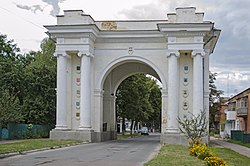 Triumphal Arch
 -
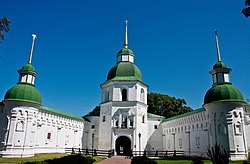 Savior-Transfiguration Monastery
 -
 House of seminary
 -
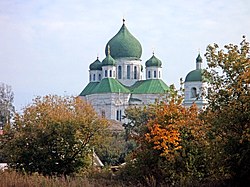 Cathedral of the Assumption
 -
 Savior-Transfiguration Cathedral
 -
 Women's gymnasium
 -
 The museum
 -
 St. Nicholas Church


,_%D0%9D%D0%BE%D0%B2%D0%B3%D0%BE%D1%80%D0%BE%D0%B4-%D0%A1%D1%96%D0%B2%D0%B5%D1%80%D1%81%D1%8C%D0%BA%D0%B8%D0%B9_002.jpg)
References
[edit]- ^ "Новгород-Северская городская громада" (in Russian). Портал об'єднаних громад України.
- ^ Чисельність наявного населення України на 1 січня 2022 [Number of Present Population of Ukraine, as of January 1, 2022] (PDF) (in Ukrainian and English). Kyiv: State Statistics Service of Ukraine. Archived (PDF) from the original on 4 July 2022.
- ^ "Про утворення та ліквідацію районів. Постанова Верховної Ради України № 807-ІХ". Голос України (in Ukrainian). 18 July 2020. Retrieved 3 October 2020.
- ^ "Нові райони: карти + склад" (in Ukrainian). Міністерство розвитку громад та територій України.
- ^ УІНП. "Рік визволення: Чернігівщина". УІНП (in Ukrainian). Retrieved 31 January 2025.
- ^ "Яка гуманітарна ситуація на Новгород-Сіверщині?" (in Ukrainian). Суспільне. 11 March 2022. Archived from the original on 11 May 2024. Retrieved 11 May 2024.
- ^ Yakunina, Oksana (30 May 2022). Тисячолітній Новгород-Сіверський ніколи не здавався, навіть в окупації, - голова громади Людмила Ткаченко [Thousand-years-old Novhorod-Siverskyi never gave up, even during occupation - the head of hromada Liudmyla Tkachenko]. Decentralization.
- ^ "В Новгороді-Сіверському внаслідок авіаудару 3 людини загинули та 12 травмовані, – ДСНС" (in Ukrainian). Суспільне. 12 May 2022. Archived from the original on 11 May 2024. Retrieved 11 May 2024.
- ^ Музей-заповідник [Museum-reserve]. Novhorod-Siverksyi museum-reserve "The Tale of Igor's Campaign".
External links
[edit]
- Novhorod-Siverskyi on the Official Tourism website of Chernihiv Region (in Ukrainian, nice photographs)
- Some of the sites at Podorozh Ukraïnoyu (in Ukrainian, with pictures)
- Forum[permanent dead link] (in Russian, city info basically copied from the Wikipedia in Russian)
- The murder of the Jews of Novhorod-Siverskyi during World War II, at Yad Vashem website.


| International | |
|---|---|
| National | |
| Other | |

Novhorod-Siverskyi
View on GrokipediaGeography and Demographics
Location and Physical Features
Novhorod-Siverskyi is situated in northern Chernihiv Oblast, Ukraine, at approximately 52°00′N 33°18′E, on the right bank of the Desna River.[4][8] The city lies about 150 kilometers northeast of the oblast center, Chernihiv, within the broader context of Ukraine's northern frontier regions.[8] The terrain consists of the gently rolling plains characteristic of the East European Plain, with an average elevation of around 140 meters above sea level.[4][9] The Desna River valley provides a notable topographic feature, featuring low-lying floodplains that contrast with the surrounding elevated plains and support fertile agricultural lands through alluvial soils.[10] Geographically, Novhorod-Siverskyi is positioned approximately 45 kilometers from the Russian border, enhancing its exposure to cross-border influences and potential threats due to the flat, open landscape offering limited natural barriers.[11] The proximity to international boundaries underscores the area's strategic physical setting amid expansive plains extending into neighboring territories.[12]Climate and Environment
Novhorod-Siverskyi lies within the humid continental climate zone, classified as Dfb under the Köppen-Geiger system, typical of northern Ukraine's Polissia region, with distinct cold winters and moderately warm summers. Average annual temperatures range from approximately -7°C in January, marked by frequent snowfall and frost, to 19°C in July, with occasional heatwaves exceeding 30°C. Precipitation totals around 650 mm annually, distributed relatively evenly but peaking in summer months due to convective storms, supporting agricultural cycles while contributing to soil moisture in the surrounding lowlands.[13][14] The local environment faces challenges from the Desna River's seasonal flooding, primarily in spring due to snowmelt, which historically inundates floodplains and alters hydrological patterns in the Polissia lowlands. Soil erosion and deforestation, stemming from past logging practices in mixed forests, have degraded land cover, with rates exacerbated by recent disruptions including wildfires linked to regional instability. These factors increase vulnerability to runoff and sedimentation, though no large-scale irreversible loss has been quantified specifically for the immediate vicinity.[15][16][17] Biodiversity in the area encompasses mixed pine-oak-linden forests and extensive Desna River floodplains, including wetlands and fens that harbor diverse aquatic and terrestrial species representative of Eastern Polissia ecosystems. These habitats support fauna such as European bison reintroductions and various waterfowl, alongside flora adapted to periodic inundation, as documented in the nearby Desnianskyi Biosphere Reserve. Proximity to active conflict zones has raised concerns over potential contamination from military operations, including chemical pollutants entering waterways, though baseline ecological monitoring predates such events and highlights the region's prior high conservation value.[18][19][16][20]Population Trends and Composition
As of 2022, the population of Novhorod-Siverskyi was estimated at 12,375 residents.[21] This figure reflects a continuation of long-term demographic decline in the region, driven by low birth rates and net out-migration, trends common across rural and small urban areas in northern Ukraine since the post-Soviet period.[22] The annual population change rate stood at approximately -1.3% leading into 2022.[21] Historical data indicate slower growth during the late Soviet era, with census figures from 1989 and 2001 showing higher numbers prior to accelerated post-independence depopulation.[21] The 2022 Russian invasion further intensified the downturn through evacuations and displacement, though some reports suggest the city's resident count stabilized around 10,000 by mid-2023 amid partial returns and internal migration.[7] The broader Novhorod-Siverskyi urban hromada, encompassing surrounding settlements, had a population of 34,725 in 2023, down from pre-war levels influenced by similar factors.[23] Demographically, the population is predominantly ethnic Ukrainian, comprising over 90% based on 2001 census patterns in Chernihiv Oblast, with minorities including Russians (around 5%) and smaller Belarusian groups.[24] Pre-war data from the hromada highlight an aging structure, with children under 18 accounting for about 15.5% (3,740 out of 24,073 in early 2022) and retirement-age individuals at roughly 30.5% (7,358).[1] These proportions underscore fertility rates below replacement levels and elevated mortality, consistent with oblast-wide patterns of population aging since the 1990s.[25]Administrative and Economic Overview
Governance and Administration
Novhorod-Siverskyi functions as the administrative center of the Novhorod-Siverskyi urban territorial hromada and the broader Novhorod-Siverskyi Raion in Chernihiv Oblast, overseeing local services for a hromada population estimated at approximately 24,000 residents as of early 2022.[1] The hromada was established on August 31, 2018, as part of Ukraine's post-2014 decentralization reforms, which amalgamated the city with surrounding rural councils like Horbove to consolidate administrative functions such as education, healthcare, and infrastructure management under a single local authority.[26] This structure empowers the hromada to handle budgeting and service delivery independently from oblast-level oversight, though fiscal dependencies on central government transfers persist. Local governance is led by Mayor Liudmyla Tkachenko, who heads the Novhorod-Siverskyi City Council, the elected representative body responsible for policy-making and oversight.[1] The council operates through committees addressing urban planning, social services, and community development, with the mayor executing decisions and coordinating with raion and oblast administrations.[27] Policies emphasize resilience in border-adjacent areas, including civil defense protocols and resource allocation for potential evacuations, given the raion's position near the Belarusian frontier. Since the imposition of martial law on February 24, 2022, following Russia's full-scale invasion, local elections have been suspended nationwide, preventing renewal of council mandates and extending the tenure of incumbents like Tkachenko amid ongoing extensions approved by the Verkhovna Rada as recently as October 2025.[28] This has shifted administrative focus toward emergency coordination, including air raid shelter maintenance and collaboration with national military authorities, subordinating routine decentralization gains to wartime imperatives like threat monitoring and population safety.[29] While hromada-level autonomy facilitated pre-war service integration, current operations prioritize defense-aligned directives from Kyiv, limiting local policy innovation.[30]Economy and Industries
The economy of Novhorod-Siverskyi and its surrounding community is predominantly agrarian, with agriculture forming the backbone through cultivation of grains, potatoes, and dairy production on the fertile plains of Chernihiv Oblast.[31] Mixed farming operations, including 169 agricultural enterprises such as 106 farms, emphasize subsistence and small-scale commercial output, supplemented by forestry activities in the region's wooded areas.[32] [33] Small-scale manufacturing supports local needs via a cluster of 13-17 enterprises, primarily in food processing (including milk and meat products) and light industry, which accounts for about 90% of industrial output in the district.[1] [34] [35] These operations target the domestic market, with limited diversification due to the community's small size and rural character.[1] The Russian invasion since February 2022 has severely disrupted economic activity, including brief occupation until liberation in late March 2022, followed by repeated drone strikes on energy infrastructure that caused power outages and halted production.[36] [37] Evacuations and infrastructure damage elevated unemployment and shifted reliance toward international aid for food security and basic recovery efforts, though agricultural resilience has supported partial rebound in farming output.[36][38]Infrastructure and Transportation
Novhorod-Siverskyi is primarily accessed via road, with the Chernihiv-Novhorod-Siverskyi highway serving as the main artery linking the town to regional centers like Chernihiv, approximately 150 kilometers to the south.[39] This route forms part of broader national roadways, enabling vehicular connectivity but subject to disruptions from wartime damage and repairs. Rail infrastructure exists in adjacent communities, such as Menska, with lines supporting limited freight and passenger movement, though no major station operates directly within Novhorod-Siverskyi itself.[39] The Desna River, on whose banks the town is situated, has facilitated historical navigation and includes a key half-kilometer bridge essential for cross-river transport and regional development.[5][40] However, modern riverine transport remains underutilized, with emphasis instead on road and limited rail links. Post-2014 decentralization initiatives spurred projects like a modern Desna embankment in the town, funded by an EU grant starting in 2021 to enhance riverside infrastructure, but construction stalled amid the 2022 Russian invasion.[41] Utilities face ongoing challenges from Russian aerial attacks targeting energy and water systems in Chernihiv Oblast. Power outages have been recurrent, including a drone strike on September 5, 2025, that disrupted electricity across Novhorod-Siverskyi, and persistent blackouts following strikes on October 3, 2025, affecting energy infrastructure in the district.[42][43] Similar assaults on October 21, 2025, damaged grids in Novhorod-Siverskyi and surrounding areas, leaving hundreds of thousands without power.[44] Water supply, reliant on Desna River sources and pumping stations, suffers parallel interruptions, with post-attack protocols shifting to generator-backed morning and evening distributions as of October 2025.[45][43] Critical facilities have increasingly depended on diesel generators since 2022 to mitigate these vulnerabilities, though national grid reinforcements remain incomplete due to sustained hostilities.[45][46]Historical Development
Founding and Early Medieval Period
Novhorod-Siverskyi was founded in the late 10th century during the reign of Grand Prince Vladimir the Great (r. 980–1015), who established it as a fortified settlement to secure the northern frontiers of Kievan Rus' against potential threats.[3] Positioned along the Desna River, the town functioned primarily as a defensive outpost, with initial structures consisting of wooden fortifications typical of early Rus' border settlements, including palisades and earthen ramparts designed to repel incursions.[47] These defenses reflected the strategic needs of Kievan Rus' to control trade routes and monitor nomadic movements from the southern steppes, though the site's northern orientation relative to the core Kievan territories emphasized consolidation of Slavic-held lands.[48] The earliest surviving reference to Novhorod-Siverskyi appears in historical chronicles dating to the 11th century, underscoring its integration into the administrative and military fabric of Kievan Rus'. By this period, the settlement had evolved into a key nodal point for regional governance, hosting princely residences and garrisons that supported broader Rus' expansion and defense efforts. Archaeological evidence from similar Kievan-era sites confirms the prevalence of timber-based constructions, which were vulnerable to fire but allowed rapid erection and adaptation to local resources.[49] A pivotal event in the early medieval history occurred in the late 12th century under Prince Igor Svyatoslavich (r. 1178–1198), who ruled Novhorod-Siverskyi as part of the Chernihiv branch of the Rurikid dynasty. In 1185, Igor launched a raid against the Polovtsian (Cuman) nomads near the Don River, aiming to curb steppe raids that threatened Rus' southern borders; the expedition ended in defeat, with Igor captured and his forces decimated. This campaign, documented in contemporary annals, highlighted the persistent vulnerabilities of frontier principalities like Novhorod-Siverskyi to nomadic warfare and inspired the anonymous epic The Tale of Igor's Campaign, which laments the disunity among Rus' princes while portraying Igor's endeavor as a heroic, if ill-fated, assertion of princely valor.[50] The event exemplified the dual role of such outposts in both offensive expeditions and defensive resilience during the fragmenting phases of Kievan Rus'.Principality Era and Mongol Invasions
The Principality of Novgorod-Seversky emerged as an autonomous appanage territory within the broader framework of Kievan Rus' fragmentation following the Lyubech Congress of Princes in 1097, which formalized divisions among Rurikid branches to curb inter-princely strife but ultimately exacerbated feudal disunity.[51] Centered on the fortified town of Novgorod-Seversky along the Desna River, it initially fell under the influence of the Chernigov branch before developing its own ruling line from the Svyatoslavichi dynasty, descendants of Svyatoslav Olgovich, who consolidated local power amid the weakening of central Kievan authority. This appanage structure, driven by inheritance practices that splintered lands among heirs, fostered regional autonomy but undermined coordinated defense against nomadic threats from the steppe.[51] The principality reached a notable peak of military assertiveness under Prince Igor Svyatoslavich (r. 1178–1198), whose ill-fated expedition in May 1185 against the Polovtsian (Cuman) tribes along the Don River exemplified both princely ambition and the perils of uncoordinated raids. Igor's force, numbering several thousand including allies like his brother Vsevolod and son Vladimir, initially succeeded in capturing Polovtsian encampments but suffered decisive defeat at the Kayala River due to overextension, numerical inferiority after detachments were sent home with booty, and Polovtsian tactical superiority in open terrain. This campaign, though a tactical failure resulting in Igor's capture (from which he escaped after four months), highlighted the principality's strategic position as a frontier bastion against steppe incursions, yet also underscored causal vulnerabilities from feudal individualism, where personal glory often trumped alliance-building. The Mongol invasions under Batu Khan shattered the principality's independence in 1239, as part of the broader campaign that exploited Rus' internal divisions to overrun fragmented polities from 1237 onward. Batu's horde, leveraging composite bows, heavy cavalry, and siege engineering, devastated the Chernigov-Seversky lands, including Novgorod-Seversky, through systematic sieges and scorched-earth tactics that depopulated regions and razed fortifications; contemporary accounts note the fall of nearby Chernigov in October 1239 after prolonged bombardment, with similar fates for subordinate towns amid widespread princely flight or submission. This conquest imposed Golden Horde suzerainty, extracting tribute and military levies while local rulers operated as vassals, further entrenching fragmentation as surviving Olgovichi and Svyatoslavichi lines fragmented under pressure.[52] Post-invasion recovery was gradual and contingent on shifting overlords, with the principality transitioning through Bryansk princely control before integration into the Grand Duchy of Lithuania by the mid-14th century, functioning as a contested border stronghold amid Lithuanians' opportunistic expansion into depopulated Rus' territories weakened by Horde dominance. Lithuanian grand dukes like Gediminas (r. 1316–1341) capitalized on anti-Mongol sentiments and feudal vacuums to annex such lands, rebuilding Novgorod-Seversky as a defensive outpost with fortified monasteries and trade routes, though persistent raids delayed full stabilization until Lithuanian administrative consolidation in the 1350s. This phase marked a partial resurgence, enabled by Lithuania's centralized military but limited by ongoing Horde tribute demands until the empire's later fractures.[51]Imperial and Soviet Periods
Following the Truce of Andrusovo in 1667, which concluded the Russo-Polish War and ceded Left-Bank Ukraine including Novhorod-Siverskyi to the Tsardom of Russia, the town became integrated into the expanding Russian imperial administration.[53] This treaty marked the end of Polish-Lithuanian influence and the onset of direct Russian governance, with the region initially retaining elements of Cossack autonomy under the Hetmanate.[54] By the late 18th century, as part of Catherine II's reforms, Novhorod-Siverskyi served as the administrative center of the Novhorod-Siverskyi Vicegerency (namestnichestvo), established in 1782, encompassing territories from the former Starodub and parts of Chernihiv and Nizhyn Cossack regiments.[55] This unit facilitated centralized control, supplanting regimental structures and diminishing Hetmanate privileges through land reallocations and noble integration into imperial service, though local socio-economic patterns like agriculture persisted with gradual serfdom intensification.[56] The vicegerency was abolished in 1796 under Paul I, subsuming its areas into the Chernihiv Governorate, reflecting broader shifts toward guberniya-based governance.[55] In the Soviet period, after brief turmoil in the Ukrainian War of Independence, Novhorod-Siverskyi fell under Bolshevik control by 1920 as part of the Ukrainian Soviet Socialist Republic, with minimal industrialization focused instead on agriculture.[57] Forced collectivization from 1928 onward dismantled private farming, imposing kolhosp systems that triggered widespread rural resistance and contributed to the Holodomor famine of 1932–1933, which devastated Chernihiv Oblast including this district through grain requisitions exceeding harvests by quotas up to 44% of output, resulting in excess mortality estimated at 3.9 million across Ukraine.[58] Local effects included depopulation and livestock losses, as documented in regional Soviet archives, though precise town-level figures remain sparse due to underreporting.[59] During World War II, German forces occupied Novhorod-Siverskyi from September 1941 to September 1943 as part of Operation Barbarossa's advance into Ukraine, exploiting agricultural resources while facing Soviet partisan sabotage in the surrounding forests.[60] Partisan units, numbering up to 43,500 across Ukraine by late 1943 per Soviet records, disrupted supply lines through ambushes and intelligence, though operations in this rear area were limited compared to frontline zones.[61] Post-liberation in 1943, reconstruction emphasized collective farming restoration amid war damages estimated at 70% of infrastructure in affected oblasts. After 1945, Soviet policies accelerated Russification via mandatory Russian-language instruction in schools—reaching 80% of Ukrainian curriculum by the 1970s—and administrative Russification, eroding local Ukrainian cultural elements despite nominal federalism.[62] Population recovery, from wartime lows around 8,000 to over 12,000 by 1959, stemmed partly from state-directed resettlement of ethnic Russians and Ukrainians from other republics to bolster labor in agriculture, though industrial development remained negligible with reliance on forestry and light processing.[63] These shifts prioritized ideological conformity over ethnic preservation, as evidenced by demographic data showing Russian speakers rising to 20–30% in similar border regions.[62]Post-Independence and Russo-Ukrainian War Impacts
Following Ukraine's independence declaration on August 24, 1991, and confirmatory referendum on December 1, 1991, Novhorod-Siverskyi maintained its status as an urban-type settlement and administrative center within Novhorod-Siverskyi Raion of Chernihiv Oblast, with local governance focused on regional administration amid national economic transitions.[64] Relative administrative stability persisted through the 1990s and 2000s, punctuated by Ukraine's broader post-Soviet reforms, until the 2014 Russian annexation of Crimea and outbreak of conflict in Donbas elevated border security risks in northern oblasts like Chernihiv. In August 2020, as part of Ukraine's decentralization reforms aimed at consolidating local authority and fiscal autonomy, the Novhorod-Siverska urban hromada was formally established, merging the city with adjacent villages to form a unified territorial community responsible for services such as education and infrastructure.[26] The Russian full-scale invasion launched on February 24, 2022, brought acute threats to Novhorod-Siverskyi owing to its proximity—roughly 40 kilometers—to Russia's Bryansk Oblast border, positioning it within range of ground advances and cross-border fire. Russian troops pushed into Chernihiv Oblast in late February and March 2022, besieging the regional capital and prompting evacuations, but failed to occupy Novhorod-Siverskyi or achieve lasting control in the area, retreating northward by April 9, 2022, after Ukrainian counteroffensives and logistical strains.[65] Since then, the town has faced recurrent shelling from Russian positions across the border, including artillery and air strikes that have damaged residential areas and prompted ongoing civilian restrictions due to the persistent threat.[66] On October 21, 2025, Russian forces executed a daytime drone assault involving approximately 20 Shahed-type unmanned aerial vehicles on Novhorod-Siverskyi, striking the city center and energy infrastructure, which killed four civilians—two men and two women—and injured at least seven others, including a 10-year-old girl in serious condition.[67][68][69] The strikes caused widespread power blackouts affecting thousands of residents in the hromada, exemplifying Russia's pattern of low-intensity, cost-effective drone operations to erode civilian resilience in frontier zones through cumulative infrastructure degradation and psychological strain.[70][71] Ukrainian authorities reported intercepting some drones but highlighted the challenges of defending against such dispersed, attritional tactics amid resource constraints.[72]Culture and Architecture
Architectural Landmarks
The Spaso-Preobrazhensky Monastery represents the preeminent architectural landmark in Novhorod-Siverskyi, originating from foundations laid around 1033 and featuring thick stone walls with corner towers rebuilt in the 17th century after destruction by Mongol forces in 1239.[73] Its Transfiguration Cathedral, constructed in Classicist style with five cupolas from 1791 to 1796 to designs by Giacomo Quarenghi, serves as the complex's central edifice.[74] Supporting structures include the cruciform Saints Peter and Paul Church from the 16th–17th centuries and a late 17th-century Baroque main gate incorporating an octagonal bell tower.[74] Beyond the monastery, the Dormition Church, built between 1671 and 1715 with a bell tower added in 1820, embodies Cossack Baroque characteristics.[8] The wooden Saint Nicholas Church, dating to 1760, exemplifies 18th-century Chernihiv school folk architecture through its carpentry techniques.[8] Remnants of medieval fortifications persist within the monastery grounds, including stone defensive walls integrated into later reconstructions.[73] The Triumphal Arch, erected in 1787 to honor Empress Catherine II's passage through the city, marks another neoclassical feature but incurred partial damage from Russian military strikes commencing in 2022.[1][3] Pre-invasion restoration projects at these sites, including the monastery as a designated cultural-historical preserve, have been interrupted by the conflict.[74]Cultural Heritage and Traditions
Novhorod-Siverskyi's cultural heritage centers on the medieval epic Slovo o polku Ihorevi (The Tale of Igor's Campaign), composed circa 1185–1187, which chronicles the ill-fated 1185 expedition led by Prince Igor Sviatoslavich, ruler of the Principality of Novhorod-Seversky, against the Cumans (Polovtsians). This anonymous work, surviving in a single late-12th-century vellum codex discovered in 1795 and lost in 1812, exemplifies early East Slavic oral-poetic traditions, blending pagan mythology, Christian motifs, and heroic lamentation to evoke unity amid fragmentation in Kievan Rus'. Its enduring influence extends to Ukrainian literature, inspiring romantic nationalism and modern adaptations that underscore regional identity tied to princely valor and steppe warfare.[75][76] Local traditions draw from Orthodox Christianity and historical Slavic roots, featuring festivals such as Easter (Velykden) with ritual egg decorating (pysanky) and midnight processions, and Christmas (Rizdvo) with koliadky caroling that preserve pre-Christian solstice customs adapted under Byzantine influence since the 10th century. These practices, common across Left-Bank Ukraine including Novhorod-Siverskyi, reflect Cossack-era legacies from the 17th–18th-century Hetmanate, when the area hosted Cossack regiments maintaining folk songs, dances, and martial rituals amid Polish-Lithuanian and Muscovite contests for control. Pre-2022 full-scale invasion, community events occasionally included historical pageants evoking these elements, though documentation remains limited.[77] Soviet policies from the 1920s onward imposed Russification, suppressing Ukrainian folklore and language in education and media to foster a unified "Soviet people" identity, which marginalized local dialects and epics like the Tale by framing them as shared "Russian" heritage. Post-1991 independence, Ukraine's 1989 Language Law evolution and 1996 Constitution elevated Ukrainian as the state language, spurring regional revivals including enhanced teaching of vernacular traditions and folklore in Chernihiv Oblast communities like Novhorod-Siverskyi, countering prior assimilation through grassroots cultural associations and heritage initiatives.[62][78]Museums and Educational Institutions
The Novhorod-Siverskyi Historical and Cultural Museum-Reserve "The Tale of Igor's Campaign" serves as the primary institution preserving the region's medieval heritage, focusing on the 12th-century epic poem Slovo o polku Ihorevi and associated Rus' artifacts. Established in 1990 as Ukraine's first state entity dedicated to the poem's study, the reserve operates within the Savior-Transfiguration Monastery complex and features exhibitions on princely history, archaeological finds, and manuscript replicas.[79][80] Its collections underscore the city's role in Kievan Rus' principalities, drawing from monastic archives and local excavations.[81] The Local Lore Museum, located at Soborna Street 3, complements these efforts by documenting Novhorod-Siverskyi's urban and rural history from the 11th century onward, with displays of ethnographic items, Cossack-era relics, and 19th-20th century artifacts. Founded in 1920, it operates daily from 8:00 to 17:00 and emphasizes the area's transition through imperial, Soviet, and independent periods, including exhibits on traditional crafts and daily life.[82][83] Both museums have received support from international aid programs amid wartime challenges, aiding preservation of over 10,000 items despite risks from proximity to the border.[84] Novhorod-Siverskyi's educational landscape centers on secondary institutions, with the Gymnasium—established in 1804 as one of Ukraine's oldest—providing advanced studies in humanities and sciences to approximately 500 students annually. The community hosts 14 schools total, including Lyceum No. 1 and specialized programs in arts and sports, fostering regional identity through curricula on local history and Ukrainian language.[85][1] Higher education access remains limited, with residents relying on regional centers like Chernihiv for colleges, though a medical college operates locally for vocational training. The Russo-Ukrainian War has severely disrupted these institutions, with multiple schools damaged or destroyed since February 2022, including a full demolition in Novhorod-Siverskyi on May 12, 2022, and further incidents from drone strikes in March and May 2025. Enrollment dropped amid evacuations and infrastructure losses, affecting over 700 students in key facilities, yet reconstruction prioritizes schools as recovery anchors, with community incentives for educators to sustain operations.[5][86][87] These centers continue promoting historical awareness, countering external narratives through evidence-based exhibits and lessons on Siverskyi Cossack traditions.[88]Notable Individuals
Historical Figures
Igor Svyatoslavich (1151–c. 1202), known as Igor the Brave, ruled as prince of Novgorod-Seversky from 1180 to 1198 as a member of the Olgovichi branch of the Rurik dynasty.[89] Born into the princely family tied to the Chernigov region, he ascended amid inter-princely rivalries following the fragmentation of Kievan Rus'.[89] In May 1185, Igor launched an unauthorized expedition against the Polovtsian (Cuman) nomads along the Don River, aiming to curb their raids; his forces suffered defeat on May 31, leading to his capture alongside his brother Vsevolod.[89] Escaping captivity after three months through a dramatic flight, Igor returned to Novgorod-Seversky and resumed rule, later expanding influence by seizing Chernigov in 1198.[89] His Polovtsian campaign became the subject of the 12th-century epic Slovo o polku Igorevi (The Tale of Igor's Campaign), a key literary work depicting Rus' unity against steppe threats, though its authenticity and precise authorship remain debated among historians due to the manuscript's late discovery in 1795.[89] Igor died around 1202, leaving sons Vladimir and Oleg who continued the dynasty's struggles against Mongol incursions post-1237.[89] Svyatoslav Olegovich (d. 1164), Igor's father, briefly held Novgorod-Seversky as part of broader Chernigov appanages before his death in battle against rivals, solidifying the local branch's claim during the principality's early consolidation around 1097.[89]Modern Contributors
Zino Davidoff (1906–1994), born in Novhorod-Siverskyi to a Jewish family involved in tobacco trade, emigrated to Switzerland in 1911 amid political instability in the Russian Empire.[90][91] He founded the Davidoff luxury brand in Geneva, initially focusing on cigars and tobacco accessories imported from Havana, which emphasized meticulous craftsmanship and premium quality, expanding later into perfumes and watches that achieved global recognition by the late 20th century.[90] Liudmyla Tkachenko, as head of the Novhorod-Siverska community since at least the early 2020s, led local governance during the Russian occupation starting in February 2022, coordinating civilian resilience and basic services under duress.[5] Her administration facilitated post-liberation recovery, including the establishment of a community Alley of Memory for war victims funded by charity in 2024 and the signing of a memorandum for reconstruction and investment partnerships in July 2025.[92][93] These efforts underscore administrative adaptation to wartime challenges and subsequent rebuilding in the region.[5]References
- https://en.wikibooks.org/wiki/World_Cultures/Culture_in_Europe/Culture_of_Ukraine