Hubbry Logo
ObertauernObertauernMain
Open search
Obertauern
Community hub
Obertauern
logo
8 pages, 0 posts
0 subscribers
Be the first to start a discussion here.
Obertauern
Obertauern
from Wikipedia
Obertauern is located in Austria
Obertauern
Location of Obertauern in Austria
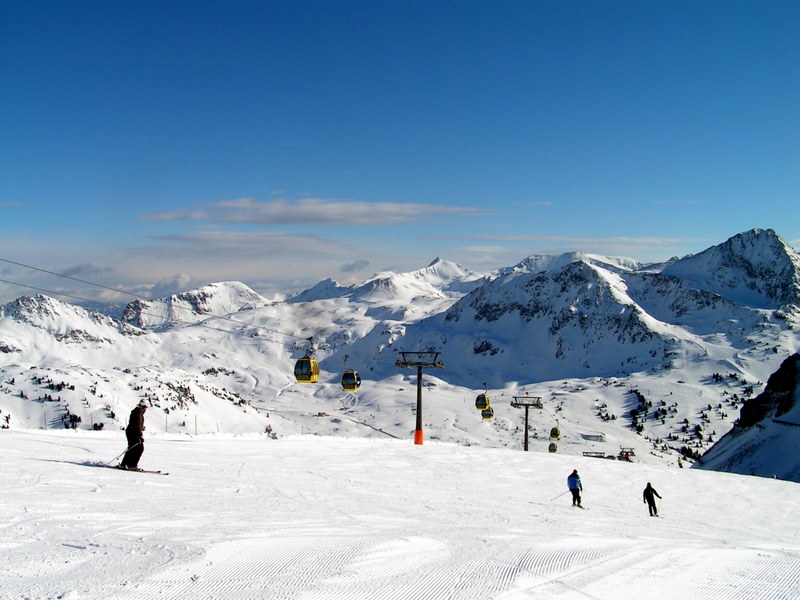
Obertauern ski area

Obertauern is a tourist destination which is located in the Radstädter Tauern in the Salzburger Land of Austria. The winter sports resort is separated in two communities: Tweng and Untertauern.

Geography

[edit]
Obertauern is amongst the bigger skiing centres in Austria.

Obertauern lies in the southeast of the state of Salzburg in the Radstädter Tauern mountains at heights of between 1,630 and 2,526 metres above sea level. The village is near to the highest point of the Radstädter Tauern Pass over which the Katschberg road (Katschberger Straße, the B 99) runs. Obertauern belongs to two districts: St. Johann/Pongau and Tamsweg, hence why the community is separated into the two municipalities of Untertauern (Pongau) and Tweng (Lungau). The municipal boundary runs at the height of the pass and hence through the centre of the village.

Climate

[edit]

Obertauern has a subarctic climate (Köppen Dfc).

Climate data for Obertauern: 1772m (1991−2020 normals)
Month Jan Feb Mar Apr May Jun Jul Aug Sep Oct Nov Dec Year
Record high °C (°F) 10.5
(50.9)
12.6
(54.7)
15.0
(59.0)
18.2
(64.8)
23.9
(75.0)
28.2
(82.8)
28.1
(82.6)
28.1
(82.6)
22.7
(72.9)
21.1
(70.0)
16.2
(61.2)
11.0
(51.8)
28.2
(82.8)
Mean daily maximum °C (°F) −1.6
(29.1)
−1.3
(29.7)
1.7
(35.1)
5.6
(42.1)
10.1
(50.2)
13.7
(56.7)
15.4
(59.7)
15.5
(59.9)
11.4
(52.5)
7.5
(45.5)
2.2
(36.0)
−1.1
(30.0)
6.6
(43.9)
Daily mean °C (°F) −4.5
(23.9)
−4.3
(24.3)
−1.6
(29.1)
2.1
(35.8)
6.6
(43.9)
10.4
(50.7)
12.2
(54.0)
12.3
(54.1)
8.1
(46.6)
4.5
(40.1)
−0.5
(31.1)
−3.8
(25.2)
3.5
(38.2)
Mean daily minimum °C (°F) −6.9
(19.6)
−8.0
(17.6)
−4.8
(23.4)
−1.5
(29.3)
2.3
(36.1)
5.8
(42.4)
7.5
(45.5)
7.6
(45.7)
4.2
(39.6)
1.0
(33.8)
−3.1
(26.4)
−6.1
(21.0)
−0.2
(31.7)
Record low °C (°F) −20.6
(−5.1)
−22.2
(−8.0)
−22.3
(−8.1)
−14.8
(5.4)
−6.5
(20.3)
−3.2
(26.2)
−0.7
(30.7)
−1.5
(29.3)
−4.9
(23.2)
−13.7
(7.3)
−16.8
(1.8)
−22.3
(−8.1)
−22.3
(−8.1)
Average precipitation mm (inches) 39.0
(1.54)
27.8
(1.09)
49.4
(1.94)
53.3
(2.10)
103.3
(4.07)
158.6
(6.24)
182.9
(7.20)
168.8
(6.65)
112.4
(4.43)
79.6
(3.13)
55.5
(2.19)
35.1
(1.38)
1,065.7
(41.96)
Source: Central Institute for Meteorology and Geodynamics[1]

History

[edit]

Celts and Romans

[edit]

Obertauern has a long history, which goes back to the era of the Celts (4th – 1st century B.C.). Also, the Roman road led over the Tauern Pass (in Alpe) to Iuvavum (Salzburg). The tracks of old Roman wagons have been uncovered on this road. The relics of old milestones attest to Roman use of the pass. The upgrade of the road probably dates back to the time of the Emperor Claudius (41-54).

Development of the village

[edit]

The first definite mention of the Radstädter Tauern was in the year 1207. In 1224, the records note that there was already a small church at the top of the pass. In 1517, it is documented that there were two innkeepers on the Tauern, referring to the houses of Schaidberg and Wisenegg. These two buildings are still in good order today. In 1519, the road was widened for to take coaches and wagons. In 1764, Archbishop Sigismund of Schrattenbach opened the posting house of Untertauern and there were two post runs per week. In 1870 this increased to four per week, and, in 1895, to twice daily. In 1902, the first skiers are recorded.

The tourist resort of Obertauern

[edit]

In 1920, after the First World War, the first skiers came to Obertauern – on foot. Their baggage was transported by horse-drawn sleighs. From 1925 to 1927, the so-called Tauern races for cars and motorcycles took place, attracting many visitors. The people of Obertauern date the foundation of their village to 8 December 1929, because it was on that day that regular winter traffic over the Tauern Pass began for the first time. In 1948, the first lift was installed at the Seekarhaus. From 1948 to 1960, the slope was posted by skiers. For one hour of piste preparation, they got 3 free runs. Roads and avalanche protection were extended in 1950 and the first button lifts were built. The creation of the hotel village of Obertauern began in 1952. Between 1952 and 1961, a large number of modern cable cars, gondola lifts and drag lifts were installed.

From the 1960s to the present day

[edit]

In 1961, the modern cable car on the Zehnerkar was taken into service. In 1962, Obertauern became the official name of the village. One year later, the first motorised piste basher in Austria started work in Obertauern and the pistes no longer had to be tamped down by foot by the skiers. At that time the "Skiing Comprehensive School" (Schifahrende Volksschule) became well-known; the school incorporating skiing in the afternoons, after following the normal timetable in the mornings.

In 1965, Obertauern was used by The Beatles in their film, "Help!". The town was chosen as it was one of the few areas to have snow at the time.[2]

1967 saw piste construction using bulldozers took place for the first time. This resulted in radical changes to the terrain in order to make the runs easier to negotiate for piste maintenance equipment and also for a wider range of tourists. By linking several of the lifts, a precursor to the present day Tauern Circuit (Tauernrunde) was created.

In 1985 the first snow cannon was installed and in the years that followed numerous drag lifts and chair lifts were replaced. Between 1991 and 1998 many modernization projects were completed – such as the floodlit ski slope and the introduction of the contactless ski pass system. In December 1999, the German, Christian Flühr, set the world marathon skiing record in Obertauern – skiing for three days non-stop (68 hours and 23 minutes). This is the distance between America and Europe. One season later, in February 2001, Christian Flühr set the world record again by skiing for more than 4 days (103 hours and 21 minutes) non-stop. Later, he beat this world record several times but in other locations.

Obertauern has also established itself as one of the top après ski resorts in Austria.[3] The Edelweißalm and the area around the Lürzer Alm are internationally renowned.[4]

Cemetery of the Unknown

[edit]

At the top of the pass is the Cemetery of the Unknown (Friedhof der Namenlosen). The name comes from the time when people crossed the Tauern Pass on foot with poor clothing and equipment, often in bad weather, losing their lives as a result. Often these travellers could not be identified and were thus buried "nameless". Today it is the cemetery for the population of the ski village of Obertauern.

Winter sport in Obertauern

[edit]

Skiing and snowboarding

[edit]
The legendary Gamsleiten peak

Skiing is the most popular sporting activity in Obertauern, followed by snowboarding. The ski region has around 100 kilometres of prepared pistes and 26 lifts that are capable of transporting 48,000 - 49,000 people per hour. The area is served by 1 gondola, 19 chair lifts and 6 drag lifts, and has 100 km of runs.[5] The pistes are graded using a colour scheme: blue (61%) for easy runs, red (35%) for runs of medium difficulty and black (4%) for difficult pistes, the piste alongside the Gamsleiten 2 lift being the second steepest run in Austria. All the lifts will take non-skiers to the top as well, but only the Zehnerkarbahn and Grünwaldkopfbahn will take passengers down again. Daytime visitors may park on the 24,000 m2 of car parks in the vicinity of the slopes. The Liftgemeinschaft Obertauern (LGO) is responsible for all the lifts.

The Tauern Circuit

[edit]

Because the lifts are laid out in a circle around the village, it is possible to do a "Tauern Circuit" (Tauernrunde), either clockwise (following the red signs) or anti-clockwise (following the green signs). To cross the B 99 (Katschberg-Straße) there are ski bridges by the Gamsleiten/Edelweiß, Kirchbühel (two bridges) and Grünwaldkopf/Zehnerkar pistes. The circuit may begin at any lift and returns the skier to the start. Good signposting also enables pistes outside the circuit to be skied.

Cross-country skiing

[edit]

In addition to downhill skiing and snowboarding, Obertauern offers other winter sport activities. Visitors may used the 26 kilometres of cut cross-country skiing tracks, including one used for the world cup, as well as hiking trails.

Ski passes

[edit]

Obertauern has its own ski pass that, since the 2012/13 season, is also valid for the Großeck-Speiereck ski region some 15 kilometres away. The Lungo Ski Pass (for the Obertauern - Lungau - Katschberg region) and the "Super Salzburg Ski Card" (Salzburger Land) are also valid, but not the Ski Amadé pass.

Summer tourism

[edit]

In summer, Obertauern is a popular base for numerous hiking trails because the village lies on the Central Alpine Way (Zentralalpenweg). The two Alpine huts, Oberhütte towards Styria and the Südwiener Hütte in the direction of Flachau may be reached in 2 hours on foot.

In August and September, motorcycle gatherings take place.

However, Obertauern is mostly a winter resort and many hotels and businesses are closed in the summertime.

Obertauern sports centre

[edit]

Obertauern has a sports centre (the Sportzentrum Obertauern) where visitors may play various sports. Facilities include: 2 tennis indoor courts, 3 squash courts, 1 badminton court, 3 fully automatic bowling alleys, a bodybuilding and fitness room with a cardio area, a multi-purpose hall as well as a billiards facility. There is also a big vitality centre (600 square metres) and sports medical advice is available. In earlier times, famous sportsmen like Hermann Maier and Michael Walchhofer trained in this centre between races. Heinz Schilchegger, a world-class skier, is also from Obertauern.

Flora and fauna

[edit]

Obertauern is also popular with scientists and friends of nature. In this region you can find the rare red-breasted bluethroat.

References

[edit]
Revisions and contributorsEdit on WikipediaRead on Wikipedia
from Grokipedia
Obertauern is a high-altitude and in the District of , , situated at 1,630 meters above sea level amid the Radstädter Tauern mountains. With a resident population of approximately 200 (as of 2024), it serves primarily as a hub, renowned as 's snowiest ski area and known for early snow reliability due to its location in a natural "snow bowl" where south- and north-facing slopes ensure reliable snowfall and an extended season from to May. The encompasses 100 kilometers of well-groomed pistes across varied —predominantly and runs suitable for families and intermediates, with options for experts—accessed by 26 modern lifts, including high-speed gondolas, enabling convenient "ski-in, ski-out" access from accommodations without reliance on cars or buses. Obertauern's origins trace to Roman times, when a key road connected northern and through the Tauern passes, facilitating trade and military movement. The area's transformation into a winter destination began around 110 years ago, with the arrival of soldiers for training on rudimentary slopes, supported by a handful of basic lodgings and emergency huts. Following , in the late 1940s, it emerged as a spot amid Austria's postwar boom, evolving rapidly with infrastructure expansions to accommodate growing visitors. International recognition came in 1965, when filmed scenes for their movie Help! in Obertauern, drawing global attention to its pristine alpine setting and boosting its status as a celebrity-favored retreat. Beyond and , Obertauern offers diverse winter activities, including approximately 67 kilometers of cross-country trails, runs, hikes, and family-oriented attractions like Bobby's Kinderland with ski schools, a monster park, and a . In summer, the resort shifts to , , and across over 280 kilometers of trails, highlighting its year-round appeal in a protected . Notable features include the Gamsleiten 2 , Austria's steepest at 45 degrees, and panoramic views from peaks reaching 2,313 meters, underscoring Obertauern's blend of , reliability, and scenic that defines it as a premier alpine destination.

Geography

Location and topography

Obertauern is situated in the Radstädter Tauern mountains of the , within the state of , , approximately 90 kilometers south of the city of . The area spans the administrative districts of and Tamsweg, with the village divided between the municipalities of Untertauern in and Tweng in Tamsweg (Lungau ). This positioning places Obertauern in a high-altitude basin surrounded by steep alpine terrain, contributing to its isolation and appeal as a . The elevation of Obertauern ranges from 1,630 meters to 2,526 meters above , with the village center located at approximately 1,740 meters. It lies directly on the Radstädter Tauern Pass at 1,738 meters, a historic route connecting the Pongau and Lungau regions, which forms part of the broader Central Alpine Way (Zentralalpenweg), a long-distance trail spanning the . Prominent surrounding peaks include the Gamsleiten at 2,313 meters, which overlooks the ski area and provides panoramic views of the basin. Geologically, Obertauern is embedded in the Radstädter Tauern, a subrange of the Low Tauern within the , characterized by a complex tectonic history involving the collision of the European and African plates. The region features crystalline basement rocks overlain by sedimentary layers from the era, with metamorphic influences from evident in the surrounding schists and gneisses. This setting exemplifies the structural diversity of the , where systems and fault lines have shaped the dramatic topography.

Climate

Obertauern exhibits a classified as Dfb under the Köppen-Geiger system, featuring cold, snowy winters and cool, relatively short summers due to its high elevation above 1,700 meters. This reflects the region's continental influences, with temperatures rarely exceeding 20°C even in peak summer and frequent sub-zero conditions from late fall through early spring. The local climate is shaped by topographical factors, including the enclosing Tauern mountain ranges that channel moist air masses and enhance orographic . Based on 1991–2020 normals from GeoSphere Austria (formerly ZAMG), annual averages 905.7 mm, distributed across approximately 140 rainy or snowy days per year. Monthly varies significantly, with winter months showing lower liquid equivalents but substantial snowfall contributions.
MonthPrecipitation (mm)Mean Temperature (°C)
January39.0-4.5
February27.8-3.8
March49.40.1
April53.34.3
May79.08.7
June111.211.8
July141.713.9
August130.512.3
September93.68.5
October70.14.8
November57.10.0
December53.0-3.2
These figures illustrate a peak in summer rainfall, supporting alpine vegetation, while winter precipitation primarily falls as . Snowfall patterns result in reliable snow cover from to May, with average depths exceeding 200 cm at mid-mountain levels during peak season, and Obertauern is known for its early snow reliability due to its high elevation and northerly exposure in the . Obertauern's reputation as Austria's snowiest stems from its high elevation and northerly exposure in the , which intercepts frequent moisture-laden winds from the north and west, promoting abundant snowfall averaging over 7 meters annually at higher altitudes. This combination ensures exceptional snow reliability compared to lower-lying areas, with minimal reliance on artificial for extended winter operations.

Administration and demographics

Municipal status

Obertauern holds the administrative status of an Ortschaft, or locality, without independent municipal , as it is divided between two parent municipalities in the state of : the northern portion falls under the municipality of Untertauern in the St. Johann im Pongau district (Pongau), while the southern portion is part of the municipality of Tweng in the Tamsweg district (Lungau). This division reflects the locality's position astride the historic Radstädter Tauern Pass, with boundaries aligned along the pass's topography rather than administrative convenience. The population of Obertauern is thus distributed across these two municipal jurisdictions, with local services coordinated accordingly. Following the 19th-century reforms in the , particularly the 1849 March Constitution and subsequent municipal codes that established self-governing Gemeinden, both Untertauern and Tweng were formalized as independent municipalities within 's emerging administrative framework. Prior to these changes, the areas were part of larger judicial and districts under Habsburg rule, but the reforms integrated them into the modern state structure of , which became a federal state in and retained its district-based organization. Obertauern's non-independent status persisted through these developments, as it evolved primarily as a seasonal settlement without seeking separate incorporation. In terms of local institutions, governance relies on the parent municipalities for core functions such as land registry and taxation, with Obertauern integrated into their respective Katastralgemeinden—cadastral municipalities—for property and purposes. The Obertauern Tourist Board operates as a joint entity spanning both divisions, promoting the locality as a unified destination and handling visitor-related administration, including permits and infrastructure coordination. Emergency services jurisdiction is similarly collaborative; the Voluntary Obertauern (Freiwillige Feuerwehr Obertauern) serves the entire locality under the oversight of both municipal fire brigades, ensuring rapid response across the divided area through shared resources and training.

Population statistics

Obertauern maintains a small permanent of 321 residents as of January 1, 2025 (estimate), distributed as 188 in the Untertauern portion and 133 in the Tweng portion, with the majority residing in the northern area. This figure reflects the locality's role as a high-altitude community, encompassing both year-round inhabitants and those tied to operations. Available historical data for the Untertauern portion indicate a decline from 214 residents in 2011 to 188 in 2022, with no change through 2025, underscoring the stability of this remote alpine settlement; data for the Tweng portion are limited. The demographic profile features a predominance of working-age adults, which aligns with the demands of the seasonal tourism workforce that supports the resort's operations. Low birth rates, consistent with broader rural Austrian patterns at around 8.5 live births per 1,000 population, contribute to this age structure, alongside a notable seasonal influx of temporary residents that swells the effective population during winter months. In comparison to Salzburg state averages, where the working-age group accounts for roughly 62% of the 572,905 residents in 2025, Obertauern's demographics emphasize its unique balance of a minimal permanent base against significant transient elements, distinguishing it from more urbanized areas in the region.

History

Ancient and early settlement

The Tauern region encompassing Obertauern, which spans the Pongau and Lungau districts in , shows evidence of human activity dating back to the Celtic period. From the , the area belonged to the Celtic kingdom of , a prosperous culture known for its metalworking and trade networks across the . Archaeological evidence suggests Celtic settlements and pathways utilized the natural routes through the Tauern mountains, facilitating early exchanges of goods such as from mines. Roman expansion into the began with the conquest of in 15 BC under Emperor Augustus, transforming it into a by around AD 50. The Romans engineered a major road over the Radstädter Tauern Pass, connecting to the Adriatic via Aquileia and serving as a critical artery for military movements and commerce. This infrastructure supported the transport of metals, including Noricum's renowned , and salt from nearby sources, underscoring the pass's role as a key waypoint in transalpine trade routes that linked the Danubian provinces to . Remnants of this road, including stone-paved sections and milestones, attest to Roman prowess in navigating the challenging alpine terrain. Archaeological discoveries in the broader Tauern region highlight sustained Roman presence through the AD. Finds such as a Roman ground near Lessach in the Lungau area, containing urns and , indicate settled communities along the trade corridors. Roman artifacts, including coins, , and tools recovered near the pass, further evidence ongoing activity despite the empire's decline. The first written reference to the Radstädter Tauern as a waypoint appears in 1207, in documents from the archdiocese recording ecclesiastical privileges along the path. This early medieval notation marks the transition from Roman infrastructure to sustained local use as a vital alpine crossing.

Medieval to early modern development

Obertauern emerged as a modest farming and settlement in the 13th century, situated along the border of the Pongau and Lungau districts under the authority of the archbishopric. The area was first documented around 1210 with the mention of a Tauernhospiz, a serving travelers along the Radstädter Tauern pass route, reflecting its role as a transit point amid alpine pastures. By 1336, records in the archbishopric's tax books list approximately 50 inhabitants, including 31 tenant farmers (Urbarleute) and 19 freeholders (Freisassen), who sustained themselves through mixed and rearing on the high valley lands. The settlement experienced disruptions during the Peasants' War of 1525–1526, which engulfed the region, including Pongau and Lungau, as miners, farmers, and townsfolk rose against heavy taxes and administrative grievances. Local unrest in the area involved occupations of key sites, leading to economic strain on herding and farming communities through disrupted and reprisals; the conflict culminated in the Radstädter Blutgericht execution of 1526, exacerbating long-term displacements in the archbishopric. The further impacted the local economy in the early 19th century, as 's secularization in 1803 and subsequent annexations—first to in 1809 and then back to in 1816—altered administrative structures and flows, though Obertauern's remote position limited direct military involvement while contributing to broader regional instability in . By the , improvements to the Radstädter Tauern pass road facilitated greater traveler traffic, with postal services expanding from four times weekly in 1870 to twice daily by 1895, supporting the establishment of early inns such as those at Wisenegg and Schaidberg, documented since as Tauernhäuser. This shift prompted gradual changes in and , from predominantly agricultural pursuits—evidenced by 201 farms and herding stations in 1784—to increased reliance on transit-related activities; the resident remained small, fluctuating between 20 and 25 individuals from 1785 to 1806, before declining to 6–8 by the 1840s, underscoring the area's sparse settlement amid growing pass usage.

Emergence as a tourist destination

Following , Obertauern began its shift from a modest transit village to an emerging recreational hub, with the arrival of the first skiers in 1920. These early visitors, mainly soldiers undertaking training exercises, trekked on foot through the snow-covered pass, while their baggage was hauled by horse-drawn sleighs to rudimentary accommodations that had previously served travelers on the historic north-south route. The post-World War II era accelerated this transformation through key infrastructural advancements. In 1948, the installation of Obertauern's inaugural at the Seekarhaus site dramatically improved access to higher elevations, replacing arduous climbs and enabling broader participation in . This development coincided with the official opening of dedicated ski slopes in 1950, which quickly drew enthusiasts eager to explore the basin's reliable snowfall and varied terrain. The marked a period of explosive growth, as Obertauern solidified its status as a premier destination. New cable cars and drag lifts expanded the accessible area, while a surge in hotel construction catered to rising visitor numbers; notable examples include the early origins of what became the Hotel Lürzerhof from a simple restaurant and the completion of the Hotel Zehnerkar in 1959. This era also saw the initial establishment of trails for both cross-country and downhill , fostering a diverse culture that emphasized the region's natural bowl-like for reliable, high-altitude pursuits. These foundations laid the groundwork for Obertauern's continued evolution into a major Alpine resort in subsequent decades.

Post-1960s developments

In 1965, filmed key winter scenes for their movie Help! in Obertauern, including sequences at the Olympic ski jump, on the slopes, and in an après-ski bar, which significantly elevated the resort's international profile. The visit acted as a major catalyst for winter , sparking a skiing boom and drawing global attention to the area as a premier destination. Local residents served as stunt doubles for the band members, who had limited skiing experience, further embedding the event in the village's cultural memory. This exposure boosted visitor numbers and solidified Obertauern's reputation beyond regional borders. Following this surge, Obertauern underwent substantial infrastructure upgrades during the and to accommodate growing demand, including the addition of more ski lifts and the expansion of pistes to reach approximately 100 kilometers in total length. These developments transformed the from a modest training ground for early skiers into a comprehensive hub, with enhanced connectivity via the Tauern Round circuit that encircles the village. The investments focused on improving and capacity, enabling the resort to handle increased international traffic while maintaining its high-altitude snow reliability. From the through the , Obertauern adapted to environmental and operational challenges by implementing advanced systems across key slopes, ensuring consistent coverage even in variable weather conditions. These systems, combined with energy-efficient technologies, supported extended seasons from to May. Parallel sustainability initiatives emerged, such as waste reduction programs, renewable energy adoption in accommodations, and eco-friendly lift operations, reflecting a commitment to preserving the alpine ecosystem amid rising tourism pressures. Many hotels achieved certifications for sustainable practices, emphasizing resource conservation in this high-elevation setting. Recent milestones as of 2025 highlight Obertauern's resilience and forward momentum, including preparations for the 2025/26 season with a planned partial opening on November 21, 2025, followed by opening featuring concerts by Seiler & Speer on November 28 and on December 5. The resort's sector continues to thrive post-COVID-19 recovery, with visitor numbers exceeding pre-pandemic levels as of the 2024/25 season and sustained growth into 2025, aligning with Austria's broader industry rebound.

Cultural and historical sites

Cemetery of the Unknown

The Cemetery of the Unknown, known locally as the Tauernfriedhof or Friedhof der Namenlosen, is situated near the village church in Obertauern at the Radstädter Tauern Pass, at an elevation of 1,738 meters above . It was established as a burial ground primarily for unidentified travelers—such as pilgrims, wanderers, and mountaineers—who died from exposure, , or accidents while crossing the perilous pass. Historical records indicate the cemetery's origins in the early , linked to the reconsecration of the nearby Peterskirchlein church in 1515, with the oldest surviving gravestones dated to 1534 and 1545. While it accommodated both named locals, including Tauern innkeepers and alpine workers, its defining role was interring the anonymous dead whose identities could not be determined, a practice that continued until the last burial in 1918. After 1918, the cemetery saw no burials until the 1980s, when it resumed use for named local burials. In local , the site embodies the enduring dangers of the Tauern Pass, serving as a somber reminder of the human cost of travel through the and honoring the nameless victims as unsung figures in the region's history. This cultural resonance is evident in annual commemorations on and , where it is invoked alongside lesser-known saints to reflect on mortality and resilience. Currently preserved as a protected under Austrian heritage laws, the features a walled with uniform simple iron crosses, an open chapel-like niche housing an 18th-century , and remnants of historical renovations from and later decades. Interpretive elements, such as contextual plaques, highlight its role in alpine burial traditions, ensuring its significance endures for visitors tracing ties to ancient trade routes.

Beatles filming locations and memorials

In March 1965, arrived in , , to film the snowy alpine sequences for their second , Help!, directed by . The production team, consisting of approximately 60 members including the band, stayed primarily at the Hotel Edelweiss and the Marietta Hotel for about two weeks starting in mid-March. Local residents served as ski stunt doubles for the band members, who lacked advanced skills, enabling the capture of dynamic chase and performance scenes amidst the Tauern Mountains. Key filming sites included the Edelweissalm slope near the Hotel Edelweiss, where exterior shots and après-ski sequences were recorded, featuring in casual winter attire. Village streets in Obertauern and nearby slopes were also utilized for transitional shots and broader pursuit scenes, integrating the resort's quaint and frozen landscapes into the narrative's alpine adventure. These locations highlighted the film's blend of music and absurdity, with sequences like the "Ticket to Ride" performance filmed on nearby slopes. To commemorate the 50th anniversary of the shoot, two bronze monuments featuring life-sized statues of were unveiled in 2015. The primary installation, depicting the four members in ski outfits from the film, stands in front of the Hotel Edelweiss, where a details the production's historical significance. A second monument, including a replica of the wooden piano used in a , is located at the Grünwaldkopf mountain station atop the Edelweissalm slope, while another plaque marks the Kirchbühellift site. These memorials draw international visitors, particularly fans, and inspired annual tribute events such as photo exhibitions, concerts, and film screenings, with the 60th anniversary in March 2025 featuring expanded programming like symphonic performances. The 1965 filming elevated Obertauern's profile as a celebrity-endorsed destination, contributing to its tourism surge by associating the resort with global pop culture. Today, these sites and memorials reinforce the village's branding as "The Beatles' Alpine Retreat," attracting pilgrims who blend with and sustaining the band's legacy in the region's economy.

Economy

Tourism as economic driver

Tourism dominates the economy of Obertauern, a small alpine village with approximately 200 residents, serving as its primary economic engine through high-volume winter visitor traffic. Pre-pandemic data indicate approximately 1,046,000 overnight stays annually (2018/2019), underscoring the resort's appeal as a premier destination. In the 2022/23 tourism year, this translated to roughly 5,442 overnight stays per resident—dramatically higher than Austria's national average of 15—highlighting the intense seasonal demand that sustains local businesses. The sector generates substantial employment, with approximately 2,500 individuals engaged across , guiding, and related services during peak winter periods in the broader region, though this supports an estimated 200–300 positions year-round given the village's modest permanent . This reliance contrasts with broader n trends, where contributes about 6.2% to national GDP and winter activities account for approximately 46% of the country's 154 million annual overnight stays as of , often balanced by more diversified summer and urban economies. Obertauern's tourism has shown resilience post-COVID, aligning with national recovery trends where overnight stays surpassed pre-2019 levels by 0.2% from January to September 2024. In the 2023/24 tourism year, overnight stays totaled 1,079,098, indicating sustained recovery. However, ongoing challenges include climate change, which threatens snow reliability essential for skiing operations, prompting discussions on adaptation strategies like enhanced snowmaking to maintain economic viability.

Infrastructure and accessibility

Obertauern is accessible primarily by road via the B99 federal highway, which passes through the Radstädter Tauern Pass, connecting the resort to major transport routes in the region. Travelers from the north can reach it by taking the A10 Tauern Motorway to the Radstadt exit (exit 63), followed by the B99 Katschberg road through Radstadt to Obertauern. The resort lies approximately 90 kilometers south of , making it a convenient destination for international visitors arriving by air. Public transportation options include bus connections from , such as line 270 from the airport to Eben im Pongau and line 280 onward to Obertauern, with journey times around 2.5 hours. Regional trains operated by serve Radstadt, about 20 kilometers away, from where postbuses, taxis, or shuttles complete the trip to the resort. During the winter season, dedicated shuttle services operate from and Klagenfurt airports, and free ski buses circulate within Obertauern for pass holders, enhancing accessibility for non-drivers. The resort offers extensive accommodations, including over 60 hotels and numerous apartments clustered along the main road and near ski lifts, providing ski-in/ski-out options for convenience. These facilities collectively support a capacity of around 20,000 guests, accommodating the high volume of winter tourists through a mix of luxury hotels, family-run guesthouses, and self-catering units. Supporting utilities feature modern water management and systems that cover nearly 100% of the 100 kilometers of pistes, ensuring reliable snow conditions from early winter onward through efficient pumping and distribution networks. Emergency infrastructure includes a seasonal and doctor's in Obertauern, operational during the winter months to handle medical needs, , and 24-hour urgent care via Austria's national emergency line (144). Improved access via these systems has bolstered the local economy by facilitating longer seasons and higher visitor numbers.

Sports and recreation

Winter sports facilities

Obertauern's winter sports facilities center on its extensive ski area, featuring approximately 100 kilometers of groomed pistes suitable for and . These slopes are distributed as 61 kilometers of blue runs (61%), 35 kilometers of red runs (35%), and 4 kilometers of black runs (4%), with approximately 60% of the trails being blue runs ideal for beginners and families with novice skiers, catering to , intermediates, and advanced skiers alike. Among the challenging black runs, Gamsleiten 2 stands out as one of 's steepest pistes, with a maximum of 100% over its 1.3-kilometer length and 362-meter vertical drop. This unmaintained, mogul-covered descent from the resort's highest point at 2,313 meters demands expert technique and is a highlight for advanced riders seeking high-adrenaline terrain. The infrastructure supports high-volume access with 26 modern lifts, including gondolas, chairlifts, and drag lifts, providing a total transport capacity of 51,258 passengers per hour. Snowmaking systems cover 95% of the slopes—equating to 95 kilometers—ensuring reliable conditions from late November through early May (as of the 2025/26 season), even in variable weather. As a high-altitude resort, Obertauern offers excellent snow reliability and is often among the first in Austria to open its slopes. Beyond downhill skiing, Obertauern offers approximately 70 kilometers of groomed cross-country trails, including the scenic Gnadenalm high-altitude loop and the Hundsfeldloipe, which accommodate both classic and skating styles across easy to intermediate difficulties. The Tauern Circuit, a signature loop encircling the village, allows skiers to explore the full resort via interconnected lifts and pistes in either clockwise (red) or counterclockwise (green) directions, offering varied terrain and panoramic views; the resort's compact layout with trails surrounding the villages makes it particularly convenient for children and families. Ski passes provide flexible access, with single-day adult tickets priced at €69.50 and multi-day options ranging from €135 for two days to €401 for seven days (high season, 2025/26); passes valid for 1.5 days or longer integrate with the nearby Grosseck-Speiereck resort, expanding access to an additional 50 kilometers of terrain via a short shuttle. Obertauern has long served as a training ground for elite athletes, including teams, due to its consistent snow and diverse slope profiles.

Summer activities and events

Obertauern's summer landscape transforms into a haven for outdoor enthusiasts, with over 280 kilometers of marked hiking trails weaving through pristine alpine meadows and peaks in the surrounding region. These paths range from gentle family strolls to challenging ascents, often leading to alpine huts offering traditional refreshments and panoramic views. A popular option is the guided 3-Lake Hike, which circumnavigates Grünwaldsee, Krummschnabelsee, and Hundsfeldsee, providing opportunities to observe local waterways and wildlife along the way. Longer routes, such as segments of the Zentralalpenweg 02—a long-distance trail traversing the Central Alps over more than 600 kilometers—allow hikers to connect with the broader Tauern mountain range, typically involving multi-day treks with overnight stays at mountain inns. Beyond , the area supports a variety of adventure sports suited to the green . enthusiasts can tackle the Taurista, a demanding 147-kilometer circuit with 4,700 meters of elevation gain, passing waterfalls and high-alpine terrain. offers thrilling flights over the valleys, launching from accessible points near the resort, while in the crystal-clear mountain lakes and streams—such as the Twenger Almsee—provides a serene pursuit, with permits available for catching and other species during the May-to-September . Family-oriented activities ensure inclusivity, including e-bike rentals for effortless exploration of trails and the Wildlife & Leisure Park in nearby Untertauern, featuring a with goats, rabbits, ponies, and alpacas for interactive encounters. Seasonal events add vibrancy, particularly in late summer; motorcycle enthusiasts enjoy guided tours along historic routes like the B99 , which spans 114 kilometers through the Tauern passes. Music festivals, such as the Obertauern Goes Symphonic series, culminate in open-air concerts like the annual to (held in September 2025), blending classical orchestras with pop hits against the mountain backdrop.

Natural environment

Flora and fauna

Obertauern's flora is characteristic of the high-alpine environment in the Salzburg Lungau region, featuring diverse plant life adapted to elevations between 1,600 and 2,500 meters. Alpine meadows dominate the landscape below the treeline, supporting a variety of herbaceous species that thrive in nutrient-poor, rocky soils. Prominent among these are edelweiss (Leontopodium nivale), a protected perennial with woolly white flowers that grows on lime-rich grasslands and rock crevices from 1,800 to 3,500 meters, symbolizing alpine resilience. Gentians, such as the spring gentian (Gentiana verna) with its deep blue blooms appearing from March to August, add vibrant color to these meadows, favoring calcareous substrates. Above the meadows, coniferous forests reach the treeline, where stone pine (Pinus cembra), a hardy species up to 25 meters tall with five-needled clusters, forms mixed stands with larch on acidic humus soils, enduring winds and poor conditions for centuries. The region's fauna reflects the rugged terrain, with mammals well-suited to steep slopes and seasonal extremes. Chamois (Rupicapra rupicapra), agile goat-antelopes with backward-curving horns in both sexes, inhabit rocky areas in herds separated by age and sex, their summer coat rusty brown shifting to blackish in winter for camouflage. Marmots (Marmota marmota), large rodents living in family burrows at 1,400 to 2,700 meters, emit distinctive whistles to alert against predators and hibernate through winter to conserve energy. Ibex (Capra ibex), reintroduced in the 1960s, roam cliffs in matriarchal groups, with males boasting curved horns up to one meter long and weighing over 90 kilograms. Among birds, the rare bluethroat (Luscinia svecica), a small migratory passerine with a striking blue throat, breeds in wetland fringes and shrubby edges within the broader Austrian alpine zone, though sightings in the Tauern area are infrequent. Seasonal variations shape the visibility and behavior of species in Obertauern. In spring, alpine meadows burst with wildflowers like gentians and edelweiss precursors, drawing pollinators to nutrient-rich blooms amid . Winter brings adaptations such as chamois' darker coats for blending into snow-dusted rocks and marmots' in insulated burrows, while remain active on wind-swept ridges. These patterns enhance the appeal of local trails, where observers can spot and in their natural cycles. Biodiversity hotspots concentrate around Twenger Almsee, a high-altitude lake at over 2,100 meters, where margins support diverse aquatic and plants alongside habitats. High pastures above the treeline, such as those near the forests, serve as key refuges for and , fostering a of species interactions in this subalpine zone.

Conservation efforts

Obertauern's location in the Radstädter Tauern mountains places it in close proximity to the Hohe Tauern National Park, Austria's largest spanning over 1,800 km² across , , and Tyrol, which serves as a core zone for alpine conservation. Local protected areas, such as the Obertauern-Hundsfeldmoor Nature and European Conservation Area situated north of the village, contribute to broader wildlife corridors by preserving wetland and moorland habitats essential for species migration in the Tauern range. These efforts align with the EU's network, where the Hohe Tauern designation under the Fauna-Flora-Habitat and Birds Directives supports ecological connectivity through habitat restoration and minimal human intervention in sensitive zones. Conservation initiatives in Obertauern emphasize practices to mitigate environmental impacts, including widespread adoption of sources like photovoltaic systems in accommodations and upgraded technologies that reduce water and . Local hotels and the resort operator promote waste reduction through programs, plastic-free policies, and shuttle services to cut vehicle emissions, with ski pass revenues partially funding community and environmental projects. measures, bolstered by advanced monitoring systems and regular safety patrols, have been integral since the 1965 catastrophes near Obertauern prompted the establishment of the Austrian Board for Alpine Safety, ensuring safer operations while protecting slopes from . efforts in the region, supported by 's national forest programs, focus on restoring mixed alpine woodlands to enhance stability and , with initiatives dating back to the early in adjacent Lungau areas. Balancing with preservation presents ongoing challenges, as Obertauern attracts over one million overnight stays annually, straining alpine ecosystems through increased foot traffic and demands. Monitoring programs for indicator species, such as the red-spotted in the Hohe Tauern vicinity, track population trends to assess tourism's effects on breeding grounds and inform . EU-funded projects bolster these local efforts, with initiatives like ADAPTAlp providing guidelines for natural hazard management and climate-resilient planning in alpine regions, including risk assessments for areas like the Tauern. The CLimate-Induced Impacts on Spatial planning of linear infrastructures in the Alps () project supports strategies, such as corridor enhancements, to address warming effects on ecosystems near Obertauern. Additionally, the region's inclusion in the Biosphere Reserve Salzburger Lungau promotes integrated conservation through certified models that harmonize with protection.

References

Add your contribution
Related Hubs
User Avatar
No comments yet.