Hubbry Logo
Old Slains CastleOld Slains CastleMain
Open search
Old Slains Castle
Community hub
Old Slains Castle
logo
8 pages, 0 posts
0 subscribers
Be the first to start a discussion here.
Old Slains Castle
Old Slains Castle
from Wikipedia

Slains Castle (otherwise known as Old Slains Castle) is a ruined castle near Collieston in Aberdeenshire, Scotland. It is not to be confused with New Slains Castle, a separate building located five miles (eight kilometres) northeast. Originally built in the 13th century, with the surviving remains largely dating from the 15th century, it was partly destroyed in 1594.

Key Information

History

[edit]

The castle was originally built in the 13th century as a fortress and was the property of the Comyn, Earl of Buchan, with the surviving tower-house largely dating from the 15th century.[1] After the forfeiture of the Comyns in the 14th century it was given to Sir Gilbert Hay by Robert the Bruce in recognition for his support against the English.[2]

Slains Castle next comes into prominence when Francis Hay, 9th Earl of Erroll took part in a Catholic Rebellion in the north of Scotland. King James VI came to Abedeen in April 1589 and placed a garrison of soldiers at Slains Castle.[3] In January 1593, the Earl of Erroll was said to have welcomed so many English and Scottish Catholics in a tower at Slains that he was put to great expense.[4] The rebellion culminated in the Battle of Glenlivet in 1594, which left the Catholic army substantially weakened, and the rebellion collapsed.

James VI marched north with an army intent on capturing the leaders of the rebellion, including Francis Hay, however they evaded capture.[5] He then proceeded to blow up their castles, including Old Slains Castle. At the king's request, Aberdeen Council provided 20 stone (130 kilograms) weight of gunpowder together with pickaxes and other tools, required for ‘demolishing and casting down of houses and fortalices to the sum of 548 pounds six shillings’.[6] The castle was destroyed with gunpowder and cannon on 1 November.[7] Aberdeen town council sent the stonemason John Fraser and other workmen to the demolition work at Huntly Castle and Slains, equipped with new shovels.[8] Two walls meeting at a corner survived the explosion.

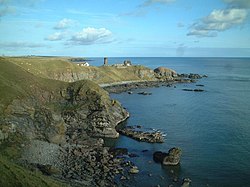
(Old) Slains Castle. What remains after it was blown up with gunpowder in 1594.

Next year, Elizabeth Douglas, Countess of Erroll, a friend of Anne of Denmark, hired masons to repair the building.[9] However, it was beyond saving. She then moved into the farmhouse of Clochtow, 12 mile (800 metres) northwest of the ruined castle. She remained in this ‘mean abode, and continued there sometime after 1597, when the honours and estates were restored... The Countess, all her remaining days, preferred to her noble title of Countess of Erroll the plain designation of “Guidwife of Clochtow”, because this designation had never been taken by the crown from her, and she had been known by it during the period of her husband’s exile, when he was a wanderer abroad, and only plain “Francis Hay”.’[10]

Francis Hay later built a tower house called Bowness on what is now the site of New Slains Castle.[11]

Structure

[edit]

Originally a strongly built 5-storey oblong keep (of which a small part remains), a wall defending the landward side was added in the early 16th century.

Modern day

[edit]

Two sections of wall remain standing, at approximately 25 metres (82 ft) in height. The south-facing wall partially collapsed on 31 May 1979. An estimated 100 tons of rubble fell on the road next to the castle, blocking the road and partially burying a lorry.[12]

In the 1950s, a 3-storey house was built within the ruins, adjoining a fishing cottage built in the 18th century. Since 1991 several archaeological excavations have been carried out, the last one in 2007.[2] The remains of the old castle are designated as a scheduled monument.[2]

References

[edit]

Further reading

[edit]
Revisions and contributorsEdit on WikipediaRead on Wikipedia
from Grokipedia
Old Slains Castle is the ruined remnant of a 13th-century located on a coastal approximately 2 kilometers northeast of Collieston in , . Originally constructed as a fortress stronghold, it was granted by King to Sir Gilbert Hay, ancestor of the Earls of Erroll, who made it their principal seat. The castle's strategic position overlooked the , providing defensive advantages typical of medieval Scottish s with an oblong keep design. In 1594, following the 9th Earl of Erroll's participation in a Catholic plot against King James VI led by the of , royal forces under the king's orders demolished the castle using gunpowder and artillery, rendering it uninhabitable as punishment for . This destruction marked the end of Old Slains as a residence, prompting the Hay family to construct several miles to the north near . Today, the site preserves a single substantial wall fragment rising about 25 meters high, with archaeological evidence indicating late medieval origins and minimal later modifications due to the thorough 16th-century . The ruins, scheduled as a protected , exemplify the causal consequences of feudal loyalties clashing with emerging monarchical authority in post-Reformation .

Site and Physical Characteristics

Location and Environmental Context

Old Slains Castle is situated near the coastal village of Collieston in , , on a cliff-top projecting into the . The site's coordinates place it at approximately 57°21'40"N, 1°56'W, roughly 5 miles south of near . This elevated position provided inherent defensive benefits through sheer drops to the sea on three sides, limiting landward access. The promontory's exposure to the renders the site susceptible to severe maritime conditions, including high winds, storm surges, and wave undercutting that accelerate cliff . Aberdeenshire's rocky coastline experiences sustained rates, with historic structures like Slains Castle identified as high-risk due to these dynamic forces. The prevailing westerly and northerly gales, combined with salt-laden air, have contributed to the progressive degradation of the ruins beyond their 1594 destruction by . Collieston, a traditional settlement approximately 1 mile to the north, integrates with the local terrain through its harbor and coastal paths linking to the castle site, reflecting human adaptation to the rugged environment post-castle abandonment. The village's proximity underscores the area's historical reliance on amid challenging coastal geology.

Surviving Architectural Features

The surviving architectural features of Old Slains Castle are limited to fragmentary remnants of its original later medieval tower-house, primarily the south-eastern corner of the structure accompanied by scattered wall sections. These ruins, situated on a coastal near Collieston, , reflect the severe destruction inflicted in 1594, after which extensive quarrying of the stone for nearby constructions, including and local buildings, further diminished the site. No substantial defensive elements such as intact gun loops or bartizans remain visible, though the overall configuration indicates a fortified adapted to 13th-14th century threats, with walls originally up to two meters thick constructed from and faced stone. The site's exposure to harsh conditions, including salt spray and prevailing winds, has accelerated natural , compounded by the absence of maintenance or consolidation efforts. Designated as a since 1972, the ruins have undergone no significant 20th- or 21st-century reconstructions, preserving them in their dilapidated state as a testament to medieval Scottish practices amid ongoing .

Historical Timeline

Medieval Origins and Construction

The castle originated as a 13th-century stronghold, initially held by the Comyn Earls of amid the feudal conflicts of medieval . Its construction aligned with the era's defensive imperatives, featuring robust stone suited to withstand raids and secure control over coastal territories vulnerable to both internal clan rivalries and external threats during the Wars of Scottish Independence. Positioned on cliffs overlooking the near Collieston in , the site exploited natural defenses while enabling oversight of maritime approaches, reflecting pragmatic principles prioritizing elevation and proximity to economic resources like fisheries. Following the Comyns' forfeiture circa 1308 for their opposition to , the estate—including the existing castle—was granted to Sir Gilbert Hay in reward for his military support against English forces and rival claimants. Under Hay stewardship from the early , the structure was adapted as their primary residence, supplanting earlier family holdings in and incorporating enhancements typical of Scottish tower houses, such as thickened walls and projecting turrets for improved surveillance and defense against localized aggressions. These modifications addressed the clan's need for a secure base in Aberdeenshire's unstable political landscape, where baronial authority demanded fortified seats to deter incursions and maintain feudal order. As the caput of the Barony of Slains, the castle functioned as the administrative and defensive nucleus, overseeing agrarian lands, tenant obligations, and coastal trade routes that sustained the local economy through agriculture and sea-based activities. This central role underscored its evolution from a Comyn outpost to a Hay , emblematic of how medieval land grants consolidated power through fortified inheritance amid Scotland's fragmented lordships.

16th-Century Political Entanglements

Old Slains Castle served as the principal residence of the Hay family, , who maintained adherence to Catholicism amid King James VI's enforcement of following his assumption of personal rule in 1583. Francis Hay, the 9th , who inherited the title and estates in 1585, converted to Catholicism around 1587, aligning the family with northern nobles resisting royal religious policies aimed at uniformity and suppressing . This stance reflected broader peripheral noble opposition to centralized authority, as the Hays leveraged their northeastern stronghold to sustain Catholic practices, including private masses and clerical support, despite crown edicts against nonconformity. In the late 1580s, suspicions arose that the Errolls, from Old Slains, colluded with Spanish forces during the 1588 Armada invasion, prompting royal scrutiny of their amid fears of foreign-backed Catholic resurgence. By the early 1590s, Erroll forged a key with George Gordon, 6th Earl of Huntly, another Catholic sympathizer, to coordinate resistance against James VI's campaigns for confessional conformity and political control. Their plotting, documented in intercepted correspondence seeking Spanish aid, escalated tensions, culminating in the earls' on 25 September 1593 for promoting Catholicism over royal dictates. These activities at Old Slains underscored causal frictions: noble autonomy in remote territories clashed with the king's drive to dismantle factional strongholds through military and ecclesiastical pressure. Contemporary royal records highlight James VI's repeated expeditions northward, such as in February 1593, to curb Erroll and 's influence, illustrating how the castle's role as a recusant hub provoked direct crown intervention without yet resorting to demolition. This prefigured broader conflicts, as the Hays' persistent defiance—rooted in familial tradition and regional power—challenged the monarch's causal strategy of co-opting or coercing elites to enforce religious and fiscal obedience.

Destruction and Immediate Aftermath

In October 1594, King James VI ordered the destruction of Old Slains Castle as a punitive measure against , for his role in the Spanish Blanks plot—a conspiracy uncovered in 1592 wherein Erroll and other Catholic lords signed blank documents authorizing military intervention to overthrow the Protestant monarchy. Erroll's treasonous actions, including alliances with amid fears of Catholic , prompted the king to declare him a traitor and target his stronghold to neutralize potential rebel operations. Royal forces, led by Archibald Campbell, 7th Earl of Argyll, executed the by detonating within the castle's walls, reducing its core fortifications to rubble and rendering it indefensible. This method ensured the structure could no longer serve as a base for Erroll's faction, which had previously harbored plots against , including coordination with George Gordon, Earl of Huntly. Contemporary records confirm the demolition's thoroughness, with fire supplementing explosives to breach towers and walls. In the immediate aftermath, the ruins were abandoned as a site, though local inhabitants began limited repurposing of salvaged materials and peripheral areas for settlement, as evidenced by the overlay of a post-medieval village on parts of the footprint. The deliberate ruination severed the Hay family's strategic hold on the coastal position, directly linking Erroll's plotting to the permanent loss of the castle's defensive utility without immediate reconstruction efforts by , who faced .

Ownership by the Hay Family

Lineage and Key Figures

The lands comprising Old Slains were granted to Sir Gilbert Hay of Erroll, a supporter of , in the early following the forfeiture of the Comyn family after their opposition to the Bruce claim to the Scottish throne. This marked the Hay family's initial control over the Slains estate, which they retained through subsequent generations via strict male , the standard inheritance practice among Scottish that prioritized the eldest legitimate son to maintain undivided estates and titles. The castle site thus became a hereditary seat symbolizing Hay allegiance to the Scottish crown, enduring as such until the late 16th-century religious divisions disrupted this continuity. In 1452, William Hay, then the hereditary constable of Scotland and ninth of Erroll, was elevated to the Earldom of Erroll by King James II, with the Lord of Slains affirming the estate's premier status within the viscountcy. This formalization integrated Slains into the core Hay patrimony, passed intact down the male line across eight subsequent earls without significant partition or female inheritance deviations. Prominent figures in the Hay lineage tied directly to Old Slains include Sir Gilbert Hay (d. c. 1333), the initial grantee whose possession laid the genealogical foundation; William Hay, 1st (c. 1423–1462), whose ennoblement cemented the site's noble prestige; and Francis Hay, 9th (bap. 1564–1631), whose Catholic sympathies led to by in 1594 for rebellion alongside the Earls of and Angus, culminating in the castle's by royal forces and temporary forfeiture of titles and lands before partial restoration in 1597.

Role in Scottish Nobility and Conflicts

of Erroll, as hereditary Lord High Constables of , strategically employed Old Slains Castle to consolidate regional authority in , balancing feudal duties to with pursuits of independent noble influence. This office, originating with Sir Gilbert Hay in the and formalized through grants like the barony of Slains, positioned the Hays to mediate local disputes and host assemblies that reinforced alliances among northeastern clans amid recurring hostilities. The castle's coastal location facilitated oversight of maritime threats, enabling the Hays to negotiate pacts that prioritized clan autonomy over strict royal , as evidenced by their consistent elevation of hereditary privileges in noble councils. Following the 1707 Act of Union, the Hays maintained pronounced Jacobite leanings, reflecting a broader northeastern resistance to centralized British authority that diverged from the acquiescence of many lowland peers who integrated into the new . While Old Slains' ruination curtailed its utility as a physical hub post-16th century, the family's enduring anti-Union stance—exemplified by Charles Hay, 13th Earl, who faced imprisonment in 1708 for suspected —underscored a causal persistence of pre-Union ambitions against eroding feudal structures. This contrasted with compliant southern nobles, whose alignment with Hanoverian rule preserved estates without equivalent disruption. Crown responses to Hay-led disturbances, documented in forfeiture proceedings and parliamentary ratifications, reveal a pattern of targeted reprisals designed to deter repeated challenges to monarchical control. For example, restorations such as that granted to Francis Hay in 1617 followed prior confiscations tied to alliances defying royal policy, illustrating how such measures enforced deterrence by disrupting noble resource bases without fully extinguishing lineage claims. Recurrent cycles of forfeiture and reinstatement across generations, including post-Union Jacobite entanglements, empirically demonstrated the crown's pragmatic calculus: penalizing uprisings to reassert while allowing pragmatic recoveries to maintain social order.

Architectural and Structural Analysis

Original Design Elements

The core of Old Slains Castle comprised a five-storey oblong keep, serving as the primary defensive stronghold and residence, with construction dating to the 13th or early 14th century. This design prioritized verticality for surveillance and structural resilience, featuring a vault entered at ground level to store provisions essential for withstanding sieges, in line with medieval principles of fortified self-sufficiency. Access to upper levels included a stone turnpike staircase within the tower and an external wooden staircase to the second storey, collapsible for security during threats. Defensive adaptations emphasized practicality, with thick walls likely containing chambers for storage or guards, and battlements equipped with bartizans and machicolations to enable dropping projectiles on assailants. Initially enclosed by a wooden and associated ditches forming inner and outer wards in the , the complex evolved into a more robust fortalice by the early , when the was replaced by a stone defending the landward approach, complete with a positioned to counter emerging risks. These modifications reflected escalating pressures, transitioning from reliance on natural defenses and manpower to engineered barriers against weaponry, without ornate embellishments that might compromise integrity. Adjacent functional outbuildings in a ""—including wattle-and-daub structures for stables, barns, and workshops—supported operational independence, encircled by an outer and to protect and resources during isolation. gates at key entry points, such as the basement vault, provided iron-barred against forced breaches, a standard in Scottish tower houses for balancing access and impregnability. The overall layout, reconstructed from Hay family records and remnant earthworks, underscored a utilitarian ethos geared toward survival in feudal conflicts rather than grandeur.

Extent of Ruins and Deterioration Causes

The deliberate destruction of Old Slains Castle occurred in October 1594 on the orders of King James VI, following the 9th Earl of Erroll's participation in the rebellion led by the Earl of Huntly and the Spanish Blanks conspiracy; the structure was demolished using and , reducing it to fragmented core walls and rubble scattered across its coastal site. By the early , only the southeastern corner of the original L-shaped vaulted remained intact, with walls approximately 8 feet (2.4 meters) thick, alongside traces of a barmkin enclosure wall clinging to the southern and southeastern cliff faces and earthen ramparts defining an outer ward on the west and south sides, measuring about 3 meters wide and 1 meter high. Subsequent deterioration stemmed primarily from the site's exposed position on a rocky peninsula jutting into the , where relentless gales and wave undercutting have eroded natural slopes and cliff edges, accelerating the collapse of unsupported masonry and infilling defensive ditches that were already partly natural formations. Human factors compounded this, including systematic stone removal—evidenced by mutilations to the barmkin ditch and ramparts from later local constructions—and opportunistic quarrying of dressed stone for nearby builds, such as the contemporaneous erected by the Hay family starting around 1597, though direct attribution remains circumstantial based on proximity and material reuse patterns in the region. These processes left scant intervention, as the remote coastal location deterred maintenance amid post-Reformation shifts in land use and noble priorities favoring the new seat. 20th-century surveys by the Royal Commission on the Ancient and Historical Monuments of Scotland (RCAHMS), including visits in 1958 and 1970 alongside from 1979 and 2013, consistently recorded the in a stabilized but progressively fragmented state, with no substantive preservation efforts until formal scheduling as a in 1972 (amended 2008), underscoring how unchecked environmental forces and historical neglect perpetuated the decline without engineered countermeasures.

Historical and Cultural Legacy

Political and Religious Implications

The destruction of Old Slains Castle in October 1594 exemplified the Scottish crown's assertion of sovereignty against noble-led Catholic conspiracies threatening national stability during the post-Reformation era. , a prominent Catholic noble, had signed blank documents—the "Spanish Blanks"—intended to secure Spanish military aid for a Catholic uprising against the Protestant of James VI, uncovered in 1592-1593. This plot, involving Erroll and allies like the Earl of Huntly, reflected persistent Catholic resistance in northeast , where nobles leveraged regional autonomy to defy royal religious policies amid Europe's Wars of Religion, including Spain's Catholic militancy post-Armada defeat. James VI's response—ordering the castle's demolition with and after declaring Erroll a traitor—directly enforced Protestant uniformity, targeting strongholds that symbolized feudal independence and potential foreign-backed rebellion. Politically, the event underscored the perils of noble overreach, as Erroll's actions prioritized confessional loyalty and peripheral power over crown authority, prompting James VI to dismantle such threats to consolidate monarchical control. The of Erroll, who fled abroad before abjuring Catholicism in 1597 to regain favor, temporarily disrupted Catholic noble networks in , weakening coordinated resistance in a region known for "popish lords" who harbored priests and opposed reforms. This outcome aligned with James's broader centralization efforts, reducing the capacity of landed elites to negotiate religious exceptions or alliances with Catholic powers like , though Erroll's eventual highlighted pragmatic royal flexibility rather than total eradication. Long-term, Old Slains's ruin served as a cautionary of failed noble claims under the early Stuarts, contributing to the erosion of feudal privileges without endorsing the conspirators' divisive tactics. By privileging state enforcement over localized religious defiance, the destruction reinforced causal links between internal Catholic intrigue and external threats, fostering a for royal intervention that aided Scotland's integration into unified British governance post-1603. Verifiable weakening of northeast Catholic , including the loss of Slains as a symbolic , diminished overt networks until later Jacobite revivals, prioritizing empirical royal dominance over ideologically driven peripheral challenges.

Connection to New Slains Castle and Broader Erroll History

Following the destruction of Old Slains Castle in October 1594 by order of King James VI in response to the 9th Earl of Erroll's involvement in Catholic rebellion, Francis Hay, 9th Earl of Erroll, returned from exile and commenced construction of in 1597 about 3 miles south near , establishing it as the family's relocated seat. This transition preserved Hay territorial continuity in despite the forfeiture and demolition of the original stronghold, with New Slains functioning as the Erroll principal residence for centuries thereafter. The abandonment of the Old Slains site represented a calculated familial strategy to mitigate further royal penalties, as retaining prominence at the razed fortress risked renewed ; instead, the shift to a proximate new build sustained baronial operations amid James VI's crackdown on northern recusant lords. Within the wider Erroll lineage, the Hays upheld their peerage and office as Hereditary Lord High Constable of Scotland through the 1707 Acts of Union and ensuing Jacobite disturbances, exerting political sway—evident in the 18th Earl William Hay's post-Union prosperity and parliamentary roles—independent of the derelict original castle.

Modern Preservation and Access

Conservation Efforts and Challenges

Old Slains Castle was designated a scheduled ancient monument (SM3250) on 26 December 1972, placing it under the protection and monitoring of Historic Environment Scotland to preserve its archaeological integrity. This status mandates limited physical interventions, prioritizing the site's authenticity over extensive reconstruction, with ongoing oversight focused on preventing further damage from natural and human factors. Archaeological efforts have included targeted investigations, such as surveys conducted in 1991 that revealed significant structural remains and a watching brief in April 2007 during utility cable trenching, which uncovered demolition debris from the 16th-century destruction. These non-intrusive methods have yielded artifacts and insights into the castle's layout, including earthworks suggesting inner and outer wards, without compromising the ruins' stability. Conservation faces substantial challenges due to the site's on a surrounded by cliffs prone to erosion from exposure, which has historically deterred major stabilization owing to prohibitive rebuilding costs. The presence of modern structures, such as 1960s cottages excluded from the scheduled area, further complicates comprehensive preservation efforts. No significant restoration projects have occurred between 2020 and 2025, reflecting persistent funding constraints and environmental risks that outweigh potential interventions.

Visitor Information and Contemporary Relevance

Old Slains Castle is reachable by footpaths from the nearby village of Collieston, involving an approximately 2.7-mile hike with 413 feet of elevation gain, rated as easy to moderate in difficulty and taking 1 to 1.5 hours one way. Access tracks and paths lead to the site, though the terrain includes rough, steep initial ascents and fading trails near the ruins. Entry to the ruins is free, with no on-site facilities such as restrooms or visitor centers, necessitating that explorers arrive prepared with appropriate gear and supplies for self-reliant visits. The site presents hazards including unstable structures, proximity to cliff edges, and tidal risks along the adjacent shoreline, particularly during high tide when shore access becomes perilous. Visitors are advised to avoid climbing ruins or venturing near edges to mitigate dangers. The castle draws history enthusiasts seeking insights into the Hay family's role in Scottish nobility and conflicts, though it remains overshadowed by the more prominent New Slains Castle ruins nearby. In modern heritage discussions, Old Slains exemplifies the decisive royal response to feudal defiance, as seen in its deliberate destruction by order of King James VI in 1594 following the earls' involvement in Catholic intrigues, thereby highlighting the crown's capacity to enforce authority and accelerate the erosion of independent lordly power bases amid centralizing state formation. Recent aerial documentation efforts, including drone-based 3D modeling in the 2020s, facilitate virtual preservation and study, enabling broader access without physical risks.

References

Add your contribution
Related Hubs
User Avatar
No comments yet.