Hubbry Logo
Huntly CastleHuntly CastleMain
Open search
Huntly Castle
Community hub
Huntly Castle
logo
8 pages, 0 posts
0 subscribers
Be the first to start a discussion here.
Huntly Castle
Huntly Castle
from Wikipedia

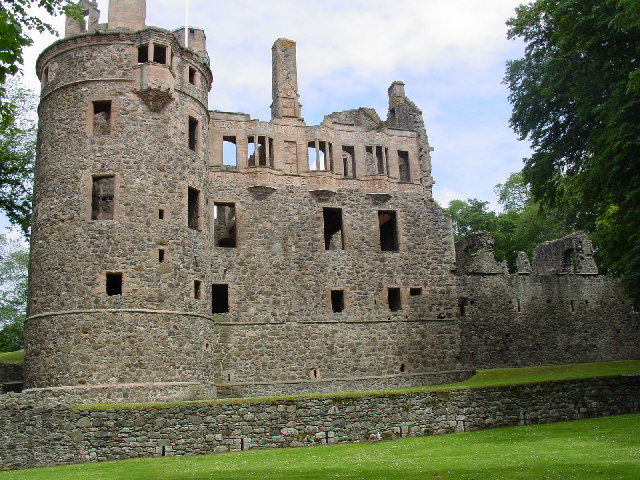
Huntly Castle is a ruined castle north of Huntly in Aberdeenshire, Scotland, where the rivers Deveron and Bogie meet.[1] It was the ancestral home of the chief of Clan Gordon, Earl of Huntly. There have been four castles built on the site that have been referred to as Huntly Castle, Strathbogie Castle or Peel of Strathbogie.[1][2]

Key Information

Location

[edit]

Huntly Castle was built on the crossing of the rivers Deveron and Bogie, north of Huntly and roughly 40 miles from Aberdeen. The original wooden castle was built on a motte. The second castle, made of stone, was built on the northern end of the bailey. The third and modern castles were built to the east of the original, at the southern end of the estate.[2]

History

[edit]

The castle was originally built by Duncan II, Earl of Fife, on the Strathbogie estate sometime around 1180 and 1190.[2][1] The castle became known as the Peel of Strathbogie.[3]

The Earl Duncan's third son, David, inherited the Strathbogie estate and later, through marriage, became earls of Atholl around 1204.[1] During the Strathbogie family's time at the estate, Robert the Bruce was a guest after falling ill at Inverurie. The family was loyal to him and when he got better, Robert the Bruce went on to win the battle of Bannockburn.[3] However, around 1314, David of Strathbogie shifted his support to the English right before Robert the Bruce won the battle of Bannockburn. Robert the Bruce saw this as treachery and granted the castle and estate to Sir Adam Gordon of Huntly because he was consistently loyal. In 1506, the castle was officially renamed Huntly Castle.[2]

Reign of James IV

[edit]

Although the castle was burned to the ground, a grander castle was built in its place. In 1496, the pretender to the English throne, Perkin Warbeck, was married to Lady Catherine Gordon the daughter of George Gordon, 2nd Earl of Huntly, witnessed by King James IV of Scotland at Edinburgh. James IV came to Huntly in October 1501 and gave gifts of money to the stonemasons working on the castle. In October 1503, James IV came again and played in a shooting contest at a target called a "prop".[4] He came back again in the following October, on his way south, accompanied by four Italian minstrels and an African drummer known as the "More taubronar".[5] James IV played cards at the castle on 10 October 1505 and gave a tip to masons working on the building. These visits were part of his annual pilgrimage to the shrine of Saint Duthac at Tain.[6] Architecturally the L plan castle consists of a well-preserved five-story tower with an adjoining great hall and supporting buildings. Areas of the original ornate facade and interior stonework remain. Wings were added to the castle in the 16th and 17th centuries.

Carved inscriptions feature on the facade

Reign of Mary, Queen of Scots

[edit]

William Mackintosh was executed on 23 August 1550 at "Castle Strathbogie", as a conspirator against the Earl of Huntly, the queen's lieutenant in the North.[7][8] It is said that Elizabeth Keith, Countess of Huntly gave the order.[9][10] Regent Arran came to Huntly in 1552.[11] When the Earl of Huntly wrote to Mary of Guise from the castle in August 1553, he dated the letter from "your grace's place of Huntle".[12] Mary of Guise visited in 1555 or 1556.[13] According to Robert Gordon of Straloch, Mary of Guise was impressed with the quantity of food stored in cellars and larders at the castle, supplied by the earl's distant retainers, but the French diplomat Henri Cleutin advised the earl was too powerful.[14]

The English diplomat Thomas Randolph stayed two nights in September 1562,[15] and wrote that the castle was "fayer, beste furnishede of anye howse that I have seen in thys countrie."[16] Mary, Queen of Scots decided to take the castle, giving as a cause that the Earl withheld from her a royal cannon lent to him by Regent Arran.[17] She sent her half-brother John Stewart, Commendator of Coldingham to arrest the George Gordon, 4th Earl of Huntly at Huntly Castle in October 1562. On the day William Kirkcaldy of Grange and the Tutor of Pitcur arrived first and surrounded the house. While Kirkcaldy was talking to the castle porter, the castle watchman on the tower spotted Coldingham and the Master of Lindsay and their troops a mile off. He alerted the Earl, who ran without "boot or sword" and hopped over a low wall at the back of the castle and found a horse before Pitcur could stop him. Elizabeth Keith, Countess of Huntly then welcomed the queen's men and gave them a meal and showed them around the place. She still had her chapel furnished for Roman Catholic worship.[18][19]

Mary made plans to come to Huntly Castle in person at this time, and another half brother, Lord James, Earl of Moray, who was in Aberdeen, sent invitations to the laird of Kilravock and others on 21 October 1563. This meeting of her "lieges of Moray and Nairn" did not take place.[20]

George Gordon, 4th Earl of Huntly died after the Battle of Corrichie on 28 October 1562, and the castle was garrisoned for Queen Mary by Charles Crawfurd and twenty soldiers. Furnishings including beds and 45 tapestries were carted to Aberdeen and shipped in barrels to Edinburgh for the royal collection and refurbishment by Servais de Condé.[21] After the surrender of Mary, Queen of Scots, at the battle of Carberry Hill, the Earl of Bothwell came north to meet George Gordon, 5th Earl of Huntly at "Stawboggye", and moved on to Spynie Castle after Huntly deserted his cause.[22] In July 1570, after the Rising of the North in England, the exiled Earl of Westmorland found refuge at Huntly and the Countess of Northumberland at Pluscarden.[23]

John Gordon, Earl of Sutherland

[edit]

John Gordon, 11th Earl of Sutherland and his wife Marion Seton were poisoned at Helmsdale Castle in 1567 by Isobel Sinclair, the wife of Gordon of Gartly.[24] Isobel Seton's own son also died, but the fifteen-year-old heir of Sutherland, Alexander Gordon was unharmed. He was made to marry the Earl of Caithness' daughter Barbara Sinclair. In 1569 he escaped from the Sinclairs to Huntly Castle and remained at Huntly until he came of age in 1573. Barbara Sinclair died, and Alexander Gordon, now Earl of Sutherland, married Jean Gordon, former wife of the Earl of Bothwell, who had also found a refuge at Huntly Castle.[25]

A fatal football match

[edit]

An early description of the death of George Gordon, 5th Earl of Huntly in 1576, transcribed or copied down by Richard Bannatyne as "The Maner of the Erle of Huntlies Death", gives some details of how the castle was used,[26][27] and has been examined by historians including Charles McKean and Jenny Wormald.[28] The Earl of Huntly was a healthy man and had been out hunting hares and a fox at Winton's Wood. After returning to Huntly, he suffered a stroke after dinner, or a collapse caused by food poisoning, while playing football outside the Castle on the Green.[29]

The Earl was given his cloak, and began to stagger as he approached the castle's outer gate, falling in a puddle. He was helped by the Master of Huntly to his own bedchamber in the round tower of the palace block, which was then called the "New Warke of Strathbogie." The tower room was adjacent to the "Grit Chalmer", the Great Chamber. After the Earl died, his brother Adam Gordon arranged for his body was laid out in the "Chamber of Dais", another name for the Great Chamber, and his valuables in boxes in coffers were secured in the same chamber and the outer chamber door of the suite was locked.[30]

After the Earl's steward left the castle, a number of alleged supernatural events occurred beginning with the sudden collapse of one of the servants who had gathered in the "Laich Chalmer", Low Chamber. This "Laich Chalmer" was in another part of the castle, under a stair, opposite the "Auld Hall." On the following day, a servant went up to the Gallery at the top of the "New Warke" a room where valuable spices were stored (near the room where the Earl's body lay). This servant and two companions also collapsed and when revived complained of feeling cold.[31]

After the Earl's body was embalmed by the Aberdeen surgeon William Urquhart and taken to the chapel, the Earl's brother Patrick Gordon heard unexplained sounds while sitting on bench near the room where the body had been embalmed. It was said that "there is not a live thing bigger than a mouse may enter in that chamber with the door locked."[32] References to a "leather chamber" at the castle in some retellings of the story likely derive from Scots terms "laich" and "letter" for the secondary or lower servant's hall.[33] The account is hostile to the Gordon family, and ends with a complaint that Regent Morton and the young James VI were sympathetic to them, James VI is supposed to have wished the Lord Gordon should be brought to be his companion at Stirling Castle.[34]

Engraving of the castle by James Fittler in Scotia Depicta, published 1804
Rear courtyard ruins of Huntly Castle

James VI slights the castle

[edit]

In March 1584 an English recusant Catholic Sir Thomas Gerard of Bryn was sent by Lady Ferniehirst to find refuge at Huntly.[35] George Gordon, 6th Earl of Huntly was a Catholic and James VI decided to subdue his power in the north. The king arrived at Huntly on 26 April 1589 after spending a night at Kintore. The Earl of Huntly had fled to the mountains, stripping the countryside and emptying the house of furniture. James brought 100 workmen to demolish the castle. Huntly sent the king an offer to spare the house and surrendered.[36]

In March 1593 a royal garrison of 16 men commanded by Archie Carmichael was to be put in Huntly Castle.[37] In May 1593 the Earl captured a man called Pedder in the lands of Atholl. Pedder was hanged and dismembered and his body parts displayed on poles at Huntly.[38]

In April 1594 a Flemish ship came to Montrose and it was suspected that a messenger rode to Huntly Castle with a bag of Spanish gold.[39] In July, the Earl was overseeing the building of a new hall and gallery.[40] Following the battle of Glenlivet, James VI came with workmen again and his master of works William Schaw, and planned to blow up the "gret old tower" which had been "fourteen years in building" on 29 October 1594.[41] The kirk minister Andrew Melville was with the king and a vocal advocate for demolition.[42] Aberdeen town council bought twenty stones in weight of gunpowder for the demolition of Huntly and other places,[43] and sent the stonemason John Fraser and other workmen to the demolition work at Huntly and Old Slains Castle, equipped with new shovels.[44]

The royal council met at Terrisoule to discuss the planned demolition on 28 October. Some Lords wanted the fortress kept to hold a loyal garrison. James VI still wished the whole castle, the new and old work, to be slighted.[45] It was decided not to completely demolish Huntly and Slains Castle and other houses, but preserve them for the convenience of the royal garrisons. It was also said that the pleas of the Countesses of Huntly and Erroll to save the houses were successful.[46] David Foulis wrote to Anthony Bacon that Henrietta Stewart, Countess of Huntly, watched the demolition at Huntly and was not allowed to have an audience with the king to plead her case.[47] The king made his friend Sir John Gordon of Pitlurg the keeper of the remaining buildings at Huntly.[48]

Restored for a Marquess

[edit]

The Marquess of Huntly restored and rebuilt the castle.[49] In 1746, an English soldier, James Ray, saw the ruins and commented on ceilings, still decorated with "history-painting".[50]

Huntly spent large sums restoring and enlarging the castle in April 1597.[51] The restored facade of the main block was carved with the names and titles of the marquess, "George Gordon" and his wife, "Henrietta Stewart" who was a favourite of the queen, Anne of Denmark.[52] In February 1603 James VI made plans to resolve the Marquess's feuds including a royal visit to Huntly with Anne of Denmark and the Earl of Moray later in the year. The visit did not take place because of the death of Elizabeth I and the subsequent Union of the Crowns.[53]

The Castle was occupied in 1640 by a Scottish Covenanter army under Major-General Robert Monro. James Gordon, Parson of Rothiemay, tells us how the house "was preserved from being rifled or defaced, except some emblems and imagery, which looked somewhat popish and superstitious lycke; and therefore, by the industry of one captain James Wallace (one of Munro's foote captaines) were hewd and brocke doune off the frontispiece of the house; but all the rest of the frontispiece containing Huntly's scutcheon, etc, was left untouched, as it stands to this daye."

Captured in October 1644, the castle was briefly held by James Graham, 1st Marquess of Montrose against the Duke of Argyll. In 1647 it was gallantly defended against General David Leslie by Lord Charles Gordon, but its 'Irish' garrison was starved into surrender. Savage treatment was meted out, for the men were hanged and their officers beheaded. In December of the same year the Marquess of Huntly himself was captured and on his way to execution at Edinburgh was detained, by a refinement of cruelty, in his own mansion. His escort was shot against its walls.

An inventory made by the garrison on 10 November 1648 shows the state rooms were still fully furnished, including the earl's "chapel bed" and the "laich chamber or common hall".[54] There were portraits of King Charles, James VI, Anne of Denmark, and Robert Maxwell, 1st Earl of Nithsdale, and others. An ammunition house contained 81 muskets, match cord, and ten cannon.[55] In 1650 Charles II visited briefly on his way to the Battle of Worcester, defeat and exile. The Civil War brought an end to the Gordon of Huntly family's long occupation of the castle.

Jacobites and after

[edit]

In 1689, during the first Jacobite rising, the castle was briefly the headquarters for Viscount Dundee and his Jacobite army, at the end of April, just after the start of the revolt. However, by the early eighteenth century the castle was already in decay and providing material for predatory house builders in the village. In 1746, during a later Jacobite rising, it was occupied by British government troops. Thereafter, it became a common quarry until a groundswell of antiquarian sentiment in the 19th century came to the rescue of the noble pile.

Huntly Castle remained under the ownership of the Clan Gordon until 1923. Today, the remains of the castle are cared for by Historic Environment Scotland as a scheduled monument.[56]

Pure Strength I, a major international strongman competition, was held on the grounds of Huntly Castle in 1987. The winner of the contest was Jón Páll Sigmarsson of Iceland.[57]

In fiction

[edit]

Huntly, as the Castle of Strathbogie, is described in a fictionalised account of the reign of Mary, Queen of Scots, The Queen's Cause by Mrs Hubert Barclay (1938).[58]

References

[edit]
[edit]
Revisions and contributorsEdit on WikipediaRead on Wikipedia
from Grokipedia

Huntly Castle comprises the ruins of a substantial late medieval palace and fortress located in the town of Huntly, Aberdeenshire, Scotland.
It originated as a motte-and-bailey castle constructed around 1190 by the Earls of Fife but was acquired by the Gordon family in the 14th century, who renamed it and elevated it to their principal seat as chiefs of Clan Gordon and holders of the titles Earl and Marquess of Huntly.
Beginning around 1450, the 1st Earl of Huntly initiated major expansions transforming the site into one of Scotland's most impressive late medieval residences, further embellished in the early 17th century by the 6th Earl with a Renaissance-style frontage adorned with inscribed stone friezes and heraldic sculptures proclaiming the family's power and piety.
As the stronghold of one of medieval and Renaissance Scotland's most influential noble houses, the castle witnessed pivotal events including clan conflicts, royal sieges, and the Wars of the Three Kingdoms, during which it was besieged and substantially damaged by Covenanter forces in 1640, leading to its abandonment and gradual decay into the preserved ruins managed today by Historic Environment Scotland.

Geography and Setting

Location and Access

Huntly Castle is located in the town of , , , approximately 1 mile north of the town centre at the confluence of the Rivers Deveron and . The site occupies a promontory surrounded by the fertile agricultural landscapes characteristic of northeastern , an area renowned for its productive farmland. Its geographical coordinates are 57°27′16″N 2°46′54″W. The castle is readily accessible by road via the A96 trunk road, which passes nearby, and public transport options include Huntly railway station, 1 mile to the south, served by regular trains from (about 50 minutes) and (about 1 hour). Bus services from major towns such as and also stop in , with footpaths linking the town centre to the site. Managed by , the castle requires paid admission for interior access: £7.50 for adults, £4.50 for children aged 7-15 years, with concessions at £5.50 and family tickets ranging from £15.00 to £24.50 depending on composition. It operates seasonally, open daily from 9:30 a.m. to 5:30 p.m. (last entry 4:30 p.m.) between 1 and 30 , and Saturdays, Sundays, and Wednesdays from 10:00 a.m. to 4:00 p.m. (last entry 3:00 p.m.) from 1 to 31 March, subject to weather and maintenance closures. Parking is available on-site, though access to upper levels involves steps.

Strategic and Topographical Importance

Huntly Castle is situated on an elevated motte-and-bailey earthwork, originally constructed around 1190 by the Earls of at the of the Rivers Deveron and , to guard the vital crossing point in northeast . This raised plateau provided a commanding vantage over the Deveron valley, facilitating surveillance of approaching threats and the surrounding terrain. The motte, a constructed approximately 24 meters in , enhanced defensive , allowing occupants to monitor the landscape effectively while deterring unauthorized access. The site's topography underpinned its role in dominating the Strathbogie region, a fertile lowland area essential for and resource extraction in medieval . Control of this valley secured influence over productive farmlands and riverine pathways, positioning the castle as the administrative seat for successive lords overseeing local power dynamics. The rivers themselves formed natural barriers, channeling potential invaders into predictable approaches and bolstering the stronghold's resilience against raids from neighboring clans. These geographical features—elevated terrain, river confluences, and valley oversight—collectively ensured the castle's longevity as a regional , adapting from wooden fortifications to stone expansions while maintaining its core defensive utility.

Origins and Early Development

Establishment as Peel of Strathbogie

The Peel of Strathbogie was established around 1190 by Duncan II, Earl of Fife, as a on the estate of Strathbogie in , serving as the caput of the family's northern holdings. This earth-and-timber fortification consisted of a raised motte mound topped with a wooden palisade and keep, defended by a surrounding ditch, alongside a larger bailey enclosure for ancillary buildings and livestock. Its strategic placement at the confluence of the Rivers Deveron and Bogie enabled oversight of a key crossing and trade route northward into Moray, facilitating regional administrative control amid the feudal consolidation of 12th-century Scotland. The castle's primary function was defensive and seigneurial, reflecting the Earls of Fife's role in extending royal authority into peripheral lordships following the reforms of , though no direct ties to southern Anglo-Scottish conflicts are evidenced for this phase. Upon Duncan's death in 1204, the estate passed to his son , who adopted the territorial designation "of Strathbogie," underscoring the site's centrality to lineage identity. Little of the original timber superstructure survives, with the motte reduced to a grassy embankment and the bailey obscured by subsequent stone constructions after 1300; archaeological traces confirm the early layout but yield scant artifacts from the foundational period.

Transition to Gordon Ownership

The barony of Strathbogie, encompassing the original known as , was granted by King Robert I (the Bruce) to Sir Adam Gordon of in during the early 14th century, following the forfeiture of the estates from David de Strathbogie, Earl of , for disloyalty during the Wars of Independence. This transfer marked the initial establishment of Gordon control over the strategic lordship, rewarding Sir Adam's consistent allegiance to the Bruce cause amid the conflicts with English forces and internal Scottish factions. Gordon possession endured through the but faced a succession crisis in 1402 upon the death of a later Sir Adam Gordon at the , leaving no direct male heirs. His daughter, Elizabeth Gordon, emerged as heiress to the Strathbogie estates; in , she wed her distant kinsman Sir Alexander Seton of Seton, who assumed the Gordon surname to claim inheritance and consolidate family claims under the Gordon lineage. By the 1430s, Alexander styled himself Lord Gordon, solidifying the clan's hold without immediate challenges to title. In circa 1445, King James II elevated Alexander Gordon to the newly created Earldom of in recognition of his military and political support, including aid against rebellious nobles. Concurrently, the early Gordons initiated modest structural enhancements at the castle, replacing the antecedent timber peel with a substantial stone to bolster defensive capabilities amid regional instabilities, prioritizing and territorial security over aesthetic or palatial development.

Architectural Evolution

Medieval Core and Tower House

The medieval core of Huntly Castle comprises a substantial L-plan erected around 1375 by the Gordon family, supplanting an antecedent timber . This foundational structure, now largely reduced to foundations, embodied early stone defensive architecture in northern , prioritizing amid regional rivalries. The main block formed an oblong keep roughly 76 feet long by 36 feet broad, augmented by a prominent of 38 feet at the southwest , alongside a smaller opposing round tower. Walls, constructed from local stone, attained considerable thickness to resist , incorporating gun loops—wide-mouthed in the round tower for handgonne or early fire—reflecting adaptations to emerging weaponry by the late . A vaulted provided secure storage and refuge, while upper levels accommodated principal living quarters including a in the primary range. In the ensuing decades, circa , a hall block was appended eastward, featuring additional vaulted cellars beneath, yet the core retained its L-plan defensive essence without ornate flourishes. This configuration underscored the tower house's role as a robust stronghold, emblematic of pre-Jacobean Scottish baronial precedents emphasizing functionality over display.

Renaissance and Jacobean Expansions

![Detail of front inscriptions at Huntly Castle]float-right The principal expansion of Huntly Castle took place under George Gordon, 6th Earl of Huntly (later 1st Marquess), who transformed the medieval into a palatial residence by reconstructing the palace block in 1602. This campaign added a U-shaped palace block featuring open loggias and an ornate decorative front, marking a shift from defensive fortifications to -inspired grandeur. Stylistic influences drew from French and Italian Renaissance architecture, evident in the symmetrical facades, arcaded galleries, and sculpted elements, likely mediated through masons familiar with James VI's court projects that incorporated continental designs. The upper works of the palace block, including these embellishments, represent the most prominent surviving features of this phase, emphasizing aesthetic sophistication over martial utility. Complementary service structures, such as the brewhouse and bakehouse, were integrated into the complex during the late 16th and early 17th centuries to support the expanded household, with the brewhouse dating to the 16th century and forming one of the best-preserved subsidiary buildings. These additions completed the Jacobean-era development by the 1620s, creating a self-sufficient palatial ensemble aligned with the era's architectural trends in Scotland.

Notable Structural Features

The above the main entrance, erected in under the direction of George Gordon, 1st Marquess of , stands as a prime example of Jacobean heraldic architecture, rising approximately 33 feet and incorporating the quartered arms of Huntly and his wife, Henrietta Stewart, flanked by strapwork cartouches and Latin inscriptions such as "Veritas Vincit" ("Truth Conquers") and family mottos including the Gordon "Bydand." This elaborate facade, unique in Scottish castle design for its vertical integration of symbolic panels, underscores the marquessate's recent elevation and alliance with the Stewarts. Among surviving ancillary structures, a 16th-century dovecot provides evidence of the castle's self-sufficiency, featuring numerous nesting boxes integrated into its walls for pigeon rearing, a common aristocratic practice for meat and messaging. Adjacent service buildings include a bakehouse, part of the outer courtyard complex, with robust stone vaults designed for high-volume baking to support the household. Remnants of the great hall's timber roof framing persist, hinting at its original scale though much decayed post-slighting. Lost interiors reveal the castle's former opulence through contemporary accounts and inventories; a 17th-century English described it as Scotland's finest noble residence, stocked with tapestries, silver, and furnishings per confiscated goods lists following royal seizures. Painted ceilings, noted by soldier James Ray in 1746 as bearing "history-painting" motifs, exemplify decorative arts, with patterns and allegories typical of Gordons' Catholic-leaning patronage, though none survive . These elements, corroborated by period records, distinguish as a pinnacle of pre-Union display.

16th-Century Ascendancy and Conflicts

Rise of the Earls of Huntly

Alexander Gordon, 3rd Earl of Huntly (c. 1460–1524), strengthened the family's influence through steadfast allegiance to James IV, earning substantial royal land grants in , , and that bolstered their territorial holdings and revenue from feudal rents. In 1500, he secured the hereditary sheriffdom of , conferring judicial authority over legal disputes and generating income from fines, fees, and enforcement prerogatives in the northern highlands. His command of the Scottish army's left wing at the on 9 September 1513—where he survived amid the deaths of the king and much of the nobility—elevated the Gordons' stature, as their survival and continued control of northeastern resources filled a in the fragile post-battle regency. Alexander's death on 21 January 1524 passed the earldom to his grandson George Gordon, 4th Earl of Huntly (1514–1562), then aged about ten, whose minority was overseen by Queen Margaret Tudor as ward, ensuring crown oversight while preserving family assets. George, a cousin and close playmate of the young James V, benefited from this personal tie, which sustained royal patronage amid the king's minority and early reign. Around 1528, George obtained the hereditary sheriffdom of Aberdeen-shire, amplifying the Gordons' economic foundation through additional judicial revenues and oversight of vast estates yielding annual rents estimated in the thousands of merks from tenants and vassals. These offices and land accumulations, rooted in military reliability and administrative utility to the crown, transformed the Earls of Huntly from regional lords into indispensable northern pillars under James IV and V, underpinning their fiscal self-sufficiency via diversified income streams beyond mere agriculture.

Feuds with Clan Forbes

The rivalry between the Gordons of Huntly and the Forbes clan, centered in Aberdeenshire, originated in medieval land disputes, with the Gordons securing Strathbogie around 1320 and the Forbeses later expanding through royal charters amid competing territorial claims. These tensions escalated in the 16th century due to the Protestant Reformation, as the Catholic-leaning Gordons aligned with Mary, Queen of Scots, while the Protestant Forbeses supported the emerging royal Protestant faction, transforming personal and property conflicts into religiously charged clan warfare marked by ambushes, castle burnings, and mass killings. A pivotal clash occurred at the Battle of Corrichie on 28 October 1562, where forces led by , —including Forbes allies such as the Frasers, Munros, and Mackenzies—defeated George Gordon, 4th , who had mobilized around 1,000-2,000 Gordons in rebellion against perceived Protestant encroachments on Catholic influence. The royalists routed the Gordons, killing approximately 120 and capturing another 100, with Huntly dying of during the retreat and his son Sir John Gordon executed for ; this victory enabled , 7th Lord , to receive forfeited Gordon lands via charters in 1563 and 1568. Retaliation intensified with the Battle of Craibstone on 20 November 1571, during the , pitting around 900 Gordons against 800 es near ; the Gordons, using musketeers and bowmen in an , prevailed after about an hour, capturing the Master of (Alexander Forbes) and up to 200 men, while slaying several gentlemen including Arthur Forbes of Pitsligo. Casualty estimates vary, with some accounts reporting 60 deaths per side and others up to 300 slain, underscoring the feud's brutality through summary executions and prisoner-taking rather than quarter. These engagements, alongside related skirmishes like Tillieangus earlier that year, perpetuated regional instability, prompting two parliamentary acts to compel truces and highlighting the raw violence of clan retribution over any chivalric ideals.

Key Events: Football Match Massacre and Political Intrigues

In 1562, George Gordon, 4th Earl of , led a against , primarily due to opposition to her Protestant advisors, culminating in his defeat and death at the Battle of Corrichie, where approximately 120 Gordons were killed. His son, George Gordon (later 5th Earl), faced accusations of treason for concealing the conspiracy, leading to his by Parliament on February 8, 1563, and a death sentence that was commuted to imprisonment at pending the queen's decision. The was reversed in 1565 following Mary's restoration of the Huntly title, reflecting the family's subsequent alignment with her interests amid shifting alliances in the post-Corrichie power vacuum. During the (1568–1573), which pitted supporters of Mary against the regency government of her son James VI, the Gordons' pro-Mary stance intertwined with rivalries, exacerbating localized violence against the , who backed the king's party. On November 20, 1571, Gordons ambushed and defeated forces at the Battle of Craibstone near , inflicting heavy casualties in a skirmish tied to broader partisan conflicts. Shortly thereafter, at a banquet ostensibly for reconciliation at Druminnor (the seat), clansmen massacred around 20 Gordons, prompting retaliation as Gordons sacked the castle, killing 27 of Towie in the ensuing assault. These episodes underscored the Gordons' use of political loyalty to Mary as leverage in feuds, though parliamentary acts were later required to enforce truces amid the escalating bloodshed.

17th-Century Fortunes and Decline

Elevation to Marquessate and Restoration

In 1599, George Gordon, 6th of Huntly, was elevated to the rank of 1st by King James VI, recognizing his political services and influence in the north of despite prior involvement in rebellions such as the 1594 uprising against royal authority. This marquessate, one of the highest peerages created in at the time, underscored the Gordon clan's enduring power and the king's strategy to secure loyalty through honors rather than outright suppression. Following this elevation, Gordon initiated a major reconstruction of Huntly Castle around , converting the medieval stronghold into a Renaissance-style that blended defensive tower-house elements with luxurious residential features, symbolizing the family's resurgence after decades of feuds and burnings. The project, continuing into the 1620s, incorporated ornate interiors with elaborate , heraldic carvings, and fireplaces dated to 1606, alongside decorative oriel windows, as a deliberate assertion of status amid the relative stability post-Union of the Crowns in 1603. Gordon's marriage in 1588 to Henrietta Stewart, daughter of Esmé Stewart, 1st and a close relative of James VI, further solidified these alliances, linking the Gordons to the Stewart dynasty and facilitating royal favor that enabled such ambitious rebuilding. This union, performed at Holyroodhouse on 21 July 1588, not only bolstered the clan's Catholic-leaning networks but also positioned Huntly Castle as a center for courtly influence during the early 17th-century transition to greater integration with England.

Royal Slighting under James VI

In late 1594, following George Gordon, 6th Earl of Huntly's victory over royal troops at the Battle of Glenlivet on 3 October, James VI personally led forces to Huntly Castle, ordering its partial as punishment for the earl's . The operation involved demolishing sections of the structure with —particularly the medieval —and setting fires, though the full extent of destruction remains uncertain and appears targeted rather than comprehensive. Huntly's uprising stemmed from his refusal to renounce Catholicism, defying royal mandates for Protestant conformity, including a 1593 decree requiring Catholic nobles to subscribe to the Negative or face forfeiture. This religious defiance, coupled with the Gordons' entrenched control over northeastern , posed dual threats: undermining James's push for religious uniformity post-Reformation and resisting monarchical efforts to dismantle feudal autonomies in favor of centralized governance. The thus served as a deliberate curb on aristocratic power, exemplifying James's strategy against "overmighty subjects" who leveraged loyalties and private armies to evade royal oversight. Though severely compromised, the castle was not razed entirely; surviving elements, including later additions, permitted garrison use and eventual restoration after Huntly's pardon in 1597 and elevation to marquessate in 1599. Subsequent damage in 1640, during the Second Bishops' War, saw Covenanter troops under Major-General Robert Monro occupy the site, plundering furnishings, burning interiors, and effacing Catholic iconography as part of their campaign against perceived royalist and papist strongholds. This occupation reinforced the pattern of targeted diminishment against the Gordons, whose continued Catholic allegiance and regional influence clashed with Presbyterian ascendancy and anti-absolutist sentiments.

Involvement in Civil Wars

During the First Bishops' War of 1639, the Gordons under , formed the core of royalist opposition to the Covenanting movement in northeastern , rallying local lairds against the imposition of the and resisting Covenanter incursions into . Huntly's forces clashed with Covenanting armies led by figures like the Earl of Argyll, who conducted punitive raids into Gordon territories, plundering estates and seizing strongholds such as Strathbogie Castle (later associated with Huntly Castle) to suppress royalist defiance. These early conflicts highlighted the Gordons' commitment to episcopalianism and royal authority over presbyterian reforms, positioning Huntly Castle as a symbolic center of resistance amid escalating tensions leading into the broader . As hostilities intensified in 1644, Huntly's sons—Lord Gordon and Lord Lewis Gordon—aligned with James Graham, Marquess of Montrose, providing crucial reinforcements of Gordon clansmen for his royalist campaigns against Covenanting forces. Lord Lewis, in particular, led aggressive actions, including assaults on Covenanting positions near and contributions to Montrose's victories, such as the relief efforts that bolstered royalist momentum in the Highlands despite the elder Huntly's personal reluctance to fully commit due to past grievances with Montrose. This alliance drew retaliatory strikes from Argyll's Campbell forces, who ravaged Gordon lands, burned properties, and systematically plundered Huntly's estates to dismantle royalist networks in the region. By 1647, the tide turned against the Gordons; George, 2nd of Huntly, was captured by Covenanting authorities after prolonged evasion and held in , where he faced trial for before being executed by beheading on 30 March 1649. His successor, as 3rd Marquess, continued sporadic resistance into the early 1650s, including raids against remaining Covenanting garrisons, though the family's Catholic leanings increasingly framed their cause as a defense of monarchical prerogative rather than purely sectarian interests, adapting to broader alliances with Protestant like Montrose amid the collapse of organized opposition post-Dunbar in 1650. Huntly Castle itself endured further depredations from these campaigns, serving intermittently as a royalist base before being slighted or abandoned as the Gordons' military fortunes waned.

Jacobite Era and Aftermath

Role in Jacobite Risings

The Gordons of , longstanding Catholic supporters of the Stuart , aligned with the Jacobite cause in the 1715 rising as a rejection of the Hanoverian succession imposed after the 1688 . William Gordon, 2nd Marquess of , attended the pivotal Jacobite gathering at on 26 August 1715, hosted by the , where the standard was raised six days later. Though Castle had lain in ruins since its by royal forces in 1594, it retained symbolic significance as the ancestral seat of the Gordon chiefs, emblematic of their monarchist fidelity amid clan mobilization in . The marquess's participation reflected the family's persistent opposition to Protestant Whig dominance, though he secured a post-rising, avoiding full . In the 1745 rising, the castle's role remained indirect but notable through the actions of Lord Lewis Gordon, younger brother of the pro-Hanoverian 2nd , who defied his sibling to champion Prince . From the ruined precincts of Huntly Castle, Lewis dated a missive on 25 November 1745 to rally supporters like the of Stonywood, coordinating recruitment amid local Jacobite fervor. He raised two regiments from Gordon tenants and levies, defeating government troops under General MacLeod at the Battle of on 23 October 1745, approximately 15 miles northwest of Huntly. These forces, drawn from family estates, underscored the Gordons' divided loyalties but enduring Jacobite sympathies rooted in dynastic legitimacy over elective Protestant rule. Following the Jacobite defeat at Culloden on 16 April 1746, escaped to France, and while the ducal line evaded forfeiture due to the 2nd Duke's allegiance, cadet branches faced reprisals. John Gordon of Glenbucket, a key Jacobite commander whose men fought at Culloden, saw his estates confiscated under the 1746 Attainder Act, with proceeds funding Highland infrastructure. The castle, uninhabitable and unfortified, symbolized the Gordons' resilient Stuart devotion but played no active military part, highlighting the risings' reliance on personal networks rather than static strongholds.

Final Abandonment and Ruin

Following the defeat of the Jacobite rising in 1746, Huntly Castle experienced rapid decline as the Gordon family's fortunes waned under government reprisals, including the effects of the Disarming Act and broader suppression of Jacobite sympathizers. By the early , the structure was already deteriorating, with stones systematically removed for local construction in the expanding town of , serving as an informal quarry. The Gordons fully abandoned the castle as a residence by the late , relocating to the more comfortable and modern Lodge, which exposed the unoccupied buildings to unchecked and further despoliation. Natural , combined with ongoing extraction of for village homes, led to the collapse of roofs, upper floors, and non-essential walls, transforming the once-grand into a skeletal ruin. Throughout the 19th century, the castle received minimal interventions beyond occasional estate-level maintenance, remaining a largely unmanaged relic amid growing Romantic appreciation for such sites. Later assessments, including 20th-century archaeological probes, documented extensive structural losses, such as infilled ditches, fragmented foundations, and ruinous chambers, underscoring centuries of neglect and material reuse. The property stayed in Gordon hands until 1923, when the 10th Duke of Richmond and Gordon (also 5th Duke of Gordon) transferred it to the state under the Ancient Monuments Consolidation and Amendment Act 1913, initiating its shift from private decay to scheduled national guardianship.

Historical and Cultural Significance

Political and Clan Influence

Huntly Castle functioned as the fortified headquarters of the Earls of Huntly, chiefs of , who leveraged its strategic position in to dominate northeastern politically and militarily from the 15th century onward. This control extended to influencing local parliamentary elections, securing sheriffships, and mobilizing levies for both royal campaigns and clan interests, thereby embedding Gordon authority in the region's governance structures. The castle's robust defenses, including fortifications added in the late 16th century, enabled the Gordons to enforce feudal loyalties and resist encroachments from rival clans like the , consolidating their role as regional overlords. In the religious sphere, the Gordons positioned Huntly Castle as a bastion of Catholic resistance amid Scotland's , with successive earls defying Protestant mandates from . George Gordon, 4th Earl of Huntly, appointed in 1547 following the death of Cardinal Beaton, maintained Catholic sympathies despite nominal adherence to regency policies, using the castle to shelter traditionalist networks. His son, the 5th Earl, and grandson, George Gordon, 6th Earl, further embodied this stance; the 6th Earl actively pursued politics from 1581 to 1595, opposing and the Anglo-Scottish treaty of 1586, which foreshadowed unionist pressures. This defiance stemmed causally from the castle's isolation and fortifications, which allowed the Gordons to raise private armies—such as in 1594 when the 6th Earl mobilized against royal forces—preserving Catholic hierarchies against centralized Protestant reforms. The Gordons' tenure at Castle exemplified broader tensions between peripheral power and emerging royal absolutism, as the stronghold facilitated repeated challenges to Edinburgh's authority while upholding traditional noble privileges. By controlling vast estates and vassal clans, the earls influenced national policy through leverage in the Convention of Estates and resistance to levying reforms, delaying the erosion of feudal autonomy in the north. Even after partial royal interventions, such as the 1594 campaign, the castle's symbolic and practical role sustained Gordon influence, underscoring how fortified seats like perpetuated decentralized power dynamics against monarchical consolidation.

Architectural and Symbolic Legacy

Huntly Castle stands as a prime example of Scottish , distinguished by the innovative integration of a defensive with a luxurious palace block reconstructed in 1602 by George Gordon, 1st . This addition features magnificent upper works, including oriel windows and elaborate decorative elements that blend fortification with palatial comfort. The structure retains significant Renaissance sculpture on its north façade and interiors, such as intricately carved fireplaces and heraldic friezes around windows, exemplifying the period's emphasis on ornate stonework and symbolic display. regards it as one of the best-preserved 17th-century s in eastern , highlighting its architectural quality amid the ruins. The castle's design influenced subsequent architectural trends, particularly the 19th-century Scottish Baronial revival, which drew upon its projecting bays, corner towers, and martial aesthetic to evoke national heritage. Documented in antiquarian works like Robert William Billings' The Baronial and Ecclesiastical Antiquities of Scotland (1852), Huntly's features served as a model for reviving feudal grandeur in Victorian-era estates. Symbolically, the castle embodies the Gordon clan's assertion of feudal and resilience, with its heraldic motifs and monumental scale proclaiming lineage, authority, and resistance to absolutist centralization. The elaborate inscriptions and sculptures underscore a deliberate projection of aristocratic power, positioning as an enduring emblem of regional lordship amid Scotland's transition from medieval clan structures to unified .

Preservation and Modern Context

Conservation Efforts

Huntly Castle was placed under state guardianship in 1925, initiating formal conservation management by the Ministry of Works (later ) to stabilize its ruins and prevent further deterioration. Early efforts included comprehensive clearance excavations in the led by archaeologist Douglas Simpson, which removed accumulated debris and vegetation to expose the underlying motte-and-bailey earthworks and stone structures, while consolidating exposed footings to halt collapse. These works prioritized structural integrity over reconstruction, preserving the site's authenticity as a ruined monument despite compromising some archaeological layers by sealing earlier deposits beneath cleared surfaces. The castle's local pink sandstone, prone to erosion from Aberdeenshire's harsh weather, presented ongoing challenges, necessitating periodic vegetation removal—such as ivy and tree roots that had overgrown interiors by the 19th century—to mitigate frost damage and moisture ingress without invasive interventions. Conservation adhered to minimal intervention principles, avoiding over-restoration to retain evidential value, as excessive rebuilding could obscure historical phases from the 12th to 17th centuries. Archaeological investigations complemented stabilization; the 1920s digs uncovered evidence of the original timber-and-earth defenses overlaid by later stone builds, including fragments of medieval and structural alignments. A 1997 watching brief during minor works identified pre-16th-century wall foundations, informing targeted preservation and highlighting the site's layered occupational history without disrupting intact . These empirical approaches ensured long-term viability while safeguarding archaeological potential for future study.

Tourism and Recent Developments

Huntly Castle, managed by , serves as a key attraction for visitors exploring Aberdeenshire's medieval heritage, with entry requiring advance booking to ensure access. The site offers interpretive panels detailing the castle's evolution and the Gordon clan's influence, supplemented by occasional guided talks from staff that highlight architectural features like heraldic sculptures and inscribed friezes. Open daily from 10am to 4:30pm (last entry 3:30pm) between April and September, and with reduced winter hours, it provides facilities including toilets and a to support on-site visits. In January 2025, the castle's tower reopened after safety repairs, enabling public access to the upper levels and offering elevated views across and the , a feature unavailable in late 2024 due to ongoing works. This enhancement has boosted the site's appeal for educational focused on the Gordons' role in Scottish political and clan history, as emphasized in Historic Environment Scotland's interpretive materials. Visitor numbers remain modest compared to major Scottish sites, with 5,984 recorded in according to of Leading Visitor Attractions, reflecting its status as a niche ruin rather than a high-traffic monument. The draws to , integrating with local promotion of the town's historical and clan-related narratives to encourage extended stays and support nearby commerce.

Depictions in Culture

References in Fiction and Media

Huntly Castle features as a central setting in Kristin Gleeson's historical The Braes of Huntly: A Highland Romance of Tudor (2018), part of the Highland Ballad series, where it depicts intrigue, , and familial alliances involving the of amid 16th-century Scottish . The narrative portrays the castle as a hub of power and peril, with protagonist Abby navigating threats from trafficking networks tied to the Gordon family. The castle's ruins are linked to through the legend, a spectral figure said to haunt the site, often identified in oral traditions as a Countess of Strathmore from an ill-fated or a tragic young woman in white robes. Variants emphasize her appearances near the grounds or specific rooms, reflecting romanticized 19th-century interpretations of noble misfortune rather than documented events, though contemporary accounts like Richard Bannatyne's Memorials () describe post-death disturbances at the castle without explicit ghostly attribution. In modern media, Huntly Castle appears in documentaries and focused on heritage, such as the Historic Environment Scotland's animated short "A Haunting Story from Huntly Castle" (2020), which dramatizes 1576 events following the 5th of Huntly's death, including eerie noises reported by inhabitants. The Stories of Scotland episode "Huntly Castle: A North Scotland Stronghold" (2023) explores its narrative role in lore without fictional embellishment. No major feature films or television series prominently feature the castle, though it integrates into local videos emphasizing its Jacobite-era associations via Gordon family sagas.

References

Add your contribution
Related Hubs
User Avatar
No comments yet.