


Community hub
0 subscribers8 pages, 0 posts
Recent from talks
All channels
Be the first to start a discussion here.
Be the first to start a discussion here.
Be the first to start a discussion here.
Be the first to start a discussion here.
Contribute something
Welcome to the community hub built to collect knowledge and have discussions related to Leptopodomorpha.
Nothing was collected or created yet.
Leptopodomorpha
View on Wikipediafrom Wikipedia
| Shore bugs and allies | |
|---|---|

| |
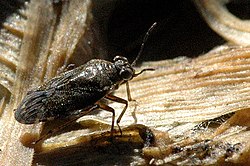
| Saldula palustris | |
Scientific classification 
| |
| Kingdom: | Animalia |
| Phylum: | Arthropoda |
| Class: | Insecta |
| Superorder: | Condylognatha |
| Order: | Hemiptera |
| Suborder: | Heteroptera |
| Infraorder: | Leptopodomorpha |
Leptopodomorpha is an infraorder of insects in the order Hemiptera (true bugs). Leptopodomorpha is an infraorder of the order Heteroptera that contains more than 380 species. These small insects are also called shore bugs, or spiny shore bugs. As their name suggests, shore bugs range from being intertidal, to living near streams and lakes. Four families belong to this infraorder, the largest of which is Saldidae with about 350 species, compared to about 30 in Leptopodidae, and only 5 and 1 in Omaniidae and Aepophilidae respectively.[1] Saldidae are known in particular for their jumping ability.
Families
[edit]Two superfamilies are recognised:
Leptopodoidea
[edit]- Leptopodidae- spiny shore bugs
- Omaniidae
- Corallocoris Cobben, 1970 – SE Asia, Australia, Oceania, Japan
- Omania: includes Omania coleoptrata Horváth, 1915 - Oman
Saldoidea
[edit]- Aepophilidae Puton, 1879
- monotypic Aepophilus bonnairei Signoret, 1879
- Saldidae- shore bugs
- †Archegocimicidae Handlirsch, 1906 (Late Triassic~Early Cretaceous)[2]
References
[edit]- ^ J.H. Thorp; D.C. Rogers, eds. (2015). Thorp and Covich's Freshwater Invertebrates: Ecology and General Biology. Vol. 1 (4 ed.). Elsevier. pp. 954–955. ISBN 978-0-12-385026-3.
- ^ Ryzhkova, Olga V.; Coram, Robert A. (June 2016). "Archegocimicidae (Insecta: Heteroptera) from the Purbeck Limestone Group (Lower Cretaceous: Berriasian) of southern England". Cretaceous Research. 61: 199–208. doi:10.1016/j.cretres.2016.01.008.