


Community hub
Recent from talks
Contribute something
Nothing was collected or created yet.
Corixidae
View on Wikipedia
| Corixidae Temporal range:
| |
|---|---|

| |
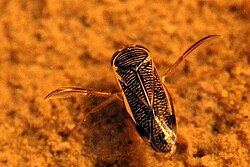
| Hesperocorixa castanea | |
Scientific classification 
| |
| Kingdom: | Animalia |
| Phylum: | Arthropoda |
| Class: | Insecta |
| Order: | Hemiptera |
| Suborder: | Heteroptera |
| Infraorder: | Nepomorpha |
| Family: | Corixidae Leach, 1815 |
| Subfamilies and genera | |
|
52 genera in 5 subfamilies | |
Corixidae is a family of aquatic insects in the order Hemiptera. They are found worldwide in virtually any freshwater habitat and a few species live in saline water.[1] There are about 500 known species worldwide, in 55 genera, including the genus Sigara.
Members of the Corixidae are commonly known as lesser water boatmen: the term used in the United Kingdom to distinguish species such as Corixa punctata[2] from Notonecta glauca, or greater water-boatman, an insect of a different family, Notonectidae.
Morphology and ecology
[edit]Corixidae generally have a long flattened body ranging from 2.5 to 15 mm (0.1–0.6 in) long.[1] Many have extremely fine dark brown or black striations marking the wings. They tend to have four long rear legs and two short front ones. The forelegs are covered with hairs and shaped like oars, hence the name "water boatman". Their four hindmost legs have scoop- or oar-shaped tarsi to aid swimming.[3] They also have a triangular head with short, triangular mouthparts. Corixidae dwell in slow rivers and ponds, as well as some household pools.

Unlike their relatives the backswimmers (Notonectidae), who swim upside down, Corixidae swim right side up. It is easy to tell the two types of insects apart simply by looking at the swimming position.[1]
Corixidae are unusual among the aquatic Hemiptera in that some species are non-predatory, feeding on aquatic plants and algae instead of insects and other small animals. They use their straw-like mouthparts to inject enzymes into plants. The enzymes digest the plant material, letting the insect suck the liquified food back through its mouthparts and into its digestive tract.[1] However, most species are not strictly herbivorous and can even be completely predatory, like those of the subfamily Cymatiainae.[4] In fact, Corixidae have a broad range of feeding styles: carnivorous, detritivorous, herbivorous and omnivorous.
Some species within this family are preyed upon by a number of amphibians including the rough-skinned newt (Taricha granulosa).[5]
The reproductive cycle of Corixidae is annual. Eggs are typically oviposited (deposited) on submerged plants, sticks, or rocks. In substrate limited waters (waters without many submerged oviposition sites), every bit of available substrate will be covered in eggs.

Genera
[edit]These 52 genera belong to the family Corixidae:
- Acromocoris Bode, 1953 g
- Agraptocorixa Kirkaldy, 1898 g
- Archaecorixa Popov, 1968 g
- Arctocorisa Wallengren, 1894 i c g b
- Bakharia Popov, 1988 g
- Bumbacorixa Popov, 1986 g
- Callicorixa White, 1873 i c g b
- Cenocorixa Hungerford, 1948 i c g b
- Centrocorisa Lundblad, 1928 i c g
- Corisella Lundblad, 1928 i c g b
- Corixa Geoffroy, 1762 i c g
- Corixalia Popov, 1986 g
- Corixonecta Popov, 1986 g
- Corixopsis Hong & Wang, 1990 g
- Cristocorixa Popov, 1986 g
- Cymatia Flor, 1860 i c g b
- Dasycorixa Hungerford, 1948 i c g b
- Diacorixa Popov, 1971 g
- Diapherinus Popov, 1966 g
- Diaprepocoris c g
- Ectemnostegella Lundblad, 1928 g
- Gazimuria Popov, 1971 g
- Glaenocorisa Thomson, 1869 i c g b
- Graptocorixa Hungerford, 1930 i c g b
- Haenbea Popov, 1988 g
- Heliocorisa Lundblad, 1928 g
- Hesperocorixa Kirkaldy, 1908 i c g b
- Liassocorixa Popov, Dolling & Whalley, 1994 g
- Linicorixa Lin, 1980 g
- Lufengnacta Lin, 1977 g
- Mesocorixa Hong & Wang, 1990 g
- Mesosigara Popov, 1971 g
- Morphocorixa Jaczewski, 1931 i c g
- Neocorixa Hungerford, 1925 i c g
- Neosigara Lundblad, 1928 g
- Palmacorixa Abbott, 1912 i c g
- Palmocorixa b
- Paracorixa Stichel, 1955 g
- Parasigara Poisson, 1957 g
- Pseudocorixa Jaczewski, 1931 i c g
- Ramphocorixa Abbott, 1912 i c g b
- Ratiticorixa Lin, 1980 g
- Shelopuga Popov, 1988 g
- Siculicorixa Lin, 1980 g
- Sigara Fabricius, 1775 i c g b
- Sigaretta Popov, 1971 g
- Trichocorixa Kirkaldy, 1908 i c g b
- Velocorixa Popov, 1986 g
- Venacorixa Lin Qibin, 1986 g
- Vulcanicorixa Lin, 1980 g
- Xenocorixa Hungerford, 1947 g
- Yanliaocorixa Hong, 1983 g
Data sources: i = ITIS,[6] c = Catalogue of Life,[7] g = GBIF,[8] b = Bugguide.net[9]
References
[edit]- ^ a b c d Randall T. Schuh; James Alexander Slater (1996). True Bugs of the World (Hemiptera:Heteroptera): Classification and Natural History (2 ed.). Cornell University Press. pp. 119–122. ISBN 978-0801420665.
- ^ BBC Science and Nature: Water boatman, common backswimmer Notonecta glauca Retrieved on 2008-07-26
- ^ Missouri Department of Conservation: Water boatmen Retrieved on 2016-08-08
- ^ Nieser, N. (2002): Guide to aquatic Heteroptera of Singapore and Peninsular Malaysia. IV. Corixoidea. The Raffles Bulletin of Zoology 50: 26–274.
- ^ C. Michael Hogan (2008) Rough-skinned Newt (Taricha granulosa), Globaltwitcher, ed. Nicklas Stromberg Archived 2009-05-27 at the Wayback Machine
- ^ "Corixidae Report". Integrated Taxonomic Information System. Retrieved 2018-04-20.
- ^ "Browse Corixidae". Catalogue of Life. Archived from the original on 2018-04-21. Retrieved 2018-04-20.
- ^ "Corixidae". GBIF. Retrieved 2018-04-20.
- ^ "Corixidae Family Information". BugGuide.net. Retrieved 2018-04-20.
External links
[edit]

- EverythingAbout.net
- Water Boatmen
- Buglopedia waterboatmen article
- water boatmen photos on the Tree of Life
- more water boatmen photos on Bug Guide
| National | |
|---|---|
| Other | |

Corixidae
View on GrokipediaTaxonomy and classification
Etymology and nomenclature
The family name Corixidae is derived from the type genus Corixa, which originates from the Ancient Greek word koris (κόρις), meaning "bedbug" or "bug," combined with the taxonomic suffix -idae denoting a family in zoology.[5][6] This nomenclature was formally established by British zoologist William Elford Leach in his 1815 publication The Zoological Miscellany, where he described the group as a distinct family of aquatic hemipterans.[1][7] Members of Corixidae are commonly known as water boatmen, a name reflecting their boat-like body shape and oar-like hind legs adapted for swimming in an upright orientation.[8] In regions like the United Kingdom, they are specifically termed "lesser water boatmen" to distinguish them from the superficially similar Notonectidae (backswimmers or greater water boatmen), which swim upside down near the water surface and are predatory, whereas corixids typically forage right-side up along the bottom.[9] This terminological distinction aids in avoiding confusion with other nepomorphan families, such as Nepidae (water scorpions), which possess a prominent respiratory tail and raptorial forelegs unlike the more streamlined corixids.[10][11] Historically, the nomenclature of Corixidae has followed standard Linnaean conventions for Heteroptera, with Leach's 1815 designation marking the initial familial recognition after earlier placements under broader categories like Hydrocorisae.[1] Subsequent revisions in catalogs, such as those by Henry and Froeschner (1988), have stabilized the family name without major synonyms, though numerous genera have undergone synonymy or restructuring; for instance, older names like Cenocorixa and Arctocorisa are now considered junior synonyms or subgenera within broader groupings such as Sigara or Hesperocorixa.[1][12] These changes reflect ongoing taxonomic refinements based on morphological and distributional data, ensuring consistency in classifying the family's approximately 600 species worldwide.[1]Phylogenetic position and diversity
Corixidae belongs to the order Hemiptera, suborder Heteroptera, infraorder Nepomorpha, and superfamily Corixoidea. Within Corixoidea, the family is positioned as the sister group to Micronectidae, with Diaprepocoridae forming the basal lineage; this arrangement is supported by total-evidence phylogenies integrating molecular and morphological data.[4][13][14] The family encompasses approximately 600 described species distributed across about 55 genera worldwide, making it the most species-rich group within Corixoidea. Unlike many aquatic Hemiptera families, Corixidae exhibits its highest diversity in temperate regions, particularly the Holarctic, with lower species richness in strictly tropical areas despite a cosmopolitan distribution.[1][2][13] Evolutionary adaptations enabling the fully aquatic lifestyle of Corixidae include bubble respiration using an air bubble trapped under their wings and hemelytra, facilitated by hydrophobic surfaces for underwater gas exchange, and specialized spoon-shaped fore tarsi (pala) used for scraping algae and detritus from substrates—modifications of the ancestral hemipteran piercing-sucking mouthparts suited for processing solid foods.[15] The fossil record provides evidence of these early aquatic specializations, with the oldest known corixid specimens dating to the Middle Jurassic.[4][16]List of genera
The family Corixidae encompasses approximately 55 genera distributed across four subfamilies (Corixinae, Cymatiainae, Heterocorixinae, and Stenocorixinae), with over 600 species primarily inhabiting freshwater environments worldwide. Recent molecular phylogenetic analyses, incorporating both morphological and genetic data from 122 taxa, have prompted revisions to generic boundaries post-2000, including the recognition of paraphyly in genera like Hesperocorixa and Sigara, and the elevation of tribes such as Agraptocorixini as basal to other Corixinae.[17] These studies sampled representatives from about 54% of Corixidae genera, highlighting cosmopolitan distributions but with strong regional endemism in the Holarctic and Neotropics. Most genera feature species measuring 2-10 mm in length, adapted to lentic waters like ponds and lakes.[17] Notable genera include Cenocorixa, which is adapted to saline and brackish habitats unlike the typical freshwater preferences of most corixids.[3] The list below catalogs selected genera alphabetically, focusing on key examples from global diversity; notes include the type species (where documented in taxonomic authorities), habitat preferences, and primary regions of endemism or distribution.| Genus | Type Species | Habitat Preferences | Endemic/Distribution Regions |
|---|---|---|---|
| Agraptocorixa | Agraptocorixa femorata (Fabricius, 1798) | Still freshwater ponds and streams | Tropical Old World (Africa, Asia, Australia)[17] |
| Arctocorisa | Arctocorisa carinata (Say, 1825) | Cold, oligotrophic lakes | Holarctic (Nearctic and Palearctic)[17] |
| Callicorixa | Callicorixa audeni (Hungerford, 1948) | Vegetated margins of lakes and ponds | Holarctic (primarily Nearctic)[17] |
| Cenocorixa | Cenocorixa expleta (Hungerford, 1948) | Saline lakes and brackish waters | Western Nearctic (North America)[3] |
| Cnethocymatia | Cnethocymatia pygmaea (Horváth, 1912) | Shallow, vegetated freshwater | Australasia (Queensland, New Guinea)[17] |
| Corisella | Corisella inscripta (Uhler, 1878) | Weedy ponds and slow streams | Holarctic (primarily Nearctic)[3] |
| Corixa | Corixa punctata (Illiger, 1807) | Eutrophic ponds and ditches | Holarctic[17] |
| Cymatia | Cymatia coleoptrata (Fabricius, 1777) | Brackish coastal pools and lakes | Holarctic (marine-influenced margins)[17] |
| Dasycorixa | Dasycorixa vaga (Walley, 1928) | Temporary pools and marshes | Nearctic[17] |
| Ectemnostega | Ectemnostega samartzi (Jakovlev, 1886) | Littoral zones of large lakes | Holarctic (Palearctic focus)[17] |
| Ectemnostegella | Ectemnostegella novarae (Distant, 1881) | Vegetated freshwater habitats | Holarctic[17] |
| Glaenocorisa | Glaenocorisa propinqua (Fieber, 1848) | Alpine streams and lakes | Holarctic[17] |
| Graptocorixa | Graptocorixa abdominalis (Say, 1832) | Warm, weedy ponds | New World (Nearctic-Neotropical)[17] |
| Hesperocorixa | Hesperocorixa interrupta (Say, 1825) | Large rivers and lakes | Holarctic (paraphyletic per molecular data)[17] |
| Heterocorixa | Heterocorixa auropilosa (Fieber, 1851) | Subtropical wetlands | Neotropical[17] |
| Heliocorisa | Heliocorisa serrica (Stål, 1855) | Sunny, open freshwater | Holarctic[17] |
| Monticorixa | Monticorixa mongolica (Jansson, 1986) | Montane streams | Central/Southern Asia[17] |
| Neocorixa | Neocorixa modesta (Truxal, 1953) | Desert springs and pools | New World (Nearctic)[17] |
| Paracorixa | Paracorixa kanagiensis (Matsumura, 1915) | Rice fields and marshes | Holarctic (Palearctic)[17] |
| Parasigara | Parasigara tristan (Usinger, 1946) | Island pools and streams | Holarctic (nested in Hesperocorixa clade)[17] |
| Pseudoglaenocorisa | Pseudoglaenocorisa sphaerulenta (Stål, 1855) | Tropical savanna wetlands | Afrotropical[17] |
| Sigara | Sigara lateralis (Leach, 1817) | Varied lentic waters, including saline | Cosmopolitan (paraphyletic)[17] |
| Stenocorixa | Stenocorixa protrusa (Hungerford, 1950) | Humid forest pools | Tropical Africa (Stenocorixinae)[17] |
| Trichocorixa | Trichocorixa calva (Say, 1825) | Coastal and inland ponds | Holarctic (Nearctic dominant)[17] |