Hubbry Logo
LygaeidaeLygaeidaeMain
Open search
Lygaeidae
Community hub
Lygaeidae
logo
8 pages, 0 posts
0 subscribers
Be the first to start a discussion here.
Lygaeidae
Lygaeidae
from Wikipedia

Lygaeidae
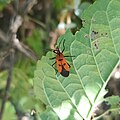
Acroleucus brevicollis
Scientific classification Edit this classification
Kingdom: Animalia
Phylum: Arthropoda
Class: Insecta
Order: Hemiptera
Suborder: Heteroptera
Infraorder: Pentatomomorpha
Superfamily: Lygaeoidea
Family: Lygaeidae
Schilling, 1829
Diversity
at least 110 genera

The Lygaeidae are a family in the Hemiptera (true bugs), with more than 110 genera in four subfamilies. The family is commonly referred to as seed bugs, and less commonly, milkweed bugs, or ground bugs.[1] Many species feed on seeds, some on sap or seed pods, others are omnivores and a few, such as the wekiu bug, are insectivores.[2][3] Insects in this family are distributed across the world.[4]

The family was vastly larger, but numerous former subfamilies have been removed and given independent family status, including the Artheneidae, Blissidae, Cryptorhamphidae, Cymidae, Geocoridae, Heterogastridae, Ninidae, Oxycarenidae and Rhyparochromidae, which together constituted well over half of the former family.[5][6]

The bizarre and mysterious beetle-like Psamminae were formerly often placed in the Piesmatidae, but this is almost certainly incorrect. Their true affiliations are not entirely resolved.[7]

Distinguishing characteristics

[edit]

Lygaeidae are oval or elongate in body shape and have four-segmented antennae.[8] Lygaeidae can be distinguished from Miridae (plant bugs) by the presence of ocelli, or simple eyes. They are distinguished from Coreidae (squash bugs) by the number of veins in the membrane of the front wings, as Lygaeidae have only four or five veins.[9]

Subfamilies and selected genera

[edit]

An incomplete list of Lygaeidae genera is subdivided as:[10][11]

subfamily Ischnorhynchinae Stål, 1872
subfamily Lygaeinae Schilling, 1829
subfamily Orsillinae Stål, 1872
subfamily † Lygaenocorinae
Unplaced genera

The Pachygronthinae Stål, 1865 (type genus Pachygrontha Germar, 1840) may be placed here[10] or elevated to the family Pachygronthidae.[11]

[edit]

References

[edit]
[edit]
Revisions and contributorsEdit on WikipediaRead on Wikipedia
from Grokipedia
Lygaeidae, commonly known as seed bugs, are a of true bugs belonging to the order and suborder , distinguished by their primarily seed-feeding habits using lacerate-and-flush feeding mechanisms. These are small to medium-sized, ranging from 1 to 12 mm in length, with oval to slender, often cryptically colored bodies, though some species exhibit aposematic black-and-red patterns warning of chemical defenses such as cardenolides. Found worldwide except , they inhabit diverse environments including grasslands, forests, and disturbed sites, with approximately 1,000 described species across about 110 genera. The family Lygaeidae is part of the superfamily Lygaeoidea within the infraorder , though its taxonomy has been revised multiple times due to , with some subfamilies elevated to family status in modern classifications (e.g., Blissidae, Geocoridae, ). Recent phylogenomic studies (as of 2023) confirm three current subfamilies: Lygaeinae (milkweed bugs), Orsillinae (false chinch bugs), and Ischnorhynchinae (catkin bugs), encompassing a mix of predators, feeders, and occasional predators. Biologically, Lygaeidae undergo hemimetabolous development with five nymphal instars, laying eggs in clutches without , and many temperate species enter or migrate seasonally. Their is closely tied to host , particularly in families like , , and , where gregarious aggregations form, often facilitated by pheromones, and some species like Oncopeltus fasciatus () serve as model organisms for studies in , , and chemical . While most are innocuous, certain taxa such as Nysius spp. act as agricultural pests by damaging crops through consumption.

Taxonomy

Classification

Lygaeidae belongs to the kingdom Animalia, phylum Arthropoda, class Insecta, order Hemiptera, suborder Heteroptera, infraorder Pentatomomorpha, and superfamily Lygaeoidea. The family was established in 1829 by Friedrich Hermann Schilling, with Lygaeus Fabricius, 1794, designated as the type genus. Historically, Lygaeidae was defined more broadly, encompassing what are now recognized as up to 19 separate families within Lygaeoidea following recent revisions. This expansive classification, proposed by James A. Slater in 1964 with 20 subfamilies, was revised starting in the 1990s through phylogenetic analyses incorporating morphological and molecular data; Thomas J. Henry elevated 10 subfamilies to family rank in 1997, reducing Lygaeidae to its current narrower scope. A 2025 phylogenomic analysis of 102 genes from 125 species across Lygaeoidea supported the paraphyly of the restricted Lygaeidae, proposing further taxonomic adjustments including elevations such as Plinthisinae to family status, thereby increasing the number of families in the superfamily to 19 while refining boundaries. Certain taxonomic uncertainties persist within or near Lygaeidae. The subfamily Psamminae, known for its beetle-like appearance, has an unclear affiliation, with past placements in Piesmatidae rejected but its precise position relative to Lygaeidae unresolved due to limited sampling in recent phylogenies. Similarly, the subfamily Pachygronthinae (currently in ) shows potential for elevation to family status based on emerging molecular evidence, though additional data are needed. As of current catalogs (as of 2024), Lygaeidae comprises approximately 957 extant described species across 111 genera, plus 35 species in 4 genera.

Subfamilies and Genera

The Lygaeidae are currently classified into four subfamilies, three of which are extant and one extinct. The subfamily Ischnorhynchinae, primarily tropical in distribution, encompasses approximately 16 genera. Lygaeinae, the largest subfamily with a cosmopolitan range, includes around 64 genera and is notable for containing many of the typical seed bugs. Orsillinae is widespread with about 30 genera, encompassing species such as the milkweed bugs. The fossil-only subfamily †Lygaenocorinae, known from Late Jurassic deposits in Karatau, Kazakhstan, comprises 3 genera. Among the genera, Lygaeus Fabricius, 1794 serves as the of the family and subfamily Lygaeinae, with its Lygaeus equestris (Linnaeus, 1758) being a well-known European bug. Spilostethus Stål, 1868, in Lygaeinae, includes pest that feed on seeds of various plants, such as Spilostethus pandurus (Scopoli, 1763). Orsillus Dallas, 1852 is the of Orsillinae and comprises often associated with coniferous seeds. Ischnorhynchus Fieber, 1860, the of Ischnorhynchinae, features elongate forms typical of tropical habitats. The family totals over 110 extant genera, though some remain pending further revision. Recent molecular phylogenies, including phylogenomic analyses using concatenated nuclear and mitochondrial genes, have supported the of the core subfamilies Ischnorhynchinae, Lygaeinae, and Orsillinae, despite the overall of Lygaeidae. The fossil record of Lygaeidae dates back to the , with the extinct †Lygaenocorinae exemplifying a distinct ancient lineage from Upper amber-like deposits of Karatau, highlighting the family's deep evolutionary history.

Description

Morphology

Lygaeidae adults exhibit an oval to elongate body form, typically measuring 3 to 12 mm in length, with a soft-bodied, punctate that provides flexibility and a textured surface. The head is equipped with four-segmented antennae, comprising a scape, pedicel, and two flagellomere segments, positioned laterally; compound eyes are prominent, with ocelli situated between them; and the piercing-sucking mouthparts form a four-segmented rostrum used for feeding. The features a trapezoidal pronotum that shields the mesonotum and metanotum; the forewings, known as hemelytra, consist of a coriaceous basal portion (corium) and a membranous apical portion () bearing four to five distinct veins. The legs are primarily adapted for walking. The displays a visible connexivum along its lateral margins and bears spiracles on the ventral surface, facilitating ; sexual dimorphism is minimal, though males are often slightly smaller than females. Nymphal stages of Lygaeidae resemble adults in overall and coloration but are wingless, undergoing five instars with progressive development of wing pads that become more pronounced in later stages, culminating in fully formed hemelytra upon reaching adulthood.

Distinguishing Features

Lygaeidae species are characterized by four-segmented antennae, with the first segment typically shorter and stouter, arising from between the compound eyes, distinguishing them from the five-segmented antennae of . The compound eyes are prominent and convex, often impinging on or embracing the pronotum in certain subfamilies, and ocelli are always present between the compound eyes, a feature absent in and . This combination of antennal segmentation and ocellar presence provides a key diagnostic trait for separating Lygaeidae from these related families. The hemelytral membrane features four to five distinct longitudinal s arising from a transverse basal , with a coriaceous clavus and corium, setting Lygaeidae apart from (which have more complex venation) and (typically six to ten radiating veins from closed cells). The body is generally dull and punctate, providing a matte texture that contrasts with the shinier surfaces in some related taxa. Paired dorsal abdominal are evident in nymphs as white patches near the tergal margins, particularly around openings on tergites 4/5 and 5/6, while adults possess metathoracic ; these structures aid in defense and are a shared heteropteran trait but prominently visible in lygaeid nymphs for identification. Lygaeidae lack prominent spines on the femora, unlike certain species in the now-separate family , which often exhibit enlarged fore- or hind-femoral spines adapted for ground-dwelling habits. In males, the pygophore—the genital capsule—varies by , with specific paramere shapes (e.g., curved or notched blades) serving as diagnostic tools for -level identification, often requiring genital . Some tropical Lygaeidae species exhibit variations such as metallic sheens on the corium or elongated , contributing to greater color diversity and size compared to temperate forms, though these are subfamily-specific and enhance aposematic displays in seed-feeding niches.

Distribution and Habitat

Global Distribution

The Lygaeidae, a family of true bugs in the order , display a , occurring on all continents except . This widespread presence is attributed to their adaptability and association with seed-based diets, enabling across diverse environments. In modern classifications, the family comprises approximately 1,000 in over 110 genera globally. Diversity is highest in tropical and subtropical regions, reflecting evolutionary hotspots where rates are elevated due to varied ecological niches. In the , Lygaeidae exhibit significant representation. The genus Lygaeus, for instance, is prominent in both European and North American landscapes, underscoring transcontinental patterns within this biogeographic zone. In the Nearctic, over 80 occur in 15 genera, concentrated in temperate grasslands and woodlands. The Afrotropical region hosts notable diversity in genera like Ischnodemus, with adapted to savannas and coastal areas. Australasian faunas include endemic elements in the subfamily Orsillinae, with 62 in 13 genera of Lygaeinae alone in , many showing Indo-Pacific affinities. The Neotropics harbor a rich assemblage, exemplified by extensive in Ischnodemus and ongoing discoveries of new taxa. Biogeographic patterns suggest ancient Gondwanan origins for certain lineages, inferred from fossil records and disjunct distributions of basal subfamilies like Orsillinae in southern continents. Recent expansions have been facilitated by human-mediated dispersal, particularly through agricultural and seed contamination, as seen with species of Nysius introduced to , such as N. caledoniae. These introductions highlight the role of global commerce in altering native ranges and increasing local diversity in isolated regions.

Preferred Habitats

Lygaeidae species are predominantly ground-dwelling hemipterans, commonly inhabiting leaf litter, loose , and under bark in various terrestrial ecosystems. They favor dry, open environments such as grasslands, deserts, and coastal areas, where sparse vegetation and sunny conditions prevail. Microhabitat preferences differ among subfamilies. Orsillinae are frequently associated with seed pods and fallen , either on the ground or on low vegetation where mature seeds accumulate. Some species inhabit sandy shores and dunes, exploiting the stable, open conditions of coastal beaches. Ischnorhynchinae tend toward arboreal microhabitats on shrubs and trees, particularly where dry fruits and are available. These bugs exhibit a strong preference for warm, arid climates, with optimal temperatures around 30°C in sunny, sparsely vegetated areas. Their altitudinal distribution spans from to over 4,000 m; for instance, the Wekiu bug (Nysius wekiuicola) thrives in the aeolian habitats of Hawaiian volcanoes at elevations up to 4,200 m. In temperate regions, many Lygaeidae enter reproductive during winter, hibernating in sheltered sites like leaf litter to survive cold periods.

Biology and Ecology

Life Cycle

Lygaeidae species exhibit hemimetabolous , progressing through , five nymphal instars, and adult stages without a pupal phase. are laid in clusters on or near host plants or in , with incubation periods typically lasting 1-2 weeks under favorable conditions. The of these eggs features micropylar openings surrounded by porous structures and tiny projections, facilitating and hatching. Nymphal development occurs over 4-8 weeks across five instars, during which wing pads become visible in the later stages as part of the incomplete . between instars is triggered by hormonal signals, allowing progressive growth and morphological changes similar to those described in adult morphology. Adults emerge with fully developed wings and reproductive structures, exhibiting lifespans of 1-2 months and generation cycles that are univoltine or multivoltine depending on , with 1-3 generations per year in temperate regions. often involves or pheromones for mate attraction, while is rare across the family. Females typically oviposit 20-100 eggs per individual, with evident in genitalia to ensure species-specific reproduction. Development is highly temperature-dependent, with optimal rates at 25-30°C; lower temperatures prolong stages or induce . In temperate zones, many species overwinter as adults under plant debris or as diapausing nymphs to survive cold periods.

Feeding Habits

Members of the Lygaeidae family are predominantly phytophagous, with the majority specializing in seed-feeding by piercing the seed coat with their rostrum to extract endosperm from ripe or dormant seeds. In the subfamily Lygaeinae, this behavior is particularly prevalent, as species such as Oncopeltus fasciatus and Lygaeus equestris target developing or mature seeds, injecting salivary enzymes that liquefy internal tissues for ingestion via a lacerate-and-flush mechanism. This process allows efficient nutrient uptake while minimizing energy expenditure on solid food processing. In contrast, species in the Orsillinae subfamily often feed on plant sap from stems, flowers, and vegetative parts, though some also consume seeds opportunistically. Adult lygaeids across subfamilies commonly supplement their diet with and , providing carbohydrates during periods of seed scarcity. Certain species exhibit omnivorous tendencies, engaging in predation on small , eggs, or even conspecifics to obtain proteins, particularly when primary plant resources are limited. Specialized adaptations include the sequestration of plant toxins; for instance, Lygaeus kalmii and O. fasciatus accumulate cardiac glycosides from milkweed ( spp.) seeds, enhancing their against predators. The digestive system of Lygaeidae features mycetomes—specialized gut organs housing obligate bacterial endosymbionts that assist in nutrient supplementation and digestion of imbalanced diets, such as providing essential deficient in . Host specificity varies widely, from monophagous taxa like O. fasciatus, which relies almost exclusively on Asclepiadaceae, to polyphagous species such as , documented on over 30 crop plants including sunflower and mustard. Some species, like those in Rhyparochrominae, show seasonal shifts, feeding on green tissues or flowers in spring before transitioning to seeds in summer. In terms of nutritional , Lygaeidae feeding plays a role in dynamics, often reducing seed viability through enzymatic damage, though isolated feeding scars can sometimes break and enhance rates in certain hosts like palo verde seeds attacked by Nysius spp. High host specificity correlates with slower development on suboptimal plants, underscoring the importance of preferred seeds for reproduction and survival.

Behavior

Members of the Lygaeidae family primarily employ cursorial locomotion, relying on walking and running across ground surfaces to navigate their environments, with hind legs adapted for occasional jumping in certain species. Adults possess functional wings that enable flight for dispersal, with flight activity varying by species—some, like Oncopeltus fasciatus, exhibit enhanced flying capability in northern populations for seasonal movement, while others fly diurnally or nocturnally depending on ecological pressures. Communication in Lygaeidae involves multiple modalities, including where individuals produce vibratory signals for by rubbing a file on the prosternum against the rostrum, as documented in various subfamilies. Seed-feeding species release aggregation pheromones to facilitate clustering on host plants, exemplified by O. fasciatus and Lygaeus kalmii, which promote group formation among nymphs and adults. Visual signals, such as aposematic coloration (often black and red patterns) and potential wing movements, serve to attract mates or warn predators, enhancing survival in exposed habitats. Sociality in Lygaeidae is limited, with no evidence of beyond site selection for oviposition; however, nymphs frequently display gregarious , clustering on seeds or for mutual protection and efficient resource exploitation, as seen in species like . Predator avoidance strategies include thanatosis (feigning death) and reflexive discharge of defensive secretions from metathoracic , which release volatile compounds to repel attackers, a common trait in aposematic species. Activity patterns in Lygaeidae are predominantly diurnal, allowing exploitation of daylight for and , though some shift to crepuscular activity in arid or hot climates to mitigate , as observed in milkweed-associated bugs. Long-distance migration is uncommon, but local dispersal through short flights is widespread, supporting colonization of nearby suitable habitats. Interspecific interactions include morphological of in tropical genera such as Neopamera, where elongated bodies and behaviors deter predators by exploiting ant aversion. Many Lygaeidae maintain symbiotic relationships with gut housed in specialized organs like mycetomes or bacteriomes, which provide nutritional or defensive benefits, including production against pathogens or predators in species like Kleidocerys resedae and Nysius spp.

Economic Importance

Agricultural Pests

Several species within the Lygaeidae family are recognized as agricultural pests, primarily due to their feeding on seeds and developing grains, which can lead to significant crop losses. The genus Nysius includes notable pests such as , known as the false chinch bug, which feeds on grains like and sunflowers, injecting that contains toxins causing wilting and abortion. Similarly, Nysius huttoni, the wheat bug, pierces grains during the milk-ripe stage, reducing protein quality and overall yield. Another example is , a seed feeder that infests crops in and , damaging seeds and contributing to reduced harvests. Damage from these pests occurs through direct feeding mechanisms, where bugs inject enzymes and toxins via their piercing mouthparts into seeds or stems, leading to abortion, deformed grains, and transmission of pathogens. In sunflowers, Nysius species feeding can cause significant yield losses in heavily infested North American fields by reducing seed fill and oil content. Outbreaks are often exacerbated by practices, which provide abundant host and limit natural dispersal. Pest species in Lygaeidae have been introduced and established globally, with Nysius vinitor (Rutherglen bug) acting as a sporadic pest in Australian crops like sunflowers and canola due to its migratory swarms. Similarly, Nysius simulans has expanded into South American soybean fields, linked to favorable conditions in introduced ranges. Management strategies for Lygaeidae pests emphasize integrated approaches. Cultural methods include to disrupt host availability and early of weedy margins to reduce breeding sites. Chemical controls, such as pyrethroids or seed treatments, are applied during vulnerable stages like milk-ripe grains, though timing is critical to avoid resistance. Biological options involve conserving predators like spiders and big-eyed bugs, which naturally suppress populations. Monitoring with or traps helps detect outbreaks early, enabling targeted interventions. Historical records document Lygaeidae as pests since the 19th century, with first noted damaging crops in around that period. Recent increases in outbreaks and range expansions, such as those of Nysius simulans in soybeans, are attributed to warming, which extends suitable habitats and synchronizes pest life cycles with crop .

Beneficial Roles

Beyond direct , Lygaeidae play key roles in services, including as prey in food webs that support higher trophic levels. Many lygaeid species, such as seed-feeding members of the Orsillini tribe, are consumed by birds, spiders, and other predators, enhancing and energy transfer in grasslands and agricultural margins. Non-predatory seed feeders may indirectly benefit native plant communities by influencing seed viability through feeding, though their precise impact on dormancy breaking remains context-specific to certain habitats. In , these bugs integrate well into low-input systems due to their relative sensitivity to broad-spectrum pesticides, encouraging the use of selective chemicals that preserve their populations. Lygaeidae species have emerged as model organisms in chemical ecology research, particularly for studies on aposematic warning coloration and toxin sequestration. For example, milkweed bugs like exhibit red-and-black patterns that advertise chemical defenses derived from host plants, providing insights into and predator deterrence. In conservation, certain endemic taxa, such as the wekiu bug Nysius wekiuicola on , , are monitored as indicators of alpine habitat health due to their rarity and sensitivity to environmental changes; it was considered for federal status but delisted as a candidate in 2015. Overall, Lygaeidae contribute to by occupying diverse niches, from predators to granivores, supporting resilient ecosystems and informing conservation strategies for threatened .

References

Add your contribution
Related Hubs
User Avatar
No comments yet.