Hubbry Logo
Open-jaw ticketOpen-jaw ticketMain
Open search
Open-jaw ticket
Community hub
Open-jaw ticket
logo
8 pages, 0 posts
0 subscribers
Be the first to start a discussion here.
Open-jaw ticket
Open-jaw ticket
from Wikipedia
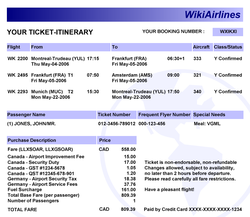
A sample itinerary for an open jaw electronic ticket from Montreal to Amsterdam, and returning from Munich

An open-jaw ticket is an airline return ticket where the destination and/or the origin are not the same in both directions. The name is derived from how it looks when drawn on a map.[citation needed]

Types

[edit]

There are three types:

  • Destination open-jaw, where a passenger flies from one city to another, but returns to the original city from a different place. For example, depart London to New York, but on the return trip fly from Philadelphia to London.
  • Origin open-jaw, where the passenger leaves from one city to another but returns to a different place. For example, flying from London to New York, but returning from New York to Manchester.
  • Double open-jaw, where two totally separate fares exist. For example, flying from London to New York, but on the return trip flying from Boston to Manchester.

Using different airports in the same city is not considered an open-jaw, so a passenger on a London to JFK trip who returned from Newark would still be a simple round trip as both airports are considered to be serving metropolitan New York City.

ARNK

[edit]

The open gaps between the cities show on the itinerary as ARNK, the same code that shows on an airline or agency's Global Distribution System. The term (pronounced arunk) means "arrival unknown".

The reason for this is that airline reservation systems (and major GDSs) require the segments following on sequentially, so arriving at one city, and then departing from another, will cause the system to return an error message. The ARNK field tells the system that this is intentional, and also allows for the ticketing system to blank the unused coupons of a ticket.

A typical destination open-jaw would look like this on an itinerary, with the ARNK on the second segment to show that it is not being flown on that ticket.

  • Segment 1: 11-NOV: SFO/IAD (San Francisco to Washington-Dulles)
  • Segment 2: ARNK:   Arrival Unknown or Surface Transportation from IAD to PHL
  • Segment 3: 15-NOV: PHL/SFO (Philadelphia to San Francisco)

Reasons for using open-jaw tickets

[edit]

In some cases, this type of arrangement is needed for boat cruises that do not return to the departure city. In other cases, the traveller wishes to explore between two points and using alternative transport (e.g. buses, trains, ferries or flights on another ticket). For example, a traveller might fly from London to Bangkok, travel around Thailand by public transport and fly back home to London from Phuket.[1] Another example would be a traveller flying from New York City to London, travelling around different countries in Europe by taking buses / trains or low-cost carrier flights, then returning from Vilnius. Open-jaw tickets are a flexible and relatively inexpensive way of flying as they are priced as a round-trip ticket, in most cases less expensive than purchasing two one-way flights between the destinations visited.

Another market commonly traveled under an open-jaw itinerary is the one of local one-way tours. Take, for example, a tour of Florida, where a traveler flying into Jacksonville, Orlando, or Miami rents a car or joins a bus tour at their arrival airport, and returns the car or ends the tour in the town from which they will be flying home.

Restrictions

[edit]

Some routing restrictions can apply to open-jaw tickets. The most common restriction is that the open-jaw segments must be shorter than the flown segments. In some circumstances, the destination and return origin must be in the same IATA region, or may be restricted to the same country.

See also

[edit]

References

[edit]
Revisions and contributorsEdit on WikipediaRead on Wikipedia
from Grokipedia
An open-jaw ticket, also known as an open-jaw flight, is a type of round-trip itinerary where the traveler flies into one but departs from a different on the return leg, effectively leaving a "gap" in the journey without requiring a return to the initial destination. This arrangement allows for greater flexibility in multi-destination travel, such as exploring multiple cities in a region without unnecessary backtracking, and is commonly used for international trips to areas like or . Open-jaw tickets fall into three primary categories based on the configuration of origins and destinations. A destination open jaw involves flying from the home city to one destination and returning from a second destination back to the home city, for example, departing New York for and returning from to New York. An origin open jaw reverses this by starting from one departure city to a destination and returning to a different home city, such as flying from to and then from back to . Finally, a double open jaw combines both, with different origins and destinations in each direction, like to outbound and to inbound, maximizing itinerary customization. These structures are priced as single round-trip fares, often making them more economical than booking separate one-way tickets, though they may require additional ground transportation between the open-jaw points. The benefits of open-jaw tickets include cost savings—potentially hundreds of dollars compared to traditional round-trips or one-ways—due to leveraging rules that discount multi-city journeys, as well as time by eliminating redundant . However, drawbacks can involve coordinating internal via or bus, which adds logistical complexity, and potential restrictions based on policies for stopovers or layovers. To book, travelers typically use the "multi-city" search option on platforms like websites or aggregators, entering the sequence of cities and dates to construct the itinerary. This ticketing method has become increasingly popular with the rise of budget and online booking tools, enabling more dynamic vacation planning.

Fundamentals

Definition

An open-jaw ticket is a type of round-trip that allows the traveler to fly from the origin to one destination but return from a different destination, or depart from a different origin on the return leg, with the "open" segment between the endpoints not covered by . For example, a traveler might fly from Florida to London and return from Athens to Florida, with the segment from London to Athens covered by ground transportation or other non-air means. This arrangement leaves a gap in the itinerary, typically filled by ground transportation, train, or other non-airline means, enabling more flexible multi-destination travel under a single fare structure. The term "open-jaw" derives from the visual appearance of the itinerary when plotted on a map, resembling the open shape of a jaw with the unfilled segment forming the gap. This metaphor highlights the non-linear path of the journey, distinguishing it from traditional point-to-point round trips. The concept was formalized in the post-World War II era as part of IATA's standardization of international fares, with early references appearing in IATA resolutions from the 1950s. Unlike two separate one-way tickets, which are often priced higher and treated as individual fares, an open-jaw ticket is constructed and charged as a single round-trip fare, providing cost efficiency while incorporating endpoint flexibility. This structure adheres to fare rules, ensuring the open segment does not violate round-trip requirements.

Key Components

An open-jaw ticket is structured around three primary itinerary segments that deviate from a standard round-trip by incorporating a non-air segment. The outbound leg transports the from the point of origin to the initial destination via , establishing the starting point of the journey. This is followed by the open segment, which represents the gap where the arranges their own ground transportation, such as by , bus, or , between the first and second destinations without utilizing services. Finally, the inbound leg returns the from the second destination to the original point of origin, completing the air-based portions of the itinerary. This configuration, often denoted in ticketing systems with symbols like "/-" for the surface break, ensures the journey forms a continuous path while allowing flexibility in the middle segment. Fare calculation for an open-jaw ticket generally sums the fares for the flown segments, such as the fare from origin to first destination plus the fare from second destination to origin, often on a half round-trip basis and selecting the lowest applicable fares between the city pairs. For certain mileage-based international fares, additional charges may apply if the open segment exceeds predefined limits or if the total mileage (TPM) exceeds the maximum permitted mileage (MPM), with surcharges tiered based on the degree of excess (e.g., starting from over 5%). This method adheres to IATA principles that prevent the open-jaw fare from being lower than a direct round-trip, ensuring economic viability. Under current IATA standards as outlined in the Ticketing Handbook (57th Edition, 2025-2026), open-jaw tickets must comply with multi-city pricing rules, including limits on international fare components (typically no more than two for standard open-jaws). Validation occurs at issuance, confirming adherence to maximum segment limits (up to 16 for electronic tickets in most systems). Open-jaw tickets integrate as a specialized of multi-city bookings, where only one intermediate air segment is deliberately omitted to create the open gap, distinguishing them from full multi-leg trips that include all flights. This structure simplifies pricing compared to complex multi-city itineraries by limiting the journey to essentially two air components linked by surface travel, while still falling under IATA's broader multi-city fare construction framework.

Types

Destination Open Jaw

A destination open jaw is a type of round-trip where the traveler flies from the origin city to one destination city but returns to the origin from a different city, typically within the same or , with the traveler responsible for ground transportation between the two destination cities. For example, a might fly from New York (JFK) to (LHR), then travel overland to , and fly back from Paris (CDG) to New York, avoiding the need to return to London for the departure flight. This structure allows the itinerary to be booked as a single ticket while incorporating a non-air segment at the destination end. In terms of pricing, a destination open jaw is often calculated using the same fare rules as a standard round-trip ticket, but the total incorporates the mileage of the open segment (the ground travel between the two destination cities) added to the ticketed point mileage (TPM) for determining the applicable level, especially in mileage-based constructions. This means the might be equivalent to a round-trip to the more distant or higher- destination city, potentially offering cost savings compared to booking two separate one-way tickets, though prices vary by , route, and availability. For instance, in the New -London/Paris-New example, the London-Paris mileage is included in the TPM to assess the overall journey against fare thresholds. Common use cases for destination open jaws include exploring multiple cities or regions within a destination area efficiently, such as touring Europe's major capitals without backtracking to a single entry point, which saves time and reduces redundant travel. This is particularly useful for travelers on multi-city vacations or travelers attending meetings in different locations within the same country. In ticketing systems and notations, a destination open jaw appears as a multi-city itinerary, often abbreviated in quotes as the outbound leg followed by a and the return leg, such as "NYC-LON; PAR-NYC," indicating the open segment between and is not flown. This notation helps agents and passengers confirm the structure during booking via global distribution systems (GDS) like Amadeus or .

Origin Open Jaw

An origin open jaw ticket refers to a return itinerary in which the point of departure for the outbound journey differs from the point of arrival for the inbound journey, typically within the same country of origin. For instance, a traveler might depart from New York on the outbound leg to and return to from , leaving the segment between New York and as the open jaw to be covered by surface or other non-air transport. This structure requires at least one segment to apply half of a round-trip , ensuring the itinerary qualifies as a valid unit under international air transport regulations. Pricing for origin open jaw tickets is calculated by summing the applicable half round-trip fares for the outbound and inbound segments, plus any for the open sector if required, though the total cannot exceed the through fare for the full journey. This method often results in higher costs compared to standard round-trips when the open jaw points are geographically distant, as it may effectively treat the legs as separate components without full round-trip discounts, subject to airline-specific fare rules and mileage limitations. In international travel, origin open jaws are particularly useful for itineraries that integrate domestic travel within the origin with transoceanic or long-haul returns, allowing passengers to position themselves at a secondary departure via ground before the international outbound flight. In and global distribution systems (GDS) such as Amadeus or , origin open jaws are coded distinctly from destination open jaws using abbreviations like "OOJ" (Origin Open Jaw) in fare construction entries, with routing governed by specific categories in the automated rules system—such as Category 10, Sub-Category 101 in Amadeus—to enforce restrictions on open segments and fare combinations. These notations ensure compliance with IATA standards for ticketing, where the open jaw is treated as a surface sector (e.g., via ARNK for unbooked connections) without application.

Double Open Jaw

A double open jaw ticket is an advanced form of open-jaw itinerary in which both the origin and destination points differ between the outbound and return legs of a round-trip journey. For instance, a traveler might fly from New York to on the outbound leg and return from to , effectively creating two distinct gaps in the routing: one at the origin (New York to ) and one at the destination ( to ). This structure combines elements of both origin and destination open jaws, allowing passengers to avoid backtracking while visiting multiple locations. In terms of fare construction, a double open jaw is treated as two separate open jaws, which can result in added mileage for each gap—typically calculated by including the surface or ground distance between the differing points in the total routing. This often leads to a higher than a standard round trip, as the total ticketed point mileage (TPM) includes the mileages of both open sectors; if the TPM exceeds the maximum permitted mileage (MPM) after applying the extra mileage allowance, an excess mileage surcharge (EMS) applies, tiered from 5% to 25% of the depending on the excess ratio (as of 2024). Pricing is typically automated in global distribution systems but varies by carrier, with the itinerary priced as a single ticket using half- plus surface sector calculations for each open jaw. Double open jaws are particularly suitable for extended transcontinental or multi-country trips, such as European tours where travelers fly into one and out of another after exploring via train or car, maximizing itinerary flexibility without unnecessary flights. They are ideal for leisure itineraries spanning diverse regions or requiring visits to multiple sites. However, availability is limited, especially among low-cost carriers that prioritize point-to-point routes and rarely support complex multi-city bookings; they are more commonly offered by full-service airlines through global distribution systems.

Usage and Benefits

Reasons for Use

Open-jaw tickets provide significant time savings for travelers by eliminating the need for unnecessary flights, allowing individuals to fly into one destination and depart from another without returning to the initial arrival point. For instance, a traveler can arrive at a major European hub like and depart from another such as , avoiding additional flight time and ground transportation to loop back. This efficiency is particularly beneficial for itineraries involving multiple stops, as it streamlines the overall journey and maximizes time spent at destinations rather than in transit. In terms of cost efficiency, open-jaw tickets are frequently priced comparably to standard round-trip , yet they enable coverage of a broader geographic area without incurring the of separate one-way tickets. This pricing structure leverages rules that treat the open segment as part of a single itinerary, often resulting in savings over booking individual legs, especially when utilizing frequent flyer miles or discounts. Open-jaw itineraries are particularly cost-effective for multi-country trips by using the open-jaw structure for long-haul flights into one country and out of another, combined with a separate affordable regional flight between countries, which minimizes total cost compared to booking single round-trips to each destination. For example, a traveler might fly into London and out of Paris, using a low-cost regional flight or train in between, avoiding the expense of returning to London. Open-jaw arrangements enhance itinerary flexibility by accommodating non-air travel segments, such as trips, journeys, or cruises, in the open portion of the ticket. This allows for seamless integration of ground-based exploration between flight endpoints, catering to diverse travel preferences like multi-city tours or regional adventures. The structure supports customized plans without the rigidity of traditional round-trips, promoting more dynamic experiences. Additionally, for business travelers, open-jaw tickets enhance convenience by fitting complex schedules involving site visits across nearby cities.

Practical Examples

A common application of a destination open-jaw ticket involves flying from to , traveling by train to , and then returning directly from to , thereby avoiding the need for a separate flight between the two Italian cities. This itinerary allows travelers to explore multiple destinations within the arrival country without backtracking to the initial entry point. For an origin open-jaw example, a traveler might fly from to , then return from to , followed by a domestic flight or drive back to . Such routing provides flexibility for U.S. domestic connections on the return leg, often making the overall journey more efficient for coast-to-coast travelers. A double open-jaw itinerary could combine international and domestic elements, such as flying from New York City to Sydney, taking a train to Melbourne, and returning from Melbourne to Los Angeles for a U.S. domestic continuation. This setup accommodates shifts between international gateways and regional hubs, enhancing trip versatility. For a trip from the United States to Northern Europe visiting Baltic and Nordic capitals, a destination open-jaw routing might involve flying from Raleigh-Durham (RDU) to Vilnius (VNO) inbound, traveling overland through the Baltic states and into Nordic countries via trains, buses, or ferries, and then returning from Copenhagen (CPH) to RDU outbound. This approach facilitates efficient exploration of multiple capitals, such as Vilnius, Riga, Tallinn, Stockholm, and Copenhagen, without the need to backtrack to the initial entry point. In terms of cost, open-jaw tickets like the Washington, D.C., to Amsterdam with a return from Brussels example can total around $1,144, compared to approximately $2,080 for two separate one-way flights, yielding savings of over $900. Similarly, origin open-jaws such as Portland to Tokyo returning to Seattle have been noted to offer significant reductions versus traditional round-trips, even accounting for ground transport costs. These examples illustrate potential economies in select scenarios, depending on routes and fares.

Booking and Rules

Booking Process

Booking open-jaw tickets requires treating the itinerary as a multi-city journey rather than a standard round-trip, allowing travelers to arrive in one city and depart from another while purchasing a single ticket. This approach is supported by most major online travel agencies (OTAs) and websites, which facilitate the process through dedicated search options. The process begins by selecting the "multi-city" or "multi-destination" option on the booking platform, instead of round-trip or one-way. For instance, on , users start by choosing "Multi-city" from the trip type dropdown, then enter the outbound leg (e.g., New York to ) in the first set of fields and the inbound leg (e.g., to New York) in the second set, specifying dates for each. Additional legs can be added if needed by clicking "Add flight." Similarly, on , after selecting "Multi-city," travelers input the sequence of cities and dates across multiple lines before searching. On Skyscanner, users select "Multi-city" on the Flights tab and can add up to six flight legs, entering the cities and dates for each segment. This method effectively combines two one-way flights into one itinerary, often at a cost comparable to or lower than separate bookings, avoiding the higher fares typically charged for individual international one-ways. Airline websites, such as those of United or Delta, also support multi-city searches directly, where users input the open-jaw structure in the fare search tool. OTAs like and offer comparable interfaces, with providing an "Add" link to expand the itinerary. Once results appear, users can filter by airline, stops, or price, then proceed to book through the platform or redirect to the airline for direct purchase to ensure better support and flexibility. Useful tools enhance the search efficiency, such as fare calendars on and , which display price trends across dates to identify optimal travel windows for each leg—though open-jaw calendars may require initial round-trip estimates before refining. Flexible date options and nearby airport inclusions help uncover deals, but travelers should verify the full itinerary to avoid pitfalls like unintended hidden-city routing, where the system suggests skipping segments that could violate ticket terms. Since 2020, the integration of in flight booking apps has increased the availability and ease of open-jaw options, with AI-driven tools scanning real-time fare variations to highlight cost-saving combinations amid fluctuating demand. Platforms like Valor Flights exemplify this by analyzing city pairs and competition to detect loopholes, such as returning from a nearby hub on a budget carrier for significant savings.

ARNK Usage

The ARNK, or Arrival Not Known, is a standardized notation in ticketing systems that indicates a will reach the origin of a subsequent flight segment via surface transportation or other non-air means, effectively closing the gap in an open-jaw itinerary without requiring an additional flight. This code ensures the overall journey is treated as a single, continuous ticket for calculation and validation purposes, preventing the need to price the open segment separately. In implementation, the ARNK segment is inserted directly into the (PNR) between the relevant flight segments; for instance, in a destination open-jaw where a traveler flies into and then proceeds by to for the return flight, the itinerary might appear as LON-ARNK-PAR to denote the ground connection. This placement maintains segment numbering and fare rules compliance across global distribution systems like Amadeus or . ARNK originated as part of the International Air Transport Association (IATA) standards for paper tickets to accommodate complex routings like open jaws, a practice that began with the widespread adoption of standardized ticketing in the mid-20th century, and it remains integral to electronic ticketing today for similar bridging functions. For validation, airlines routinely accept ARNK notations in legitimate open-jaw bookings as a standard industry practice, though they may request documentation of the connecting surface travel during ticket audits or refund processes to confirm compliance with routing rules.

Airline Restrictions

Airlines enforce restrictions on open-jaw tickets primarily through fare rules that dictate permissible routings, combinations, and modifications to prevent misuse and ensure pricing integrity. For instance, defines an open-jaw trip as "travel which is essentially of a round trip nature but the outward point of departure and inward point of arrival and/or outward point of arrival and inward point of departure are not the same." When fares are combined to form an open-jaw itinerary, "the most restrictive provisions will apply to the entire transportation," potentially limiting options based on the underlying fare components. Variations exist across carriers; some fare rules, as processed by global distribution systems like , require that the mileage of the open segment be equal to or less than the mileage of the shortest flown fare component to qualify for round-trip pricing. Similarly, Amadeus fare rules for turnaround open jaws stipulate that at least one segment must constitute half of a round-trip fare, with geographic bands defining allowable deviations. Routing restrictions mandate adherence to the fare's specified geographic bands and carrier paths, with violations risking ticket invalidation or re-pricing at higher fares. explicitly prohibits manipulations such as hidden cities ticketing or point-beyond ticketing, which could exploit open-jaw structures, and defines as "the cities and/or and/or type of via which carriage is provided by the carrier(s) between two points." Any rerouting must align with these parameters, or the ticket may be deemed invalid upon verification at or boarding. Change and refund policies for open-jaw tickets are typically stringent, especially for non-refundable or award fares. states that nonrefundable fares "have no value after ticketed departure time," and once transportation commences, a one-way ticket cannot be converted into an open-jaw trip. award tickets, which are priced for open-jaws based on one-way award rules, can generally be changed or canceled without fees for travel originating from the U.S./Canada (except Basic Economy), with any mileage difference, taxes, and fees applying. Refunds, when applicable, cover only the prorated value of unused segments in open-jaw itineraries, subject to administrative fees.

References

Add your contribution
Related Hubs
User Avatar
No comments yet.