Recent from talks
Nothing was collected or created yet.
Flight recorder
View on Wikipedia


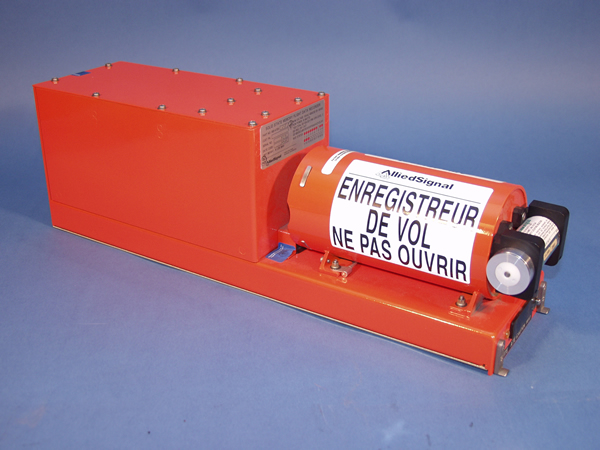
A flight recorder is an electronic recording device placed in an aircraft for the purpose of facilitating the investigation of aviation accidents and incidents. The device may be referred to colloquially as a "black box", an outdated name which has become a misnomer because they are required to be painted bright orange, to aid in their recovery after accidents.

There are two types of flight recording devices: the flight data recorder (FDR) preserves the recent history of the flight by recording of dozens of parameters collected several times per second; the cockpit voice recorder (CVR) preserves the recent history of the sounds in the cockpit, including the conversation of the pilots. The two devices may be combined into a single unit. Together, the FDR and CVR document the aircraft's flight history, which may assist in any later investigation.
The two flight recorders are required by the International Civil Aviation Organization to be capable of surviving conditions likely to be encountered in a severe aircraft accident. They are specified to withstand an impact of 3400 g and temperatures of over 1,000 °C (1,830 °F) by EUROCAE ED-112. They have been a mandatory requirement in commercial aircraft in the United States since 1967. After the unexplained disappearance of Malaysia Airlines Flight 370 in 2014, commentators have called for live streaming of data to the ground, as well as extending the battery life of the underwater locator beacons.
History
[edit]
In seafaring, a device which recorded the position of different vessels in case of an accident was patented by John Sen Inches Thomson in January, 1897.

Early designs
[edit]One of the earliest and proven attempts was made by François Hussenot and Paul Beaudouin in 1939 at the Marignane flight test center, France, with their "type HB" flight recorder; they were essentially photograph-based flight recorders, because the record was made on a scrolling photographic film 8 metres (8.7 yd) long by 88 millimetres (3.5 in) wide. The latent image was made by a thin ray of light deviated by a mirror tilted according to the magnitude of the data to be recorded (altitude, speed, etc.).[1] A pre-production run of 25 "HB" recorders was ordered in 1941, and HB recorders remained in use in French flight test centers well into the 1970s.[2][3]
In 1947, Hussenot founded the Société Française des Instruments de Mesure with Beaudouin and another associate, so as to market his invention, which was also known as the "hussenograph". This company went on to become a major supplier of data recorders, used not only aboard aircraft but also trains and other vehicles. SFIM is today part of the Safran group and is still present in the flight recorder market. The advantage of the film technology was that it could be easily developed afterwards and provides a durable, visual feedback of the flight parameters without needing any playback device. On the other hand, unlike magnetic tapes or later flash memory-based technology, a photographic film cannot be erased and reused, and so must be changed periodically. The technology was reserved for one-shot uses, mostly during planned test flights: it was not mounted aboard civilian aircraft during routine commercial flights. Also, cockpit conversation was not recorded.
Another form of flight data recorder was developed in the UK during World War II. Len Harrison and Vic Husband developed a unit that could withstand a crash and fire to keep the flight data intact. The unit was the forerunner of today's recorders, in being able to withstand conditions that aircrew could not. It used copper foil as the recording medium, with various styli, corresponding to various instruments or aircraft controls, indenting the foil. The foil was periodically advanced at set time intervals, giving a history of the aircraft's instrument readings and control settings. The unit was developed at Farnborough for the Ministry of Aircraft Production. At the war's end, the Ministry got Harrison and Husband to sign over their invention to it and the Ministry patented it under British patent 19330/45.

The first modern flight data recorder, called "Mata-Hari", named after the famous spy, was created in 1942 by Finnish aviation engineer Veijo Hietala. This black high-tech mechanical box was able to record all required data during test flights of fighter aircraft that the Finnish Air Force repaired or built in its main aviation factory in Tampere, Finland.[4]
During World War II, both British and American air forces successfully experimented with aircraft voice recorders.[5] In August 1943, the USAAF conducted an experiment with a magnetic wire recorder to capture the inter-phone conversations of a B-17 bomber flight crew on a combat mission over Nazi-occupied France.[6] The recording was broadcast back to the United States by radio two days afterwards.
Australian designs
[edit]In 1953, while working at the Aeronautical Research Laboratories (ARL) of the Defence Science and Technology Organisation in Port Melbourne,[7] Australian research scientist David Warren conceived a device that would record not only the instrument readings, but also the voices in the cockpit.[8] In 1954 he published a report entitled "A Device for Assisting Investigation into Aircraft Accidents".[9][10]
Warren built a prototype FDR called "The ARL Flight Memory Unit" in 1956,[9] and in 1958 he built the first combined FDR/CVR prototype.[8][11] It was designed with civilian aircraft in mind, explicitly for post-crash examination purposes.[12] Aviation authorities from around the world were largely uninterested at first, but this changed in 1958 when Sir Robert Hardingham, the secretary of the British Air Registration Board, visited the ARL and was introduced to David Warren.[7] Hardingham realized the significance of the invention and arranged for Warren to demonstrate the prototype in the UK.[9]
The ARL assigned an engineering team to help Warren develop the prototype to the airborne stage. The team, consisting of electronics engineers Lane Sear, Wally Boswell, and Ken Fraser, developed a working design that incorporated a fire-resistant and shockproof case, a reliable system for encoding and recording aircraft instrument readings and voice on one wire, and a ground-based decoding device. The ARL system, made by the British firm of S. Davall & Sons Ltd, in Middlesex, was named the "Red Egg" because of its shape and bright red color.[9]
The units were redesigned in 1965 and relocated at the rear of aircraft to increase the probability of successful data retrieval after a crash.[13]
Carriage of data recording equipment became mandatory in UK-registered aircraft in two phases; the first, for new turbine-engined public transport category aircraft over 12,000 lb (5,400 kg) in weight, was mandated in 1965, with a further requirement in 1966 for piston-engined transports over 60,000 lb (27,000 kg), with the earlier requirement further extended to all jet transports. One of the first UK uses of the data recovered from an aircraft accident was that recovered from the Royston "Midas" data recorder that was on board the British Midland Argonaut involved in the Stockport Air Disaster in 1967.[14]
American designs
[edit]

A flight recorder was invented and patented in the United States by James J. Ryan. Ryan's "Flight Recorder" patent was filed in August 1953 and approved on November 8, 1960, as US Patent 2,959,459.[15] A second patent by Ryan for a "Coding Apparatus For Flight Recorders" is US Patent 3,075,192[16] dated January 22, 1963.
A "Cockpit Sound Recorder" (CSR) was independently invented and patented by Edmund A. Boniface Jr., an aeronautical engineer at Lockheed Aircraft Corporation.[17][18][19] He originally filed with the US Patent Office on February 2, 1961, as an "Aircraft Cockpit Sound Recorder".[20] The 1961 invention was viewed by some as an "invasion of privacy".[citation needed] Subsequently, Boniface filed again on February 4, 1963, for a "Cockpit Sound Recorder" (US Patent 3,327,067)[17] with the addition of a spring-loaded switch which allowed the pilot to erase the audio/sound tape recording at the conclusion of a safe flight and landing.
Boniface's participation in aircraft crash investigations in the 1940s[21] and in the accident investigations of the loss of one of the wings at cruise altitude on each of two Lockheed Electra turboprop powered aircraft (Flight 542 operated by Braniff Airlines in 1959 and Flight 710 operated by Northwest Orient Airlines in 1961) led to his wondering what the pilots may have said just prior to the wing loss and during the descent as well as the type and nature of any sounds or explosions that may have preceded or occurred during the wing loss.[22]
His patent was for a device for recording audio of pilot remarks and engine or other sounds to be "contained with the in-flight recorder within a sealed container that is shock mounted, fireproofed and made watertight" and "sealed in such a manner as to be capable of withstanding extreme temperatures during a crash fire". The CSR was an analog device which provided a continuous erasing/recording loop (lasting 30 or more minutes) of all sounds (explosion, voice, and the noise of any aircraft structural components undergoing serious fracture and breakage) which could be overheard in the cockpit.[22]
On November 1, 1966, the director of the Bureau of Safety of the Civil Aeronautics Board Bobbie R. Allen and the chief of Technical Services Section John S. Leak presented "The Potential Role of Flight Recorders in Aircraft Accident Investigation" at the AIAA/CASI Joint Meeting on Aviation Safety, Toronto, Canada.[23]
Terminology
[edit]The term "black box" was a World War II British phrase, originating with the development of radio, radar, and electronic navigational aids in British and Allied combat aircraft. These often-secret electronic devices were encased in non-reflective black boxes or housings. The earliest identified reference to "black boxes" occurs in a May 1945 Flight article, "Radar for Airlines", describing the application of wartime RAF radar and navigational aids to civilian aircraft: "The stowage of the 'black boxes' and, even more important, the detrimental effect on performance of external aerials, still remain as a radio and radar problem."[24] (The term "black box" is used with a different meaning in science and engineering, describing a system exclusively by its inputs and outputs, with no information whatsoever about its inner workings.)
Magnetic tape and wire voice recorders had been tested on RAF and USAAF bombers by 1943 thus adding to the assemblage of fielded and experimental electronic devices employed on Allied aircraft. As early as 1944 aviation writers envisioned use of these recording devices on commercial aircraft to aid incident investigations.[25] When modern flight recorders were proposed to the British Aeronautical Research Council in 1958, the term "black box" was in colloquial use by experts.[26]
By 1967, when flight recorders were mandated by leading aviation countries, the expression had found its way into general use: "These so-called 'black boxes' are, in fact, of fluorescent flame-orange in colour."[27] The formal names of the devices are flight data recorder and cockpit voice recorder. The recorders must be housed in boxes that are bright orange in color to make them more visually conspicuous in the debris after an accident.[28]
Components
[edit]Flight data recorder
[edit]

A flight data recorder (FDR; also ADR, for accident data recorder) is an electronic device employed to record instructions sent to any electronic systems on an aircraft.
The data recorded by the FDR are used for accident and incident investigation. Due to their importance in investigating accidents, these ICAO-regulated devices are carefully engineered and constructed to withstand the force of a high speed impact and the heat of an intense fire. Contrary to the popular term "black box", the exterior of the FDR is coated with heat-resistant bright orange paint for high visibility in wreckage, and the unit is usually mounted in the aircraft's tail section, where it is more likely to survive a crash. Following an accident, the recovery of the FDR is usually a high priority for the investigating body, as analysis of the recorded parameters can often detect and identify causes or contributing factors.[29]
Modern day FDRs receive inputs via specific data frames from the flight-data acquisition units. They record significant flight parameters, including the control and actuator positions, engine information and time of day. There are 88 parameters required as a minimum under current US federal regulations (only 29 were required until 2002), but some systems monitor many more variables. Generally each parameter is recorded a few times per second, though some units store "bursts" of data at a much higher frequency if the data begin to change quickly. Most FDRs record approximately 17–25 hours of data in a continuous loop.[citation needed] It is required by regulations that an FDR verification check (readout) is performed annually in order to verify that all mandatory parameters are recorded.[citation needed] Many aircraft today are equipped with an "event" button in the cockpit that could be activated by the crew if an abnormality occurs in flight. Pushing the button places a signal on the recording, marking the time of the event.[30]
Modern FDRs are typically double wrapped in strong corrosion-resistant stainless steel or titanium, with high-temperature insulation inside. Modern FDRs are accompanied by an underwater locator beacon that emits an ultrasonic "ping" to aid in detection when submerged. These beacons operate for up to 30 days and are able to operate while immersed to a depth of up to 6,000 meters (20,000 ft).[31][32]
Cockpit voice recorder
[edit]
A cockpit voice recorder (CVR) is a flight recorder used to record the audio environment in the flight deck of an aircraft for the purpose of investigation of accidents and incidents. This is typically achieved by recording the signals of the microphones and earphones of the pilots' headsets and of an area microphone in the roof of the cockpit. The current applicable FAA TSO is C123b titled Cockpit Voice Recorder Equipment.[33]
Where an aircraft is required to carry a CVR and uses digital communications the CVR is required to record such communications with air traffic control unless this is recorded elsewhere. As of 2008[update] it is an FAA requirement that the recording duration is a minimum of two hours.[34] The European Aviation Safety Agency increased the recording duration to 25 hours in 2021.[35] In 2023, the FAA proposed extending requirements to 25 hours to help in investigations like runway incursions.[36][37] In a January 2024 press conference on Alaska Airlines Flight 1282, National Transportation Safety Board (NTSB) chair Jennifer Homendy again called for extending retention to 25 hours, rather than the currently-mandated 2 hours, on all existing devices, rather than only newly manufactured ones.[38]
A standard CVR is capable of recording four channels of audio data for a period of two hours. The original requirement was for a CVR to record for 30 minutes, but this has been found to be insufficient in many cases because significant parts of the audio data needed for a subsequent investigation occurred more than 30 minutes before the end of the recording.[39]
The earliest CVRs used analog wire recording, later replaced by analog magnetic tape. Some of the tape units used two reels, with the tape automatically reversing at each end. The original was the ARL Flight Memory Unit produced in 1957 by Australian David Warren and instrument maker Tych Mirfield.[40][41]
Other units used a single reel, with the tape spliced into a continuous loop, much as in an 8-track cartridge. The tape would circulate and old audio information would be overwritten every 30 minutes. Recovery of sound from magnetic tape often proves difficult if the recorder is recovered from water and its housing has been breached. Thus, the latest designs employ solid-state memory and use fault tolerant digital recording techniques, making them much more resistant to shock, vibration and moisture. With the reduced power requirements of solid-state recorders, it is now practical to incorporate a battery in the units, so that recording can continue until flight termination, even if the aircraft electrical system fails.
Like the FDR, the CVR is typically mounted in the rear of the airplane fuselage to maximize the likelihood of its survival in a crash.[42]
Combined units
[edit]With the advent of digital recorders, the FDR and CVR can be manufactured in one fireproof, shock proof, and waterproof container as a combined digital cockpit voice and data recorder (CVDR). Currently, CVDRs are manufactured by L3Harris Technologies[43] and Hensoldt[44] among others. The Enhanced Airborne Flight Recorder (EAFR), manufactured by General Electric and fitted to the Boeing 787 Dreamliner, is a combined recorder which also includes a Recorder Independent Power Supply (RIPS) to allow continued operation in the event of a power failure.[45]
Solid state recorders became commercially practical in 1990, having the advantage of not requiring scheduled maintenance and making the data easier to retrieve. This was extended to the two-hour voice recording in 1995.[46]
Additional equipment
[edit]Since the 1970s, most large civil jet transports have been additionally equipped with a "quick access recorder" (QAR). This records data on a removable storage medium. Access to the FDR and CVR is necessarily difficult because they must be fitted where they are most likely to survive an accident; they also require specialized equipment to read the recording. The QAR recording medium is readily removable and is designed to be read by equipment attached to a standard desktop computer. In many airlines, the quick access recordings are scanned for "events", an event being a significant deviation from normal operational parameters. This allows operational problems to be detected and eliminated before an accident or incident results.
A flight-data acquisition unit (FDAU) is a unit that receives various discrete, analog and digital parameters from a number of sensors and avionic systems and then routes them to the FDR and, if installed, to the QAR. Information from the FDAU to the FDR is sent via specific data frames, which depend on the aircraft manufacturer.
Many modern aircraft systems are digital or digitally controlled. Very often, the digital system will include built-in test equipment which records information about the operation of the system. This information may also be accessed to assist with the investigation of an accident or incident.
Specifications
[edit]

The design of today's FDR is governed by the internationally recognized standards and recommended practices relating to flight recorders which are contained in ICAO Annex 6 which makes reference to industry crashworthiness and fire protection specifications such as those to be found in the European Organisation for Civil Aviation Equipment[47] documents EUROCAE ED55, ED56 Fiken A and ED112 (Minimum Operational Performance Specification for Crash Protected Airborne Recorder Systems). In the United States, the Federal Aviation Administration (FAA) regulates all aspects of US aviation, and cites design requirements in their Technical Standard Order,[48] based on the EUROCAE documents (as do the aviation authorities of many other countries).
Currently, EUROCAE specifies that a recorder must be able to withstand an acceleration of 3400 g (33 km/s2) for 6.5 milliseconds. This is roughly equivalent to an impact velocity of 270 knots (310 mph; 500 km/h) and a deceleration or crushing distance of 45 cm (18 in).[49] Additionally, there are requirements for penetration resistance, static crush, high and low temperature fires, deep sea pressure, sea water immersion, and fluid immersion.
EUROCAE ED-112 (Minimum Operational Performance Specification for Crash Protected Airborne Recorder Systems) defines the minimum specification to be met for all aircraft requiring flight recorders for recording of flight data, cockpit audio, images and CNS / ATM digital messages and used for investigations of accidents or incidents.[50] When issued in March 2003, ED-112 superseded previous ED-55 and ED-56A that were separate specifications for FDR and CVR. FAA TSOs for FDR and CVR reference ED-112 for characteristics common to both types.
In order to facilitate recovery of the recorder from an aircraft accident site, they are required to be coloured bright yellow or orange with reflective surfaces. All are lettered "Flight recorder do not open" on one side in English and "Enregistreur de vol ne pas ouvrir" in French on the other side. To assist recovery from submerged sites they must be equipped with an underwater locator beacon which is automatically activated in the event of an accident.

Regulation
[edit]The first regulatory attempt to require flight data recorders occurred in April 1941, when the Civil Aeronautics Board (CAB) required flight recorders on passenger aircraft that would record the aircraft's altitude and whether the radio transmitter was turned on or off.[51]: 1 The compliance deadline for that regulation was extended several times, until June 1944 when the requirement was rescinded due to maintenance problems and the lack of parts due to World War 2.[51]: 1 A similar regulation was adopted in September 1947, which required recorders in aircraft of 10,000 pounds (4,500 kg) or more, but that requirement was again rescinded in July 1948 because of a lack of availability of reliable devices.[51]: 1 In August 1957, the CAB adopted amendments to flight regulations that required the installation of flight recorders by July 1958 in all aircraft over 12,500 pounds (5,700 kg) and that were operated at altitudes over 25,000 feet.[51]: 1–2 The requirements were further amended in September 1959, requiring the retention of records for 60 days, and the operation of the flight recorders continuously from the time of takeoff roll to the completion of the landing roll.[51]: 2
In the investigation of the 1960 crash of Trans Australia Airlines Flight 538 at Mackay, Queensland, the inquiry judge strongly recommended that flight recorders be installed in all Australian airliners. Australia became the first country in the world to make cockpit-voice recording compulsory.[52][53]

The United States' first cockpit voice recorder rules were passed in 1964, requiring all turbine and piston aircraft with four or more engines to have CVRs by March 1, 1967.[54] As of 2008[update] it is an FAA requirement that the CVR recording duration is a minimum of two hours,[34] following the NTSB recommendation that it should be increased from its previously mandated 30-minute duration.[55] From 2014 the United States requires flight data recorders and cockpit voice recorders on aircraft that have 20 or more passenger seats, or those that have six or more passenger seats, are turbine-powered, and require two pilots.[56]
For US air carriers and manufacturers, the NTSB is responsible for investigating accidents and safety-related incidents. The NTSB also serves in an advisory role for many international investigations not under its formal jurisdiction. The NTSB does not have regulatory authority, but must depend on legislation and other government agencies to act on its safety recommendations.[57] In addition, after the public outcry that followed recordings released for the crash of Delta Air Lines Flight 1141 in 1988, 49 USC Section 1114(c) prohibits the NTSB from making the audio recordings public except when related to a safety investigation, and in such cases the release is only in the form of a written transcript.[58]
The ARINC Standards are prepared by the Airlines Electronic Engineering Committee (AEEC). The 700 Series of standards describe the form, fit, and function of avionics equipment installed predominately on transport category aircraft. The FDR is defined by ARINC Characteristic 747. The CVR is defined by ARINC Characteristic 757.[59]
Post-incident overwriting of voice data by Nigerian crews led to a 2023 All Operators Letter reinforcing that this practice is forbidden.[60][61]
Proposed requirements
[edit]Deployable recorders
[edit]The NTSB recommended in 1999 that operators be required to install two sets of CVDR systems, with the second CVDR designed to be ejected from the aircraft prior to impact with the ground or water. Ejection would be initiated by computer based on sensor information indicating an crash is imminent. A deployable recorder combines the cockpit voice/flight data recorders and an emergency locator transmitter (ELT) in a single unit. The unit would be designed to eject and float away from the aircraft and survive its descent to the ground, or float on water indefinitely. It would be equipped with satellite technology to aid in prompt recovery. Deployable CVDR technology has been used by the US Navy since 1993.[62]
While the recommendations would involve a massive, expensive retrofit program, government funding would meet cost objections from manufacturers and airlines. Operators would get both sets of recorders (including the currently-used fixed recorder) free of charge. The cost of the second deployable/ejectable CVDR (or black box) was estimated at US$30 million for installation in 500 new aircraft (about $60,000 per new commercial plane).[citation needed]
In the United States, the proposed SAFE Act calls for implementing the NTSB 1999 recommendations. However, so far the proposed legislation has failed to pass Congress, having been introduced in 2003 (H.R. 2632), in 2005 (H.R. 3336), and in 2007 (H.R. 4336).[63] Originally the Safe Aviation Flight Enhancement (SAFE) Act of 2003[64] was introduced on June 26, 2003, by Congressman David Price (D-NC) and Congressman John Duncan (R-Tenn.) in a bipartisan effort to ensure investigators have access to information immediately following accidents to transport category aircraft.[62]
On July 19, 2005, a revised proposal for a SAFE Act was introduced and referred to the Committee on Transportation and Infrastructure of the US House of Representatives. The bill was referred to the House Subcommittee on Aviation during the 108th, 109th, and 110th Congresses.[65][66][67]
After Malaysia Airlines Flight 370
[edit]In the United States, on March 12, 2014, in response to the missing Malaysia Airlines Flight 370, David Price re-introduced the SAFE Act in the US House of Representatives.[68]
The disappearance of Malaysia Airlines Flight 370 demonstrated the limits of the contemporary flight recorder technology, namely how physical possession of the flight recorder device is necessary to help investigate the cause of an aircraft incident. Considering the advances of modern communication, technology commentators called for flight recorders to be supplemented or replaced by a system that provides "live streaming" of data from the aircraft to the ground.[69][70][71] Furthermore, commentators called for the underwater locator beacon's range and battery life to be extended, as well as the outfitting of civil aircraft with the deployable flight recorders typically used in military aircraft. Previous to MH370, the investigators of 2009 Air France Flight 447 urged that the battery life be extended as "rapidly as possible" after the crash's flight recorders went unrecovered for over a year.[72]
After Indonesia AirAsia Flight 8501
[edit]On December 28, 2014, Indonesia AirAsia Flight 8501, en route from Surabaya, Indonesia, to Singapore, crashed in bad weather, killing all 155 passengers and seven crew on board.[73]
On January 8, 2015, before the recovery of the flight recorders, an anonymous ICAO representative said: "The time has come that deployable recorders are going to get a serious look."[74] A second ICAO official said that public attention had "galvanized momentum in favour of ejectable recorders on commercial aircraft".[74]
Boeing 737 MAX
[edit]Live flight data streaming as on the Boeing 777F ecoDemonstrator, plus 20 minutes of data before and after a triggering event, could have removed the uncertainty before the Boeing 737 MAX groundings following the March 2019 Ethiopian Airlines Flight 302 crash.[75] In the Alaska Airlines Flight 1282 accident, the Cockpit Voice Recorder functioned properly but the data was overwritten as the CVR remained powered, and functioning. The critical accident data was overwritten by over two hours of post-incident sounds until a maintenance crew could enter the aircraft after the incident and power down the CVR.[76][77]
Image recorders
[edit]The NTSB has asked for the installation of cockpit image recorders in large transport aircraft to provide information that would supplement existing CVR and FDR data in accident investigations. They have recommended that image recorders be placed into smaller aircraft that are not required to have a CVR or FDR.[78] The rationale is that what is seen on an instrument by the pilots of an aircraft is not necessarily the same as the data sent to the display device. This is particularly true of aircraft equipped with electronic displays (CRT or LCD). A mechanical instrument panel is likely to preserve its last indications, but this is not the case with an electronic display. Such systems, estimated to cost less than $8,000 installed, typically consist of a camera and microphone located in the cockpit to continuously record cockpit instrumentation, the outside viewing area, engine sounds, radio communications, and ambient cockpit sounds. As with conventional CVRs and FDRs, data from such a system is stored in a crash-protected unit to ensure survivability.[78][better source needed] Since the recorders can sometimes be crushed into unreadable pieces, or even located in deep water, some modern units are self-ejecting (taking advantage of kinetic energy at impact to separate themselves from the aircraft) and also equipped with radio emergency locator transmitters and sonar underwater locator beacons to aid in their location.[79]
Cultural references
[edit]- The artwork for the band Rammstein's album Reise, Reise is made to look like a CVR; it also includes a recording from a crash. The recording is from the last 1–2 minutes of the CVR of Japan Air Lines Flight 123, which crashed on August 12, 1985, killing 520 people; JAL123 is the deadliest single-aircraft disaster in history.[80]
- Members of the performing arts collective Collective:Unconscious made a theatrical presentation of a play called Charlie Victor Romeo with a script based on transcripts from CVR voice recordings of nine aircraft emergencies. The play features the famous United Airlines Flight 232 that crash-landed in a cornfield near Sioux City, Iowa, after suffering a catastrophic failure of one engine and most flight controls.[81]
- Survivor, a novel by American author Chuck Palahniuk, is about a cult member who dictates his life story to a flight recorder before the plane runs out of fuel and crashes.[82]
- In stand-up comedy, many jokes have been made asking why the entire airplane is not made out of the material used to make black boxes, given that the black box survives the crash. This is referenced in the 2001 Chris Rock movie Down to Earth,[83] although the original joke is widely credited to George Carlin.[84]
See also
[edit]- Acronyms and abbreviations in avionics
- Data logger
- Emergency locator beacon
- Emergency position-indicating radiobeacon station
- Event data recorder
- Flight operations quality assurance
- Korean Air Lines Flight 007
- List of unrecovered and unusable flight recorders
- Quick access recorder
- Software flight recorder
- Train event recorder
- Voyage data recorder
References
[edit]- ^ Jean-Claude Fayer, Vols d'essais: Le Centre d'Essais en Vol de 1945 à 1960, published by E.T.A.I. (Paris), 2001, 384 pages, ISBN 2-7268-8534-9
- ^ Page 206 and 209 of Beaudouin & Beaudouin
- ^ "Black Box History". Native Khabar. May 22, 2020. Archived from the original on January 25, 2022. Retrieved May 22, 2020.
- ^ "Valtion lentokonetehdas: Mata-Hari eli musta laatikko" [State aircraft factory: Mata-Hari or black box]. Museums of Tampere (in Finnish). 1946. Archived from the original on October 19, 2017. Retrieved October 19, 2017.
- ^ Chuck Owl (February 4, 2015). Audio From the Past [E01] - WW2 - Avro Lancaster Crew Radio. Archived from the original on November 16, 2018. Retrieved February 13, 2019 – via YouTube.
- ^ Porter, Kenneth (January 1944). "Radio News, 'Radio - On a Flying Fortress'" (PDF). www.americanradiohistory.com. p. 21. Archived (PDF) from the original on January 25, 2022. Retrieved February 13, 2019.
- ^ a b "Dave Warren – Inventor of the black box flight recorder". Defence Science and Technology Organisation. Archived from the original on July 6, 2011.
- ^ a b "Australia invented the Black Box voice and instrument recorder". apc-online.com. February 9, 2000. Archived from the original on July 7, 2011. Retrieved March 11, 2014.
- ^ a b c d Marcus Williamson (July 31, 2010). "David Warren: Inventor and developer of the 'black box' flight data recorder". The Independent. Archived from the original on May 30, 2020. Retrieved September 5, 2018.
- ^ The Black Box Flight Recorder EHA Magazine May 2019 pages 16-19
- ^ A Brief History of Black Boxes Time July 20, 2009 page 22
- ^ "A Brief History of Black Boxes". Time. July 20, 2009. p. 22. Archived from the original on February 3, 2012. Retrieved February 1, 2012.
- ^ Tony Bailey (January 2006). "Flight Data Recorders – Built to Survive" (PDF). aea.net. Avionics News. p. 38. Archived (PDF) from the original on December 10, 2019. Retrieved September 5, 2018.
- ^ "1967 | 1315 | Flight Archive". Archived from the original on February 14, 2019.
- ^ "US Patent 2,959,459 for Flight Recorder by James J. Ryan". Archived from the original on January 8, 2016. Retrieved March 25, 2014.
- ^ "US Patent 3,075,192 for Coding Apparatus for Flight Recorders by James J. Ryan". Archived from the original on January 8, 2016. Retrieved January 7, 2014.
- ^ a b "Cockpit Sound Recorder". Google Patents. Google Inc. Archived from the original on April 28, 2016. Retrieved December 31, 2013.
- ^ "Airplane 'Black Box' Flight Recorder Technology, How it Works" Archived October 11, 2016, at the Wayback Machine. Slyck News, March 13, 2014
- ^ " Why Are Cockpit Voice Recorders Painted Orange and Called a Black Box?" Archived September 17, 2016, at the Wayback Machine. Guardian Liberty Voice, By Jerry Nelson on March 8, 2014
- ^ "AAHS Journal Vol 59 Nos 3-4 - Fall / Win". www.aahs-online.org. Archived from the original on September 3, 2021. Retrieved September 3, 2021.
- ^ "The Flight Data Recorder" Archived October 11, 2016, at the Wayback Machine. Aviation Digest, May 11, 2015, page 58.
- ^ a b US Patent 3,327,067 for Cockpit Sound Recorder by Edmund A. Boniface, Jr. Archived July 7, 2017, at the Wayback Machine;
- ^ Allen, B. R.; Leak, John S. (1966), "The potential role of flight recorders in aircraft accident investigation", Aviation Safety Meeting, BOSP 7-4, U.S. Civil Aeronautics Board, doi:10.2514/6.1966-810
- ^ "Flight, 'Radar for Airlines'". Flight. May 2, 1945. p. 434. Archived from the original on February 14, 2019. Retrieved February 13, 2019.
- ^ Corddry, Charles Jr. (August 1944). Flying, 'Aerial Eavesdropper'. p. 150. Archived from the original on January 25, 2022. Retrieved October 17, 2020.
- ^ [1] Archived January 24, 2014, at the Wayback Machine
- ^ Scott, Geoffrey (December 14, 1967). "Flight, 'Saving the Record'". www.flightglobal.com. p. 1002. Archived from the original on February 14, 2019. Retrieved February 13, 2019.
- ^ "France to resume 'black box' hunt". BBC News. December 13, 2009. Archived from the original on January 25, 2022. Retrieved April 30, 2010.
- ^ "Flight Data Recorder Systems" (PDF). Federal Aviation Administration. April 10, 2007. Section 3 Point B. Archived (PDF) from the original on September 13, 2009. Retrieved April 8, 2010.
- ^ "Aircraft Electronics + Electrical Systems: Flight data and cockpit voice recorders". industrial-electronics.com. A Measurement-Testing network. Archived from the original on November 11, 2018. Retrieved March 27, 2019.
- ^ "FLIGHT DATA RECORDER OSA - TM-1-1510-225-10_280". aviationandaccessories.tpub.com. Archived from the original on December 10, 2018. Retrieved August 29, 2021.
- ^ "SSFDR Solid State Flight Data Recorder, ARINC 747 - TSO C 124 - ED 55" (PDF). Archived from the original (PDF) on November 8, 2012.
- ^ "Cockpit Voice Recorder Equipment" (PDF). Federal Aviation Administration. June 1, 2006. Archived (PDF) from the original on October 26, 2007. Retrieved April 21, 2007.
- ^ a b "Federal Aviation Regulation Sec. 121.359(h)(i)(2), amendment 338 and greater – Cockpit voice recorders". Risingup.com. Archived from the original on February 6, 2012. Retrieved February 7, 2013.
- ^ Bellamy III, Woodrow (April 13, 2019). "L3 Has New Data, Voice Recorders for EASA's 2021 Mandate". Avionics International. Retrieved June 19, 2023.
- ^ Walsh, Amelia (March 21, 2023). "FAA Proposes Extending Cockpit Voice Recording to 25 Hours". FLYING Magazine. Retrieved June 19, 2023.
- ^ Wallace, Greg (March 17, 2023). "The FAA proposes lengthening cockpit voice recording time to 25 hours - CBS Sacramento". CBS News. Retrieved June 19, 2023.
- ^ Villamizar, Helwing (January 8, 2024). "No Data on Flight 1282 Cockpit Voice Recorder, NTSB Calls out FAA". Airways. Retrieved January 8, 2024.
- ^ Tracy Connor (October 28, 1999). "Learjet probe focuses on value replaced 2 days before crash". The New York Post. p. 18.
The record works on a half hour loop, so it has no information about the crucial first hour
- ^ "ARL Flight Memory Recorder". Museums Victoria Collections. Archived from the original on October 5, 2021. Retrieved October 5, 2021.
- ^ Mirfield, Theon Neuma (May 1964). "Miniature wire recording desks with limited memory". The Australian Journal of Instrument Technology. May: 94–100. Archived from the original on October 20, 2019. Retrieved October 20, 2019.
- ^ "Federal Aviation Regulation Sec. 23.1457 – Cockpit voice recorders". Risingup.com. Archived from the original on February 10, 2012. Retrieved February 7, 2013.
- ^ "L-3 Aviation Recorders". l-3ar.com. Archived from the original on July 27, 2014. Retrieved July 23, 2014.
- ^ "Flight and mission data recording & management - SferiRec". Hensoldt. 2019. Archived from the original on August 12, 2019. Retrieved August 12, 2019.
- ^ "GE delivers flight recorders for Boeing 787" (Press release). Military+Aerospace Electronics. July 26, 2008. Retrieved June 15, 2025.
- ^ "History of Flight Recorders". L3 Flight Recorders. Archived from the original on December 11, 2013.
- ^ Luftfahrt. "European Organisation for Civil Aviation Equipment". Eurocae.net. Archived from the original on January 9, 2014. Retrieved March 11, 2014.
- ^ "TSO-C124a FAA Regs". Airweb.faa.gov. May 23, 2006. Archived from the original on January 8, 2016. Retrieved March 11, 2014.
- ^ "Black box flight recorders". ATSB. April 1, 2014. Archived from the original on October 9, 2016. Retrieved October 7, 2016.
- ^ [2] Archived August 11, 2007, at the Wayback Machine
- ^ a b c d e Allen, B.R.; Leak, John S. (December 1966). The Potential Role of Flight Recorders in Aircraft Accident Investigation. Civil Aeronautics Board.
- ^ "Dave Warren - Inventor of the black box flight recorder". Defence Science and Technology Organisation. March 29, 2005. Archived from the original on May 22, 2010. Retrieved April 20, 2010.
- ^ Campbell, Neil. "The Evolution of Flight Data Analysis" (PDF). Proc. Australian Society of Air Safety Investigators conference, 2007. Archived from the original (PDF) on February 4, 2016. Retrieved April 7, 2014.
- ^ Komos, Nick (August 1989). Air Progress. Vol. 51, no. 8. Canoga, California: Challenge Publications. p. 76. ISSN 0002-2500. LCCN 43040230. OCLC 1478636.
{{cite magazine}}: Missing or empty|title=(help) - ^ "2011 Most Wanted List Page. Recorders". NTSB Archived August 4, 2014, at the Wayback Machine
- ^ U.S. Code of Federal Regulations (April 25, 2010). "14 CFR 91.609". Legal Information Institute. Cornell Law School. Archived from the original on August 9, 2016. Retrieved June 17, 2016.
- ^ "History of the NTSB". NTSB Official Site. Archived from the original on May 12, 2016. Retrieved June 17, 2016.
- ^ "CVR Handbook" (PDF). www.ntsb.gov. Archived (PDF) from the original on September 3, 2020. Retrieved June 29, 2020.
- ^ "ARINC Store, 700 series". Archived from the original on August 14, 2011. Retrieved November 12, 2015.
- ^ "RE: Continuous Overwriting of Cockpit Voice Recorder (CVR) Information. NCAA" (PDF). Nigeria Civil Aviation Authority. Retrieved January 9, 2024.
The Nigeria Civil Aviation Authority (NCAA) had noticed that some airline operators' flight crew members were in the practice of continuously overwriting the CVR information after an occurrence. This practice makes it practically impossible for the Nigerian Safety Investigation Bureau (NSIB) to retrieve actual data to aid in its investigation
- ^ Shadare, Wole (July 27, 2023). "Airlines Doctor Cockpit Voice Recorder To Hide Serious Incidents, Accidents". New Telegraph. Retrieved January 9, 2024.
airlines indulge in the unprofessional act in order to circumvent investigation by the Nigeria Safety Investigation Bureau (NSIB).[...] safety managers stated that some airlines have consistently indulged in this unwholesome practice, which could impact safety negatively. The NCAA and the NSIB had in the wake of the report of the incident involving Max Air's B747 incident expressed concern over the incessant occurrence of the issue with airlines.
- ^ a b "Aviation Today". aviationtoday.com. Archived from the original on March 25, 2014.
- ^ "Safe Aviation and Flight Enhancement Act of 2005 (2005; 109th Congress H.R. 3336) - GovTrack.us". GovTrack.us. Archived from the original on March 22, 2014. Retrieved April 7, 2014.
- ^ "Text of the Safe Aviation and Flight Enhancement Act-((SAFE) Act of 2003)". Archived from the original on September 25, 2015. Retrieved August 2, 2015 – via govtrack.us.
- ^ "Bill Text - 108th Congress (2003-2004) - THOMAS (Library of Congress)". Thomas.loc.gov. Archived from the original on January 8, 2016. Retrieved March 11, 2014.
- ^ "Bill Text - 109th Congress (2005-2006) - THOMAS (Library of Congress)". Thomas.loc.gov. Archived from the original on January 8, 2016. Retrieved March 11, 2014.
- ^ "Bill Text - 110th Congress (2007-2008) - THOMAS (Library of Congress)". Thomas.loc.gov. Archived from the original on January 8, 2016. Retrieved March 11, 2014.
- ^ Jansen, Bart. "Lawmaker urges 'black boxes' that eject from planes". USA Today. Archived from the original on July 10, 2017. Retrieved August 26, 2017.
- ^ Stephen Trimble. "Malaysia Airlines flight MH370 makes it clear: we need to rethink black boxes". The Guardian. Archived from the original on March 30, 2014. Retrieved March 31, 2014.
- ^ "Malaysia Airlines MH370: Why airlines don't live-stream black box data". Technology & Science. CBC News. August 4, 2005. Archived from the original on March 30, 2014. Retrieved March 31, 2014.
- ^ Yu, Yijun. "If we'd used the cloud, we might know where MH370 is now" Archived July 24, 2014, at the Wayback Machine, The Conversation, London, March 18, 2014. Retrieved on August 21, 2014.
- ^ "MH370: Expert demands better black box technology". The Sydney Morning Herald. April 28, 2014. Archived from the original on April 28, 2014. Retrieved April 28, 2014.
- ^ "AirAsia QZ8501: More bad weather hits AirAsia search". BBC News. January 1, 2015. Archived from the original on August 15, 2018. Retrieved June 21, 2018.
- ^ a b Lampert, Allison; Martell, Allison (January 8, 2015). "AirAsia crash makes case for ejectable black boxes". Reuters. Archived from the original on October 12, 2019. Retrieved January 5, 2021.
- ^ "Opinion: The Time Is Ripe for Live Flight Data Streaming". Aviation Week & Space Technology. March 22, 2019. Archived from the original on January 25, 2022. Retrieved March 22, 2019.
- ^ Villamizar, Helwing (January 8, 2024). "No Data on Flight 1282 Cockpit Voice Recorder, NTSB Calls out FAA". Airways Publishing, LLC. Retrieved January 9, 2024.
The NTSB sent the cockpit voice recorder (CVR) and flight data recorder (FDR) to their labs. They will use data from the FDR to narrow down the area to search for the door plug. However, the CVR was completely overwritten, meaning there is nothing on the CVR. The CVR overwrites every two hours.
- ^ Nesi, Chris (January 8, 2024). "Black box recorder from imperiled Alaska Airlines flight completely erased: 'We have nothing'". New York Post. Retrieved January 9, 2024.
- ^ a b "NTSB — Most Wanted". Ntsb.gov. Archived from the original on November 3, 2013. Retrieved March 11, 2014.
- ^ "These Black Boxes Are Designed to Eject Themselves in a Plane Crash". Travel + Leisure. Archived from the original on October 5, 2021. Retrieved October 5, 2021.
- ^ Beckner, Justin. "The Easter Egg Hidden on Rammstein's 'Reise, Reise' Album". UltimateGuitar. Retrieved July 17, 2023.
- ^ "Collective: Unconscious". Charlievictorromeo.com. July 3, 2012. Archived from the original on May 17, 2014. Retrieved February 7, 2013.
- ^ Survivor Summary & Study Guide. Retrieved July 17, 2023 – via Bookrags.
- ^ "Down to Earth Movie Script". Scripts.com. Retrieved July 17, 2023.
- ^ "Quote by George Carlin". Goodreads. Retrieved July 17, 2023.
Further reading
[edit]- American Aviation Historical Society, Volume 59, Fall-Winter 2014, "Edmund A. Boniface, Jr.: Inventing the Cockpit Sound Recorder" Archived April 2, 2015, at the Wayback Machine
- "Extraordinary Inventor", U of A Engineer Magazine, Winter 2005
- (Survivors), "Saving Survivors by Finding Fallen Aircrafts [sic]", NRC, 2008-03-05
- Jeremy Sear, "The ARL 'Black Box' Flight Recorder", University of Melbourne, October 2001
- Siegel, Greg (2014). "Chapter 3. Black Boxes". Forensic Media: Reconstructing Accidents in Accelerated Modernity. Duke University Press. pp. 89–142. ISBN 978-0-8223-7623-1.
- Wyatt, David; Mike Tooley (2009). "Chapter 18. Flight data and cockpit voice recorders". Aircraft Electrical and Electronic Systems. Routledge. p. 321. ISBN 978-1-136-44435-7.
- Ben Hargreaves (April 13, 2017). "Flight Data Recorder Evolution: Where Next?". MRO-network. Aviation Week. Archived from the original on November 16, 2018.
External links
[edit]
Media related to Flight data recorders at Wikimedia Commons
- Cockpit Voice Recorder Database
- 'The ARL 'Black Box' Flight Recorder': Melbourne University history honors thesis on the development of the first cockpit voice recorder by David Warren
- Finnish Mata-Hari Flight Recorder in Museums of Tampere City
- "Beyond the Black Box: Instead of storing flight data on board, aircraft could easily send the information in real time to the ground", by Krishna M. Kavi, IEEE Spectrum, August 2010
- "A crash course in transportation safety". Archived from the original on February 11, 2009. Retrieved April 7, 2014.
- David Warren interview transcript 2002, ABC TV (Australia)
- David Warren interview transcript 2003, ABC TV (Australia)
- etep, Flight Recorder designer
- Heavy Vehicle EDR Archived February 8, 2011, at the Wayback Machine information site for black box technology
- How Black Boxes Work at HowStuffWorks
- IRIG 106 Chapter 10: Flight data recorder digital recorder standard
- Public domain photos of recorders
- Popular Mechanics, March 19, 2008
- "His Crashes Helped Make Ours Less Dangerous"
- US 3075192 James J. Ryan: "Coding Apparatus for Flight Recorders and the Like"
- First modern flight recorder "Mata Hari" at display in Tampere Vapriikki Museum Centre.
This article incorporates public domain material from websites or documents of the National Transportation Safety Board.
Flight recorder
View on GrokipediaTypically comprising a flight data recorder (FDR) that logs parameters such as airspeed, altitude, heading, and engine performance from numerous sensors, and a cockpit voice recorder (CVR) that preserves pilot communications, radio transmissions, and ambient cockpit sounds for at least the final two hours of flight (with recent mandates, including the FAA's 2024 final rule requiring 25 hours on U.S. airliners, extending beyond this in certain jurisdictions), these units are engineered to endure extreme conditions including impact forces exceeding 3,400 g, temperatures up to 1,100°C for 60 minutes, and prolonged submersion.[3][4][5][6]
Painted bright orange for visibility and often fitted with underwater locator beacons transmitting at 37.5 kHz for up to 90 days, flight recorders have been required by regulatory standards from bodies like the FAA and ICAO since the 1960s for large commercial aircraft, recording up to 88 or more parameters in modern installations to support causal determination in post-crash analyses.[2][3][7]
The device's foundational concept emerged from Australian research in 1953 by Dr. David Warren at the Aeronautical Research Laboratory, who proposed integrating foil-based data and magnetic audio recording to address recurring unexplained crashes, leading to prototypes tested in the 1950s and eventual global adoption that has empirically enhanced aviation safety through precise identification of mechanical failures, human errors, and procedural lapses.[8][9]
History
Origins and early prototypes
In the late 1930s, French Air Force engineer François Hussenot, working at the Centre d'Essais en Vol in Marignane, collaborated with Paul Beaudouin to develop the first known flight data recorder prototype, designated the Hussenographe type HB. This device employed a photographic oscillograph system, where galvanometers traced flight parameters—including altitude, airspeed, vertical acceleration, and engine revolutions—onto continuously moving sensitized paper or film strips exposed in a darkened chamber. Primarily intended for post-flight analysis of experimental aircraft test data rather than crash survival, the Hussenographe enabled precise reconstruction of maneuvers and performance anomalies, with early models capable of recording multiple channels simultaneously.[10][11] During World War II, British engineers Len Harrison and Vic Husband designed a more robust prototype for the Ministry of Aircraft Production, utilizing a stylus mechanism to inscribe aircraft attitude, control positions, and engine data onto thin copper foil housed in a crash- and fire-resistant casing. This innovation addressed wartime needs for durable recording amid high accident rates in training and combat flights, though the design saw limited adoption due to production constraints and prioritization of other avionics.[12] Parallel efforts in the United States during the 1940s focused on voice recording for military applications, with the U.S. Army Air Forces experimenting with steel wire recorders to capture inter-crew and ground communications, as demonstrated in trials by August 1943. These early wire-based systems, while not integrating full flight data, laid groundwork for survivable audio documentation in operational aircraft, influencing subsequent hybrid prototypes.[13]Mid-20th century developments
Following World War II, flight recorders were primarily employed in military aircraft for recording data during flight tests to analyze performance and malfunctions.[14] These early devices focused on basic parameters such as airspeed, altitude, and acceleration, often using mechanical stylus-on-foil mechanisms that etched traces onto metal strips.[9] In 1953, Australian scientist David Warren at the Aeronautical Research Laboratories conceived a combined flight data and cockpit voice recorder, motivated by unexplained crashes of de Havilland Comet airliners and advancements in portable Minifon wire recording technology.[8] Warren's 1954 proposal outlined a device to capture instrument readings alongside audio from the cockpit environment, aiming to preserve critical evidence for accident investigations.[15] By 1957, initial prototypes were developed using magnetic wire to record up to four hours of voice and eight flight parameters sampled four times per second.[16] Concurrently in the United Kingdom, Penny & Giles Controls introduced the first magnetic-based aircraft accident data recorder in 1957, utilizing stainless steel wire for durable storage of flight parameters beyond traditional foil methods.[17] This innovation improved reliability and data recovery post-crash. Mid-decade air disasters, lacking survivors or witnesses, prompted regulatory bodies to mandate flight recorders in commercial aviation; for instance, the U.S. Civil Aeronautics Board required their installation on larger aircraft by 1958.[18] Australia pioneered compulsory cockpit voice recording in 1963, followed by broader adoption internationally.[19]Modern standardization and expansions
The International Civil Aviation Organization (ICAO) established comprehensive standards for flight recorders through Annex 6 to the Convention on International Civil Aviation, mandating flight data recorders (FDRs) and cockpit voice recorders (CVRs) on commercial aircraft above specified masses, with requirements for crash survivability, recording durations, and data parameters to facilitate accident investigations.[20] These standards, harmonized with regional authorities like the European Union Aviation Safety Agency (EASA), require CVRs to capture at least 25 hours of audio on aircraft exceeding 27,000 kg maximum takeoff weight (MTOW), using solid-state memory for overwrite loops and resistance to extreme conditions including 1,100°C fires for 60 minutes and 3,400 g impacts.[21] The U.S. Federal Aviation Administration (FAA) aligns via Technical Standard Orders (TSOs), such as TSO-C123c for CVRs, though it maintains a 2-hour minimum for many operations while proposing extensions to 25 hours for newly type-certificated aircraft to match ICAO and EASA amid ongoing harmonization efforts.[22][21] Expansions beyond core audio and flight data have included the integration of airborne image recorders (AIRs) to capture cockpit visuals, as outlined in ICAO's 2025 assembly discussions, aiming to provide investigators with non-verbal cues without mandating facial recognition of crew.[23] FDR parameter lists have proliferated from initial basic metrics (e.g., altitude, airspeed) to over 1,000 in modern digital systems on aircraft like the Boeing 787, encompassing engine performance, control inputs, and systems health via ARINC 429/664 protocols for granular causal analysis.[23] Underwater locator beacons (ULBs) standardized at 90-day battery life and 37.5 kHz pinging since ICAO amendments in 2014, with EASA-funded research from 2020 onward exploring automatic wireless data transmission post-crash to accelerate recovery without physical retrieval.[24] These developments reflect empirical imperatives from accident data, such as delayed recoveries in deep-water incidents (e.g., Air France Flight 447 in 2009), driving causal enhancements like deployable recorders that eject on impact for surface flotation, now optional under FAA TSO-C177a but increasingly adopted for oceanic routes.[24] Disparities persist between ICAO minima and national implementations, with FAA rules under 14 CFR Part 91 requiring datalink recording integration where equipped, underscoring ongoing refinements for data fidelity amid rising aircraft complexity.[25]Terminology and Classification
Common nomenclature and myths
![Flight data recorder exterior][float-right] The term "black box" is widely used as a colloquial synonym for flight recorders, encompassing both flight data recorders (FDRs) and cockpit voice recorders (CVRs), despite their external casings being painted international orange for enhanced post-accident visibility.[26][27] This nomenclature originated in World War II-era British aviation slang, referring to sealed, opaque electronic components in black-painted metal housings that technicians treated as inscrutable units without inspecting internals.[28][29] Early flight recorders, such as those using photographic film or magnetic wire, reinforced the "black box" label due to their light-tight enclosures preventing exposure, though modern solid-state versions retain the term by convention.[26] A persistent myth holds that flight recorders are literally black, stemming from incomplete awareness of their design evolution; in reality, the orange hue has been standard since the 1950s to facilitate recovery in debris fields, as it contrasts sharply against wreckage and terrain.[27][30] Another common misconception portrays flight recorders as indestructible, but they are engineered for survivability under specified extremes—such as 3,400 g deceleration for 6.5 milliseconds, immersion in seawater at 6,000 meters for 30 days, and exposure to 1,100°C for 60 minutes—yet failures occur rarely when conditions exceed these parameters, as in cases of extreme fragmentation or prolonged deep-sea submersion without effective locator beacons.[31][32][33] The notion that entire aircraft should be constructed from flight recorder materials ignores causal trade-offs in weight, cost, and aerodynamics; recorders are strategically mounted in the tail section, statistically the most survivable area during high-impact crashes, allowing targeted fortification without compromising overall aircraft performance.[34][35] Claims of universal recoverability overlook empirical evidence from incidents like Air France Flight 447 in 2009, where recorders were retrieved after two years at 3,900 meters only due to advanced submersible technology, highlighting limitations of underwater locator beacons' 30-90 day battery life and acoustic signal range.[33] In practice, while over 95% of U.S. commercial flight recorders have been recovered intact since 1965 per National Transportation Safety Board data, unrecoverable cases underscore that design prioritizes data preservation over absolute durability across all conceivable scenarios.[32]Types of flight recorders
Flight recorders in aviation are primarily divided into two mandatory types for commercial aircraft: the flight data recorder (FDR) and the cockpit voice recorder (CVR).[2][3] The FDR records essential parametric data such as airspeed, altitude, heading, vertical acceleration, and control surface positions, typically capturing 18 to over 1,000 parameters depending on aircraft type and regulatory requirements.[3][2] These devices store data for at least the last 25 hours of flight operation to aid in accident reconstruction.[20] The CVR, in contrast, captures audio from the cockpit environment, including pilot communications, radio transmissions, and ambient sounds like engine noise or switch activations, overwriting after two hours of recording.[3][20] Both FDR and CVR units are designed to withstand extreme conditions, including impacts up to 3,400 g-forces for 6.5 milliseconds and fire exposure at 1,100°C for 60 minutes, per standards like EUROCAE ED-112.[3][36] Combined recorders integrating FDR and CVR functions into a single crash-protected unit are permitted under ICAO standards for certain aircraft, reducing weight and installation complexity while meeting survivability requirements.[2][37] Supplementary non-mandatory recorders, such as the quick access recorder (QAR), provide crash-unprotected copies of flight data for routine operational analysis and flight operations quality assurance (FOQA) programs, enabling easier data retrieval without the need for specialized crash-survival extraction.[38][39] Other specialized variants include deployable flight incident recorders, primarily used in helicopters operating over water or military aircraft, which eject from the airframe upon crash detection to facilitate recovery.[40] Digital aircraft condition monitoring systems (ACMS) recorders, akin to QARs, focus on maintenance and performance data but lack crash protection.[41] ICAO Annex 6 mandates FDR and CVR installations for international commercial operations, with parameter and recording duration requirements scaled by aircraft size and age.[2]Technical Components and Design
Flight data recorder elements
The flight data recorder (FDR), also known as the digital flight data recorder (DFDR) in modern implementations, comprises hardware elements engineered to interface with aircraft systems, acquire and process sensor data, and store it in a survivable format. Central to its design is the crash survivable memory unit (CSMU), which houses stacked solid-state memory boards insulated by multiple layers of protective materials to shield against extreme impact, fire, and immersion.[42][43] The CSMU stores digitized flight parameters in uncompressed or formatted digital streams, with capacities supporting up to 88 mandatory parameters sampled at rates such as 1 to 1024 words per second, organized into repeating frames for reconstruction.[44] Data acquisition begins with the flight data acquisition unit (FDAU) or digital FDAU (DFDAU), which collects analog and digital signals from distributed aircraft sensors—such as those monitoring airspeed, altitude, and engine performance—conditions them through sampling and filtering, converts analog inputs to digital via multiplexing into serial streams (e.g., ARINC 717 format), and transmits them to the recorder.[2][44] An integrated controller board (ICB) or acquisition processor within the recorder unit handles signal processing, error checking, and data formatting before storage, ensuring compliance with standards like 14 CFR Part 121 Appendix M for parameter accuracy under static and dynamic conditions.[45][44] Survivability features include a rugged outer casing of stainless steel or titanium, shock-mounted internals rated for 3400 g deceleration, thermal barriers enduring 1100°C for 60 minutes, and hydrostatic resistance to 20,000 psi, as certified under TSO-C124a.[46] Power is supplied via dual independent aircraft buses, often augmented by an internal backup for at least 10 minutes during failures, while an attached underwater locator device (ULD) emits acoustic pings at 37.5 kHz for 30 to 90 days post-submersion to aid recovery.[44][46] These elements collectively enable post-accident data retrieval for causal analysis, with digital architectures replacing older foil or tape systems since the 1990s to enhance reliability and capacity.[47]Cockpit voice recorder features
The cockpit voice recorder (CVR) captures the audio environment within the aircraft's flight deck, including crew communications, radio transmissions, and ambient sounds, to facilitate post-incident analysis. It typically records four distinct audio channels: the microphone inputs from the captain's and first officer's headsets, the cockpit area microphone (CAM) for surrounding noises such as engine sounds or switch activations, and a fourth channel for the public address system or additional crew member. These channels enable investigators to reconstruct conversations, procedural adherence, and environmental cues relevant to flight operations.[5][4] Recording occurs continuously on a looping basis, with current U.S. Federal Aviation Administration (FAA) standards mandating retention of the most recent two hours of audio for most operations, though a 2025 mandate requires 25-hour capacity for newly produced aircraft and retrofits for existing fleets by 2030 to preserve extended timelines without overwriting critical pre-impact data. Audio inputs include not only voice but also received radio and interphone signals via headset earphones, ensuring capture of air traffic control exchanges and internal discussions. Modern CVRs employ solid-state memory for reliability, replacing earlier magnetic tape or foil systems, and maintain independent power for at least 10 minutes to continue recording during electrical failures. Frequency response adheres to standards like EUROCAE ED-112A, prioritizing intelligible voice reproduction over high-fidelity audio.[21][48][5] Survivability features are integral, with CVR units engineered to endure extreme conditions: impacts up to 3,400 g-forces, fire exposure at 1,100°C for 30 minutes, immersion under 6,000 meters of water pressure, and prolonged submersion with an attached underwater locator beacon transmitting at 37.5 kHz for at least 30 days. Compliance with Technical Standard Order (TSO) C123c ensures these protections, positioning the unit in the tail section to avoid cockpit damage zones. Data access requires specialized equipment and is restricted to authorized safety investigations, balancing evidentiary value against crew privacy concerns.[5][4][3]Integrated and supplementary systems
Modern flight recorders increasingly incorporate integrated designs that combine cockpit voice recording and flight data recording functions into a single unit, often termed a combined survivable recorder or integrated modular recorder. These systems utilize shared crash-protected memory and housing to meet survivability standards while reducing aircraft weight, installation complexity, and maintenance requirements compared to separate units. For instance, the EUROCAE ED-112 standard specifies that such combined units must withstand impacts of 3400 g and temperatures exceeding 1000 °C, ensuring data integrity in both audio and parametric formats.[49] Manufacturers like Acro and Curtiss-Wright produce models such as the SRVIVR25 series, which provide over 25 hours of audio and 140 hours of flight data in a compact form factor certified for commercial and military applications.[50] ICAO Annex 6 permits these integrated configurations provided they comply with individual CVR and FDR performance criteria, facilitating streamlined certification under FAA and EASA regulations.[4] Supplementary systems enhance the core recording capabilities by aiding recovery, location, or expanded data utility without altering primary crash-protected functions. Underwater locator beacons (ULBs), typically attached to the recorder unit, emit an acoustic signal at 37.5 kHz for at least 30 days (extendable to 90 days in newer models) to facilitate retrieval from submerged wreckage, a requirement for aircraft operating over water under ICAO standards.[2] These pingers activate upon water immersion and have detection ranges up to 2-4 km depending on ocean conditions, as demonstrated in recoveries like that of Air France Flight 447 in 2010 where extended-life ULBs proved critical despite challenges in deep-sea environments. Low-frequency ULBs (LF-ULBs) at 8-9 kHz extend range for oceanic searches but are supplementary to standard high-frequency models mandated by FAA for certain operations.[51] Quick access recorders (QARs) serve as non-crash-protected supplements, capturing hundreds of parameters at higher sampling rates for routine flight operations quality assurance (FOQA) programs, enabling airlines to analyze trends in fuel efficiency, maintenance needs, and pilot performance without the overwrite limitations of FDRs. Unlike FDRs, QAR data is downloaded via wireless or portable means post-flight, supporting proactive safety interventions rather than accident investigation. Integration with digital flight data acquisition units (DFDAUs) allows QARs to mirror or expand FDR inputs, though they lack the ruggedized casing required for survivability. FAA Advisory Circulars endorse QAR use for voluntary data monitoring, with systems like those on Boeing 737 incorporating them alongside ELTs for comprehensive operational oversight.[52] Emerging supplementary elements include datalink communication recording, mandated by FAA for aircraft with controller-pilot data link systems to capture textual exchanges alongside voice, addressing gaps in traditional CVR audio. Video recording capabilities, while not yet regulatory standards, are under evaluation in next-generation flight recording systems to document cockpit instrumentation and actions, potentially integrated via enhanced modular units per ICAO working group studies.[53][54]Recording Standards and Specifications
Data parameters captured
Flight data recorders (FDRs) capture parameters essential for reconstructing aircraft flight paths, system performance, and operational events during investigations. International standards, such as those in ICAO Annex 6, mandate minimum parameters for different aircraft types, with Type II FDRs—required for aeroplanes exceeding 27,000 kg maximum certificated take-off mass—focusing on core flight dynamics like time, pressure altitude, indicated airspeed, heading, normal acceleration, pitch and roll attitudes, radio transmission keying, and engine power.[55] These parameters are recorded with specified ranges, resolutions, and sampling intervals; for instance, pressure altitude spans -1,000 ft to 50,000 ft at 1-second intervals with 100 ft resolution below 15,000 ft, while normal acceleration covers -3g to +6g at 0.25-second intervals with 0.01g resolution.[55] In the United States, FAA regulations under 14 CFR § 121.344 require digital FDRs on transport category airplanes to record at least 88 core parameters, expandable based on installed systems, encompassing flight controls, navigation, engines, and warnings.[56] These include time, pressure altitude, indicated airspeed, attitudes, accelerations, control surface positions, engine thrust, autopilot status, flap selections, landing gear position, and alerts like ground proximity warnings.[56] Optional parameters activate "when an information source is installed," such as latitude/longitude, angle of attack, or wind data, without necessitating new equipment.[56] Modern FDRs exceed regulatory minima, often capturing 200–3,000 parameters via digital buses like ARINC 717, including derived values from avionics, hydraulics, electrics, and flight management systems for detailed causal analysis.[57] [58] For example, large aircraft like the Airbus A380 record over 3,000 parameters, enabling granular reconstruction beyond basic flight path.[58]| Category | Key Parameters (FAA Examples) | Notes |
|---|---|---|
| Flight Dynamics | Time; pressure altitude; indicated airspeed; heading; pitch/roll attitudes; normal/longitudinal/lateral accelerations | Sampled at high rates (e.g., attitudes at 0.25 s); ranges per Appendix M to 14 CFR Part 121.[56] |
| Controls & Configuration | Pitch/lateral/yaw control inputs; primary control surface positions; flap/trim selections; throttle position; landing gear | Discrete or analog; e.g., rudder pedal input for yaw analysis.[56] |
| Engines & Systems | Thrust/power per engine; reverser position; hydraulic pressure; electrical bus status; fuel quantity | Per-engine data; warnings like oil pressure low.[56] |
| Navigation & Alerts | Radio altitude; glideslope deviation; TCAS; GPWS; master warning; air/ground sensor | Installed-source dependent; e.g., selected altitude/speed.[56] |
Survivability and endurance requirements
Flight recorders must endure severe crash conditions to preserve data integrity, as defined in standards like EUROCAE ED-112 and FAA Technical Standard Orders TSO-C123c for cockpit voice recorders and TSO-C124c for flight data recorders.[60][61] These specifications mandate survival of an impact shock of 3400 g deceleration for 6.5 milliseconds in a half-sine pulse, simulating high-velocity crashes.[2] Static crush resistance requires withstanding 5,000 pounds of force applied sequentially to the longitudinal, lateral, and vertical axes for five minutes each.[2] Fire endurance tests include exposure to a high-intensity flame at 1,100°C covering the entire unit for 30 minutes, followed by a low-intensity oven test at 260°C for 10 hours to replicate post-fire smoldering.[2] Immersion requirements specify survival at a static pressure equivalent to 20,000 feet (6,100 meters) underwater for 30 days, plus resistance to fluids such as aviation fuel, lubricating oils, and hydraulic fluids.[2] Endurance standards also address operational recording capacity and recovery aids. Cockpit voice recorders on newly manufactured aircraft must store a minimum of 25 hours of audio, as mandated by the European Union Aviation Safety Agency since January 2021 and proposed by the FAA in November 2023 for U.S. compliance, superseding the prior two-hour limit to capture precursors in prolonged incidents.[4][51] Flight data recorders similarly require overwrite protection for at least 25 hours of parameters, ensuring retention of recent flight history across extended operations.[62] To aid underwater recovery, attached underwater locator beacons must transmit an acoustic signal at 37.5 kHz for at least 90 days from depths up to 20,000 feet, an upgrade from earlier 30-day beacons implemented post-MH370 to extend search windows in oceanic accidents.[20][63] These requirements, harmonized internationally via ICAO Annex 6, prioritize causal data preservation over cost, with non-compliance risking certification denial; empirical tests confirm that compliant units retain over 99% readability in simulated worst-case scenarios.[2] Variations exist for military or unmanned systems, but civil aviation adheres strictly to these thresholds to enable accurate post-accident reconstructions.[60]Storage and overwrite protocols
Flight data recorders (FDRs) and cockpit voice recorders (CVRs) utilize continuous loop recording protocols, wherein data is stored in solid-state crash-survivable memory modules engineered to endure extreme conditions such as high-impact forces, prolonged fire exposure, and deep-water immersion. These modules employ non-volatile flash memory to retain information without power, overwriting the oldest data segments once the storage capacity is reached to prioritize the most recent operational history.[64][2] For CVRs, the standard overwrite cycle preserves the final two hours of cockpit audio before commencing overwrite of prior segments, a duration established under FAA regulations to capture critical pre-impact exchanges while managing storage constraints.[65][21] This loop activates upon application of aircraft electrical power and continues until deactivation, typically triggered by an impact-sensing G-switch that halts recording to prevent post-accident overwrite.[66] Erasure is strictly regulated; crews may erase up to one hour of data solely for system testing, with any such action logged and prohibited otherwise to safeguard investigative integrity.[67][68] In response to incidents where two-hour limits led to data loss, the FAA proposed in 2023 extending CVR capacity to 25 hours for newly manufactured aircraft over 27,000 kg takeoff mass, aligning with ICAO and EASA standards, though implementation remains pending as of 2025.[21][69] FDR overwrite protocols differ, retaining at least 25 hours of parametric data—encompassing up to 256 or more variables sampled multiple times per second—prior to looping over the earliest entries, reflecting the greater storage feasibility for digital flight parameters versus audio.[2][70] This extended cycle ensures comprehensive capture of flight dynamics, engine performance, and system states across multiple flight legs.[71] Both recorder types incorporate underwater locator beacons activated post-impact to aid recovery, preserving stored data until extraction, with overwrite suspended by the G-switch mechanism.[44] Compliance with these protocols is verified through certification under FAA Technical Standard Orders (TSOs) such as TSO-C123 for CVRs and TSO-C124 for FDRs, mandating reliable loop operation without unintended data loss.[5]Regulatory Evolution
International mandates via ICAO
The International Civil Aviation Organization (ICAO) promulgates Standards and Recommended Practices (SARPs) for flight recorders in Annex 6 to the Convention on International Civil Aviation, with Part I addressing international commercial aeroplane operations. These mandates apply to aeroplanes engaged in scheduled or non-scheduled international air transport, requiring the installation of flight data recorders (FDRs) and cockpit voice recorders (CVRs) on aircraft exceeding specified thresholds to enable post-accident analysis of flight parameters and cockpit audio. Aeroplanes with a maximum certificated take-off mass (MTOM) over 27,000 kg must carry both an FDR and a CVR, while those between 5,700 kg and 27,000 kg MTOM require an FDR, and smaller aircraft may have reduced obligations or exemptions for certain operations.[55][2] FDRs must capture a minimum of core parameters, including time, pressure altitude, indicated airspeed, magnetic heading, vertical acceleration, pitch attitude, roll attitude, control wheel or stick position, and thrust/power settings, with advanced systems recording up to dozens more as outlined in Appendix 6 of Annex 6; the exact list has expanded through amendments to include engine performance indicators and configuration data for enhanced reconstruction accuracy. CVRs are required to record audio from microphones at flight crew stations, public address systems, and cockpit area, with a minimum duration of two hours for most installations, extending to 25 hours for aeroplanes manufactured after specified dates to preserve extended incident sequences. Both recorders must incorporate crash-survivable memory, underwater locating beacons operational for at least 90 days, and provisions for data safeguarding post-incident to prevent premature overwriting or tampering.[55][23][21] Amendments to Annex 6 have iteratively strengthened these requirements since their initial incorporation in the 1970s, driven by accident investigations revealing gaps in data coverage; for instance, post-2000 updates increased FDR parameters from basic flight essentials to over 80 variables, mandated longer CVR loops, and introduced optional airborne image recording for newer aircraft types. Following the 2014 disappearance of Malaysia Airlines Flight 370, 2016 amendments required new aeroplane designs certified after 2020 to include automatic deployable flight recorders or extended-duration underwater locator beacons (up to 90 days at 6,000 meters depth) to facilitate recovery in remote or oceanic environments. Operators must ensure compliance through maintenance programs, with data usage restricted primarily to safety investigations under protections against non-safety misuse, as reinforced in 2019 amendments emphasizing privacy safeguards while prioritizing evidentiary value.[72][2][55]National implementations and variances
While the International Civil Aviation Organization (ICAO) establishes global standards for flight recorders in Annex 6 to the Convention on International Civil Aviation, national authorities adapt these with variances in timelines, applicability thresholds, retrofit obligations, and parameter specifics. For instance, ICAO Annex 6 requires cockpit voice recorders (CVRs) with at least 25 hours of recording capacity for new aircraft exceeding 27,000 kg maximum takeoff weight (MTOW) manufactured after January 1, 2021, but allows shorter durations for legacy fleets unless nationally mandated otherwise.[21] In the United States, the Federal Aviation Administration (FAA) historically lagged ICAO on CVR duration, mandating only two hours for most commercial operations until recent updates. The FAA finalized rules in 2023 requiring 25-hour CVRs on newly produced aircraft over 60,000 lbs MTOW starting May 2025, with retrofits for existing fleets phased in by 2030 to align with ICAO and enhance investigative utility post-incidents like the 2009 Colgan Air Flight 3407 crash.[73][74] For flight data recorders (FDRs), FAA standards under 14 CFR Part 121 specify at least 88 parameters for large jets, exceeding ICAO minima in some sampling rates but differing in crash survivability tests from European norms, which has led to operator confusion in multinational fleets.[75] The European Union Aviation Safety Agency (EASA) implements stricter timelines, requiring 25-hour CVRs since 2014 for aircraft over 27,000 kg MTOW, including mandatory retrofits for certain operators by 2020, driven by post-crash analyses emphasizing extended audio for causal determination.[62] EASA Regulation (EU) No 965/2012 also mandates FDRs capturing ICAO-specified parameters plus additional ones like thrust reverser positions for specific types, with variances allowing combined FDR/CVR units only under explicit ICAO provisions, unlike some U.S. flexibilities for smaller aircraft.[2] Australia's Civil Aviation Safety Authority (CASA) pioneered mandatory CVRs in 1967, predating ICAO, and maintains advanced national readout facilities for both domestic and international incidents, enforcing 25-hour standards since aligning with ICAO in the 2010s while requiring enhanced underwater locator beacon durations beyond global minima for regional search challenges.[40] In Canada, Transport Canada mirrors EASA closely but applies variances for smaller operators under CARs Part VII, exempting aircraft under 19,000 kg MTOW from full FDR parameter sets if operations remain low-risk. Developing nations, such as those under ICAO's Asia-Pacific oversight, often face implementation gaps, with partial compliance on FDR parameters due to resource constraints, as noted in ICAO audits revealing variances in retrofit enforcement.[62] These national differences underscore causal factors in investigative efficacy, where delayed alignments like the U.S. CVR extension have historically limited data in multi-hour precursors to accidents.[76]Responses to major incidents
The crash of Swissair Flight 111 on September 2, 1998, into the Atlantic Ocean off Nova Scotia, Canada, resulting from an in-flight fire, revealed vulnerabilities in flight recorder protection against thermal damage, as both the cockpit voice recorder (CVR) and flight data recorder (FDR) ceased functioning approximately six minutes before impact despite the aircraft remaining airborne for another 13 minutes.[77] The Transportation Safety Board of Canada (TSB) investigation recommended enhancements to recorder fire resistance, including materials capable of withstanding higher temperatures for longer durations and provisions for continued operation during electrical failures or fires.[78] These findings prompted regulatory actions, such as the FAA's 2001 directive on improved aircraft wiring insulation and circuit protection to mitigate fire propagation risks to recorders, alongside international calls for extended CVR loop durations beyond the standard 30 minutes to capture pre-fire events.[79] The 2009 crash of Air France Flight 447 into the South Atlantic Ocean, where the FDR and CVR were recovered from depths exceeding 3,900 meters after a two-year search, underscored challenges in locating recorders in remote oceanic areas, with the underwater locator beacons (ULBs) exhausting their 30-day battery life before recovery.[80] In response, ICAO amended standards in 2014 to require ULBs with 90-day battery life and stronger acoustic signals for new aircraft manufactured after 2020, while encouraging retrofits; the European Union Aviation Safety Agency (EASA) mandated these upgrades for large aircraft by 2023.[80] Additionally, the incident accelerated development of hardened underwater locator equipment (HULE) devices, deployable from the aircraft to enhance signal detectability at greater depths.[80] The disappearance of Malaysia Airlines Flight 370 on March 8, 2014, over the Indian Ocean, where recorders remain unrecovered despite extensive searches, catalyzed global reforms under ICAO's Global Aeronautical Distress and Safety System (GADSS), implemented progressively from 2016, mandating real-time position reporting every 15 minutes in remote areas and post-distress autonomous tracking every minute.[81] Key recorder-specific responses included requirements for automatic deployable flight recorders (ADFRs) or equivalent data streaming capabilities on new aircraft by 2023, designed to eject and transmit location data via satellite upon crash detection, combining FDR, CVR, and emergency locator transmitter functions. The NTSB and ICAO endorsed ADFRs for their potential to reduce search areas, with Airbus incorporating them as options on A350 models from 2018.[82] More recent regulatory pushes, informed by incidents like the 2009 Colgan Air Flight 3407 crash highlighting fatigue-related gaps in two-hour CVR loops, culminated in the FAA's 2024 notice of proposed rulemaking for 25-hour CVR overwrite cycles on new transport-category aircraft, extending beyond the prior two-hour standard to capture extended pre-accident sequences without compromising cockpit privacy concerns.[21] These evolutions reflect a pattern of iterative enhancements driven by empirical failures in recorder accessibility and data integrity during investigations.Deployment and Operational Aspects
Installation and certification processes
Flight recorders, comprising flight data recorders (FDRs) and cockpit voice recorders (CVRs), are installed in the aft fuselage of aircraft, typically in or near the tail section, to optimize survivability during impacts, as this location experiences reduced deceleration forces compared to forward areas.[2][3][26] Installation occurs during original aircraft manufacturing under type certification or via supplemental type certificates (STCs) for retrofits, with wiring routed from aircraft sensors, avionics, and microphones to the recorder using dedicated paths connected to reliable electrical buses to prevent common-mode failures.[44] For combined FDR-CVR units, installation ensures no single external electrical fault disables both functions, and systems are configured for continuous operation from the initiation of takeoff roll until shutdown.[44][67] Underwater locator beacons are integrated and oriented to activate upon water immersion, transmitting at 37.5 kHz for at least 30 days.[3] Post-installation procedures include functional testing of recording range, accuracy, sampling rates, and data quality under static and dynamic conditions, followed by operational checks to verify active capture and interface integrity with aircraft systems.[44] Wiring diagrams and signal tracing from sources like the digital flight data acquisition unit (DFDAU) are documented to substantiate compliance, with redundancy sometimes employed via dual recorders—one forward near the cockpit for reduced cabling and one aft for enhanced protection.[44][83] Instructions for continued airworthiness, including periodic inspections per ICAO Annex 6 Appendix 8, ensure ongoing serviceability through readout tests and fault isolation.[84][85] Certification processes for flight recorders involve compliance with technical standard orders (TSOs) under FAA oversight or European technical standard orders (ETSOs) via EASA, demonstrating adherence to performance specifications like EUROCAE ED-112A for crash-protected systems, which mandates survivability against 3,400 g impacts, 1,100°C fires for 60 minutes, and 20,000-foot depths.[60][86] For instance, FDRs must meet FAA TSO-C124a, recording parameters such as altitude, airspeed, and control positions at specified rates, while CVRs align with TSO-C123b for audio fidelity.[44] Aircraft-level certification, per 14 CFR Part 25 or EASA CS-25, requires applicants to show through analysis, tests, and documentation that the installation integrates without degrading airworthiness, including correlation of recorded data to aircraft parameters by deadlines like October 2011 for certain filtered data reconstructions.[44][87] ICAO standards in Annex 6 inform these, mandating type-specific recorders (e.g., Type II FDR for aeroplanes over 5,700 kg) with national variances, such as EASA's CRI for data link recording.[55][88] Final approval via type certificate (TC), amended TC, or field approval confirms the system meets empirical crashworthiness and operational reliability criteria prior to revenue service.[44]Maintenance, testing, and reliability
Flight recorders require periodic maintenance and testing to ensure compliance with regulatory standards and operational reliability. Under ICAO Annex 6, operators must conduct inspections of flight recorder systems as specified in Appendix 8 to confirm continued serviceability, including verification that all required parameters are recorded correctly.[85] In the United States, FAA Advisory Circular 20-186A provides guidance for airworthiness approval and maintenance of cockpit voice recorders (CVRs), emphasizing checks on system installation and functionality.[5] These procedures typically involve annual inspections, with recording systems examined at least once per year, though intervals may be extended with regulatory approval.[89] Testing protocols for CVRs include ground-based activation of test switches to confirm power supply and recording initiation, often using 28 VDC aircraft power while ensuring circuit breakers are engaged.[90] In-flight intelligibility tests assess audio quality during cruise phases, limited to 15 minutes to avoid disrupting operations, and involve playback verification of cockpit sounds, pilot voices, and ambient noises.[91] For flight data recorders (FDRs), annual verification readouts extract and analyze data to validate that mandatory parameters—such as altitude, airspeed, and control positions—are captured accurately.[2] Airworthiness flight tests may temporarily deactivate recorders to evaluate system performance without compromising safety data integrity, as permitted under 14 CFR § 91.609.[25] Reliability is engineered through stringent survivability standards, with recorders required to endure 1100°C for 30 minutes, impacts from a 500-pound weight dropped from specified heights, and prolonged immersion in seawater. These tests, aligned with Technical Standard Orders (TSOs) like TSO-C123a for CVRs, ensure post-accident data recovery in most scenarios, contributing to their role as indispensable tools in investigations.[92] Empirical performance demonstrates high durability, though failures can occur from extreme fire exposure, deep-water submersion beyond underwater locator beacon limits, or pre-impact malfunctions if maintenance lapses; regular testing mitigates such risks by detecting faults early.[93] Advances in recording technologies have further enhanced assessability, reducing investigative uncertainties in accident reconstructions.[94]Investigative Applications
Successful contributions to accident analyses
Flight data recorders (FDRs) and cockpit voice recorders (CVRs) have enabled investigators to reconstruct sequences of events in numerous accidents, identifying causal factors that might otherwise remain obscure. By capturing parameters such as altitude, airspeed, control inputs, and audio of crew communications, these devices facilitate causal analysis grounded in empirical evidence from the final moments of flight.[3] Their data has repeatedly pinpointed human error, mechanical failures, or systemic issues, leading to targeted safety recommendations. In the 1977 Tenerife airport disaster, involving a collision between KLM Flight 4805 and Pan Am Flight 1736 on the runway at Los Rodeos Airport, recovered CVRs from both aircraft revealed critical miscommunications. The KLM captain's interpretation of an ambiguous takeoff clearance, combined with the Pan Am crew's position reports obscured by transmission overlap, initiated the KLM aircraft's premature rollout without explicit permission. Analysis of the CVR transcripts demonstrated how phonetic similarities in radio phraseology and the KLM crew's failure to confirm clearance contributed to the deadliest aviation accident in history, killing 583 people and prompting reforms in standardized phraseology and crew resource management.[95][96] The 1989 crash of United Airlines Flight 232, a McDonnell Douglas DC-10, exemplified FDR utility in mechanical failure probes. Data indicated an uncontained fan disk fracture in the tail-mounted engine, severing all three hydraulic systems and rendering primary flight controls inoperable. Corroborated by CVR audio of crew responses to escalating warnings, the recordings detailed improvised control via differential engine thrust, which extended the glide but could not prevent a survivable-yet-catastrophic landing in Sioux City, Iowa, with 112 fatalities. This evidence drove enhancements in engine containment and redundant hydraulic designs.[97] Recovery of the FDR and CVR from Air France Flight 447, an Airbus A330 that stalled into the Atlantic Ocean in 2009, clarified a chain of events initiated by iced-over pitot tubes causing unreliable airspeed indications. The devices, retrieved from 13,000 feet of water in 2011, showed pilots' persistent nose-up inputs exacerbating the stall, despite stall warnings, due to erroneous assumptions about aircraft attitude. The BEA's analysis rejected initial speculations of structural failure, attributing the loss of 228 lives to inadequate high-altitude stall recovery training and angle-of-attack sensor reliability issues, influencing global simulator training mandates.[98][99] In the 2004 incident of Pinnacle Airlines Flight 3701, a Bombardier CRJ200 that crashed after dual engine flameout, CVR captured pilots engaging in unauthorized high-altitude "fun flight" maneuvers, ignoring procedures and fuel management. FDR parameters confirmed engine shutdown from compressor stalls at 41,000 feet, with inadequate descent planning leading to uncontrollability and the deaths of both crew members. NTSB findings emphasized the role of such data in exposing deviations from standard operating procedures, resulting in stricter oversight of regional airline pilot training.[100]Challenges in recovery and data extraction
Recovery of flight recorders poses significant challenges, particularly in oceanic crashes where wreckage may lie at depths exceeding 3,000 meters, as demonstrated by the prolonged search for Air France Flight 447, whose recorders were located and retrieved nearly two years after the June 1, 2009, incident at approximately 3,900 meters in the Atlantic Ocean.[101] Currents, debris fields, and biofouling can displace or obscure devices, complicating sonar detection and remotely operated vehicle (ROV) operations.[102] Underwater locator beacons (ULBs) attached to flight recorders emit ultrasonic pulses at 37.5 kHz every second upon water immersion, but their batteries typically last only 30 days, after which passive detection becomes reliant on imprecise acoustic ranging or visual searches in vast areas.[103] In deep water, signal attenuation and multipath propagation limit effective range to a few kilometers, introducing bearing ambiguity that hinders precise triangulation.[102] The search for Malaysia Airlines Flight 370, which disappeared on March 8, 2014, exemplified these issues, as ULB signals likely expired before the suspected crash site in the southern Indian Ocean was identified, rendering recovery efforts futile despite extensive surveys covering over 120,000 square kilometers.[104] Terrestrial recoveries face obstacles from rugged terrain, vegetation, or burial under debris, as seen in high-impact crashes where recorders may embed deeply in soil or structures.[105] Post-crash fires, impact forces beyond design limits (up to 3,400 g), and crushing can compromise structural integrity despite crashworthy casings tested to withstand 1,100°C for 60 minutes.[93] In cases like the 1989 Partnair Flight 394 crash, recorders were rendered unusable by explosion and fire damage.[106] Data extraction requires specialized forensic laboratories to interface with potentially corroded or fragmented memory modules, where physical damage may yield only partial datasets, necessitating reconstruction of parameters like altitude, speed, and voice transcripts.[1] Cybersecurity vulnerabilities in modern solid-state media and overwriting protocols can further complicate readability if not addressed pre-extraction.[107] The U.S. Government Accountability Office has noted that such recovery difficulties delay investigations and limit causal determinations in approximately 10-20% of deep-sea incidents.[108]Safety Impact and Empirical Effectiveness
Evidence from accident rate reductions
The implementation of flight recorder mandates in the mid-20th century coincided with a marked decline in commercial aviation fatal accident rates, though isolating their causal impact requires accounting for concurrent advancements in aircraft design, pilot training, and air traffic control. According to Boeing's analysis of worldwide commercial jet operations, the hull loss accident rate per million departures averaged around 20-30 in the 1960s and 1970s—shortly after U.S. Federal Aviation Regulations required flight data recorders (FDRs) on large transport aircraft starting in 1957 and cockpit voice recorders (CVRs) from 1964—but fell to under 5 by the 1990s and below 1 in the 2010s through 2022.[109] Similarly, Airbus data indicate a 10-year moving average fatal accident rate per million flights dropping from over 4 in the late 1950s to 0.1 by the 2020s.[110] These trends reflect broader safety gains, with flight recorders facilitating detailed reconstructions of events that were previously speculative, thereby enabling regulatory responses to recurrent issues like controlled flight into terrain (CFIT). Specific investigative outcomes from recorder data have demonstrably curbed certain accident subtypes. For instance, NTSB examinations using FDR and CVR evidence from multiple CFIT incidents in the 1970s contributed to the development and mandate of ground proximity warning systems (GPWS) in 1977, which ICAO data show correlated with an 80-90% reduction in such accidents globally by the 1990s.[111] Enhanced terrain awareness warning systems (TAWS), informed by further recorder-enabled probes, yielded a 98% drop in CFIT fatal accident rates over the last two decades per Airbus statistics.[110] Loss-of-control-in-flight (LOC-I) incidents, another category addressed via recorder-derived insights into aerodynamic stalls and system failures, saw a 72% fatal rate reduction in the same period.[110] The NTSB attributes such preventive measures to recorder-provided empirical data, which underpin recommendations averting future crashes, though comprehensive econometric models quantifying recorder-specific contributions remain limited due to multifaceted safety evolutions.[111]| Decade | Worldwide Jet Fatal Accident Rate (per million departures, approx.) | Key Recorder-Related Safety Interventions |
|---|---|---|
| 1960s | 5-10 | Initial FDR/CVR mandates; early stall analyses |
| 1970s | 3-5 | GPWS development from CFIT probes |
| 1980s | 1-3 | TAWS precursors; engine reliability fixes |
| 1990s | 0.5-1 | Digital FDR expansions; LOC-I mitigations |
| 2010s+ | <0.2 | Ongoing data-driven regulatory refinements[109][110] |
