Hubbry Logo
search
logo
Operad
Operad
current hub

Operad

logo
Community Hub0 Subscribers
Read side by side
from Wikipedia

In mathematics, an operad is a structure that consists of abstract operations, each one having a fixed finite number of inputs (arguments) and one output, as well as a specification of how to compose these operations. Given an operad , one defines an algebra over to be a set together with concrete operations on this set which behave just like the abstract operations of . For instance, there is a Lie operad such that the algebras over are precisely the Lie algebras; in a sense abstractly encodes the operations that are common to all Lie algebras. An operad is to its algebras as a group is to its group representations.

History

[edit]

Operads originate in algebraic topology; they were introduced to characterize iterated loop spaces by J. Michael Boardman and Rainer M. Vogt in 1968[1][2] and by J. Peter May in 1972.[3]

Martin Markl, Steve Shnider, and Jim Stasheff write in their book on operads:[4]

"The name operad and the formal definition appear first in the early 1970's in J. Peter May's "The Geometry of Iterated Loop Spaces", but a year or more earlier, Boardman and Vogt described the same concept under the name categories of operators in standard form, inspired by PROPs and PACTs of Adams and Mac Lane. In fact, there is an abundance of prehistory. Weibel [Wei] points out that the concept first arose a century ago in A.N. Whitehead's "A Treatise on Universal Algebra", published in 1898."

The word "operad" was created by May as a portmanteau of "operations" and "monad" (and also because his mother was an opera singer).[5]

Interest in operads was considerably renewed in the early 90s when, based on early insights of Maxim Kontsevich, Victor Ginzburg and Mikhail Kapranov discovered that some duality phenomena in rational homotopy theory could be explained using Koszul duality of operads.[6][7] Operads have since found many applications, such as in deformation quantization of Poisson manifolds, the Deligne conjecture,[8] or graph homology in the work of Maxim Kontsevich and Thomas Willwacher.

Intuition

[edit]

Suppose is a set and for we define

,

the set of all functions from the cartesian product of copies of to .

We can compose these functions: given , , the function


is defined as follows: given arguments from , we divide them into blocks, the first one having arguments, the second one arguments, etc., and then apply to the first block, to the second block, etc. We then apply to the list of values obtained from in such a way.

We can also permute arguments, i.e. we have a right action of the symmetric group on , defined by

for , and .

The definition of a symmetric operad given below captures the essential properties of these two operations and .

Definition

[edit]

Non-symmetric operad

[edit]

A non-symmetric operad (sometimes called an operad without permutations, or a non- or plain operad) consists of the following:

  • a sequence of sets, whose elements are called -ary operations,
  • an element in called the identity,
  • for all positive integers , , a composition function

satisfying the following coherence axioms:

  • identity:
  • associativity:

Symmetric operad

[edit]

A symmetric operad (often just called operad) is a non-symmetric operad as above, together with a right action of the symmetric group on for , denoted by and satisfying

  • equivariance: given a permutation ,
(where on the right hand side refers to the element of that acts on the set by breaking it into blocks, the first of size , the second of size , through the th block of size , and then permutes these blocks by , keeping each block intact)
and given permutations ,
(where denotes the element of that permutes the first of these blocks by , the second by , etc., and keeps their overall order intact).

The permutation actions in this definition are vital to most applications, including the original application to loop spaces.

Morphisms

[edit]

A morphism of operads consists of a sequence

that:

  • preserves the identity:
  • preserves composition: for every n-ary operation and operations ,
  • preserves the permutation actions: .

Operads therefore form a category denoted by .

In other categories

[edit]

So far operads have only been considered in the category of sets. More generally, it is possible to define operads in any symmetric monoidal category C . In that case, each is an object of C, the composition is a morphism in C (where denotes the tensor product of the monoidal category), and the actions of the symmetric group elements are given by isomorphisms in C.

A common example is the category of topological spaces and continuous maps, with the monoidal product given by the cartesian product. In this case, an operad is given by a sequence of spaces (instead of sets) . The structure maps of the operad (the composition and the actions of the symmetric groups) are then assumed to be continuous. The result is called a topological operad. Similarly, in the definition of a morphism of operads, it would be necessary to assume that the maps involved are continuous.

Other common settings to define operads include, for example, modules over a commutative ring, chain complexes, groupoids (or even the category of categories itself), coalgebras, etc.

Algebraist definition

[edit]

Given a commutative ring R we consider the category of modules over R. An operad over R can be defined as a monoid object in the monoidal category of endofunctors on (it is a monad) satisfying some finiteness condition.[note 1]

For example, a monoid object in the category of "polynomial endofunctors" on is an operad.[8] Similarly, a symmetric operad can be defined as a monoid object in the category of -objects, where means a symmetric group.[9] A monoid object in the category of combinatorial species is an operad in finite sets.

An operad in the above sense is sometimes thought of as a generalized ring. For example, Nikolai Durov defines his generalized rings as monoid objects in the monoidal category of endofunctors on that commute with filtered colimits.[10] This is a generalization of a ring since each ordinary ring R defines a monad that sends a set X to the underlying set of the free R-module generated by X.


Understanding the axioms

[edit]

Associativity axiom

[edit]

"Associativity" means that composition of operations is associative (the function is associative), analogous to the axiom in category theory that ; it does not mean that the operations themselves are associative as operations. Compare with the associative operad, below.

Associativity in operad theory means that expressions can be written involving operations without ambiguity from the omitted compositions, just as associativity for operations allows products to be written without ambiguity from the omitted parentheses.

For instance, suppose is a binary operation which is written as or ( is not necessarily associative). Then what is commonly written is unambiguously written operadically as . This sends to (apply on the first two, and the identity on the third), and then the on the left "multiplies" by . This is clearer when depicted as a tree:

Tree before composition

which yields a 3-ary operation:

Tree after composition

However, the expression is a priori ambiguous: it could mean , if the inner compositions are performed first, or it could mean , if the outer compositions are performed first (operations are read from right to left). Writing , this is versus . That is, the tree is missing "vertical parentheses":


Tree before composition

If the top two rows of operations are composed first (puts an upward parenthesis at the line; does the inner composition first), the following results:

Intermediate tree

which then evaluates unambiguously to yield a 4-ary operation. As an annotated expression:

Tree after composition

If the bottom two rows of operations are composed first (puts a downward parenthesis at the line; does the outer composition first), following results:

Intermediate tree

which then evaluates unambiguously to yield a 4-ary operation:

Tree after composition

The operad axiom of associativity is that these yield the same result, and thus that the expression is unambiguous.

Identity axiom

[edit]

The identity axiom (for a binary operation) can be visualized in a tree as:

The axiom of identity in an operad

meaning that the three operations obtained are equal: pre- or post-composing with the identity makes no difference. In category theory, is part of the definition of a category.

Examples

[edit]

Endomorphism operad in sets and operad algebras

[edit]

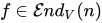
The most basic operads are the ones given in the section on "Intuition", above. For any set , we obtain the endomorphism operad consisting of all functions . These operads are important because they serve to define operad algebras. If is an operad, an operad algebra over is given by a set and an operad morphism . Intuitively, such a morphism turns each "abstract" operation of into a "concrete" -ary operation on the set . An operad algebra over thus consists of a set together with concrete operations on that follow the rules abstractely specified by the operad .

Endomorphism operad in vector spaces and operad algebras

[edit]

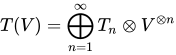
If k is a field, we can consider the category of finite-dimensional vector spaces over k; this becomes a monoidal category using the ordinary tensor product over k. We can then define endomorphism operads in this category, as follows. Let V be a finite-dimensional vector space The endomorphism operad of V consists of[11]

  1. = the space of linear maps ,
  2. (composition) given , , ..., , their composition is given by the map ,
  3. (identity) The identity element in is the identity map ,
  4. (symmetric group action) operates on by permuting the components of the tensors in .

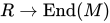
If is an operad, a k-linear operad algebra over is given by a finite-dimensional vector space V over k and an operad morphism ; this amounts to specifying concrete multilinear operations on V that behave like the operations of . (Notice the analogy between operads&operad algebras and rings&modules: a module over a ring R is given by an abelian group M together with a ring homomorphism .)

Depending on applications, variations of the above are possible: for example, in algebraic topology, instead of vector spaces and tensor products between them, one uses (reasonable) topological spaces and cartesian products between them.

"Little something" operads

[edit]
Operadic composition in the little 2-disks operad, explained in the text.

The little 2-disks operad is a topological operad where consists of ordered lists of n disjoint disks inside the unit disk of centered at the origin. The symmetric group acts on such configurations by permuting the list of little disks. The operadic composition for little disks is illustrated in the accompanying figure to the right, where an element is composed with an element to yield the element obtained by shrinking the configuration of and inserting it into the i-th disk of , for .

Analogously, one can define the little n-disks operad by considering configurations of disjoint n-balls inside the unit ball of .[12]

Originally the little n-cubes operad or the little intervals operad (initially called little n-cubes PROPs) was defined by Michael Boardman and Rainer Vogt in a similar way, in terms of configurations of disjoint axis-aligned n-dimensional hypercubes (n-dimensional intervals) inside the unit hypercube.[13] Later it was generalized by May[14] to the little convex bodies operad, and "little disks" is a case of "folklore" derived from the "little convex bodies".[15]

Rooted trees

[edit]

In graph theory, rooted trees form a natural operad. Here, is the set of all rooted trees with n leaves, where the leaves are numbered from 1 to n. The group operates on this set by permuting the leaf labels. Operadic composition is given by replacing the i-th leaf of by the root of the i-th tree , for , thus attaching the n trees to and forming a larger tree, whose root is taken to be the same as the root of and whose leaves are numbered in order.

Swiss-cheese operad

[edit]
The Swiss-cheese operad.

The Swiss-cheese operad is a two-colored[definition needed] topological operad defined in terms of configurations of disjoint n-dimensional disks inside a unit n-semidisk and n-dimensional semidisks, centered at the base of the unit semidisk and sitting inside of it. The operadic composition comes from gluing configurations of "little" disks inside the unit disk into the "little" disks in another unit semidisk and configurations of "little" disks and semidisks inside the unit semidisk into the other unit semidisk.

The Swiss-cheese operad was defined by Alexander A. Voronov.[16] It was used by Maxim Kontsevich to formulate a Swiss-cheese version of Deligne's conjecture on Hochschild cohomology.[17] Kontsevich's conjecture was proven partly by Po Hu, Igor Kriz, and Alexander A. Voronov[18] and then fully by Justin Thomas.[19]

Associative operad

[edit]

Another class of examples of operads are those capturing the structures of algebraic structures, such as associative algebras, commutative algebras and Lie algebras. Each of these can be exhibited as a finitely presented operad, in each of these three generated by binary operations.

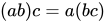
For example, the associative operad is a symmetric operad generated by a binary operation , subject only to the condition that

This condition corresponds to associativity of the binary operation ; writing multiplicatively, the above condition is . This associativity of the operation should not be confused with associativity of composition which holds in any operad; see the axiom of associativity, above.

In the associative operad, each is given by the symmetric group , on which acts by right multiplication. The composite permutes its inputs in blocks according to , and within blocks according to the appropriate .

The algebras over the associative operad are precisely the semigroups: sets together with a single binary associative operation. The k-linear algebras over the associative operad are precisely the associative k-algebras.

Terminal symmetric operad

[edit]

The terminal symmetric operad is the operad which has a single n-ary operation for each n, with each acting trivially. The algebras over this operad are the commutative semigroups; the k-linear algebras are the commutative associative k-algebras.

Operads from the braid groups

[edit]

Similarly, there is a non- operad for which each is given by the Artin braid group . Moreover, this non- operad has the structure of a braided operad, which generalizes the notion of an operad from symmetric to braid groups.

Linear algebra

[edit]

In linear algebra, real vector spaces can be considered to be algebras over the operad of all linear combinations [citation needed]. This operad is defined by for , with the obvious action of permuting components, and composition given by the concatentation of the vectors , where . The vector for instance represents the operation of forming a linear combination with coefficients 2,3,-5,0,...

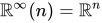
This point of view formalizes the notion that linear combinations are the most general sort of operation on a vector space – saying that a vector space is an algebra over the operad of linear combinations is precisely the statement that all possible algebraic operations in a vector space are linear combinations. The basic operations of vector addition and scalar multiplication are a generating set for the operad of all linear combinations, while the linear combinations operad canonically encodes all possible operations on a vector space.

Similarly, affine combinations, conical combinations, and convex combinations can be considered to correspond to the sub-operads where the terms of the vector sum to 1, the terms are all non-negative, or both, respectively. Graphically, these are the infinite affine hyperplane, the infinite hyper-octant, and the infinite simplex. This formalizes what is meant by being or the standard simplex being model spaces, and such observations as that every bounded convex polytope is the image of a simplex. Here suboperads correspond to more restricted operations and thus more general theories.

Commutative-ring operad and Lie operad

[edit]

The commutative-ring operad is an operad whose algebras are the commutative rings. It is defined by , with the obvious action of and operadic composition given by substituting polynomials (with renumbered variables) for variables. A similar operad can be defined whose algebras are the associative, commutative algebras over some fixed base field. The Koszul-dual of this operad is the Lie operad (whose algebras are the Lie algebras), and vice versa.

Free Operads

[edit]

Typical algebraic constructions (e.g., free algebra construction) can be extended to operads. Let denote the category whose objects are sets on which the group acts. Then there is a forgetful functor , which simply forgets the operadic composition. It is possible to construct a left adjoint to this forgetful functor (this is the usual definition of free functor). Given a collection of operations E, is the free operad on E.

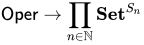
Like a group or a ring, the free construction allows to express an operad in terms of generators and relations. By a free representation of an operad , we mean writing as a quotient of a free operad where E describes generators of and the kernel of the epimorphism describes the relations.

A (symmetric) operad is called quadratic if it has a free presentation such that is the generator and the relation is contained in .[20]

Clones

[edit]

Clones are the special case of operads that are also closed under identifying arguments together ("reusing" some data). Clones can be equivalently defined as operads that are also a minion (or clonoid).

Operads in homotopy theory

[edit]

In Stasheff (2004), Stasheff writes:

Operads are particularly important and useful in categories with a good notion of "homotopy", where they play a key role in organizing hierarchies of higher homotopies.

Higher-order operad

[edit]

In algebra, a higher-order operad is a higher-dimensional generalization of an operad.[21][22]

See also

[edit]

Notes

[edit]

References

[edit]
[edit]
Revisions and contributorsEdit on WikipediaRead on Wikipedia
from Grokipedia
An operad is a mathematical structure in abstract algebra and algebraic topology that encodes a family of operations with multiple inputs and a single output, equipped with composition maps that allow these operations to be combined in a coherent, associative manner, often incorporating symmetric group actions to account for permutations of inputs.[1] Formally, in a symmetric monoidal category, an operad consists of objects C(n)C(n) for n0n \geq 0, a unit element in C(1)C(1), right actions by the symmetric group Σn\Sigma_n on each C(n)C(n), and partial composition maps γ:C(k)C(j1)C(jk)C(j1++jk)\gamma: C(k) \otimes C(j_1) \otimes \cdots \otimes C(j_k) \to C(j_1 + \cdots + j_k) satisfying associativity, unit, and equivariance axioms.[1] These structures generalize monoids and provide a framework for studying multi-ary operations beyond binary ones, facilitating the definition of algebras and modules over them.[2] Operads were introduced by J. Peter May in his 1972 work The Geometry of Iterated Loop Spaces to model the higher homotopies in based loop spaces and iterated loop spaces, building on earlier ideas from homotopy theory.[3] Independently, Jim Stasheff developed related concepts through his work on associahedra and higher homotopy associativity (A_\infty spaces), which motivated the abstraction of operads as tools for "bookkeeping" families of composable n-ary functions.[3] The term "operad" itself evokes both "operations" and "monads," reflecting their role in generating monads via endomorphism operads and enabling the study of algebraic structures up to homotopy.[2] Key examples include the endomorphism operad EndX\mathrm{End}_X, where EndX(n)\mathrm{End}_X(n) consists of maps from XnX^n to XX for a space or set XX, which acts on XX to recover familiar structures like associative algebras when restricted appropriately.[3] The little n-cubes operad EnE_n, comprising configurations of small n-dimensional cubes inside a unit cube, models EnE_n-algebras, such as strictly commutative rings for n=1n=1 or homotopy commutative spaces for higher nn.[3] Applications span homotopy theory (e.g., recognition principles for loop spaces), homological algebra (e.g., A_\infty and L_\infty structures), and mathematical physics (e.g., string field theory), where operads capture coherent systems of operations with weak associativity.[3] More broadly, operads in symmetric monoidal categories unify the study of various algebraic and topological phenomena, with extensions to \infty-operads in higher category theory.[1]

History and Motivation

Historical Development

The concept of operads emerged from efforts in algebraic topology to formalize structures on loop spaces, building on earlier work in homotopy theory. In the 1960s, Jim Stasheff introduced the notion of A_\infty-structures, which captured higher homotopy associativity in H-spaces through infinite sequences of operations satisfying generalized associativity conditions up to homotopy.[4] These structures provided precursors to operads by addressing the obstructions to strict associativity in topological settings.[5] The formal definition of operads was established by J. Peter May in 1972, motivated by the need to recognize iterated loop spaces in algebraic topology.[6] May's framework encoded the compositions of operations in loop spaces, enabling the study of their algebraic properties through a sequence of spaces with partial compositions.[7] Around the same time, in the early 1970s, J. Michael Boardman and R. M. Vogt developed symmetric operads, incorporating symmetric group actions to handle permutations of inputs in topological and algebraic structures.[8] Key publications advanced the theory significantly. May's seminal book The Geometry of Iterated Loop Spaces (1972) laid the foundational geometric and topological perspective.[6] In the 1990s, Ezra Getzler and J. D. S. Jones explored connections between operads and moduli spaces of genus 0 curves, revealing deep links to Riemann surfaces and algebraic geometry.[9] Concurrently, the theory evolved into broader algebraic and categorical contexts, with contributions from Jean-Louis Loday on cyclic and other variants, and Victor Ginzburg and Mikhail Kapranov introducing Koszul duality for operads, which provided homological tools for deformation and resolution theories.[10][11] Post-2000 developments have extended operads to more general settings, including colored operads that allow multiple types of operations and inputs, enhancing applications in categorical algebra.[12] These extensions have found use in quantum field theory, where operads model algebraic structures underlying field interactions and renormalization, with ongoing research exploring their role in conformal field theories and beyond.[13]

Intuition and Motivation

Operads provide a framework for abstracting operations that take multiple inputs and produce a single output, generalizing the notion of composition found in familiar algebraic structures such as associative algebras, where multiplication combines two elements but can be iterated to handle more.[14] This abstraction captures the essence of multi-ary operations, allowing one to specify how such operations compose in a coherent manner without specifying the underlying space or category.[15] Just as monoids generalize the binary multiplication of numbers by encoding associativity and units abstractly, operads extend this idea to operations of arbitrary arity, treating n-ary compositions as fundamental building blocks that satisfy higher-order compatibility conditions.[15] In this view, an operad acts like a "theory" for algebras, prescribing the rules for plugging outputs of smaller operations into the inputs of larger ones, much like how categories generalize monoids to multi-object settings.[15] A key motivation arose in algebraic topology, where operads were developed to encode the structure of iterated loop spaces—topological spaces whose points represent loops that can be composed in multiple ways, requiring compositions to satisfy not just ordinary associativity but higher-dimensional analogues to ensure coherence under repeated iterations.[16] Informally, these compositions can be visualized as grafting trees: each operation corresponds to a node with branches for inputs, and composing involves attaching subtrees to those branches, relabeling the leaves to track the overall arity while preserving the structure's integrity.[14] Operads prove particularly useful because they enable the transfer of algebraic structures between different mathematical contexts, such as mapping the operations on a topological space to those on its chain complex in homology, thereby facilitating computations and generalizations across categories like spaces, spectra, and modules.[15] This transferability stems from the roots in J. Peter May's foundational work on loop spaces, which highlighted operads' power in unifying disparate algebraic phenomena.[16]

Core Definitions

Non-Symmetric Operads

A non-symmetric operad, also known as a plain or non-Σ operad, is a sequence of sets $ P(n) $ for $ n \geq 0 $, where each $ P(n) $ collects the $ n $-ary operations of the structure. These operads provide a framework for encoding multi-ary operations without permuting inputs, building on the intuition of composing operations in a fixed order to model non-commutative algebraic structures.[10] The partial composition maps are defined as $ \circ_i : P(n) \times P(m) \to P(n + m - 1) $ for each $ 1 \leq i \leq n $, where the map grafts an operation from $ P(m) $ into the $ i $-th input slot of an element of $ P(n) $, yielding a single operation of total arity $ n + m - 1 $. This composition respects the ordered nature of inputs, allowing for precise control over how suboperations are inserted without requiring symmetry. The total composition can be derived as $ \gamma: P(k) \times P(j_1) \times \cdots \times P(j_k) \to P(j_1 + \cdots + j_k) $. For instance, if $ \mu \in P(2) $, $ f \in P(m_1) $, and $ g \in P(m_2) $, then the total composition $ \mu \circ (f, g) $ grafts $ f $ into the first input and $ g $ into the second of $ \mu $, resulting in an element of $ P(m_1 + m_2) $. Partial compositions are defined via $ \mu \circ_i \nu = \gamma(\mu; \mathrm{id}, \dots, \nu, \dots, \mathrm{id}) $ with $ \nu $ in the $ i $-th position.[10][14] The partial compositions satisfy a compatibility axiom, ensuring consistent grafting of inputs across multiple levels of composition. Specifically, there are two cases for associativity: sequential, where $ (\mu \circ_i \nu) \circ_j \rho = \mu \circ_i (\nu \circ_{j-i+1} \rho) $ for $ j > i $, with appropriate index adjustments, and parallel, where insertions do not overlap, such as $ \mu \circ_{i+k-1} (\nu \circ_j \rho) = (\mu \circ_i \nu) \circ_{j+m-1} \rho $ for disjoint slots. These ensure that the order of compositions does not affect the final operation. Unlike symmetric operads, no equivariance under permutations of the inputs is imposed, preserving the distinguished ordering of the inputs.[10][14] A unit element $ \mathrm{id} \in P(1) $ serves as the identity for compositions, satisfying $ \mathrm{id} \circ_1 \theta = \theta $ and $ \theta \circ_i \mathrm{id} = \theta $ for any $ \theta \in P(n) $ and $ 1 \leq i \leq n $. This unitality ensures that inserting the identity leaves operations unchanged, facilitating the modeling of algebraic identities without additional symmetry constraints.[10][14]

Symmetric Operads

Symmetric operads extend the framework of non-symmetric operads by endowing each arity component with a right action of the symmetric group $ S_n $, allowing operations to account for permutations of indistinguishable inputs. This addition provides the prevailing modern notion of an operad, widely used to encode algebraic structures like associative or commutative algebras, where the labeling of inputs is irrelevant.[10] In the category of sets, a symmetric operad $ \mathcal{P} $ is a sequence of sets $ \mathcal{P}(n) $ for $ n \geq 0 $, each with a right $ S_n $-action denoted $ \mu \cdot \sigma $ for $ \mu \in \mathcal{P}(n) $ and $ \sigma \in S_n $, a unit $ \mathrm{id} \in \mathcal{P}(1) $, and partial composition operations
i ⁣:P(n)×P(m)P(n+m1),1in, m0, \circ_i \colon \mathcal{P}(n) \times \mathcal{P}(m) \to \mathcal{P}(n + m - 1), \quad 1 \leq i \leq n, \ m \geq 0,
written $ \mu \circ_i \nu $. Equivalently, the compositions can be described via the total map
γ ⁣:P(k)P(j1)P(jk)P(j1++jk), \gamma \colon \mathcal{P}(k) \otimes \mathcal{P}(j_1) \otimes \cdots \otimes \mathcal{P}(j_k) \to \mathcal{P}(j_1 + \cdots + j_k),
for $ k \geq 0 $, $ j_r \geq 0 $, denoted $ \gamma(\mu; f_1, \dots, f_k) $ or $ \mu \circ (f_1, \dots, f_k) $.[10][1] The defining axioms are unitality, associativity, and equivariance. Unitality requires that compositions with the unit yield the original operation: $ \mathrm{id} \circ_1 \mu = \mu $ and $ \mu \circ_i \mathrm{id} = \mu $ for all suitable $ \mu $ and $ i $. In total notation, $ \mu \circ (\mathrm{id}, \dots, \mathrm{id}) = \mu $ and $ \mathrm{id} \circ (f) = f $. Associativity ensures well-defined iterated compositions via commuting diagrams, such as
(μiν)jρ=μi(νjρ) (\mu \circ_i \nu) \circ_j \rho = \mu \circ_i (\nu \circ_{j'} \rho)
with index adjustment $ j' = j - i + 1 $ if $ j > i $, or similar for total compositions.[10][17] The equivariance axiom enforces compatibility with symmetric group actions. In partial composition notation, for $ \sigma \in S_n $, $ \tau \in S_m $,
(μiν)(στ)=(μσ)σ(i)(ντ), (\mu \circ_i \nu) \cdot (\sigma \oplus \tau) = (\mu \cdot \sigma) \circ_{\sigma(i)} (\nu \cdot \tau),
where $ \sigma \oplus \tau \in S_{n+m-1} $ is the block-sum permutation acting on the combined inputs. In total composition notation, for $ \sigma \in S_k $, $ \tau_r \in S_{j_r} $,
σ(μ(f1,,fk))=μσ(fσ1(1)τσ1(1),,fσ1(k)τσ1(k))ρ, \sigma \cdot (\mu \circ (f_1, \dots, f_k)) = \mu \circ_{\sigma} (f_{\sigma^{-1}(1)} \cdot \tau_{\sigma^{-1}(1)}, \dots, f_{\sigma^{-1}(k)} \cdot \tau_{\sigma^{-1}(k)}) \cdot \rho,
where $ \circ_{\sigma} $ permutes the input slots according to $ \sigma $, and $ \rho \in S_{j_1 + \cdots + j_k} $ is the induced block permutation $ \tau_1 \oplus \cdots \oplus \tau_k $ rearranged by $ \sigma $. These relations ensure that permuting the positions or inputs of a composition corresponds to permuting the overall result.[10][17][1] The symmetry via $ S_n $-actions is motivated by applications in algebra and physics, where operations often treat inputs as unordered, such as multilinear maps in invariant theory or vertex operators in quantum field theory, enabling a more natural description of such systems compared to ordered variants.[10][15]

Operad Morphisms

A morphism between two nonsymmetric operads PP and QQ (in the category of vector spaces or sets) is a sequence of maps ϕn:P(n)Q(n)\phi_n: P(n) \to Q(n) for each n0n \geq 0, compatible with the operad structures. Specifically, these maps must preserve the partial compositions, satisfying
ϕk(μi(μ1,,μk))=ϕn(μ)i(ϕn1(μ1),,ϕnk(μk)) \phi_k \left( \mu \circ_i (\mu_1, \dots, \mu_k) \right) = \phi_n(\mu) \circ_i \left( \phi_{n_1}(\mu_1), \dots, \phi_{n_k}(\mu_k) \right)
for all μP(n)\mu \in P(n), μjP(nj)\mu_j \in P(n_j) with n=n1++nkn = n_1 + \cdots + n_k and 1in1 \leq i \leq n, and preserve the units, so ϕ1(idP)=idQ\phi_1(id_P) = id_Q.[10] For symmetric operads, a morphism ϕ:PQ\phi: P \to Q additionally requires each ϕn\phi_n to be equivariant with respect to the symmetric group actions, meaning ϕn(μσ)=ϕn(μ)σ\phi_n(\mu \cdot \sigma) = \phi_n(\mu) \cdot \sigma for all μP(n)\mu \in P(n) and σSn\sigma \in S_n. This ensures the morphism respects the permutations in the operad structure. In both cases, the collection {ϕn}\{\phi_n\} forms a strict morphism, preserving the algebraic operations exactly.[10] An isomorphism of operads is a bijective strict morphism whose inverse is also a strict morphism, establishing an equivalence of the operad structures. In the differential graded setting, weak variants such as \infty-morphisms (or homotopy morphisms) generalize this by allowing higher homotopical data, where a map is an \infty-isomorphism if it is invertible up to homotopy in the category of dg operads. These weak morphisms play a role in deformation theory and homotopy algebra. Free resolutions, such as the bar-cobar resolution ΩBPP\Omega B P \to P, appear as quasi-isomorphisms (weak morphisms inducing homology isomorphisms) in advanced homological contexts for operads.[10]

Operads in Arbitrary Categories

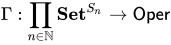
In categories equipped with finite coproducts, nonsymmetric operads generalize the set-based notion by replacing disjoint unions with categorical coproducts. Specifically, let C\mathcal{C} be a category with finite coproducts and a terminal object 11. A nonsymmetric operad P\mathcal{P} in C\mathcal{C} consists of objects P(n)C\mathcal{P}(n) \in \mathcal{C} for each n0n \geq 0, a unit morphism η:1P(1)\eta: 1 \to \mathcal{P}(1), and composition morphisms γk;n1,,nk:P(k)P(n1)P(nk)P(n1++nk)\gamma_{k; n_1, \dots, n_k}: \mathcal{P}(k) \coprod \mathcal{P}(n_1) \coprod \cdots \coprod \mathcal{P}(n_k) \to \mathcal{P}(n_1 + \cdots + n_k) for all k0k \geq 0 and ni0n_i \geq 0, satisfying associativity (compositions associate via the pentagon axiom adapted to coproducts) and unitality (inserting the unit yields identity morphisms).[10] These axioms ensure that algebras over P\mathcal{P}—objects ACA \in \mathcal{C} equipped with maps P(n)AnA\mathcal{P}(n) \coprod A^{\coprod n} \to A compatible with compositions—form a monoidal category under a suitable tensor product.[1] This setup requires C\mathcal{C} to have all finite coproducts to handle the multiple inputs in compositions, distinguishing it from the set case where coproducts are explicit disjoint unions.[10] For symmetric operads, the ambient category must be symmetric monoidal to incorporate symmetric group actions on inputs. Let (V,,I)(\mathcal{V}, \otimes, I) be a symmetric monoidal category, where \otimes is the monoidal product and II the unit. A symmetric operad P\mathcal{P} in V\mathcal{V} comprises objects P(n)V\mathcal{P}(n) \in \mathcal{V} for n0n \geq 0, right actions of the symmetric group Σn\Sigma_n on each P(n)\mathcal{P}(n) (i.e., morphisms P(n)InP(n)\mathcal{P}(n) \otimes I^{\otimes n} \to \mathcal{P}(n) permuting tensor factors compatibly), a unit η:IP(1)\eta: I \to \mathcal{P}(1), and equivariant composition morphisms γk;n1,,nk:P(k)P(n1)P(nk)P(n1++nk)\gamma_{k; n_1, \dots, n_k}: \mathcal{P}(k) \otimes \mathcal{P}(n_1) \otimes \cdots \otimes \mathcal{P}(n_k) \to \mathcal{P}(n_1 + \cdots + n_k), again satisfying associativity, unitality, and now also Σ\Sigma-equivariance (actions commute with compositions).[1] The monoidal structure \otimes must support iterated tensors for the domain of γ\gamma, often requiring V\mathcal{V} to be closed or cocomplete for practical constructions.[10] In enriched settings, such as V\mathcal{V}-enriched categories, the symmetric actions are enriched over V\mathcal{V}, meaning the Σn\Sigma_n-actions are natural transformations in the enriched sense, allowing operads to model enriched algebraic structures like enriched monoids.[10] This framework applies to diverse categories beyond sets. In the category of vector spaces over a field kk (denoted Vectk\mathbf{Vect}_k), equipped with the tensor product k\otimes_k as the monoidal structure, operads P\mathcal{P} have components P(n)\mathcal{P}(n) as kk-vector spaces and compositions as kk-linear maps, enabling the study of linear algebraic varieties like associative or Lie algebras via their endomorphism operads.[1] Similarly, in the category of abelian groups Ab\mathbf{Ab}, using the direct sum \oplus (which serves as both product and coproduct) as the monoidal operation, operads capture additive structures such as modules over rings.[10] For topological spaces Top\mathbf{Top}, operads can use the cartesian product (for nonsymmetric cases) or disjoint union (coproducts) as the monoidal structure, though pointed variants often employ the smash product to model homotopy-invariant operations like those in loop spaces.[10] In enriched categories over a symmetric monoidal V\mathcal{V}, adjustments for symmetric actions involve defining Σn\Sigma_n-representations enriched in V\mathcal{V}, ensuring compositions respect the enrichment (e.g., via enriched naturality).[10] This is crucial for applications in homotopy theory or higher categories, where V\mathcal{V} might be simplicial sets. Operads in arbitrary categories relate to the broader framework of PROPs (products and permutations categories), which generalize operads by allowing operations with arbitrary output arities (natural numbers as objects) and all permutations as morphisms, thus encompassing multilinear algebraic theories beyond single-output operations.[10]

Axioms and Properties

Associativity Axiom

The associativity axiom in an operad governs the compatibility of partial compositions, ensuring that the order in which operations are composed does not affect the final result. For a symmetric operad PP, consider elements λP()\lambda \in P(\ell), μP(m)\mu \in P(m), and νP(n)\nu \in P(n). The axiom consists of two conditions: the nested case, given by
(λiμ)i+j1ν=λi(μjν) (\lambda \circ_i \mu) \circ_{i+j-1} \nu = \lambda \circ_i (\mu \circ_j \nu)
for 1i1 \leq i \leq \ell and 1jm1 \leq j \leq m, and the disjoint case,
(λiμ)k+m1ν=(λkν)iμ (\lambda \circ_i \mu) \circ_{k+m-1} \nu = (\lambda \circ_k \nu) \circ_i \mu
for 1i<k1 \leq i < k \leq \ell, where r\circ_r denotes partial composition in the rr-th input position. Here, kk in the nested case adjusts to i+j1i+j-1 to account for the shift in input positions after the inner composition μjν\mu \circ_j \nu. In tree interpretations, operad elements correspond to rooted trees with operations at vertices and inputs at leaves; partial composition αrβ\alpha \circ_r \beta grafts the root of the tree for β\beta onto the rr-th leaf of the tree for α\alpha. The associativity axiom ensures that double compositions, whether nesting ν\nu into μ\mu first and then into λ\lambda, or grafting ν\nu directly into the adjusted position of λ\lambda after composing μ\mu and λ\lambda, yield isomorphic trees with the same structure and labeling.[18] This condition holds because it enforces consistent grafting rules on the planar trees underlying operad compositions, preventing discrepancies in how subtrees are attached regardless of the sequencing of operations. As a consequence, the axiom allows for the unambiguous definition of infinite iterated compositions, such as in the construction of infinite loop spaces or homotopy algebras, by guaranteeing that any finite approximation converges independently of parenthesization.

Unitality Axiom

The unitality axiom in the definition of an operad PP posits the existence of an identity element idP(1)\mathrm{id} \in P(1), which serves as a unary operation acting as the identity with respect to the partial composition operations. Specifically, for any fP(n)f \in P(n), the right unit conditions require fiid=ff \circ_i \mathrm{id} = f for 1in1 \leq i \leq n, meaning that inserting the identity into the ii-th input slot of ff yields ff itself, while the left unit condition requires id1f=f\mathrm{id} \circ_1 f = f, ensuring that composing ff with the identity as the outer operation also recovers ff. These conditions ensure that the identity behaves neutrally under operadic composition, preserving the structure of operations without alteration.[19] The arity-zero component P(0)P(0) plays a complementary role in unital operads, consisting of constant (nullary) operations that produce outputs without inputs. In unital operads, P(0)P(0) often consists of nullary operations, and the partial composition fiηf \circ_i \eta for ηP(0)\eta \in P(0) and fP(n)f \in P(n) is defined, yielding an element of P(n1)P(n-1) that effectively replaces the ii-th input of ff with the constant provided by η\eta. This allows constants to be incorporated into higher-arity operations, reducing arity accordingly. In the context of unital operads over a field kk, P(0)P(0) is often isomorphic to kk, providing a single constant generator that interacts compatibly with the identity in P(1)P(1). This setup allows constants to propagate through compositions while maintaining coherence with the unit.[20] The unitality axiom is essential for defining algebras over an operad, as it induces a unit element in the algebra. Given a unital operad PP and a PP-algebra structure on a vector space VV, the action of idP(1)\mathrm{id} \in P(1) provides a map VVV \to V that is the identity morphism, while elements of P(0)P(0) yield constant maps from the base field to VV, ensuring the algebra possesses a distinguished unit compatible with all operations. For instance, in the unital associative operad, this guarantees that algebras are unital associative algebras with a multiplicative identity satisfying μ(1V,v)=v=μ(v,1V)\mu(1_V, v) = v = \mu(v, 1_V) for the binary multiplication μ\mu and all vVv \in V. Without unitality, algebras lack this canonical unit, modeling structures like non-unital associative algebras where no such identity exists. Variations in non-unital operads drop the requirement for idP(1)\mathrm{id} \in P(1), allowing extensions to broader classes of algebraic structures but requiring additional axioms for coherence in compositions.[19][20]

Equivariance Axiom

For symmetric operads, the equivariance axiom ensures that the partial compositions are compatible with the right actions of the symmetric groups Σn\Sigma_n on each P(n)P(n). Specifically, for μP(m)\mu \in P(m), λP(n)\lambda \in P(n), σΣm\sigma \in \Sigma_m, τΣn\tau \in \Sigma_n, and 1im1 \leq i \leq m, the axiom states:
(μσ)i(λτ)=(μσ(i)λ)(\idmiτ), (\mu \cdot \sigma) \circ_i (\lambda \cdot \tau) = (\mu \circ_{\sigma(i)} \lambda) \cdot (\id_m \circ_i \tau),
wait, more precisely, the induced permutation on the total inputs is the shuffle permutation corresponding to plugging τ\tau into the i-th position permuted by σ\sigma. Equivalently, the full composition γ\gamma satisfies γ(μσ;λ1τ1,,λkτk)=γ(μ;λ1,,λk)(σ\shuffle(τ1,,τk))\gamma(\mu \cdot \sigma; \lambda_1 \cdot \tau_1, \dots, \lambda_k \cdot \tau_k) = \gamma(\mu; \lambda_1, \dots, \lambda_k) \cdot (\sigma \shuffle (\tau_1, \dots, \tau_k)), where \shuffle\shuffle denotes the induced block permutation. In tree interpretations, the symmetric group actions permute the leaves of the trees, and equivariance ensures that permuting inputs before or after grafting yields the same result up to relabeling. This axiom accounts for the indistinguishability of inputs under permutation, essential for modeling symmetric multi-ary operations.[19]

Fundamental Examples

Endomorphism Operads

The endomorphism operad associated to a set XX, denoted \EndX\End_X, has components \End_X(n) = \Hom_{\Set}(X^n, X) for each n0n \geq 0, where X0X^0 is a singleton and elements of \EndX(n)\End_X(n) are all functions from the nn-fold Cartesian product XnX^n to XX.[10] The symmetric group SnS_n acts on \EndX(n)\End_X(n) by permuting the inputs: for σSn\sigma \in S_n and f\EndX(n)f \in \End_X(n), (fσ)(x1,,xn)=f(xσ1(1),,xσ1(n))(f \cdot \sigma)(x_1, \dots, x_n) = f(x_{\sigma^{-1}(1)}, \dots, x_{\sigma^{-1}(n)}).[10] The unit is the identity map in \EndX(1)\End_X(1).[10] The operadic composition in \EndX\End_X is defined by substitution of functions on partitioned inputs: for f\EndX(k)f \in \End_X(k), gi\EndX(ni)g_i \in \End_X(n_i) with i=1,,ki = 1, \dots, k, and total arity m=n1++nkm = n_1 + \cdots + n_k, the composite γ(f;g1,,gk)\EndX(m)\gamma(f; g_1, \dots, g_k) \in \End_X(m) is given by
γ(f;g1,,gk)(x1,,xm)=f(g1(x1,,xn1),,gk(xn1++nk1+1,,xm)), \gamma(f; g_1, \dots, g_k)(x_1, \dots, x_m) = f\bigl( g_1(x_1, \dots, x_{n_1}), \dots, g_k(x_{n_1 + \cdots + n_{k-1} + 1}, \dots, x_m) \bigr),
where the inputs are partitioned into consecutive blocks of sizes n1,,nkn_1, \dots, n_k.[10] This composition is associative, unital, and equivariant with respect to the SnS_n-actions, making \EndX\End_X a symmetric operad in the category of sets.[10] In the category of vector spaces over a field kk, the endomorphism operad \EndV\End_V associated to a vector space VV is defined analogously by \EndV(n)=\Homk(Vn,V)\End_V(n) = \Hom_k(V^{\otimes n}, V) for n0n \geq 0, where V0=kV^{\otimes 0} = k and elements are kk-linear maps (multilinear in the inputs).[10] The SnS_n-action is induced by permuting the tensor factors: (fσ)(v1vn)=f(vσ1(1)vσ1(n))(f \cdot \sigma)(v_1 \otimes \cdots \otimes v_n) = f(v_{\sigma^{-1}(1)} \otimes \cdots \otimes v_{\sigma^{-1}(n)}).[10] The composition follows the same substitution pattern as in sets, but using tensor products:
γ(f;g1,,gk)(v1vm)=f(g1(v1vn1)gk(vn1++nk1+1vm)), \gamma(f; g_1, \dots, g_k)(v_1 \otimes \cdots \otimes v_m) = f\bigl( g_1(v_1 \otimes \cdots \otimes v_{n_1}) \otimes \cdots \otimes g_k(v_{n_1 + \cdots + n_{k-1} + 1} \otimes \cdots \otimes v_m) \bigr),
with f\EndV(k)f \in \End_V(k), gi\EndV(ni)g_i \in \End_V(n_i), and m=n1++nkm = n_1 + \cdots + n_k; this yields a symmetric operad structure.[10] An algebra over an operad PP (a PP-algebra) on a vector space VV is realized by a morphism of symmetric operads ϕ:P\EndV\phi: P \to \End_V, which equips VV with compatible nn-ary operations ϕn(μ):VnV\phi_n(\mu): V^{\otimes n} \to V for each generator μP(n)\mu \in P(n).[10] In this framework, when PP is the associative operad, the action via \EndV\End_V generates the structure of an associative algebra on VV, consisting of a bilinear multiplication that is associative and unital.[10]

Little Operads

Little operads, also known as "little something" operads, are topological operads that encode homotopy coherent algebraic structures through geometric configurations of embeddings.[21] These operads provide models for recognizing certain types of loop spaces by approximating the geometric operations in iterated loop constructions.[21] The paradigmatic example is the little nn-disks operad, often denoted EnE_n or CnC_n, where the space En(k)E_n(k) consists of configurations of kk pairwise disjoint open nn-disks embedded into the interior of the unit nn-disk DnD^n via affine maps that send the boundary of each small disk to the boundary of DnD^n.[21] These embeddings are parametrized by translations and positive scalings in each coordinate direction, ensuring the images are disjoint and contained in the open unit disk; equivalently, one may use little nn-cubes embedded linearly into the unit cube In=[0,1]nI^n = [0,1]^n with parallel axes.[21] The operad composition is induced by composing these embeddings: given a configuration in En(k)E_n(k) and configurations in En(ji)E_n(j_i) for i=1,,ki=1,\dots,k, one embeds the jij_i small disks into each of the kk disks of the first configuration, yielding a new configuration in En(ji)E_n(\sum j_i).[21] This structure satisfies the operad axioms, with the symmetric group Σk\Sigma_k acting freely on En(k)E_n(k) by permuting the kk small disks, making EnE_n a symmetric operad.[21] A non-symmetric variant of the little nn-disks operad omits the Σk\Sigma_k-action, resulting in a non-symmetric operad that encodes operations without inherent permutability.[21] For n=1n=1, the little 1-disks (or intervals) operad E1E_1 models associative operations up to homotopy, with E1(k)E_1(k) parametrizing kk disjoint open intervals embedded affinely into (0,1)(0,1).[21] For n=2n=2, the little 2-disks (or squares) operad E2E_2 captures structures that are commutative up to homotopy, where E2(k)E_2(k) involves configurations of kk small disks or squares in the unit disk or square.[21] These little operads relate to delooping via the recognition principle, which asserts that a topological space equipped with a free action of the little nn-disks operad EnE_n is weakly homotopy equivalent to an nn-fold loop space.[21] This principle facilitates the identification of nn-fold deloopings in homotopy theory by verifying EnE_n-algebra structures.[21] In analogy to endomorphism operads, little operads emphasize geometric embeddings to model homotopy coherence rather than strict algebraic maps.[21]

Tree-Based Operads

Tree-based operads provide a combinatorial framework for encoding algebraic operations through the structure of rooted trees, where each operation corresponds to a tree and compositions are realized graphically via grafting. In this construction, the components of the operad in arity nn, denoted P(n)P(n), are formal linear combinations or sets of rooted trees possessing exactly nn leaves, with the arity determined solely by the number of leaves.[10] This graphical representation facilitates an intuitive understanding of operadic compositions, as grafting subtrees onto the leaves of a primary tree mirrors the substitution of operations within an algebra.[22] The non-symmetric version of the tree operad employs ordered or planar rooted trees, where the children of each internal vertex are arranged in a fixed sequence, reflecting the sequential nature of inputs without permutations. Here, the composition operation γ:P(k)×P(n1)××P(nk)P(n1++nk)\gamma: P(k) \times P(n_1) \times \cdots \times P(n_k) \to P(n_1 + \cdots + n_k) is defined by grafting the roots of the kk input trees onto distinct leaves of the primary tree in P(k)P(k), preserving the planar embedding. The unit element resides in P(1)P(1) as the trivial tree consisting of a single edge connecting the root to a single leaf.[10] In contrast, the symmetric tree operad incorporates the action of the symmetric group SnS_n on the leaves of each tree in P(n)P(n), allowing for reordering of inputs; the underlying trees are non-planar rooted trees, and compositions via grafting are equivariant under this group action to ensure compatibility with symmetries.[10] These tree-based operads bear a configurational similarity to little operads, such as the little disks operads, in their use of tree-like embeddings to model compositions, though the former rely on discrete combinatorial structures rather than continuous topological ones. Furthermore, tree-based operads are intimately connected to free operads, as the latter can be realized explicitly using trees as basis elements to generate all possible compositions from a given collection of generators.[10]

Associative Operad

The associative operad, denoted Ass\mathrm{Ass}, is a nonsymmetric operad that encodes structures of associative algebras in a symmetric monoidal category, such as vector spaces over a field. It provides a universal framework for defining associative multiplications of arbitrary arity, where the operations satisfy generalized associativity conditions derived from tree compositions.[10] The components of Ass\mathrm{Ass} are defined as one-dimensional vector spaces for n1n \geq 1, spanned by a single generator μn\mu_n representing the fully associative nn-ary multiplication, while Ass(0)\mathrm{Ass}(0) is the zero space. The symmetric group actions are absent in this nonsymmetric setting, distinguishing it from symmetric variants. The partial compositions are given by μkiμl=μk+l1\mu_k \circ_i \mu_l = \mu_{k+l-1} for 1ik1 \leq i \leq k, which uniquely determines the grafting of operations and corresponds to the unique way to associate inputs along any planar tree structure. This composition rule ensures that all possible associations of inputs yield the same result, reflecting the core property of associativity without additional relations.[10][23] An algebra over Ass\mathrm{Ass} in a category like vector spaces consists of an object AA equipped with maps μn:AnA\mu_n: A^{\otimes n} \to A for n1n \geq 1, satisfying the operad's composition relations, which enforce that higher-arity operations are compatible with iterated binary multiplications. These algebras are precisely the associative algebras, where the binary operation μ2\mu_2 satisfies (ab)c=a(bc)(a \cdot b) \cdot c = a \cdot (b \cdot c), and higher μn\mu_n extend it associatively. For unital versions, one adjoins a unit in arity 1, but the core Ass\mathrm{Ass} focuses on nonunital structures.[10][14] The operad Ass\mathrm{Ass} arises as a quotient of the endomorphism operad EndV\mathrm{End}_V for a vector space VV, where the higher relations imposed by associativity collapse the free structure to a single generator per arity, eliminating independent higher operations beyond those dictated by binary compositions. This quotient captures the essential algebraic data of associativity without the full generality of endomorphisms.[10]

Commutative and Lie Operads

The commutative operad, denoted Com, is a fundamental example of a symmetric operad that encodes the structure of commutative associative algebras. It is defined such that Com(n) is the one-dimensional vector space over the base field K for each n ≥ 1, generated by a single element representing the n-ary commutative multiplication, with the symmetric group S_n acting trivially on Com(n). This trivial action reflects the full symmetry of the operations, where permutations of inputs do not alter the result, and compositions are defined via the unique maps induced by the unit isomorphisms in the symmetric monoidal category. Algebras over Com are precisely commutative monoids (or commutative associative algebras when unital), where a structure map μ: A ⊗ A → A satisfies μ(x ⊗ y) = μ(y ⊗ x) and the associativity condition, generalizing to higher arities through the operad composition.[10] In contrast, the Lie operad, denoted Lie, captures the axioms of Lie algebras through a quadratic presentation. It is generated by a single binary operation, the Lie bracket [−, −]: Lie(2) → K⟨[x₁, x₂]⟩, which is antisymmetric under the sign representation of S₂, and higher arity components Lie(n) are obtained by composing this generator while quotienting by the ideal of relations. Specifically, Lie(n) is the (n−1)!-dimensional S_n-module consisting of the multilinear Lie polynomials in n variables, spanned by fully bracketed expressions like nested brackets on {x₁, ..., x_n}, with S_n acting by permuting the variables and incorporating signs from antisymmetry. The defining relations are antisymmetry, [x, y] + [y, x] = 0, and the Jacobi identity, [[x, y], z] + [[y, z], x] + [[z, x], y] = 0, which ensure that all compositions satisfy these identities in every arity. Algebras over Lie are Lie algebras, vector spaces equipped with a bilinear skew-symmetric bracket obeying the Jacobi identity, such as the tangent space of a Lie group at the identity.[10] These operads build on the associative operad by incorporating additional symmetry or antisymmetry constraints, respectively, to model more specific algebraic structures. Notably, Com and Lie are Koszul dual to each other, with the Koszul dual of Com being Lie and vice versa, highlighting their complementary roles in operad theory.[10]

Advanced Constructions

Free Operads

In operad theory, the free operad generated by a collection $ S = {S(n)}_{n \geq 0} $ of sets, denoted Free(S)\mathrm{Free}(S), is the symmetric operad whose components consist of all possible abstract compositions of elements from $ S $, subject only to the axioms of symmetric operads (associativity, unitality, and equivariance under symmetric group actions), with no additional relations imposed.[10] This construction embeds $ S $ into Free(S)\mathrm{Free}(S) via inclusion maps $ i_n: S(n) \to \mathrm{Free}(S)(n) $, making Free(S)\mathrm{Free}(S) the "freest" such operad.[17] The explicit construction of Free(S)\mathrm{Free}(S) proceeds via decorated trees: its underlying S\mathbb{S}-module is spanned by isomorphism classes of rooted trees whose internal vertices are labeled by elements of $ S $, with leaves corresponding to inputs and the root to the output, where the arity of a tree is the number of leaves.[10] Composition in Free(S)\mathrm{Free}(S) is defined by grafting such trees at designated input edges, followed by symmetrization under the action of the symmetric group Σn\Sigma_n on the $ n $-ary component. This tree-based presentation ensures that every element arises from finite iterated substitutions of generators from $ S $, modulo the operadic axioms.[17] The free operad Free(S)\mathrm{Free}(S) satisfies a universal property: for any symmetric operad $ P $ and any family of maps $ f_n: S(n) \to P(n) $ compatible with the inclusions, there exists a unique operad morphism $ \tilde{f}: \mathrm{Free}(S) \to P $ such that $ \tilde{f} \circ i_n = f_n $ for all $ n $.[10] This characterizes Free(S)\mathrm{Free}(S) as the initial object in the category of symmetric operads equipped with maps from $ S $, allowing it to serve as a universal envelope for generating collections.[17] In the graded setting, where $ S $ is a graded S\mathbb{S}-module with components $ S(n)_d $ in degree $ d $, the free operad Free(S)\mathrm{Free}(S) inherits a bigrading by arity $ n $ and total degree $ k $ (e.g., sum of labels' degrees). The dimension of the (n,k)(n,k)-component is the number of rooted trees with $ n $ leaves, internal vertices labeled by homogeneous generators from $ S $ totaling degree $ k $, divided by the order of the stabilizer under Σn\Sigma_n-actions on the leaves.[10]

Clones

In universal algebra, a clone on a fixed set AA is defined as a subset of the class of all finitary operations on AA—that is, functions from finite powers AnA^n to AA for n0n \geq 0—such that it contains all projection operations πi,n:AnA\pi_{i,n}: A^n \to A (where πi,n(x1,,xn)=xi\pi_{i,n}(x_1, \dots, x_n) = x_i for 1in1 \leq i \leq n) and is closed under composition of operations.[24] Composition in a clone is defined by substituting operations into the inputs of another: for an mm-ary operation f:AmAf: A^m \to A and mm njn_j-ary operations gj:AnjAg_j: A^{n_j} \to A (j=1,,mj = 1, \dots, m), the composite is the $ (n_1 + \dots + n_m) $-ary operation f(g1,,gm):An1++nmAf(g_1, \dots, g_m): A^{n_1 + \dots + n_m} \to A.[25] Non-symmetric operads embed into the category of clones via a forgetful functor that associates to each operad its underlying clone generated by the operad's operations under the permitted compositions, thereby viewing operadic structures as special presentations of clone-closed systems.[26] This embedding highlights clones as a broader framework for studying composition-closed operation sets, where the operad's partial and total composition maps induce the clone's closure property. A representative example is the full clone on AA, which comprises all possible finitary functions AnAA^n \to A for every n0n \geq 0; this is closed under composition by function composition and includes all projections as the basic unary and higher-ary selectors.[24] In contrast, a polynomial clone arises in the context of algebras over rings: for a commutative ring RR with identity, the polynomial clone on RR consists of all functions RnRR^n \to R expressible as polynomial maps with coefficients in RR, generated from projections, constants, and addition/multiplication, and closed under substitution.[27] Clones differ from non-symmetric operads in that they impose no restrictions on the arities beyond finiteness and lack the associative or unital axioms that define operadic algebras, focusing instead solely on closure under arbitrary compositions while mandating the inclusion of all projections to ensure variable access without additional structure.[26] This makes clones a parallel but more permissive construct for abstracting algebraic operations in single-sorted settings.

Higher-Order Operads

Higher-order operads, also known as operads of operads, generalize the concept of an operad by constructing them within the category of operads themselves. Formally, given a category E\mathcal{E} equipped with a cartesian monad TT, a TT-operad consists of a TT-graph C:ET1C: \mathcal{E} \to T \mathbf{1} (where 1\mathbf{1} is the terminal object) together with a composition map CCCC \circ C \to C in the category Span(E,T)\mathrm{Span}(\mathcal{E}, T), satisfying associativity and unit axioms analogous to those of standard operads.[28] Here, the objects C(n)C(n) for n0n \geq 0 are themselves operads in E\mathcal{E}, and the composition combines these operads via the monad structure, allowing operations to act on operations in a hierarchical manner. This structure captures iterated abstractions where the arity in one level corresponds to operads at the next level.[28] In more explicit terms, within an iterated monoidal category VV that is kk-fold monoidal, an nn-fold operad C\mathcal{C} comprises objects C(j)\mathcal{C}(j) for j0j \geq 0, a unit map J:IC(1)J: I \to \mathcal{C}(1), and composition maps γp,q:C(k)p(C(j1)qqC(jk))C(j)\gamma_{p,q}: \mathcal{C}(k) \otimes_p (\mathcal{C}(j_1) \otimes_q \cdots \otimes_q \mathcal{C}(j_k)) \to \mathcal{C}(j) for appropriate indices, where p\otimes_p and q\otimes_q are the monoidal products at levels pp and qq, and these satisfy associativity and unit laws using interchange transformations ηp,q\eta_{p,q}.[29] Each C(j)\mathcal{C}(j) inherits the operad structure from the ambient category, enabling the modeling of multi-sorted operations on algebraic structures.[29] A canonical example is the operad of endomorphism operads. For an object XX in a symmetric monoidal category E\mathcal{E}, the endomorphism operad End(X)\mathrm{End}(X) has End(X)(n)=E(Xn,X)\mathrm{End}(X)(n) = \mathcal{E}(X^{\otimes n}, X); extending this, the higher-order version EndO(X)\mathrm{End}^{\mathcal{O}}(X) acts on operads over XX, where (EndO(X))(n)(\mathrm{End}^{\mathcal{O}}(X))(n) consists of natural transformations between endomorphism operads, composing via substitution of operations.[28] This example illustrates how higher-order operads parametrize families of operads, such as those arising from algebras over a base operad.[28] Higher-order operads find applications in modeling operations on operations, particularly in higher category theory, where they provide a framework for defining nn-categories as algebras over such structures.[29] For instance, they facilitate the construction of weak higher categories by encoding pasting diagrams and coherence conditions through operadic composition.[28] This iterated abstraction supports the study of meta-theories in algebra and topology.[29] These structures relate to polycategories, as higher-order operads can be viewed as special cases of polycategories with multiple output arities, where the operadic composition corresponds to poly-morphisms in a higher-dimensional setting; similarly, they connect to higher PROPs by generalizing the symmetric monoidal framework to allow for operad-valued operations.[28]

Applications in Homotopy Theory

Operads in Topology

In the category of topological spaces, an operad is a topological operad if all structure maps, including the compositions γ:P(n)×P(k1)××P(kn)P(k1++kn)\gamma: \mathcal{P}(n) \times \mathcal{P}(k_1) \times \cdots \times \mathcal{P}(k_n) \to \mathcal{P}(k_1 + \cdots + k_n), are continuous functions.[21] This ensures that algebras over such operads inherit topological structures compatible with their operations, facilitating the study of homotopy-invariant algebraic structures on spaces.[21] A prototypical example is the little nn-disks operad En\mathcal{E}_n, where each En(k)\mathcal{E}_n(k) consists of the space of configurations of kk disjoint open nn-disks (of any radii less than 1) embedded into the unit nn-disk DnD^n, parameterized by translations and scalings without overlap.[21] Compositions are defined by embedding one configuration of disks into another via affine maps, preserving the topological category structure and enabling the modeling of nn-fold loop space operations.[21] The Boardman-Vogt resolution, or WW-construction, provides a cofibrant replacement for topological operads by replacing abstract operations with labeled trees whose edges carry lengths in the interval [0,1][0,1], inducing a weak equivalence W(P)PW(\mathcal{P}) \simeq \mathcal{P} in the model category of topological spaces.[30] This resolution incorporates explicit homotopy data, allowing the transfer of algebraic structures across weak equivalences while preserving the operad's homotopy type, and it plays a key role in delooping constructions for infinite loop spaces.[30] May's recognition theorem asserts that a topological space XX is weakly equivalent to an nn-fold loop space ΩnY\Omega^n Y for some connected YY if and only if XX admits the structure of a grouplike algebra over the little nn-disks operad En\mathcal{E}_n, up to weak equivalence.[21] More precisely, grouplike En\mathcal{E}_n-algebras classify nn-fold deloopings, with the monoid structure on π0(X)\pi_0(X) ensuring connectivity and the operad action encoding higher homotopies.[21] This equivalence extends to E\mathcal{E}_\infty-operads for infinite loop spaces, providing a topological criterion for deloopability without relying on explicit fibrations.[21] To bridge simplicial and topological settings, the fat realization functor :sTopTop|-| : \mathbf{sTop} \to \mathbf{Top} applies to simplicial operads by taking the fat geometric realization of each component space, which preserves finite limits up to homotopy and converts levelwise weak equivalences of simplicial operads into weak equivalences of the resulting topological operads. Unlike the thin realization, the fat version disregards degeneracies to ensure compatibility with monoidal structures and homotopy colimits, making it suitable for realizing combinatorial operad models in topology.[20]

Koszul Duality for Operads

Koszul duality provides a powerful framework for studying resolutions and homological properties of operads, particularly those that are quadratic. A quadratic operad PP over a field kk of characteristic zero is presented by a symmetric collection EE of generators and a collection RT(E)(2)R \subseteq T(E)(2) of quadratic relations, where T(E)T(E) denotes the free operad on EE. The Koszul dual operad P!P^! is then defined as the quadratic operad generated by the sign-shifted dual sEsE^\vee with relations orthogonal to RR, formally P!=T(sE)/(R)P^! = T(sE^\vee)/(R^\perp). This duality extends the classical Koszul duality for associative algebras to the operadic setting, enabling the construction of minimal free resolutions for PP-algebras.[12][10] Central to this theory is the bar-cobar construction, which yields free resolutions for Koszul operads. The bar construction B(P)B(P) on a dg operad PP produces a dg cooperad, while the cobar construction Ω(C)\Omega(C) on a conilpotent dg cooperad CC yields a dg operad, with these functors being adjoint. For a quadratic operad PP, the Koszul complex is formed via the twisted composite K(P)=P!κPK(P) = P^! \circ_\kappa P, where κ:P!B(P)\kappa: P^! \to B(P) is the canonical twisting morphism encoding the quadratic relations. An operad PP is Koszul if this complex is acyclic, meaning H(K(P))PH(K(P)) \cong P as cooperads, providing a minimal free resolution Ω(B(P))P\Omega(B(P)) \simeq P that is quasi-isomorphic to PP itself. This resolution is particularly effective for computing homology and cohomology of PP-algebras.[12][10] The duality manifests through a pairing between the operad PP and the cobar construction on its dual. Specifically, there is a natural bilinear pairing ,:PΩ(P!)k\langle -, - \rangle: P \otimes \Omega(P^!) \to k induced by the duality between generators and relations, which is non-degenerate when PP is Koszul. This pairing underlies the homological algebra, allowing the identification of Ext and Tor groups in the category of PP-algebras via the Koszul resolution. For quadratic relations, the pairing respects the operadic composition, ensuring that the cohomology of the Koszul complex captures the minimal model of PP.[12][10] Prominent examples illustrate the theory's scope. The associative operad Ass\mathrm{Ass}, governing associative algebras, is quadratic with generators in arity 2 and the associativity relation; it is self-dual (Ass!Ass\mathrm{Ass}^! \simeq \mathrm{Ass}) and Koszul, yielding a trivial resolution via its bar-cobar construction. The commutative operad Com\mathrm{Com}, for commutative algebras, has Com!Lie\mathrm{Com}^! \simeq \mathrm{Lie} (up to suspension), and both are Koszul, with the duality pairing the symmetric relations of Com\mathrm{Com} against the antisymmetric Jacobi and Leibniz relations of Lie\mathrm{Lie}. Similarly, the Lie operad is Koszul, dual to Com\mathrm{Com}, facilitating explicit computations of their homologies. These cases confirm the acyclicity of the Koszul complexes through confluence criteria on monomial relations.[10][31] Applications of Koszul duality extend to deformation theory and rational homotopy theory. In deformation theory, the Koszul resolution provides a dg Lie algebra model for the deformations of a PP-algebra, where Maurer-Cartan elements in the resolution encode infinitesimal deformations, and the cobar construction resolves obstruction spaces via higher homotopy. For instance, for Koszul operads like Lie\mathrm{Lie}, this yields explicit control over quantizations and moduli spaces. In rational homotopy theory, Koszul duality links minimal models of simply connected spaces to Com\mathrm{Com}- and Lie\mathrm{Lie}-algebra structures, with the bar-cobar resolution producing Sullivan or Quillen models that compute rational homotopy groups through operadic cohomology. This algebraic framework underpins the equivalence between rational homotopy categories and formal moduli problems.[10][12]

References

User Avatar
No comments yet.