


Community hub
Recent from talks
Contribute something
Nothing was collected or created yet.
Battle of Bajaur
View on Wikipedia
| Battle of Bajaur (Operation Sherdil) | |||||||
|---|---|---|---|---|---|---|---|
| Part of the Insurgency in Khyber Pakhtunkhwa | |||||||
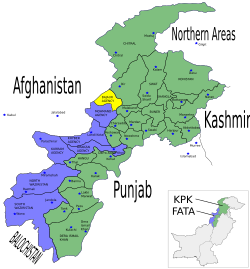
 Bajaur is the yellow colored region | |||||||
| |||||||
| Belligerents | |||||||
 Pakistan Pakistan |
 TTP TTP Al-Qaeda Al-Qaeda TNSM TNSM | ||||||
| Commanders and leaders | |||||||
 MG Tariq Khan[1] B.Gen. Abid Mumtaz[1] B.Gen. Zafar ul haq Col Nauman Saeed MG Tariq Khan[1] B.Gen. Abid Mumtaz[1] B.Gen. Zafar ul haq Col Nauman Saeed |
Faqir Mohammed Abu Saeed Al-Masri | ||||||
| Units involved | |||||||
|
TTP Al-Qaeda TNSM | |||||||
| Strength | |||||||
| 9,000–15,000[1] | ~4,000[1] | ||||||
| Casualties and losses | |||||||
|
30 killed and 4 wounded (Pakistan army) |
1,500 killed and 2,000 wounded (Militants) | ||||||


The Battle of Bajaur (English: Operation Lion Heart), also known as Operation Sherdil, was a military campaign in the Bajaur region of Pakistan. It was conducted on 7 August 2008 by the Frontier Corps and Infantry Brigade of Pakistan army. The operation was primarily launched to end the political movement of the Tehrik-e-Taliban Pakistan. Bajaur area was administered by Tehrik-e-Taliban Pakistan until 2007, and it remained Al-Qaeda's central command and control for carrying out activities in Northeast Afghanistan and Kunar province.[2][3] Recent reports indicate that ongoing conflict has newly displaced an estimate of 7,000 people between 3 and 4 March in Nurgal district.[4]
Ambush in Bajaur
[edit]During the early days of August in 2008, a check-post was established by the Frontier Corps to seize control of the Afghan-Pakistan border crossing over Tehrik-e-Taliban. Check-post was constructed near the town of Loyesam which is 12 km away from Khaar.[5][6] Loyesam (or Loisam) is a strategic position that controls passage into Afghanistan's Kunar province. The militant attacks caused heavy casualties to the Pakistani army. Eventually, the army was relocated to Khar town.[2][7][8]
Background
[edit]Several days later, the Frontier Corps began a large-scale offensive under the command of Major-General Tariq Khan, codenamed Operation Sherdil (Lion heart), intending to regain control of Bajaur from the Taliban.[9] About 8,000 troops belonging to the FC and Army, backed by Cobra attack helicopters and fighter jets were deployed that attacked Taliban hideouts. To support the Army, the Pakistan Air Force responded with aggressive air campaign. Pakistani military sources revealed that the army was surprised by the resistance of the insurgents. Taliban used advanced tactics to fight prepared defense system.[10]
By the end of the year, the Army claimed that it had killed more than 1,000 militants, including the foreign commander of Al Qaeda, an Egyptian called Abu Saeed Al-Masri.[11] The Army suffered 20 casualties.[12] The military encouraged local tribes to rebel against the Taliban by raising the lashkars (tribal militias) to fight alongside the government forces. The Salarzai tribe reportedly counted 4,000 armed fighters, responded favorably to this initiative.[1] On 7 October, the Salarzai elders announced that they had cleared their tribal territory of militants, and requested the deployment of government troops to consolidate the gains they had made.[13]
According to several sources, the Islamabad Marriott Hotel bombing might have occurred in retaliation for the military offensive in Bajaur.[10]
On 8 October, during a briefing to the Parliament, the military announced that the operation killed 2,744 militants, including 321 foreigners, and caused 1,400 casualties to the militants.[14] On 25 October, the Pakistan forces reportedly recaptured Taliban militants in Loi Sam village.[15] About 500 militants were reportedly killed in the Bajaur area on 25 October.[16] By the end of 2008, security forces were stationed at Torghudai, Nawagai, Utmankhel, and Salarzai. By mid-2009, the security forces controlled the bulk of the Mamund and Chahrmang valleys as well. The last operation was launched in February 2010 with fresh reinforcements to mop up the last pockets of militants, including the notorious Damadola stronghold. Bajaur was ultimately declared clear in March 2010. When the operation was completed, a large number of militants surrendered before the army.

Strategic significance
[edit] | This article needs to be updated. (March 2012) |
The opinion of military leaders in the early stages of the battle asserted that it was a decisive confrontation of Pakistan's war against the Taliban. Military officials allegedly said the conflict "could decide the fate of other tribal areas" with Bajaur possibly being the most crucial militant stronghold outside of Waziristan.
The influx of Taliban fighters from the Kunar province across the border of Afghanistan was viewed as a further sign that dictated the nature of the fight by diverting resources away from fighting with International Security Assistance Force.[10]
Results
[edit]
On 28 February 2009,[17] the security forces defeated the Taliban and other Islamist militants in Bajaur, which was a strategically important region on the Afghan border. Major-General Tariq Khan, who was commanding the military operations in five of the seven agencies stated that the Army and the Frontier Corps killed most militants in Bajaur, the smallest of the agencies but a major infiltration route into Afghanistan, after a six-month long offensive. The Pakistan Army killed over 1,800 militants. However, the forces suffered 30 deaths and four wounded.
Leadership
[edit]Maj Gen. Tariq Khan
[edit]Gen. Tariq Khan served as the Inspector General of the Frontier Corps during Operation Sherdil. He is known as the architect of the Battle of Bajaur. He is primarily credited with transforming the Frontier Corps into a highly efficient and professional counter-terrorism force. He supervised all operations in Bajaur. His physical presence at the forward-most positions during critical stages of the battle was an inspiration for the junior leaders and a morale booster for the troops.[18]
Brig. Abid Mumtaz
[edit]Brigadier Abid Mumtaz served as the officer commanding of Operation Sherdil in Bajaur. A commander noted for leading his troops from the front. He emerged an example of his dedication to service on 9 September 2008, when the leading forces under his command reached at Rashakai town. The militants disrupted the communication line at Nissarabad, and he chose to stay on the frontline. He personally led the frontline forces for 15 days and did not return to headquarters until communication line was restored. He was awarded[when?] for his gallant actions and is now serving as the Major General. Mumtaz also conducted Khyber 2 operation in Tirah Valley in 2015.
Brig. Zafar-Ul-Haq.
[edit]Brigadier Zafar-ul-Haq replaced Brig Abid Mumtaz on 24 February 2010. He launched several operations to completely wipe out the Taliban's presence in Bajaur and expanded the security forces in each area of Bajaur. Brigadier Zafar-Ul-Haq pushed the Taliban away from the local areas and has ensured safety for the local people.
Battalion Commanders
[edit]Battalion commanders who served in Operation Sherdil.
- Lt Col Javed Baloch & Lt Col Munawar
- Lt Col Anjum Saleem (34 Baloch)
- Lt Col Nadir Khan, Lt Col Rashid
- Lt Col Asad, Lt Col Ali, Lt Col Amjad
The dedication of combatant commanders helped the Bajaul Valley to end the terrorism.[citation needed]
Col. Nauman Saeed
[edit]Colonel Nauman Saeed served as the operation commandant in Bajaur, where he was posted in and was due to assume command on 14 August 2008. However, owing to extraordinary circumstances, he had to leave for Bajaur on 6 August 2008. Miscreants surrounded a party that was sent to establish a post in Loesam. Nauman led the link-up unit on 8 August 2008 after the previous day's failed link attempt.
The troops were ambushed at Tankhatta, where they retaliated and held their positions for over 8 hours against well-entrenched militants to facilitate previous infiltration of the party besieged at Loesam.[citation needed]

In another incident, the convoy of Inspector-General Frontier Corps Major-General Tariq Khan was ambushed on 9 September 2009 at Nissarabad. Col. Nauman went back to the ambush site with a tank and a Quick Response Force to extricate the crew of a vehicle that was disabled by the militants fire. His tank received multiple hits by RPG-7s and his operator suffered a bullet injury. However, they extracted the stranded vehicle along with the soldiers. He was awarded by the government for his contribution to the operation.[19]
See also
[edit]References
[edit]- ^ a b c d e Hussain, Zahid (30 September 2008). "Pakistan Turns to Tribal Militias". The Wall Street Journal. Archived from the original on 4 October 2008. Retrieved 7 October 2008.
- ^ a b Roggio, Bill (10 August 2008). "Pakistani troops retreat after Taliban onslaught in Bajaur". The Long War Journal. Archived from the original on 19 September 2008. Retrieved 9 October 2008.
- ^ Gall, Carlotta (14 July 2008). "9 Americans Die in Afghan Attack". The New York Times. Retrieved 26 April 2010.
- ^ "Afghanistan: Update on the situation in Kunar Province - Flash Update (09 March 2020)". ReliefWeb. 9 March 2020. Retrieved 10 March 2020.
- ^ Khan, Hasbanullah (AFP) (8 August 2008). "Bajaur battle kills 10 troops, 25 militants". Daily Times. Archived from the original on 7 October 2008. Retrieved 24 August 2008.
- ^ Cogan, James (23 August 2008). "Military offensive displaces 300,000 in north-west Pakistan". World Socialist Web Site. Archived from the original on 26 August 2008. Retrieved 24 August 2008.
- ^ Jane Perlez, Pir Zubair Shah (10 August 2008). "Taliban Force Pakistani Troops From Tribal Area". The New York Times. Retrieved 10 August 2008.
- ^ Khan, Habib (10 August 2008). "Pakistani forces bomb houses near Afghan border". Associated Press. Retrieved 10 August 2008. [dead link]
- ^ "Speech in Urdu". Archived from the original on 20 August 2016. Retrieved 18 August 2016.
- ^ a b c Gall, Carlotta; Khan, Ismail (22 September 2008). "Battle of Bajaur: A critical test for Pakistan's military". International Herald Tribune. Archived from the original on 26 September 2008. Retrieved 9 October 2008.
- ^ "Battle of Bajaur a crucial test for Pakistan". AFP. 27 September 2008. Archived from the original on 4 October 2012. Retrieved 9 October 2008.
- ^ "AP IMPACT: Pakistan offensive shows slow success - Yahoo! News". Archived from the original on 15 December 2008. Retrieved 14 December 2008.
- ^ Anwarullah, Khan (7 October 2008). "Bajaur areas cleared of militants, claim elders: Deployment of security men sought". Dawn. Archived from the original on 12 October 2008. Retrieved 9 October 2008.
- ^ Bano, Masooda (14 October 2008). "Briefing parliament". The News International. Archived from the original on 17 June 2009. Retrieved 14 October 2008.
- ^ http://ukpress.google.com/article/ALeqM5hZu3Qpjdvqh8valFIKmIDGT_F_dg [dead link]
- ^ "Pakistani troops capture militant stronghold". Archived from the original on 28 October 2008. Retrieved 25 October 2008.
- ^ Talibowie strictly prowincję Badżur Archived 27 September 2011 at the Wayback Machine rp.pl
- ^ Archive | Your Source of News on the World Wide Web. Dawn.Com. Retrieved 19 October 2011.
- ^ http://www.dawn.com/wps/wcm/connect/dawn-content-library/dawn/the-newspaper/national/military-awards-announced-589rp.pl [dead link]
Battle of Bajaur
View on GrokipediaPrelude and Background
Geopolitical and Historical Context
Bajaur Agency, located in northwestern Pakistan along the Afghan border with Kunar and Nangarhar provinces, formed part of the Federally Administered Tribal Areas (FATA), a semi-autonomous region historically governed under the British-era Frontier Crimes Regulation (FCR) that emphasized tribal jirgas over direct state control. This system persisted after Pakistan's independence in 1947, fostering limited central authority and reliance on maliks (tribal elders) for administration, which created governance vacuums exploited by non-state actors. The rugged, mountainous terrain and the disputed Durand Line—demarcated in 1893 but never fully accepted by Afghanistan—facilitated illicit cross-border movements, including smuggling and militancy, exacerbating bilateral tensions.[6][3] Following the U.S.-led invasion of Afghanistan in October 2001, which toppled the Taliban regime, thousands of Taliban fighters, al-Qaeda operatives, and affiliated militants relocated to FATA sanctuaries, including Bajaur, leveraging tribal hospitality codes (melmastia) and porous borders to regroup and launch cross-border attacks into Afghanistan. Pakistan, initially supportive of the mujahideen during the Soviet-Afghan War (1979–1989) through U.S.-backed programs, faced domestic backlash for aligning with the U.S. "War on Terror," including allowing overflights and logistics support, which militants framed as apostasy. This resentment fueled local insurgencies, with groups like the Tehrik-e-Nifaz-e-Shariat-e-Mohammadi (TNSM) under Sufi Muhammad expanding influence in adjacent areas, while foreign fighters from Uzbekistan's Islamic Movement of Uzbekistan (IMU) and Arab al-Qaeda elements established training camps in Bajaur by the mid-2000s.[7][6][8] The formation of Tehrik-e-Taliban Pakistan (TTP) in December 2007 under Baitullah Mehsud unified disparate militant factions across FATA and Khyber Pakhtunkhwa, including Bajaur's networks led by Maulvi Faqir Muhammad, who pledged allegiance to TTP and imposed strict Sharia governance, destroying girls' schools, beheading opponents, and ambushing security forces. By early 2008, militants controlled over 90% of Bajaur, using it as a logistics hub for attacks in Afghanistan and suicide bombings in Pakistan proper, such as the September 2008 Delhi-to-Lahore train blast linked to Bajaur-based operatives. Geopolitically, Bajaur's proximity to U.S. bases in Kunar heightened pressures on Pakistan from Washington for decisive action, amid failed peace deals like the 2005 agreement with Nek Muhammad in South Waziristan that emboldened rather than contained militants, underscoring the causal link between inconsistent counterinsurgency and escalating control by ideologically driven networks.[9][10][3]Rise of Tehrik-e-Taliban Pakistan in Bajaur
Following the U.S.-led invasion of Afghanistan in October 2001, Bajaur Agency emerged as a sanctuary for Taliban and al-Qaeda fighters fleeing across the border, drawn by its mountainous terrain and adjacency to Afghanistan's Kunar and Nuristan provinces. Local Pashtun commanders, such as Maulvi Faqir Mohammad—who had fought in the Soviet-Afghan War during the 1980s—provided protection and logistical support to these groups, facilitating the establishment of training facilities and safe havens that attracted Arab, Chechen, and Uzbek militants.[3][11] This influx transformed disparate jihadi networks into more organized entities, leveraging tribal hospitality codes and resentment toward Pakistan's initial cooperation with U.S. forces to consolidate footholds in areas like Mamund tehsil.[11] By 2006, militant influence had deepened, exemplified by al-Qaeda deputy leader Ayman al-Zawahiri's recorded video message from Bajaur praising local efforts against coalition forces.[3] The Pakistani government's October 2006 Bajaur Accord, intended to demobilize fighters and restore state authority, collapsed as militants violated its terms, with groups affiliated with Tehrik-e-Nifaz-e-Shariat-e-Mohammadi (TNSM) expanding control through intimidation and parallel administration. In May 2007, over 250 TNSM fighters erected checkpoints across Bajaur, enforcing bans on music, videos, and un-Islamic attire while targeting shops and individuals non-compliant with their edicts, amid minimal resistance from local authorities.[11][11] These actions capitalized on cross-border alliances and retaliation against Pakistani military incursions in neighboring FATA agencies, enabling militants to position Bajaur as a hub for operations into eastern Afghanistan.[3] The formal rise of Tehrik-e-Taliban Pakistan (TTP) in December 2007, as an umbrella alliance of militant factions formed in response to Pakistani offensives in South Waziristan, integrated Bajaur's networks under its banner.[12] Maulvi Faqir Mohammad pledged allegiance on behalf of Bajaur fighters to TTP leader Baitullah Mehsud, assuming the role of deputy emir and transforming the agency into a core operational zone with fortified bunkers and tunnels.[3][12] This alignment amplified TTP's capabilities, as Faqir's forces assassinated anti-Taliban tribal elders, disrupted state institutions, and coordinated with foreign commanders like Qari Zia Rahman—linked to Osama bin Laden—to sustain momentum against both Pakistani security forces and NATO targets.[3] By late 2007, TTP dominance in Bajaur reflected a causal chain of sanctuary provision, failed truces, and ideological unification, setting the stage for escalated confrontations.[11][3]Forces and Preparations
Pakistani Military Deployment
The Pakistani military's deployment for the Battle of Bajaur, conducted as Operation Sherdil from August 2008 to February 2009, relied heavily on the Frontier Corps (FC) as the lead ground force, with the Bajaur Scouts—stationed in the agency headquarters at Khar—serving as the primary paramilitary unit for localized operations and intelligence gathering.[13] These FC elements, under the broader FC North-West Frontier Province command including figures like Maj. Gen. Tariq Khan during intensified phases starting September 2008, handled initial patrols and engagements in the agency's mountainous terrain.[13] Regular Pakistan Army infantry units augmented the FC, providing reinforcements for large-scale clearing actions and enabling a shift toward population-centric counterinsurgency tactics, such as coordinating with tribal militias (lashkars) and evacuating civilians to facilitate unrestricted use of firepower.[4] This integration allowed for methodical advances against entrenched Tehrik-i-Taliban Pakistan positions, though it exposed troops to ambushes in areas like Loisam.[14] Aerial support was critical, with the Army Aviation Corps deploying AH-1 Cobra helicopters for close air support and troop transport in confined valleys, complementing Pakistan Air Force airstrikes that targeted militant hideouts and training facilities.[4] Artillery units provided indirect fire to soften defenses prior to infantry assaults, contributing to the eventual militant surrender negotiations by early 2009.[4] Overall, the operation highlighted the FC's evolution into a more effective force for irregular warfare when backed by army maneuver elements, despite initial setbacks from inadequate adaptation to guerrilla tactics.[4]Militant Forces and Alliances
The primary militant force engaged in the Battle of Bajaur was the Tehrik-e-Taliban Pakistan (TTP), an alliance of Deobandi jihadist groups established in December 2007 to oppose Pakistani military operations and enforce sharia governance. In Bajaur Agency, TTP operations were directed by Maulvi Faqir Muhammad, a local Pashtun cleric who served as a deputy to TTP leader Baitullah Mehsud and received public endorsements from al-Qaeda deputy Ayman al-Zawahiri for his resistance against Pakistani forces.[3][12] Faqir Muhammad's faction consolidated control over much of Bajaur by early 2007 through alliances with transnational jihadist networks, including al-Qaeda affiliates, which enabled the hosting of foreign fighters such as Afghans under Qari Zia Rahman, Arabs, Chechens, and Central Asians from the Islamic Movement of Uzbekistan (IMU) and Islamic Jihad Union (IJU). These partnerships strengthened TTP capabilities with cross-border logistics, training in improvised explosive devices, and suicide operations, while local groups like Tehrik-e-Nifaz-e-Shariat-e-Mohammadi (TNSM) provided ideological and recruitment support under Faqir's influence.[3][15] Additional allied militias included Jaish-e-Islam, led by Qari Wali Rahman, which reconciled with TTP after prior rivalries, and Harkat-ul-Jihad-al-Islami (HuJI) under Qari Saifullah Akhtar, contributing fighters versed in asymmetric warfare. Pakistani military assessments reported eliminating over 1,800 militants during Operation Sherdil from August 2008 to March 2009, implying an initial combatant strength reinforced to several thousand through these networks, though independent verification of numbers remains limited due to the clandestine nature of the groups.[3][16]Course of the Battle
Initial Ambush and Response
The Pakistani military initiated Operation Sherdil on 6 August 2008 in Bajaur Agency to counter the Tehrik-i-Taliban Pakistan (TTP) and affiliated militants who had seized control of key areas, enforcing strict Islamic edicts and launching attacks on security forces following the collapse of a 2007 peace accord with TTP commander Maulvi Faqir Muhammad.[15] [4] Approximately 8,000 troops from the Pakistan Army and Frontier Corps were deployed, marking a shift from prior restraint to aggressive counterinsurgency after militants exploited ceasefires to strengthen positions linked to al-Qaeda.[15] Initial engagements focused on the militant bastion of Loi Sam, where security forces advanced under cover of artillery barrages and airstrikes from helicopter gunships and fixed-wing aircraft, encircling TTP fighters by 10 August.[15] Militants responded with defensive resistance, fortifying positions in civilian areas including mosques and schools, and firing on civilians attempting to flee to prevent their use as human shields or to deny intelligence to advancing troops.[15] Clashes intensified on 7 August, with Pakistani forces reporting 25 TTP fighters killed and 30 wounded in expanded fighting across the agency.[17] The military's early tactics emphasized brute force suppression through combined arms operations, including suppressive fire and rapid ground maneuvers, to overcome guerrilla-style countermeasures by militants who exploited rugged terrain for hit-and-run attacks on patrols and supply lines.[4] These initial responses resulted in significant militant losses but also civilian disruptions, with schools closed agency-wide by 7 August and air operations claiming 28 lives in strikes by 13 August, amid reports of inadequate evacuation warnings.[15] The operation's opening phase highlighted the challenges of dislodging entrenched insurgents, setting the stage for prolonged clearing efforts.[4]Major Offensive Phases
The major offensive of Operation Sherdil commenced on September 9, 2008, following an ambush on Pakistani security forces that killed several personnel and prompted a full-scale ground assault against Tehrik-i-Taliban Pakistan (TTP) strongholds in southern Bajaur Agency, particularly around Loargi and nearby tunnels used by militants for storage and movement.[18][19] Pakistani forces employed combined arms tactics, integrating airstrikes from helicopter gunships and artillery barrages to soften militant positions before infantry advances, targeting networks led by figures like Qari Ziaur Rehman affiliated with TTP and al-Qaeda.[4][19] Intensified clearing operations extended into October and November 2008, focusing on central and northern areas such as Khar and Inayat Kalay, where militants had established parallel governance structures and conducted attacks like bank robberies and suicide bombings.[19] By early December 2008, Pakistani military reports indicated over 1,000 militants killed alongside 63 security personnel losses, with discoveries of extensive underground complexes underscoring the scale of entrenched insurgent infrastructure.[18][19] These phases relied on human intelligence for precision targeting and mobile units supported by helicopters to pursue fleeing fighters, though the emphasis on discriminate fire increased risks to troops by limiting broad bombardments.[4] From late 2008 through February 2009, operations transitioned toward consolidation, incorporating population-centric measures such as joint patrols with Frontier Corps elements and leveraging local lashkars (tribal militias) to hold cleared terrain and disrupt militant logistics.[4] A notable development in March 2009 involved negotiations with the Mamood tribe, facilitating the surrender or dismantling of remaining TTP pockets, marking a shift from kinetic dominance to tribal engagement for sustained control.[4] This phase aimed to erode the TTP's operational hub in Bajaur, though sporadic militant activity persisted into 2009.[4]Key Tactical Engagements
One pivotal engagement occurred in Loargi (also spelled Loi Sam), where militants from Tehrik-e-Taliban Pakistan (TTP) besieged a Frontier Corps paramilitary convoy in August 2008, prompting the launch of Operation Sherdil.[3] This ambush highlighted the militants' control over key routes and served as the immediate trigger for broader Pakistani military intervention, involving ground troops supported by artillery and airstrikes to break the encirclement.[4] Subsequent clashes intensified in Charmang and Tang Khatta, where Pakistani forces, including the Frontier Corps under Major General Tariq Khan and elements of the 14th Infantry Division, encountered entrenched TTP resistance using improvised explosive devices, sniper fire, and fortified positions.[4][3] These areas, strategic due to their proximity to Afghan border sanctuaries in Kunar and Nuristan provinces, saw combined arms tactics: initial bombardment by Pakistan Air Force jets and helicopter gunships, followed by infantry advances and mobile patrols to clear militant strongholds.[4] Local tribal lashkars (militias) were mobilized in support, contributing to the disruption of TTP supply lines.[4] Renewed fighting in Loargi and surrounding villages through late 2008 involved house-to-house clearances, with security forces reporting the neutralization of over 1,800 militants across the operation, though these figures represent local government claims and likely include unverified kills.[3] By early 2009, population-centric measures, including negotiations with tribes like the Mamozai, facilitated the surrender of TTP commanders such as Maulvi Faqir Muhammad and Maulvi Omar, leading to a ceasefire on March 9, 2009, and temporary clearance of militant presence.[4][3] These engagements underscored the shift from conventional maneuvers to counterinsurgency adaptations, though they incurred 84 security personnel deaths and over 400 injuries.[3]Results and Casualties
Military Achievements
The Pakistani military's operations in Bajaur Agency, commencing in August 2008 and intensifying through early 2009, marked a pivotal shift in counterinsurgency tactics, resulting in the clearance of central arterial roadways and the dismantling of entrenched Tehrik-i-Taliban Pakistan (TTP) strongholds such as those in Loargi and Mamond areas.[4] By integrating human intelligence with combined arms maneuvers—including ground assaults supported by airstrikes, artillery barrages, and helicopter insertions—forces overcame prior tactical failures, enabling systematic advances that displaced militants from population centers.[4] Key achievements included the formation and arming of local lashkars (tribal militias) alongside regular army and Frontier Corps units, which facilitated population-centric patrolling and reduced militant infiltration; this approach, coupled with negotiations compelling the Mamond tribe to expel and surrender TTP elements in March 2009, degraded the group's command structure and logistics networks.[4] The campaign effectively neutralized the TTP's second-largest faction operating in Bajaur, under leaders aligned with figures like Faqir Mohammed, through targeted eliminations and the destruction of training camps and weapons caches.[20] Overall, these efforts restored government control over approximately 65% of militant activity across northern FATA agencies by mid-2009, as assessed by Frontier Corps commander General Tariq Khan, demonstrating improved operational coordination and a departure from conventional warfare doctrines toward more adaptive, intelligence-driven strategies.[4][21]Verified Casualties and Losses
The Pakistani military claimed to have killed over 1,500 militants affiliated with Tehrik-e-Taliban Pakistan and allied groups during the operation, including key commanders and foreign fighters, with thousands more reported wounded or captured.[22] [16] These figures, disseminated through the Inter-Services Public Relations (ISPR), encompassed ground engagements, artillery barrages, and air strikes across Bajaur Agency from mid-2008 onward, but lacked independent corroboration due to restricted access for journalists and observers in the conflict zone. Militant sources disputed the totals, often claiming lower losses while alleging high civilian deaths misreported as combatant casualties. Pakistani security forces reported sustaining fewer than 100 fatalities among soldiers and paramilitary personnel, primarily from ambushes, improvised explosive devices, and suicide attacks by retreating militants.[4] Specific verified incidents included the deaths of 12 soldiers in clashes during late 2009 extensions of the operation.[23] Wounded numbered in the hundreds, reflecting the use of artillery and air support to minimize close-quarters risks, though exact aggregates remain unconfirmed beyond official statements.| Side | Killed (Claimed) | Wounded/Captured (Claimed) | Attribution |
|---|---|---|---|
| Pakistani Forces | ~80–100 | Hundreds | Military reports[4] |
| Militants (TTP et al.) | >1,500 | Thousands | ISPR/Pakistani Army[22] [16] |