Hubbry Logo
Optical theoremOptical theoremMain
Open search
Optical theorem
Community hub
Optical theorem
logo
7 pages, 0 posts
0 subscribers
Be the first to start a discussion here.
Optical theorem
Optical theorem
from Wikipedia

In physics, the optical theorem is a general law of wave scattering theory, which relates the zero-angle scattering amplitude to the total cross section of the scatterer.[1] It is usually written in the form

where f(0) is the scattering amplitude with an angle of zero, that is the amplitude of the wave scattered to the center of a distant screen and k is the wave vector in the incident direction.

Because the optical theorem is derived using only conservation of energy, or in quantum mechanics from conservation of probability, the optical theorem is widely applicable and, in quantum mechanics, includes both elastic and inelastic scattering.

The generalized optical theorem, first derived by Werner Heisenberg, follows from the unitary condition and is given by[2]

where is the scattering amplitude that depends on the direction of the incident wave and the direction of scattering and is the differential solid angle. When , the above relation yields the optical theorem since the left-hand side is just twice the imaginary part of and since . For scattering in a centrally symmetric field, depends only on the angle between and , in which case, the above relation reduces to

where and are the angles between and and some direction .

History

[edit]

The optical theorem was originally developed independently by Wolfgang Sellmeier[3] and Lord Rayleigh in 1871.[4] Lord Rayleigh recognized the zero-angle scattering amplitude in terms of the index of refraction as

(where N is the number density of scatterers), which he used in a study of the color and polarization of the sky.

The equation was later extended to quantum scattering theory by several individuals, and came to be known as the Bohr–Peierls–Placzek relation after a 1939 paper. It was first referred to as the "optical theorem" in print in 1955 by Hans Bethe and Frederic de Hoffmann, after it had been known as a "well known theorem of optics" for some time.

Derivation

[edit]

The theorem can be derived rather directly from a treatment of a scalar wave. If a plane wave is incident along positive z axis on an object, then the wave scattering amplitude a great distance away from the scatterer is approximately given by

All higher terms, when squared, vanish more quickly than , and so are negligible a great distance away. For large values of and for small angles, a Taylor expansion gives us

We would now like to use the fact that the intensity is proportional to the square of the amplitude . Approximating as , we have

If we drop the term and use the fact that , we have

Now suppose we integrate over a screen far away in the xy plane, which is small enough for the small-angle approximations to be appropriate, but large enough that we can integrate the intensity over to in x and y with negligible error. In optics, this is equivalent to summing over many fringes of the diffraction pattern. By the method of stationary phase, we can approximate in the below integral. We obtain

where A is the area of the surface integrated over. Although these are improper integrals, by suitable substitutions the exponentials can be transformed into complex Gaussians and the definite integrals evaluated resulting in:

This is the probability of reaching the screen if none were scattered, lessened by an amount , which is therefore the effective scattering cross section of the scatterer.

See also

[edit]

References

[edit]
Revisions and contributorsEdit on WikipediaRead on Wikipedia
from Grokipedia
The optical theorem is a fundamental relation in that connects the imaginary part of the forward to the total cross-section, encompassing both elastic and inelastic processes, for waves or particles interacting with a target. In its non-relativistic form, it states that the imaginary part of the f(0)f(0) at zero angle is proportional to the total cross-section σtotal\sigma_{\rm total} via Imf(0)=k4πσtotal\operatorname{Im} f(0) = \frac{k}{4\pi} \sigma_{\rm total}, where kk is the wave number. This theorem arises from the unitarity of the , ensuring conservation of probability, and holds across classical wave phenomena like and acoustics as well as quantum mechanical contexts such as . The origins of the optical theorem trace back to classical electrodynamics in the late 19th century, with independent developments by Wolfgang Sellmeier and Lord Rayleigh in 1871, where Rayleigh identified its connection to forward scattering in light waves. In the quantum era, E. Feinberg established the theorem's formulation for three-dimensional in 1932, building on wave function conservation, while , , and George Placzek extended it to nuclear scattering applications in 1939. These early works laid the groundwork for its integration into , where relativistic versions relate the imaginary part of the forward matrix element to the total cross-section as ImM(0)=2E1E2v1v2σtotal\operatorname{Im} M(0) = 2 E_1 E_2 |v_1 - v_2| \sigma_{\rm total}. Beyond its classical and basic quantum forms, the optical theorem has been generalized to higher dimensions, anisotropic potentials, and vectorial fields, addressing limitations in scenarios like radially polarized beams or evanescent waves where the standard version fails due to longitudinal components or non-plane wave illumination. Experimental validations, including scattering from spheres and optical interactions with nanoparticles, confirm these extensions, demonstrating non-zero extinction despite zero forward scattering in structured beams. In particle physics, it underpins analyses of high-energy collisions, decay rates, and perturbation theory in theories like λϕ4\lambda \phi^4, providing a tool to extract total cross-sections from measurable forward amplitudes.

Definition

Statement

The optical theorem relates the total scattering cross-section to the imaginary part of the forward in non-relativistic . In this context, the total cross-section σtot\sigma_\mathrm{tot} is given by σtot=4πkImf(0),\sigma_\mathrm{tot} = \frac{4\pi}{k} \operatorname{Im} f(0), where kk is the wave number of the incident particle and f(0)f(0) denotes the forward at scattering angle θ=0\theta = 0. In relativistic , the theorem takes the form σtot=ImT(forward)2E1E2v1v2,\sigma_\mathrm{tot} = \frac{\operatorname{Im} T(\mathrm{forward})}{2 E_1 E_2 |v_1 - v_2|}, where E1,E2E_1, E_2 are the energies of the incoming particles, v1v2|v_1 - v_2| is their , ss is the square of the center-of-mass energy, and T(forward)T(\mathrm{forward}) is the forward scattering matrix element, with the expression incorporating standard normalization factors for relativistic states. For classical wave scattering, particularly in optics or acoustics involving absorbing media, the extinction cross-section σext\sigma_\mathrm{ext} (which includes both and absorption) is expressed as σext=4πk2ReS(0),\sigma_\mathrm{ext} = \frac{4\pi}{k^2} \operatorname{Re} S(0), where S(0)S(0) is the forward scattering function, a quantity equivalent to the imaginary part of the Imf(0)\operatorname{Im} f(0) in formulations for absorbing scatterers. The elastic (or scattering) cross-section σel\sigma_\mathrm{el} (or σsca\sigma_\mathrm{sca} in the classical case) is defined as the integral of the differential cross-section over all solid angles: σel=f(θ)2dΩ\sigma_\mathrm{el} = \int |f(\theta)|^2 \, d\Omega, where the integration covers the full 4π4\pi steradians, while the total cross-section is σtot=σel+σabs\sigma_\mathrm{tot} = \sigma_\mathrm{el} + \sigma_\mathrm{abs} (in classical absorbing media) or σtot=σel+σinel\sigma_\mathrm{tot} = \sigma_\mathrm{el} + \sigma_\mathrm{inel} (in quantum mechanics with inelastic channels). The scattering amplitude f(θ)f(\theta) arises from the asymptotic form of the scattered wave function, ψ(r)eikz+f(θ)eikrr\psi(\mathbf{r}) \sim e^{i k z} + f(\theta) \frac{e^{i k r}}{r}, representing an incident plane wave along the zz-direction plus an outgoing spherical wave. In terms of units and dimensionality, the cross-section σtot\sigma_\mathrm{tot} or σext\sigma_\mathrm{ext} has dimensions of length squared (e.g., barns in or square meters in ), while the scattering amplitude f(θ)f(\theta) has dimensions of length, ensuring dimensional consistency in the relations.

Physical Interpretation

The optical theorem provides an intuitive link between the total cross-section, which measures the effective "shadow" cast by a scatterer on an incident wave, and the interference effects manifested in the forward . This connection arises from the destructive interference between the incident wave and the scattered waves in the forward direction, which depletes the intensity of the wave propagating straight ahead. A classic illustration in classical is the extinction paradox, observed for large opaque objects where the cross-section equals twice the geometric cross-section, σext=2σgeom\sigma_{\rm ext} = 2 \sigma_{\rm geom}. Here, half of the results from direct or absorption, while the other half stems from around the object's edges, which interferes destructively with the incident beam to further attenuate the forward transmission. In quantum mechanical terms, the imaginary part of the forward quantifies the total probability flux extracted from the incident beam by all possible processes, thereby enforcing conservation of probability across elastic and inelastic channels. This "shadow " interpretation highlights how the captures the overall depletion of the incident wave, akin to an optical shadow formed behind the scatterer. For instance, in potential scenarios involving purely elastic interactions, the optical theorem demonstrates that phase shifts induced by the potential lead to interference effects that reduce the forward intensity, even without inelastic losses, as the redistributed probability accounts for into non-forward directions.

Theoretical Foundations

Quantum Mechanical Basis

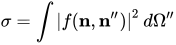
In , processes are analyzed using the asymptotic form of the wave function for an incident propagating along the z-direction. Far from the scattering center, as rr \to \infty, the wave function takes the form ψ(r)eikz+f(θ,ϕ)eikrr,\psi(\mathbf{r}) \sim e^{i k z} + f(\theta, \phi) \frac{e^{i k r}}{r}, where kk is the wave number, f(θ,ϕ)f(\theta, \phi) is the scattering amplitude depending on the polar angle θ\theta and azimuthal angle ϕ\phi, the first term represents the incident wave, and the second term describes the outgoing spherical wave. The differential cross-section, which gives the probability density for scattering into a solid angle dΩd\Omega, is defined as dσdΩ=f(θ,ϕ)2\frac{d\sigma}{d\Omega} = |f(\theta, \phi)|^2. This formulation assumes a central potential and non-relativistic kinematics, with the total cross-section obtained by integrating over all angles: σ=f2dΩ\sigma = \int |f|^2 d\Omega. The S-matrix formalism provides the foundational framework for connecting these scattering amplitudes to underlying quantum principles. The , or matrix, is a SS that maps incoming asymptotic states to outgoing ones, ensuring the conservation of probability in quantum transitions. Unitarity is expressed as SS=1S^\dagger S = 1, which guarantees that the sum of probabilities for all possible final states from a given initial state equals unity. In this picture, the ff is related to the matrix elements of the T-operator (transition operator) via f(θ,ϕ)=m2π2kTkf(\theta, \phi) = -\frac{m}{2\pi \hbar^2} \langle \mathbf{k}' | T | \mathbf{k} \rangle, where mm is the and k,k\mathbf{k}, \mathbf{k}' are initial and final wave vectors, with the S-matrix written as S=1+iTS = 1 + i T. This structure emerged from early efforts to describe high-energy particle interactions without full field-theoretic details. The optical theorem directly follows from the unitarity of the S-matrix, as it imposes relations between the forward scattering amplitude (θ=0\theta = 0) and the total cross-section through the imaginary part of the amplitude, reflecting the interference between unscattered and rescattered waves. Specifically, unitarity leads to an expression where the imaginary part of f(0)f(0) is proportional to σ\sigma, without needing detailed dynamics of intermediate states; this motivates the theorem's generality across scattering scenarios but defers the explicit derivation to unitarity conditions on the amplitudes. The theorem does not require time-reversal invariance for its validity, though it assumes elastic scattering dominance at low energies where inelastic channels are negligible. Extensions to include inelastic processes generalize the theorem by incorporating sums over all possible final states in the unitarity relation, allowing application to absorption or reaction cross-sections. In the context of partial wave expansion, suitable for central potentials, the scattering amplitude is decomposed into contributions from different angular momenta ll: f(θ)=12ikl=0(2l+1)(Sl1)Pl(cosθ),f(\theta) = \frac{1}{2 i k} \sum_{l=0}^\infty (2l+1) (S_l - 1) P_l(\cos \theta), where PlP_l are and Sl=e2iδlS_l = e^{2 i \delta_l} are the partial wave elements with phase shifts δl\delta_l. Unitarity requires Sl=1|S_l| = 1, and the optical theorem arises naturally in the forward direction (θ=0\theta = 0) from summing over ll, where the total cross-section is given by σ=4πk2l(2l+1)sin2δl\sigma = \frac{4\pi}{k^2} \sum_l (2l+1) \sin^2 \delta_l, highlighting how phase shifts encode the theorem's content without a full proof here. This expansion is particularly useful for low-energy scattering where only low ll contribute significantly. Relativistic considerations extend the optical theorem to , where s=(p1+p2)2s = (p_1 + p_2)^2 (center-of-mass energy squared) and t=(p1p1)2t = (p_1 - p_1')^2 (momentum transfer squared) parameterize the process. In the forward limit t0t \to 0 at high energies (large ss), the theorem takes the form σtot=1sImM(s,t=0)\sigma_{\rm tot} = \frac{1}{s} \operatorname{Im} \mathcal{M}(s, t=0), with M\mathcal{M} the invariant amplitude, derived from unitarity in the relativistic regime and applicable to collisions involving creation of intermediate states. This formulation underscores the theorem's role in high-energy phenomenology, such as limits.

Classical Wave Basis

The classical foundation of the optical theorem rests on the theory of wave in deterministic systems, such as those governed by the scalar for time-harmonic waves. In , problems for scalar waves, like acoustic pressure or simplified electromagnetic fields, are described by the 2ψ+k2ψ=0\nabla^2 \psi + k^2 \psi = 0 in free space, where ψ\psi is the wave field, k=ω/ck = \omega / c is the with ω\omega and speed cc, and an incident ψi=eikr\psi_i = e^{i \mathbf{k} \cdot \mathbf{r}} interacts with a scatterer introducing a potential or boundary condition that perturbs the field. The total field ψ=ψi+ψs\psi = \psi_i + \psi_s includes the scattered component ψs\psi_s, which satisfies the to ensure outgoing waves at infinity. In the far-field approximation, valid at large distances rλ/2πr \gg \lambda / 2\pi where λ=2π/k\lambda = 2\pi / k is the , the scattered wave takes the asymptotic form ψs(r)f(θ,ϕ)eikrr\psi_s(\mathbf{r}) \sim f(\theta, \phi) \frac{e^{ikr}}{r}, with f(θ,ϕ)f(\theta, \phi) denoting the that encodes the angular distribution of the scattered energy. This amplitude determines the differential scattering cross-section dσ/dΩ=f2d\sigma / d\Omega = |f|^2, representing the scattered power per unit normalized to the incident . Energy conservation in classical wave scattering is enforced through the Poynting theorem, which for time-harmonic fields equates the rate of energy dissipation or absorption within a volume to the net flux through its surface via the time-averaged Poynting vector S=12(E×H)\mathbf{S} = \frac{1}{2} \Re(\mathbf{E} \times \mathbf{H}^*) for electromagnetic waves or analogous intensity expressions for scalar fields. In scattering, this relates the incident power flux to the scattered and absorbed powers, with the total scattering cross-section σsca=f2dΩ\sigma_\mathrm{sca} = \int |f|^2 d\Omega quantifying the integrated scattered energy and the absorption cross-section σabs\sigma_\mathrm{abs} the energy removed from the wave. The cross-section σext=σsca+σabs\sigma_\mathrm{ext} = \sigma_\mathrm{sca} + \sigma_\mathrm{abs} measures the total power removed from the incident beam, which for non-absorbing scatterers reduces to σext=σsca\sigma_\mathrm{ext} = \sigma_\mathrm{sca}; the optical theorem in classical waves links this to the forward via σext=4πkf(0)\sigma_\mathrm{ext} = \frac{4\pi}{k} \Im f(0), highlighting interference in the forward direction as the physical origin of . In , while electromagnetic waves are vectorial and polarization-dependent, satisfying , the scalar approximation via the suffices for many scenarios like or small particles, neglecting vector effects for conceptual simplicity. An analogous framework applies to acoustic scattering, where the pressure field pp obeys the scalar 2p+k2p=0\nabla^2 p + k^2 p = 0 with k=ω/csk = \omega / c_s and sound speed csc_s, and the similarly describes far-field radiation from obstacles like rigid bodies or soft scatterers, enabling the optical theorem to relate total to forward scattering in lossless media.

Derivation

From Unitarity

The optical theorem arises directly from the unitarity of the in quantum scattering theory, which guarantees the conservation of total probability across all possible outcomes. The S^\hat{S} satisfies S^S^=I^\hat{S}^\dagger \hat{S} = \hat{I}, implying that for an incident state i|i\rangle, the completeness relation yields niS^nnS^i=1\sum_n \langle i | \hat{S}^\dagger | n \rangle \langle n | \hat{S} | i \rangle = 1, where the sum runs over a complete of final states n|n\rangle. To connect this to scattering observables, introduce the transition operator T^\hat{T} via the decomposition S^=I^+iT^\hat{S} = \hat{I} + i \hat{T}, where the sign convention aligns with time-ordered perturbation theory. Unitarity then imposes i(T^T^)=T^T^i(\hat{T} - \hat{T}^\dagger) = -\hat{T}^\dagger \hat{T}, or equivalently, 2ImT^=T^T^2 \operatorname{Im} \hat{T} = \hat{T}^\dagger \hat{T}. Taking the matrix element in the incident state gives 2ImiT^i=nnT^i2,2 \operatorname{Im} \langle i | \hat{T} | i \rangle = \sum_n |\langle n | \hat{T} | i \rangle|^2, where the right-hand side sums the squared magnitudes of all transition amplitudes from the initial state to any final state. This relation captures the probabilistic interpretation: the imaginary part of the forward transition amplitude equals half the total probability flux into all possible channels. In non-relativistic quantum mechanics, the scattering amplitude f(θ)f(\theta) for elastic scattering into direction k\mathbf{k}' from incident k\mathbf{k} (with k=k=k|\mathbf{k}| = |\mathbf{k}'| = k) relates to the T-matrix element as f(θ)=m2π2kT^k,f(\theta) = -\frac{m}{2\pi \hbar^2} \langle \mathbf{k}' | \hat{T} | \mathbf{k} \rangle, with mm the reduced mass. For the forward direction (θ=0\theta = 0, so k=k\mathbf{k}' = \mathbf{k}), this becomes f(0)=m2π2iT^if(0) = -\frac{m}{2\pi \hbar^2} \langle i | \hat{T} | i \rangle, assuming continuum-normalized plane-wave states. The total cross-section σtot\sigma_\text{tot} is defined as the integral over all differential cross-sections, including both elastic and inelastic contributions: σtot=f(θ)2dΩ+σinelastic\sigma_\text{tot} = \int |f(\theta)|^2 d\Omega + \sigma_\text{inelastic}. Substituting the unitarity relation and accounting for phase-space factors (with relative velocity v=k/mv = \hbar k / m) yields the optical theorem: Imf(0)=k4πσtot.\operatorname{Im} f(0) = \frac{k}{4\pi} \sigma_\text{tot}. This form emerges after normalizing the states appropriately and integrating the summed probabilities over outgoing momenta, where the factor δ(0)\delta(0) from continuum normalization cancels in the ratio. The sum in the unitarity relation encompasses all final states, including the elastic channel (n=in = i) and inelastic channels (e.g., excitation or processes). Consequently, σtot\sigma_\text{tot} represents the total interaction cross-section, not merely the elastic one; the imaginary part of the forward thus probes the overall strength of , with inelastic processes contributing positively to both sides of the equation. In the absence of inelastic channels, the reduces to a relation between elastic forward and the integrated elastic cross-section, enforced by unitarity alone. This derivation assumes a complete basis of asymptotic states with no absorption into unobserved channels (e.g., bound states or external reservoirs) and relies on the exact forward limit (θ=0\theta = 0). In practice, high-energy approximations often simplify evaluations, as forward peaking dominates due to small-angle , but the theorem holds exactly within the theory's framework for conservative systems.

From Energy Conservation

In classical wave theory, the optical theorem emerges from the principle of applied to the flux of the wave field through a closed surface enclosing the scatterer. For electromagnetic waves, the incident carries a time-averaged power flux ( magnitude) proportional to |E_inc|^2 / (2 Z), where E_inc is the incident amplitude and Z is the impedance of the medium; an analogous expression holds for scalar waves with flux proportional to |ψ_inc|^2. This flux represents the energy per unit area per unit time incident on the scatterer. The total scattered power, quantified by the scattering cross-section σ_sca, is obtained by integrating the differential scattering cross-section over all solid angles: σ_sca = ∫ |f(θ, φ)|^2 dΩ, where f(θ, φ) is the far-field and dΩ = sin θ dθ dφ. However, the total extinction cross-section σ_ext, which accounts for both and absorption (or any irreversible energy loss), is not simply σ_sca but is instead revealed through the interference-induced depletion of the incident beam in the forward direction. In the forward scattering direction (θ = 0), the total field asymptotically takes the form E_tot(r → ∞, θ=0) ≈ E_inc [1 + (f(0)/r) e^{i k r}], where the e^{i k r} accounts for the , and the imaginary part of f(0) captures the destructive interference that removes energy from the forward beam. To derive the theorem rigorously, consider a large spherical surface of radius r >> wavelength enclosing the scatterer, where the net time-averaged energy flux outward through this surface must balance the energy absorbed or scattered by the object, per conservation laws. The time-averaged Poynting vector is S = (1/2) Re(E × H^), and its surface integral ∫ S · dA over the sphere yields the total power. In the far field, the total field E_tot = E_inc + E_sca, so the flux integral separates into incident, scattered, and cross terms: the incident term gives the incoming power through the projected area, the scattered term integrates to the total scattered power (proportional to σ_sca |E_inc|^2), and the cross term ∫ Re(E_inc^ · E_sca) dA captures the extinction due to interference. Using the far-field form E_sca(θ) ≈ - (e^{i k r} / r) f(θ) E_inc (with appropriate vector orientation for EM waves) and evaluating the angular integral via the delta-function-like behavior in the forward direction (from e^{i k r (1 - cos θ)} ≈ 1 for small θ), the cross term simplifies to - (4π / k) Re[E_inc^* · f(0) E_inc]. Normalizing by the incident flux gives the extinction cross-section: σext=4πkImf(0),\sigma_\text{ext} = \frac{4\pi}{k} \operatorname{Im} f(0), where k = 2π / λ is the wavenumber, and f(0) is normalized such that |f(θ)|^2 has units of area (for scalar waves, the factor is identical; for EM, it applies per polarization). This step-by-step evaluation often employs Green's theorem to relate the volume integral of the wave equation to the surface flux or reciprocity relations for the far-field asymptotics. In the non-absorbing case (no internal dissipation), energy conservation requires σ_ext = σ_sca, implying that the integrated scattered power equals the extinguished power, with the forward interference accounting for the "shadow" scattering. This resolves the extinction paradox for large opaque obstacles, where geometric optics predicts σ_ext ≈ 2 × geometric cross-section: the factor of 2 arises because half the extinction comes from reflection (true scattering) and half from diffraction, which casts a shadow by interfering destructively in the forward direction, effectively doubling the apparent removal of energy from the beam. For example, in scalar diffraction theory for a large disk, the scattering amplitude f(0) ≈ -i (k a^2 / 2) (with a the radius) yields σ_ext ≈ 2 π a^2, matching the paradox resolution without absorption.

Applications

In Particle Physics

In particle physics, the optical theorem plays a crucial role in high-energy collisions by relating the imaginary part of the forward to the total cross-section, enabling precise measurements of hadronic interactions. At facilities like the (LHC) and the (RHIC), experiments measure forward elastic scattering to infer the total cross-section σ_tot through the relation σ_tot = (4π / s) Im f(0), where f(0) is the forward scattering amplitude and s is the center-of-mass energy squared. For instance, in proton-proton collisions at RHIC energies of √s = 200 GeV, the STAR experiment has reported σ_tot ≈ 42 mb using Roman Pot detectors to tag forward protons, providing benchmarks for QCD models. At LHC energies around √s = 13 TeV, measurements yield σ_tot ≈ 100–110 mb, reflecting the increasing interaction strength with energy. The theorem's application in explains the observed rise in σ_tot at high energies through the exchange of Regge poles, particularly the Pomeron, a leading trajectory with vacuum quantum numbers. The forward amplitude is dominated by Pomeron exchange, where the imaginary part Im f(0) ∝ s^α_P(0) - 1, with α_P(0) ≈ 1.08 leading to a logarithmic increase in σ_tot ≈ β_P s^{α_P(0)-1}, consistent with data from collider experiments. This framework, rooted in analytic theory, accounts for the slow growth observed in pp scattering without violating unitarity. Unitarity constraints derived from the optical theorem impose fundamental bounds on σ_tot, most notably the Froissart bound, which states that σ_tot < (π / m_π^2) (ln s / s_0)^2, where m_π ≈ 140 MeV is the mass and s_0 is a . This bound arises from combining the theorem with analyticity and partial wave unitarity, ensuring cross-sections cannot grow faster than logarithmically, a limit approached but not exceeded in current data up to TeV scales. Experimental verifications at RHIC and LHC confirm σ_tot remains well below this bound, supporting the theorem's consistency with . Extensions of the optical theorem apply to inelastic processes, where the imaginary part of the forward amplitude relates to total event rates in channels like (DIS) and jet production. In DIS, the structure function F_2(x, Q^2) is proportional to the imaginary part of the forward virtual Compton amplitude via the theorem, allowing extraction of parton distributions from inclusive lepton-hadron scattering data at and LHC. For jet production, similar relations connect inclusive cross-sections to absorptive parts, aiding QCD validation in high-multiplicity events. These applications highlight the theorem's role in decomposing total rates into elastic and inelastic contributions. Experimental techniques for implementing the theorem rely on detecting forward-scattered particles to extrapolate to t=0, using specialized detectors like Roman Pots positioned along the to tag intact protons in elastic events. At the LHC, the and ATLAS/ALFA setups employ Roman Pots at distances up to 220 m from the interaction point, achieving high acceptance (∼90%) for |t| < 0.1 GeV^2, with luminosity normalization via van der Meer scans ensuring absolute scale. These methods minimize systematic uncertainties from beam optics and pileup, enabling precise σ_tot determinations. As of 2022, ATLAS measurements from at √s = 13 TeV yield σ_tot = 104.7 ± 1.1 mb, underscoring the theorem's enduring utility in probing asymptotic QCD dynamics. Ongoing analyses from Run 3 at √s = 13.6 TeV by ATLAS/ALFA and continue to investigate the energy dependence.

In Optics and Wave Phenomena

In classical , the optical theorem finds prominent application in electromagnetic by spherical particles, as described by Mie theory. This theory provides an exact solution to for from a homogeneous , where the total cross section σext\sigma_\text{ext} is related to the real part of the forward amplitudes through the partial wave expansion: σext=2πk2l=1(2l+1)Re(al+bl),\sigma_\text{ext} = \frac{2\pi}{k^2} \sum_{l=1}^\infty (2l+1) \operatorname{Re}(a_l + b_l), with ala_l and blb_l as the Mie coefficients for electric and magnetic multipoles, respectively, kk the , and the sum capturing interference effects that link forward to overall energy removal from the incident beam. This relation, derived from , enables efficient computation of without integrating over all angles, crucial for modeling light interaction with micron-sized particles where both and absorption contribute. In , the theorem underpins the analysis of , particularly for via systems. particles in the atmosphere cause total σext\sigma_\text{ext} that combines and absorption, with the theorem relating this to enhanced forward amplitudes, allowing inference of distributions and composition from measured lidar ratios (-to-backscatter ratios). For instance, inelastic Raman retrieves vertical profiles of coefficients by exploiting the theorem's prediction that forward dominates the total cross section, aiding climate modeling and air quality assessment where direct measurement of forward amplitudes is impractical. This approach has been validated in studies of urban and volcanic , confirming values on the order of 0.1–1 km⁻¹ at visible wavelengths. The optical theorem extends to acoustic wave phenomena, informing in and applications within . For sound waves interacting with submerged objects like fish schools or seafloor features, the theorem equates the total cross section to the imaginary part of the forward , scaled by 4π/k4\pi / k in scalar acoustics, enabling estimation of total backscattering strength σbs\sigma_{bs} integrated over angles. In oceanographic , this facilitates mapping of volume strength svs_v (in m⁻¹ sr⁻¹), where the theorem constrains models of bubble clouds or layers, predicting backscattering levels up to 10⁻³ m⁻¹ for dense aggregations at 200 kHz frequencies. imaging similarly uses it to differentiate tissue from absorption, with applications in medical diagnostics revealing total cross sections on the order of 10⁻⁴ cm² for blood cells. For vector waves like electromagnetic fields, the theorem generalizes to polarization-dependent forms, accounting for the tensor nature of amplitudes. In standard plane-wave incidence, arises from interference between incident and forward-scattered fields, but for structured beams, the relation modifies to include beam profile and polarization effects. Notably, experiments with radially polarized beams demonstrated violations of the classical scalar form, where the forward alone does not fully capture due to azimuthal polarization variations, requiring a weighted over the beam's transverse profile; this was verified using tightly focused beams on spheres, showing up to 20% deviations in predicted cross sections. These polarization effects are critical in vectorial , influencing applications like high-resolution . In nanophotonics, the theorem is essential for plasmonic particles, where absorption plays a key role in light-matter interactions. For metallic nanoparticles supporting surface plasmons, the total extinction σext\sigma_\text{ext} encompasses both scattering σsca\sigma_\text{sca} and absorption σabs\sigma_\text{abs}, with the theorem yielding σabs=σextσsca\sigma_\text{abs} = \sigma_\text{ext} - \sigma_\text{sca} directly from forward scattering measurements, bypassing full angular integration. This relation has enabled design of gold nanospheres with plasmon resonances at 520 nm, achieving absorption efficiencies exceeding 50% for photothermal therapy, as the theorem quantifies energy dissipation via ohmic losses in the metal. Such applications highlight the theorem's utility in subwavelength regimes, where near-field enhancements amplify the forward interference term. Recent advances leverage the optical theorem in metamaterials and topological photonics to engineer scattering responses, including generalizations for time-modulated structures and robust edge states in photonic crystals.

History

Origins in Classical Optics

The origins of the optical theorem lie in 19th-century studies of light scattering in classical optics, particularly through investigations into atmospheric phenomena and particle interactions with electromagnetic waves. In 1871, Wolfgang Sellmeier and independently Lord Rayleigh (John William Strutt) developed early forms of the theorem. Rayleigh published his foundational work on the scattering responsible for the blue color of the sky, "On the light from the sky, its polarization and colour," where he analyzed the scattering of sunlight by small atmospheric particles much smaller than the wavelength of light. In this paper, Rayleigh derived the intensity of scattered light and noted the critical relation between forward diffraction around the particle and the total extinction (removal of light from the incident beam), establishing an early form of the theorem by linking the imaginary part of the forward scattering amplitude to the total cross-section. This insight explained how diffraction contributes equally to extinction as scattering does, a principle central to the theorem's classical basis. Building on Rayleigh's approximations for small particles, Gustav Mie extended the theory to arbitrary particle sizes in 1908 with his exact solution for electromagnetic wave scattering by a homogeneous , detailed in "Beugung elektromagnetischer Wellen an einem Kugel von beliebigem Durchmesser." Mie's formalism, derived from using , implicitly incorporates the optical theorem through the extinction efficiency factor QextQ_{\text{ext}}, which asymptotes to 2 for large particles (where the size parameter ka1ka \gg 1, with kk the and aa the radius). This value of 2 arises from the sum of scattering (Qsca1Q_{\text{sca}} \approx 1) and contributions, each equal to the geometrical optics limit of 1, highlighting the theorem's role in resolving apparent paradoxes in wave . The theoretical framework supporting these scattering relations drew from reciprocity principles in electromagnetism developed in the late 19th and early 20th centuries. Hendrik Lorentz formulated his reciprocity in the 1890s, as part of his work on electromagnetic fields in moving media, which relates the response of a to sources in forward and reciprocal configurations, enabling connections between amplitudes and in optical contexts. Paul Drude, in his 1900 treatise "The Theory of Optics," further integrated reciprocity into dispersion and propagation theories, applying it to wave interactions that foreshadow forward relations in problems. These provided the arguments essential for deriving from forward without direct computation of total cross-sections. Early discussions of the extinction paradox—the counterintuitive result that extinction doubles the geometrical cross-section for large opaque obstacles—traced back to analogies in hydrodynamics from Lord Kelvin's work in the early on wave resistance and ship wakes, where similar interference effects doubled drag predictions beyond shadow . Although H. C. van de Hulst formalized the factor of 2 in electromagnetic in his 1957 monograph "Light Scattering by Small Particles," attributing it to into the forward shadow, the paradox's roots in classical wave theory were recognized earlier through these hydrodynamic parallels. Prior to 1950, the underlying principles of the theorem were employed unnamed in and propagation analyses, particularly during efforts to model atmospheric and target cross-sections, where forward interference was used to estimate total signal loss without the formal "optical" nomenclature.

Development in Quantum Theory

In the formative years of quantum mechanics during the 1920s, , , and developed , introducing early concepts of scattering processes through non-commuting observables and unitary transformations that preserved probability. These foundational ideas implied relations between forward scattering amplitudes and total cross sections, akin to the optical theorem, as unitarity ensured conservation of probability flux in quantum transitions. By , the optical theorem received its first explicit quantum mechanical derivation in the Soviet physics literature, credited to E. L. Feinberg in 1932, who applied it to in potential fields, establishing the link between the imaginary part of the forward and the total cross section. In 1939, , , and George Placzek extended the theorem to nuclear applications. In the 1950s, amid advances in , K. M. Watson formulated an for multiple , incorporating a time-delay approach to derive the optical theorem for potential , which facilitated modeling of complex nuclear interactions while maintaining unitarity constraints. The explicit naming of the "optical theorem" occurred in 1955, when Hans A. Bethe and Frederic de Hoffmann introduced the term in their textbook Mesons and Fields, Volume II, explicitly drawing the analogy to classical optical extinction principles to describe absorption in quantum scattering. Following , in the 1950s, Geoffrey F. Chew and Francis E. Low prominently utilized the theorem in analyses of pion-nucleon scattering, integrating it with dispersion relations to extrapolate low-energy amplitudes and constrain coupling constants from unitarity and crossing symmetry. By the 1960s, the optical theorem was rigorously generalized within through the Lehmann-Symanzik-Zimmermann (LSZ) reduction formula, which connected time-ordered correlation functions to elements, thereby extending the theorem's validity to relativistic processes and reinforcing its central role in theory for high-energy particle interactions.

References

Add your contribution
Related Hubs
User Avatar
No comments yet.