


Community hub
Recent from talks
Contribute something
Nothing was collected or created yet.
Order of Liberty
View on Wikipedia| Order of Liberty Ordem da Liberdade | |
|---|---|
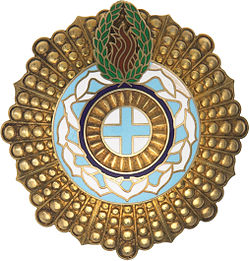
 Star of The Order of Liberty | |
Awarded by  Portuguese Republic Portuguese Republic | |
| Type | Order |
| Established | 1976 |
| Eligibility | Portuguese and foreign citizens; military or civilian |
| Awarded for | Distinguished and important services rendered to the cause of democracy and freedom.[1] |
| Status | Currently constituted |
| Grand Master | President of the Portuguese Republic |
| Chancellor | Manuela Ferreira Leite |
| Grades | Grand Collar Grand Cross Grand Officer Commander Officer Member |
| Precedence | |
| Next (higher) | Order of Prince Henry |
| Next (lower) | Order of Camões |
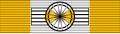
 Ribbon bar of the Order of Liberty | |

The Order of Liberty, or the Order of Freedom (Portuguese: Ordem da Liberdade), is a Portuguese honorific civil order that distinguishes relevant services to the cause of democracy and freedom, in the defense of the values of civilization and human dignity. The order was created in 1976, after the Carnation Revolution of 1974 in which the corporatist authoritarian Estado Novo regime of António de Oliveira Salazar and Marcello Caetano was deposed. The Grand Collar can also be given by the President of Portugal to former Heads of State and others whose deeds are of an extraordinary nature and particular relevance to Portugal, making them worthy of such a distinction.[2] This can include political acts, physical acts of defense for Portugal, or the good representation of Portugal in other countries.
Grades
[edit]The order includes six classes; in decreasing order of seniority, these are:[3]
 Grand Collar (Grande-Colar – GColL)
 Grand Cross (Grã-Cruz – GCL)
 Grand Officer (Grande-Oficial – GOL)
 Commander (Comendador – ComL)
 Officer (Oficial – OL)
 Knight/Dame (Cavaleiro – CvL / Dama – DmL)


Like the other Portuguese orders, the title of Honorary Member (Membro Honorário – MHL) can be awarded to institutions and locals.
List of Grand Collars of the Order of Liberty
[edit]Portuguese recipients
[edit]- 9 March 1996: Mário Soares, former president of the Republic
- 9 March 2006: Jorge Sampaio, former president of the Republic
- 18 December 2015: António Ramalho Eanes, former president of the Republic
- 9 March 2016: Aníbal Cavaco Silva, former president of the Republic
Foreign recipients
[edit]- 28 October 1987: François Mitterrand, former president of France
- 13 October 1988: King Juan Carlos I of Spain
- 13 December 1990: Václav Havel, former president of the Czech Republic
- 11 November 1991: António Mascarenhas Monteiro, former president of Cape Verde
- 26 August 1992: Patricio Aylwin, former president of Chile
- 12 October 1992: Miguel Trovoada, former president of São Tomé and Príncipe
- 11 May 1993: Lech Wałęsa, former president of Poland
- 13 September 1994: Zhelyu Zhelev, former president of Bulgaria
- 4 October 1995: Fernando Henrique Cardoso, former president of Brazil
- 11 October 1995: Sam Nujoma, former president of Namibia
- 23 July 2003: Luiz Inácio Lula da Silva, former president of Brazil
- 11 October 2005: Kofi Annan, former secretary-general of United Nations
- 30 June 2016: Joaquim Chissano, former president of Mozambique
- 19 July 2016: François Hollande, former president of France
- 30 March 2017: Michelle Bachelet, former president of Chile
- 10 April 2017: Jorge Carlos Fonseca, former president of Cape Verde
- 23 May 2017: Henri, Grand Duke of Luxembourg
- 13 November 2017: Juan Manuel Santos, former president of Colombia
- 6 December 2017: Sergio Mattarella, President of Italy
- 15 April 2018: King Felipe VI of Spain
- 10 December 2022: Amílcar Cabral (posthumously)
- 24 August 2023: Volodymyr Zelenskyy, President of Ukraine
- 7 October 2023: Klaus Iohannis, President of Romania
- 27 February 2025: Emmanuel Macron, President of France
List of Grand Crosses of the Order of Liberty
[edit]Foreign recipients
[edit]- 16 July 1988: Maria Helena Vieira da Silva, abstract painter
- 30 June 1989: Andreas Papandreou, former prime minister of Greece
- 22 April 1991: Nelson Mandela, former president of South Africa
- 25 January 1993: Árpád Göncz, former president of Hungary
- 9 June 1993: Xanana Gusmão, former president of East Timor
- 28 December 1994: Álvaro Lins, former ambassador of Brazil
- 24 April 1995: Miguel Ángel Martínez Martínez, former Parliamentary Assembly President, Council of Europe
- 29 May 1995: José Francisco Peña Gómez, former mayor of Santo Domingo, Dominican Republic
- 17 June 1995: Mikhail Gorbachev, former president of Soviet Union
- 1 March 1996: Javier Pérez de Cuéllar, former secretary-general of United Nations
- 22 February 1996: Adolfo Suárez, former prime minister of Spain
- 9 June 1998: José Ramos-Horta, President of East Timor
- 11 March 2000: Pascoela Barreto, Ambassador of East Timor to Portugal
- 23 July 2003: Marisa Letícia Lula da Silva, former first lady of Brazil
- 22 March 2005: Lionel Jospin, former prime minister of France
- 5 January 2006: Albie Sachs, former judge of Constitutional Court, South Africa
- 13 May 2016: Ban Ki-moon, former secretary-general of United Nations
- 16 January 2017: Martin Schulz, former president of the European Parliament
- 19 July 2017: Shah Karim Aga Khan IV
- 15 April 2018: Queen Letizia of Spain
- 5 July 2018: Sir Peter Cosgrove, former governor-general of Australia
- 24 August 2023: Volodymyr Zelensky, President of Ukraine
See also
[edit]References
[edit]- ^ "HISTÓRIA DA ORDEM DA LIBERDADE - Página Oficial das Ordens Honoríficas Portuguesas" (in Portuguese). Ordens.presidencia.pt. Retrieved 2012-05-28.
- ^ "ORDEM DA LIBERDADE". Página Oficial das Ordens Honoríficas Portuguesas (in Portuguese). Retrieved 2012-05-28.
- ^ Graus e Insignias Da Ordem Da Liberdade - official website of the Order
External links
[edit]
- List of the Grand Collar of Freedom (in Portuguese)
 Orders, decorations, and medals of Portugal Orders, decorations, and medals of Portugal | |||||||||||
|---|---|---|---|---|---|---|---|---|---|---|---|
| Honours of the Portuguese Republic |
| ||||||||||
| Honours of the Autonomous Regions |
| ||||||||||
 Portuguese Red Cross Portuguese Red Cross | |||||||||||
 Dynastic Orders of Dynastic Orders ofthe Portuguese Royal House |
| ||||||||||


_BAR.svg)
_BAR.svg)
_BAR.svg)


_-_ribbon_bar.gif)


Order of Liberty
View on GrokipediaHistory
Establishment Following the Carnation Revolution
The Carnation Revolution, occurring on April 25, 1974, marked the end of Portugal's authoritarian Estado Novo regime through a bloodless military coup led by the Armed Forces Movement, which rapidly gained popular support and initiated a transition to democracy amid decolonization and political upheaval.[6] In this context of rejecting the prior corporatist dictatorship under António de Oliveira Salazar and Marcelo Caetano, Portuguese authorities sought to institutionalize recognition for contributions to democratic values, contrasting with pre-1974 honorific orders tied to the old regime's ideology.[3] The Order of Liberty was formally established by Decree-Law No. 709-A/76, promulgated on October 4, 1976, under the provisional government during the democratic consolidation phase.[7] This legislation created a national civil honorific order explicitly "destined to distinguish and award relevant services rendered to the cause of democracy and liberty," as stated in Article 1 of the decree.[7] The preamble emphasized that existing orders failed to adequately reflect the "new values of liberty and democracy" emergent from the revolution, positioning the Order as a symbolic break from authoritarian honors and a tool to honor revolutionaries, dissidents, and promoters of pluralistic governance.[8] Instituted by President António Ramalho Eanes, a key figure in stabilizing post-revolutionary Portugal, the Order's creation aligned with the 1976 constitutional framework that enshrined fundamental rights following the April 25 events.[9] Initial implementation focused on retroactively recognizing anti-dictatorship efforts, with the decree outlining grades from Grand Collar to Knight and vesting award authority in the President of the Republic upon Council of State recommendation.[7] This establishment reflected causal priorities of the era: prioritizing empirical defense of civil liberties over regime loyalty, though early awards drew scrutiny for favoring military coup participants amid ensuing political turbulence, including attempted counter-coups and economic challenges through 1975-1976.[3] By formalizing such distinctions, the Order embedded revolutionary ideals into state symbolism, influencing Portugal's honor system during its integration into democratic Europe.[10]Legal Framework and Initial Awards
The Order of Liberty was instituted by Decree-Law n.º 709-A/76 of 4 October 1976, enacted by the Presidency of the Council of Ministers under the post-revolutionary transitional government.[7] [3] This legislation created a national honorific order specifically to recognize and reward "relevant services rendered to the cause of democracy and liberty," addressing a perceived gap in pre-existing Portuguese orders, which were deemed insufficient for honoring contributions aligned with the ideals of the 25 April 1974 Carnation Revolution.[3] [9] The order's foundational purpose emphasized distinctions for individuals demonstrating devotion to human rights, social justice, republican values, and democratic principles, encompassing both Portuguese and foreign nationals, civilians, and military personnel.[3] The decree vested the President of the Republic, as Grand Master, with exclusive authority over nominations and conferrals, establishing a framework where awards would promote civic virtues and national reconciliation in the democratic transition.[3] [4] Initial grades included the Grand Collar as the highest class, followed by Grand Cross, Grand Officer, Commander, Officer, and Knight (or Dame for women), with insignia designs later formalized by Regulatory Decree n.º 27/79 of 24 May 1979 to symbolize liberty through a green-enameled cross and laurel wreath.[11] [4] Initial awards prioritized military leaders instrumental in the Carnation Revolution and advocates for human rights, reflecting the order's role in legitimizing the new democratic order.[3] Among early recipients was Captain Otelo Saraiva de Carvalho, a central coordinator of the 25 April operation, who received recognition for his contributions to ending the authoritarian Estado Novo regime. Subsequent early bestowals extended to other revolutionaries, such as Colonel Vasco Gonçalves, though comprehensive lists from 1976–1977 remain limited in public records; higher grades like Grand Cross were conferred by the early 1980s, as seen with Lieutenant Colonel Fernando Salgueiro Maia in 1983 for his leadership in capturing key Lisbon sites during the revolution.[12] The first Grand Collar awards, the order's pinnacle, occurred later, with French President François Mitterrand receiving it in 1987 for supporting Portugal's democratic consolidation.[3] These initial conferrals underscored the order's function as a tool for honoring anti-authoritarian efforts without retroactively validating prior regime loyalists.Subsequent Reforms and Expansions
Following its establishment in 1976, the Order of Liberty's objectives were refined through subsequent organic legislation, which expanded the criteria to encompass services rendered in defense of civilization's values alongside the promotion of human dignity and liberty.[3] Decree-Law No. 132/85, dated May 1, 1985, revised the organizational structure of Portugal's honorary orders, terminating the regime established by Decree-Law No. 94/75 and thereby standardizing administrative and procedural aspects applicable to the Order of Liberty, including eligibility and award processes.[13][3] The order's scope was further expanded to include foreign nationals distinguished by exceptional civic merits, particularly through the Grand Collar class reserved for heads of state or equivalents; notable early awards went to French President François Mitterrand on June 22, 1987, and Polish solidarity leader Lech Wałęsa in 1993, acknowledging international advancements in democratic principles and human rights.[3]Purpose and Criteria
Defining Contributions to Liberty and Democracy
The Order of Liberty recognizes distinguished services rendered to the cause of democracy and freedom, as established by Decree-Law No. 709-A/76 of 4 October 1976, which created the order explicitly to "distinguish and reward relevant services provided to the cause of democracy and liberty." These contributions are characterized by exceptional actions advancing republican and democratic principles, often in opposition to authoritarianism, and include efforts to uphold human rights and social justice.[3] The statute emphasizes deeds of particular relevance to Portugal's post-1974 democratic consolidation, prioritizing empirical demonstrations of commitment such as non-violent advocacy for political pluralism, rule of law, and individual freedoms over mere ideological alignment.[3] Subsequent statutory modifications expanded the criteria to encompass services in defense of civilization's values and the dignity of the human person, reflecting a broader causal link between liberty and foundational ethical norms.[3] Qualifying contributions typically involve verifiable impacts, such as leadership in transitional justice processes, defense against repressive regimes, or institutional reforms fostering electoral integrity and civil liberties—evidenced by the order's early bestowal on Carnation Revolution participants who enabled Portugal's shift from 48 years of dictatorship to multiparty democracy on 25 April 1974.[3] Awards are not granted for routine civic participation but for transformative acts that empirically strengthen democratic resilience, as determined by the President of the Republic under Article 134 of the Portuguese Constitution.[14] This focus on causal efficacy in promoting liberty distinguishes the order from more general merit awards, requiring proposers to substantiate nominations with specific evidence of outcomes like policy changes or societal shifts toward greater freedoms, thereby ensuring selections align with objective advancements rather than subjective acclaim.[3] International recipients, such as heads of state exemplifying democratic transitions, further illustrate criteria extending to global defenses of self-determination and anti-totalitarian efforts.[3]Eligibility Requirements and Selection Process
The Order of Liberty is conferred for relevant services rendered in defense of civilization's values, the dignity of the human person, and the cause of freedom, whether in Portugal or internationally.[15] Eligible recipients include Portuguese citizens distinguished by personal merits or exceptional acts, as well as foreign nationals awarded honorary membership, often in recognition of contributions to democratic principles or human rights.[1] There are no codified restrictions on citizenship, age, or duration of service, emphasizing merit-based distinction over formal prerequisites; posthumous awards are permitted for deceased individuals whose actions align with the order's criteria.[16] The Grand Collar, the order's highest degree, is specifically granted to foreign heads of state during official visits, to former heads of state, or to individuals whose extraordinary deeds demonstrate particular relevance to Portugal's interests in liberty and democracy.[1] Lower degrees, such as Grand Cross or Knight, follow the same substantive criteria but are scaled to the prominence of the service, with no numerical quotas or mandatory evaluations specified in the governing statutes. Proposals for conferral originate from the President of the Assembly of the Republic or the Prime Minister, who may nominate Portuguese or foreign citizens for any degree.[15] The President of the Republic, serving as Grand-Master of all Portuguese honorary orders, exercises exclusive competence to approve or reject these proposals and to issue the decree of concession.[15] This process, outlined in Lei n.º 5/2011 of 2 March, prioritizes discretionary presidential judgment informed by the proposers' justifications, without formal advisory councils or public competitions for the Order of Liberty.[15] Awards are typically announced via presidential decree and formalized in investiture ceremonies at the Palácio de Belém.[17]Insignia and Grades
Design Elements and Symbolism
The insignia of the Order of Liberty features a medallion as its central element, consisting of a white-enamel circle bearing a blue-enamel Greek cross outlined in gold, superimposed upon a gold laurel wreath.[18] This medallion is encircled by a silver nimbus with radiating silver rays that interlace with an outer gold laurel garland.[18] The reverse side displays Portugal's traditional quinas shield, surrounded by the inscription "Ordem da Liberdade."[18] The ribbon, in alternating stripes of blue and white, measures 25 mm in width for standard use, symbolizing the colors associated with the Carnation Revolution of 1974 that ended Portugal's authoritarian regime.[5] For higher grades, the insignia incorporates additional elements: the Grand Collar class uses a chain composed of links alternating between the order's medallion and laurel motifs, while the Grand Cross employs a broad sash of the order's ribbon colors, 100 mm wide for men and a bow for women.[18] Lower grades suspend the medallion from a ribbon bar or rosette, with dimensions scaling down—such as 40 mm for Commander—and gold clasps or stars for officers and above.[5] Women recipients wear the insignia as a bow rather than a straight ribbon for certain classes.[18] The design elements draw on heraldic traditions to evoke liberty and national honor: the unadorned Greek cross represents universal democratic values and equality under law, while the laurel wreaths signify civic achievement and triumph over oppression, consistent with classical symbolism repurposed for post-revolutionary Portugal.[18] The inclusion of the quinas on the reverse affirms the order's tie to Portuguese sovereignty and identity, established following the 1974 transition to democracy.[18] Blue and white evoke purity, hope, and the revolutionary events, though official documentation specifies the design without explicit interpretive mandates.[5]Hierarchy of Classes and Precedence
The Order of Liberty consists of six classes, arranged in descending order of precedence: Grand Collar, Grand Cross, Grand Officer, Commander, Officer, and Knight (or Dame for women). This hierarchy reflects the degree of distinction for services rendered in defense of liberty, democracy, and human dignity, with the Grand Collar reserved exclusively for heads of state or figures of exceptional merit, while lower classes recognize progressively broader contributions.[5][15] Higher classes entail more elaborate insignia: the Grand Collar includes a collar chain, sash, and breast star; Grand Cross features a sash and breast star; Grand Officer a neck ribbon or bow and breast star; Commander a neck ribbon or bow and silver breast star; Officer a rosette on the ribbon; and Knight/Dame a simple ribbon bar. The central medallion across all classes depicts a white-enamel disc with a blue Greek cross edged in gold, surmounted by a red flame symbolizing liberty within a green laurel wreath, suspended from a yellow-and-white ribbon denoting national colors.[5] In Portuguese protocol, these classes maintain strict internal precedence, with recipients wearing the highest-held class prominently; when multiple national honors are displayed, insignia are positioned from right to left by rank, and the Order of Liberty—as a civil national order—follows the ancient military orders (Christ, Aviz, Santiago) and select military-national orders (Tower and Sword, Prince Henry) in the overall sequence of Portuguese honors. Foreign decorations yield to national ones, ensuring the Order's classes take priority in official ceremonies.[4][19]| Class | Insignia Elements | Typical Recipients |
|---|---|---|
| Grand Collar | Collar, sash, breast star (gold) | Heads of state, exceptional merit |
| Grand Cross | Sash, breast star (gold) | High officials, major contributors |
| Grand Officer | Neck ribbon/bow, breast star (gold) | Senior figures in liberty-related fields |
| Commander | Neck ribbon/bow, breast star (silver) | Notable professionals, activists |
| Officer | Ribbon with rosette, gold clasp | Dedicated supporters of democratic values |
| Knight/Dame | Ribbon bar | Individuals with significant service |
Awarding and Ceremonial Aspects
Nomination Procedures and Presidential Role
The nomination process for the Order of Liberty involves proposals submitted by authorized entities, primarily the Prime Minister and the President of the Assembly of the Republic, who may recommend any degree of the order for Portuguese or foreign nationals based on distinguished services in defense of liberty and democratic values.[20] Additional proposals may originate from other high-ranking officials or on the President's own initiative, reflecting the order's role in recognizing contributions aligned with Portugal's post-1974 democratic framework.[14] As Grand Master of all Portuguese honorific orders under Article 134 of the Constitution, the President of the Republic possesses exclusive authority to approve or reject these nominations and to formally grant the awards, ensuring final discretion rests with the executive head of state.[21] This centralized presidential role, codified in Law No. 5/2011 of March 2, underscores the order's alignment with national sovereignty, with grants typically formalized via presidential decree published in the official gazette.[15] Supporting structures include a Chancellor, appointed by the President, who oversees administrative functions, and a Council composed of notable figures proposed by the Chancellor, which advises on policy, eligibility assessments, and disciplinary matters but lacks binding veto power over the President's decisions.[14] In practice, the Council may review proposals for consistency with the order's statutes—emphasizing empirical contributions to human dignity and freedom—but the President's approval remains the decisive step, as evidenced in high-profile awards like the Grand Collar to foreign dignitaries during state visits.[1] For lower degrees, processes emphasize documented evidence of relevant service, with the President occasionally delegating investiture ceremonies while retaining conferral authority.[21]Notable Bestowal Events and Traditions
The bestowal of the Order of Liberty occurs through formal ceremonies presided over by the President of the Republic, who serves as the order's grand master and personally confers the insignia in most cases. These events typically take place at the Belém Palace in Lisbon, emphasizing the order's connection to democratic values established after the 1974 Carnation Revolution.[22][23] The President often delivers a speech highlighting the recipient's contributions to liberty, human dignity, and civilization's values, with proceedings including the reading of the decree and the physical imposition of the medal or collar. For posthumous awards or when recipients cannot attend, the insignia are delivered to designated representatives, such as family members or institutional proxies, maintaining the ceremonial protocol.[16] Collective awards to military units or organizations may occur at their respective sites, incorporating military honors like parades or salutes.[24] Ceremonies frequently align with national commemorations, particularly April 25—Portugal's Freedom Day marking the 1974 revolution—to underscore the order's foundational purpose. Awards to foreign dignitaries, especially the Grand Collar class reserved for heads of state, often coincide with state visits, symbolizing bilateral commitments to democratic principles. Protocols require recipients to wear the insignia during official events post-bestowal, reinforcing public recognition of their service.[1] Among notable events, the April 25, 2016, ceremony at Belém Palace awarded the Grand Cross to former Prime Minister António Arnaut and neurosurgeon João Lobo Antunes, recognizing their roles in advancing social justice and medical ethics amid Portugal's democratic transition.[25] On June 29, 2020, President Marcelo Rebelo de Sousa decorated the Regimento de Comandos with the order during a military ceremony, honoring the unit's contributions to national security and liberty defense.[24] In December 2024, nine captains from the 1974 revolutionary forces received the Grand Officer class in a Belém Palace event, acknowledging their direct role in ending the authoritarian regime.[26] A 2023 ceremony marked the 50th anniversary of the Expresso newspaper by bestowing the order on the publication, with President Rebelo de Sousa emphasizing media's safeguarding of free expression.[27] These events illustrate the order's use in commemorating both individual heroism and institutional milestones tied to Portugal's post-revolutionary identity.Recipients
Grand Collar Recipients
The Grand Collar represents the pinnacle of the Order of Liberty, reserved primarily for foreign heads of state whose actions have profoundly advanced democratic values and human freedoms, though it has occasionally honored Portuguese national figures for foundational roles in the country's democratic consolidation.[1] Conferred solely by the President of the Republic, this distinction underscores Portugal's diplomatic emphasis on global liberty, often during state visits or in recognition of resistance against authoritarianism. Recipients wear a ceremonial chain of flames, laurel wreaths, and crosses symbolizing enlightenment and resilience.[5] Among Portuguese recipients, General António Ramalho Eanes, the first civilian President after the 1974 Carnation Revolution, received the Grand Collar on 18 December 2015 from President Aníbal Cavaco Silva for his pivotal leadership in stabilizing democracy amid post-revolutionary turmoil.[28] Similarly, Aníbal Cavaco Silva himself was awarded the honor on 9 March 2016 by incoming President Marcelo Rebelo de Sousa, acknowledging his decade-long tenure in fostering economic liberty and institutional stability.[29] Foreign honorees include Ukrainian President Volodymyr Zelenskyy, decorated on 15 February 2023 by President Marcelo Rebelo de Sousa to salute his defiance of Russian aggression and defense of sovereign democracy, marking a rare non-visit conferral amid wartime constraints.[30] French President Emmanuel Macron followed on 27 February 2025 during a state visit to Lisbon, where the award highlighted bilateral commitments to European democratic solidarity and liberty against emerging threats.[31] These selections reflect the order's criteria prioritizing empirical demonstrations of liberty's defense over partisan alignment, though critiques have arisen regarding perceived inconsistencies in application to non-Western leaders.[32]Grand Cross Recipients
The Grand Cross (Grã-Cruz) grade of the Order of Liberty is conferred upon individuals who have rendered exceptional services in promoting democratic values, human dignity, and the defense of liberty, often recognizing pivotal roles in Portugal's transition to democracy following the 1974 Carnation Revolution.[1] Awards at this level are typically bestowed by the President of Portugal during significant national commemorations, such as the anniversary of the revolution on April 25 or Portugal Day on June 10.[33] Notable Portuguese recipients include military and political figures instrumental in establishing democratic institutions. General António Ramalho Eanes, Portugal's first democratically elected president after the revolution, received the Grand Cross on April 24, 2004, alongside jurist António Almeida Santos, acknowledging their foundational contributions to the post-authoritarian framework.[33] Similarly, on March 1, 2006, sociologist Teófilo Silva Bento, banker Rui da Costa Ferreira, and Lieutenant-General Faria Leal were honored for their efforts in stabilizing economic and security structures during the democratic consolidation period.[34] In recognition of intellectual and cultural advocacy for liberty, architect and democracy activist Nuno Teotónio Pereira was awarded the Grand Cross on June 9, 1986, by President Mário Soares for his opposition to the Estado Novo regime and support for civil rights.[10] Medical and social policy leaders António Arnaut, architect of Portugal's National Health Service, and neurosurgeon João Lobo Antunes received the honor on April 26, 2016, for advancing public welfare and ethical standards aligned with democratic principles.[35] Sociologist António Barreto was conferred the Grand Cross on October 5, 2017, for his analytical work on Portuguese society and advocacy for transparent governance.[36] Recent awards continue to highlight ongoing commitments to liberty. On July 11, 2024, diplomat José Carlos Vasconcelos was granted the Grand Cross for contributions to international relations and democratic outreach.[23] Posthumous recognitions, such as that to engineer João Cardona Gomes Cravinho on May 3, 2017, underscore enduring legacies in public service and institutional reform.[37]| Recipient | Year | Key Contribution |
|---|---|---|
| António Ramalho Eanes | 2004 | Leadership in democratic transition |
| Almeida Santos | 2004 | Legal framework for democracy |
| Teófilo Silva Bento | 2006 | Sociological and economic stabilization |
| Rui da Costa Ferreira | 2006 | Financial sector reforms |
| Faria Leal | 2006 | Military security during transition |
| Nuno Teotónio Pereira | 1986 | Anti-regime activism and civil rights |
| António Arnaut | 2016 | Health policy and social equity |
| João Lobo Antunes | 2016 | Medical ethics and public health |
| António Barreto | 2017 | Sociological analysis of democracy |
| José Carlos Vasconcelos | 2024 | Diplomatic promotion of liberty |
Other Notable Recipients by Class
Grand Officer ClassNumerous military officers who directly participated in the Carnation Revolution on April 25, 1974, have received the Grand Officer class, recognizing their contributions to restoring democracy in Portugal. In December 2024, President Marcelo Rebelo de Sousa awarded this grade to nine such individuals during a ceremony commemorating the revolution's 50th anniversary.[38] [39] Earlier, in 2024, members of the National Salvation Junta, excluding higher-ranked figures like António de Spínola and Francisco da Costa Gomes who received the Grand Collar, were honored with the Grand Officer for their roles in the transitional government following the revolution.[40] [41] Writer and journalist Maria Teresa Horta, known for her antifascist writings and opposition to the Estado Novo dictatorship, was posthumously noted for receiving this class.[42] Commander Class
The Commander class has been awarded to individuals for sustained advocacy of liberty and human rights. Diplomat Francesc Vendrell received it in August 2019 for his efforts in promoting democratic values internationally.[43] Lawyers who defended political prisoners under the Salazar regime, such as Amadeu António Pereira Lopes Sabino and António José (full name not specified in decree), were granted this grade in April 2024 by President Rebelo de Sousa.[44] Educator Maria Amélia Carreira Rebelo was honored as Commander in June 2024 for her long career advancing public instruction and democratic principles.[45] José Augusto Gouveia, a notable freemason and regional figure, held this distinction for services aligned with liberty's cause.[46] Officer and Knight Classes
Lower grades like Officer and Knight recognize targeted contributions to freedom, often in cultural, legal, or activist spheres. Colonel José Fernando Decoppet dos Santos Coelho received the Officer class for military service tied to democratic transitions.[47] These classes are less frequently highlighted in public decrees but align with the order's statute for meritorious acts supporting Portugal's post-1974 liberties, with awards documented in official gazettes.[1] Specific Knight recipients are primarily enlisted or junior contributors, though comprehensive lists remain decree-based rather than publicized rosters.[48]