Community hub
Recent from talks
Contribute something
Nothing was collected or created yet.
Dynastic order
View on WikipediaA dynastic order, monarchical order, or house order is an honorific distinction under royal patronage. This type of order is bestowed by a reigning sovereign or by the head of a formerly ruling family,[1] recognized as a legitimate source of honors (fons honorum). These orders are often considered an integral part of the cultural and historical heritage of the ruling family. Traditionally, dynastic orders were created or maintained to reward services rendered to a monarch or their dynasty, thereby strengthening bonds of loyalty and allegiance to the crown.
In parallel, there are national or state orders, which are similar distinctions (such as orders of merit) conferred by sovereign states but not under the authority of a ruling dynasty. These national orders are typically awarded by governments or republican institutions to honor exceptional contributions to the nation, whether in the fields of politics, culture, science, or society.
While dynastic orders are deeply rooted in monarchical history and traditions, national orders reflect the values and priorities of a modern state. These two types of distinctions often coexist, illustrating the diversity of honorific systems around the world.
In personal gift of sovereign
[edit]Dynastic orders are under the exclusive control of a monarch and are bestowed without the advice of the political leadership (prime minister or cabinet).[2] A recent report by the British Government mentioned that there is "one remaining exercise that has been identified of the Monarch's truly personal, executive prerogative: that is, the conferment of certain honours that remain within [the Sovereign’s] gift (the Orders of Merit, of the Garter, of the Thistle and the Royal Victorian Order)."[3]
Generally, dynastic or house Orders are granted by the monarch for whatever reason the monarch may deem appropriate[4] whereas other orders, often called Merit Orders, are granted on the recommendation of government officials to recognize individual accomplishments or services to the nation.[5]
Portugal
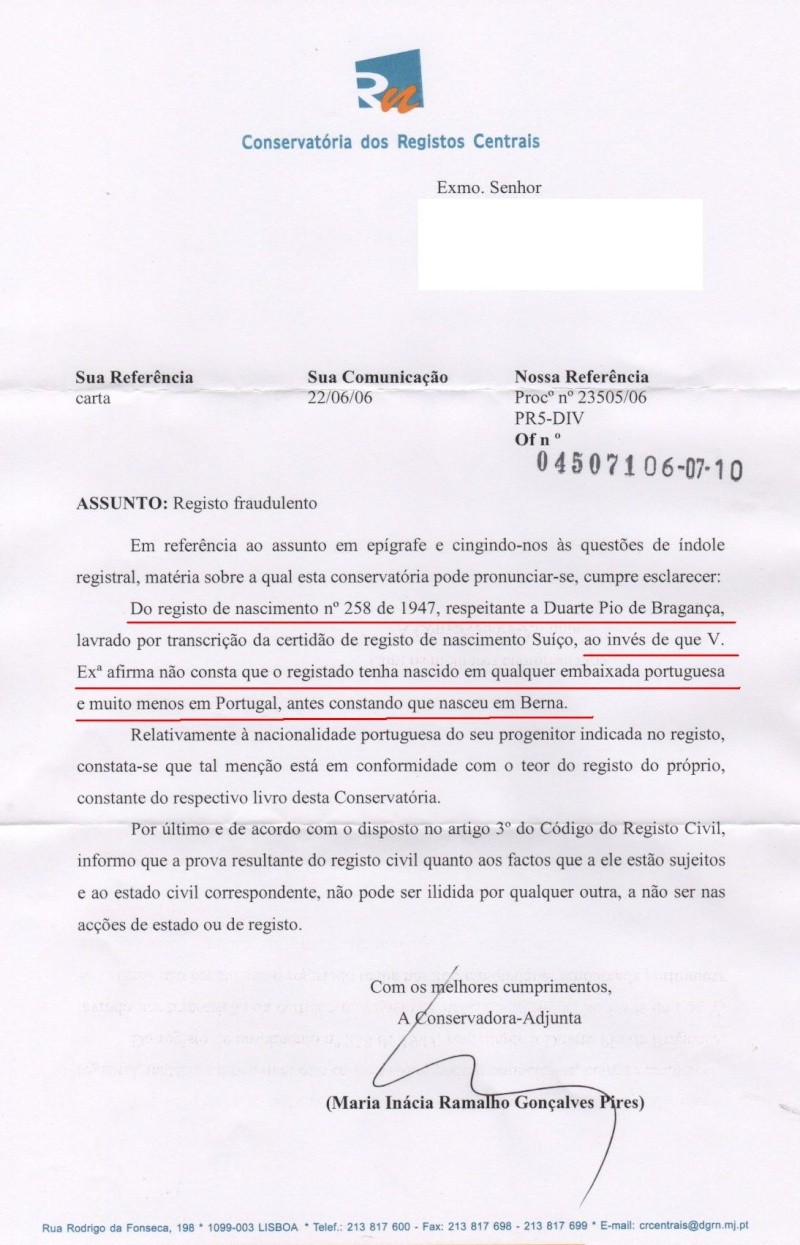
[edit]The term dynastic order is also used for those orders that continue to be bestowed by former monarchs and their descendants after they have been removed from power.[6] For instance, the website of Duarte Pio de Bragança,[7] a pretender to the throne of Portugal using the title Duke of Braganza, asserts that the Order of the Immaculate Conception of Vila Viçosa,[8] "being a Dynastic Order of the House of Bragança and not an Order of State, continued to be conferred by the last King Dom Manuel II, in the exile." On the basis of his succession to King Manuel II, Duarte Pio continues to award those orders of the Kingdom of Portugal[9] not taken over by the Portuguese Republic.[10]
The Portuguese Republic views things somewhat differently, regarding all the royal orders as extinct following the 5 October 1910 revolution with some of them revived in republican form in 1918.[11] For official purposes, Portugal simply ignores the orders awarded by the royal pretender, Duarte Pio.[10] Although no one is prosecuted for accepting orders from Dom Duarte, including himself, Portuguese law requires government permission to accept any official award, either from Portugal or foreign powers; the awards of Dom Duarte simply do not appear anywhere on either list.[12]
Italy
[edit]A similar situation exists in Italy, where the Republican Government regards the orders of the former kings to have been abolished[13] but the last king's heir continues to award them.[14] However, the Italian situation is unique, since the Order of Saints Maurice and Lazarus is one of the few orders of knighthood that has been explicitly recognized by a papal bull, in which Pope Gregory XII gave the House of Savoy the right to confer that knighthood in perpetuity.[15] Thus, under principles of international law, the Italian heir to the throne in exile asserts that control of the Savoy dynastic orders exists separate from the Kingdom of Italy so that he retains the right to award the orders, and accompanying privileges."[16] The royal family of Savoy additionally have the Supreme Order of the Most Holy Annunciation which is their highest ranked order of Knighthood. In addition to this the Order of Merit of Savoy is a Dynastic order knighthood given out by the head of the Royal House of Savoy, Order of chivalry. Following the demise of the last reigning monarch Umberto II of Italy in 1983, the Order of the Crown of Italy was replaced in 1988 by the Order of Merit of Savoy which was instituted by his heir, the current head of the former Royal House, Vittorio Emanuele, Prince of Naples.[17] While the Ordine al merito d'Savoia it has never been a national order, it is subsidiary to the Civil Order of Savoy which was the Order of Merit and it has around 2,000 members and, as with the Order of the Crown of Italy previously, it is entrusted to the Chancellor of the Order of Saints Maurice and Lazarus.
In addition to this Italy contains orders of the royal House of Bourbon-Two Sicilies which still confer their Dynastic Knightly orders. The most interesting of which is the Sacred Military Constantinian Order of Saint George because the Italian Republic recognises the order as an Order of Chivalry under Law n° 178 of 1951 authorises the Italian citizens awarded with the Constantinian decoration to show them as authoritatively recognised also by the Italian State Council in its decision number 1869/81. Therefore those citizens lawfully awarded with Constantinian decorations can ask to use them on the territory of the Italian Republic by Presidential Decree or Decree of the Ministry of Foreign Affairs. By Decree of the President of the Republic, in 1973 the National Italian Association of the Knights of the Sacred Military Constantinian Order of St. George.[18] Additionally there is the Royal Order of Francis I of the Kingdom of the Two Sicilies. One branch of the family (led by Prince Carlo, Duke of Castro) claims that the Order of Francis I was attached to the crown not the state, and thus awards it as a dynastic order.[19] The other branch (led by Infante Carlos, Duke of Calabria) regards the Order of Francis I as a state order that became extinct when the Borbon-Two Sicilies royal family accepted the abolition of their monarchy and the state's inclusion in the Kingdom of Italy.[20]
Russia
[edit]A third situation of mutual co-existence is maintained in Russia, where, since the fall of communism, the orders of Saint Andrew, Saint George, and Saint Catherine have been reinvented as State Orders of Merit of the Russian Federation. However, the Russian Imperial Orders of Saint Andrew, Saint George, Saint Catherine, Saint Anna, Saint Vladimir, and Saint Stanislav have continued to be awarded since the revolution by the successive heads of the Imperial House of Romanov Grand Duke Kirill Vladimirovich, Grand Duke Vladimir Kirillovich, and Grand Duchess Maria Vladimirovna. In addition, Dynastic Orders of Knighthood were revived and new ones created under Grand Duke Kirill (Order of Saint Nicholas the Wonderworker), Grand Duke Vladimir (Order of St. Michael the Archangel), and Grand Duchess Maria Vladimirovna (Order of St. Anastasia). Awards of these honours are allowed to be worn in Russia, and enjoy semi-official recognition by the church and the state; for example, on 14 December 2001 the Ministry of Defence of the Russian Federation legalized the wearing of the Order of Saint Nicholas the Wonderworker in Russia by military persons on active duty.[21]
Central Europe
[edit]In Central Europe, the head of the Habsburg family had the right to dispose of the Order of the Golden Fleece even after 1918. The very extensive treasure and the associated archive are in the Vienna Treasury. The Republic of Austria has expressly confirmed this. During the Nazi era, many Habsburg goods and orders were expropriated and dissolved. The USSR maintained this state of affairs during the Cold War to prevent any opposition among its oppressed peoples. After the collapse of communism, the order of St. George was reactivated by the Habsburg family as a Central European dynasty order. With both the Order of the Golden Fleece and the Order of St. George, deserved personalities are made knights today.[22][23][24][25][26]
Various dynastic orders
[edit]There are many dynastic orders of knighthood, primarily in Europe.[27] Today, dynastic orders include those still being bestowed by a reigning monarch, those bestowed by the head of a royal house in exile, and those that became extinct. Although it is sometimes asserted that the heads of former reigning houses retain the right to their dynastic orders but cannot create new ones,[28] that view is challenged by others who believe that the power to create orders remains with a dynasty forever.[29] In a few cases, formerly reigning families are accused of "fudging" the issue by claiming to revive long extinct orders[30] or by changing non-dynastic state orders into dynastic ones.[31] One example of this is the Order of Saint Michael of the Wing,[32] which is sometimes described as a revival of a long dormant order last awarded in the eighteenth century[33] but also described as a new order created in 2004.[34] Finally, there is the example of a Russian pretender Maria Vladimirovna who published a decree on 20 August 2010 to create the entirely new Imperial Order of the Holy Great Martyr Anastasia.[35]
Bestowed by the Holy See
[edit]Although some former royal families and their supporters claim that Roman Catholic Church formally recognizes their right to award various orders, the Vatican denies all such assertions.[36] On 16 October 2012, the Vatican Secretary of State renewed its formal announcement that it only recognizes the orders issued by the Pope, namely:[36]
- Supreme Order of Christ
- Order of the Golden Spur
- Order of Pope Pius IX
- Order of Saint Gregory the Great
- Order of Pope Saint Sylvester
Under Papal protection
[edit]Explicitly recognized by papal bull
[edit]The Secretary of State cautioned that "other orders, whether of recent origin or mediaeval foundation, are not recognised by the Holy See...To avoid any possible doubts, even owing to illicit issuing of documents or the inappropriate use of sacred places, and to prevent the continuation of abuses which may result in harm to people of good faith, the Holy See confirms that it attributes absolutely no value whatsoever to certificates of membership or insignia issued by these groups, and it considers inappropriate the use of churches or chapels for their so-called 'ceremonies of investiture.'"[36]
Bestowed by current sovereign monarch
[edit]- The Most Noble Order of the Garter (United Kingdom)[3]
- The Distinguished Order of the Golden Fleece (Spain)[37]
- The Order of the Gold Lion of the House of Nassau (Netherlands and Luxembourg)[38]
- The Royal Victorian Order (Commonwealth realms)[3]
- The Order of the Elephant (Denmark)[39]
- The Order of the Dannebrog (Denmark)
- The Order of Merit (Commonwealth realms)[3]
- The Order of the House of Orange (Netherlands)[40]
- The Most Ancient and Most Noble Order of the Thistle (United Kingdom)[3]
- The Royal Order of the Seraphim (Sweden)
- The Royal Norwegian Order of Saint Olav (Norway)
- The Order of al-Hussein bin Ali (Jordan)
Bestowed by head of formerly reigning dynasty
[edit]
- The Order of Saint George (Bavaria-Wittelsbach)[41]
- The Order of St. Hubert (Bavaria-Wittelsbach)[42]
- The Order of Theresa (Bavaria-Wittelsbach)
- The Order of Saint Alexander (Bulgaria)
- The Imperial Ethiopian Order of Saint Mary of Zion (Ethiopia)
- The Order of the Holy Spirit (France)[43][44][45]
- The Order of Saint Michael (France)[43][46]
- The Order of the Eagle of Georgia (Georgia, Bagrationi Dynasty)[47][48]
- The Royal Order of the Crown of Georgia Kingdom (Georgia, Nugzar Bagration-Gruzinsky)
- The House Order of Hohenzollern (Hohenzollern, Germany)
- The Order of Saints George and Constantine, (former Greek royal family)
- The Order of Saints Olga and Sophia, (former Greek royal family)
- The Order of Skanderbeg (Albania, House of Zogu)
- The Imperial Austrian Order of Elizabeth (Habsburg-Lorraine)[49]
- The Noble Order of the Golden Fleece[50] (Habsburg-Lorraine)[51][52]
- The Order of the Starry Cross (Habsburg-Lorraine)[53][54]
- The Order of St. George (Habsburg-Lorraine)
- The Order of Vitéz (Habsburg-Lorraine)
- The Order of Saint Stephen of Hungary (Hungary)
- The Order of Prince Danilo I (Montenegro)[55]
- The Order of Petrovic Njegos (Montenegro)[56]
- The Order of Saint Peter of Cetinje (Montenegro)[57]
- The Order of Saint George of Parma (Parma)[58][59]
- The Order of the Immaculate Conception of Vila Viçosa (Portugal, House of Braganza)[60]
- The Order of Saint Isabel (Portugal, House of Braganza)
- The Order of Merit of the Portuguese Royal House (Portugal, House of Braganza)
- The Order of Saint Michael of the Wing (Portugal, House of Braganza)[32]
- The Order of Carol I (Romania, order founded in 1906 and discontinued with King Michael's abdication in 1947, and then revived by him on 5 January 2005 as a dynastic order)[61]
- The Order of the Crown (Romania), founded as a state order it was revived by King Michael I as a Dynastic Order in 2011.[62]
- The Order of Saint Andrew (Imperial House of Russia)
- The Order of Saint Catherine (Imperial House of Russia)
- The Order of Saint Alexander Nevsky (Imperial House of Russia)
- The Order of the White Eagle (Imperial House of Russia)
- The Order of Saint Anna (Imperial House of Russia)[63]
- The Order of Saint Vladimir (Imperial House of Russia)
- The Order of Saint Nicholas the Wonderworker (Imperial House of Russia, a modern order created in exile on 1 August 1929 by the pretender Kirill Vladimirovich, a cousin of the last Tsar, Nicholas II of Russia)[64]
- The Order of Saint Stanislav (Imperial House of Russia)
- The Order of Saint Anastasia (Imperial House of Russia), a modern order created in exile in 2010 by the Head of the Imperial House.
- The Order of Saint Michael the Archangel (Imperial House of Russia, a modern order created in exile in 1988 by the Head of the Imperial House Vladimir Kirillovich
- The Royal Order of the Intare (Rwanda)
- The Supreme Order of the Most Holy Annunciation (Savoy)[65]
- The Order of Saints Maurice and Lazarus (Savoy)[65]
- The Order of Merit of Savoy (Savoy)
- The Order of Parfaite Amitié (Thurn and Taxis)
- The Order of Saint Joseph (Tuscany)
- The Sacred Military Constantinian Order of Saint George (Two Sicilies)
- The Order of Saint Januarius (Two Sicilies)
- The Royal and Hashemite Order of the Pearl (Sulu, Royal House of Sulu)
- The Imperial Order of the Lion of Mandé (Mali, Imperial House of Mandé)
- The Order of the Rose (Brazil, House of Orleans-Braganza)
- The Order of the Southern Cross (Brazil, House of Orleans-Braganza)
- The Order of Saint James of the Sword (Brazil) (Brazil, House of Orleans-Braganza)
- The Imperial Order of Christ (Brazil, House of Orleans-Braganza)
- The Order of Pedro I (Brazil, House of Orleans-Braganza)
- The Order of the Rasulids (Royal House of Tahir Buruj of the Rasulid dynasty)[66]
Bestowed by head of non-sovereign traditional monarchies
[edit]- The Royal Order of Merit of Prince Uchicho (Bolivia, House of Pinedo)[67]
- The Order of King Pōtatau Te Wherowhero (Aotearoa) - Established in 2014 by Māori King Tūheitia as an independent honours system separate from the New Zealand government and Commonwealth sovereignty.[68]
See also
[edit]References
[edit]- ^ Geller, Jonny (24 June 2010). "Bonington awarded the Royal Victorian Order". News. Curtis Brown Literary and Talent Agency. Retrieved 27 November 2012.
The Royal Victorian Order is a dynastic order of knighthood and a house order of chivalry recognising distinguished personal service to the order's Sovereign
- ^ Duren, Peter Bander van (1987). The cross on the sword : supplement to 'Orders of Knighthood, awards and the Holy See' [third edition]. Gerrards Cross: Van Duren. pp. 2–17. ISBN 9780905715322.
- ^ a b c d e "Governance of Britain: Review of the Executive Royal Prerogative Powers: Final Report". Ministry of Justice. 2009-10-15. p. 6. Archived from the original on 2009-12-24. Retrieved 2011-01-20.
- ^ "Royal Honours, Other Honours". Chancellery of the Netherlands Orders. 2001-08-15. Archived from the original on 2011-04-25. Retrieved 2011-01-29.
- ^ "Royal Honours, Civil Orders and the Civil Honours Advisory Commission". Chancellery of the Netherlands Orders. 2001-08-15. Archived from the original on 2011-09-02. Retrieved 2011-01-29.
- ^ Duren, Peter Bander van (1995). Orders of knighthood and of merit : the pontifical, religious and secularised Catholic-founded Orders and their relationship to the Apostolic See. Gerrards Cross: Smythe. p. 217. ISBN 9780861403714.
- ^ Conservatória dos Registos Centrais - Registo fraudulento de nacionalidade, accessed 20 January 2011.
- ^ Serafin, Thomas J. "Knighthood Bestowed". Saints Alive. USA Territorial Headquarters of the ICHR/USA. Retrieved 2011-01-21.
- ^ Rodrigues Lima, Carlos (2009-01-09). "Nuno da Câmara Pereira ganha batalha judicial a D. Duarte". Diário de Notícias (in Portuguese). Archived from the original on 2011-09-28. Retrieved 2011-01-21.
No processo cível, a Casa Real invocou que a expressão..."o uso das insígnias e denominações das Ordens Dinásticas são pertença da Casa Real portuguesa e do senhor D. Duarte". (In civil proceedings, the Royal House has argued..."the use of emblems and names of the Dynastic Orders are owned by the Portuguese Royal House and Dom Duarte.")
- ^ a b "REGULAMENTO DAS ORDENS HONORÍFICAS PORTUGUESAS" (PDF). Chancelaria das Ordens Honoríficas Portuguesas, Presidência da República. 2006–2010. Archived from the original (PDF) on 2011-01-21. Retrieved 2011-01-20.
- ^ "AS ORDENS HONORÍFICAS PORTUGUESAS". Chancelaria das Ordens Honoríficas Portuguesas, Presidência da República. 2006–2010. Archived from the original on 2011-01-21. Retrieved 2011-01-20.
- ^ "Cidadãos Portugueses com Condecorações Estrangeiras, 1926-2007" (PDF). Chancelaria das Ordens Honoríficas Portuguesas, Presidência da República. 2007. Archived from the original (PDF) on 2010-08-03. Retrieved 2011-01-20., "ANUÁRIO ORDENS HONORÍFICAS PORTUGUESAS, 1975-2007" (PDF). Chancelaria das Ordens Honoríficas Portuguesas, Presidência da República. 2007. Archived from the original (PDF) on 2011-01-21. Retrieved 2011-01-20.
- ^ "L. 3 marzo 1951, n. 178 (1). Istituzione dell'Ordine "Al merito della Repubblica italiana" e disciplina del conferimento e dell'uso delle onorificenze (2)". Presidenza della Repubblica. Retrieved 2011-01-20.
- ^ John Hooper (2006-06-23). "The fall of the house of Savoy". guardian.co.uk. Retrieved 2011-01-20.
- ^ "Order of Saint Lazarus: Primary sources" (PDF).
- ^ "A Brief History of the Orders of Saint Maurice and Lazarus". Archived from the original on 2011-07-24. Retrieved 2011-01-20.
- ^ Bennett, Eric (2005-04-07), "Savoy Ballroom", African American Studies Center, Oxford University Press, doi:10.1093/acref/9780195301731.013.43280, ISBN 978-0-19-530173-1, retrieved 2022-09-20
- ^ Deym, Maximilian (2020-12-13), "Annotazioni sul Sacro Militare Ordine Constantiniano di San Giorgio", Sapientia, Temperantia, Fortitvdo, Ivstitia, Wien: Böhlau Verlag, pp. 618–640, doi:10.7767/9783205210641.618, ISBN 978-3-205-21062-7, S2CID 230545188, retrieved 2022-09-20
- ^ "The Royal Order of Francis (Francesco) I". Sacred Military Constantinian Order of Saint George, Delegation for Great Britain and Ireland. 2008. Archived from the original on 2008-10-06. Retrieved 2011-01-21.
Royal Order of Francis I remains an ancient, dynastic and internationally recognised institution. The Order, which is neither a state decoration of the Italian Republic or the Holy See, has continued to be conferred long after the overthrow of King Francesco II, in 1861. Today the Order is bestowed by HRH The Duke of Castro, as Head of the Royal House of Bourbon of the Two Sicilies, and a great-great-great grandson of the Order's founder.
- ^ "Royal Order of Francis I". The Royal House of the Two Sicilies. 2006. Archived from the original on 2011-07-25. Retrieved 2011-01-21.
The Order was not awarded after 1920, however, and as a state merit award was allowed to become extinct
- ^ Sainty, Guy Stair, ed. (2006). World Orders of Knighthood and Merit. Burke's. ISBN 0-9711966-7-2.
- ^ Peter Diem "Die Symbole Österreichs (German - The symbols of Austria)" (1995), p 214.
- ^ Johannes Krejci "Aus der Geschichte des Alten Ordens vom St. Georg.", Wien 2002
- ^ Frank Millard "The Palace and the Bunker: Royal Resistance to Hitler" 2011.
- ^ Homepage of the St. Georgsorden
- ^ Birgit Schwarz "Hitlers Sonderauftrag Ostmark: Kunstraub und Museumspolitik im Nationalsozialismus" (2018), p 129; James Longo "Hitler and the Habsburgs: The Fuhrer's Vendetta Against the Austrian Royals" (2018).
- ^ Lantz, Gunnar Boalt, Robert Eriksson, Harry Glück, Herman (1972). The European orders of chivalry. Carbondale: Southern Illinois U.P. pp. 1–17. ISBN 978-0809305063.
{{cite book}}: CS1 maint: multiple names: authors list (link) - ^ Trost, Ernst & Franz Goëss (1983). Das blieb vom Doppeladler: 04-Der Orden vom Goldenen Vlies (in German). Vienna, Austria: Österreichischer Rundfunk. Archived from the original (Videocassette) on 21 January 2013. Retrieved 27 November 2012.
- ^ See, for instance, the website of Maria Vladimirovna, a pretender to the throne of Russia announcing the creation of an entirely new order of knighthood in 2010, "The Head of the House of Romanoff has established for women the Imperial Order of St. Anastasia in Honor of the First Tsaritsa of the Romanoff Family, Anastasia Romanovna". www.imperialhouse.ru/. 2010-08-20. Archived from the original on 2016-03-26. Retrieved 2011-01-21.
- ^ For an example of such discussions see, Anderson, James (1732). Royal genealogies: or, The genealogical tables of emperors, kings and princes, from Adam to these times; in two parts. London: James Bettenham. pp. ix. Retrieved 9 December 2011.
St Michael's Wing in Portugal founded by the said King Alphonse 1165 or 1171 after his obtaining a notable Victory over Moors and Alberto King of Seville in which Battle MICHAEL the Arch Angel is said to appear on the right Side of Alphonse and fight against them. This Order is now out of use. (1732)
, Gieseler, John C. L. (also known as Johann K.L. Gieseler (2009). A Text-Book of Church History. BiblioBazaar. pp. 447–48. ISBN 978-1-116-21129-0., and Almeida, Gomes Abrunhosa Marques de and Manuel Ângelo (2007). Precedentes histórico-teóricos dos regionalismos dos Açores e da Galiza. Santiago de Compostela: Univ Santiago de Compostela. p. 187. - ^ Velde, François R (2003-11-24). "Royal Order of Francis I". rec.heraldry. Retrieved 2011-01-21.
It is an order of the kingdom of the Two Sicilies, a political entity that disappeared 143 years ago. There are currently rival claimants to be head of the dynasty that once ruled the Two Sicilies, and one claimant has of late begun to bestow that order, although it had been discontinued. The fact that it was clearly a state order, and that it fell into disuse for so long before being resurrected by one claimant, makes it a little odd.
- ^ a b Rodrigues Lima, Carlos (2009-01-09). "Nuno da Câmara Pereira ganha batalha judicial a D. Duarte". Diário de Notícias (in Portuguese). Archived from the original on 2011-09-28. Retrieved 2011-01-21.
Juíza vinca que Portugal é uma República, desvalorizando herança. O Tribunal Cível de Lisboa acaba de dar razão a Nuno da Câmara Pereira num conflito que o opunha a D. Duarte de Bragança, obrigando este último a desistir da denominação Real Ordem de São Miguel de Ala, uma ordem que criou em 2004. (Judge stresses that Portugal is a Republic, and values heritage. The Civil Court of Lisbon has just ruled in favor of Nuno da Câmara Pereira in a conflict with Dom Duarte de Bragança, forcing the latter to give up the name the Royal Order of Saint Michael of the Wing, an order created in 2004.)
- ^ Sainty, Guy Stair. "A Summary of the Use of the Royal Prerogative, Its Use by the Heirs to Former Thrones, and by Republican or Revolutionary Regimes". www.chivalricorders.org. Retrieved 2011-01-21.
re-established a long dormant Order, that of Saint Michael of the Wing, with members across Europe and a handful in the United States (now reformed as an Association rather than an Order)
- ^ Rodrigues Lima, Carlos (2009-01-09). "Nuno da Câmara Pereira ganha batalha judicial a D. Duarte". Diário de Notícias (in Portuguese). Archived from the original on 2011-09-28. Retrieved 2011-01-21.
Real Ordem de São Miguel de Ala, uma ordem que criou em 2004. (Royal Order of Saint Michael of the Wing, an order created in 2004.)
- ^ "The Head of the House of Romanoff has established for women the Imperial Order of St. Anastasia in Honor of the First Tsaritsa of the Romanoff Family, Anastasia Romanovna". www.imperialhouse.ru/. 2010-08-20. Archived from the original on 2016-03-26. Retrieved 2011-01-21.
- ^ a b c "Note of Clarification from the Secretariat of State". news.va. Pontifical Council for Social Communication. 16 October 2012. Archived from the original on 18 October 2016. Retrieved 27 November 2012.
Vatican City, (VIS) – In response to frequent requests for information concerning the recognition by the Holy See of Equestrian Orders dedicated to the saints or to holy places, the Secretariat of State considers it opportune to reiterate what has already been published, namely that, other than its own Equestrian Orders (the Supreme Order of Christ, the Order of the Golden Spur, the Pian Order, the Order of Saint Gregory the Great, and the Order of Pope Saint Sylvester), the Holy See recognises and supports only the Sovereign Military Order of Malta – also known as the Sovereign Military Hospitaller Order of Saint John of Jerusalem of Rhodes and of Malta – and the Equestrian Order of the Holy Sepulchre of Jerusalem. The Holy See foresees no additions or innovations in this regard. All other orders, whether of recent origin or mediaeval foundation, are not recognised by the Holy See. Furthermore, the Holy See does not guarantee their historical or juridical legitimacy, their ends or organisational structures. To avoid any possible doubts, even owing to illicit issuing of documents or the inappropriate use of sacred places, and to prevent the continuation of abuses which may result in harm to people of good faith, the Holy See confirms that it attributes absolutely no value whatsoever to certificates of membership or insignia issued by these groups, and it considers inappropriate the use of churches or chapels for their so-called "ceremonies of investiture".
- ^ Cardinale, Hyginus Eugene (31 December 1985). Orders of Knighthood Awards, and the Holy See. Chester Springs, PA: Dufour Editions, Inc. p. 140. ISBN 978-0-905715-26-1.
- ^ Information and Press Service of the Luxembourg Government. "Honorary distinctions of the Grand Duchy of Luxembourg" (PDF). Ministry of State/Information and Press Service of the Luxembourg Government. Retrieved 2011-01-21.
The brevet is awarded in agreement with the head of the Ottonian branch of the House of Nassau (The Netherlands).
- ^ The Royal House of Denmark. "The Royal Orders of Chivalry". The Danish Monarchy. Kongehuset. Archived from the original on 2011-03-09. Retrieved 2011-01-21.
Now, as always, the decision to award an Order remains with the Master of the Order, HM The Queen, and is hers alone.
- ^ The Government Information Service (RVD) (2011-01-13). "Orders for services to the Royal House". Dutch Royal House. Ministry of General Affairs of the Netherlands. Archived from the original on 2011-04-26. Retrieved 2011-01-21.
There are two such orders...the Order of the House of Orange... conferred on persons who have rendered special service to the Royal House...The Queen is Grand Master of the Order of the House of Orange.
- ^ Arnold, Clarisa Sands (2009). Four girls in europe : four girls in europe. [S.l.]: Iuniverse Inc. p. 231. ISBN 9781440186585. Retrieved 27 November 2012.
- ^ Cardinale, Hyginus Eugene (1984). Bander van Duren, Peter (ed.). "The Royal House of Bavaria (Wittelsbach)". Orders of Knighthood, Awards and the Holy See. Gerrards Cross, Buckinghamshire: Van Duren: 152–53. ISBN 0905715233.
The Royal House of Bavaria (Wittelsbach)...The Order of St George, Defender of the Faith in the Immaculate Conception...The Order of St Hubert
- ^ a b Cardinale, Hyginus Eugene (1984). Bander van Duren, Peter (ed.). "The Royal House of Bourbon-Orleans". Orders of Knighthood, Awards and the Holy See. Gerrards Cross, Buckinghamshire: Van Duren: 154–56. ISBN 0905715233.
The Royal House of Bourbon-Orleans, The Order of the Holy Ghost...The Order of St. Michael of France
- ^ État présent de la maison de Bourbon. Quatrième édition. Paris, Le Léopard d’or, 1991; p. 222: « Louis XIX, Henri V, Charles XI et Jaques I continuèrent à donner l’ordre dans la discrétion et en 1972, Jacques-Henri VI suivit leur exemple, sont fils Alphonse II faisant de même. L’État présent… donne ensuite le nom de quatre chevaliers, créés par lettres patentes de 1972 et 1973.
- ^ Warner, Gerald (29 May 2010). "French royalists celebrate the birth of twin sons to Louis XX, rightful King of France". The Telegraph. Archived from the original on 31 May 2010. Retrieved 3 December 2012.
The Duke and Duchess of Anjou and their daughter were recently received in private audience by Pope Benedict XVI, when the head of the Bourbon dynasty wore the cordon and plaque of the Order of the Holy Ghost, of which he claims to be hereditary Grand Master. This news will give immense pleasure to French legitimists and traditionalists who have never abandoned the principles of Throne and Altar and for whom Louis XX is the embodiment of the France of Saint Louis and his descendants, the Most Christian Kings.
- ^ "Biographie de Monseigneur le Duc d'Anjou". Institut du Duc d'Anjou. 17 May 2011. Archived from the original on 22 February 2013. Retrieved 3 December 2012.
En qualité de chef de la Maison de Bourbon, il est le Grand-maître des ordres de Saint-Michel (fondé par Louis XI) et du Saint-Esprit (fondé par Henri III).
- ^ "Order Eagle of Georgia". Royal family of Georgia.
- ^ "Login".
- ^ "Archduchess Regina von Habsburg". The Telegraph. 2010-02-10. Retrieved 2011-01-26.
Archduchess Regina von Habsburg....was Protectress of the Order of the Starry Cross, an all-female Roman Catholic order founded in the 17th century; Grand Mistress of the Order of Elisabeth, a similar organisation
- ^ Covert, Glen (15 May 2008). The Habsburg Most Illustrious Order of the Golden Fleece: Its potential relevance on modern culture in the European Union (PDF). Ljubljana, Slovenia: The Historical Seminar, Scientific Research Center, Slovenian Academy of Sciences and Arts. pp. 40–41. Retrieved 27 November 2012.
But the world has changed somewhat since 1430 including that the Sovereign of the Order of the Golden Fleece is not a reigning monarch: Archduke Karl of Austria....Nevertheless, only briefly in Der österreichische Orden vom Goldenen Vlies. Geschichte und Probleme (1971) did Annemarie Weber characterize its nature as an entity with an Austria-recognized international legal personality, its existence dependent upon its recognition in international politics.
- ^ Opfell, Olga S (2001). Royalty Who Wait: The 21 Heads of Formerly Regnant Houses of Europe. Jefferson, North Carolina: McFarland & Company. pp. 8–10. ISBN 978-0-7864-0901-3.
- ^ "Archduchess Regina von Habsburg". The Telegraph. 2010-02-10. Retrieved 2011-01-26.
Although Otto was the heir to the Austrian Empire, he was unusual among "pretenders" in electing to ignore his aristocratic title, preferring to style himself Dr Otto von Habsburg; in 1979 he was voted into the European Parliament as Christian Democrat member for North Bavaria and served for the next 20 years, becoming the highly-regarded Father of the House and its only member to have been born before the First World War. He never claimed the throne of Austria, and in 2000 renounced his sovereignty of the Order of the Golden Fleece, the last sign of his leadership of the Imperial Family.
- ^ "Archduchess Regina von Habsburg". The Telegraph. 2010-02-10. Retrieved 2011-01-26.
She herself was Protectress of the Order of the Starry Cross, an all-female Roman Catholic order founded in the 17th century
- ^ Brook-Shepherd, Gordon (2004-01-17). Uncrowned emperor: the life and times of Otto von Habsburg. London: Hambledon & London. pp. 234. ISBN 978-1-85285-439-3.
After Regina, she will be the head of our Order!
- ^ "Constantinian Order knights decreed into Royal Order of Danilo I of Montenegro". The Sacred Military Constantinian Order of Saint George: Delegation for Great Britain and Ireland. London: The Chancery of Sacred Military Constantinian Order of Saint George, Delegation of Great Britain and Ireland. 31 December 2007. Archived from the original on 23 December 2012. Retrieved 27 November 2012.
Podgorica – December 2007. HRH Crown Prince Nicholas II of Montenegro has decreed three delegation Knights into the Royal Order of Danilo I. The awards of Knight Grand Cross have been awarded to the Constantinian Order's Grand Magistral Delegate for Inter-Religious Relations, HE Anthony Bailey, and to HE Ambassador Dr Peter Löw. Dr Martin Vorderwülbecke was decreed to the rank of Knight Commander. The awards were made in recognition of their contribution to interfaith and charitable work within Montenegro. The Montenegro dynasty ruled from 1711 and in 2007 Montenegro regained its full independence following a referendum to separate from Serbia. The first Montenegrin state Order was established by HRH Prince Danilo Petrovic in 1853, as the Order of Danilo I for the independence of Montenegro in 1852-53. This Decoration is still awarded to prominent champions of the preservation of Montenegrin independence and the conditions by which the Order is awarded were defined by Statute. Many deserving men and women have been awarded the Order of Prince Danilo I over time including foreigners. The illustrious list includes many decorated servicemen during the World Wars and a host of other notables, including Queen Victoria and King Edward VII of Great Britain. Recent recipients include HE The President of the Republic of Montenegro, HMEH Fra' Andrew Bertie, Prince and Grand Master of the Order of Malta, HSH Sovereign Prince Albert II of Monaco, HRH The Duke of Braganza, HRH The Count of Paris and other senior members of reigning and non-reigning dynasties. The Order is recognised by the Republic of Montenegro.
- ^ "Order of Petrović-Njegoš". orderofdanilo.org. Cetinje, Montenegro: Order of Prince Danilo I of Montenegro. 5 March 2009. Archived from the original on 16 May 2009. Retrieved 5 December 2012.
The Order is given to members of the Dynasty and kinsmen exclusively and is not an Order that is generally given beyond that. The Order was not bestowed in 1996 while Montenegro remained a non-sovereign state. In 2008, celebrating the passage of 300 years since the first Petrovic Njegoš rulers ascent, the Crown Prince of Montenegro bestowed the Order in recognition of this landmark.
- ^ "Order of Saint Peter". orderofdanilo.org. Cetinje, Montenegro: Order of Prince Danilo I of Montenegro. 2 May 2006. Archived from the original on 19 July 2011. Retrieved 5 December 2012.
The Order of Saint Peter is the House Order of the Royal House of Montenegro and the present Grand Master is H.R.H. Crown Prince Nikola of Montenegro and the Grand Chancellor is John Gvozdenović Kennedy. The Order consists of a single class, and is normally reserved for members of the Royal Family and their kinsmen and in exceptional circumstances prominent foreign citizens.
- ^ "HRH Prince Carlos Hugo". The Telegraph. 2010-08-24. Retrieved 2011-01-26.
He also claimed to be head of the Constantinian Order of St George.
- ^ Conforti, Paolo (2007). I Borbone Parma Gran Maestri del Sacro Angelico Imperiale Ordine Costantiniano di San Giorgio. www.borboneparma.it.
- ^ Haffner, Paul; Foreword by Dom Duarte, Duke of Braganza (2004). "Foreword". The Mystery of Mary. Chicago, Illinois: Liturgy Training Publications. pp. xi–xii. ISBN 978-1-59525-008-7.
I have the honour of being the Grand Master of the order of Our Lady of Conception.
- ^ "Ordinul Carol I" (in Romanian). www.familiaregala.ro. 2009-12-30. Retrieved 2011-01-21.
Alin 1. La data de 5 ianuarie 2005 a fost reinviat "Ordinul Carol I", ca Ordin dinastic, de familie. (On 5 January 2005, the Order of Carol I was revived as a dynastic-family Order.)
- ^ "Familia Regala - Ordinului Coroana Romaniei". Archived from the original on 2015-02-06. Retrieved 2012-03-13.
- ^ "Heads of the Order". Order of Saint Anna (in English and Russian). [www.saintanna.ru]. 2006. Retrieved 2011-01-26.
Heads of the Order...Grand Duchess Maria Vladimirovna
- ^ "Decree №1/Nic.-2001". www.imperialhouse.ru. 2001-08-04. Archived from the original on 2015-07-12. Retrieved 2011-01-21.
On 1 August (19 July O.S) 1929, in fulfilment of the intentions of the Tsar-Martyr Nicholas II and in honor of his memory as the Supreme Commander of the valiant Imperial Army and Navy of old, Our Grandfather the Emperor Kirill I of blessed memory, established the Order of St. Nicholas the Wonderworker, the purpose of which was to award the veterans of the Great War of 1914–1918.
- ^ a b Cardinale, Hyginus Eugene (1984). Bander van Duren, Peter (ed.). "Catholic dynastic orders bestowed by a sovereign in exile". Orders of Knighthood, Awards and the Holy See. Gerrards Cross, Buckinghamshire: Van Duren: 135–39. ISBN 0905715233.
Two examples of Catholic Dynastic Orders conferred by a Sovereign in exile are "the Supreme Order of the Most Holy Annunciation" and the "Order of SS. Maurice and Lazarus", both belonging to the Royal House of Savoy and taken by ex-King Umberto of Italy into exile (1946)....King Umberto II died in exile on 18 March 1983. The Grand Mastership of the Order of the Most Holy Annunciation and the Order of SS. Maurice and Lazarus passed to the King's son, Prince Victor Emmanuel, who became the Head of the Royal House of Savoy on the death of his father. Both Orders belong now in the category of Catholic Dynastic Orders bestowed by a legitimate successor of a Sovereign in exile.
- ^ "Royal House of Tahir Buruj". 2021-04-17. Archived from the original on 2021-05-18. Retrieved 2021-05-24.
- ^ "Real Orden del Mérito". Afro-Bolivian Royal House. Retrieved 3 May 2024.
- ^ "Maori King creates honours system". Radio New Zealand. 21 August 2014.
| Distinctions (Lists) |
|    | ||||||||||||||||||||||||||||||||||||
|---|---|---|---|---|---|---|---|---|---|---|---|---|---|---|---|---|---|---|---|---|---|---|---|---|---|---|---|---|---|---|---|---|---|---|---|---|---|---|
| Ceremonies and events | ||||||||||||||||||||||||||||||||||||||
| Related organisations | ||||||||||||||||||||||||||||||||||||||
| Related concepts | ||||||||||||||||||||||||||||||||||||||
| ||||||||||||||||||||||||||||||||||||||