Hubbry Logo
Orion ArmOrion ArmMain
Open search
Orion Arm
Community hub
Orion Arm
logo
8 pages, 0 posts
0 subscribers
Be the first to start a discussion here.
Orion Arm
Orion Arm
from Wikipedia
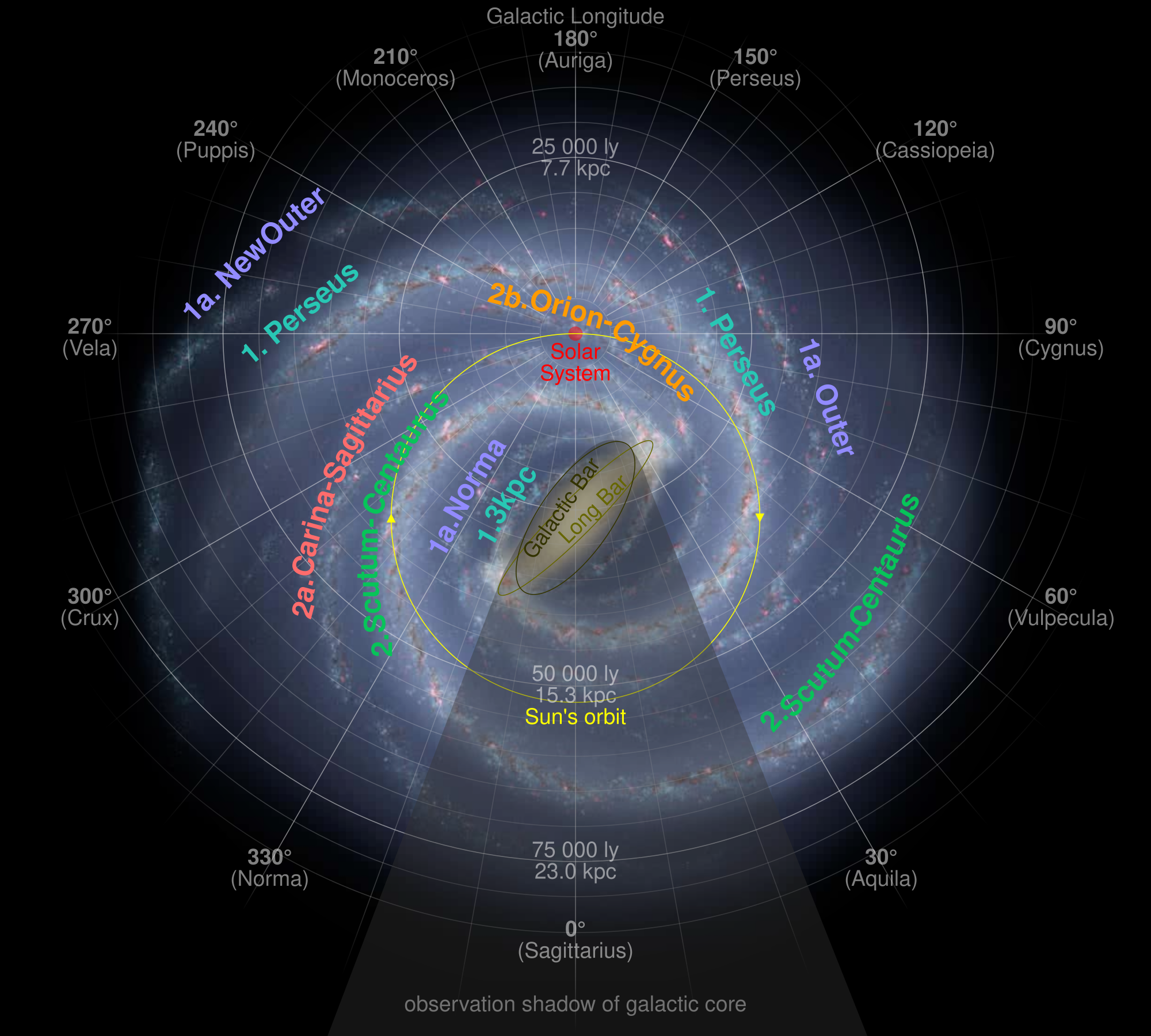
Figure 1.The reconstructed structure of the Milky Way's spiral arms[1]

The Orion Arm, also known as the Orion–Cygnus Arm, is a minor spiral arm within the Milky Way Galaxy spanning 3,500 light-years (1,100 parsecs) in width and extending roughly 20,000 light-years (6,100 parsecs) in length.[2] This galactic structure encompasses the Solar System, including Earth. It is sometimes referred to by alternate names such as the Local Arm or Orion Bridge, and it was previously identified as the Local Spur or the Orion Spur. It should not be confused with the outer terminus of the Norma Arm, known as the Cygnus Arm.

Naming and brightness

[edit]

The arm is named after the Orion Constellation, one of the most prominent constellations of the Northern Hemisphere in winter (or the Southern Hemisphere in summer). Some of the brightest stars in the sky as well as other well-known celestial objects of the constellation (e.g. Betelgeuse, Rigel, the three stars of Orion's Belt, and the Orion Nebula) are found within it, as shown on Orion Arm's interactive map.

Location

[edit]

The Orion Arm is located between the Carina–Sagittarius Arm, the local portion of which projects toward the Galactic Center, and the Perseus Arm's local portion, which forms the main outer-most arm.

Scientists once believed the Orion Arm to be a minor structure, namely a "spur" between Carina-Sagittarius and Perseus, but evidence presented in 2013 suggests the Orion Arm to be a branch of the Perseus Arm or possibly an independent arm segment.[3]

The Solar System is close to its inner rim, about halfway along the arm's length, in a relative cavity in the arm's interstellar medium, known as the Local Bubble. It is approximately 8,000 parsecs (26,000 light-years) from the Galactic Center.

Composition

[edit]

Recently, the BeSSeL Survey (Bar and Spiral Structure Legacy Survey) analyzed the parallax and proper motion of more than 30 methanol (6.7-GHz) and water (22-GHz) masers in high-mass, star-forming regions within a few kiloparsecs of the Sun. Their measurement has accuracy above ±10% and even 3%.[citation needed] The accurate locations of interstellar masers in HMSFRs (high-mass star-forming regions) suggests the Local Arm appears to be an orphan segment of an arm between the Sagittarius and Perseus arms that wraps around less than a quarter of the Milky Way. The segment has a length of ~20,000 ly in length and ~3,000 ly in width, with a pitch angle of 10.1° ± 2.7° to 11.6° ± 1.8°. These results suggest the Local Arm is larger than previously thought, and both its pitch angle and star formation rate are comparable to those of the Galaxy's major spiral arms. The Local Arm is reasonably referred to as the fifth feature in the Milky Way.[4][5][6][7][8]

Form

[edit]

To understand the form of the Local Arm between the Sagittarius and Perseus arms, the stellar density of a specific population of stars with about 1 Gyr of age between 90° ≤ l ≤ 270° have been mapped using the Gaia DR2.[9] The 1 Gyr population have been employed because they are significantly more-evolved objects than the gas in HMSFRs tracing the Local Arm. Investigations have been carried out to compare both the stellar density and gas distribution along the Local Arm. Researchers have found a marginally significant arm-like stellar overdensity close to the Local Arm, identified with the HMSFRs, especially in the region of 90° ≤ l ≤ 190°.[8]

The researchers have concluded that the Local Arm segment is associated only with gas and star-forming clouds, showing a significant overdensity of stars. They have also found that the pitch angle of the stellar arm is slightly larger than the gas-defined arm, and there is an offset between the gas-defined and stellar arm. These differences in pitch angles and offsets between the stellar and HMSFR-defined spiral arms are consistent with the expectation that star formation lags behind gas compression in a spiral density wave that lasts longer than the typical star formation timescale of 107 − 108 years.[10]

Messier objects

[edit]

The Orion Arm contains a number of Messier objects:

Maps

[edit]
A rough artist's depiction of the Orion Arm within the Milky Way, with features marked.
Molecular clouds around the Sun inside the Orion-Cygnus Arm

Interactive maps

[edit]
Rosette NebulaCrab NebulaOrion NebulaTrifid NebulaLagoon NebulaOmega NebulaEagle NebulaNorth America NebulaRigelOrion's BeltPolarisSunBetelgeuseDenebPerseus ArmOrion ArmSagittarius Arm
Orion and neighboring arms (clickable map)
Rosette NebulaSeagull NebulaCone NebulaCalifornia NebulaHeart NebulaOrion NebulaSoul NebulaNorth America NebulaCocoon NebulaGamma Cygni NebulaVeil NebulaTrifid NebulaCrescent NebulaLagoon NebulaOmega NebulaEagle NebulaCat's Paw NebulaEta Carinae NebulaCrab NebulaMessier 37Messier 36Messier 38Messier 50Messier 46Messier 67Messier 34Messier 48Messier 41Messier 47Messier 44Messier 45Messier 39Messier 52Messier 93Messier 7Messier 6Messier 25Messier 23Messier 21Messier 18Messier 26Messier 11Messier 35NGC 2362IC 2395NGC 3114NGC 3532IC 1396IC 2602NGC 6087NGC 6025NGC 3766IC 4665IC 2581IC 2944NGC 4755NGC 3293NGC 6067NGC 6193NGC 6231NGC 6383Tr 14Tr 16Messier 103Messier 29HPerChi PerCol 228O VelPerseus ArmOrion ArmSagittarius ArmStar clusterNebula
The nearest nebulae and star clusters (clickable map)

See also

[edit]

References

[edit]
[edit]
Revisions and contributorsEdit on WikipediaRead on Wikipedia
from Grokipedia
The Orion Arm, also known as the Orion Spur or Orion–Cygnus Arm, is a minor spiral arm of the galaxy. It lies between the major Sagittarius and arms and contains the Solar System, with the Sun positioned near its inner edge toward the .

Overview and Characteristics

Definition and Key Features

The Orion Arm, also known as the Orion Spur or Orion-Cygnus Arm, is a minor spiral arm of the galaxy characterized as a partial or inter-arm structure situated between the major Sagittarius and arms. It spans at least 26,000 light-years (8 kpc) in length and about 3,500 light-years (1 kpc) in width, with the length extended based on data from the mission's Early Data Release 3 (EDR3) and subsequent analyses, surpassing earlier estimates of around 10,000–20,000 light-years from radio observations. This configuration positions it as a relatively short and narrow feature compared to the galaxy's primary spiral arms, which can extend tens of thousands of light-years farther. Key features of the Orion Arm include its lower overall stellar density relative to the major arms, which are dominated by higher concentrations of both young and old stars, whereas the Orion Arm is primarily composed of gas-rich regions interspersed with pockets of active . It hosts numerous young, massive stars and associated H II regions—ionized hydrogen clouds illuminated by ultraviolet radiation from these stars—exemplified by the prominent (Messier 42), a stellar nursery approximately 1,340 light-years from . These elements contribute to the arm's distinction as an inter-arm spur, a transitional structure that bridges gaps between the denser major arms rather than forming a continuous, grand spiral segment. The arm's brightness profile is uneven, with enhanced luminosity arising from embedded star-forming regions that scatter light and emit across multiple wavelengths, creating visible concentrations amid otherwise fainter interstellar material. The Solar System resides near the inner edge of this arm, about 26,000 light-years from the .

Astronomical Significance

The Orion Arm's proximity to the Solar System, located approximately 8 kiloparsecs from the , positions it as a key region for detailed observations of nearby processes within the . This location enables high-resolution studies of the arm's gaseous structures, such as the , which serves as a primary reservoir for molecular clouds and offers a local to investigate the dynamics of spiral arm gas flows and compression mechanisms. Nearly all known star-forming regions in the solar neighborhood, including prominent examples like the , are embedded within supercloud complexes along this arm, facilitating insights into the efficiency and triggers of stellar birth in minor spiral features. The arm's relatively low stellar density compared to major arms enhances the clarity of these observations, allowing astronomers to map interactions with unprecedented detail. The Orion Arm plays a crucial role in evaluating galactic habitability zones, as the Solar System resides within the proposed Galactic Habitable Zone (GHZ), spanning roughly 7 to 9 kiloparsecs from the center where conditions balance stellar density, , and rates to favor long-term planetary stability. This positioning informs models of by highlighting how minor arms like Orion provide environments with moderate and collision risks, potentially optimal for complex life compared to denser inner regions or sparser outer ones. Furthermore, the arm's structure influences assessments of feasibility, as its alignment with nearby stellar concentrations—such as toward the Orion-Cygnus direction—suggests pathways for future missions that minimize exposure to hazardous galactic fields. As a minor or inter-arm spur between the major Sagittarius and Perseus arms, the Orion Arm contributes significantly to refining models of spiral galaxy dynamics, particularly through applications of density wave theory, which posits that spiral arms arise from gravitational density waves that compress gas and trigger star formation. Observations of open cluster birthplaces within the arm support the theory's predictions of differential rotation and wave propagation speeds, revealing how minor features like Orion interact with the galaxy's overall potential to amplify or dampen these waves. This arm's well-defined extent allows for testing the theory's assumptions on smaller scales, where local perturbations can be isolated from global patterns, enhancing predictions for arm stability in other spiral galaxies. The structure of the Orion Arm provides valuable insights into the evolutionary history of the Milky Way's spiral pattern, illustrating how minor arms may represent transient features in the transition toward a grand design two-armed spiral configuration. By tracing Cepheid variables and young stellar populations along its length, researchers infer that such spurs evolve through interactions with major arms, influencing the galaxy's long-term morphological changes over billions of years. Unlike the more persistent major arms, the Orion Arm's characteristics suggest it is not part of the galaxy's fundamental "grand design" but rather a secondary branch that records episodes of spiral arm bifurcation and merging, aiding in reconstructions of the Milky Way's dynamical past.

Nomenclature and History

Naming Conventions

The primary name for this minor spiral arm of the is the Orion Arm, derived from the prominent constellation Orion, the stars of which lie within the arm and are visible along its length due to their relative proximity to the Solar System. Alternative designations include the Orion , which underscores its minor status as a partial arm or branch between the larger Sagittarius and arms, and the Orion-Cygnus Arm, reflecting the structure's extension toward the constellation Cygnus. Additional terms such as Local Arm, Local , and Orion Bridge are also used in astronomical contexts to denote the same feature. Early astronomical catalogs and observations highlighted the region's brightness from the glow of dense star clusters and nebulae, influencing its association with the vivid Orion constellation in nomenclature. The International Astronomical Union does not enforce a strict preferred name for Milky Way spiral arms, but "Orion Arm" is the widely adopted standard in contemporary English-language literature, with variations like "Orion Spur" gaining prominence to reflect its morphological details. In non-English sources, the name follows direct translations, such as Bras d'Orion in French or Brazo de Orión in Spanish, maintaining consistency with the constellation's nomenclature.

Discovery and Historical Context

The earliest indirect hints of structured features within the came from star counts conducted in the late by , who systematically tallied stars across different sky regions using his large reflecting telescopes to infer the galaxy's overall shape as a flattened disk-like system with the Sun near its center. These efforts, though limited by observational biases and lack of distance measurements, suggested irregular concentrations of stars that later aligned with arm-like distributions. Building on this approach in the early , refined star-counting techniques with photographic plates, proposing a centralized stellar system approximately 15 kpc in diameter and 3 kpc thick, inadvertently highlighting denser stellar zones toward the that foreshadowed local arm structures. In the 1930s, Swedish astronomer Bertil Lindblad advanced theoretical models of galactic dynamics, proposing as the mechanism sustaining spiral arms in the , which he applied to local observations by interpreting stellar motions and distributions as evidence of curved, rotating features. This hypothesis, initially developed in the and refined through kinematic analyses, provided a framework for understanding the galaxy's spiral nature, though direct observational confirmation awaited improved technology. Lindblad's ideas were observationally supported by in the late , who used proper motions of stars to demonstrate the predicted rotation curve, laying groundwork for identifying specific arms like the local one. The initial recognition of the Orion Arm as a distinct feature emerged in the 1950s through pioneering , particularly mappings of neutral (HI) emissions at the 21-cm wavelength, predicted in 1944 by Hendrik van de Hulst and discovered in , and quickly applied in surveys by international teams including in the and starting in 1952, as well as by teams at the newly established National Observatory (NRAO) in Green Bank, West Virginia, starting in 1957. These surveys revealed concentrations of atomic gas tracing spiral patterns, with the local arm appearing as a prominent of HI emission near the Sun's position. Complementing this, optical studies by William W. Morgan in used distributions of hot O and B stars to delineate the arm's stellar component, associating it with the Orion region and distinguishing it from adjacent structures. Confirmation of the Orion Arm as a separate spiral feature solidified in the via combined optical and radio surveys, which clearly differentiated it from the neighboring Sagittarius and arms based on gradients and spatial alignments of H II regions and young star clusters. For instance, kinematic analyses of ionized emissions mapped the arm's extent over thousands of parsecs, confirming its minor status between major arms. Refinements in the through higher-resolution 21-cm line observations further clarified its boundaries and gas , using larger telescopes to resolve fields and reduce ambiguities in earlier data. These efforts, including surveys toward the , solidified the arm's role in the galaxy's four-armed spiral model.

Position and Extent

Galactic Location

The Orion Arm is situated between the major Sagittarius and spiral arms of the , at galactocentric distances ranging from approximately 20,000 to 33,000 light-years (6–10 kpc) from the . It spans a significant portion of galactic , from near the constellation Carina (longitude ~220°) through Orion and the solar neighborhood to Cygnus (longitude ~60°), placing the Solar System about 26,000 light-years (8 kpc) from the center near the arm's inner edge.

Spatial Dimensions

The Orion Arm, spanning approximately 25,000 light-years in length, extends from regions near the Orion constellation, passing through the solar neighborhood, and reaching toward the Cygnus area before approaching the boundary with the Perseus Arm. More recent analyses using Gaia mission data refine this extent to at least 25,000 light-years, highlighting its role as a substantial but minor feature in the galaxy's spiral structure. The arm measures roughly 3,500 light-years in width, perpendicular to its primary axis, with thickness varying along its extent due to the Milky Way's disk warp, which increases from around 1,000 light-years near the to several thousand light-years outward. Its boundaries are primarily defined by overdensities in stellar populations, such as young O- and B-type stars mapped via , and by contours of neutral hydrogen (HI) emission traced in 21-cm radio surveys, marking a coherent structure distinct from adjacent arms. Compared to the Milky Way's major spiral arms, such as the and Sagittarius Arms, which extend over scales of 50,000 light-years or more along their arcs, the Orion Arm's more modest dimensions underscore its classification as a secondary or inter-arm feature. The Solar System resides near the inner edge of this arm, providing a vantage point offset from its central ridge.

Structure and Composition

Morphological Form

The Orion Arm is classified as a minor spur or interarm branch originating from the Sagittarius Arm, fitting within the framework of the for galactic spiral structure. This theory, originally developed by Lin and Shu, describes spiral arms as quasi-stationary density waves that propagate through the galactic disk, compressing gas and stars to create the observed patterns without requiring the material to rotate at a constant angular speed. The morphological form of the Orion Arm features a relatively open spiral curvature, characterized by a pitch of approximately 10° to 12°, which renders it less tightly wound than the major arms such as the or Sagittarius arms. Detailed kinematic analyses of molecular clouds and young stars yield a mean pitch of 11.3° for the Orion Arm, supporting its role as a subordinate feature in the galaxy's overall spiral architecture. Recent observational models, incorporating data from radio surveys and astrometry, provide evidence of branching structures or connections linking the Orion Arm to the Norma Arm and the Outer Arm (also known as the Cygnus Arm), indicating a networked morphology rather than an isolated segment.

Stellar and Gaseous Components

The Orion Arm hosts a diverse dominated by young, massive O and B-type stars concentrated in OB associations, such as Orion OB1 and those in the region, which trace recent along the arm's length. These hot, luminous stars, often embedded in loose groupings spanning hundreds of parsecs, contribute significantly to the arm's visible structure and ionized regions. Intermediate-age stellar clusters, like the Hyades with ages around 600 million years, are also present, providing evidence of ongoing evolutionary stages within the arm. The gaseous components of the Orion Arm primarily consist of molecular clouds traced by carbon monoxide (CO) emission, forming coherent structures like the Radcliffe Wave, a 3 kpc-long filament linking major complexes such as Orion, Taurus, and Perseus. Atomic hydrogen (HI) gas complements these, distributed more diffusely and outlining the arm's broader extent in 21 cm surveys. Metallicity patterns in the Orion Arm mirror those of the solar neighborhood, with average iron abundances [Fe/H] ≈ -0.05, close to solar values, as determined from spectroscopic studies of young clusters and associations. This near-solar composition supports efficient star formation akin to local conditions and reflects the arm's integration within the galactic disk's chemical evolution.

Star Formation and Interstellar Medium

Active Regions

The active regions of the Orion Arm feature intense driven by gravitational instabilities in giant molecular clouds, often triggered by interactions such as cloud-cloud collisions that compress gas and initiate core collapse. The represents the arm's dominant site of such activity, encompassing the elongated Orion A and the more fragmented Orion B , which together span over 100 parsecs and serve as nurseries for both low- and high-mass stars. Over the past 12 million years, this complex has generated at least 10,000 stars across multiple subgroups, yielding a time-averaged rate of roughly 500 solar masses per million years under a standard with an average of ~0.5 solar masses. Key processes include the triggered collapse of dense cores within these clouds, as evidenced by kinematic evidence of colliding flows in Orion A that have likely initiated high-mass star formation, and radiative feedback from newly formed massive stars that ionizes surrounding gas to form H II regions. These H II regions, such as the , expand and disrupt nearby material while compressing edges to potentially spark additional collapse, regulating the pace of star formation through a balance of destruction and triggering. The current star formation rate in the complex, derived from infrared surveys of young stellar objects, stands at approximately 9 × 10^{-4} solar masses per year, concentrated in dense clusters around recent massive star birth sites. Prominent embedded clusters like the Trapezium, centered on the with an age of ~1 million years, exemplify these dynamics by housing ~2,000 stars that collectively drive outflows and turbulence, contributing to the broader arm's evolution through gas dispersal and pressure support against spiral density waves. The star formation efficiency in the remains low at ~1-5%, as only a small fraction of the cloud's ~2 × 10^5 solar masses of molecular gas converts to stars before feedback halts further , consistent with observations across nearby clouds.

Dust and Gas Distribution

The in the Orion Arm features prominent dust lanes concentrated along the inner regions of the arm, where denser concentrations of grains create elongated filaments visible in and optical maps. These dust lanes are particularly evident in the , an extended structure spanning approximately 3 kpc that serves as a coherent filamentary backbone for the arm's gas and distribution. Toward the Orion region, these lanes contribute to an average visual of about 1-2 magnitudes in the V-band, attenuating from background stars and highlighting the arm's patchy opacity. The distribution of gas in the Orion Arm exhibits influenced by the Galaxy's , with kinematic patterns traced by neutral (HI) and (CO) emissions. HI observations reveal broad profiles across the arm, while CO maps denser molecular components, both showing a typical of around 10 km/s that reflects turbulent motions within the . This dispersion arises from a combination of local cloud dynamics and the arm's shear, maintaining a relatively uniform gas layer amid varying densities. Recent 2024 models of the Galactic using Faraday rotation measures indicate ordered structures aligned roughly parallel to the spiral arms with a local pitch angle of about 11°.1 strengths in the Orion Arm are estimated at 1–3 μG from RM analyses.2 Such alignment suggests the magnetic fields help channel gas flows and resist perpendicular perturbations. Interactions between molecular clouds and the density waves of the Orion Arm drive localized enhancements in gas density, compressing interstellar material as clouds traverse the arm's potential wells. These cloud-arm encounters, akin to compressive shocks in spiral , increase densities by factors of 2-10 in affected regions, fostering the clumpy distribution observed in and emission surveys.

Notable Objects and Features

Cataloged Deep-Sky Objects

The Orion Arm hosts several prominent cataloged deep-sky objects, particularly from the Messier catalog, which highlight its rich stellar and nebular content. Among these, the , designated Messier 42 (M42) and also known as NGC 1976, stands out as a quintessential . Located approximately 1,344 light-years from , it spans about 24 light-years across and serves as a vivid example of ionized hydrogen gas illuminated by young, hot stars within the . Adjacent to M42 is Messier 43 (M43), another often referred to as De Mairan's Nebula, situated at a similar distance of around 1,350 light-years and extending roughly 9 light-years in diameter. This object features a prominent dark lane bisecting its glowing structure, excited primarily by the B0.5V star NU Orionis. Further within the Orion region, (M78) represents a classic , where interstellar dust scatters light from embedded B-type stars rather than emitting its own glow. Positioned about 1,350 light-years away, M78 measures approximately 3 light-years across and appears as a hazy patch visible to small telescopes. These nebulae are loosely associated with ongoing processes in the arm's molecular clouds. Beyond nebulae, the arm features notable open clusters, such as Messier 45 (M45), the , an open star cluster located 440 light-years distant in Taurus. Comprising over 1,000 stars, many visible to the naked eye, it spans about 13 light-years and exemplifies the young, hot stellar populations typical of the Orion Arm's structure. Prominent Messier objects in the Orion Arm, totaling around 22, are spread across several constellations including Orion, , Taurus, , and Sagittarius, reflecting the arm's concentration of star-forming activity along its length. Observationally, these objects are best appreciated from the Northern Hemisphere during winter months, when the constellation Orion rises prominently in the evening sky, allowing clear views through moderate telescopes or binoculars under dark conditions.

Recent Discoveries

In 2020, astronomers discovered the Radcliffe Wave, a coherent, oscillating structure of gas and young stars spanning approximately 9,000 light-years along the Orion Arm, with a width of about 400 light-years and a total gas mass exceeding three million solar masses. This wave-like feature exhibits a damped sinusoidal oscillation with an amplitude of roughly 500 light-years, suggesting dynamic motion within the arm rather than a rigid spiral structure. The structure, estimated to be around 100 million years old, serves as a primary reservoir for star formation in the local Milky Way, encompassing major complexes like Orion and Cygnus. Data from the mission's third release in 2022 and subsequent updates through 2025 have refined the boundaries and extent of the Orion Arm, revealing it to be longer and more structured than previously modeled, extending over several kiloparsecs with clearer delineation from adjacent arms like . These releases, incorporating astrometric data for billions of stars, also indicate that the Solar System undergoes vertical oscillations through the arm's midplane approximately every 30 million years, driven by the Galaxy's and influencing local stellar distributions. Such oscillations highlight the arm's vertical thickness of about 300-500 parsecs and provide insights into the dynamical evolution of the local . Recent mappings of in the Orion Arm, informed by analyses of Faraday measures from radio observations as of 2022, reveal helical configurations that align with the arm's spiral morphology and may contribute to its formation and stability by channeling gas flows. These fields, with strengths on the order of several microgauss, follow the arm's and exhibit reversals near boundaries, linking magnetic dynamics to the observed distribution of ionized gas and dust. Observations from the telescope since 2023 have pierced the dense dust of Orion's cloud nurseries, such as LDN 1641 in the Orion A complex, uncovering hundreds of hidden protostars at distances of about 1,300 light-years. Using near-infrared sensitivity, reveals these embedded young stars accreting material and ejecting jets, previously obscured by up to 100 magnitudes of visual extinction, thereby mapping previously undetected regions of active within the arm.

Observations and Mapping

Historical Surveys

In the early 20th century, Harlow Shapley's analysis of distributions provided the first indirect indications of the Sun's position within a structured , placing it in what would later be recognized as the Orion Arm. By measuring distances to approximately 100 using photometry and apparent diameters, Shapley established that these old stellar systems form a halo centered about 15 kpc (roughly 50,000 light-years) from the Sun toward Sagittarius, implying the Sun resides off-center in the galactic disk rather than at its core. This off-center location suggested the local stellar environment, including nearby clusters and gas concentrations, belonged to a peripheral feature of the galaxy's spiral framework. Shapley's work, building on earlier star counts by Kapteyn and others, shifted paradigms from a central Sun to a more complex galactic architecture, setting the stage for arm-specific mappings. The discovery of the 21-cm hyperfine transition of neutral hydrogen in 1951 enabled direct tracing of interstellar gas, leading to pivotal radio surveys in the through that delineated the Orion Arm as a minor spur. Observations with the Telescope's 91-meter dish during the Maryland-Green Bank Galactic HI Survey (1959–1964) mapped emission profiles across galactic longitudes, revealing enhanced HI densities along a local ridge between the and Sagittarius arms, consistent with a spur-like extension approximately 3–4 kpc long. Complementary surveys in the 1960s and , utilizing its 305-meter dish for high-resolution velocity mapping, confirmed the arm's gaseous continuity and gradients, supporting its identification as a short inter-arm feature rather than a major spiral branch. These efforts, including data from the initial HI survey (), collectively established the Orion Arm's scale and position through kinematic models of gas rotation. Optical surveys provided visual corroboration but highlighted mapping challenges due to . The Survey (POSS-I, 1949–1958), using the 1.2-meter Oschin Schmidt to image the entire northern on blue-sensitive plates, identified prominent dust lanes and dark nebulae in the Orion-Cygnus , tracing the arm's foreground through absorption features. These plates cataloged patterns, such as those in the Taurus and Orion clouds, that aligned with radio-detected gas ridges. However, pervasive interstellar in the plane limited penetration to about 1–2 kpc, yielding incomplete two-dimensional projections unable to resolve the arm's full depth or tangential extents.

Modern Data and Visualizations

The European Space Agency's Gaia mission has revolutionized the study of the Orion Arm through its Data Release 3 (DR3), published in June 2022, which provides astrometric data—including positions, parallaxes, and proper motions—for approximately 1.8 billion stars across the Milky Way. This dataset enables precise three-dimensional reconstructions of spiral arm structures, including the Orion Arm, by mapping stellar distributions and velocities with unprecedented accuracy, revealing its extent and curvature within 3 kiloparsecs of the Sun. Data Release 4 (DR4), anticipated for late 2026, will incorporate an additional 66 months of observations, enhancing resolution for faint stars and radial velocities to further refine local arm models. Infrared surveys from NASA's and the European Space Agency's have complemented optical data by penetrating dust-obscured regions in the Orion Arm. The Spitzer GLIMPSE survey mapped the , including the Orion Arm, at mid-infrared wavelengths (3.6–8.0 μm), identifying embedded star-forming complexes and dust lanes invisible in visible light. Similarly, Herschel's Hi-GAL survey covered the plane at far-infrared wavelengths (70–500 μm), cataloging over 32,000 filamentary dust structures that trace the arm's gaseous components and sites. These datasets highlight temperature variations in dust, with cooler components appearing in red and warmer in green, as seen in composite images of the region. Interactive visualization tools have made these datasets accessible for exploring the Orion Arm's structure. The Aladin Sky Atlas allows users to overlay Gaia DR3 data on infrared surveys, enabling interactive 2D sky projections of arm features. The Gaia Archive provides query-based access to DR3 parameters, supporting custom 3D plots of stellar densities along the arm. For immersive views, Gaia Sky offers real-time 3D and renderings of the local , including the Orion Arm's spiral segments based on . In September 2025, ESA released an updated 3D map of stellar nurseries, such as those in the Orion-Eridanus , derived from data to illustrate arm-scale dynamics. Looking ahead, the (JWST) is enhancing resolution of dust and young stars in the Orion Arm through near- and mid- imaging, as demonstrated in its 2022 observations of the that resolved protostellar disks and outflows. The , scheduled for launch in late 2026, will conduct a high-resolution Survey, providing wide-field data to map arm substructures at scales below 100 parsecs, complementing and Spitzer for a fuller 3D view.

Footnotes

  1. https://arxiv.org/abs/2311.12120
  2. https://arxiv.org/abs/astro-ph/0012459

References

Add your contribution
Related Hubs
User Avatar
No comments yet.