


Community hub
Recent from talks
Contribute something
Nothing was collected or created yet.
Messier 39
View on Wikipedia| Messier 39 | |
|---|---|
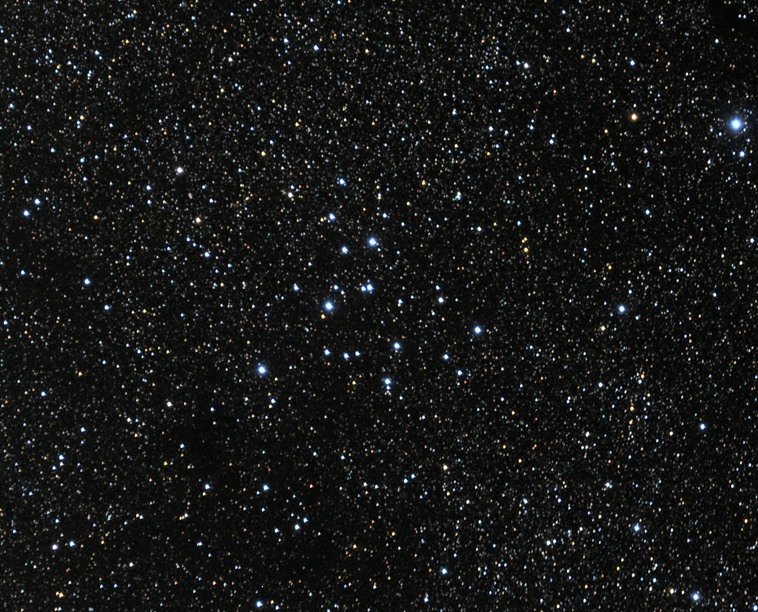
 Messier 39 contains bright, young B-type blue giant stars | |
| Observation data (J2000 epoch) | |
| Right ascension | 21h 31m 48.0s[1] |
| Declination | +48° 26′ 00″[1] |
| Distance | 1,010 ly (311 pc)[2] |
| Apparent magnitude (V) | 4.6[3] |
| Apparent dimensions (V) | 29′[4] |
| Physical characteristics | |
| Mass | 232+210 −110[5] M☉ |
| Estimated age | 278.6[1] Myr |
| Other designations | M 39, NGC 7092,[6] Cr 438 |
| Associations | |
| Constellation | Cygnus |
Messier 39 or M39, also known as NGC 7092, is an open cluster of stars in the constellation of Cygnus, sometimes referred to as the Pyramid Cluster. It is positioned two degrees south of the star Pi Cygni[7] and around 9° east-northeast of Deneb.[8] The cluster was discovered by Guillaume Le Gentil in 1749, then Charles Messier added it to his catalogue in 1764.[7][9] When observed in a small telescope at low power the cluster shows around two dozen members[7] but is best observed with binoculars.[7] It has a total integrated magnitude (brightness) of 4.6 and spans an angular diameter of 29 arcminutes[4] – about the size of the full Moon.[8] It is centered about 1,010 light-years (311 parsecs) away.[2]
This cluster has an estimated mass of 232 M☉ and a linear tidal radius of 8.6±1.8 pc.[5] Of the 15 brightest components, six form binary star systems; one more is suspected. HD 205117 is a probable eclipsing binary system with a period of 113.2 days that varies by 0.051 in visual magnitude. Both members seem to be subgiants.[10] Within are at least five[11] chemically peculiar stars and ten[12] suspected short-period variable stars.
Map
[edit]
See also
[edit]References
[edit]- ^ a b c Wu, Zhen-Yu; et al. (November 2009), "The orbits of open clusters in the Galaxy", Monthly Notices of the Royal Astronomical Society, 399 (4): 2146–2164, arXiv:0909.3737, Bibcode:2009MNRAS.399.2146W, doi:10.1111/j.1365-2966.2009.15416.x, S2CID 6066790.
- ^ a b Kharchenko, N. V.; et al. (2005), "Astrophysical parameters of Galactic open clusters", Astronomy and Astrophysics, 438 (3): 1163–1173, arXiv:astro-ph/0501674, Bibcode:2005A&A...438.1163K, doi:10.1051/0004-6361:20042523, S2CID 9079873.
- ^ "Messier 39". SEDS Messier Catalog. Retrieved 29 April 2022.
- ^ a b WEBDA page Lynga catalogue data, Department of Theoretical Physics and Astrophysics of the Masaryk University, retrieved 18 February 2018.
- ^ a b Piskunov, A. E.; et al. (January 2008), "Tidal radii and masses of open clusters", Astronomy and Astrophysics, 477 (1): 165–172, Bibcode:2008A&A...477..165P, doi:10.1051/0004-6361:20078525.
- ^ "M 39". SIMBAD. Centre de données astronomiques de Strasbourg. Retrieved November 24, 2018.
- ^ a b c d Streicher, Magda (October 2015), "Sky Delights: Another Cross", Monthly Notes of the Astronomical Society of Southern Africa, 74 (10): 243–248, Bibcode:2015MNSSA..74..243S.
- ^ a b Bone, Neil (August 2005), "Sky notes for 2005 August and September", Journal of the British Astronomical Association, 115 (4): 230, Bibcode:2005JBAA..115..230B.
- ^ Stoyan, Ronald; et al. (2008), Atlas of the Messier Objects: Highlights of the Deep Sky, translated by Schroeder, Klaus-Peter, Cambridge University Press, pp. 530–533, ISBN 978-1139473118
- ^ Zakirov, M. M.; et al. (July 1995), "Variability of HD205117 in the Open Cluster M39 (NGC 7092)", Information Bulletin on Variable Stars, 4220: 1, Bibcode:1995IBVS.4220....1Z.
- ^ Gray, R. O.; Corbally, C. J. (August 2002), "A Spectroscopic Search for λ Bootis and Other Peculiar A-Type Stars in Intermediate-Age Open Clusters", The Astronomical Journal, 124 (2): 989–1000, Bibcode:2002AJ....124..989G, doi:10.1086/341609.
- ^ Schuff, Sarah; et al. (December 2006), "A Search for Variable Stars in the Field of NGC 7092 (M39)", Bulletin of the American Astronomical Society, 38: 1135, Bibcode:2006AAS...20916514S.
External links
[edit]
- Messier 39, SEDS Messier pages
- NASA Astronomy Picture of the Day: M39: Open Cluster in Cygnus (12 April 2009)
- Messier 39 on WikiSky: DSS2, SDSS, GALEX, IRAS, Hydrogen α, X-Ray, Astrophoto, Sky Map, Articles and images


| List |
|  |
|---|---|---|
| See also | ||

