Hubbry Logo
OrionidsOrionidsMain
Open search
Orionids
Community hub
Orionids
logo
8 pages, 0 posts
0 subscribers
Be the first to start a discussion here.
Orionids
Orionids
from Wikipedia
Orionids (ORI)
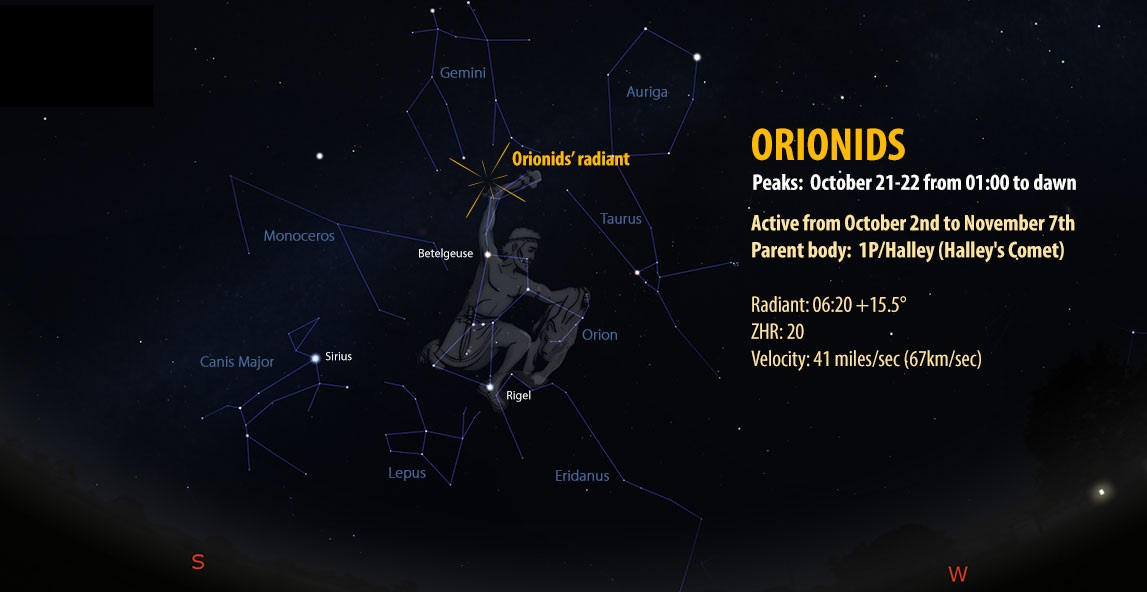
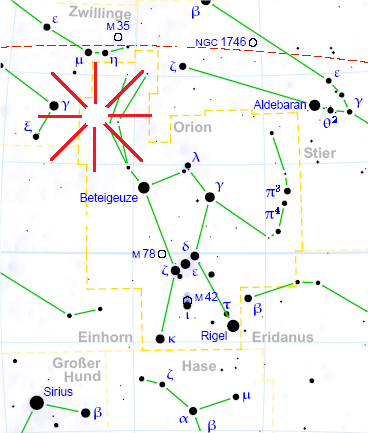
The radiant of the Orionids is located about 10 degrees northwest of Betelgeuse[1]
Discovery dateOctober 1839[2]
Parent body1P/Halley[1]
Radiant
ConstellationOrion (10 degrees northeast of Betelgeuse)[1]
Right ascension06h 21m [3]
Declination+15.6°[3]
Properties
Occurs duringOctober 2 – November 7[1]
Date of peakOctober 21[3]
Velocity66.9[4] km/s
Zenithal hourly rate20[5]
See also: List of meteor showers

The Orionids meteor shower, often shortened to the Orionids, is one of two meteor showers associated with Halley's Comet (the other one being the Eta Aquariids). The Orionids are named because the point they appear to come from (the radiant) lies in the constellation of Orion. The shower occurs annually, lasting approximately one week in late October. In some years, meteors may occur at rates of 50–70 per hour.[6][7]

Orionid outbursts occurred in 585, 930, 1436, 1439, 1465, and 1623.[8] The Orionids occur at the ascending node of Halley's comet. The ascending node reached its closest distance to Earth around 800 BCE. Currently Earth approaches Halley's orbit at a distance of 0.154 AU (23.0 million km; 14.3 million mi; 60 LD) during the Orionids. The next outburst might be in 2070 as a result of particles trapped in a 2:13 mean-motion resonance with Jupiter.[8]

History

[edit]

Meteor showers were connected to comets in the 1800s. E.C. Herrick made an observation in 1839 and 1840 about the activity present in the October night skies. Alexander Herschel produced the first documented record that gave accurate forecasts for the next meteor shower.[9] The Orionids meteor shower is produced by Halley's Comet, which was named after astronomer Edmund Halley and last passed through the inner Solar System in 1986 on its 75–76 year orbit.[10] When the comet passes through the Solar System, the Sun sublimates some of the ice, allowing rock particles to break away from the comet. These particles continue on the comet's trajectory and appear as meteors when they enter Earth's upper atmosphere.

The meteor shower radiant is located in Orion about 10 degrees northeast of Betelgeuse.[1] The Orionids normally peak around October 21–22 and are fast meteors that make atmospheric entry at about 66 km/s (150,000 mph).[3] Halley's comet is also responsible for creating the Eta Aquariids, which occur each May as a result of Earth passing close to the descending node of Halley's comet.[8]

An outburst with a zenithal hourly rate of over 100 occurred on 21 October 2006 as a result of Earth passing through the 1266 BCE, 1198 BCE, and 911 BCE meteoroid streams.[11] In 2015, the meteor shower peaked on October 26.[12]

Year Activity Date Range Peak Date ZHRmax
1839 October 8–15[9]
1864 October 18–20[9]
1936 October 19[11]
1981 October 18–21[9] October 23 20
1984 October 21–24[9] October 21–24 (flat maximum)
2006 October 2 — November 7[9][13] October 21–24[13][14] 100+[11]
2007 October 20–24[15] October 21 (predicted)[15] 70[16]
2008 October 15–29[17] October 20–22 (predicted)[17] 39
2009 October 18–25 [9] October 22[18] 45[18]
2010 October 23 38
2011 October 22 33
2012 October 2 — November 7 October 20 and October 23 43[19]
2013 October 22 ~30[20]
2014 October 2 — November 7 October 21 28
2015 October 2 — November 7 October 26 37
2016 October 2 — November 7 October 21[21] 84[12]
2017 October 21 55
2018 October 21 58
2019 October 22 40
2020 October 22 36
2021 October 21 41
2022 October 22 38
2023 October 21 48[12]

Some Orionid showers have had double peaks, as well as plateaus of activity lasting several days.[9]

[edit]

See also

[edit]

References

[edit]
[edit]
Revisions and contributorsEdit on WikipediaRead on Wikipedia
from Grokipedia
The Orionids is an annual meteor shower visible primarily in October, caused by Earth passing through streams of dust and debris left by Comet 1P/Halley. Active from October 2 to November 7, the shower peaks around October 21–22, when observers under dark skies can expect a zenithal hourly rate (ZHR) of about 20 meteors per hour. These swift meteors travel at approximately 41 miles (66 kilometers) per second, entering Earth's atmosphere from a radiant point near the star Betelgeuse in the constellation Orion. Renowned for their brightness and speed, Orionid meteors often leave persistent glowing trains and can produce spectacular fireballs, making the shower one of the most visually striking annual events, though its rates are typically moderate compared to peaks like the . Visibility is best after midnight in both hemispheres, with no need for telescopes—simply lie back in a dark location away from . In exceptional years, such as 2006–2009, enhanced activity has pushed rates to 50–75 meteors per hour due to alignments with denser comet debris trails. The shower's parent , Halley, orbits the Sun every 76 years, ensuring a reliable annual display as Earth intersects its path twice yearly—the other encounter producing the in May.

Overview

Characteristics

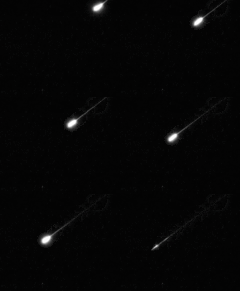
The Orionids constitute an annual resulting from Earth's passage through dust particles ejected by 1P/Halley. These particles, remnants of the comet's icy nucleus, vaporize upon , producing visible streaks of light observable primarily in the . Orionid meteors are renowned for their exceptional speed, entering Earth's atmosphere at approximately 66 km/s (41 mi/s), which ranks them among the swiftest meteor showers. This high velocity contributes to their striking appearance, often manifesting as bright trails that can persist for several seconds after the meteor passes. Typically, these meteors exhibit a white or yellowish hue, influenced by the composition of the dust particles, including elements like sodium and iron. In terms of brightness, many Orionid meteors achieve magnitudes of +2 or brighter, rendering them visible to the under dark skies, while the shower frequently produces fireballs exceeding magnitude -3 in intensity. The average (ZHR) during peak activity reaches 20-25 meteors per hour, though occasional short bursts have elevated rates to 50-75 in exceptional years. The shower's activity spans from October 2 to November 7, with maximum intensity occurring around October 21-22, when intersects the densest portion of the stream.

Radiant and Timing

The Orionid meteor shower's radiant, the apparent point in the sky from which the meteors seem to originate, is located in the constellation Orion at 6h 20m and +16°, positioned near the star . This radiant lies along the border between Orion and Gemini, allowing meteors to streak across a wide swath of the sky once it rises. The shower is active annually from 2 to November 7, with peak activity occurring on October 21–22, when passes through the densest portion of the meteoroid stream. Visibility is primarily optimal in the , where the radiant rises in the eastern sky after midnight , reaching a suitable altitude for observation by around 10 p.m. in many locations. The late timing aligns with 's orbital position, which intersects the comet's dust trail at this period, enhancing the encounter with s. Geographically, the Orionids are best observed from latitudes between 0° and 60° N, where the radiant's moderate allows it to climb sufficiently high in the sky for extended viewing. In the , visibility is less favorable due to the radiant's lower altitude above the horizon, resulting in shorter meteor trails and reduced rates, though the shower remains detectable as far south as 75° S under clear conditions.

Origin

Association with Halley's Comet

The Orionids meteor shower is produced by debris shed from the periodic comet 1P/Halley, commonly known as . This comet, first identified and predicted to be periodic by English astronomer in 1705 based on historical observations, has an of approximately 75-76 years. Its last visible passage through the inner solar system occurred in 1986, with the next expected in 2061. Earth intersects the comet's extensive dust trail twice annually due to the geometry of its highly elliptical, retrograde orbit, which crosses 's path at two distinct points. The Orionids result from encountering debris near the comet's aphelion, the farthest point from the Sun at about 35 AU, while the May stem from material near perihelion, the closest approach at roughly 0.6 AU. These encounters occur because the comet continuously ejects particles along its al path during each solar system visit. The meteoroids comprising the Orionids are primarily small icy dust particles, along with some rocky fragments, released predominantly during the comet's perihelion passages when solar heating vaporizes ices and drives out embedded dust over thousands of years. This material forms a broad stream that plows through, producing the visible meteors upon . The scientific association between the Orionids and 1P/Halley was confirmed in the through meticulous orbital calculations that aligned the shower's radiant position and timing with the comet's predicted path, despite initial challenges posed by the stream's nodal distance from .

Meteoroid Stream Dynamics

The Orionid meteoroid stream originates from dust particles ejected from the nucleus of Comet 1P/Halley during its perihelion passages, when solar heats the icy surface and drives the release of entrained grains into a trailing filament along the comet's orbit. These ejections primarily occur near the comet's closest approach to the Sun, every approximately 76 years, with particles following slightly perturbed trajectories due to non-gravitational forces like and . Over multiple orbital cycles, this process builds a of debris trails that intersects annually in . The 's structure is filamentary, comprising multiple narrow trails of varying densities from past ejections, with an overall width extending up to several million kilometers perpendicular to the , influenced by gravitational perturbations from planets such as . 's 1:6 with the plays a key role in shaping these filaments, trapping particles and creating periodic density enhancements that manifest as activity variations. Particle sizes within the span from micrometers to centimeters, though smaller grains (typically 10–100 micrometers) dominate the population responsible for visible , as larger ones are less abundant and less affected by drag forces. The has evolved over thousands of years, with an estimated age exceeding 3,000 years based on the integration of orbital histories, leading to gradual dispersion through planetary encounters and Poynting-Robertson drag on smaller particles. Despite this broadening, the maintains coherence in denser cores from recent ejections, and periodic enhancements arise from outbursts that inject fresh material, temporarily increasing filament densities. The dynamical encounter between and the occurs at a of approximately 66 km/s, reflecting the high of Halley-type particles as crosses the 's ascending node. Future evolution models predict heightened Orionid activity around 2061, aligned with Halley's next perihelion return, as newly ejected material from the active nucleus will replenish the stream and potentially amplify encounter rates with .

Observation

Viewing Conditions

The optimal viewing time for the Orionids occurs during the pre-dawn hours, typically between 2 and 5 a.m. local time, when the radiant in the constellation Orion reaches its highest altitude of up to 50 degrees above the horizon, allowing for the best visibility across a wide sky area. In the Southern Hemisphere, the radiant rises earlier but remains lower in the sky (typically 20-40° altitude at peak), making best viewing from midnight onward in dark sites. Moonlight significantly impacts meteor visibility by washing out fainter trails, making new moon phases ideal for observation; in 2025, the peak on October 20-21 coincided with a new moon on October 21, resulting in minimal lunar interference and optimal dark skies. Light pollution from urban areas reduces the number of detectable meteors, with dark rural skies ( 1-4) essential for seeing the full expected rate of 15-20 per hour, while city viewing is often limited to 5-10 meteors per hour due to . Clear weather is crucial, as clouds or can obscure the sky entirely, so observers should check local forecasts for transparent conditions during the active period from October 2 to November 7. The Orionids may experience minor interference from overlapping showers like the Southern Taurids (active in early November) or the early Leonids, but their high speed of 66 kilometers per second makes them easily distinguishable from the slower . Annual variability in the (ZHR) for the Orionids arises from Earth's precise alignment with the stream, typically yielding 15-20 meteors per hour under ideal conditions, though occasional outbursts—such as those from 2006 to 2009, which reached peaks of up to 75 per hour—can dramatically enhance activity due to denser stream filaments. No specialized equipment is required to view the Orionids, as they are best observed with the after 20-30 minutes of dark adaptation; however, observers should avoid direct exposure to during any pre-dawn twilight periods to prevent or damage, and select safe, stable locations to minimize risks like tripping in the dark.

Best Practices

To maximize sightings during the Orionid , observers should select rural sites with minimal and unobstructed views of the sky, arriving early to allow 20-30 minutes for dark adaptation by avoiding bright lights. Comfortable setups, such as lying down on a or using a reclining , enable relaxed viewing, with the gaze directed about 45 degrees away from the radiant to capture meteors streaking across a wider portion of the sky. Sessions typically last 1-2 hours to maintain concentration and effectiveness, during which observers count only confirmed Orionids by tracing their paths back to the radiant near and noting their swift, consistent motion. Patience is essential, as rates can vary, but focusing on the pre-dawn hours around the peak often yields the best results. For recording, maintain a log or use meteor-tracking apps to note each sighting's time, estimated magnitude, length of any persistent , and direction, ensuring accurate data for personal analysis or contribution to . Observers are encouraged to report counts and notable events, such as bright fireballs, to organizations like the International Meteor Organization (IMO) or American Meteor Society (AMS) via their online forms. The is sufficient and preferred for scanning large sky areas, though can help spot fainter or examine fireballs after they appear, but should not be used for active searching to avoid narrowing the field of view. When observing with family or groups, educate participants on distinguishing true —brief, non-flashing streaks—from false positives like satellites (steady, slow-moving lights) or airplanes (with navigation beacons), to improve overall accuracy and enjoyment.

History

Early Records

The earliest documented observations of the Orionid appear in ancient East Asian astronomical records, where they were noted as unusual celestial events during the autumn months. In , during the , annals describe meteor activity in October resembling "stars falling like rain," with the earliest confirmed references dating to around 585 CE, reflecting meticulous sky monitoring for astrological and calendrical purposes. These sightings were often recorded in official histories, such as those compiled in the Hou Hanshu, highlighting the shower's visibility amid clear seasonal skies. Japanese chronicles provide additional early accounts from the 6th century CE, as preserved in texts like the . These observations noted the meteors' intensity and direction, though without modern interpretive frameworks, they were cataloged alongside other atmospheric phenomena. In , such events frequently coincided with harvest seasons, when agricultural societies emphasized nocturnal vigilance for weather and celestial signs, embedding the Orionids in cultural narratives of seasonal transition and abundance. In medieval , sightings of the Orionids were sporadic and not systematically connected to annual patterns, with astronomers recording notable meteor activity amid broader stellar observations. These entries described luminous trails without attributing them to a specific radiant, viewing them instead as transient wonders. Early attributions across cultures often framed such meteors as divine omens or portents, lacking any understanding of , as seen in East Asian interpretations linking them to imperial fortunes or natural cycles. The marked a shift toward scientific recognition, with British astronomer Alexander Stewart Herschel identifying the Orionids as an annual shower in 1864 through systematic radiant plotting. Herschel's observations confirmed recurring peaks, building on earlier notes of heightened activity in 1839 and 1847 by American observer Edward C. Herrick, who documented meteor clusters without full annual correlation. This work laid the groundwork for predictable forecasting, transitioning the shower from anecdotal record to established astronomical phenomenon.

Modern Observations

Modern observations of the Orionids have been systematically documented since the early , with consistent (ZHR) data available from the 1930s onward through visual and instrumental records compiled by various astronomical organizations. The International Meteor Organization (IMO), established in 1988, has played a central role in coordinating global amateur and professional observations, standardizing ZHR calculations based on +6.5 under ideal conditions, and maintaining a visual meteor database (VMDB) that includes Orionid data spanning decades. These efforts have revealed the shower's typical annual ZHR of 20-25, with variations attributed to stream structure and observing conditions. Notable outbursts have punctuated this baseline activity, including suspected enhanced rates in the (particularly 1933-1938) linked to resonant trails, and a series of stronger events from 2006 to 2009 where ZHRs reached 50-80, comparable to major showers like the . The 2006 outburst, for instance, produced ZHRs exceeding 60 over multiple nights due to Earth encountering dense filamentary streams from ancient perihelion passages of . Scientific campaigns in the , including radar observations at 40 MHz by facilities like the and optical studies supported by , measured stream density and particle flux, confirming higher concentrations of smaller particles (masses <10^{-6} g) and velocities around 66 km/s. These studies highlighted the shower's filamentary nature and provided quantitative flux profiles. In recent years, the Orionids have maintained moderate activity, with the 2023 peak yielding an estimated ZHR of approximately 25 under favorable dark-sky conditions, as reported by international observers. Reports from amateur observers in 2025 indicated rates slightly below predictions, with hourly counts of 10–15 under optimal conditions, as compiled by the IMO. In 2025, the peak on October 21–22, under new moon conditions, yielded observed rates of approximately 15–20 meteors per hour at dark sites, consistent with the shower's typical activity. Global amateur networks, such as the American Meteor Society (AMS) and IMO visual programs, have contributed extensively to these datasets, underscoring year-to-year variability influenced by stream perturbations. Looking ahead, models predict no major Orionid outbursts through 2050, though the return of Halley's Comet in 2061 is expected to inject fresh dust, potentially enhancing shower activity in subsequent decades.

References

Add your contribution
Related Hubs
User Avatar
No comments yet.