


Community hub
Recent from talks
Contribute something
Nothing was collected or created yet.
Camarillo Airport
View on Wikipedia
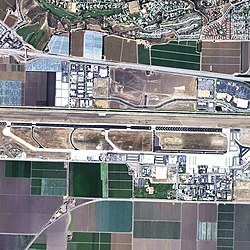
Camarillo Airport (ICAO: KCMA, FAA LID: CMA) is a public airport located three miles (5 km) west of the central business district of Camarillo, a city in Ventura County, California, United States.[1] The airport has one runway and serves privately operated general aviation and executive aircraft with no scheduled commercial service. A separate, uncontrolled runway in the southwest quadrant of the airport is for exclusive use of light-sport aircraft and ultralights, and is not connected to the larger airport. The airport is the site for an annual air show "Wings Over Camarillo", organized by the Southern California Wing of the Commemorative Air Force.[2]
Key Information


According to the US Federal Aviation Administration's National Plan of Integrated Airport Systems for 2011–2015, it is categorized as a reliever airport.[3]
History
[edit]Camarillo Airport was established in 1942 when the U.S. Public Roads Administration acquired 100 acres (40 ha) of farmland to develop a landing strip for light planes.[4] California State Highway Department constructed an auxiliary landing field with a 5,000 ft (1,500 m) runway, which was later extended to 8,000 ft (2,400 m) in 1951 to accommodate what by then had developed into Oxnard Air Force Base. The Aerospace Defense Command, via the 414th Fighter Group at Oxnard AFB, directed the 354th, 437th, and 460th Fighter-Interceptor Squadrons successively.
In the years following the closure of Oxnard AFB in January 1970, the Ventura County government actively pursued the acquisition of the former military base property from the Department of Defense for commercial airport use. This initiative ran into public opposition, opposed primarily by local residents concerned about the noise of growing commercial traffic. In 1976, the transfer of the airport was finally approved, provided the runway length was shortened to 6,000 feet (1,800 m) by displacing the runway threshold each end, substantially at the eastern end.[5] The agreement also did not allow cargo and large commercial passenger flights.[6] By 1985, the airport was entirely managed by the Ventura County Department of Airports.[7]
From 1995 to 2012, one of the last Lockheed EC-121 Warning Stars underwent a major restoration and dominated the tarmac. After completion of work, it was flown out to the Yanks Air Museum in Chino, California.[8] The Ventura County Department of Airports began work in 2022 on a layout plan dealing with maintenance and other near-term projects for the airport.[6]
On October 8, 2020 the Ampaire Electric EEL completed the longest flight to date for an airplane employing electric propulsion after launching from the airport. The hybrid electric aircraft, developed by U.S. startup Ampaire, will be used in a series of demonstration flights with Mokulele Airlines on its short-haul routes. The plane had just undergone four weeks of flight testing over the Oxnard Plain.[9]
Facilities and operations
[edit]Camarillo Airport covers an area of 650 acres (260 ha) and contains one runway (8/26) which measures 6,013 x 150 ft (1,833 x 46 m). It has two helipads, both measuring 50 by 50 ft (15 x 15 m).
For the 12-month period ending December 31, 2020 the airport had 108,566 aircraft operations, an average of 297 per day: 94% general aviation, 2% air taxi and 3% military. There were 383 aircraft based at this airport: 301 single engine, 35 multi-engine, 24 jet aircraft, 22 helicopters, and 1 glider.[1]
The airport is an FAA-towered facility, with a number of Fixed-Base Operators headquartered at the airfield, including vintage aviation organizations, flight schools, charter airlines, aircraft maintenance providers, and aircraft dealers.[10]
The Camarillo Composite Squadron 61 of the California Wing of the Civil Air Patrol is based at this airfield, located near Sky Blue Air, at the east end of the airport.
The Ventura County Fire Department and Sheriff's Office each support large, separate facilities at opposite ends of the field to support new recruit and recurring refreshment training.
A "Viewport" opened in 2014, providing a child-friendly area to view the airport activities which had become difficult with increased security concerns.[11]
The Chapter 723 of the Experimental Aircraft Association[12] and its facilities are located to the west of CAF museum in two hangars.
CAF Southern California Wing and Air Museum
[edit]
The Southern California Wing of the Commemorative Air Force[2] and its museum are located to the west of the Waypoint Cafe in three large hangars.[13][14] It is home to a variety of flyable historic aircraft — maintained and operated entirely by volunteers — as well as static aircraft, displays, models, and historical artifacts. The collection of flyable aircraft includes a PBJ-1J Mitchell (the only surviving example), A6M3 mod. 22 Zero, F6F-5 Hellcat, Bf 108 D-1, and Spitfire FR Mk. XIVe, along with privately owned aircraft (such as a MiG-17F) on public display. The unit features a Cadet Program which introduces kids and young adults to the aviation and aerospace sectors, and provides them scholarship opportunities for flight training.[15]
Accidents and incidents
[edit]- On July 20, 2007, a North-American P-51 Mustang, carrying a single pilot flipped during landing and resulted in the death of the pilot onboard. The pilot had been practicing with an instructor earlier that day, and the crash occurred during the pilot's first solo landing.[16]
- On November 9, 2018, Todd McNamee, the Ventura County Director of Airports drove his personal vehicle at high-rates-of-speed down Camarillo Airport's runway around 7:00am, before crashing into a ditch off the western edge of the airport. McNamee was found by Ventura County Fire Department fire crews after the vehicle caught fire, and the investigation conducted by the Ventura County Sheriff's Office determined the act to be an intentional suicide.[17]
- On August 7, 2019, a private aircraft from Wheeler Express crashed 1,000 feet (300 m) from the runway of the airport. Both people on board were killed.[18]
- On October 8, 2019, a single engine, home-built aircraft crashed into a field southwest of Camarillo Airport shortly after takeoff. The aircraft, a Bede BD-5, was destroyed in a post-crash fire, which also claimed the life of the 82 year old solo-pilot onboard.[19][20]
- On January 26, 2020, a helicopter en route to Camarillo Airport crashed into a hillside in Calabasas, California, under heavy fog, killing all nine people on board, including basketball player Kobe Bryant.[21][22] The cause of the crash was pilot error and spatial disorientation.[23][24]
- On June 10, 2022, a small piston aircraft carrying a single pilot impacted the terrain west of the airport shortly after takeoff, resulting in the death of the pilot and the total destruction of the aircraft. The aircraft, a Mooney M20K, enroute from Camarillo Airport to Phoenix Deer Valley Airport, was being operated by a single-pilot at the time of the crash. Reports of the accident came from witnesses traveling on US Route 101, who reported a low-flying aircraft impacting a building, crashing into a field and subsequently starting a fire. The initial investigation deemed IMC (Instrument Meteorological Conditions) to be the leading cause for the eventual CFIT (Controlled Flight-Into-Terrain), despite the pilot holding an Instrument Rating.[25]
- On August 18, 2022, an ultra-light aircraft operated by a single-pilot crashed upside-down onto the hangars located at Camarillo Airport's Ultralight Park. The pilot, the only person onboard the aircraft during the time of the accident, sustained critical injuries and was airlifted to the Ventura County Medical Center.[26]
- On January 30, 2024, a light-experimental aircraft carrying two passengers en route from Santa Monica Municipal Airport to Camarillo Airport was forced to make an emergency landing in a field approximately 4.5 miles southeast of Camarillo Airport.[27] Both passengers were able to evacuate the aircraft before fire crews arrived, with one passenger being in critical condition.[28] The aircraft, a Raptor Junior 540, suffered an electrical and engine failure, and was forced to make an emergency landing after repeated attempts by the pilot to restart the aircraft.[27]
- On July 25, 2024, a small bi-plane carrying a single pilot overturned on the runway at Camarillo Airport, the pilot was able to walk away unharmed, and authorities quickly responded to the incident.[29]
"Wings Over Camarillo" Air Show
[edit]Camarillo Airport continues to host the "Wings Over Camarillo" Air Show every year around the month of August.[30] The airshow traces it roots back to the 1980's[31] and will be celebrating its 45th Annual "Wings Over Camarillo" Air Show in August 2026. During the Air Show, the Ventura County Department of Airports puts a high regard on safety, and hasn't seen a single accident in over 40 years.[31]
References
[edit]- ^ a b c FAA Airport Form 5010 for CMA PDF, retrieved 2022-05-22
- ^ a b Southern California Wing of the Commemorative Air Force. Retrieved 2022-05-22
- ^ Appendix A of Report to Congress: National Plan of Integrated Airport Systems (NPIAS), 2011-2015. Retrieved 2022-05-22
- ^ "Camarillo Airport". US Army Corps of Engineers: Los Angeles District: Formerly Used Defense Sites. Archived from the original on October 19, 2016. Retrieved May 22, 2022.
- ^ "Camarillo Airport History". County of Ventura Department of Airports. Archived from the original on January 14, 2022. Retrieved January 14, 2022.
- ^ a b Varela, Brian J. (July 12, 2022). "Ventura County to announce plans to ditch Camarillo Airport Master Plan update". Ventura County Star. Retrieved July 13, 2022.
- ^ History of Camarillo Airport Archived 2012-02-07 at the Wayback Machine
- ^ Lawrence, Carol (January 14, 2012). "'Connie' spy plane leaves Camarillo Airport for new home". Ventura County Star. Retrieved April 17, 2017.
- ^ Madler, Mark (October 13, 2020). "Record Flight for Electric Airplane at Camarillo Airport". San Fernando Valley Business Journal. Retrieved October 14, 2020.
- ^ "Camarillo Airport Businesses – Ventura County Airports". Retrieved November 24, 2024.
- ^ Foster, Jeremy (June 27, 2014) "Camarillo Airport lands outdoor space for aviation buffs, public" Ventura County Star
- ^ Chapter 723
- ^ Ogden, Bob. Aviation Museums and Collections of North America, Sudbourne, England, 2007. ISBN 978-0851303857.
- ^ Parker, Dana T. Building Victory: Aircraft Manufacturing in the Los Angeles Area in World War II, Cypress, CA, 2013. ISBN 978-0-9897906-0-4.
- ^ "Cadet Program - CAF SoCal" CAF So. Cal. Wing Retrieved 30 November 2024.
- ^ ohtadmin (July 20, 2007). "Father of two killed in Camarillo plane crash". Camarillo Acorn -. Retrieved November 24, 2024.
- ^ wpeditor. "Airport director dies in car crash". Camarillo Acorn -. Retrieved November 24, 2024.
- ^ "2 Dead After Single-Engine Homebuilt Plane Crashes Off Camarillo Airport Runway: VCFD". KTLA. August 7, 2019. Retrieved January 28, 2020.
- ^ Jung, Mina (November 1, 2019). "Pilot killed after small plane crashes near Camarillo Airport". Talon. Retrieved November 24, 2024.
- ^ "Bede BD-5, N501BD: Fatal accident occurred October 08, 2019 near Camarillo Airport (KCMA), Ventura County, California". Retrieved November 24, 2024.
- ^ Philipps, Dave; Arango, Tim; Keene, Louis (January 27, 2020). "Flying Into Patchy Fog, Kobe Bryant's Pilot Had a Decision to Make". The New York Times. ISSN 0362-4331. Retrieved January 28, 2020.
- ^ Cohen, Ben; Ailworth, Erin (January 27, 2020). "The Last Flight of Kobe Bryant's Life". The Wall Street Journal. New York: Dow Jones & Company, Inc. Retrieved January 28, 2020.
- ^ "Investigators report Kobe Bryant's pilot got disoriented in clouds". February 9, 2021. Retrieved February 10, 2021.
- ^ "Rapid Descent Into Terrain Island Express Helicopters Inc. Sikorsky S-76B, N72EX Calabasas, California January 26, 2020" (PDF). National Transportation Safety Board. February 9, 2021. Retrieved November 8, 2024.
- ^ "Mooney M20K 305 Rocket, N305L: Fatal accident occurred June 10, 2022 near Camarillo Airport (KCMA), Ventura County, California". Retrieved November 24, 2024.
- ^ Hernandez, Salvador (August 18, 2022). "Small plane crashes upside down onto hangars at Camarillo Airport". Los Angeles Times. Retrieved November 24, 2024.
- ^ a b "Accident Berkut 540 N906CR, Tuesday 30 January 2024". asn.flightsafety.org. Retrieved November 24, 2024.
- ^ Soto • •, Missael (January 30, 2024). "1 hospitalized in critical condition after small plane crashes into Camarillo field". NBC Los Angeles. Retrieved November 24, 2024.
- ^ "Small plane crashes at Camarillo Airport; pilot unharmed". Ventura County Star. Retrieved November 24, 2024.
- ^ "Wings Over Camarillo | Best Air Show in California". Wings Over Camarillo. Retrieved November 24, 2024.
- ^ a b Huerta, Bailey (August 16, 2023). "Exploring the History of Wings Over Camarillo". Visit Camarillo. Retrieved November 24, 2024.
External links
[edit]- Camarillo Airport at County of Ventura website
- FAA Airport Diagram (PDF), effective February 19, 2026
Camarillo Airport
View on GrokipediaLocation and Geography
Site Description and Regional Context
Camarillo Airport (IATA: CMA, ICAO: KCMA, FAA LID: CMA) occupies a 650-acre site located three miles west of the central business district of Camarillo, a city in Ventura County, California.[5][6] The airport's coordinates are approximately 34°12′50″N 119°05′40″W, with a surveyed elevation of 76.8 feet (23.4 meters) above mean sea level, situated on flat terrain typical of the surrounding alluvial coastal plain.[1][7] This positioning facilitates general aviation operations amid low-relief topography, with minimal obstructions noted in aviation charts for the primary runway orientations.[1] In the regional context of Southern California, the airport functions as a key reliever facility within Ventura County, part of the South Central Coast Air Basin, helping to distribute aviation traffic from congested hubs such as Los Angeles International Airport and Van Nuys Airport.[8] The surrounding area features a mix of urban development in Camarillo to the east, agricultural fields, and proximity to the Pacific Ocean approximately 8 miles to the south, influencing local weather patterns with frequent coastal fog and moderate seismic activity in the seismically active Ventura Basin.[9][10] Ventura County's moderate non-attainment status for air quality standards underscores environmental considerations for airport expansions, with the facility supporting over 150,000 annual operations as a county-owned public-use airport.[8][2]Proximity to Population Centers and Infrastructure
Camarillo Airport is positioned within the municipal boundaries of Camarillo, Ventura County, California, approximately 2-3 miles northwest of the city's central commercial district, enabling straightforward access for local residents comprising a population of 70,741 as recorded in the 2020 U.S. Census. Its location places it roughly 5 miles north of Oxnard, 10 miles south of Ventura, and 50 miles northwest of downtown Los Angeles, positioning it as a gateway for general aviation serving the Ventura County metropolitan area of over 850,000 inhabitants and the expansive Southern California basin.[11] The facility benefits from direct adjacency to the U.S. Highway 101 corridor, with principal ground access achieved via the Las Posas Road interchange—exiting south from the freeway and proceeding west along Pleasant Valley Road or Airport Way—offering efficient connectivity to regional thoroughfares without significant urban congestion.[12] [10] This proximity to the 101, a primary north-south artery linking Ventura County to Los Angeles and beyond, supports rapid ingress and egress for aircraft owners and visitors, typically within 5-10 minutes from the freeway under normal conditions.[13] Rail infrastructure is accessible via the Camarillo Metrolink and Amtrak station at 30 Lewis Road, situated about 4 miles southeast of the airport, which provides commuter and intercity service to Los Angeles Union Station but lacks dedicated shuttle links, necessitating private vehicle, rideshare, or taxi for the final leg.[14] Public bus options through Camarillo Area Transit operate in the vicinity but do not extend directly to the airport premises, underscoring reliance on personal automobiles for most ground transport in this suburban setting.[15]Historical Development
World War II Origins and Military Use
The origins of what is now Camarillo Airport trace to 1942, when the U.S. Public Roads Administration constructed a basic light plane landing strip on approximately 100 acres of farmland near Camarillo, California, featuring a 5,000-foot runway as an auxiliary field for emergency and training landings.[9] In 1943, the U.S. Army Air Corps acquired the site along with an additional 303 acres—bringing the total to about 403 acres—and repurposed it for military operations, renaming it Oxnard Flight Strip to support the war effort amid expanding aviation needs.[9][2] During World War II, Oxnard Flight Strip functioned primarily as a training and support installation under the Army Air Forces, hosting flight training for pilots, aircraft maintenance activities, and temporary troop housing to accommodate personnel involved in Pacific Theater preparations.[9] The facility emphasized fighter pilot proficiency, including gunnery and bombing exercises, with operations aligned to the AAF Training Command's demands for rapid expansion of combat-ready aircrews.[16] Specific testing occurred there, such as evaluations of the experimental XCG-16 cargo glider in 1943–1944, where modified B-17 bombers towed the prototype for performance assessments critical to potential assault glider deployments.[17] The site's military infrastructure during this period included wooden hangars and support buildings erected hastily for wartime urgency, enabling on-site repairs and storage for training aircraft like pursuit fighters, though exact unit assignments were transient and tied to broader West Coast training networks rather than permanent basing.[18] Munitions handling and disposal practices, including explosives used in training, left residual ordnance that required later remediation, underscoring the facility's active role in ordnance-related drills.[9] By war's end in 1945, Oxnard Flight Strip had contributed to the U.S. aerial training pipeline without direct combat deployment, reflecting the strategic inland positioning for safe, high-volume instruction away from coastal vulnerabilities.[9]Post-War Transition to Civil Aviation
Following the conclusion of World War II in 1945, the Oxnard Flight Strip continued to function as a military installation, with its runway extended to 8,000 feet shortly thereafter and further lengthened to 9,000 feet by 1958 to support ongoing Air Force operations.[19] It was redesignated Oxnard Air Force Base in the early 1950s, serving as part of Air Defense Command for fighter-interceptor missions during the Cold War era until its deactivation on December 31, 1969.[2] At the time of closure, the base housed 99 officers and 990 enlisted personnel, along with associated aircraft and infrastructure.[20] In January 1970, the U.S. Department of Defense declared the 650-acre site excess to military needs and transferred it to the General Services Administration for disposal as surplus property.[9] Ventura County pursued acquisition to develop it as a civil airport for general aviation and potential air carrier service, but faced significant opposition from the adjacent City of Camarillo, which contested the site's suitability and potential noise impacts, prolonging negotiations for seven years.[21] The dispute resolved in 1976 with an agreement limiting the facility to general aviation operations and capping the runway at 6,000 feet to address local concerns.[2] On October 28, 1976, Ventura County received a quitclaim deed from the General Services Administration for the core 650 acres, enabling the shift to civilian control.[21] Initial management fell to the county's Property Administration Agency, which oversaw the conversion of military hangars and runways for private aircraft use, marking the airport's entry into general aviation as a reliever facility for the Los Angeles area.[2] By 1985, oversight transferred to the newly formed County of Ventura Department of Airports, facilitating steady growth in non-commercial operations without scheduled passenger service.[21]County Acquisition and Expansion Phases
Ventura County acquired approximately 650 acres of the former Oxnard Air Force Base site in October 1976 through a quitclaim deed from the General Services Administration, following the U.S. Department of Defense's declaration of the property as surplus in December 1969.[2] The transfer, valued at $40 million but conveyed at no cost to the county, faced a seven-year delay due to opposition from the City of Camarillo, culminating in a compromise agreement that restricted operations to general aviation and limited the primary runway length to 6,010 feet.[8] The airport reopened for civil use on October 21, 1976, under county ownership, marking the transition from military to public reliever airport status.[2] In 1985, Ventura County established a dedicated Department of Airports to manage Camarillo Airport independently from general property administration, enabling focused oversight of facility improvements and operations.[2] Early post-acquisition expansions emphasized pavement rehabilitation and basic infrastructure, including runway and taxiway maintenance to support growing general aviation traffic, with the county funding projects through a combination of local revenues, leases, and federal Airport Improvement Program grants.[8] Subsequent expansion phases aligned with airport master plans, beginning with the 1996 plan that proposed enhancements such as a parallel taxiway 700 feet south of the main runway for improved small aircraft and training operations, alongside midfield taxiway extensions and increased hangar capacity.[8] Implementation in the late 1990s and early 2000s included phased construction of Taxiway G (1999–2001) for dual-parallel flow, rehabilitation of Runway 8-26 (1996–1997), and completion of a new fire station in 2001, alongside apron expansions totaling over 150,000 square feet by 2003 to accommodate rising based aircraft numbers, which grew from around 400 in the 1990s to over 560 by the 2010s.[8] [2] The 2010 master plan update outlined further phased developments through 2028, divided into short-term (2010–2014: e.g., parallel taxiway at 700 feet separation costing $4.4 million, northeast apron expansion of 8,000 square yards), intermediate-term (6–10 years: e.g., 60 new hangars and localizer antenna installation), and long-term (10+ years: e.g., potential 3,500-foot parallel runway 700 feet south and additional T-hangars) horizons, prioritizing airside efficiency and landside capacity to handle projected operations increases from 152,540 annually by 2013 to 196,730 by 2028.[8] These phases incorporated environmental reviews and FAA coordination, with total projected investments exceeding $39.8 million, largely grant-eligible, though ambitious elements like the parallel runway remained contingent on demand and funding.[8] Ongoing hangar developments, such as the phased northeast hangar project for up to 105 T-hangars and 13 executive units, continued to expand storage for private and corporate aircraft.[22]Infrastructure and Facilities
Runways, Taxiways, and Hangars
Camarillo Airport operates with a single runway, designated 08/26, measuring 6,013 feet in length by 150 feet in width.[1] The runway surface comprises asphalt, concrete, and rubberized friction seal coat, maintained in good condition.[1] It accommodates aircraft landing gear with single-wheel capacities up to 50,000 pounds, double-wheel up to 80,000 pounds, and double-tandem up to 125,000 pounds.[1] Lighting includes medium-intensity edge lights, precision approach path indicators (PAPI) at a 3.00-degree glide path, and runway end identifier lights (REIL).[1] Two concrete helipads, each 34 by 34 feet, support helicopter operations adjacent to the runway.[1] The taxiway system features a parallel Taxiway A aligned with the runway, supplemented by Taxiways B, C, and D.[23] [24] These pavements undergo regular rehabilitation, including slurry sealing and drainage improvements as part of ongoing maintenance projects.[24] Helicopter training pads are situated north of Taxiway B and the runway.[1] T-hangars are positioned along the north side of the parallel taxiway.[23] Hangar facilities at the airport support general aviation, corporate jets, and aviation organizations, with both county-owned and private structures. County-managed hangars include Group A units of 800 to 850 square feet, available via wait lists for aircraft storage only.[25] The Commemorative Air Force Southern California Wing occupies three hangars for aircraft preservation and operations.[18] Private developments encompass a $32 million jet hangar complex covering seven acres in the northeast quadrant, a 65,258-square-foot facility at Air 7 FBO with two large bays, and a 2022-opened complex of four 25,200-square-foot Group 1 hangars.[26] [27] [28] East Hangar Complex pavements have been rehabilitated, and past master plans addressed relocating 15 hangars from the Taxiway A safety area to remove obstructions.[24] [8]Terminal and Support Buildings
Camarillo Airport, designated as a general aviation reliever facility, does not feature a dedicated commercial passenger terminal but relies on fixed-base operator (FBO) amenities for transient passenger handling and crew support.[1] These FBO-provided structures serve as de facto terminals, offering lounges, conference areas, and concierge services tailored to private and corporate aviation users. Support buildings emphasize aircraft storage and maintenance over public transit infrastructure, aligning with the airport's role in accommodating based aircraft and regional operations without scheduled airline service.[29] Hangar facilities dominate the support infrastructure, comprising conventional hangars, T-hangars, executive hangars, and portable units like Port-A-Ports, leased through county programs or private operators. Ventura County maintains a waitlist for its limited hangar spaces, restricted to aircraft storage without vehicle or non-aviation use, while tiedowns provide additional outdoor parking options.[30][25] Private developments, such as Sun Air Jets' complex, include 120,000 square feet of luxury hangar space with 24/7 security and environmental certifications, supporting high-end clientele including corporate jets and celebrity transport.[31][32] FBO-specific support buildings enhance operational efficiency. Sun Air Jets' 22,000-square-foot terminal and office area features a private crew lounge with sleep rooms and showers, executive conference facilities, electric vehicle charging, and five-star concierge services including catering and ground transportation.[32][31] Similarly, Channel Islands Aviation operates a passenger terminal and lounge, complemented by hangar leasing and maintenance services from other providers like Air 7 and AVEX, which focus on fueling and aircraft handling without dedicated public-facing terminals.[1] These facilities collectively support the airport's emphasis on business aviation, with no provisions for commercial enplanement beyond private charters.[29]Fuel and Maintenance Services
Camarillo Airport provides aviation fuel through several fixed-base operators (FBOs), including Channel Islands Aviation, Sun Air Jets, Air 7, and Avex Aviation, which collectively offer 100LL avgas for piston-engine aircraft and Jet A for turbine-powered aircraft.[29][33][34] Sun Air Jets additionally supplies sustainable aviation fuel (SAF) and UL94, positioning it as the first FBO in Southern California to offer SAF as a lower-emission alternative to conventional Jet A.[32] Fueling services are available around the clock at select FBOs, such as Sun Air Jets and Air 7, with options for into-plane delivery and additives like Prist at additional cost.[33][35] Aircraft maintenance at the airport is supported by independent shops and FBO-affiliated services, focusing primarily on general aviation piston and turboprop aircraft. Camarillo Aircraft Service performs annual inspections, 100-hour checks, engine overhauls, and airframe repairs on models including Cessna, Piper, Mooney, Beechcraft, and Cirrus aircraft.[36][37] Specialized maintenance for Daher TBM turboprops is available through Avex Aviation, encompassing routine servicing, avionics upgrades, and pre-buy inspections.[38] These facilities operate under FAA Part 145 certifications where applicable, emphasizing compliance with airworthiness directives and manufacturer service bulletins, though operators must verify specific capabilities for experimental or antique aircraft.[37] Hangar-based maintenance is facilitated by FBOs like Air 7, which provide secure space for extended repairs alongside fueling.[39]Operations and Traffic
Aircraft Operations and User Demographics
Camarillo Airport handles an average of 143,535 aircraft operations annually over recent five-year periods, with 2018 recording 140,598 total operations, predominantly comprising local general aviation touch-and-go maneuvers and itinerant flights.[4] Operations are overwhelmingly general aviation, accounting for over 98% of activity, supplemented by minor air taxi and transient military usage, reflecting its role as a reliever airport alleviating congestion at larger regional facilities like Van Nuys or Santa Monica.[4] [8] The airport bases approximately 400 aircraft, serving a user base centered on private and corporate general aviation operators within Ventura County.[4] Over half of these owners reside within 10 miles, primarily in Camarillo, Oxnard, Thousand Oaks, and Simi Valley, with many citing the facility's proximity as critical to personal or business operations—61% deeming it very important or important to their economic activities.[8]| Aircraft Type | Number Based | Percentage |
|---|---|---|
| Single-Engine | 285 | 70% |
| Multi-Engine | 37 | 9% |
| Jet | 35 | 9% |
| Helicopter | 13 | 3% |
| Ultralight | 30 | 8% |
| Total | 400 | 100% |
Management and Regulatory Framework
Camarillo Airport is owned and operated by Ventura County through its Department of Airports, with day-to-day management overseen by Airport Manager Keith Freitas.[1][7] The facility spans approximately 650 acres and functions under a partnership with the City of Camarillo, facilitated by a Joint Use and Lease Agreement that supports joint operational responsibilities.[40] The Camarillo Airport Authority, established via a Joint Powers Agreement, advises the Camarillo City Council and Ventura County Board of Supervisors on operational policies, development plans, and land use compatibility within the designated Camarillo Airport Zone.[41] As a publicly owned general aviation reliever airport, Camarillo is included in the Federal Aviation Administration's (FAA) National Plan of Integrated Airport Systems (NPIAS) for 2025-2029, subjecting it to federal grant assurances that obligate the county to maintain and operate the facility for public use.[42][43] The FAA exercises exclusive jurisdiction over air traffic control, with an on-airport Airport Traffic Control Tower (ATCT) operating from 0700 to 2100 local time daily.[44] Local regulation is governed by the Ventura County Airport Ordinance, which establishes minimum standards for enforcement to protect life, property, and public welfare through controls on aeronautical activities.[45] Additional guiding frameworks include the Airport Master Plan, which aligns development with FAA design standards and safety goals, and a Noise Compatibility Program approved by the FAA effective June 6, 2025, ensuring compliance with 14 CFR Part 150 for noise exposure mapping and abatement measures.[46][47] Minimum Standards for Aeronautical Development further regulate facility leases, services, and tenant operations to maintain operational efficiency and safety.[46]Statistical Trends in Usage
Annual aircraft operations at Camarillo Airport peaked at 203,941 in 2002 before entering a period of decline, with total operations falling 31% to 140,598 by 2018.[4] This downward trend reflects broader patterns in general aviation activity, where itinerant general aviation operations decreased 13.7% from 2008 to 2018, while local operations showed relative stability.[4] Data from the FAA Air Traffic Activity Data System (ATADS) indicate that operations averaged 143,535 annually from 2014 to 2018, predominantly general aviation comprising over 95% of activity.[4][48] The following table summarizes total annual operations from 1991 to 2016, sourced from FAA ATADS records provided to local authorities:| Year | Total Annual Operations |
|---|---|
| 1991 | 215,122 |
| 1992 | 185,483 |
| 1993 | 179,025 |
| 1994 | 190,850 |
| 1995 | 167,114 |
| 1996 | 172,905 |
| 1997 | 179,398 |
| 1998 | 173,078 |
| 1999 | 187,572 |
| 2000 | 186,476 |
| 2001 | 179,460 |
| 2002 | 203,941 |
| 2003 | 185,887 |
| 2004 | 162,889 |
| 2005 | 153,501 |
| 2006 | 149,825 |
| 2007 | 148,518 |
| 2008 | 158,245 |
| 2009 | 162,170 |
| 2010 | 146,863 |
| 2011 | 133,403 |
| 2012 | 132,679 |
| 2013 | 136,510 |
| 2014 | 144,637 |
| 2015 | 147,020 |
| 2016 | 135,517 |
Economic Contributions
Revenue Generation and Job Creation
Camarillo Airport derives its operating revenues chiefly from facility leases, hangar rentals, tiedown fees, fuel flowage charges, and landing fees paid by tenants and users. For fiscal year 2022-23, the Ventura County Department of Airports projected total revenues of $7,119,668, with over 98% stemming from property use and leases, including $2,775,570 in fixed lease rents, $2,039,171 in percentage rents from commercial activities, $1,023,931 from county-owned hangars, and $265,955 from fuel flowage fees.[50] These streams reflect the airport's role as a hub for 54 private tenants—such as fixed-base operators, maintenance firms, and avionics providers—and 10 public agencies, alongside transient general aviation traffic. Historical data from 2008 indicate operating revenues around $3.6 million annually, dominated by rents and concessions at 89% of the total.[8] The airport fosters direct job creation through on-site businesses and operations, employing 1,002 workers as of the 2018 baseline in roles spanning aircraft maintenance, fueling, administrative support, and aviation services.[4] This direct payroll totaled $76 million, supporting a diverse tenant base that includes specialized firms generating secondary employment in supply chains. Including indirect and induced effects modeled via FAA-approved input-output analysis (IMPLAN), the airport sustains 1,764 total jobs regionally, with on-airport activities alone contributing $123.5 million in direct economic output.[4] Capital improvements, averaging $6.8 million annually, further bolster temporary construction jobs, though visitor spending from 49,338 annual transient days adds modestly with 35 positions.[4] These figures underscore the airport's self-sustaining model, where lease revenues fund maintenance without relying on general county taxes.Regional Economic Multipliers
The Camarillo Airport generates regional economic multipliers through indirect and induced effects, where on-airport activities and visitor expenditures stimulate further spending by suppliers and employee households in Ventura County. A 2019 economic benefit analysis, based on 2018 data and utilizing the IMPLAN input-output model with county-specific coefficients, quantified these multipliers as 1.7 for employment—meaning every 100 direct jobs supported by the airport create an additional 70 jobs regionally—and 1.807 for output, whereby each $1 million in direct output yields $0.807 million in secondary output.[4] These multipliers capture the airport's role as a hub for general aviation, maintenance, and related services, fostering supply chain linkages in industries such as aerospace parts, fuel distribution, and hospitality.[4] Direct on-airport impacts included $123.5 million in output, 1,002 jobs, and $76.0 million in payroll, supplemented by $4.1 million in output, 35 jobs, and $1.1 million in payroll from visitor spending. Indirect effects, arising from purchases of goods and services by airport tenants, added 203 jobs, $11.9 million in payroll, and $28.5 million in output, while induced effects from employee re-spending contributed 524 jobs, $26.3 million in payroll, and $74.6 million in output. Combined secondary effects totaled 727 jobs, $38.2 million in payroll, and $103.1 million in output, elevating the airport's overall contribution to $230.8 million in regional output and 1,764 jobs.[4]| Impact Type | Jobs | Payroll ($ million) | Output ($ million) |
|---|---|---|---|
| Direct (On-Airport) | 1,002 | 76.0 | 123.5 |
| Direct (Visitor) | 35 | 1.1 | 4.1 |
| Indirect | 203 | 11.9 | 28.5 |
| Induced | 524 | 26.3 | 74.6 |
| Total | 1,764 | 115.3 | 230.8 |
Comparisons to Similar Airports
Camarillo Airport (KCMA) shares operational and infrastructural similarities with other Southern California general aviation (GA) reliever airports, such as Oxnard Airport (KOXR) and Van Nuys Airport (KVNY), which help divert traffic from congested commercial hubs like Los Angeles International Airport (LAX). These facilities primarily accommodate piston and turbine-powered GA aircraft, corporate jets, and flight training, with single or parallel runways supporting instrument approaches. Unlike commercial-service airports, they emphasize fixed-base operator (FBO) services, maintenance, and hangar storage over passenger terminals. Camarillo's 6,000-foot runway and extensive hangar capacity position it as a mid-sized GA venue, contrasting with smaller fields like those in rural Ventura County but aligning with urban-edge relievers in traffic density and user demographics dominated by private pilots and businesses.[1] Compared to Oxnard Airport, co-owned and operated by Ventura County, Camarillo handles higher GA volumes despite lacking scheduled commercial flights, which Oxnard supports with limited regional service. Oxnard records approximately 70,000 annual operations and 128 based aircraft, while Camarillo supports 359–383 based aircraft and exceeds 100,000 operations, reflecting greater GA demand and facilities like expansive t-hangars. This disparity contributes to Camarillo generating five times Oxnard's economic output, driven by denser GA activity and events, even though Camarillo's physical infrastructure is roughly double Oxnard's in scale. Both enforce noise abatement protocols due to residential proximity, but Camarillo's pure GA focus sustains higher local touch-and-go training traffic.[52][53] Van Nuys Airport, the world's busiest GA facility, eclipses Camarillo in scale with over 217,000 annual operations across two parallel 8,000-foot runways, accommodating a higher jet mix for Hollywood-adjacent business aviation. Camarillo's operations, predominantly local piston flights (over 80% single-engine), mirror mid-tier GA patterns but at lower intensity, enabling less constrained access for recreational users compared to Van Nuys's tower-managed congestion. Both serve as LAX relievers, yet Camarillo's aviation heritage—bolstered by the Commemorative Air Force—fosters community events absent in Van Nuys's more utilitarian profile, though Van Nuys supports more FBOs and maintenance for larger fleets.[54]| Metric | Camarillo (KCMA) | Oxnard (KOXR) | Van Nuys (KVNY) |
|---|---|---|---|
| Based Aircraft | 359–383 | 128 | ~550 (est.) |
| Annual Operations | >100,000 | ~70,000 | >217,000 |
| Primary Runway Length | 6,000 ft | 6,804 ft | 8,000 ft (x2) |
| Ownership | Ventura County | Ventura County | LAWA |