


Community hub
Recent from talks
Contribute something
Nothing was collected or created yet.


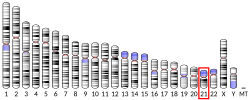
6-phosphofructokinase, liver type (PFKL) is an enzyme that in humans is encoded by the PFKL gene on chromosome 21.[5] This gene encodes the liver (L) isoform of phosphofructokinase-1, an enzyme that catalyzes the conversion of D-fructose 6-phosphate to D-fructose 1,6-bisphosphate, which is a key step in glucose metabolism (glycolysis). This enzyme is a tetramer that may be composed of different subunits encoded by distinct genes in different tissues. Alternative splicing results in multiple transcript variants. [provided by RefSeq, Mar 2014][5]
Structure
[edit]Gene
[edit]The PFKL mRNA sequence includes 55 nucleotides at the 5' and 515 nucleotides at the 3' noncoding regions, as well as 2,337 nucleotides in the coding region, encoding 779 amino acids. This coding region only shares a 68% similarity between PFKL and the muscle-type PFKM.[6]
Protein
[edit]This 80-kDa protein is one of three subunit types that comprise the five tetrameric PFK isozymes. The liver PFK (PFK-5) contains solely PFKL, while the erythrocyte PFK includes five isozymes composed of different combinations of PFKL and the second subunit type, PFKM.[7][8] The muscle isozyme (PFK-1) is composed solely of PFKM.[7][9][10] These subunits evolved from a common prokaryotic ancestor via gene duplication and mutation events. Generally, the N-terminal of the subunits carries out their catalytic activity while the C-terminal contains allosteric ligand binding sites[11]
Function
[edit]This gene encodes one of three protein subunits of PFK, which are expressed and combined to form the tetrameric PFK in a tissue-specific manner. As a PFK subunit, PFKL is involved in catalyzing the phosphorylation of fructose 6-phosphate to fructose 1,6-bisphosphate. This irreversible reaction serves as the major rate-limiting step of glycolysis.[7][10][11][12] Notably, knockdown of PFKL has been shown to impair glycolysis and promote metabolism via the pentose phosphate pathway. Moreover, PFKL regulates NADPH oxidase activity through the pentose phosphate pathway and according to NADPH levels.[12]
PFKL has also been detected in leukocytes, kidney, and brain.[9]
Clinical significance
[edit]As the erythrocyte PFK is composed of both PFKL and PFKM, this heterogeneic composition is attributed with the differential PFK activity and organ involvement observed in some inherited PFK deficiency states in which myopathy or hemolysis or both can occur, such as glycogenosis type VII (Tarui disease).[7][8]
Overexpression of PFKL has been associated with Down's syndrome (DS) erythrocytes and fibroblasts and attributed with biochemical changes in PFK that enhance its glycolytic function. Moreover, the PFKL gene maps to the triplicated region of chromosome 21 responsible for DS, indicating that this gene, too, has been triplicated.[13]
Interactive pathway map
[edit]Click on genes, proteins and metabolites below to link to respective articles.[§ 1]
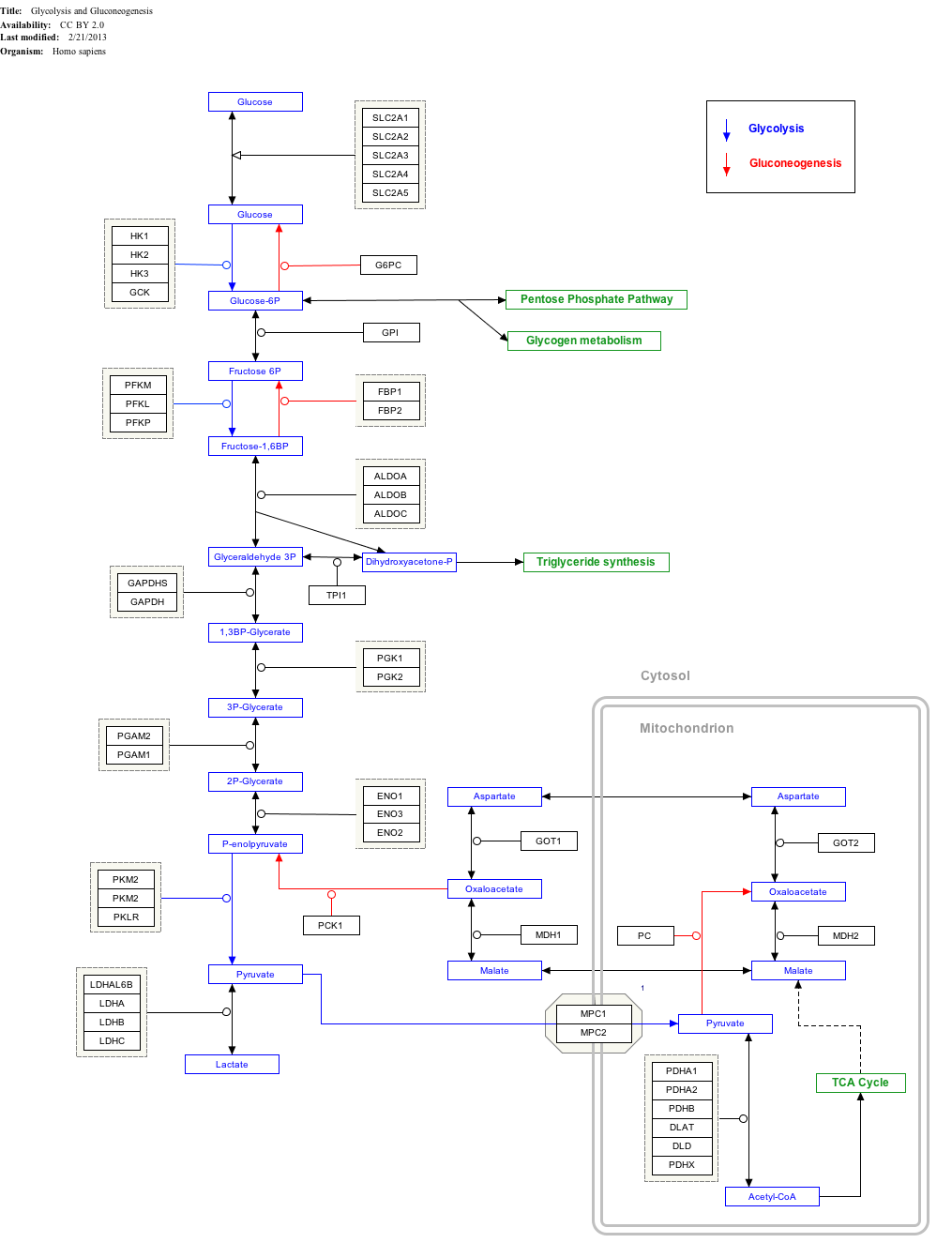
- ^ The interactive pathway map can be edited at WikiPathways: "GlycolysisGluconeogenesis_WP534".
See also
[edit]References
[edit]- ^ a b c GRCh38: Ensembl release 89: ENSG00000141959 – Ensembl, May 2017
- ^ a b c GRCm38: Ensembl release 89: ENSMUSG00000020277 – Ensembl, May 2017
- ^ "Human PubMed Reference:". National Center for Biotechnology Information, U.S. National Library of Medicine.
- ^ "Mouse PubMed Reference:". National Center for Biotechnology Information, U.S. National Library of Medicine.
- ^ a b "Entrez Gene: PFKL phosphofructokinase, liver".
- ^ Levanon D, Danciger E, Dafni N, Bernstein Y, Elson A, Moens W, Brandeis M, Groner Y (December 1989). "The primary structure of human liver type phosphofructokinase and its comparison with other types of PFK". DNA. 8 (10): 733–43. doi:10.1089/dna.1989.8.733. PMID 2533063.
- ^ a b c d Vora S, Seaman C, Durham S, Piomelli S (January 1980). "Isozymes of human phosphofructokinase: identification and subunit structural characterization of a new system". Proceedings of the National Academy of Sciences of the United States of America. 77 (1): 62–6. Bibcode:1980PNAS...77...62V. doi:10.1073/pnas.77.1.62. PMC 348208. PMID 6444721.
- ^ a b Vora S, Davidson M, Seaman C, Miranda AF, Noble NA, Tanaka KR, Frenkel EP, Dimauro S (December 1983). "Heterogeneity of the molecular lesions in inherited phosphofructokinase deficiency". The Journal of Clinical Investigation. 72 (6): 1995–2006. doi:10.1172/JCI111164. PMC 437040. PMID 6227635.
- ^ a b Koster JF, Slee RG, Van Berkel TJ (April 1980). "Isoenzymes of human phosphofructokinase". Clinica Chimica Acta; International Journal of Clinical Chemistry. 103 (2): 169–73. doi:10.1016/0009-8981(80)90210-7. PMID 6445244.
- ^ a b Musumeci O, Bruno C, Mongini T, Rodolico C, Aguennouz M, Barca E, Amati A, Cassandrini D, Serlenga L, Vita G, Toscano A (April 2012). "Clinical features and new molecular findings in muscle phosphofructokinase deficiency (GSD type VII)". Neuromuscular Disorders. 22 (4): 325–30. doi:10.1016/j.nmd.2011.10.022. PMID 22133655. S2CID 20133199.
- ^ a b Brüser A, Kirchberger J, Kloos M, Sträter N, Schöneberg T (May 2012). "Functional linkage of adenine nucleotide binding sites in mammalian muscle 6-phosphofructokinase". The Journal of Biological Chemistry. 287 (21): 17546–53. doi:10.1074/jbc.M112.347153. PMC 3366854. PMID 22474333.
- ^ a b Graham DB, Becker CE, Doan A, Goel G, Villablanca EJ, Knights D, Mok A, Ng AC, Doench JG, Root DE, Clish CB, Xavier RJ (21 July 2015). "Functional genomics identifies negative regulatory nodes controlling phagocyte oxidative burst". Nature Communications. 6 7838. Bibcode:2015NatCo...6.7838G. doi:10.1038/ncomms8838. PMC 4518307. PMID 26194095.
- ^ Elson A, Bernstein Y, Degani H, Levanon D, Ben-Hur H, Groner Y (March 1992). "Gene dosage and Down's syndrome: metabolic and enzymatic changes in PC12 cells overexpressing transfected human liver-type phosphofructokinase". Somatic Cell and Molecular Genetics. 18 (2): 143–61. doi:10.1007/bf01233161. PMID 1533471. S2CID 38259672.
Further reading
[edit]- Kahn A, Meienhofer MC, Cottreau D, Lagrange JL, Dreyfus JC (April 1979). "Phosphofructokinase (PFK) isozymes in man. I. Studies of adult human tissues". Human Genetics. 48 (1): 93–108. doi:10.1007/bf00273280. PMID 156693. S2CID 23300861.
- Kristensen T, Lopez R, Prydz H (1992). "An estimate of the sequencing error frequency in the DNA sequence databases". DNA Sequence. 2 (6): 343–6. doi:10.3109/10425179209020815. PMID 1446073.
- Wang D, Fang H, Cantor CR, Smith CL (April 1992). "A contiguous Not I restriction map of band q22.3 of human chromosome 21". Proceedings of the National Academy of Sciences of the United States of America. 89 (8): 3222–6. Bibcode:1992PNAS...89.3222W. doi:10.1073/pnas.89.8.3222. PMC 48838. PMID 1565613.
- Elson A, Levanon D, Brandeis M, Dafni N, Bernstein Y, Danciger E, Groner Y (May 1990). "The structure of the human liver-type phosphofructokinase gene". Genomics. 7 (1): 47–56. doi:10.1016/0888-7543(90)90517-X. PMID 2139864.
- Levanon D, Danciger E, Dafni N, Bernstein Y, Elson A, Moens W, Brandeis M, Groner Y (December 1989). "The primary structure of human liver type phosphofructokinase and its comparison with other types of PFK". DNA. 8 (10): 733–43. doi:10.1089/dna.1989.8.733. PMID 2533063.
- Van Keuren M, Drabkin H, Hart I, Harker D, Patterson D, Vora S (September 1986). "Regional assignment of human liver-type 6-phosphofructokinase to chromosome 21q22.3 by using somatic cell hybrids and a monoclonal anti-L antibody". Human Genetics. 74 (1): 34–40. doi:10.1007/bf00278782. PMID 2944814. S2CID 26346007.
- Levanon D, Danciger E, Dafni N, Groner Y (November 1986). "Genomic clones of the human liver-type phosphofructokinase". Biochemical and Biophysical Research Communications. 141 (1): 374–80. Bibcode:1986BBRC..141..374L. doi:10.1016/S0006-291X(86)80379-5. PMID 2948503.
- Vora S, Davidson M, Seaman C, Miranda AF, Noble NA, Tanaka KR, Frenkel EP, Dimauro S (December 1983). "Heterogeneity of the molecular lesions in inherited phosphofructokinase deficiency". The Journal of Clinical Investigation. 72 (6): 1995–2006. doi:10.1172/JCI111164. PMC 437040. PMID 6227635.
- Vora S, Seaman C, Durham S, Piomelli S (January 1980). "Isozymes of human phosphofructokinase: identification and subunit structural characterization of a new system". Proceedings of the National Academy of Sciences of the United States of America. 77 (1): 62–6. Bibcode:1980PNAS...77...62V. doi:10.1073/pnas.77.1.62. PMC 348208. PMID 6444721.
- Koster JF, Slee RG, Van Berkel TJ (April 1980). "Isoenzymes of human phosphofructokinase". Clinica Chimica Acta; International Journal of Clinical Chemistry. 103 (2): 169–73. doi:10.1016/0009-8981(80)90210-7. PMID 6445244.
- Vora S, Francke U (June 1981). "Assignment of the human gene for liver-type 6-phosphofructokinase isozyme (PFKL) to chromosome 21 by using somatic cell hybrids and monoclonal anti-L antibody". Proceedings of the National Academy of Sciences of the United States of America. 78 (6): 3738–42. Bibcode:1981PNAS...78.3738V. doi:10.1073/pnas.78.6.3738. PMC 319647. PMID 6455664.
- Zeitschel U, Bigl M, Eschrich K, Bigl V (December 1996). "Cellular distribution of 6-phosphofructo-1-kinase isoenzymes in rat brain". Journal of Neurochemistry. 67 (6): 2573–80. doi:10.1046/j.1471-4159.1996.67062573.x. PMID 8931492. S2CID 46068703.
- Gevaert K, Goethals M, Martens L, Van Damme J, Staes A, Thomas GR, Vandekerckhove J (May 2003). "Exploring proteomes and analyzing protein processing by mass spectrometric identification of sorted N-terminal peptides". Nature Biotechnology. 21 (5): 566–9. doi:10.1038/nbt810. PMID 12665801. S2CID 23783563.
- Zhang C, Dowd DR, Staal A, Gu C, Lian JB, van Wijnen AJ, Stein GS, MacDonald PN (September 2003). "Nuclear coactivator-62 kDa/Ski-interacting protein is a nuclear matrix-associated coactivator that may couple vitamin D receptor-mediated transcription and RNA splicing". The Journal of Biological Chemistry. 278 (37): 35325–36. doi:10.1074/jbc.M305191200. PMID 12840015.
- Colland F, Jacq X, Trouplin V, Mougin C, Groizeleau C, Hamburger A, Meil A, Wojcik J, Legrain P, Gauthier JM (July 2004). "Functional proteomics mapping of a human signaling pathway". Genome Research. 14 (7): 1324–32. doi:10.1101/gr.2334104. PMC 442148. PMID 15231748.
- Rush J, Moritz A, Lee KA, Guo A, Goss VL, Spek EJ, Zhang H, Zha XM, Polakiewicz RD, Comb MJ (January 2005). "Immunoaffinity profiling of tyrosine phosphorylation in cancer cells". Nature Biotechnology. 23 (1): 94–101. doi:10.1038/nbt1046. PMID 15592455. S2CID 7200157.