


Community hub
Recent from talks
Contribute something
Nothing was collected or created yet.
P protein
View on Wikipedia
| OCA2 | |||||||||||||||||||||||||||||||||||||||||||||||||||
|---|---|---|---|---|---|---|---|---|---|---|---|---|---|---|---|---|---|---|---|---|---|---|---|---|---|---|---|---|---|---|---|---|---|---|---|---|---|---|---|---|---|---|---|---|---|---|---|---|---|---|---|
| Identifiers | |||||||||||||||||||||||||||||||||||||||||||||||||||
| Aliases | OCA2, BEY, BEY1, BEY2, BOCA, D15S12, EYCL, EYCL2, EYCL3, HCL3, PED, SHEP1, OCA2 melanosomal transmembrane protein, P | ||||||||||||||||||||||||||||||||||||||||||||||||||
| External IDs | OMIM: 611409; MGI: 97454; HomoloGene: 37281; GeneCards: OCA2; OMA:OCA2 - orthologs | ||||||||||||||||||||||||||||||||||||||||||||||||||
| |||||||||||||||||||||||||||||||||||||||||||||||||||
| |||||||||||||||||||||||||||||||||||||||||||||||||||
| |||||||||||||||||||||||||||||||||||||||||||||||||||
| |||||||||||||||||||||||||||||||||||||||||||||||||||
| |||||||||||||||||||||||||||||||||||||||||||||||||||
| Wikidata | |||||||||||||||||||||||||||||||||||||||||||||||||||
| |||||||||||||||||||||||||||||||||||||||||||||||||||


P protein, also known as melanocyte-specific transporter protein or pink-eyed dilution protein homolog, is a protein that in humans is encoded by the oculocutaneous albinism II (OCA2) gene.[5] The P protein is believed to be an integral membrane protein involved in small molecule transport, specifically of tyrosine—a precursor of melanin. Certain mutations in OCA2 result in type 2 oculocutaneous albinism.[5] OCA2 encodes the human homologue of the mouse p (pink-eyed dilution) gene.

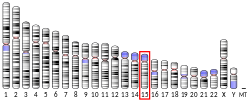
The human OCA2 gene is located on the long arm (q) of chromosome 15, specifically from base pair 28,000,020 to base pair 28,344,457 on chromosome 15.
Function
[edit]OCA2 provides instructions for making the protein called P protein which is located in melanocytes which are specialized cells that produce melanin, and in the cells of the retinal pigment epithelium. Melanin is responsible for giving color to the skin, hair, and eyes. Moreover, melanin is found in the light-sensitive tissue of the retina of the eye which plays a role in normal vision.
The exact function of protein P is unknown, but it has been found that it is essential for the normal coloring of skin, eyes, and hair; and likely involved in melanin production. This gene seems to be the main determinant of eye color depending on the amount of melanin production in the iris stroma (large amounts giving rise to brown eyes; little to no melanin giving rise to blue eyes).
This gene is mutated in Astyanax mexicanus, a Mexican fish which is characterized by a chronic albinism in cave-dwelling individuals. It exists as a deletion in fish from the Pachón and Molino caves, which produces albinism.[6]
Clinical significance
[edit]Mutations in the OCA2 gene cause a disruption in the normal production of melanin; therefore, causing vision problems and reductions in hair, skin, and eye color. Oculocutaneous albinism caused by mutations in the OCA2 gene is called oculocutaneous albinism type 2. The prevalence of OCA type 2 is estimated at 1/38,000-1/40,000 in most populations throughout the world, with a higher prevalence in the African population of 1/3,900–1/1,500.[7] Other diseases associated with the deletion of the OCA2 gene are Angelman syndrome (light-colored hair and fair skin) and Prader–Willi syndrome (unusually light-colored hair and fair skin). With both these syndromes, the deletion often occurs in individuals with either syndrome.[8][9]
A mutation in the HERC2 gene adjacent to OCA2, affecting OCA2's expression in the human iris, is found common to nearly all people with blue eyes. It has been hypothesized that all blue-eyed humans share a single common ancestor with whom the mutation originated.[10][11][12]
The His615Arg allele of OCA2 is involved in the light skin tone and the derived allele is restricted to East Asia with high frequencies, with highest frequencies in Eastern East Asia (49-63%), midrange frequencies in Southeast Asia, and the lowest frequencies in Western China and some Eastern European populations.[13][14]
References
[edit]- ^ a b c ENSG00000277361 GRCh38: Ensembl release 89: ENSG00000104044, ENSG00000277361 – Ensembl, May 2017
- ^ a b c GRCm38: Ensembl release 89: ENSMUSG00000030450 – Ensembl, May 2017
- ^ "Human PubMed Reference:". National Center for Biotechnology Information, U.S. National Library of Medicine.
- ^ "Mouse PubMed Reference:". National Center for Biotechnology Information, U.S. National Library of Medicine.
- ^ a b "Entrez Gene: OCA2 oculocutaneous albinism II (pink-eye dilution homolog, mouse)". Retrieved 2015-03-12.
- ^ Warren WC, Boggs TE, Borowsky R, Carlson BM, Ferrufino E, Gross JB, et al. (March 2021). "A chromosome-level genome of Astyanax mexicanus surface fish for comparing population-specific genetic differences contributing to trait evolution". Nature Communications. 12 (1) 1447. Bibcode:2021NatCo..12.1447W. doi:10.1038/s41467-021-21733-z. PMC 7933363. PMID 33664263.
- ^ Hayashi M, Suzuki T (April 2013). "Oculocutaneous albinism type 2". Orphanet. Retrieved 2014-11-09.
- ^ "OCA2 - oculocutaneous albinism II". Genetics Home Reference - Your guide to understanding genetic conditions. U.S. National Library of Medicine. Retrieved 30 March 2013.
- ^ "Don't it make your brown eyes blue?". Understanding Genetics. Archived from the original on 12 May 2018. Retrieved 30 March 2013.
- ^ Bryner J (2008-01-31). "Here's what made those brown eyes blue". Health News. NBC News. Retrieved 2008-11-06.; Bryner J (2008-01-31). "One Common Ancestor Behind Blue Eyes". LiveScience. Imaginova Corp. Retrieved 2008-11-06.; "Blue-eyed humans have a single, common ancestor". News. University of Copenhagen. 2008-01-30. Archived from the original on 2013-07-02. Retrieved 2008-11-06.
- ^ Eiberg H, Troelsen J, Nielsen M, Mikkelsen A, Mengel-From J, Kjaer KW, et al. (March 2008). "Blue eye color in humans may be caused by a perfectly associated founder mutation in a regulatory element located within the HERC2 gene inhibiting OCA2 expression". Human Genetics. 123 (2): 177–187. doi:10.1007/s00439-007-0460-x. PMID 18172690. S2CID 9886658.
- ^ Sturm RA, Duffy DL, Zhao ZZ, Leite FP, Stark MS, Hayward NK, et al. (February 2008). "A single SNP in an evolutionary conserved region within intron 86 of the HERC2 gene determines human blue-brown eye color". American Journal of Human Genetics. 82 (2): 424–431. doi:10.1016/j.ajhg.2007.11.005. PMC 2427173. PMID 18252222.
- ^ Donnelly MP, Paschou P, Grigorenko E, Gurwitz D, Barta C, Lu RB, et al. (May 2012). "A global view of the OCA2-HERC2 region and pigmentation". Human Genetics. 131 (5): 683–696. doi:10.1007/s00439-011-1110-x. PMC 3325407. PMID 22065085.
- ^ Edwards M, Bigham A, Tan J, Li S, Gozdzik A, Ross K, et al. (March 2010). "Association of the OCA2 polymorphism His615Arg with melanin content in east Asian populations: further evidence of convergent evolution of skin pigmentation". PLOS Genetics. 6 (3) e1000867. doi:10.1371/journal.pgen.1000867. PMC 2832666. PMID 20221248.
Further reading
[edit]- Oetting WS, King RA (1999). "Molecular basis of albinism: mutations and polymorphisms of pigmentation genes associated with albinism". Human Mutation. 13 (2): 99–115. doi:10.1002/(SICI)1098-1004(1999)13:2<99::AID-HUMU2>3.0.CO;2-C. PMID 10094567. S2CID 27315644.
- Brilliant MH (April 2001). "The mouse p (pink-eyed dilution) and human P genes, oculocutaneous albinism type 2 (OCA2), and melanosomal pH". Pigment Cell Research. 14 (2): 86–93. doi:10.1034/j.1600-0749.2001.140203.x. PMID 11310796.
- Ramsay M, Colman MA, Stevens G, Zwane E, Kromberg J, Farrall M, et al. (October 1992). "The tyrosinase-positive oculocutaneous albinism locus maps to chromosome 15q11.2-q12". American Journal of Human Genetics. 51 (4): 879–884. PMC 1682821. PMID 1415228.
- Gardner JM, Nakatsu Y, Gondo Y, Lee S, Lyon MF, King RA, et al. (August 1992). "The mouse pink-eyed dilution gene: association with human Prader-Willi and Angelman syndromes". Science. 257 (5073): 1121–1124. Bibcode:1992Sci...257.1121G. doi:10.1126/science.257.5073.1121. PMID 1509264. S2CID 5800811.
- Ludowese CJ, Thompson KJ, Sekhon GS, Pauli RM (September 1991). "Absence of predictable phenotypic expression in proximal 15q duplications". Clinical Genetics. 40 (3): 194–201. doi:10.1111/j.1399-0004.1991.tb03076.x. PMID 1773534. S2CID 28419032.
- Lee ST, Nicholls RD, Jong MT, Fukai K, Spritz RA (March 1995). "Organization and sequence of the human P gene and identification of a new family of transport proteins". Genomics. 26 (2): 354–363. doi:10.1016/0888-7543(95)80220-G. PMID 7601462.
- Spritz RA, Fukai K, Holmes SA, Luande J (June 1995). "Frequent intragenic deletion of the P gene in Tanzanian patients with type II oculocutaneous albinism (OCA2)". American Journal of Human Genetics. 56 (6): 1320–1323. PMC 1801108. PMID 7762554.
- Lee ST, Nicholls RD, Schnur RE, Guida LC, Lu-Kuo J, Spinner NB, et al. (November 1994). "Diverse mutations of the P gene among African-Americans with type II (tyrosinase-positive) oculocutaneous albinism (OCA2)". Human Molecular Genetics. 3 (11): 2047–2051. PMID 7874125.
- Durham-Pierre D, Gardner JM, Nakatsu Y, King RA, Francke U, Ching A, et al. (June 1994). "African origin of an intragenic deletion of the human P gene in tyrosinase positive oculocutaneous albinism". Nature Genetics. 7 (2): 176–179. doi:10.1038/ng0694-176. PMID 7920637. S2CID 6185436.
- Lee ST, Nicholls RD, Bundey S, Laxova R, Musarella M, Spritz RA (February 1994). "Mutations of the P gene in oculocutaneous albinism, ocular albinism, and Prader-Willi syndrome plus albinism". The New England Journal of Medicine. 330 (8): 529–534. doi:10.1056/NEJM199402243300803. PMID 8302318.
- Rinchik EM, Bultman SJ, Horsthemke B, Lee ST, Strunk KM, Spritz RA, et al. (January 1993). "A gene for the mouse pink-eyed dilution locus and for human type II oculocutaneous albinism". Nature. 361 (6407): 72–76. Bibcode:1993Natur.361...72R. doi:10.1038/361072a0. PMID 8421497. S2CID 21794972.
- Spritz RA, Lee ST, Fukai K, Brondum-Nielsen K, Chitayat D, Lipson MH, et al. (1997). "Novel mutations of the P gene in type II oculocutaneous albinism (OCA2)". Human Mutation. 10 (2): 175–177. doi:10.1002/(SICI)1098-1004(1997)10:2<175::AID-HUMU12>3.0.CO;2-X. PMID 9259203. S2CID 5762140.
- Kerr R, Stevens G, Manga P, Salm S, John P, Haw T, et al. (2000). "Identification of P gene mutations in individuals with oculocutaneous albinism in sub-Saharan Africa". Human Mutation. 15 (2): 166–172. doi:10.1002/(SICI)1098-1004(200002)15:2<166::AID-HUMU5>3.0.CO;2-Z. PMID 10649493. S2CID 1306686.
- Oetting WS, Gardner JM, Fryer JP, Ching A, Durham-Pierre D, King RA, et al. (1998). "Mutations of the human P gene associated with Type II oculocutaneous albinism (OCA2). Mutations in brief no. 205. Online". Human Mutation. 12 (6): 434. doi:10.1002/(SICI)1098-1004(1998)12:6<434::AID-HUMU16>3.0.CO;2-7. PMID 10671067. S2CID 34505863.
- Passmore LA, Kaesmann-Kellner B, Weber BH (September 1999). "Novel and recurrent mutations in the tyrosinase gene and the P gene in the German albino population". Human Genetics. 105 (3): 200–210. doi:10.1007/s004390051090 (inactive 12 July 2025). PMID 10987646.
{{cite journal}}: CS1 maint: DOI inactive as of July 2025 (link) - Manga P, Kromberg J, Turner A, Jenkins T, Ramsay M (March 2001). "In Southern Africa, brown oculocutaneous albinism (BOCA) maps to the OCA2 locus on chromosome 15q: P-gene mutations identified". American Journal of Human Genetics. 68 (3): 782–787. doi:10.1086/318800. PMC 1274491. PMID 11179026.
- Manga P, Orlow SJ (October 2001). "Inverse correlation between pink-eyed dilution protein expression and induction of melanogenesis by bafilomycin A1". Pigment Cell Research. 14 (5): 362–367. doi:10.1034/j.1600-0749.2001.140508.x. PMID 11601658.
- Toyofuku K, Valencia JC, Kushimoto T, Costin GE, Virador VM, Vieira WD, et al. (June 2002). "The etiology of oculocutaneous albinism (OCA) type II: the pink protein modulates the processing and transport of tyrosinase". Pigment Cell Research. 15 (3): 217–224. doi:10.1034/j.1600-0749.2002.02007.x. PMID 12028586.
External links
[edit]