Hubbry Logo
Arbutus menziesiiArbutus menziesiiMain
Open search
Arbutus menziesii
Community hub
Arbutus menziesii
logo
8 pages, 0 posts
0 subscribers
Be the first to start a discussion here.
Arbutus menziesii
Arbutus menziesii
from Wikipedia

Pacific madrone

Secure  (NatureServe)[2]
Scientific classification Edit this classification
Kingdom: Plantae
Clade: Tracheophytes
Clade: Angiosperms
Clade: Eudicots
Clade: Asterids
Order: Ericales
Family: Ericaceae
Genus: Arbutus
Species:
A. menziesii
Binomial name
Arbutus menziesii
Natural range of Arbutus menziesii
Synonyms[4]
  • Arbutus menziesii var. elliptica DC.
  • Arbutus menziesii var. oblongifolia DC.
  • Arbutus procera Douglas ex Lindl. 1836 not Sol. ex DC. 1839

Arbutus menziesii, or Pacific madrone (commonly madrone or madrona in the United States and arbutus in Canada), is a species of broadleaf evergreen tree in the family Ericaceae. It has waxy foliage, a contorted growth habit, and flaky bark.

It is native to the western coastal areas of North America, from British Columbia to California.

Description

[edit]

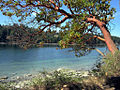
Arbutus menziesii is an evergreen tree about 10 to 25 metres (33 to 82 feet) in height, but in the right conditions up to 30 m (98 ft). The trunk is usually about 60 centimetres (24 inches) thick.[5] The thin bark is a rich orange-red, and when mature naturally peels away in thin sheets, leaving a greenish, silvery appearance that has a smooth satin sheen.[6] Older trunks are gray-brown near the base.[5] Individual trees can live for over 300 years.[5]

The leaves are thick with a waxy texture, elliptical, 7 to 15 cm (2+34 to 6 in) long and 4 to 8 cm (1+12 to 3+14 in) broad, arranged spirally; they are glossy dark green above and a lighter, more grayish green beneath, with an entire margin. The leaves are evergreen, lasting a few years before detaching. Some second-year leaves turn orange to red and detach in the autumn.[5] In the north of its range, wet winters often promote a brown to black leaf discoloration due to fungal infections;[7][8] the stain lasts until the leaves naturally detach at the end of their lifespan.

In spring, the tree bears sprays of small white to pink bell-like flowers,[5] and in autumn, red berries.[6]

Common names

[edit]

It is nicknamed the "refrigerator tree" because its bark contains water, and it stays cool in the summer.[citation needed]

In Canada, it is simply referred to as arbutus. It is known in the United States as the madrona,[9] madrone, madroño, madroña, or bearberry. The name strawberry tree (A. unedo) may also be found in relation to A. menziesii (though it has no relation to the strawberry fruit). According to the Sunset Western Garden Book, in the United States, the name "madrone" is more common south of the Siskiyou Mountains of southern Oregon and Northern California and the name "madrona" is more common north of the Siskiyous. The Concow tribe calls the tree dis-tā'-tsi (Konkow language) or kou-wät′-chu.[10] Its species name was given it in honor of the Scottish naturalist Archibald Menzies, who noted it during George Vancouver's voyage of exploration.[11][12]

Distribution and habitat

[edit]

Madrones are native to the western coast of North America, from British Columbia (chiefly Vancouver Island and the Gulf Islands) to California. They are mainly found in Puget Sound, the Oregon Coast Range, and the California Coast Ranges, but are also scattered on the west slope of the Sierra Nevada and Cascade mountain ranges. They are rare south of Santa Barbara County, with isolated stands south to Palomar Mountain in California.[6] One author lists their southern range as extending as far as Baja California in Mexico,[13] but others point out that there are no recorded specimens collected that far south,[6] and the trees are absent from modern surveys of native trees there.[14] However, other Arbutus species are endemic to the area.

It fares well in dry and rocky sites, is tolerant of salt water, but fairly intolerant of shade.[5]

Ecology

[edit]

The tree can be found growing along with Douglas-fir.[5] The thin bark is susceptible to fire, but new saplings readily sprout after such disturbances.[5] Mature trees survive fire, and can regenerate more rapidly after fire than Douglas-firs. Pacific madrone also produce very large numbers of seeds, which sprout following fire.[6] The tree also sprouts from cut stems.[5]

Many mammal and bird species feed off the berries,[15] including juncos, American robins, cedar waxwings, band-tailed pigeons, varied thrushes, quail, mule deer, raccoons, ring-tailed cats, and bears. As the fruit are produced in great quantity and may persist on the tree into winter, their value as a food source is great. Mule deer will also eat the young shoots when the trees are regenerating after fire.[6][16] The flowers also produce nectar which can be made into honey.[17] Mature leaves are almost always ignored by browsing animals, but young leafy sprouts are eaten by ungulates and the dusky-footed woodrat. It is considered a high-importance winter forage species for many ungulates.[18]

It is important as a nest site for many birds,[16] and in mixed woodland it seems to be chosen for nestbuilding disproportionately to its numbers.[citation needed] This may be due to the susceptibility of the tree to heart rot, which makes it desirable for cavity-nesting birds. Pacific Madrona also provides cover for big game and small mammals, and perching sites for a variety of bird species. They are important habitat for woodpecker and sapsucker species.[18]

Pathogens

[edit]

Arbutus menziesii has low disease resistance and hosts many pathogens such as heart rot, butt rot, and stem cankers. It is afflicted by a fungal leaf blister disease caused by Exobasidium vaccinii which causes mostly aesthetic damage.[18] The species is also lethally affected by fungi of the genus Phytophthora, including the sudden oak death (Phytophthora ramorum) which damages branches and foliage,[6] and a canker disease caused by Phytophthora cactorum which leads to root and butt rot.[18] Other pathogens include Arbutus canker (Nattrassia mangiferae), which causes shoot blight; Fusicoccum aesculi which causes dieback and creates a burned appearance; and Neofusicoccum arbuti, madrone canker, which cause dead or dying branches, crown dieback, cankers, and sometimes death.[19] Thinning stands, soil loss and compaction, and a host of other impacts increase susceptibility to disease, especially on less dense stands.[18]

Conservation

[edit]

Although drought tolerant and relatively fast growing, A. menziesii is currently declining throughout most of its range. One likely cause is fire control; under natural conditions, the madrona depends on intermittent naturally occurring fires to reduce the conifer overstory.[11][6][16]

Increasing development pressures in its native habitat have also contributed to a decline in the number of mature specimens. This tree is extremely sensitive to alteration of the grade or drainage near the root crown. Until about 1970, this phenomenon was not widely recognized on the west coast; thereafter, many local governments have addressed this issue by stringent restrictions on grading and drainage alterations when A. menziesii trees are present.[citation needed]

Invasive species such as Scotch broom and gorse are a threat to the Pacific madrona as they can invade natural areas and outcompete young saplings for space, light, nutrients, and water.[18]

Largest specimen burned

[edit]

During the Soberanes Fire in mid-2016, the largest known specimen of madrone was burned and possibly killed. The tree, 38 m (125 ft) tall and more than 7.6 m (25 ft) in circumference, was listed on the American Forests National Big Tree list, a register of the biggest trees by species in the United States. The tree was located within the Joshua Creek Canyon Ecological Reserve on the Big Sur Coast of California.[20] The fire was caused by an illegal campfire.[21]

Cultivation

[edit]

The trees are difficult to transplant and a seedling should be set in its permanent spot while still small.[8] Transplant mortality becomes significant once a madrone is more than 30 cm (1 ft) tall. The site should be sunny (south- or west-facing slopes are best), well drained, and lime-free (although occasionally a seedling will establish itself on a shell midden).[8][16] In its native range, a tree needs no extra water or food once it has become established.

Uses

[edit]

The berries are considered unpalatable and may be harmful if consumed by people or pets.[16][22] According to legend, Native Americans ate the berries raw and cooked, but because the berries have a high tannin content and are thus astringent, they more often chewed them or made them into a cider. Overeating causes cramps.[17] Native Americans also use the berries to make necklaces and other decorations, and as bait for fishing (as did the Karuk people to catch steelhead).[5] The bark was often made into tea to be drunk for supposed medicinal purposes.[16][23]

Early Californian settlers may have used charcoal from the species to make gunpowder.[5]

The wood is durable and has a warm color after finishing, so it has become more popular as a flooring material, especially in the Pacific Northwest.[16][24] An attractive veneer can also be made from the wood.[25] However, because large pieces of madrona lumber warp severely and unpredictably during the drying process, they are not used much.[12] Madrone is burned for firewood, though,[16][26] since it is a very hard and dense wood that burns long and hot, surpassing even oak in this regard.[citation needed] The W̱SÁNEĆ people of British Columbia have a prohibition against burning arbutus due to its salvific role in their creation myths; an arbutus anchored their canoes to the world during the deluge.[27][28]

References

[edit]
[edit]
Revisions and contributorsEdit on WikipediaRead on Wikipedia
from Grokipedia
Arbutus menziesii, commonly known as the Pacific madrone or madrona, is a broad-leaved evergreen in the heath family () native to the Pacific coastal regions of . It typically grows 20–65 feet (6–20 m) tall with a broad crown, featuring smooth, reddish-brown bark that exfoliates in thin sheets to reveal greenish inner layers, alternate glossy dark green leathery leaves 3–6 inches (7.5–15 cm) long, clusters of small white urn-shaped flowers in spring, and spherical orange-red berries about 0.3–0.5 inches (8–12 mm) in diameter that persist into winter. The species is distributed from southwestern , including southeastern and the , southward through Washington, , and to the Sierra Nevada foothills and southern coastal ranges as far as Mount Palomar, generally occurring in a narrow belt along the at elevations from to 5,000 feet (0–1,500 m). It thrives in dry, rocky, well-drained soils on wooded slopes, canyons, and bluffs in full sun to partial shade, exhibiting moderate but low resistance to frost and poor adaptability to heavy, wet soils. Ecologically, A. menziesii is an early-successional that regenerates primarily through basal from a or following disturbance, supplemented by seed production dispersed by birds and mammals, with flowers pollinated by bees and hummingbirds in May and berries ripening from to . The provides food and habitat for , including berries for birds like robins and , browse for deer and bears, and nesting sites for cavity-nesting birds, while forming ericoid mycorrhizal associations and contributing to via its extensive root system. Native American tribes have utilized the plant for various purposes, such as fermenting berries into , crafting necklaces from them, using bark for medicinal teas to treat issues, and employing the hard for tools and . In modern contexts, it is valued in for its ornamental qualities but can be challenging to cultivate due to sensitivity to and susceptibility to diseases in non-native settings, with fire suppression posing a conservation threat by favoring competing shade-tolerant .

Taxonomy

Classification

Arbutus menziesii Pursh belongs to the kingdom Plantae, division Tracheophyta, class Magnoliopsida, order , family , subfamily Arbutoideae, genus , and species menziesii. The specific epithet honors Archibald Menzies, a Scottish and naturalist who collected the type specimen during the late 18th century. The name was first validly published by Frederick Traugott Pursh in his 1813 work Flora Americae Septentrionalis, based on material from the . Within the , commonly known as the heath or heather family, Arbutus menziesii is placed in the subfamily Arbutoideae, a group characterized by woody shrubs and trees with urceolate flowers, indehiscent fruits, and often peeling bark; this subfamily includes about 15 genera and is distinguished from other Ericaceae subfamilies by molecular phylogenetic analyses confirming its . The genus comprises approximately 12 species of evergreen trees and shrubs, primarily distributed in the Mediterranean Basin, , and western (about 8 species, mostly in ), of which A. menziesii is the only species native to and the northern Pacific coast of the . A historical synonym is Arbutus procera Douglas ex Lindl., proposed by David Douglas in the 1830s but later reduced to synonymy under A. menziesii due to overlapping morphological traits and geographic range; this reflects early taxonomic confusion arising from multiple collections in the . No infraspecific taxa, such as varieties or , are currently recognized in major floras, though minor morphological variants (e.g., in leaf shape) have been noted without formal taxonomic status. The classification aligns with the (APG) IV system, which places in the euasterids II clade of the , emphasizing the family's ericoid habit and mycorrhizal associations.

Etymology and nomenclature

The scientific name Arbutus menziesii was formally published by Frederick Pursh in 1813, honoring the Scottish surgeon and naturalist Archibald (1754–1842), who first documented the species during the in 1792 while exploring the Pacific coast of . The genus name derives from the classical Latin term for the European strawberry tree (), reflecting the similarity in fruit appearance among species in the . The specific epithet menziesii is a Latinized form of Menzies' surname, a common botanical convention to commemorate collectors and contributors to . Menzies initially described the tree as the "Oriental Strawberry Tree" due to its resemblance to Mediterranean species like Arbutus andrachne. The name gained traction after Pursh's publication in Flora Americae Septentrionalis, establishing it as the accepted binomial under the family . A later synonym, procera Douglas ex Lindley, was proposed but is now considered invalid. Common names such as Pacific madrone or madrona stem from the Spanish madroño, applied by explorer Juan Crespi during the 1769 to describe related strawberry trees; this term was adapted for the Pacific species due to shared and bark traits. In , it is often simply called , while regional variants include Oregon laurel in some Indigenous and early settler contexts.

Description

Morphology

Arbutus menziesii is a broadleaf or tall that typically reaches heights of 20 to 65 feet (6 to 20 meters), though it can occasionally exceed 100 feet under optimal conditions. It exhibits a single or multi-stemmed habit with contorted, irregularly branched growth, forming an open, rounded, or umbrella-like crown that spreads 10 to 50 feet wide. The growth rate is slow to medium, and the tree often develops a leaning or crooked trunk, contributing to its picturesque, sculptural appearance. The bark is one of the tree's most distinctive features, smooth and thin on young stems, transitioning to reddish-brown or coppery on mature trunks. It exfoliates annually in papery sheets or thin flakes, peeling away to reveal a fresh, glossy olive-green or reddish underlayer that darkens with age. This peeling process occurs primarily in summer, creating a mottled, colorful mosaic effect on the trunk and branches. Twigs are slender, reddish, and initially pubescent, becoming smooth over time. Leaves are simple, alternate, and elliptical to ovate in , measuring 2 to 6 inches (5 to 15 cm) long and 1.5 to 3 inches (4 to 7.5 cm) wide. They are leathery and waxy, with a glossy dark green upper surface and a paler, sometimes yellowish-green underside, featuring entire margins and a prominent midvein. The leaf base is rounded to wedge-shaped, and the apex is obtuse or slightly acute, with petioles about 0.5 to 1 inch long. As an species, the foliage persists for 2 to 3 years before shedding. Flowers are small, urn- or bell-shaped, and pendulous, occurring in terminal panicles 3 to 9 inches (7 to 23 cm) long. Each flower is creamy white to pinkish, approximately 0.25 to 0.4 inches (6 to 10 mm) long, with five fused petals forming the urn and ten stamens. They bloom in spring, typically April to May, and are fragrant, attracting pollinators such as bees and hummingbirds. The fruit is a berry-like , ellipsoid to rounded, 0.3 to 0.75 inches (8 to 19 mm) in diameter, maturing from green to bright orange-red or in late summer to fall. It features a warty or mealy texture and persists on the into winter, containing numerous tiny embedded in gritty flesh. The fruits are edible but mealy and are primarily dispersed by birds.

Reproduction and growth

Arbutus menziesii, commonly known as Pacific madrone, reproduces both sexually through and asexually via vegetative , with the latter being the primary mode of in disturbed habitats. Flowers are small, whitish, urn-shaped, and perfect, borne in dense terminal racemes that bloom from mid-March to , progressing from lower to higher elevations. occurs primarily by bees and possibly hummingbirds, leading to the development of berries that mature from mid-September to mid-November. These berries are bright red or reddish-orange, 8-12 mm in diameter, and contain 2-37 each (average 20), with seed varying annually—abundant in most years but with bumper crops rare (about once every 10 years). Seed dispersal is facilitated by gravity, with many falling near the parent tree's crown, as well as by animals including birds (such as and waxwings), , and mammals like deer and bears, which consume the nutritious berries and deposit seeds away from the source. is and requires cold stratification for 30-60 days at 2-5°C in a moist medium like peat-vermiculite to achieve rates of 55-94%; without stratification, rates are low. Seeds number 434,310-705,470 per kg, and optimal occurs on bare mineral soil in partial shade, though high seedling mortality (90-100% in the first year) results from damping-off fungi, , and herbivores like slugs. Establishment is rare under closed canopies, and is most successful in disturbed sites post-fire or logging. Vegetative reproduction predominates, especially after disturbances like or cutting, where root crown burls produce numerous sprouts from dormant buds at or above the root collar—over 300 sprouts have been recorded on a single 25-cm stump. These sprouts grow rapidly, with vigorous individuals reaching 1.5 ft (46 cm) per year initially; by age 3, sprout clumps average 13 stems, 10 ft (3 m) tall, and 7.6 ft (2.3 m) wide, while 10-year-old sprouts can attain 22 ft (6.7 m) in height. This resprouting forms multi-trunked trees or groves and allows persistence in fire-prone ecosystems, though it requires ample for success. Growth in A. menziesii is characterized by slow initial seedling development followed by more rapid juvenile and mature phases, influenced by site conditions. Seedlings grow slowly, with 6-month-old shoots averaging 3-4 cm tall and 2-year-olds reaching about 9 cm, thriving best in sunny to partially shaded, well-drained sites. Juvenile height growth accelerates to 1-3 ft (30-91 cm) per year, sustaining at 1-2 ft (30-61 cm) annually from ages 15-30, while diameter growth continues steadily on mature trees. Overall, trees reach heights of 8-38 m (typically 20-30 m) and diameters up to 1 m over a lifespan of 200-500 years, with straight boles in dense stands and crooked, leaning forms in open areas due to phototropism toward light gaps. Mature trees demand full sun and tolerate droughty, rocky soils but are sensitive to transplanting and root disturbance, which can hinder growth.

Range and ecology

Distribution and habitat

Arbutus menziesii, commonly known as Pacific madrone, is native to western , with its range extending from southwestern , where it is primarily restricted to southeastern and adjacent mainland areas, southward through Washington and to San Diego County in . In , populations are limited to low elevations up to about 300 m, while in Washington and , it occurs from to 1,500 m, and in , it spans 90–1,220 m, occasionally reaching higher in the San Lucia Range above 1,200 m. The appears in scattered populations in the coastal ranges, , Peninsular Ranges, and also in the Sierra Nevada foothills and middle elevations. This thrives in mild maritime climates characterized by oceanic winters and dry summers, with annual ranging from 380 to 4,220 mm across its range. It prefers full sun exposure and is commonly found on dry, well-drained sites such as rocky bluffs, slopes, and outcrops, often on southerly or westerly aspects to maximize sunlight and minimize . Soils are typically shallow and rocky, derived from glacial tills, , , , or , with textures from to clay ; the species exhibits high but low resistance to temperatures below -10°C. Ecologically, Arbutus menziesii inhabits open woodlands, forest edges, and mixed conifer forests, associating with species such as Douglas-fir (Pseudotsuga menziesii), tanoak (Notholithocarpus densiflorus), western hemlock (Tsuga heterophylla), Oregon white oak (Quercus garryana), and redwood (Sequoia sempervirens). It is a component of fire-adapted ecosystems, where periodic disturbances create canopy gaps essential for its regeneration, and it persists as a relict of the ancient Madro-Tertiary geoflora in coastal environments. In urban or fragmented landscapes, it favors watershed sites near saltwater, highlighting its affinity for coastal influences.

Biotic interactions

Arbutus menziesii engages in mutualistic interactions with pollinators, primarily bees and hummingbirds, which facilitate its reproduction by transferring pollen among its pendulous, urn-shaped flowers during the spring blooming period. Native bees, including species from genera such as Bombus and Andrena, are key pollinators, drawn to the nectar-rich blooms, while rufous hummingbirds (Selasphorus rufus) and possibly other hummingbird species contribute to cross-pollination in coastal habitats. Butterflies, notably the spring azure (Celastrina echo), also visit the flowers, enhancing pollination diversity within Ericaceae family dynamics. The species forms arbutoid mycorrhizae, a type of ericoid mycorrhizal association, with a diverse community of fungi primarily from the phylum, including genera like , which enhance nutrient uptake—particularly and —in nutrient-poor, acidic soils typical of its . These symbiotic relationships position A. menziesii as a central hub for mycorrhizal fungal diversity in mixed evergreen forests, where it connects fungal networks among conifers like Douglas-fir (Pseudotsuga menziesii) and other ericaceous shrubs, promoting overall forest regeneration and resilience. Studies indicate that a highly diverse community, with 86 to 126 distinct fungal taxa associating with its roots, underscoring its role in facilitating seedling establishment for co-occurring species through shared mycorrhizal pathways. As of 2025, populations in the region are experiencing declines due to heightened disease incidence and altered disturbance regimes from . Herbivory on A. menziesii primarily affects young foliage and sprouts, with (Odocoileus hemionus columbianus) and browsing terminal buds and leaves, potentially limiting regeneration in heavily grazed areas. Berries serve as a food source for a range of , including birds such as band-tailed pigeons (Patagioenas fasciata) and (Junco hyemalis), as well as small mammals like , which consume the fruits and inadvertently aid in seed scarification. The also supports lepidopteran larvae, acting as a host plant for the (Hyalophora euryalus) and brown elfin butterfly (Callophrys augustinus), whose caterpillars feed on leaves without causing widespread defoliation. These interactions contribute to trophic dynamics in ecosystems, balancing plant defense mechanisms like tannin-rich foliage against consumer pressures. Seed dispersal is predominantly ornithochorous, with birds such as mourning doves (Zenaida macroura) and California quail (Callipepla californica) ingesting the red, berry-like drupes and depositing viable seeds across forested landscapes, often far from parent trees. Mammalian dispersers, including mule deer and rodents, further aid in short-distance dispersal through endozoochory or caching behaviors, while gravity facilitates local propagation on slopes. This multi-vector strategy enhances the species' adaptability in fragmented habitats, with seeds exhibiting dormancy that aligns with post-dispersal germination cues from mycorrhizal colonization.

Pathogens and pests

Arbutus menziesii is susceptible to several fungal pathogens that cause foliage diseases, including leaf spots and blights. These are primarily induced by over a dozen fungal species, such as Ruptoseptoria unedonis (formerly Mycosphaerella arbuticola), Rhytisma arbuti, and Phacidiopycnis washingtonensis, which produce circular to irregular spots ranging from 0.25 to 0.5 inches in diameter, often with grayish centers and purplish-brown margins, or black tar-like lesions. Spores spread via air or water during wet, cool weather, leading to unsightly defoliation and increased tree stress, though rarely fatal on their own. More severe threats include cankers and root diseases, notably Phytophthora root rot and canker caused by Phytophthora cactorum or P. cinnamomi. These oomycete pathogens infect through roots or wounds in saturated soils, resulting in sunken, brown-to-black cankers at the trunk base, foliage wilting, leaf curling, and eventual tree decline or death, particularly in poorly drained sites. Branch and trunk cankers from fungi like Neofusicoccum arbuti and Botryosphaeria dothidea manifest as discolored, peeling bark and blackened wood, causing dieback that can girdle stems and lead to rapid mortality if multiple infections occur. Wood-decay fungi such as Phellinus igniarius and Fomitopsis cajanderi cause heartrot, primarily affecting older trees through wounds, though they provide habitat for wildlife with minimal overall impact on vigor. Insect pests generally cause minor damage to A. menziesii, with leaf miners like Marmara arbutiella creating sinuous trails in foliage, and defoliators such as the fall webworm (Hyphantria cunea) and western tent caterpillar () forming webs and skeletonizing leaves, occasionally deforming young trees. (Wahlgreniella nervata) may curl leaves, while wood-boring beetles (Neoclytus conjunctus) and bark beetles target stressed or injured trees, exacerbating decline but rarely acting as primary pests. Slugs can significantly impact seedlings in shaded conditions by consuming foliage, contributing to high mortality rates.

Conservation

Status and threats

Arbutus menziesii, commonly known as Pacific madrone, is considered globally secure, with a NatureServe rank of G5, indicating it is not currently at risk of extinction or extirpation on a rangewide basis. It is assessed as Least Concern on the IUCN Red List of Threatened Species, reflecting its relatively stable populations across its native range from British Columbia to northern California. In the United States, it holds national rank of NNR (not ranked nationally) and state ranks of SNR (not ranked) in California, Oregon, and Washington, while in Canada, it is ranked N5 (secure nationally) and S5 (secure provincially) in British Columbia. Despite its secure global status, Pacific madrone faces several localized threats that contribute to population declines, particularly in urban and fragmented habitats. Habitat loss and degradation from residential development and past logging are primary concerns, especially in the Puget Trough region of Washington, where mature stands have been reduced and invaded by nonnative species such as velvet grass (Holcus lanatus) and hairy cat's ear (). Fire suppression exacerbates this by allowing competitive species like tanoak to dominate, reducing madrone regeneration, while soil compaction, erosion, and thinning in urban areas increase vulnerability to environmental stress. Diseases pose a significant threat, with fungal pathogens causing widespread mortality. Arbutus canker (Nattrassia mangiferae), a foliar and branch dieback disease, leads to leaf spotting, twig , and trunk lesions, particularly in stressed trees. Sudden oak death () affects Pacific madrone in and , causing bleeding cankers and death. Emerging fungal threats, such as Neofusicoccum arbuti, cause latent infections leading to cankers and decline across a broad host range. Insect pests like and western further weaken trees under stress. Additional pressures include invasive plants like Scotch broom () and gorse (), which outcompete madrone in oak-madrone ecosystems, and increased herbivory from deer, which prevents seedling establishment due to . amplifies these risks by altering patterns and increasing stress, potentially expanding ranges and reducing suitability. In the Salish Sea region, combined effects of herbivory, , and human activities like carving have led to noticeable declines in populations.

Notable specimens and events

One of the most notable specimens of Arbutus menziesii, the former national champion Pacific madrone, was located in the Joshua Creek Canyon Ecological Reserve in . This tree, nominated in 2003, measured 316 inches in circumference at breast height, 88 feet in height, and had a crown spread of 116 feet, earning it 433 points under American Forests' scoring system. Tragically, it was severely damaged and likely killed during the Soberanes Fire in July 2016, which burned over 130,000 acres in the region and highlighted the vulnerability of large madrones to . Following the loss of the national champion, state-level records provide insight into exceptional specimens. Oregon's state champion grows in Douglas County, with a circumference of 250 inches, height of 96 feet, and crown spread of 97.5 feet. Another remarkable tree, cited as a U.S. champion in some records, stands in , measuring 635 cm (approximately 250 inches) in circumference, 29 meters (95 feet) in height, and a 30-meter crown spread, as documented in 2012. In California, a historically large specimen in Humboldt County reached a circumference exceeding 384 inches at 0.9 meters above ground and 24 meters (79 feet) in height, known as the Council Madrone, which later blew down, though standard breast-height measurements limit typical diameters to 152 cm (60 inches). Key conservation events underscore efforts to protect A. menziesii amid threats like disease and habitat loss. The Arbutus ARME initiative, launched in April 2016 by Washington State University and partners, aims to advance research on leaf blight resistance, track population health via the TreeSnap app, and foster restoration through symposia and volunteer networks; its inaugural "Future of the Pacific Madrone" Symposium gathered experts to address declining populations. As of 2025, the initiative remains active in promoting conservation. Complementing this, the Madrone Recovery Project, initiated in 2018 as part of Seattle's Green Seattle Partnership, targets restoration of urban madrone ecosystems over a 20-year period, planting disease-resistant stock and monitoring sites to counteract urbanization impacts. The project continues as part of ongoing urban forest restoration efforts.

Human relations

Cultivation

Arbutus menziesii, commonly known as Pacific madrone, is challenging to cultivate due to its sensitivity to root disturbance and specific environmental needs, yet it is valued in for its ornamental features including peeling reddish bark, foliage, and spring blooms. Successful and establishment require mimicking its native conditions of well-drained, rocky soils on slopes, with minimal intervention once rooted. It thrives in USDA hardiness zones 7 to 9, though some sources extend this to zones 5a to 8b in protected sites. Propagation is primarily achieved through seeds, which must undergo cold stratification to break dormancy. Ripe fruits are collected in fall when deep orange-red, fermented to separate seeds (each fruit yielding about 8 viable seeds), and stratified at 4°C (40°F) for 60 days in moist medium before sowing in a greenhouse at 15–18°C (59–64°F), yielding germination in approximately 2 weeks with rates exceeding 90%. Seedlings are transplanted to containers when they develop 2–4 true leaves, using a sandy potting mix to promote growth to 30–40 cm by the end of the first season. Vegetative propagation via stem cuttings is possible but less commonly detailed, with rooting success varying; layering may also be attempted in natural settings. In landscape settings, plant in full sun to partial shade on well-drained, low-fertility soils with ranging from acidic (<6.0) to neutral (6.0–8.0), avoiding heavy clay or waterlogged areas to prevent . Initial watering should keep soil slightly moist until establish (about 1–2 years), after which is minimal—infrequent and deep only during extreme —to replicate its native dry-slope . Fertilization is unnecessary and often detrimental, as excess nutrients promote weak growth susceptible to diseases like . Mulching is optional but should not retain moisture; instead, allow natural leaf litter to decompose for mycorrhizal associations essential to the tree's . Transplanting poses the greatest challenge, with high mortality from root damage; container-grown or air-pot seedlings are recommended, planted in their original orientation to minimize shock, and spaced at least 6 feet apart for air circulation. Expect slow establishment, with multiple plantings often needed (e.g., 3 per desired mature tree) due to survival rates below 50% in non-native sites. is rarely required, but any wounds should heal quickly in sunny, dry conditions to avoid infections. Overall maintenance is low once adapted, though urban and overwatering can lead to decline.

Uses and cultural significance

Arbutus menziesii, known as Pacific madrone, has been utilized by various of the and for food, medicine, and material purposes. Tribes such as the , , and consumed the berries fresh, dried them for later use, or processed them into , often harvesting them by hand or with sticks due to their tannic flavor, which limited intake to small quantities. The berries were also chewed for flavor without swallowing or strung as decorative necklaces. Medicinally, the tree's parts have served multiple roles among Indigenous groups. The and chewed leaves to alleviate cramps and stomachaches, while the prepared bark infusions or tannic teas to treat skin sores, colds, sore throats, and as an astringent wash. The Saanich and W̱SÁNEĆ peoples used bark and leaves to address colds, stomach aches, cramps, cuts, wounds, , and sore throats, with the W̱SÁNEĆ also employing it as a post-childbirth contraceptive. The bark's further aided in tanning and curing hides. Beyond food and medicine, the tree provided practical materials. Coast Salish Nations, including the W̱SÁNEĆ, crafted tools and clothing from the inner bark, which was woven into dresses. The wood, though knotty and not commercially harvested, has been used for , (including in production), flooring, cabinets, and veneer. Berries served as bait for , and leaves and berries were employed decoratively or in treatments for ailments like . Culturally, Arbutus menziesii holds deep significance for First Nations, particularly the W̱SÁNEĆ, who call it ḰEḰEIȽĆ and regard it as sacred in their Great Flood story, where it anchored survival canoes on LÁU,WELNEW (Mount Newton). It embodies broader cultural heritage in the , reflecting longstanding ethnobotanical knowledge and spiritual connections to the landscape.

References

Add your contribution
Related Hubs
User Avatar
No comments yet.