Hubbry Logo
Palazzo GrassiPalazzo GrassiMain
Open search
Palazzo Grassi
Community hub
Palazzo Grassi
logo
8 pages, 0 posts
0 subscribers
Be the first to start a discussion here.
Palazzo Grassi
Palazzo Grassi
from Wikipedia

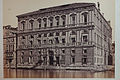
Palazzo Grassi (also known as the Palazzo Grassi-Stucky) is a building in the Venetian Classical style located on the Grand Canal of Venice (Italy), between the Palazzo Moro Lin and the campo San Samuele.

Key Information

History

[edit]

First owners

[edit]

During the 16th century, the building was owned by the Cini family. In February 1605, Alamanno Aragon Hocheppan, grandson of Cosimo I, acquired it. The Grassi family first moved in the building in 1655.[2]

Grassi family

[edit]

The Palazzo Grassi was designed by Giorgio Massari, and rebuilt between 1748 and 1772. Massari started the Palazzo while he was finishing the Ca' Rezzonico on the opposite bank of the river.[3]

A latecomer among the palaces on the Grand Canal of Venice, Palazzo Grassi has an academic classical style that is in contrast to the surrounding Byzantine Romanesque and Baroque Venetian palazzi. It has a formal palace façade, constructed of white marble, but lacks the lower mercantile openings typical of many Venetian patrician palaces. The main stairwell is frescoed by Michelangelo Morlaiter and Francesco Zanchi, and the ceilings are decorated by the artists Giambattista Canal and Christian Griepenkerl. The Palazzo Grassi was the last palace to be built on the Grand Canal before the fall of the Venetian Republic,[4] and the largest-sited.[3]

Fiat-Agnelli

[edit]

The Grassi family sold the palazzo in 1840, with ownership that followed passing through many different individuals. In 1857, the building was bought by Baron Simeone De Sina. A small scenic garden was created adjacent to the building.[4]

In 1951, the building became the International Centre of Arts and Costume. The adjacent garden was turned into an open-air theatre (Teatrino), which was finally covered in the 1960s.[4] The International Centre for Arts and Costume closed in 1983.[4]

The Palazzo was purchased by the Fiat Group in 1983, under the late chairman Gianni Agnelli, and it underwent a complete restoration overseen by architect Gae Aulenti. The group's aim was to transform Palazzo Grassi into an exhibition hall for the visual arts. It continues to be used as an art gallery today.[5]

Between 1984 and 1990, Pontus Hultén was in charge of the art museum which also contained a 600-seat outdoor theatre. In 1990, the architect Aldo Rossi received the Pritzker Architecture Prize in this building.[3]

Pinault Collection

[edit]

In May 2005, the French entrepreneur François Pinault bought the Palazzo Grassi for 29 million euros. The remodeling of the building was assigned to the Japanese architect Tadao Ando. The Palazzo reopened in April 2006 with the exhibit Where Are We Going?. The Palazzo is divided in 40 rooms, providing 5,000 m2 of exhibition floor. Jean-Jacques Aillagon was the museum's first director.[6][7]

In 2007, François Pinault acquired the Punta della Dogana to transform it into a contemporary art museum paired with the Palazzo Grassi. The replanning of the building, which was in disrepair when acquired, was also assigned to Tadao Ando.[8] The Punta della Dogana reopened after 14 months of renovation.[9]

In 2013, Tadao Ando redesigned the Teatrino into a 225-seat auditorium.[4][10]


Exhibitions

[edit]
Since 2006, Palazzo Grassi has been presenting temporary exhibitions from the Pinault Collection:[11]
  • Where Are We Going? A selection of works from the Pinault Collection, curated by Alison Gingeras, April 2006 - October 2006
  • Picasso, la joie de vivre. 1945-1948, curated by Jean-Louis Andral, November 2006 - March 2007
  • François Pinault Collection: a Post-Pop Selection, curated by Alison Gingeras, November 2006 - March 2007
  • Sequence 1 – Painting and Sculpture from the François Pinault Collection, curated by Alison Gingeras, May 2007 – November 2007
  • Rome and the barbarians. The Birth of a New World, curated by Jean-Jacques Aillagon, January 2008 – July 2008
  • Italics. Italian Art Between Traditions and Revolutions, 1968-2008, curated by Francesco Bonami, September 2008 - March 2009
  • Mapping the Studio: Artists from the François Pinault Collection, curated by Francesco Bonami and Alison Gingeras. Presented at Palazzo Grassi and at Punta della Dogana. June 2009 – April 2011
  • The World Belongs to You, curated by Caroline Bourgeois, June 2011 – February 2012
  • Madame Fisscher, solo exhibition by Urs Fischer curated in collaboration with Caroline Bourgeois, April 2012 – July 2012
  • Voice of Images, curated by Caroline Bourgeois, August 2012 – January 2013
  • Rudolf Stingel,[12] solo exhibition curated by the artist in collaboration with Elena Geuna, April 2013 – January 2014
  • The Illusion of Light, curated by Caroline Bourgeois, April 2014 – January 2015
  • Irving Penn, Resonance, curated by Pierre Apraxine and Matthieu Humery, April 2014 – January 2015
  • Martial Raysse, curated by Caroline Bourgeois in collaboration with the artist, April 2015 – November 2015
  • Sigmar Polke, curated by Elena Geuna and Guy Tosatto, April 2016 – November 2016
  • Treasures from the Wreck of the Unbelievable, Damien Hirst,[13] curated by Elena Geuna. Presented at Palazzo Grassi and at Punta della Dogana. April 2017 – December 2017
  • Cows by the Water, Albert Oehlen,[14] curated by Caroline Bourgeois, April 2018 - January 2019
  • La Pelle, Luc Tuymans,[15] curated by the artist in collaboration with Caroline Bourgeois, March 2019 - January 2020

Building

[edit]

The Palazzo Grassi was designed by Giorgio Massari. The main stairwell was frescoed by Michelangelo Morlaiter and Francesco Zanchi. The ceilings were decorated by Giovanni Battista Canal and Christian Griepenkerl.[4]

See also

[edit]

References

[edit]

Bibliography

[edit]
[edit]
Revisions and contributorsEdit on WikipediaRead on Wikipedia
from Grokipedia
Palazzo Grassi is a historic palace in , , situated on the Grand Canal between Palazzo Moro Lin and Campo San Samuele, renowned as the last major noble residence built before the fall of the Venetian Republic in 1797. Constructed between 1748 and 1772 by architect Giorgio Massari on behalf of the Grassi family, it exemplifies late 18th-century Venetian with classical influences, featuring a sober Grand Canal facade and more varied detailing on the landward side. Acquired by in 2005 and renovated by Japanese architect , it reopened in 2006 as a venue for exhibitions from the , one of the world's largest private collections of postwar and contemporary works, alongside . The palace's early history traces back to the 16th century when it was owned by the Cini family, before passing to in 1605 and the Grassi family in 1655, who commissioned its reconstruction to replace earlier structures damaged by fire and decay. In 1857, it was sold to Baron Simeone de Sina, who added 19th-century opulent ceiling decorations; subsequent owners included the Marinotti family in the mid-20th century, who established it as an International Centre for Arts and from 1951 to 1983. The Group purchased it in 1983 and oversaw restorations led by Gae Aulenti, transforming it into an exhibition space until Pinault's acquisition marked its shift to focusing on modern and contemporary art. Architecturally, Palazzo Grassi stands out for its grand entrance hall with a and inlaid marble floor, a monumental adorned with frescoes by artists such as Carlo Innocenzo Carloni and Michelangelo Morlaiter, and interiors featuring 18th- and 19th-century frescoes by Francesco Zanchi, Giambattista Canal, and . Ando's minimalist renovation preserved these elements while introducing subtle modern interventions, such as enhanced natural and artificial lighting, to adapt the space for art display without invasive alterations. Adjacent to the palace is the Teatrino Grassi, a 1960s addition restored in 2013, which hosts cultural events including lectures, concerts, and performances. As of November 2025, Palazzo Grassi operates as a dynamic without a permanent collection, presenting temporary exhibitions of works by artists from the onward, often including site-specific commissions—such as Tatiana Trouvé's ongoing show (April 2025–January 2026)—and draws visitors for its blend of historical grandeur and cutting-edge programming.

History

Origins and Construction

In 1748, the Grassi family, a noble Venetian lineage originally from who had acquired the site in the mid-17th century, commissioned the reconstruction of Palazzo Grassi to serve as their primary residence, replacing an earlier structure on the property. Construction spanned from 1748 to 1772, marking it as one of the last major palazzi built on the Grand Canal before the fall of the in 1797. The project was entrusted to architect Giorgio Massari, a prominent figure in late-Baroque and early neoclassical Venetian architecture, who drew on Palladian and Sansovinian influences to create a design emphasizing sobriety and elegance. Massari's specific choices included a three-story façade crafted from Istrian stone and white Veronese marble, featuring a balanced tripartite arrangement with central windows and restrained ornamentation that contrasted with the more ornate Gothic and styles prevalent in earlier Venetian palaces. Situated on the left bank of the Grand Canal, between Palazzo Moro Lin and Campo San Samuele, Palazzo Grassi integrated seamlessly into Venice's urban fabric as a symbol of 18th-century aristocratic prestige, its water-facing main entrance facilitating the family's social and commercial activities along the waterway. This positioning underscored the Grassi family's status within the declining but still opulent , where such residences served both residential and representational functions.

Grassi Family Ownership

The Grassi family, a prominent mercantile dynasty originally from , acquired Palazzo Grassi in 1655 after it had passed through earlier owners, including the Cini family during the and Alamanno Aragon Hocheppan, grandson of , who purchased it in 1605. The family's wealth derived from trade, enabling them to purchase a noble title in the early and integrate into Venetian , where they played roles in and commerce amid the Republic's declining maritime dominance. Key family members, including those who oversaw the palazzo's major reconstruction from 1748 to 1772 under architect Giorgio Massari, transformed the aging structure into a grand neoclassical residence symbolizing their elevated status. During this period, the palazzo functioned as the family's primary residence, hosting daily life activities and serving as a venue for social gatherings that reflected Venetian elite customs. By the early , the Grassi lineage faced financial difficulties exacerbated by the Republic's fall in and broader economic shifts, leading to the sale of the property in 1840.

19th- and Early 20th-Century Ownership

Following the sale of Palazzo Grassi by the Grassi family in 1840, the property changed hands among several private owners over the subsequent decades. In 1857, Venetian banker and philanthropist Baron Simeone De Sina acquired the palazzo and adapted it for residential purposes, commissioning modifications that included the creation of an adjacent scenic garden featuring fountains, columns, pergolas, and greenhouses to enhance its private leisure spaces. The building remained in private ownership through the early , passing to various individuals and families amid Venice's evolving social and economic landscape. By 1949, it was purchased by Italian industrialist Franco Marinotti through his company Snia Viscosa, a multinational chemical firm specializing in synthetic fibers, marking a shift toward more institutional utilization. Under Marinotti's stewardship, Palazzo Grassi was transformed in into the International Centre of Arts and (Centro Internazionale dell'Arte e del Costume), a venue dedicated to exhibitions exploring history, , and contemporary design. The center quickly became a hub for post-World War II Venetian cultural revival, hosting temporary displays such as rare book collections on , shows featuring international designers, and conventions that blended with industry. From 1959 to 1978, it mounted exhibitions of contemporary visual artists, including works by alongside and , underscoring its role in promoting modern aesthetics amid Venice's recovery and tourism boom. The adjacent garden was repurposed as the open-air Teatrino di Palazzo Grassi, accommodating theatrical performances like and in the 1960s, further embedding the site in the city's performative arts scene. By the early 1980s, escalating maintenance challenges, including structural decay from decades of adaptive uses and rising costs in a shifting cultural funding environment, led to the center's closure in 1983.

Fiat Ownership and Initial Restoration

In 1983, the Group, led by chairman , acquired Palazzo Grassi for approximately $6 million, viewing the purchase as an opportunity to engage in cultural patronage and revive a historic Venetian landmark that had deteriorated over the previous decades. This move aligned with Agnelli's broader commitment to , reflecting Fiat's strategy of corporate in during the late 20th century. The restoration project, directed by architect Gae Aulenti from 1984 to 1986, addressed the building's structural weaknesses through reinforcements of original support beams and the introduction of modern elements like wire mesh and rough stone walls to ensure stability and functionality. Aulenti's design also adapted the interiors for exhibition purposes, gutting non-essential spaces while preserving the neoclassical essence, at a cost of nearly $9 million. This comprehensive refurbishment transformed the palazzo from a neglected private residence into a viable public cultural venue. Palazzo Grassi reopened as an exhibition gallery in 1986, with its inaugural show, "," drawing significant attention and marking Fiat's entry into Venice's scene. Under Fiat's management, the palazzo hosted a series of high-profile cultural events focused on and , selected by a team appointed by Agnelli. Fiat maintained sponsorship of these programs through 2005, investing in exhibitions that attracted over seven million visitors and underscoring the company's role in promoting Italian heritage as a form of enlightened corporate responsibility. This era positioned Palazzo Grassi as a symbol of industrial Italy's cultural contributions, bridging economic power with artistic legacy.

Pinault Acquisition and Contemporary Era

In May 2005, French billionaire acquired Palazzo Grassi from for €29 million, marking a pivotal shift toward its role as a venue for within the . This purchase integrated the historic palazzo into Pinault's broader cultural initiatives, transforming it from a corporate space into a dedicated for his extensive holdings of postwar and contemporary works. Following the acquisition, Pinault commissioned Japanese architect to oversee a comprehensive remodeling from 2005 to 2006, which involved adding modern concrete elements to the interiors while preserving the building's neoclassical facade and historical structural integrity. The project balanced contemporary functionality with respect for the 18th-century architecture, including the removal of prior modifications to restore original spatial qualities. Palazzo Grassi reopened to the public in April 2006, debuting as the primary exhibition site for the in . The site's expansion continued in 2007 when Pinault secured through a public tender, restoring it under Ando's design and reopening it in June 2009 as a complementary space adjacent to Palazzo Grassi. In 2013, Ando completed the renovation of the adjacent Teatrino, a former 1960s theater, adding a 225-seat with concrete and wood finishes to support cultural programming. As of 2025, the —managed by the Pinault Foundation—continues to oversee Palazzo Grassi, , and Teatrino, emphasizing temporary exhibitions of and enhanced public access through seasonal programs that explore themes like portraiture and bodily expression. This ongoing commitment has positioned the complex as a of Venice's modern , drawing international visitors while maintaining the sites' historical significance.

Architecture

Exterior Design

Palazzo Grassi exemplifies Venetian neoclassical architecture through its restrained yet elegant facade, constructed primarily from white Istrian stone that gives it a luminous, pristine appearance along the Grand Canal. The facade, designed by Giorgio Massari and built between 1748 and 1772, adopts a sober and regular composition that aligns with traditional Venetian palace aesthetics while anticipating neoclassical principles. Massari's design draws clear influences from Andrea Palladio's rational symmetry and Jacopo Sansovino's classical proportions, resulting in a harmonious three-story structure that includes a with a water-level entrance for direct access, a , two upper floors, and an attic level. The central portal provides a focal point at the base, leading to the interior while emphasizing the building's orientation toward the waterway. The upper levels feature grouped windows—round-arched on the first floor and rectangular with curved or triangular pediments on the second—framed by subtle balconies that enhance the vertical rhythm without ornate excess. Positioned prominently on the Grand Canal between Palazzo Moro Lin and Campo San Samuele, the palazzo spans approximately 50 meters in width, offering commanding views of the waterway and underscoring its role as one of Venice's last grand noble residences before the fall of the . The facade's clean lines and balanced proportions reflect the Grassi family's status as wealthy merchants.

Interior Features

The interior of Palazzo Grassi is structured across three principal floors: the , the piano nobile, and the upper levels, encompassing approximately 40 rooms that provide 5,000 square meters of space adaptable for exhibitions. This layout reflects the palazzo's original design for aristocratic residence, with expansive reception areas on the piano nobile intended for formal entertaining and social gatherings. The grand staircase, known as the scalone d'onore, serves as a central feature, its walls adorned with frescoes by Michelangelo Morlaiter and Zanchi depicting elegant masked figures in mythological reception scenes. These 18th-century artworks contribute to the opulent ambiance of the main salons, where intricate decorations and polished floors enhance the spatial grandeur. Ceiling paintings further elevate the interiors, including Giambattista Canal's 1780 depiction of the in the double-height ballroom, and Christian Griepenkerl's 19th-century in the Neptune and room portraying marine deities amid ornate elements. These decorative schemes, combining painting, , and architectural detailing, underscore the palazzo's role as a showcase of Venetian artistry tailored for elite hospitality.

Restorations and Modifications

In the mid-19th century, following its acquisition by Baron Simeone de Sina in 1857, Palazzo Grassi underwent updates that modernized the structure for contemporary residential use, including the installation of systems and minor expansions to accommodate evolving needs. De Sina also commissioned sumptuous new ceilings on the upper floors, painted by artist , which introduced ornate 19th-century decorative elements contrasting the building's original neoclassical austerity. The most extensive restoration of the occurred between 1984 and 1986 under the ownership of the Fiat Group, led by architect Gae Aulenti, who transformed the dilapidated palace into a premier venue while addressing structural vulnerabilities. This involved seismic reinforcements to bolster the aging foundations against Venice's and minor risks, alongside meticulous conservation of the interior frescoes, including those by Carlo Innocenzo Carloni, using innovative techniques to restore their vibrancy without altering historical layers. Aulenti's interventions also included converting grand salons and portego spaces into adaptable galleries, with the removal of a 1951 Venini glass to reveal original architectural features, ensuring the building's revival as a cultural hub at a cost exceeding $12 million. In 2005, acquired Palazzo Grassi and commissioned Japanese architect for a comprehensive remodel completed in 2006, which integrated minimalist modern elements while safeguarding the neoclassical core designed by Giorgio Massari. Ando's design incorporated polished concrete floors, glass flooring in select areas for natural light penetration, and subtle LED lighting systems to highlight artworks and architectural details. These modifications enhanced functionality for displays, with pivoting wall panels and minimal interventions preserving the palazzo's volumetric integrity and original stonework while expanding exhibition space without impacting the historic facade. A subsequent phase of Ando's work focused on the adjacent Teatrino in 2013, redesigning the 1961 structure—originally an open-air theater space—into a fully enclosed 225-seat with advanced acoustic for performances, screenings, and conferences. The project retained the external historic envelope, inserting a new curved interior volume clad in orthogonal grids at openings, which improved isolation and event versatility while respecting the site's romantic garden heritage. This addition completed the palazzo complex's adaptation for multifaceted cultural programming under the .

Exhibitions and Programs

Fiat-Era Exhibitions

During Fiat's ownership of Palazzo Grassi from 1983 to 2005, the venue transitioned into a prominent cultural institution dedicated to major temporary s, opening to the public following a comprehensive restoration completed in 1986. The inaugural , "Futurismo e Futurismi," curated by Pontus Hultén and others, ran from May 4 to October 12, 1986, and explored the origins and global developments of the Futurist movement, drawing on over 1,000 works including paintings, sculptures, and manifestos from international collections. This show marked the palace's debut as a kunsthalle-style space, attracting significant attention for its ambitious scale and scholarly depth, with Hultén's direction emphasizing interdisciplinary connections between , technology, and society—aligning with Fiat's industrial heritage. Subsequent exhibitions under Fiat sponsorship prioritized Italian cultural heritage, archaeology, and historical narratives, often highlighting regional and national identity through artifacts and artworks loaned from global museums. Notable examples included "I Fenici" (1988), which showcased Phoenician artifacts to trace Mediterranean influences on ancient Italy; "Leonardo & Venezia" (1992), examining Leonardo da Vinci's ties to Venetian art and science; and "La pittura fiamminga e olandese da Van Gogh, Ensor, Magritte, Mondrian ai contemporanei" (1997), bridging Northern European influences with Italian collections. Other shows delved into fashion and design elements, such as "Il Calendario Pirelli 1964-1997" (1997), a brief display of the iconic Pirelli calendars that blended commercial imagery with artistic photography, and "Palazzo Grassi: Palazzo Aperto - Scene di vita veneziana di Pietro Longhi e Gabriel Bella" (1995), featuring 18th-century Venetian genre paintings to evoke local history and daily life. These programs, typically running six to nine months, were curated by international experts and supported by Fiat's cultural foundation, reinforcing the company's branding as a patron of high-profile, educational initiatives that promoted Italy's artistic legacy. The Fiat-era exhibitions enjoyed strong public reception, cumulatively drawing approximately seven million visitors over nearly two decades, with individual shows like "I Celti. La prima Europa" (1991) and "I Maya" (1998–1999) generating widespread acclaim for their immersive presentations and accessibility, often including educational lectures and films to engage diverse audiences from around the world. This success underscored Palazzo Grassi's role in elevating as a hub for blockbuster cultural events, while Fiat's involvement—totaling 15 major shows—served as a form of corporate , enhancing the company's global image through associations with prestigious art and heritage. The exhibition program concluded amid preparations for the sale of the palace in 2005, with the final Fiat-sponsored show being a retrospective on from September 4, 2004, to January 16, 2005, celebrating the artist's centenary through over 200 works including paintings, sculptures, and documents. Fiat's withdrawal from sponsorship, announced in 2003 following the death of , reflected a strategic shift away from cultural investments, ending an era that had firmly established Palazzo Grassi as a foundational venue for public engagement with art and history.

Pinault Collection Exhibitions

The Pinault Collection's exhibition program at Palazzo Grassi commenced with the inaugural presentation "Where Are We Going?" from April 29 to October 1, 2006, curated by Alison M. Gingeras, which showcased over 200 works by approximately 50 postwar artists drawn exclusively from François Pinault's holdings. This thematic exploration of contemporary art's evolution emphasized bold, provocative pieces, including paintings and sculptures by Cy Twombly, signaling the collection's focus on innovative postwar expressions. Subsequent exhibitions built on this foundation, with "Mapping the Studio: Artists from the Collection" running from June 6, 2009, to April 10, 2011, at both Palazzo Grassi and , curated by Alison M. Gingeras and Francesco Bonami. Featuring around 200 works by 66 artists, the show delved into the creative process through diverse mediums, from installations to paintings, highlighting the studio as a site of invention and referencing Bruce Nauman's video work of the same name. In 2015, "," curated by artist Danh Vo in collaboration with Caroline Bourgeois, was presented at from April 12 to December 31, incorporating contributions from 35 artists that examined historical contingencies and linguistic slips via sculptures, photographs, and ready-mades. During the same period, Palazzo Grassi hosted the solo exhibition "Martial Raysse," curated by Caroline Bourgeois, featuring works from 1958 to 2015 by the French artist. A landmark solo presentation arrived in 2017 with Damien Hirst's "Treasures from the Wreck of the Unbelievable," held from April 9 to December 3 across Palazzo Grassi and , presenting over 250 new sculptures, paintings, and jewels fabricated as fictional ancient artifacts recovered from a . The 's narrative of discovery and authenticity blurred lines between reality and myth, utilizing the venues' architecture to evoke submerged histories. Under Caroline Bourgeois, the Pinault Collection's chief curator and artistic advisor to since the mid-2000s, exhibitions have adopted a curatorial approach that prioritizes site-specific installations, adapting contemporary works to harmonize with Palazzo Grassi's neoclassical interiors and grand staircases for immersive, contextual dialogues. This method fosters intimate encounters between art and architecture, as seen in tailored placements that leverage the palazzo's frescoed ceilings and canal views. The program frequently incorporates joint programming with , the Pinault Collection's adjacent venue, to create unified thematic experiences, such as the synchronized displays in "Mapping the Studio" and Hirst's project. This synergy has defined the collection's presence, promoting cross-venue curatorial narratives. Recent examples include ". Ensemble," a major survey of over 50 works by the artist at Palazzo Grassi from March 17, 2024, to January 6, 2025, curated by Caroline Bourgeois in collaboration with Nairy Baghramian and Huma Bhabha at , and the upcoming "Tatiana Trouvé" solo exhibition at Palazzo Grassi from April 6, 2025, to January 4, 2026, featuring sculptures, drawings, and installations.

Teatrino Events and Performances

The Teatrino di Palazzo Grassi, a 225-seat black-box designed by Japanese architect , was added to the palazzo complex in 2013 as part of its broader renovation. Featuring curving concrete walls that create a versatile, blank-canvas space illuminated by zenithal light, the includes a spacious foyer, dressing rooms, and technical facilities, enabling flexible staging for diverse cultural activities. Since its inauguration, the Teatrino has hosted a range of performative and educational programs, including contemporary dance, film screenings, concerts, and artist talks, often in collaboration with international institutions and universities. Notable examples include live dance performances such as Pam Tanowitz Dance's presentations in the foyer in 2022 and Bintou Dembélé's choreography during the fall 2024 public program, alongside jazz concerts by Jason Moran and experimental music by Éliane Radigue. Film screenings tied to contemporary artists, such as works by Anri Sala, Philippe Parreno, and Loris Gréaud, have been featured to deepen thematic explorations. A key component is the "Casa delle Parole" lecture series, an annual program of literary readings held monthly from October to June, where native speakers perform texts in their original languages followed by Italian translations. The 2023–2024 edition explored themes like "Orient(s)," "Betrayals," "Wings," and "Rebels," concluding with a collaborative student exhibition on linguistic forms in partnership with Università Iuav di Venezia; the 2024–2025 season continues with themes including "The Voice," "Solitude," and "Temptation." These programs integrate closely with the by featuring performances and talks inspired by artists in the collection, extending exhibition narratives through live elements such as sound-based works and body-focused explorations. For instance, the 2021 "" project curated performances in two acts—"Rifare il corpo" with artists like Enrique Ramírez using neutral masks to examine identity, and "Il montaggio delle azioni" involving Ludovica Carbotta and Annamaria Ajmone on urban utopias—directly engaging collection themes of and the body. Over its first decade, the Teatrino has presented more than 100 such events, fostering dynamic interactions between performers and audiences. The Teatrino emphasizes public accessibility, with full mobility support including lifts, ramps, and on-request wheelchairs, ensuring entry from nearby stops without barriers. Events are generally open to all ages, with most free of charge, though select performances require tickets purchased online via the official platform or at the , priced variably from €7 for young adults to €18 for full entry, with reductions and free access for residents, students, and members. This approach broadens the palazzo's cultural outreach, transforming the space into a vital hub for Venice's contemporary scene beyond static programming.

References

Add your contribution
Related Hubs
User Avatar
No comments yet.