Hubbry Logo
Palestine Liberation ArmyPalestine Liberation ArmyMain
Open search
Palestine Liberation Army
Community hub
Palestine Liberation Army
logo
8 pages, 0 posts
0 subscribers
Be the first to start a discussion here.
Palestine Liberation Army
from Wikipedia

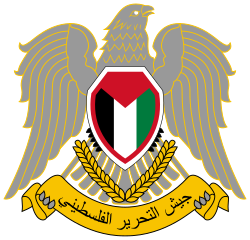
The Palestine Liberation Army (PLA; Arabic: جيش التحرير الفلسطيني, romanizedJaysh at-Taḥrīr al-Filasṭīnī) is the de jure military wing of the Palestine Liberation Organization (PLO), set up at the 1964 Arab League summit held in Alexandria, Egypt, with the mission of fighting Israel. However, it has never been under effective PLO control, but rather it has been controlled by its various host governments, usually Syria. Even though it initially operated in several countries, in 2015 the PLA was only active in Syria and recruited male Palestinian refugees.[4]

Key Information

History

[edit]

Foundation and early operations

[edit]

Immediately after its creation at the 1964 Arab League summit in Alexandria, the PLO (then headed by Ahmad Shukeiri) was effectively under the control of the Arab states, especially Nasser's Egypt. The Palestinians would not gain independent control of the organization until Yasser Arafat's Fatah faction wrested it from Nasser-backed Palestinians in 1968–69.

Accordingly, the PLA was officially set up in 1964 as the PLO's armed wing[7] despite lacking an actual operation link to the PLO. In reality, the PLA was created by Nasser as an "auxiliary formation".[2] It was staffed by Palestinian refugees under the control of the host countries, who would perform their military service in these units instead of in their host countries' regular armed forces. Formally, the PLA fell under the command of the PLO's Military Department, but in practice, none of the governments involved relinquished control of the brigades. From an early point, the PLA became especially influenced by Syria.[7]

The PLA was originally organized into three brigades, named after historic battles:[2]

Syrian President Amin al-Hafiz with army officers at the PLA parade, 1966

The PLA was relatively well equipped and trained, and even fielded armour.[2] Its materiel mostly originated in the Soviet Union.[8] However, the three PLA brigades remained under-strength until the 1980s.[2] The PLA was never deployed in the form of a single fighting unit for the PLO, but instead elements were utilized as an auxiliary and support force by its controller governments.[2][7] PLA brigades fought in the Six-Day War of 1967 as part of the Egyptian and Syrian militaries.[8] In 1968, the Popular Liberation Forces (Arabic: quwwat at-tahrir ash-sha'biyya), better known as the "Yarmouk Brigade", were established within the framework of the PLA to perform commando actions against Israeli forces in the Gaza Strip, occupied by Israeli forces the year before. Generally the PLA refrained from this kind of underground action, having been built up as something of a conventional military parade showpiece complete with bands and guards of honor.

Black September, Yom Kippur War, and Lebanese Civil War

[edit]

After its foundation, the PLA came to be used as political cover by its host governments, especially Syria. In course of the Black September of 1970, hastily repainted Syrian Army tanks under the command of the PLA were sent into Jordan to aid the Palestinian guerrillas against the Jordanian Armed Forces,[7] probably with the ultimate aim to overthrow the Jordanian monarchy.[9] Although the initial invasion was successful, with PLA forces capturing Irbid and declaring it a "liberated" city,[9] the Jordanian military eventually managed to stall the attack in course of heavy fighting.[10] After international pressure, and threats of intervention from both Israel and the United States, the combined PLA-Syrian forces were forced to turn back; an embarrassment which would contribute greatly to the overthrow of the government of Salah Jadid by Hafez al-Assad. The failure of the invasion has also attributed to the fact that the Syrian Air Force under al-Assad had refused to enter the fighting in the first place.[11]

PLA units saw action during the Yom Kippur War in 1973, fighting both at the Syrian and Egyptian fronts.[8] From 1973, the PLA effectively became part of the Syrian Army.[2]

During the Lebanese Civil War, Syria likewise made extensive use of the PLA as a proxy force, including against the PLO (the PLA however proved unreliable when ordered to fight other Palestinians, and suffered from mass defections).[12] In this conflict, it acted alongside the as-Sa'iqa faction of the PLO to support Syrian interests.[13] Already deployed from 1975 in Lebanon, the PLA acted as cover for the Syrian Armed Forces during the start of the Syrian occupation of Lebanon in 1976, as invading Syrian soldiers were dressed in PLA uniforms.[7] The PLA and as-Sa'iqa offered protection during the 1976 Lebanese presidential election, helping Élias Sarkis in getting elected as President of Lebanon.[13] Overall, the PLA proved to be relatively ineffective in Lebanon.[12] The PLA was largely destroyed as a fighting force during the 1982 Israeli invasion of southern Lebanon that started the 1982 Lebanon War. Its fighters in Lebanon left for Tunis when the PLO evacuated Beirut that year, in a US-sponsored cease fire agreement. The Egyptian PLA was also deployed in Lebanon in 1976, after Palestinian leader Yassir Arafat had approached the Egyptian president Anwar Sadat, to mend relations damaged by Sadat's peacemaking attempts with Israel. Still, the Egyptian units never proved as important as the fully deployed Syrian PLA. In 1991, the first commander-in-chief of the PLA Maj. Gen. Wajih Al Madani died.

Many PLA soldiers in Egypt and Jordan later became the core of the Palestinian Authority's (PNA) National Guard, after the signing of the 1993 Oslo Accords, when they were allowed to enter the Palestinian Territories to take up positions in the PNA security services.[14]

Syrian Civil War

[edit]

The Syrian PLA remains active, closely coordinated with as-Sa'iqa, although the importance of both had diminished over the years. The PLA has been rebuilt and Palestinians in Syria are still drafted to perform their military service in its ranks. Though completely staffed by Palestinians, it remains outside of the PLO's control, and is in effect integrated into the Syrian Army. Nevertheless, it poses as an independent entity, and occasionally organizes pro-government rallies celebrating Syrian commitment to the Palestinian cause.[15]

With the outbreak of the Syrian Civil War, the PLA sided with the government and began to fight against the Syrian opposition.[15][16] Led by Major General Muhammad Tariq al-Khadra,[3][4] the PLA has taken part in campaigns in the Rif Dimashq, Daraa, and Quneitra Governorates. In early 2015, a number of PLA fighters led by Major Khaldoun Al Nader were allegedly executed for refusing to fight against rebels in Daraa.[17][18]

Around 228 PLA fighters have been killed in action by September 2017;[5] one of the highest ranking fatalities being a brigadier general Anwar al-Saqa.[15]

On 5 August 2020, commander of the PLA Maj. Gen. Muhammad Tariq al-Khadra[3] died in Damascus due to COVID-19.[19]

After the fall of the Assad regime in late 2024, the Syrian transitional government demanded that all Palestinian armed groups in Syria disarm themselves, dissolve their military formations, and instead focus on political and charitable work.[20] Meanwhile, the PLA and other Palestinian armed factions met at the Damascus headquarters of the PLO where they expressed support for Syrian unity and the removal of Assad as well as condemned the 2024 Israeli invasion of Syria.[21] By late January 2025, the Syrian transitional government had abolished the compulsory conscription for Syrian Palestinians into the PLA and begun to reorganize the entire Syrian military. General Intelligence Service director Majed Faraj of the Palestinian Authority indicated that the PLA would be dissolved into the reorganized Syrian army.[22]

Operations

[edit]

See also

[edit]

References

[edit]

Further reading

[edit]
[edit]
Revisions and contributorsEdit on WikipediaRead on Wikipedia
from Grokipedia
The Palestine Liberation Army (PLA; Arabic: جيش التحرير الفلسطيني, Jaysh aṭ-Taḥrīr al-Filasṭīnī) was the conventional military branch of the (PLO), established in 1964 under auspices as a intended to liberate through regular warfare rather than guerrilla tactics. Composed mainly of Palestinian volunteers, the PLA operated in battalions and brigades seconded to host Arab armies in (the largest contingent), , and , functioning under their operational control while nominally loyal to the PLO. Its units participated in the 1967 , where forces in Gaza and suffered significant defeats, and the 1973 alongside Syrian and Egyptian troops, though with limited independent impact due to integration into host structures. Over decades, the Syrian-based PLA evolved into a pro-regime force, engaging in the against anti-Syrian factions and supporting during the , which strained relations with other Palestinian groups prioritizing anti-Israel operations. The organization's effectiveness was hampered by dependence on Arab patrons, who often prioritized their geopolitical interests over Palestinian goals, leading to its marginalization amid the rise of independent groups like . Following the overthrow of the Assad regime in December 2024, the PLA's remnants were dissolved by 's new authorities led by Hay'at Tahrir al-Sham, ending its formal existence and prompting questions about the future of Palestinian military presence in .

Origins and Establishment

Founding by Arab League

The Palestine Liberation Army (PLA) was established in 1964 as the designated military arm of the (PLO), pursuant to resolutions adopted at the first summit held in from January 13 to 17. The summit, convened primarily to address Israeli water diversion projects, endorsed the creation of a Palestinian entity under Arab auspices, including an army tasked with the "liberation of Palestine" through coordinated operations, though its formation, armament, and training were to be directed by the joint Arab military command. This initiative reflected Arab states' strategic interest in channeling to bolster their own regional postures against , rather than fostering an autonomous Palestinian force. Initial PLA units were organized under the operational control of host Arab governments, with battalions subordinated to Egyptian, , Iraqi, and commands to align with state-specific military doctrines and priorities. Recruitment drew primarily from in Gaza, , and , targeting individuals with prior experience or from refugee camps, though numbers remained modest in the early stages, totaling around 8,000 troops across integrated units by mid-decade. Training was conducted by the respective host armies, emphasizing tactics suited to , which underscored the PLA's dependence on patronage and limited its independence as a distinctly Palestinian . This structure ensured the PLA served as an extension of Arab state forces, prioritizing inter-Arab coordination over unified Palestinian command.

Initial Objectives and Structure

The Palestine Liberation Army (PLA) was formed in 1964 as the designated military branch of the (PLO), with its creation endorsed by the summit in to channel Palestinian armed resistance within a coordinated pan-Arab framework. Initial objectives emphasized the recovery of Palestinian territories through organized military action, subordinating Palestinian aspirations to the collective Arab effort against , as articulated in the PLO's . This alignment reflected a causal dependency on Arab state sponsorship, positioning the PLA as an extension of regional alliances rather than an autonomous entity capable of independent strategy. Structurally, the PLA was organized hierarchically into three brigades—'Ayn Jalut in , Hittin in , and Qadisiyya in —each named after decisive historical battles and embedded within the host nations' armies for operational control and sustainment. These units totaled approximately 12,000 regulars by the early 1970s, building from smaller initial cadres in the mid-1960s, but their integration underscored foundational vulnerabilities: regimens, , and deployment decisions remained tethered to patron states' priorities and capacities. Early deployments were restricted to frontier patrols and skirmishes proximate to host borders, revealing empirical constraints in mobility and that stemmed directly from this outsourced and command architecture. Declassified analyses indicate that such limitations perpetuated a symbolic rather than substantive role, where pan-Arab rhetoric masked the PLA's role as a auxiliary force advancing interstate agendas over purely Palestinian ones.

Integration with Syrian Forces

Shift to Syrian Command in 1973

In the aftermath of the (October 6–25, 1973), during which Palestine Liberation Army (PLA) units fought integrated with Syrian forces on the front, Syria consolidated authority over its hosted PLA contingents, primarily the Hittin Brigade. This integration subordinated these units—totaling several thousand personnel—to Syrian military oversight, with operational directives issued directly from rather than through (PLO) channels. Syrian commanders assumed control, effectively transforming the formations into auxiliary components of the Syrian Arab Army, ending any nominal independence under auspices. The shift was propelled by Syria's geopolitical calculus: leveraging Palestinian units as expendable proxies for regional maneuvering, particularly to circumvent Arafat's growing dominance within the PLO and assert Syrian primacy over Palestinian militancy. President al-Assad's regime viewed the PLA's Syrian-based elements as tools for deniability in conflicts, insulated from Arafat's Fatah-led PLO, which increasingly rivaled for influence over the Palestinian cause. This realignment reflected Syria's broader pattern of co-opting Palestinian groups to align with Ba'athist priorities, prioritizing loyalty to the host state over pan-Arab or PLO unity. By late 1973, PLA personnel in Syria operated under Syrian officers for training, logistics, and deployment, with recruitment increasingly drawn from local Palestinian refugees integrated into Syrian military structures. This dependency curtailed the units' autonomy, as evidenced by their exclusion from independent PLO decision-making and alignment with Syrian strategic vectors, marking the dissolution of the PLA's original multi-national framework in Syrian territory.

Organizational Changes and Dependencies

Following the 1973 , the Palestine Liberation Army's Syrian command underwent significant reorganization, effectively subordinating its units to the Syrian Army's operational structure. PLA brigades were restructured as reserve forces within the Syrian military hierarchy, with personnel drawn from Palestinians conscripted into the rather than independent recruitment. This shift sidelined many Palestinian officers in favor of Syrian command oversight, diminishing the PLA's autonomy and aligning its deployments with Damascus's strategic priorities over Palestinian-specific objectives. The PLA's dependencies on Syrian and external patrons became pronounced, lacking self-sufficient , supply chains, or mechanisms. Arms and were primarily supplied through Syrian channels, often augmented by Soviet funneled via , rendering the organization reliant on host-state approvals for maintenance and operations. Recruitment was tethered to Palestinian populations in Syrian-administered camps, such as Yarmouk near , where eligible males faced mandatory service under Syrian draft laws, exposing the PLA to fluctuations in intra-Arab relations and regime policies that prioritized over mobilization. These ties fostered vulnerabilities, as shifts in Syrian could redirect PLA resources away from Palestinian goals. By the 1980s, the PLA had devolved into a de facto Syrian proxy, exhibiting no major independent initiatives and subordinating Palestinian liberation rhetoric to Syrian interests, such as interventions in . This erosion of its distinct was evident in its operational integration, where units functioned under Syrian high command without evidence of autonomous decision-making or funding diversification.

Key Military Engagements

Pre-1973 Operations: Six-Day War and War of Attrition

The Palestine Liberation Army's (PLA) involvement in the Six-Day War of June 5–10, 1967, was limited to its integration within the armies of sponsor states, primarily Syria and Egypt. The Syrian branch, including the Hittin Brigade, operated under Syrian command on the Golan Heights front, where it participated in defensive efforts against Israeli advances. Syrian forces, incorporating PLA elements, faced rapid Israeli breakthroughs beginning June 9, resulting in the loss of the Golan Heights and approximately 1,000 Syrian fatalities, alongside 2,500 killed and 5,000 wounded per some estimates. The Hittin Brigade, however, reportedly remained one of the few PLA units to emerge relatively intact, avoiding total decimation amid broader Arab tactical collapses marked by poor coordination and air inferiority. Egypt's PLA contingent, the 20th Division based in Gaza, supported Egyptian operations in the northern Sinai and Gaza Strip but suffered alongside the defeated Egyptian army, contributing to over 11,000 Egyptian casualties without halting Israeli territorial gains. These engagements exposed foundational PLA weaknesses, including limited operational autonomy, inadequate training, and dependence on host militaries' flawed strategies, yielding no advances and underscoring causal failures in unified Arab command structures. In the subsequent War of Attrition (1967–1970), PLA Syrian units continued under Damascus's control, engaging in sporadic artillery duels, patrols, and defensive postures along the Golan Heights border. These low-intensity actions, often intertwined with Syrian regular forces and occasional fedayeen raids, aimed to pressure Israeli positions but inflicted negligible strategic damage, as Israeli air and artillery superiority enabled effective counterstrikes. Syrian-PLA efforts on this front registered minimal territorial or psychological impact, with Arab casualties mounting—part of broader estimates exceeding 5,000 Arab deaths across fronts—while Israel maintained control without concessions until the 1970 ceasefire. The operations highlighted persistent deficiencies in firepower projection and inter-force synchronization, empirically demonstrating the PLA's marginal role in attritional warfare against a technologically superior adversary.

Yom Kippur War Participation

The Palestine Liberation Army's Syrian branch, consisting primarily of the al-Hittin Brigade, was deployed to the front as part of the Syrian offensive launched on October 6, 1973. These units, numbering several thousand fighters integrated into Syrian divisions, supported initial advances against Israeli positions but transitioned to defensive roles amid the Israeli counteroffensive beginning October 8. PLA forces participated in infantry assaults, including engagements around Tel el-Faris, where they coordinated with Syrian troops to hold key terrain against Israeli armored thrusts. Despite claims from PLA leadership of contributing to minor territorial gains before the ceasefire on October 25, the brigade's exposure in infantry-heavy roles revealed operational limitations, including inadequate anti-tank capabilities and vulnerability to Israeli air superiority and tank maneuvers. Syrian command utilized PLA units to absorb initial Israeli pressure, but the lack of independent armor and artillery support hampered effectiveness, resulting in significant attrition as Israeli forces recaptured most pre-war Syrian positions by mid-October. The war's toll on PLA ranks, including documented losses of senior officers in the northern Golan sector, highlighted dependencies on Syrian logistics and command structures. This performance underscored the brigade's role as an auxiliary force rather than an autonomous actor, paving the way for deepened Syrian oversight post-ceasefire to address perceived inefficiencies in coordination and sustainment.

Involvement in Lebanese Civil War

The Palestine Liberation Army (PLA), operating under Syrian command, deployed multiple brigades to starting in early 1976 as part of Syria's intervention in the , functioning primarily as a proxy to advance Damascus's regional interests over . By January 1976, a third PLA brigade had joined two others already in the country, bolstering Syrian efforts to contain the (PLO)'s expanding influence amid clashes between and Lebanese Christian militias. Initially aligned with leftist forces against Maronite-dominated groups, the PLA's role shifted as Syria prioritized curbing PLO autonomy, leading to direct confrontations with Arafat's mainstream Fatah-led factions. From 1976 onward, PLA units supported Syrian offensives in key areas, including battles around where they clashed with PLO irregulars, fracturing Palestinian unity by pitting Syrian-aligned against those loyal to the PLO's independent agenda. In the Bekaa Valley, PLA forces under Syrian operational control secured positions against both PLO dissidents and local militias, contributing to the suppression of Arafat's bid for statehood within . These engagements, which prioritized Syrian geopolitical aims—such as preventing a PLO victory that could destabilize Assad's influence—resulted in thousands of Palestinian casualties and deepened intra-Palestinian divisions, as PLA actions effectively subordinated armed struggle against Israel to intra-Arab power struggles. By 1982, amid escalating Syrian-PLO hostilities, the PLA's proxy role had solidified its reputation for enforcing Damascus's veto over Palestinian decision-making in .

Role in Syrian Civil War

The Palestine Liberation Army (PLA) aligned with the Syrian government forces following the outbreak of protests in 2011, functioning primarily as a pro-regime integrated into the structure. Its involvement was concentrated in defensive operations around , particularly Yarmouk in , where it collaborated with units to counter rebel advances by groups such as the and later affiliates. These efforts included repelling incursions into camp perimeters starting in late 2012, amid broader sieges that displaced much of the camp's population and led to heavy fighting in adjacent suburbs like Hajar al-Aswad. PLA units suffered notable casualties in these localized battles, with the Action Group for Palestinians of Syria documenting 285 PLA members killed since the conflict's onset through 2025, mostly in Damascus-area engagements. While some Palestinian fighters from the camps defected to opposition factions—forming groups like Aknaf Beit al-Maqdis that allied with rebels—the PLA as an organization maintained loyalty to the Assad regime, avoiding large-scale defections at the command level. Its role remained ancillary and small-scale compared to core operations, lacking independent offensive initiatives or significant territorial gains, which underscored the PLA's limitations in modern . By , following the partial government recapture of Yarmouk and surrounding areas, the PLA's active participation waned, reflecting its obsolescence amid the war's evolution toward airstrikes, foreign interventions, and proxy dynamics rather than conventional ground defense. This diminished presence highlighted the force's dependence on Syrian patronage, with no verifiable record of major victories attributable solely to PLA actions.

Operational Doctrine and Capabilities

Tactics and Equipment

The Palestine Liberation Army (PLA) primarily utilized conventional suited to its role as integrated units within host Arab armies, focusing on assaults coordinated with mechanized support rather than innovative or asymmetric guerrilla methods. Operations emphasized massed frontal advances and defensive positions under the doctrinal guidance of sponsoring forces, particularly the Syrian Arab Army after 1971, with PLA brigades like al-Quds and serving as auxiliary formations reliant on Syrian command structures for barrages and aerial cover to compensate for limited organic . This dependence curtailed independent tactical flexibility, as PLA units lacked dedicated or maneuver elements, resulting in predictable engagements vulnerable to superior enemy air and armor . PLA equipment mirrored standard Soviet-era inventories supplied via Syrian intermediaries, comprising small arms such as rifles and PK machine guns for infantry, launchers for anti-armor roles, and heavier assets including T-55 tanks and /60 armored personnel carriers loaned from Syrian depots. Absent were advanced systems like wire-guided missiles or night-vision optics, with challenges exacerbating high attrition rates from mechanical failures and ammunition shortages during sustained combat. This outdated materiel, emblematic of 1950s-1960s designs, proved inadequate against opponents employing precision-guided munitions and reactive armor, underscoring the PLA's proxy limitations without host-state resupply.

Command and Control Issues

The Palestine Liberation Army (PLA), particularly its Hittin Brigade stationed in , operated under a command structure that integrated it directly into the Syrian , with Palestinian officers subordinate to Syrian generals for operational decisions. This subordination, formalized after the PLA's establishment in and intensified following the 1971 relocation of its Syrian contingent, meant that unit deployments, tactics, and engagements required approval from , often delaying responses to threats or aligning actions with Syrian geopolitical priorities rather than exclusively Palestinian aims. Dual loyalties inherent in this setup exacerbated command frictions, as Palestinian commanders balanced fidelity to the broader (PLO) with enforced obedience to Syrian directives, fostering internal divisions and eroded morale when orders conflicted with Palestinian solidarity. A stark empirical illustration occurred during the 1976 Syrian intervention in the , where Syrian-controlled PLA units—treated as extensions of Damascus's forces—were deployed against mainstream PLO militias, compelling Palestinian troops to combat their own nationalist allies and highlighting how regime survival imperatives overrode liberation objectives, resulting in operational inefficiencies and fractured cohesion. These structural dependencies causally contributed to the PLA's diminished effectiveness as an independent fighting force, as Syrian oversight vetoed or redirected initiatives perceived as risking broader Arab state stability, such as autonomous cross-border raids, thereby subordinating Palestinian agency to host-government calculus and perpetuating a proxy dynamic that hampered strategic initiative.

Controversies and Criticisms

Proxy Status and Lack of Palestinian Autonomy

The (PLA) was established on 1 January 1964 by the as the regular military arm of the , with its units organized under the command structures of host Arab states including , , , and . This subordination ensured that PLA contingents, such as 's Brigade, lacked operational independence, functioning instead as extensions of the host nations' armies with armament, training, and deployment dictated by those governments. The arrangement reflected Arab states' strategy to harness Palestinian resistance while retaining control, preventing the PLA from developing autonomous strategy or unified command. After the 1967 , PLA units outside Syria largely dissolved or were integrated into host forces, leaving the Syrian branch dominant and progressively embedded within the Syrian Arab Army. By the post-1973 period, the PLA operated without independent funding, relying solely on Syrian logistical support and directives, which rendered it a auxiliary unit rather than a sovereign Palestinian force. This dependency eliminated any capacity for self-directed operations, with Palestinian recruits in Syria subject to mandatory into the PLA under Syrian oversight. Palestinian nationalists, especially in Fatah and the PLO mainstream, criticized the PLA as co-opted by the Assad regime, arguing it advanced Damascus's regional priorities over Palestinian goals. Unlike Fatah, which built clandestine networks for independent free from state tutelage, the PLA's integration prioritized host-state utility, evidenced by its role in Syrian military frameworks without contributing to Palestinian institutional autonomy or state-building. Syrian authorities, conversely, valued the PLA as a loyal Palestinian contingent bolstering their forces. Empirical records confirm this proxy dynamic, as the PLA's actions consistently aligned with Syrian strategic imperatives rather than independent Palestinian liberation objectives.

Alignment with Assad Regime and Atrocities

The Palestine Liberation Army (PLA) maintained close operational alignment with the Assad regime during the , functioning as an integrated pro-regime force that suppressed opposition in provinces including , , , Suwayda, and , with at least 300 PLA fighters reported killed in these clashes. As a conscripted unit under Syrian command, the PLA obeyed regime directives, including participation in defensive and offensive operations against rebels, which critics argue diverted it from its original mandate of Palestinian liberation to enabling Ba'athist repression. Pro-regime perspectives, such as those from PLA leadership like Tariq al-Hadra, framed this loyalty as ideological consistency with and reciprocity for Syria's historical hosting of since 1948. PLA units, including elements stationed in or around Palestinian refugee camps, contributed to the enforcement of regime sieges on rebel-held areas, notably the prolonged blockade of in from 2013 to 2018, where documented deliberate starvation tactics resulting in hundreds of civilian deaths from and related causes, classified as and . While some PLA personnel claimed roles in minor defensive actions to protect camp perimeters from rebel incursions, causal evidence from monitors indicates their integration with Syrian forces facilitated the siege's humanitarian impact on Palestinian residents, exacerbating displacement of over 100,000 from Yarmouk by 2018. Reports of regime detention and torture of dissenting PLA members—estimated at least 30 cases for refusing combat orders—highlight internal coercion but do not negate broader complicity in allied operations that indirectly supported documented regime crimes, such as indiscriminate shelling and aid denial. Critics, including Palestinian defectors and Syrian opposition analysts, view the PLA's alignment as a profound betrayal of populations, prioritizing Assad's survival over Palestinian autonomy and enabling atrocities that killed thousands of Syrian , per estimates from groups like the Syrian Network for Human Rights. These sources, often aligned against the regime, emphasize how PLA participation fractured Palestinian solidarity, contrasting with neutral or dissenting factions that faced reprisals. Regime supporters counter that such involvement secured against Islamist extremists, though empirical data on camp devastation— including Yarmouk's near-total depopulation—undermines claims of net protection. Overall, the PLA's doctrinal subordination to prioritized host-state stability over independent advocacy, rendering it causally entangled in the regime's repressive architecture despite occasional intra-unit dissent.

Relations with PLO and Other Factions

The Palestine Liberation Army (PLA), established under auspices but effectively controlled by after 1969, maintained strained relations with the (PLO), dominated by Yasser Arafat's faction, primarily due to the PLA's subordination to Syrian strategic interests over Palestinian national unity. This alignment positioned the PLA as a rival entity, with its Syrian-based units often deployed against PLO forces to enforce Damascus's influence in regional conflicts, rather than coordinating under a centralized Palestinian command. Tensions escalated during the 1976 Syrian intervention in the Lebanese Civil War, when PLA brigades fought alongside Syrian troops against Arafat-led PLO militias, contributing to the curtailment of Palestinian guerrilla operations from Lebanese soil and earning the PLA accusations of treason from Fatah leaders who prioritized independent PLO autonomy. Similar clashes recurred in 1983 amid the anti-Arafat mutiny in Tripoli, Lebanon, where Syrian-backed PLA elements battled PLO loyalists, reinforcing perceptions within mainstream Palestinian groups that the PLA functioned as a Syrian proxy undermining unified resistance efforts. These episodes highlighted the absence of a cohesive Palestinian military structure, as the PLA's operational loyalty to host states like Syria fragmented broader militant coordination and sowed distrust among factions. Following the 1993 , the PLO's shift toward diplomatic recognition of and establishment of the Palestinian Authority further marginalized the PLA, which rejected compromise and remained tethered to Syria's hardline stance, rendering it irrelevant to the emerging political framework dominated by Arafat's negotiations. During the starting in 2011, internal PLA divisions exacerbated these rifts, with most units adhering to Bashar al-Assad's regime while smaller elements defected to opposition forces, underscoring persistent splits and the PLA's detachment from PLO-aligned priorities amid the lack of a unified Palestinian command.

Israeli and Western Perspectives on Terrorism

Israeli authorities have classified the Palestine Liberation Army's (PLA) participation in fedayeen raids and artillery attacks from Syrian territory during the as terrorism, emphasizing the deliberate targeting of civilian areas in northern . Syrian-backed operations, utilizing PLA units alongside groups like , involved over 50 documented infiltrations and shelling incidents between 1965 and 1967, resulting in at least 15 Israeli civilian deaths and injuries to dozens more in settlements such as kibbutzim near the . These actions, which included sabotage and ambushes on non-combatants, were seen as violations of international norms distinguishing combatants from civilians, justifying Israel's retaliatory airstrikes on Syrian positions and contributing causally to the preemptive ground offensive in the 1967 to neutralize the threat. From a Western perspective, particularly and , the PLA was perceived primarily as a Syrian state proxy rather than an independent Palestinian force, with its cross-border aggressions framed as extensions of Damascus's irredentist policies rather than legitimate efforts. U.S. intelligence assessments from the described PLA-linked activities as part of a broader pattern of Arab-initiated aimed at destabilizing , leading to American diplomatic support for Israeli countermeasures and arms supplies to bolster defenses against such incursions. Post-1973, following the , Western sanctions and isolation of for sponsoring proxy violence indirectly constrained PLA capabilities, though the group evaded direct terrorist designations akin to those later applied to PLO factions in 1987 due to its integration into Syrian military structures. This assessment contrasts with occasional portrayals in certain left-leaning outlets as "national liberation" resistance, which overlook the of targeting and the PLA's subordination to Syrian strategic aims—such as escalating tensions to divert attention from internal Ba'athist vulnerabilities—over genuine Palestinian concessions or . By prioritizing attrition tactics without reciprocal , the PLA's doctrine exacerbated cycles of retaliation, hindering paths to evident in alternative frameworks like the post-1979 Egypt-Israel , and reinforcing views of it as a conflict perpetuator rather than resolver.

Decline, Dissolution, and Legacy

Post-Cold War Marginalization

Following the expulsion of Palestinian forces from in 1982 during Israel's Operation Peace for Galilee, the Palestine Liberation Army (PLA) ceased to conduct significant independent military operations, confining its activities primarily to where its contingent operated under Damascus's direct control. This post-1982 dormancy persisted into the post-Cold War era, as the PLA's Syrian branch—numbering around 15,000 personnel in the early —transitioned into a largely ceremonial and integrated unit within the Syrian military structure, lacking autonomy or offensive capabilities beyond symbolic parades and border security roles. The collapse of the in 1991 exacerbated the PLA's decline by curtailing arms supplies, training programs, and financial support previously channeled through Moscow's alliances with and rejectionist Palestinian factions, which had sustained the group's equipment and recruitment since the . , as the PLA's primary host and patron, faced its own economic and military constraints post-Soviet era, leading to reduced funding and operational readiness for proxy forces like the PLA; by the mid-1990s, effective troop strength had dwindled to under 5,000, with many units repurposed for internal Syrian defense rather than Palestinian liberation objectives. This funding shortfall aligned with broader Arab state realignments, including Gulf monarchies' withdrawal of patronage from Palestinian militancy after the PLO's support for in the 1990–1991 , further isolating Syrian-aligned groups. The 1993 Oslo Accords between the PLO and marked a pivotal shift toward diplomacy, sidelining armed organizations and rendering the PLA—tied to rejectionist stances opposing recognition of —irrelevant in mainstream Palestinian politics. While select PLA elements, approximately 5,000 personnel, returned with in 1994 to integrate into the nascent Palestinian Authority's security apparatus, the core Syrian contingent rejected the accords and remained politically ostracized, emblematic of the PLO's internal divisions but devoid of strategic influence.

Impact of Syrian Regime Change in 2024

The fall of Bashar al-Assad's regime on December 8, 2024, after opposition forces under Hay'at Tahrir al-Sham (HTS) seized , precipitated the rapid dissolution of the Palestine Liberation Army (PLA), a long-standing Syrian-backed proxy with remnants integrated into regime defenses. HTS authorities issued immediate directives for pro-regime Palestinian militias, including the PLA, to disband military formations, surrender weapons, and vacate bases, framing this as a prerequisite for any future political or charitable roles under the transitional government. By late December 2024, conscription into the PLA had ceased, with units in key like Yarmouk—previously a stronghold for pro-Assad fighters—either defecting, integrating into local security arrangements, or dissolving amid the collapse of command structures. As of early 2025, the PLA exhibited no independent operational capacity, its forces scattered or demobilized without access to prior Syrian logistics, funding, or territorial bases that had sustained it since the 1960s. Palestinian factions outside Syria, including those historically rival to the PLA, voiced broad endorsement of the upheaval, prioritizing Syrian stability and Palestinian rights over reviving Assad-aligned militias, which underscored the entity's dependence on state patronage for survival. This development empirically terminated the PLA's viability as a coherent fighting force, as the abrupt withdrawal of regime support—coupled with HTS's monopoly on armaments—left no viable path for reorganization amid Syria's fragmented post-Assad security environment. Pro-Assad Palestinian groups shifted toward internal restructuring or exile, but without external backing, the PLA's dissolution reflected the causal fragility of proxy militias reliant on a single patron's endurance.

Assessment of Achievements versus Failures

The Palestine Liberation Army (PLA), established in 1964 as the nominal military arm of the , achieved limited symbolic value by representing a formal Palestinian structure amid the post-1948 and Arab state sponsorship, fostering a sense of organized resistance without direct control over operations. Its units, often integrated into host armies like Syria's, provided minor tactical support in Arab-Israeli conflicts; for instance, PLA elements assisted Egyptian forces during the 1967 and joined Syrian advances in the during the initial phases of the 1973 , contributing to early penetrations before broader Arab setbacks. These roles, however, yielded no measurable territorial or strategic gains for Palestinian objectives, serving primarily as adjuncts to state militaries rather than independent forces capable of altering conflict outcomes. In contrast, the PLA's failures dominate its record, marked by an absence of any advancement toward or liberation of claimed territories, as its proxy status under Syrian command subordinated Palestinian goals to Damascus's geopolitical priorities, including clashes with fellow Palestinian factions and opposition to broader unity efforts. By the and beyond, the organization's marginalization post-Oslo Accords highlighted its inability to adapt to diplomatic shifts, with units effectively dissolving into Syrian structures or scattering amid the , where PLA loyalty to the Assad regime—deploying against anti-regime Palestinians—exemplified prioritization of authoritarian alliances over national aspirations, fracturing Palestinian cohesion without yielding state-building progress. This pattern of dependence prolonged cycles of displacement and conflict for Palestinians, as evidenced by zero net territorial recovery despite decades of mobilization, underscoring a causal disconnect between armed posturing and viable paths that diplomatic negotiations, however imperfect, later pursued more effectively.

References

Add your contribution
Related Hubs
User Avatar
No comments yet.