
Recent from talks
Panpsychism
Knowledge base stats:
Talk channels stats:
Members stats:
Panpsychism
In philosophy of mind, panpsychism (/pænˈsaɪkɪzəm/) is the view that the mind or consciousness is a fundamental and ubiquitous feature of reality. It is also described as a theory that "the mind is a fundamental feature of the world which exists throughout the universe". It is one of the oldest philosophical theories and has been ascribed, in some form, to philosophers including Thales, Plato, Spinoza, Leibniz, Schopenhauer, William James, Alfred North Whitehead, and Bertrand Russell. In the 19th century, panpsychism was the default philosophy of mind in Western thought, but it saw a decline in the mid-20th century with the rise of logical positivism. Recent interest in the hard problem of consciousness and developments in the fields of neuroscience, psychology, and quantum mechanics have revived interest in panpsychism in the 21st century, because it addresses the hard problem directly.
The term panpsychism comes from the Greek pan (πᾶν: "all, everything, whole") and psyche (ψυχή: "soul, mind"). The use of "psyche" is controversial, because it is synonymous with "soul", a term usually taken to refer to something supernatural; more common terms now found in the literature include mind, mental properties, mental aspect, and experience.
Panpsychism holds that mind, or a mind-like aspect, is a fundamental and ubiquitous feature of reality. It is sometimes defined as a theory in which "the mind is a fundamental feature of the world which exists throughout the universe". Panpsychists posit that the type of mentality we know through our own experience is present, in some form, in a wide range of natural bodies. This notion has taken on a wide variety of forms. Some historical and non-Western panpsychists ascribe attributes such as life or spirits to all entities (animism). Contemporary academic proponents, however, hold that sentience or subjective experience is ubiquitous, while distinguishing these qualities from more complex human mental attributes. They therefore ascribe a primitive form of mentality to entities at the fundamental level of physics, but may not ascribe mentality to most aggregate things, such as rocks or buildings.
The philosopher David Chalmers, who has explored panpsychism as a viable theory, distinguishes between microphenomenal experiences (the experiences of microphysical entities), and macrophenomenal experiences (the experiences of larger entities, such as humans).
Philip Goff draws a distinction between panexperientialism and pancognitivism. In the form of panpsychism under discussion in the contemporary literature, conscious experience is present everywhere at a fundamental level, hence the term panexperientialism. Pancognitivism, by contrast, is the view that thought is present everywhere at a fundamental level—a view that had some historical advocates but has no present-day academic adherents. Contemporary panpsychists do not believe microphysical entities have complex mental states, such as beliefs, desires, and fears.
Originally, the term panexperientialism had a narrower meaning, having been coined by David Ray Griffin to refer specifically to the form of panpsychism used in process philosophy (see below).
Panpsychist views are a staple in pre-Socratic Greek philosophy. According to Aristotle, Thales (c. 624 – 545 BCE), the first Greek philosopher, posited a theory which held "that everything is full of gods". Thales believed that magnets demonstrated this. This has been interpreted as a panpsychist doctrine. Other Greek thinkers associated with panpsychism include Anaxagoras (who saw the unifying principle or arche as nous or mind), Anaximenes (who saw the arche as pneuma or spirit), and Heraclitus (who said "The thinking faculty is common to all").
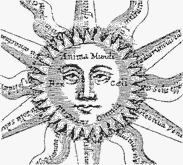
Plato argues for panpsychism in his Sophist, in which he writes that all things participate in the form of Being, and that it must have a psychic aspect of mind and soul (psyche). In the Philebus and Timaeus, Plato argues for the idea of a world soul or anima mundi. According to Plato:
Hub AI
Panpsychism AI simulator
(@Panpsychism_simulator)
Panpsychism
In philosophy of mind, panpsychism (/pænˈsaɪkɪzəm/) is the view that the mind or consciousness is a fundamental and ubiquitous feature of reality. It is also described as a theory that "the mind is a fundamental feature of the world which exists throughout the universe". It is one of the oldest philosophical theories and has been ascribed, in some form, to philosophers including Thales, Plato, Spinoza, Leibniz, Schopenhauer, William James, Alfred North Whitehead, and Bertrand Russell. In the 19th century, panpsychism was the default philosophy of mind in Western thought, but it saw a decline in the mid-20th century with the rise of logical positivism. Recent interest in the hard problem of consciousness and developments in the fields of neuroscience, psychology, and quantum mechanics have revived interest in panpsychism in the 21st century, because it addresses the hard problem directly.
The term panpsychism comes from the Greek pan (πᾶν: "all, everything, whole") and psyche (ψυχή: "soul, mind"). The use of "psyche" is controversial, because it is synonymous with "soul", a term usually taken to refer to something supernatural; more common terms now found in the literature include mind, mental properties, mental aspect, and experience.
Panpsychism holds that mind, or a mind-like aspect, is a fundamental and ubiquitous feature of reality. It is sometimes defined as a theory in which "the mind is a fundamental feature of the world which exists throughout the universe". Panpsychists posit that the type of mentality we know through our own experience is present, in some form, in a wide range of natural bodies. This notion has taken on a wide variety of forms. Some historical and non-Western panpsychists ascribe attributes such as life or spirits to all entities (animism). Contemporary academic proponents, however, hold that sentience or subjective experience is ubiquitous, while distinguishing these qualities from more complex human mental attributes. They therefore ascribe a primitive form of mentality to entities at the fundamental level of physics, but may not ascribe mentality to most aggregate things, such as rocks or buildings.
The philosopher David Chalmers, who has explored panpsychism as a viable theory, distinguishes between microphenomenal experiences (the experiences of microphysical entities), and macrophenomenal experiences (the experiences of larger entities, such as humans).
Philip Goff draws a distinction between panexperientialism and pancognitivism. In the form of panpsychism under discussion in the contemporary literature, conscious experience is present everywhere at a fundamental level, hence the term panexperientialism. Pancognitivism, by contrast, is the view that thought is present everywhere at a fundamental level—a view that had some historical advocates but has no present-day academic adherents. Contemporary panpsychists do not believe microphysical entities have complex mental states, such as beliefs, desires, and fears.
Originally, the term panexperientialism had a narrower meaning, having been coined by David Ray Griffin to refer specifically to the form of panpsychism used in process philosophy (see below).
Panpsychist views are a staple in pre-Socratic Greek philosophy. According to Aristotle, Thales (c. 624 – 545 BCE), the first Greek philosopher, posited a theory which held "that everything is full of gods". Thales believed that magnets demonstrated this. This has been interpreted as a panpsychist doctrine. Other Greek thinkers associated with panpsychism include Anaxagoras (who saw the unifying principle or arche as nous or mind), Anaximenes (who saw the arche as pneuma or spirit), and Heraclitus (who said "The thinking faculty is common to all").
Plato argues for panpsychism in his Sophist, in which he writes that all things participate in the form of Being, and that it must have a psychic aspect of mind and soul (psyche). In the Philebus and Timaeus, Plato argues for the idea of a world soul or anima mundi. According to Plato:
Recent media