Hubbry Logo
History of BMW motorcyclesHistory of BMW motorcyclesMain
Open search
History of BMW motorcycles
Community hub
History of BMW motorcycles
logo
8 pages, 0 posts
0 subscribers
Be the first to start a discussion here.
History of BMW motorcycles
from Wikipedia

BMW R 32 (1923–1926)

BMW's motorcycle history began in 1921 when the company commenced manufacturing engines for other companies. BMW's own motorcycles—sold under the BMW Motorrad brand—began in 1923 with the BMW R 32, which was powered by a flat-twin engine (also called a "boxer-twin" engine). Production of motorcycles with flat-twin engines continues to this day, however BMW has also produced many models with other types of engines.

Motorcycle history

[edit]

1921–1938

[edit]
BFw Helios (1920–1923)
BMW R 32 (1923–1926)
BMW R 2 (1931–1936)

At the end of World War I, the Treaty of Versailles demanded that BMW cease production of aircraft engines. To remain in business, the company began producing small industrial engines (along with farm equipment, household items and railway brakes). In 1920, BMW M2B15 flat-twin petrol engine was released. Despite being designed as a portable industrial engine, the M2B15 was also used by several motorcycle manufacturers, including for the 1920–1923 Victoria KR1 and the 1920–1922 Bayerische Flugzeugwerke (BFw) Helios motorcycles.[1]: 14–17 [2]

BMW merged with Bayerische Flugzeugwerke in 1922, and the BFw Helios became the starting point for the first BMW motorcycle.[1][2] Released in 1923, the BMW R 32 used a 486 cc (29.7 cu in) flat-twin petrol engine,[3] which was longitudinally-mounted to eliminate the cooling problems of the transversely mounted engine in the Helios. This engine with 6.3 kW (8.5 hp), resulting in a top speed of 95 to 100 km/h (59 to 62 mph).[4] At a time when many motorcycle manufacturers used total-loss oiling systems, the new BMW engine featured a recirculating wet sump oiling system with a drip feed to roller bearings; a design which BMW used until 1969. The R 32 also started the tradition of shaft drive, which was used on all BMW motorcycles until 1994.

The BMW R 37, produced from 1925 to 1926, was BMW's first sporting model. It was based on the R 32 and used an overhead valve engine producing 12 kW (16 hp).

The first single-cylinder BMW motorcycle was the 1925 BMW R 39, which was BMW's smallest model and used a 250 cc (15.3 cu in) engine. It was not successful and was discontinued in 1927.[5] The next single-cylinder motorcycle was the BMW R 2, which was released in 1931.[6] It used a 200 cc (12.2 cu in) engine and could therefore be ridden in Germany without a motorcycle licence at that time.[7][8]: 58  The lineage of single-cylinder motorcycles continued with the 400 cc (24.4 cu in) BMW R 4 in 1932 and the 300 cc (18.3 cu in) BMW R 3 in 1936.[9]: 33–34 

The BMW R 11, introduced in 1930, was the first touring motorcycle in the 750cc class manufactured by BMW with a pressed-steel frame.

The BMW R 12 and BMW R 17, both introduced in 1935, were the first production motorcycles with hydraulically damped telescopic forks.[6][9]: 34–36 

In 1937, Ernst Henne recorded a top speed of 279.5 km/h (173.7 mph) on a BMW 500 Kompressor racing motorcycle, setting a world record that stood for 14 years.

The BMW R 71 746 cc (45.5 cu in) big flat-twin motorcycle was exceptional. It was the Icon of BMW, well engineered but expensive to build. Unfortunately only 2,638 motorcycles could be built before production was disrupted due to the War. Original bikes are now rare and highly sought after. Around 500 are known to survive today. It was either licensed to the Soviet Union in 1938 or just copied there,[10] resulting in the Dnepr M-72 (produced from 1942 to 1960) and IMZ-Ural (modernised version still in production) motorbikes .

1939–1945

[edit]

During World War II, the German military needed as many vehicles as it could get of all types and many other German companies were asked to build motorcycles. The BMW R 75 performed particularly well in the harsh operating environment of North Africa, partly due to the protruding cylinders of the flat-twin engine providing more effective cooling than other configurations which overheated in the sun. Shaft drives also performed better than chain-drives which were damaged by desert grit. The R 75 inspired similar models from U.S. manufacturers, such as the Indian 841 and Harley-Davidson XA.[11]

1945–1955

[edit]
East German-built BMW R 35 (1945–1955)
BMW R 24 (1948–1950)
BMW R 51/3 (1951–1954)

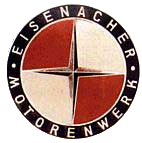
In Soviet-controlled East Germany, BMW's sole motorcycle plant in Eisenach recommenced production of R35 and R75 motorcycles soon after the war, for reparations. The factory continued to use the BMW name, causing two separate companies (one in Eisenach and the other in Munich, West Germany) to be using the BMW name between 1948 and 1952. The head office of BMW, based in Munich, had no control over the operations in East Germany. Eventually in 1952, after the Soviets ceded control of the plant to the East German Government, and following a trademark lawsuit, the East German company was renamed Eisenacher Motorenwerk (EMW). Instead of BMW's blue-and-white roundel, EMW used a very similar red-and-white roundel as its logo.[12]

In West Germany, many of BMWs facilities had been badly damaged during the war, including the Munich factory which was in ruins. Initially, the terms of Germany's surrender forbade BMW from manufacturing motorcycles. In 1947, when BMW received permission to restart motorcycle production from US authorities in Bavaria,[1]: 76  BMW had to start from scratch. There were no plans, blueprints, or schematic drawings because they were all in Eisenach. The first post-war BMW motorcycle in Western Germany, was the 1948 BMW R 24. The R 24 was reverse-engineered from the pre-war BMW R 23 motorcycle with several improvements[13] and powered by a 247 cc (15 cu in) single-cylinder engine. It was the only postwar West German model without rear suspension. In 1949, BMW produced 9,200 units and by 1950 production surpassed 17,000 units.

Production of flat-twin models resumed in 1950 with the 500 cc (31 cu in) R 51/2 model, which was followed by the BMW R 51/3 and BMW R 67 twins in 1951, and the sporting 26 kW (35 hp) BMW R 68 in 1952. Except for the R 68, all flat-twin models came with "bell-bottom" front fenders and front stands.

1955–1969

[edit]
BMW R 50 (1955–1960)
BMW R 27 (1960–1966)

Motorcycle sales in Europe plummeted as the 1950s progressed, with three of BMW's major German competitors going out of business in 1967. In 1954, BMW produced 30,000 motorcycles. By 1957, that number was less than 5,500.

In 1955, BMW began introducing a new range of motorcycles with Earles forks and enclosed drive shafts. These were the 19 kW (26 hp) BMW R 50, the 22 kW (30 hp) BMW R 60 and the sporting model BMW R 69 with 35 hp (26 kW). On June 8, 1959, John Penton rode a BMW R 69 from New York to Los Angeles in 53 hours and 11 minutes, slashing over 24 hours from the previous record.

By the late 1950s, the overall BMW company was in financial trouble. The company narrowly avoided a merger with Daimler-Benz through the combination of financing from brothers Herbert Quandt and Harald Quandt, increased success of the automobile division and the selling off its aircraft engine division. Changes in the motorcycle market saw BMW's last shaft-driven single-cylinder model, the BMW R 27, end production in 1967. Also, most of BMW's offerings were still designed to be used with sidecars. However, by the late 1960s, sidecars were no longer a consideration of most riders; people were interested in sportier motorcycles instead. The BMW R 50/2, R 60/2, and R 69 S were the last sidecar-capable BMWs, with the latter being the most powerful and desirable model.[14]

In the United States, sales of motorcycles were strong through the 1950s, in contrast to drastically declining sales in Europe. Later, specific "US" models were sold in the United States for the 1968 and 1969 model years: the BMW R 50 US, R 60 US and the R 69 US. These models were sold with telescopic forks (alongside other BMW models which were sold with Earles forks) and without sidecar lugs.

1969–1982

[edit]
BMW R75/5 (1969–1973)
BMW R75/6 (1973–1976)

The model range was entirely revamped in 1969 with the introduction of the BMW /5 range, consisting of the 500 cc BMW R 50/5, the 600 cc BMW R 60/5 and the 750 cc BMW R 75/5 models.[15][1]: 126  The engines were a complete redesign, with the crankshaft bearings upgraded from roller bearings to shell-type journal bearings (the type used in modern car engines).[15][1]: 126  The camshaft was now chain-driven and located underneath the crankshaft instead of at the top of the engine, in order to lower the centre of gravity.[15] An electric starter was available for the first time, although the traditional gearbox-mounted kick starter was also retained.[15] The styling of the first models included chrome-plated side panels and a restyled tank. In 1973, the rear swingarm was lengthened, which improved the handling and allowed a larger battery to be installed.

The introduction of the "/5" models coincided with production relocating from Munich to a new factory in Spandau, West Berlin.[15][16]: 21  at a site earlier occupied by a Siemens aircraft engine factory.[17][9]: 83 

The BMW /6 range replaced the "/5" models in 1974, with the 500 cc (31 cu in) engine being discontinued and a 900 cc (55 cu in) engine introduced. The "/6" model range consisted of the 600 cc BMW R 60/6, the 750 cc BMW R 75/6, the 900 cc BMW R 90/6 and the sporting 900 cc BMW R 90 S.[1]: 126 [18] Other upgrades included a five-speed gearbox,[1]: 126 [18] brakes and the electrical system. In 1975, the kick starter was finally eliminated.[18]

In 1976, the BMW /7 range replaced the "/6" models. The 800 cc BMW R 80/7 model was introduced, and the 900 cc BMW R 90/6 and BMW R 90S models were replaced by the 1,000 cc BMW R 100/7, BMW R 100S and BMW R 100RS models. The latter was a full-fairing design which produced 51 kW (68 hp) and had a top speed of 200 km/h (124 mph).[19] Later variants of the 1,000 cc models included the BMW R 100T ("Touring"), the BMW R 100 RT and BMW R 100CS ("Classic Sport").

The 1978 BMW R 45 and BMW R 65 were entry-level 450 cc and 650 cc models that replaced the BMW R 60/7. Later variants of the BMW R 65 included the 1982 BMW R65 LS, the sporting BMW R 65 S and the 1987 dual-sport BMW R 65 GS.

1983–1992

[edit]
BMW K 100 RS (1983–1993)
BMW R 100 RT (1978–1996)

The BMW K 100, introduced in 1983, marked a departure from BMW's tradition of air-cooled flat-twin engines. It was powered by a water-cooled inline-four engine with a displacement of 987 cc (60 cu in), which was also BMW's first fuel-injected motorcycle engine. The frame was tubular steel and the rear suspension was a single-sided swingarm.

In 1985, the BMW K 75 was added as the entry-level model. The K 75 was powered by a 750 cc inline-three engine, which was BMW's first engine to use a counterbalance shaft. In 1988, the K 100 became the first motorcycle to have anti-lock brakes (ABS)[20] and in 1989 the K 100 RS 4V model became the first BMW motorcycle to use an engine with four valves per cylinder.

The 1988 BMW K 1 sports tourer was BMW's first full-fairing sport bike. It had an aerodynamic body which was designed to minimise drag at high speeds.

Production of flat-twin touring models continued with the BMW R 100 and BMW R 80 model ranges.

1993–2003

[edit]
BMW K 1200 RS (1996–2004)
BMW R 1200 C (1997–2004)

Beginning with the BMW R 1100 RS sports tourer in 1993, BMW began to transition from engines with air-cooled cylinder heads ("airhead" engines) to oil-cooled cylinder heads ("oilhead" engines). The BMW R 1100 RS also used "Telelever" front suspension (where braking forces are transferred horizontally to minimize "fork dive") and a stressed engine.

Also introduced in 1993 were the single-cylinder BMW F 650 models, which was based on the Aprilia Pegaso 650. The related BMW F650 CS began production in 2001.

The "airhead" BMW R80R; R100R and R100R Mystic as well as BMW R 80 GS and R 100 GS models remained in production until 1997, before being replaced by the newer "oilhead" models such as the BMW R 850 series, the 1994–1999 BMW R 1100 R standard motorcycle, the 1994–1999 BMW R 1100 GS dual-sport, the 1996–2001 BMW R 1100 RT tourer, the 1998–2005 BMW R 1100 S sports, and the 1999–2004 BMW R1150 GS dual-sport.

The K Series models, powered by a water-cooled inline-four engine, included the 1996–2004 BMW K 1200 RS sports tourer, the 1998–2009 BMW K 1200 LT luxury tourer, and the 2002–2005 BMW K 1200 GT sports tourer.

The BMW R 1200 C, produced from 1997 to 2004, was BMW Motorcycle's only entry into the cruiser market. At the other end of the model lineup, the 2000–2002 BMW C1 was BMW's first and only enclosed scooter model.

2004–2014

[edit]
BMW R 1200 GS (2004–2012)
BMW R 1200 RT (2014–2018)
BMW G650 Xchallenge (2006–2009)

The revised K Series range of water-cooled inline-four cylinder models began in 2004 with the BMW K 1200 S a sport-tourer.[21] The K1200S was primarily designed as a Super Sport motorcycle, albeit larger and heavier than the closest Japanese competitors. Other additions to the K Series range were the 2005 BMW K 1200 R naked bike and related 2007 BMW K 1200 R Sport semi-faired sport-tourer,[22] and the 2006 BMW K 1200 GT sport-tourer. The engine capacity of the K Series was expanded to 1,300 cc (79 cu in) for the 2008 BMW K 1300 S sport-tourer, the 2009 BMW K 1300 GT sport-tourer and the 2009 BMW K 1300 R naked bike.[23]

In 2011, two six-cylinder models were added to the K Series range- the BMW K 1600 GT and BMW K 1600 GTL, the former intended as a sport-tourer and the latter as a luxury-tourer.

The R Series range of flat-twin models was also updated in 2004, beginning with the BMW R 1200 GS dual-sport, which was powered by a new 1,170 cc (71 cu in) "oilhead" engine. This was followed by the 2005 BMW R 1200 ST sport-tourer, the 2005 BMW R 1200 RT tourer, the 2006 BMW R 1200 S sport-tourer, and the 2006 BMW R 1200 R naked bike. In 2014, the redesigned BMW R1200 RT used a water-cooled engine and a wet clutch.

The BMW HP2 Enduro dirt bike was introduced in 2005, based on the BMW R 1200 GS. In 2007, the HP2 Enduro was joined by the road-biased HP2 Megamoto fitted with smaller alloy wheels and street tyres.

As part of the F Series range update in 2006, the BMW F 800 S sports bike and BMW F 800 ST sport-touring models were introduced, both powered by a Rotax parallel-twin engine. The BMW F 650 GS and BMW F800 GS dual-sport bikes were added to the range in 2008, both using the same 798 cc engine, despite the different names and the F 700 GS replaced the 650 in 2012.[24] In 2009, the BMW F 800 R naked bike was introduced and in 2013 the BMW F 800 GT replaced the BMW F 800 ST sport-touring. In 2009, the BMW G 650 GS replaced the BMW F 650 GS.

The BMW G650X series range was introduced in 2006, co-developed with Aprilia and powered by a Rotax single-cylinder engine. The range consisted of the BMW G650 Xchallenge dual-sport, the BMW G650 Xcountry dual-sport and the G650 Xmoto supermoto models.[25] The BMW G 450 X hard-enduro model was produced from 2008 to 2010.[26]

In 2007, BMW acquired Husqvarna Motorcycles, including its production facilities and staff, from Italian manufacturer MV Agusta.[27][28] BMW's ownership of Husqvarna ended in 2013, when the company was sold to Pierer Industrie AG.[29]

The BMW S 1000 RR sport bike was released in 2009, to compete in the Superbike World Championship.[30] It is powered by a 999 cc (61 cu in) transverse-four engine producing 193 bhp (144 kW).

See also

[edit]

References

[edit]
[edit]
Revisions and contributorsEdit on WikipediaRead on Wikipedia
from Grokipedia
The history of BMW motorcycles, produced under the division since 1923, encompasses a century of engineering innovation, from the pioneering R 32 model with its boxer and shaft drive to contemporary advancements in safety, performance, and electric mobility, establishing the brand as a leader in touring, adventure, and superbike segments. 's entry into production followed the company's origins as an manufacturer founded on March 7, 1916, as Bayerische Flugzeug Werke AG, with early designs like the 1920 M2 B 15 (298 cc, 6.5 hp) paving the way for full vehicles after restrictions shifted focus from aviation. The landmark R 32, designed by Max Friz and unveiled at the 1923 German Motor Show, featured a 494 cc inline-twin boxer producing 8.5 hp, achieving a top speed of 100 km/h, and introduced the signature shaft drive that became a BMW hallmark for durability and low maintenance. Early racing efforts, such as the 1924 R 37 model's class victories at the Solitude racetrack with 16 hp output, underscored BMW's commitment to performance from the outset. Post-World War II reconstruction saw BMW resume production in 1948 with updated pre-war designs like the R 24 single-cylinder model, evolving through the 1969 /5 series (e.g., R 75/5 with 37 kW and 175 km/h top speed) built at the Berlin-Spandau plant, which modernized styling and reliability for global markets. The 1970s brought speed icons like the 1973 R 90 S (67 hp, 200 km/h top speed), securing wins in the 1976 Production TT and Daytona 200 Miles races, while the 1980 R 80 G/S (50 hp) revolutionized adventure riding as the first large-displacement dual-sport motorcycle, spawning the enduring GS lineage. Innovations accelerated in the late 1980s with the K1 model's 1988 debut of anti-lock braking (ABS) and four-valve technology (100 hp, 230 km/h top speed), followed by the 1993 R 1100 RS introducing Telelever suspension for enhanced handling (90 hp). In the 21st century, expanded its portfolio with high-performance superbikes like the 2009 S 1000 RR (192 hp), which debuted successfully in the , and entered new segments with the 2020 R 18 cruiser (1,802 cc boxer, 91 hp) and the 2021 CE 04 electric scooter (42 hp, 120 km/h top speed). Racing milestones include Georg Meier's 1939 victory and Ernst Henne's 1937 world speed record of nearly 280 km/h, while modern safety features like the 2010 adaptive cornering lights on the K 1600 GT six-cylinder tourer reflect ongoing emphasis on rider protection and versatility. Recent advancements include the 2024 R 1300 GS adventure bike with a 1,300 cc boxer engine producing 145 hp. Today, continues to innovate, as highlighted by the 2023 M 1000 XR prototype, celebrating 100 years of heritage through exhibitions at the in .

Founding and Pre-War Development (1921–1938)

Establishment of Motorcycle Production

BMW's origins trace back to , 1916, when it was established as Bayerische Flugzeug-Werke (BFW), an aircraft engine manufacturer formed through the merger of Gustav Otto's Flugmaschinenfabrik with Karl Rapp's engine works. During , the company focused on producing high-performance aero engines, but the 1919 prohibited from manufacturing aircraft or aircraft engines, forcing BMW to pivot to alternative products to survive. This restriction led BMW to explore industrial engines and, by 1921, to begin producing small-displacement boxer-twin engines for other motorcycle manufacturers, including Victoria and , marking the company's initial foray into two-wheeled propulsion. In 1922, chief engineer Max Friz, who had joined BMW in 1917, was tasked with developing the company's first complete motorcycle powerplant, drawing on prior boxer engine concepts to create a longitudinally mounted flat-twin design. This effort culminated in the launch of the BMW R 32 at the Berlin Motor Show in September 1923, BMW's debut motorcycle under its own brand. The R 32 featured an innovative 494 cc air-cooled boxer-twin engine producing 8.5 hp at 3,200 rpm, a double-loop tubular steel frame that integrated the engine and transmission, and a cardan shaft drive system for reliable power delivery to the rear wheel—hallmarks that set it apart from chain-driven contemporaries. These elements emphasized engineering precision, low center of gravity, and durability, quickly earning acclaim for superior handling and longevity. A sports variant, the R 37, followed in 1924 with 16 hp output, achieving class victories such as at the Solitude racetrack and contributing to early racing successes. Production of the R 32 began immediately, with approximately 1,500 units assembled in alone, contributing to a total of nearly 3,000 motorcycles by the end of its run in 1926 and solidifying BMW's reputation for high-quality in the burgeoning market. Early validation came through competitive , where the R 32 demonstrated its robustness; for instance, in , rider Franz Bieber secured a in the German 500cc Championship at the Schleizer Dreieck circuit, highlighting the model's performance potential and boosting its commercial appeal. This success not only affirmed the boxer engine's evolutionary design but also positioned as a serious contender in during the .

Key Early Models and Innovations

BMW's early motorcycle lineup evolved from the foundational R 32 design, incorporating iterative improvements in suspension, engine displacement, and performance to meet growing market demands. In 1935, the company introduced the R 12 model, which featured the world's first production telescopic front forks with hydraulic damping, significantly enhancing handling and ride comfort compared to the previous girder fork systems used on earlier models. This innovation addressed common complaints about front-end stability on rough roads, allowing for better weight distribution and reduced dive under braking. The R 12's 745 cc side-valve delivered reliable power while maintaining the signature boxer configuration for inherent balance. A significant advancement came in 1929 with the R 51, BMW's first overhead-valve (OHV) boxer-twin model, producing 23 hp from a 500 cc engine and offering improved efficiency and power over side-valve predecessors, setting the stage for future developments. By 1938, BMW expanded its offerings with the R 71, a robust 750 cc model producing approximately 18 horsepower, designed primarily for civilian touring but with features that lent themselves to potential adaptation. The R 71 incorporated a larger displacement engine for improved torque and load-carrying capacity, paired with a four-speed gearbox and the established shaft drive system, which provided superior reliability over chain-driven competitors by minimizing maintenance and exposure to dirt. This model exemplified BMW's focus on durability, with the opposed-twin layout reducing vibrations through its horizontally opposed cylinders, offering smoother operation than inline engines common among rivals like or Indian. Sports-oriented variants pushed performance boundaries, as seen in the 1938 Type 255 Kompressor, a supercharged 600 cc model generating approximately 55 horsepower for racing applications. The addition of a Roots-type boosted output for competitive events, enabling higher speeds and acceleration while showcasing BMW's engineering prowess in technology derived from expertise. These innovations helped position BMW motorcycles as premium machines, with production reaching over 10,000 units annually by 1938 and the 100,000th motorcycle completed that December, including exports to key markets like the via distributor AFN and the through select importers. The profoundly influenced BMW's development strategy in the early 1930s, prompting cost-saving measures such as the introduction of more affordable single-cylinder models like the R 23 to maintain affordability amid declining sales. Economic pressures reduced overall demand for luxury vehicles, but BMW's emphasis on efficient, vibration-free powertrains and robust shaft drives sustained its reputation for quality, allowing the company to rebound with models that balanced performance and economy. These advancements not only bolstered domestic sales but also facilitated international growth, establishing BMW as a leader in engineering before the onset of .

World War II and Immediate Aftermath (1939–1955)

Wartime Military Motorcycles

With the outbreak of in , BMW transitioned to full military production under the Nazi regime, focusing on adapting existing models for use, including the R12, R71, and R75. These motorcycles were essential for , dispatch riding, and troop mobility across various theaters. The pre-war R71, with its robust , provided the foundational design for later wartime adaptations. The R75, developed from 1938 to 1941, marked an early milestone in this shift, featuring a 750 cc overhead-valve boxer engine producing 26 hp, paired with a for transporting troops and equipment. Over 16,000 units were manufactured during its run, emphasizing durability for off-road operations. By 1941, the R12 became a common variant, incorporating enclosed driveshafts for protection against mud and debris, along with reinforced frames to withstand combat stresses. BMW engineers introduced key adaptations to enhance battlefield performance, including cold-weather modifications, such as enhanced lubrication, heating systems, and protective covers, specifically developed for operations on the Eastern Front, where harsh winters posed significant challenges. These motorcycles saw extensive deployment in elite units, notably the . Over 50,000 military motorcycles were produced by BMW during the war, supporting the Wehrmacht's mechanized forces across and . However, Allied air campaigns severely disrupted operations from 1944 onward, with repeated bombings damaging the factory and halting output at BMW's plant.

Post-War Rebuilding and First Civilian Models

Following the end of in 1945, BMW faced severe restrictions under Allied occupation, with the company banned from producing aircraft engines and vehicles due to its wartime role in armaments manufacturing. The and Allach plants were ordered dismantled by the U.S. in October 1945, with machinery shipped abroad as reparations, while the facilities were repurposed for truck assembly and other non-automotive production under Allied control. The plant, located in the Soviet occupation zone, was seized and continued producing motorcycles under the BMW brand until a 1952 lawsuit forced a rename to EMW (Eisenacher Motorenwerke); it manufactured copies of pre-war models like the R35 single-cylinder until the mid-1950s. This left Western BMW without control over its operations until 1949, forcing a pivot to household goods like pots and bicycles to survive economically. Motorcycle production resumed in the West in 1948 after obtaining Allied approval for civilian models limited to 250 cc displacement, resulting in the launch of the R 24, BMW's first motorcycle. This single-cylinder, air-cooled 247 cc four-stroke model produced 12 hp at 5,600 rpm, featuring a rigid rear frame and telescopic front forks for simplicity and compliance with restrictions, drawing on pre-war R 23 designs but updated with modern ignition. Production began in March 1948 amid material shortages, marking a cautious restart focused on basic mobility rather than the pre-war boxer twins. In 1950, BMW introduced the R 25 as an evolution of the R 24, retaining the 247 cc engine and 12 hp output but adding a welded tubular frame with rear suspension for improved stability, particularly with sidecars. Approximately 23,400 units were produced during its 1950–1951 run, reflecting growing demand despite economic pressures. The German currency reform of June 1948, which replaced the with the , initially spurred recovery by curbing inflation and black markets but also intensified competition from cheaper Italian scooters and motorcycles, contributing to BMW's near-bankruptcy by as domestic sales stagnated. To counter these challenges, BMW emphasized exports, partnering with U.S. importer Butler & Smith starting in the early to target American markets seeking premium touring bikes. The 1951 R 67/3, a 594 cc flat-twin model with 28 hp and rear suspension, served as an early luxury export variant, appealing to U.S. buyers for its reliability on long distances. By , production of the single-cylinder series (R 24 and R 25 variants) had reached significant volumes, contributing to stabilizing operations and laying the groundwork for broader recovery.

Expansion and Technological Advances (1955–1982)

1950s and 1960s: Recovery and New Designs

Following the emphasis on single-cylinder models like the R25 series, BMW revived its iconic in 1955 with the introduction of the R50, R60, and R69 models, marking a return to the boxer configuration that had defined the brand before the . These machines featured displacements of 500cc, 600cc, and 600cc respectively, with power outputs ranging from 26 to 35 horsepower, offering improved performance for touring and use. The R26, launched the same year as a 250cc single-cylinder model producing 18 horsepower, served as an entry-level option that bridged the gap between the simpler singles and the more sophisticated twins, providing reliable shaft-drive propulsion in a lightweight package weighing around 158 kg. In 1955, BMW introduced the Earles leading-link front fork on the R50, R60, and R69 models, a design patented by British engineer Eric Earles that replaced the traditional . This innovation significantly improved off-road capability and stability, particularly for configurations, by reducing brake dive and maintaining consistent geometry under load; it proved instrumental in racing dominance during the era. The R27, introduced in 1960 as the final evolution of BMW's single-cylinder line, featured a 247cc upgraded to 18 horsepower through rubber engine mounts for smoother operation, achieving a top speed of approximately 130 km/h while maintaining the brand's reputation for durability. Over its production run until 1966, BMW built 15,364 R27 units, emphasizing quality over volume in a shifting market. The 1960s saw BMW refine its touring-focused offerings with the R69S, a high-performance variant of the 600cc flat-twin launched in , delivering 42 horsepower and a top speed of 175 km/h (109 mph). This model prioritized long-distance comfort with features like a hydraulic —the first in standard production—for enhanced stability at high speeds, alongside upgraded carburetors and a revised for smoother power delivery. Despite these advances, BMW grappled with market challenges as Japanese competitors like and Yamaha flooded the with affordable, reliable alternatives, causing BMW imports to decline sharply; by the mid-1960s, annual production had fallen to around 9,000 units globally in 1966, reflecting broader struggles against the influx of lighter, cheaper imports. BMW's resurgence in bolstered its engineering credentials during this period, with the development of Rennsport models—racing variants like the RS54—optimized for competition through lightweight frames, tuned flat-twin engines, and aerodynamic fairings. These efforts culminated in consecutive victories at the Isle of Man TT race from 1959 to 1961, using R50-based machines: Walter Schneider and Hans Strauss won in 1959 on a BMW outfit, followed by Helmut Fath in 1960 and Max Deubel in 1961, securing 15 world titles overall in the and . By 1969, BMW was experimenting with advanced braking prototypes alongside further refinements in hydraulic damping, laying groundwork for future production innovations amid competitive pressures.

1970s: Modular Engines and Global Growth

In 1970, introduced the /5 series, a groundbreaking lineup that revitalized its division with a complete redesign emphasizing modern engineering and reliability. The series comprised the R 50/5 (500 cc, 32 hp), R 60/5 (600 cc, 40 hp), and R 75/5 (750 cc, 50 hp), all powered by new air-cooled boxer twin engines designed on a modular platform that allowed shared components across displacements for efficient production and maintenance. These models featured updated 12-volt electrics, a tubular steel frame, and telescopic forks, building on the twin-cylinder heritage from the while addressing contemporary demands for performance and style. The /5 series laid the foundation for modular engineering, where engine cases and other key parts were standardized, enabling easy scaling from 500 cc to 750 cc through variations in bore size while maintaining the characteristic horizontally opposed layout and shaft drive. This approach not only reduced manufacturing costs but also facilitated future upgrades, marking a shift toward versatile, adaptable powertrains that defined BMW's boxer lineup for the decade. Production of the /5 reached 12,287 units in its debut year, signaling strong initial demand. In 1974, the /6 series succeeded the /5, incorporating key upgrades such as Bosch electronic ignition for improved reliability and a standard five-speed gearbox across all models, enhancing cruising capability and rider comfort. The standout R 90 S, with its 898 cc engine producing 67 hp, introduced BMW's first factory fairing—a compact "bikini" design that improved aerodynamics and high-speed stability, positioning it as a sport-touring pioneer. These refinements addressed feedback from the /5 era, boosting overall performance without sacrificing the modular engine's core efficiency. The profoundly influenced BMW's strategy, accelerating the focus on fuel-efficient boxer designs that emphasized low-rev torque and economical operation over raw power. This pivot proved prescient, as the /6 series' improvements in gearing and ignition contributed to a sales surge, with global production climbing to approximately 25,000 units by 1977. Global expansion accelerated during the decade, particularly , where the modern /5 and /6 models revived interest after sluggish 1960s sales; imports through West Coast channels, including California-based distributors, helped recapture among touring enthusiasts. Early hints of Japanese collaborations emerged as eyed Asian growth, laying groundwork for cross-cultural exchanges in and distribution. BMW's racing prowess underscored its engineering advances, with sidecar teams dominating the World Championship from 1974 to 1980 using modified rigs based on the forthcoming /7 series, securing multiple titles including Klaus Enders' victory in 1974 on an RS-powered outfit. The /7 series debuted in 1978 as the culmination of the air-cooled modular era, featuring refined engines with larger displacements; the R 100/7 offered a 980 cc boxer twin producing 60 hp, incorporating updated carburetors and electronics for smoother delivery while remaining fully air-cooled. This model represented the final iteration before oil-cooling was introduced in later designs, capping a decade of incremental innovation that solidified BMW's reputation for durable, versatile motorcycles.

Modernization and Diversification (1983–2003)

1980s: Aerodynamic and Performance Models

In 1980, launched the R 80 G/S, marking the introduction of the world's first large-displacement adventure motorcycle and pioneering the dual-sport segment with its combination of on-road comfort and off-road capability. Featuring an 797 cc air-cooled boxer twin engine producing 50 hp at 6,500 rpm, the model incorporated innovative long-travel suspension including a 7.5-inch front and the new Monolever rear for enhanced terrain handling. This design contributed to its racing success, securing victories in the Paris-Dakar Rally in 1981, 1983, 1984, and 1985, which solidified BMW's reputation in adventure touring. BMW continued to emphasize aerodynamic refinements in its touring models, exemplified by the 1981 R 100 RS, which introduced a full frame-mounted fairing developed through extensive wind-tunnel testing at to minimize drag and lift at highway speeds. The R 100 RS retained the 980 cc air-cooled boxer engine from the modular /7 series base, delivering reliable performance for long-distance travel while setting standards for sport-touring . These aerodynamic advancements reduced wind resistance, enabling comfortable cruising above 100 mph and influencing subsequent designs focused on efficiency and rider protection. A major shift occurred in 1983 with the debut of the K-series, BMW's first liquid-cooled engine platform and a departure from the traditional boxer configuration. The K 100 featured a longitudinal 987 cc inline-four engine producing 90 hp at 8,000 rpm, with belt drive and shaft final drive for smooth power delivery and low maintenance. This innovative setup, mounted transversely under the , addressed vibration issues common in inline engines and positioned BMW to meet evolving performance demands in the sports-touring market. Production at BMW's Berlin-Spandau plant expanded significantly during the decade, reaching the milestone of the 250,000th motorcycle in 1980 and supporting growing global demand, including initial in through increased exports and dealer networks. By the mid-1980s, annual output had surged, reflecting the success of these new models and BMW's investment in modern manufacturing. However, the company faced challenges with stricter emissions regulations, leading to the phase-out of the /7 series by 1984 as air-cooled boxers struggled to comply without major redesigns. The decade's sports-oriented evolution culminated in the 1988 K 1, a high-performance variant of the K-series with 100 hp from its tuned inline-four and the debut of (ABS) technology, enhancing safety on sport-touring machines. BMW's first production motorcycle ABS, integrated across front and rear wheels, prevented wheel lockup during hard braking and debuted on the K 1 to underscore the brand's commitment to advanced rider aids.

1990s: New Series and Market Expansion

In the 1990s, expanded its motorcycle lineup by introducing new engine configurations and models that appealed to a broader range of riders, building on the modular inline-four foundations of the K-series. This period marked a shift toward more versatile offerings, including singles for urban use and high-performance sport-tourers, while enhancing electronic systems and suspension technologies to improve ride quality and safety. The decade also saw significant international growth, with production milestones underscoring BMW's recovering market position after earlier economic challenges. A key introduction was the 1993 F 650, BMW's first single-cylinder motorcycle since the R 27 in the 1960s, designed in collaboration with , which manufactured the bike using a liquid-cooled 652 cc engine producing 48 horsepower. Targeted at urban commuters seeking lightweight agility (at 189 kg) and modest off-road capability, the F 650 featured a fuel-injected engine and was praised for its balance of fun and practicality. This model revitalized BMW's entry-level segment and later proved its rally prowess by securing a victory in the 1999 Paris-Dakar Rally with rider Richard Sainct, marking BMW's fifth win in the event. Complementing the boxer tradition, the 1994 R 1100 RS sport-tourer debuted with an oil/air-cooled 1,085 cc flat-twin engine delivering 90 horsepower, paired with BMW's innovative Telelever front suspension as standard, which reduced dive under braking for superior handling on long-distance rides. This model exemplified the era's focus on performance touring, achieving a top speed over 200 km/h while maintaining comfort through its aerodynamic fairing and five-speed transmission. Similarly, the 1997 K 1200 RS elevated the inline-four K-series with a 1,170 cc engine producing 130 horsepower—the first BMW production motorcycle to exceed 100 hp—offering exceptional acceleration (0-100 km/h in under 3 seconds) and a top speed of 250 km/h, appealing to riders prioritizing speed and touring refinement. Technological innovations included the adoption of electronic fuel injection on boxer engines starting with the R 1100 series, enabling smoother power delivery and better emissions compliance compared to carbureted predecessors. By the late , models like the 1999 R 1100 series incorporated advanced electronic engine management systems, laying groundwork for future networking protocols. Market expansion was evident in production milestones, such as the 1,000,000th —a K 75 RT—rolling off the line in 1991, and a sales surge from approximately 37,000 units in 1990 to 65,168 by 1999, fueled largely by the growing popularity of adventure and touring segments like the R 1100 GS.

21st Century Evolution (2004–Present)

2004–2014: Digital Integration and Adventure Bikes

During the decade from 2004 to 2014, advanced its motorcycle lineup by incorporating electronic aids and safety features, while adventure-oriented models solidified the brand's reputation for versatile, long-distance touring machines. Building on the Telelever front suspension introduced in the , refined dynamics and to meet evolving rider demands for technology-enhanced reliability on varied terrains. This era marked a shift toward digital integration, with an emphasis on modular that improved control and adaptability, alongside the growing popularity of the GS series that dominated sales. The 2004 launch of the R 1200 GS represented a pivotal evolution in BMW's adventure segment, featuring a 1,170 cc air/oil-cooled boxer twin producing 100 hp at 7,000 rpm and 85 lb-ft of torque at 5,500 rpm. It incorporated a revised two-section with load-bearing engine-gearbox unit, which enhanced stability and handling, allowing for more precise cornering on both pavement and off-road paths. This model quickly became BMW Motorrad's best-seller, with over 17,000 units sold annually by the late , and received significant updates in including a water-cooled producing 125 hp for improved efficiency and power delivery. In 2005, BMW entered the superbike market more aggressively with the K 1200 S, powered by a compact 1,157 cc inline-four engine angled at 55 degrees and delivering 167 hp at 10,250 rpm along with 96 lb-ft of at 8,250 rpm. The bike's innovative Duolever front suspension and optional Electronic Suspension Adjustment (ESA) system allowed riders to dynamically adjust damping and preload via handlebar controls, optimizing performance for track or street use. Production began in June 2004 at BMW's plant, positioning the K 1200 S as a benchmark for sport-touring integration with its low 183 kg dry weight and advanced . Digital innovations accelerated mid-decade, with the 2006 R 1200 RT touring model offering optional Integral ABS as a enhancement, which distributed braking force between front and rear wheels for improved stability on wet or uneven surfaces. By 2013, BMW introduced selectable riding modes such as "Rain" and "Sport" on the updated R 1200 GS that adjusted throttle response, traction control, and ABS sensitivity for diverse conditions. TFT () color displays appeared on premium models from 2015 onward, providing clearer navigation and vehicle data readout. These features enhanced rider confidence by adapting engine mapping electronically without mechanical intervention. The 2010 F 800 R series expanded BMW's mid-capacity offerings with a 798 cc liquid-cooled parallel-twin engine generating 87 hp at 8,000 rpm and 63 lb-ft of at 5,800 rpm, emphasizing agile urban and light-adventure riding. Available in naked roadster (F 800 R) and adventure variants like the F 800 GS, the lineup featured optional ABS, with ESA added in later updates, and the parallel-twin configuration providing smooth power delivery and up to 55 . This modular platform allowed customization for or touring, contributing to the series' appeal in growing markets. Key milestones underscored BMW Motorrad's heritage during this period, including the 90th anniversary celebration in 2013, which highlighted the brand's legacy through the debut of the retro-inspired R nineT roadster with its air-cooled boxer engine and minimalist design. In 2014, BMW launched the S 1000 R naked superbike, derived from the S 1000 RR, with a 999 cc tuned to 160 hp at 11,000 rpm and 83 lb-ft at 9,250 rpm, incorporating advanced rider aids like multiple ride modes and optional dynamic traction control. Market dynamics shifted notably, with adventure models such as the R 1200 GS series accounting for over 50% of BMW's boxer engine production by the early , driven by demand for dual-purpose capability. By 2012, the emerged as BMW Motorrad's second-largest market with 12,100 units sold, trailing only and reflecting strong GS adoption among American riders.

2015–Present: Sustainability, Electric Models, and Recent Innovations

The same year saw an update to the S 1000 RR superbike, boosting its inline-four engine to 199 horsepower for enhanced track performance while improving rider feedback and ergonomics. BMW accelerated its electric vehicle initiatives in the late , unveiling the Concept Link scooter in 2019 as a vision for urban mobility with a fixed battery design and integrated connectivity. This paved the way for the 2020 CE 04 urban e-scooter, which entered production with an equivalent to a 125 cc displacement and delivering 42 horsepower, offering a range of up to 130 kilometers for city commuting. In 2021, the CE 02 concept followed, introducing a compact eParkourer format with agile handling for urban environments and a focus on youthful, . The 2020 launch of the R 18 revived BMW's big-boxer legacy with an 1,802 cc air- and oil-cooled producing 91 horsepower and 117 lb-ft of , emphasizing low-end pull and heritage aesthetics drawn from pre-war models like the R 5. By 2022, variants such as the R 18 Classic expanded the lineup, featuring elongated fenders and chrome accents for a more traditional profile while maintaining the core 's character. In 2021, BMW introduced the M 1000 RR, a high-performance superbike with a 999 cc inline-four engine tuned to 212 horsepower, incorporating MotoGP-derived technologies like carbon fiber winglets for aerodynamic downforce and advanced electronics for track dominance. Sustainability became a core focus for BMW Motorrad from 2025 onward, with models complying with Euro 5+ emissions standards to reduce pollutants and improve environmental efficiency. In 2024, several models incorporated recycled materials, such as sustainable fabrics and plastics derived from post-consumer sources, aligning with broader BMW Group goals for circular economy practices in manufacturing. Recent innovations include the 2023 R 1300 GS adventure bike, powered by a 1,300 cc boxer engine yielding 145 horsepower, and featuring adaptive control that lowers the seat from 850 mm to 820 mm at low speeds for better . The CE 02 transitioned to production in 2024 as an electric urban vehicle with 15 horsepower and a 59 mph top speed, suitable for light off-road trials in city settings. In 2025, launched the R 1300 GS Adventure, featuring the same 1,300 cc boxer engine (145 hp) in an updated adventure configuration with new frame and optional Automated Shift Assistant (ASA), alongside color updates across the lineup and the Concept RR previewing future superbike technologies for enhanced aerodynamics and performance. projects further expansion of its EV lineup, including advancements based on the Neue Klasse platform for broader electrification. Key milestones include surpassing 150,000 annual in 2020, achieving the second-best year in company history with 169,272 units delivered despite global challenges. In 2023, secured victories in endurance racing with models like the M 1000 RR, contributing to overall motorsport success.

References

Add your contribution
Related Hubs
User Avatar
No comments yet.