


Community hub
Partition function (number theory)
View on Wikipedia

In number theory, the partition function p(n) represents the number of possible partitions of a non-negative integer n. For instance, p(4) = 5 because the integer 4 has the five partitions 1 + 1 + 1 + 1, 1 + 1 + 2, 1 + 3, 2 + 2, and 4.
No closed-form expression for the partition function is known, but it has both asymptotic expansions that accurately approximate it and recurrence relations by which it can be calculated exactly. It grows as an exponential function of the square root of its argument. The multiplicative inverse of its generating function is the Euler function; by Euler's pentagonal number theorem, this function is an alternating sum of pentagonal number powers of its argument.
Srinivasa Ramanujan first discovered that the partition function has nontrivial patterns in modular arithmetic, now known as Ramanujan's congruences. For instance, whenever the decimal representation of n ends in the digit 4 or 9, the number of partitions of n will be divisible by 5.
Definition and examples
[edit]For a positive integer n, p(n) is the number of distinct ways of representing n as a sum of positive integers. For the purposes of this definition, the order of the terms in the sum is irrelevant: two sums with the same terms in a different order (e.g., 1 + 1 + 2 and 1 + 2 + 1) are not considered distinct.[a]
By convention p(0) = 1, as there is one way of representing 0 as a sum of positive integers (the empty sum). Furthermore p(n) = 0 when n is negative.
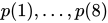
The first few values of the partition function, starting with p(0) = 1, are
Some exact values of p(n) for larger values of n include[1]

Generating function
[edit]
The generating function for p(n) is given by[2] The equality between the products on the first and second lines of this formula is obtained by expanding each factor into the geometric series To see that the expanded product equals the sum on the first line, apply the distributive law to the product. This expands the product into a sum of monomials of the form for some sequence of coefficients , only finitely many of which can be non-zero. The exponent of the term is , and this sum can be interpreted as a representation of as a partition into copies of each number . Therefore, the number of terms of the product that have exponent is exactly , the same as the coefficient of in the sum on the left. Therefore, the sum equals the product.






The function that appears in the denominator in the third and fourth lines of the formula is the Euler function. The equality between the product on the first line and the formulas in the third and fourth lines is Euler's pentagonal number theorem. The exponents of in these lines are the pentagonal numbers for (generalized somewhat from the usual pentagonal numbers, which come from the same formula for the positive values of ). The pattern of positive and negative signs in the third line comes from the term in the fourth line: even choices of produce positive terms, and odd choices produce negative terms.





More generally, the generating function for the partitions of into numbers selected from a set of positive integers can be found by taking only those terms in the first product for which . This result is due to Leonhard Euler.[3] The formulation of Euler's generating function is a special case of a -Pochhammer symbol and is similar to the product formulation of many modular forms, and specifically the Dedekind eta function.


Recurrence relations
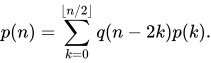
[edit]The same sequence of pentagonal numbers appears in a recurrence relation for the partition function:[4] As base cases, is taken to equal , and is taken to be zero for negative . Although the sum on the right side appears infinite, it has only finitely many nonzero terms, coming from the nonzero values of in the range The recurrence relation can also be written in the equivalent form





Another recurrence relation for can be given in terms of the sum of divisors function σ:[5] If denotes the number of partitions of with no repeated parts then it follows by splitting each partition into its even parts and odd parts, and dividing the even parts by two, that[6]


Congruences
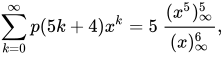
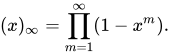
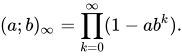
[edit]Srinivasa Ramanujan is credited with discovering that the partition function has nontrivial patterns in modular arithmetic. For instance the number of partitions is divisible by five whenever the decimal representation of ends in the digit 4 or 9, as expressed by the congruence[7] For instance, the number of partitions for the integer 4 is 5. For the integer 9, the number of partitions is 30; for 14 there are 135 partitions. This congruence is implied by the more general identity also by Ramanujan,[8][9] where the notation denotes the product defined by A short proof of this result can be obtained from the partition function generating function.


Ramanujan also discovered congruences modulo 7 and 11:[7] The first one comes from Ramanujan's identity[9]
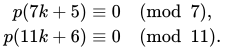

Since 5, 7, and 11 are consecutive primes, one might think that there would be an analogous congruence for the next prime 13, for some a. However, there is no congruence of the form for any prime b other than 5, 7, or 11.[10] Instead, to obtain a congruence, the argument of should take the form for some . In the 1960s, A. O. L. Atkin of the University of Illinois at Chicago discovered additional congruences of this form for small prime moduli. For example:





Ken Ono (2000) proved that there are such congruences for every prime modulus greater than 3. Later, Ahlgren & Ono (2001) showed there are partition congruences modulo every integer coprime to 6.[11][12]
Approximation formulas
[edit]Approximation formulas exist that are faster to calculate than the exact formula given above.
An asymptotic expression for p(n) is given by
- as .
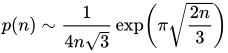

This asymptotic formula was first obtained by G. H. Hardy and Ramanujan in 1918 and independently by J. V. Uspensky in 1920. Considering , the asymptotic formula gives about , reasonably close to the exact answer given above (1.415% larger than the true value).


Hardy and Ramanujan obtained an asymptotic expansion with this approximation as the first term:[13] where Here, the notation means that the sum is taken only over the values of that are relatively prime to . The function is a Dedekind sum.
![{\displaystyle p(n)\sim {\frac {1}{2\pi {\sqrt {2}}}}\sum _{k=1}^{v}A_{k}(n){\sqrt {k}}\cdot {\frac {d}{dn}}\left({{\frac {1}{\sqrt {n-{\frac {1}{24}}}}}\exp \left[{{\frac {\pi }{k}}{\sqrt {{\frac {2}{3}}\left(n-{\frac {1}{24}}\right)}}}\,\,\,\right]}\right),}](https://wikimedia.org/api/rest_v1/media/math/render/svg/04ceae2693bf7f43119090335f73b00f55c9c3bf)



The error after terms is of the order of the next term, and may be taken to be of the order of . As an example, Hardy and Ramanujan showed that is the nearest integer to the sum of the first terms of the series.[13]


In 1937, Hans Rademacher was able to improve on Hardy and Ramanujan's results by providing a convergent series expression for . It is[14][15]
![{\displaystyle p(n)={\frac {1}{\pi {\sqrt {2}}}}\sum _{k=1}^{\infty }A_{k}(n){\sqrt {k}}\cdot {\frac {d}{dn}}\left({{\frac {1}{\sqrt {n-{\frac {1}{24}}}}}\sinh \left[{{\frac {\pi }{k}}{\sqrt {{\frac {2}{3}}\left(n-{\frac {1}{24}}\right)}}}\,\,\,\right]}\right).}](https://wikimedia.org/api/rest_v1/media/math/render/svg/91a531a51cf48ba80587a05f67f44d390aba14fc)
The proof of Rademacher's formula involves Ford circles, Farey sequences, modular symmetry and the Dedekind eta function.
It may be shown that the th term of Rademacher's series is of the order so that the first term gives the Hardy–Ramanujan asymptotic approximation. Paul Erdős (1942) published an elementary proof of the asymptotic formula for .[16][17]
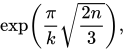
Techniques for implementing the Hardy–Ramanujan–Rademacher formula efficiently on a computer are discussed by Johansson (2012), who shows that can be computed in time for any . This is near-optimal in that it matches the number of digits of the result.[18] The largest value of the partition function computed exactly is , which has slightly more than 11 billion digits.[19]


Strict partition function
[edit]Definition and properties
[edit]A partition in which no part occurs more than once is called strict, or is said to be a partition into distinct parts. The function q(n) gives the number of these strict partitions of the given sum n. For example, q(3) = 2 because the partitions 3 and 1 + 2 are strict, while the third partition 1 + 1 + 1 of 3 has repeated parts. The number q(n) is also equal to the number of partitions of n in which only odd summands are permitted.[20]
| n | q(n) | Strict partitions | Partitions with only odd parts |
|---|---|---|---|
| 0 | 1 | () empty partition | () empty partition |
| 1 | 1 | 1 | 1 |
| 2 | 1 | 2 | 1+1 |
| 3 | 2 | 1+2, 3 | 1+1+1, 3 |
| 4 | 2 | 1+3, 4 | 1+1+1+1, 1+3 |
| 5 | 3 | 2+3, 1+4, 5 | 1+1+1+1+1, 1+1+3, 5 |
| 6 | 4 | 1+2+3, 2+4, 1+5, 6 | 1+1+1+1+1+1, 1+1+1+3, 3+3, 1+5 |
| 7 | 5 | 1+2+4, 3+4, 2+5, 1+6, 7 | 1+1+1+1+1+1+1, 1+1+1+1+3, 1+3+3, 1+1+5, 7 |
| 8 | 6 | 1+3+4, 1+2+5, 3+5, 2+6, 1+7, 8 | 1+1+1+1+1+1+1+1, 1+1+1+1+1+3, 1+1+3+3, 1+1+1+5, 3+5, 1+7 |
| 9 | 8 | 2+3+4, 1+3+5, 4+5, 1+2+6, 3+6, 2+7, 1+8, 9 | 1+1+1+1+1+1+1+1+1, 1+1+1+1+1+1+3, 1+1+1+3+3, 3+3+3, 1+1+1+1+5, 1+3+5, 1+1+7, 9 |
Generating function
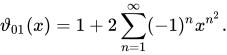
[edit]The generating function for the numbers q(n) is given by a simple infinite product:[21] where the notation represents the Pochhammer symbol From this formula, one may easily obtain the first few terms (sequence A000009 in the OEIS): This series may also be written in terms of theta functions as where and In comparison, the generating function of the regular partition numbers p(n) has this identity with respect to the theta function:



![{\displaystyle \sum _{n=0}^{\infty }q(n)x^{n}=\vartheta _{00}(x)^{1/6}\vartheta _{01}(x)^{-1/3}{\biggl \{}{\frac {1}{16\,x}}{\bigl [}\vartheta _{00}(x)^{4}-\vartheta _{01}(x)^{4}{\bigr ]}{\biggr \}}^{1/24},}](https://wikimedia.org/api/rest_v1/media/math/render/svg/7b6cfb3c0159d770c315b22b90316bfb8ae22033)

![{\displaystyle \sum _{n=0}^{\infty }p(n)x^{n}=(x;x)_{\infty }^{-1}=\vartheta _{00}(x)^{-1/6}\vartheta _{01}(x)^{-2/3}{\biggl \{}{\frac {1}{16\,x}}{\bigl [}\vartheta _{00}(x)^{4}-\vartheta _{01}(x)^{4}{\bigr ]}{\biggr \}}^{-1/24}.}](https://wikimedia.org/api/rest_v1/media/math/render/svg/d1197f6f79095ff46af1d8a9bb5617f18d2beec4)
Identities about strict partition numbers
[edit]Following identity is valid for the Pochhammer products:

From this identity follows that formula:
![{\displaystyle {\biggl [}\sum _{n=0}^{\infty }p(n)x^{n}{\biggr ]}={\biggl [}\sum _{n=0}^{\infty }p(n)x^{2n}{\biggr ]}{\biggl [}\sum _{n=0}^{\infty }q(n)x^{n}{\biggr ]}}](https://wikimedia.org/api/rest_v1/media/math/render/svg/539815eff209a5f350ab0768f832f31724971e1e)
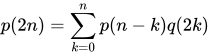
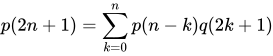
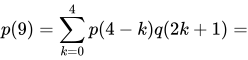
Therefore those two formulas are valid for the synthesis of the number sequence p(n):
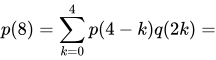
In the following, two examples are accurately executed:




Restricted partition function
[edit]More generally, it is possible to consider partitions restricted to only elements of a subset A of the natural numbers (for example a restriction on the maximum value of the parts), or with a restriction on the number of parts or the maximum difference between parts. Each particular restriction gives rise to an associated partition function with specific properties. Some common examples are given below.
Euler and Glaisher's theorem
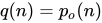
[edit]Two important examples are the partitions restricted to only odd integer parts or only even integer parts, with the corresponding partition functions often denoted and .


A theorem from Euler shows that the number of strict partitions is equal to the number of partitions with only odd parts: for all n, . This is generalized as Glaisher's theorem, which states that the number of partitions with no more than d-1 repetitions of any part is equal to the number of partitions with no part divisible by d.
Gaussian binomial coefficient
[edit]If we denote the number of partitions of n in at most M parts, with each part smaller or equal to N, then the generating function of is the following Gaussian binomial coefficient:


Asymptotics
[edit]Some general results on the asymptotic properties of restricted partition functions are known. If pA(n) is the partition function of partitions restricted to only elements of a subset A of the natural numbers, then:
If A possesses positive natural density α then , with


and conversely if this asymptotic property holds for pA(n) then A has natural density α.[22] This result was stated, with a sketch of proof, by Erdős in 1942.[16][23]
If A is a finite set, this analysis does not apply (the density of a finite set is zero). If A has k elements whose greatest common divisor is 1, then[24]


References
[edit]- ^ The corresponding objects where order is taken into account are called compositions.
- ^ Sloane, N. J. A. (ed.), "Sequence A070177", The On-Line Encyclopedia of Integer Sequences, OEIS Foundation
- ^ Abramowitz, Milton; Stegun, Irene (1964), Handbook of Mathematical Functions with Formulas, Graphs, and Mathematical Tables, United States Department of Commerce, National Bureau of Standards, p. 825, ISBN 0-486-61272-4
{{citation}}: ISBN / Date incompatibility (help) - ^ Euler, Leonhard (1753), "De partitione numerorum", Novi Commentarii Academiae Scientiarum Petropolitanae (in Latin), 3: 125–169, archived from the original on 2023-08-05, retrieved 2018-12-17
- ^ Ewell, John A. (2004), "Recurrences for the partition function and its relatives", The Rocky Mountain Journal of Mathematics, 34 (2): 619–627, doi:10.1216/rmjm/1181069871, JSTOR 44238988, MR 2072798
- ^ Wilf, Herbert S. (1982), "What is an answer?", American Mathematical Monthly, 89 (5): 289–292, doi:10.2307/2321713, JSTOR 2321713, MR 0653502
- ^ Al, Busra; Alkan, Mustafa (2018), "A note on relations among partitions", Proc. Mediterranean Int. Conf. Pure & Applied Math. and Related Areas (MICOPAM 2018), pp. 35–39, archived from the original on 2024-04-27, retrieved 2018-12-17
- ^ a b Hardy, G. H.; Wright, E. M. (2008) [1938], An Introduction to the Theory of Numbers (6th ed.), Oxford University Press, p. 380, ISBN 978-0-19-921986-5, MR 2445243, Zbl 1159.11001
- ^ Berndt, Bruce C.; Ono, Ken (1999), "Ramanujan's unpublished manuscript on the partition and tau functions with proofs and commentary" (PDF), The Andrews Festschrift (Maratea, 1998), Séminaire Lotharingien de Combinatoire, vol. 42, Art. B42c, 63, MR 1701582, archived from the original (PDF) on 2019-03-04, retrieved 2018-12-17
- ^ a b Ono, Ken (2004), The web of modularity: arithmetic of the coefficients of modular forms and -series, CBMS Regional Conference Series in Mathematics, vol. 102, Providence, Rhode Island: American Mathematical Society, p. 87, ISBN 0-8218-3368-5, Zbl 1119.11026
- ^ Ahlgren, Scott; Boylan, Matthew (2003), "Arithmetic properties of the partition function" (PDF), Inventiones Mathematicae, 153 (3): 487–502, Bibcode:2003InMat.153..487A, doi:10.1007/s00222-003-0295-6, MR 2000466, S2CID 123104639, archived from the original (PDF) on 2008-07-19, retrieved 2018-12-17
- ^ Ono, Ken (2000), "Distribution of the partition function modulo ", Annals of Mathematics, 151 (1): 293–307, arXiv:math/0008140, Bibcode:2000math......8140O, doi:10.2307/121118, JSTOR 121118, MR 1745012, S2CID 119750203, Zbl 0984.11050
- ^ Ahlgren, Scott; Ono, Ken (2001), "Congruence properties for the partition function" (PDF), Proceedings of the National Academy of Sciences, 98 (23): 12882–12884, Bibcode:2001PNAS...9812882A, doi:10.1073/pnas.191488598, MR 1862931, PMC 60793, PMID 11606715, archived from the original (PDF) on 2019-03-04, retrieved 2018-12-17
- ^ a b Hardy, G. H.; Ramanujan, S. (1918), "Asymptotic formulae in combinatory analysis", Proceedings of the London Mathematical Society, Second Series, 17 (75–115). Reprinted in Collected papers of Srinivasa Ramanujan, Amer. Math. Soc. (2000), pp. 276–309.
- ^ Andrews, George E. (1976), The Theory of Partitions, Cambridge University Press, p. 69, ISBN 0-521-63766-X, MR 0557013
- ^ Rademacher, Hans (1937), "On the partition function ", Proceedings of the London Mathematical Society, Second Series, 43 (4): 241–254, doi:10.1112/plms/s2-43.4.241, MR 1575213
- ^ a b Erdős, P. (1942), "On an elementary proof of some asymptotic formulas in the theory of partitions" (PDF), Annals of Mathematics, Second Series, 43 (3): 437–450, doi:10.2307/1968802, JSTOR 1968802, MR 0006749, Zbl 0061.07905
- ^ Nathanson, M. B. (2000), Elementary Methods in Number Theory, Graduate Texts in Mathematics, vol. 195, Springer-Verlag, p. 456, ISBN 0-387-98912-9, Zbl 0953.11002
- ^ Johansson, Fredrik (2012), "Efficient implementation of the Hardy–Ramanujan–Rademacher formula", LMS Journal of Computation and Mathematics, 15: 341–59, arXiv:1205.5991, doi:10.1112/S1461157012001088, MR 2988821, S2CID 16580723
- ^ Johansson, Fredrik (March 2, 2014), New partition function record: p(1020) computed
- ^ Stanley, Richard P. (1997), Enumerative Combinatorics 1, Cambridge Studies in Advanced Mathematics, vol. 49, Cambridge University Press, Proposition 1.8.5, ISBN 0-521-66351-2
- ^ Stanley, Richard P. (1997), Enumerative Combinatorics 1, Cambridge Studies in Advanced Mathematics, vol. 49, Cambridge University Press, Proof of Proposition 1.8.5, ISBN 0-521-66351-2
- ^ Nathanson 2000, pp. 475–85.
- ^ Nathanson 2000, p. 495.
- ^ Nathanson 2000, pp. 458–64.
External links
[edit]Partition function (number theory)
View on GrokipediaFundamentals
Definition and Notation
In number theory, the partition function $ p(n) $ counts the number of ways to express a positive integer $ n $ as a sum of positive integers, disregarding order; these are known as unrestricted partitions.[4] An integer partition of $ n $ is formally defined as a non-increasing sequence of positive integers that sum to $ n $.[5] Standard notation for partition functions includes $ p(n) $ for the number of unrestricted partitions of $ n $, $ q(n) $ for the number of partitions of $ n $ into distinct parts, and $ p_k(n) $ for the number of partitions of $ n $ into exactly $ k $ parts.[6][7] By convention, the empty partition is considered for $ n = 0 $, so $ p(0) = 1 $.[1] The mathematical study of the partition function traces its origins to Leonhard Euler, who introduced key concepts in 1748.[8]Examples and Basic Properties
The partition function $ p(n) $ can be computed explicitly for small values of $ n $ by enumerating all possible ways to write $ n $ as a sum of positive integers in non-increasing order. For $ n = 1 $, there is only one partition: $ 1 $, so $ p(1) = 1 $. For $ n = 2 $, the partitions are $ 2 $ and $ 1+1 $, giving $ p(2) = 2 $. For $ n = 3 $, they are $ 3 $, $ 2+1 $, and $ 1+1+1 $, so $ p(3) = 3 $. For $ n = 4 $, the five partitions are $ 4 $, $ 3+1 $, $ 2+2 $, $ 2+1+1 $, and $ 1+1+1+1 $, yielding $ p(4) = 5 $. For $ n = 5 $, there are seven partitions: $ 5 $, $ 4+1 $, $ 3+2 $, $ 3+1+1 $, $ 2+2+1 $, $ 2+1+1+1 $, and $ 1+1+1+1+1 $, so $ p(5) = 7 $. Continuing this process, $ p(6) = 11 $, $ p(7) = 15 $, $ p(8) = 22 $, $ p(9) = 30 $, and $ p(10) = 42 $. The values of $ p(n) $ for $ n = 1 $ to $ 20 $ are listed in the following table:| $ n $ | $ p(n) $ |
|---|---|
| 1 | 1 |
| 2 | 2 |
| 3 | 3 |
| 4 | 5 |
| 5 | 7 |
| 6 | 11 |
| 7 | 15 |
| 8 | 22 |
| 9 | 30 |
| 10 | 42 |
| 11 | 56 |
| 12 | 77 |
| 13 | 101 |
| 14 | 135 |
| 15 | 176 |
| 16 | 231 |
| 17 | 297 |
| 18 | 385 |
| 19 | 490 |
| 20 | 627 |
Generating Functions and Recurrences
Ordinary Generating Function
The ordinary generating function for the partition function is the formal power seriesPentagonal Number Theorem and Recurrences
The pentagonal number theorem, discovered by Leonhard Euler in 1740, expresses the Euler function as an infinite series involving generalized pentagonal numbers. Specifically, for ,Analytic Properties
Modular Congruences
The partition function satisfies several notable modular congruences, particularly for moduli that are primes. These relations provide exact arithmetic constraints on and arise from the modular form properties of its generating function .[10] In 1919, Srinivasa Ramanujan discovered three striking linear congruences for primes :| 0 | 1 | 1 | 1 | 1 |
| 1 | 1 | 1 | 1 | 1 |
| 2 | 2 | 2 | 2 | 2 |
| 3 | 3 | 3 | 3 | 3 |
| 4 | 5 | 0 | 5 | 5 |
| 5 | 7 | 2 | 0 | 7 |
| 6 | 11 | 1 | 4 | 0 |
| 7 | 15 | 0 | 1 | 4 |
| 8 | 22 | 2 | 1 | 0 |
| 9 | 30 | 0 | 2 | 8 |
| 10 | 42 | 2 | 0 | 9 |
| 11 | 56 | 1 | 0 | 1 |
| 12 | 77 | 2 | 0 | 0 |
| 13 | 101 | 1 | 3 | 2 |
| 14 | 135 | 0 | 2 | 3 |
| 15 | 176 | 1 | 1 | 0 |
| 16 | 231 | 1 | 0 | 0 |
| 17 | 297 | 2 | 3 | 0 |
| 18 | 385 | 0 | 0 | 0 |
| 19 | 490 | 0 | 0 | 6 |
| 20 | 627 | 2 | 4 | 0 |
Asymptotic Approximations
The leading asymptotic approximation for the partition function as is given by the Hardy–Ramanujan formula:Strict Partitions
Definition and Properties
In number theory, a strict partition of a positive integer is a way of writing as a sum of distinct positive integers, disregarding order. The function denotes the number of such strict partitions of .[6] Unlike unrestricted partitions, where parts may repeat, strict partitions require all parts to be unique, imposing a combinatorial restriction that limits the count.[6] Each strict partition of corresponds uniquely to a finite subset of the positive integers whose elements sum to , emphasizing the enumerative nature of as the count of such subsets.[6] A fundamental property is that for all , since the set of strict partitions forms a subset of all integer partitions, with strict inequality holding for .[6] For instance, while , illustrating the reduction due to the distinctness constraint.[6] The combinatorial structure of strict partitions implies that for all , but is typically small compared to , growing overall albeit more slowly.[16] Among strict partitions, self-conjugate ones form an interesting subclass, where the partition equals its conjugate, meaning the Ferrers diagram is symmetric across the main diagonal, and all row lengths (parts) remain distinct.[6] These partitions highlight the interplay between distinctness and symmetry in partition theory. The function satisfies a recurrence relation analogous to that of derived from the pentagonal number theorem, but with alternating signs modified to account for the distinct parts condition.[17] Specifically, such recurrences allow computation by subtracting contributions from prior terms indexed by generalized pentagonal numbers, adjusted for the generating function structure of strict partitions.[18] For small values of , can be enumerated directly, providing insight into the growth and patterns:| Example partitions | ||
|---|---|---|
| 1 | 1 | (1) |
| 2 | 1 | (2) |
| 3 | 2 | (3), (2+1) |
| 4 | 2 | (4), (3+1) |
| 5 | 3 | (5), (4+1), (3+2) |
| 6 | 4 | (6), (5+1), (4+2), (3+2+1) |
| 7 | 5 | (7), (6+1), (5+2), (4+3), (4+2+1) |
| 8 | 6 | (8), (7+1), (6+2), (5+3), (5+2+1), (4+3+1) |
| 9 | 8 | (9), (8+1), (7+2), (6+3), (6+2+1), (5+4), (5+3+1), (4+3+2) |
| 10 | 10 | (10), (9+1), (8+2), (7+3), (7+2+1), (6+4), (6+3+1), (5+4+1), (5+3+2), (4+3+2+1) |
Generating Function and Identities
The ordinary generating function for the partition function , which counts the number of strict partitions of , is given byRestricted Partitions
Theorems on Partitions with Parity Restrictions
One of the fundamental results in the theory of integer partitions is Euler's partition theorem, which asserts that the number of partitions of a positive integer into distinct parts equals the number of partitions of into odd parts.[22] This equality, denoted , where counts distinct-part partitions and counts odd-part partitions, was discovered by Leonhard Euler in 1748 using generating functions.[23] The generating function for partitions into distinct parts is , while for odd parts it is ; Euler showed these are identical by algebraic manipulation, establishing the equality for all .[22] A bijective proof of Euler's theorem, which provides a direct correspondence between the two sets of partitions, was later given by James Whitbread Lee Glaisher in 1883 as part of his broader generalization.[24] Glaisher's bijection relies on representing each part in a distinct-part partition via its binary expansion and regrouping the powers of 2 into odd coefficients, yielding an odd-part partition of the same weight, and vice versa.[25] Glaisher extended Euler's result in the same 1883 work to a more general theorem: for any integer , the number of partitions of into parts not divisible by equals the number of partitions of in which no part appears or more times (i.e., each part has multiplicity at most ).[25] For , this recovers Euler's theorem, as parts not divisible by 2 are odd and multiplicity at most 1 implies distinct parts.[24] Glaisher's proof employs a bijection based on base- representations: for a partition with restricted multiplicities, each part is written in base and the digits (each at most ) are interpreted as multiplicities of powers of , then recombined into parts avoiding multiples of , preserving the total sum.[25] To illustrate, consider . The partitions into odd parts are , , and (three in total). The partitions into distinct parts are , , and (also three), confirming the equality.[22] These theorems bridge unrestricted partitions with those under parity or multiplicity constraints, highlighting deep symmetries in partition theory.[23]q-Analogs and Gaussian Binomials
The q-analogs of the partition function introduce a parameter q to encode additional structure on partitions, particularly for restricted cases such as those with at most k parts, denoted p_{\leq k}(n). A key generating function for these restricted partitions is the finite product \prod_{j=1}^k \frac{1}{1 - x q^j}, where the coefficient of x^r q^n counts the number of partitions of n with exactly r parts and largest part at most k (equivalently, at most k parts by conjugation).[6] This form deforms the classical generating function \prod_{j=1}^k \frac{1}{1 - x^j} by weighting the size n with q^n while tracking the number of parts with x^r. For the unrestricted case, the analogous infinite product \prod_{k=1}^\infty \frac{1}{1 - x q^k} generates all partitions, with coefficients of x^r q^n counting partitions of n into exactly r parts. Gaussian binomial coefficients provide a fundamental tool for q-analogs of bounded partitions. Defined asAsymptotics for Restricted Cases
The asymptotic behavior of the restricted partition function , which counts the number of partitions of into distinct parts, is given by| Partition Type | Dominant Exponential Term | Relative Growth vs. |
|---|---|---|
| Unrestricted | Baseline (fastest) | |
| Distinct | Slower ( factor) | |
| Odd parts | Same as distinct |