Hubbry Logo
PeninnahPeninnahMain
Open search
Peninnah
Community hub
Peninnah
logo
8 pages, 0 posts
0 subscribers
Be the first to start a discussion here.
Peninnah
Peninnah
from Wikipedia
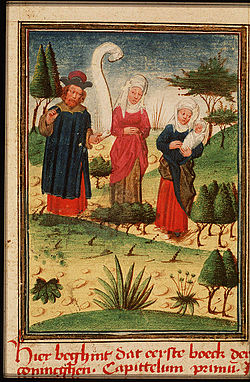
Peninnah (right) with Elkanah and Hannah as they return to Ramah.

Peninnah (Hebrew: פְּנִנָּה Pəninnā; sometimes transliterated Penina) was one of Elkanah's two wives, briefly mentioned in the first Book of Samuel (1 Samuel 1:2).[1][2] Her name derives from the word פְּנִינָּה‎ (pəninā), meaning "pearl."[3][4]

Biblical account

[edit]

Peninnah was less favored than Elkanah's other wife, Hannah; although she had borne him children whilst Hannah was childless, Peninnah also brought grief and disharmony to the household by her mocking of the infertile Hannah.[5] Peninnah would taunt Hannah for being childless. Rabbinical tradition has it that she would grieve Hannah by means of ordinary everyday activities, taking pains to remind her, at all hours of the day, of the difference between them.[6]

According to Jewish writer Lillian Klein, "Because the reader’s sympathies are directed toward the childless Hannah, Peninnah comes across as a malicious woman. In fact, she is probably a literary convention, a foil for the independence and goodness of Hannah, and should be regarded as such."[7]

Eventually, in answer to her desperate prayer, Hannah's womb was opened, and she bore Samuel, and later another three sons and two daughters.[8] After the birth of Samuel, Peninnah is not mentioned again, and 1 Samuel 2:20 says that Eli "would bless Elkanah and his wife", referring to Hannah.

Midrash

[edit]
Elkanah with wives at sacrifice

According to the midrash, Hannah was Elkanah's first wife; after they had been married for ten years, he also took Peninnah as a wife (Pesikta Rabbati 43). The midrash explains that Elkanah was compelled to marry Peninnah because of Hannah's barrenness, which explains his preference for Hannah, his first wife. Another tradition has the initiative to marry Peninnah coming from Hannah, thus comparing her to Sarah and Hagar, and Rachel and Leah, in which the beloved wife, who is barren, initiates the taking of an additional wife in order to produce offspring. The different midrashim highlight the difficulty Peninnah faced living in the shadow of another woman.[9]

A different midrash suggests that Peninnah's actions were in fact noble, and that Peninnah "mocked" the barren Hannah in order to further drive Hannah to pray even harder to God to give her children. She vexed Hannah at Shiloh, thereby causing her distraught rival wife to pray fervently. Thanks to Peninnah, Hannah's prayer was answered, and she gave birth to children.[10]

See also

[edit]

References

[edit]
[edit]
Revisions and contributorsEdit on WikipediaRead on Wikipedia
from Grokipedia
Peninnah is a minor figure in the , mentioned exclusively in the first chapter of 1 as one of the two wives of , a from in the hill country of . Unlike her co-wife Hannah, who was barren and Elkanah's favored spouse, Peninnah bore him several children. Her name, derived from the Hebrew root p-n-n, is commonly interpreted to mean "" or "pearl." In the narrative, Peninnah's primary role emerges during the family's annual pilgrimages to the sanctuary at Shiloh, where offers sacrifices and distributes portions of meat to his wives and children. As the fertile wife, she receives shares for her sons and daughters, while Hannah receives a double portion from out of his special affection for her. However, Peninnah acts as Hannah's tzarah (rival or adversary), provoking her bitterly and irritating her year after year because the Lord had closed Hannah's womb. This taunting intensifies Hannah's distress, often causing her to weep and refuse food, as seen during one such visit when Peninnah's actions lead Hannah to pour out her in before the priest Eli. Scholars interpret Peninnah's antagonism as emblematic of interpersonal rivalries in polygynous households, highlighting the societal emphasis on women's in ancient Israelite culture and the emotional toll of barrenness. Her provocations serve to underscore Hannah's suffering and spiritual resilience, culminating in the divine granting of Samuel's birth after Hannah's . While some later rabbinic traditions amplify Peninnah's villainy to exalt Hannah's piety, earlier interpretations, including the , portray her role more passively as part of Hannah's broader adversity. Peninnah's brief appearance thus contrasts with favored barrenness, a motif echoed in Hannah's triumphant song, where the barren woman rejoices while the mother of many is humbled.

Background

Etymology

The name Peninnah (פְּנִינָּה) derives from the Hebrew root p-n-n (פנן, panan), which conveys the idea of turning or continuing, and is linked to the noun peninim (פְּנִינִים), denoting red coral or a precious often interpreted as pearl or in ancient contexts. This root suggests connotations of proliferation or abundance, potentially evoking "prolific" or "fruitful" through , as her biblical depiction aligns with themes of . In Hebrew linguistics, peninim appears in scriptural passages to symbolize rarity and value, such as in :10, where it underscores incomparable worth. Connections to broader reinforce this association with precious stones and symbolic fertility. In , a related term like fanan refers to branching or extension, paralleling the Hebrew sense of continuation, while marjan denotes or pearl, highlighting shared motifs of and across Semitic traditions. Ancient translations vary slightly, with the rendering the name as Phennana (Φεννάνα) in 1 1:2, preserving phonetic similarity to emphasize symbolic layers of adornment or endurance. This adaptation implies interpretive flexibility, allowing Greek readers to associate it with enduring precious materials, though it retains the Hebrew essence without altering core linguistic ties.

Historical Context

In the during the late and early (circa 1200–1000 BCE), polygamous marriage practices were widespread among Semitic societies, enabling men of economic means to marry multiple wives and maintain concubines for purposes of household labor, alliance-building, and progeny assurance. These arrangements were particularly adaptive in agrarian contexts, where larger families supported and continuity. Levirate-like complemented polygamy by obligating a to marry a close male relative of her deceased husband, primarily to produce an heir and preserve the family lineage, as documented in texts from Mesopotamian sites like Nuzi and later codified in Israelite law. Within tribal Israelite families of the 11th–10th centuries BCE, women held essential roles in sustaining the household economy through tasks such as , textile production, and child-rearing, which directly contributed to the clan's social cohesion and survival. emerged as a core social and religious duty for women, as childbearing was perceived as a divine mandate that affirmed familial prosperity and covenantal blessings; , conversely, carried and prompted strategies like secondary marriages to fulfill this imperative. This emphasis on aligned with broader cultural norms, where women's reproductive capacity underpinned tribal expansion and religious piety. Archaeological and textual evidence from , a key Canaanite city-state in northern (destroyed around 1200 BCE), reveals parallels to co-wife dynamics in Semitic cultures, with marriage contracts and mythological texts attesting to polygynous households where multiple women shared spousal roles to enhance family resources and ensure offspring. Similar patterns appear in papyri from in (5th century BCE, reflecting earlier traditions), describing co-wives navigating inheritance and household tensions, which mirror the societal structures of early during its cultural transition from influences. These sources highlight how such practices fostered both cooperation and rivalry among women in pursuit of collective familial duties.

Biblical Narrative

Marriage to Elkanah

Peninnah was one of two wives married to , a from in the hill country of . Unlike Hannah, Elkanah's other wife, who remained barren, Peninnah bore him several sons and daughters, establishing her role as the fertile partner in this polygamous union. The household of , Hannah, and Peninnah exemplified the structure of ancient Israelite families where multiple wives could coexist to support familial and economic needs. Each year, led his family on a pilgrimage to Shiloh, the site of the , to and to the of Hosts. During these annual offerings, Elkanah apportioned shares of the sacrificial meat to Peninnah and each of her children, reflecting the customary recognition of progeny in distributions, while giving Hannah a double portion out of his special affection for her. Peninnah's multiple children fulfilled a key cultural expectation in ancient Israelite polygamous marriages, where producing heirs was essential for patrilineal continuity, labor provision, and securing the family's legacy in line with the biblical mandate to "be fruitful and multiply." This fertility contrasted sharply with Hannah's childlessness, contributing to tensions in the household dynamics.

Rivalry with Hannah

In the biblical account, Peninnah, as the fertile wife of , repeatedly provoked her barren rival Hannah during the family's annual pilgrimages to the house of the Lord at Shiloh, intensifying Hannah's distress to the point of weeping and refusing to eat. This antagonism occurred year after year amid the sacrificial feasts, highlighting the ongoing tension within the household. The culmination of this rivalry unfolded one year after the evening meal in Shiloh, when Hannah, in deep anguish, rose to pray before the , weeping bitterly and making a : if would grant her a son, she would dedicate him to divine service for life as a , with no razor touching his head. Eli the priest, observing her silent but fervent prayer, initially mistook her for intoxicated and rebuked her, but upon her explanation of her profound grief, he blessed her, wishing for to fulfill her request. Hannah departed in peace, and soon after returning home with , she conceived and bore a son, whom she named , meaning "Because I asked the for him." Following 's birth and dedication at Shiloh, the narrative shifts, with the Lord showing grace to Hannah by blessing her with three additional sons and two daughters, while Samuel grew in the Lord's presence. Peninnah, having played a pivotal role in precipitating these events through her provocations, fades from the subsequent account without further mention.

Jewish Interpretations

Midrashic Accounts

In midrashic literature, Peninnah is portrayed as Elkanah's second wife, whom he married after ten years of with his first wife, Hannah, in order to ensure the continuation of his lineage. This narrative expands on the biblical account of familial rivalry by emphasizing the cultural imperative for progeny, likening the story to those of the matriarchs and their rivals, such as and . The Babylonian Talmud provides a nuanced interpretation of Peninnah's provocations, stating in Bava Batra 16a that her taunts toward Hannah were motivated by a pious intent: to goad the barren Hannah into more intense supplication, thereby facilitating divine favor and the birth of . Rabbi Levi explains that, like in the story of Job, Peninnah acted as an adversary with ultimately beneficial aims, though God did not require such intervention. Further aggadic traditions describe severe consequences for Peninnah's actions, including the of her children as divine . According to Pesikta Rabbati 43, Peninnah bore ten sons, but with each of Hannah's five births, two of Peninnah's children died, resulting in the loss of eight; this pattern continued until only two remained. Overwhelmed by , Peninnah then implored Hannah for , prompting Hannah to intercede in on her behalf, which preserved the lives of Peninnah's surviving sons and attributed their survival to Hannah in the biblical verse (I 2:5). This account, echoed in Louis Ginzberg's compilation of midrashim, underscores themes of retribution and redemption in rabbinic exegesis.

Character Portrayal

In Jewish midrashic literature, Peninnah is frequently depicted as a jealous who taunts Hannah about her barrenness, driven by insecurity over Elkanah's greater affection for his first wife. However, other rabbinic traditions present her as a redeemable figure whose provocations, though harsh, ultimately benefit Hannah by prompting fervent that leads to the birth of . For instance, the Babylonian Talmud explains that Peninnah's motive was to spur Hannah toward deeper devotion, transforming her role from tormentor to unwitting catalyst for divine intervention. Peninnah also serves as a symbolic to Hannah, embodying physical —having borne ten children—against Hannah's childlessness and spiritual devotion, highlighting themes of divine favor beyond mere progeny. Midrashim such as Pesikta Rabbati portray her actions as part of God's broader plan, akin to a divine tool that tests and elevates the righteous, much like the adversary in the , ensuring Hannah's eventual triumph. This representation underscores Peninnah's moral ambiguity, where her contrasts with the enduring legacy of Hannah's . In later Jewish writings, particularly medieval commentaries, Peninnah's character evolves to exemplify unchecked rivalry within familial and social structures, blending earlier antagonistic views with nuanced intent. , in his 11th-century commentary on 1 Samuel, describes her as a "wicked" rival whose taunting stems from good intentions but results in harm, reflecting a synthesis of midrashic redemption with ethical critique of . This portrayal reinforces her as a cautionary figure in Jewish ethical teachings, emphasizing the consequences of rivalry even when motivated by concern.

Other Religious Traditions

Christian Views

In early Christian , Peninnah was often interpreted allegorically as a symbol of worldly or legalistic , contrasting with Hannah's representation of faithful devotion. Augustine, in De Civitate Dei, portrays Hannah as the Church, barren yet ultimately fruitful through grace, while Peninnah embodies the , once fecund under the Law but rendered spiritually barren by infidelity, highlighting the rivalry between carnal and spiritual priorities. Similarly, Gregory the Great, in his commentary on the Books of Kings, positions Peninnah as the —secondary in dignity to the Church (Hannah)—and associates her with the active, earthly life that provokes but cannot match contemplative prayer. During the Reformation era and in subsequent Puritan writings, Peninnah's role was emphasized in sermons and commentaries to underscore the transformative power of amid provocation. Matthew Henry, in his Commentary on the Whole Bible, describes Peninnah's base disposition in delighting to grieve Hannah's sorrowful spirit through relentless taunting, yet notes how this adversity intensified Hannah's bitterness of soul, driving her to a and fervent that honored with the birth of . Such interpretations framed Peninnah's rivalry not merely as malice but as a divine catalyst, illustrating how trials refine and elicit earnest to the . In contemporary Christian studies, Peninnah serves as a cautionary figure against the destructiveness of , her provocations exemplifying how erodes relationships and spiritual peace, in stark contrast to Hannah's trust in . Devotional sometimes explores a redemptive , suggesting Peninnah's taunting—rooted perhaps in her own insecurities—ultimately propelled Hannah toward redemptive and the fulfillment of God's purposes through Samuel's prophetic ministry. This view encourages believers to view interpersonal conflicts as opportunities for growth, urging avoidance of while emulating Hannah's resilient faith.

Islamic References

In Islamic tradition, the Quranic narrative in Al-Imran (3:35-37) recounts the story of the wife of —traditionally identified in exegeses as Hannah (Hanna bint Faqudh), distinct from the biblical Hannah, mother of —who vows to dedicate her unborn child to 's service, emphasizing themes of devotion and divine acceptance. This account describes the wife of Imran expressing her dedication entirely to , seeking His acceptance as the All-Hearing and All-Knowing, only to give birth to a female child, Maryam (Mary), whom she places under divine protection from . Some exegeses elaborate that she had been barren for a prolonged period, enduring reproach from women in her society, which prompted her fervent vow and prayer for a child to serve in the temple at . This portrayal highlights an implied dynamic of social adversity akin to over , underscoring the wife's patience () and ultimate reliance on , who accepts Maryam and ensures her upbringing under the care of Zakariya. Classical tafsirs, such as those by Al-Tabari and Ibn Kathir, connect this narrative to broader Abrahamic traditions, drawing on Jewish sources to contextualize the family of Imran as a lineage of prophets and righteous figures, where barrenness serves as a test of faith that provokes deeper devotion. Al-Tabari's exegesis, in particular, incorporates reports from early scholars linking the story to Israelite customs, portraying the barren woman's trials as a catalyst for spiritual resolve. These interpretations emphasize how such adversities mirror themes of endurance found in prophetic stories. Peninnah does not appear in Islamic texts, and the Quranic account does not reference a rival wife or the biblical context involving Elkanah.

Modern Scholarship

Literary Role

In the narrative of 1 Samuel 1, Peninnah functions as a foil to Hannah, her co-wife, by embodying and social security in stark contrast to Hannah's barrenness and emotional vulnerability. This opposition intensifies Hannah's distress during the annual family pilgrimages to Shiloh, where Peninnah provokes her "bitterly" to irritate her, exploiting the cultural stigma of (1 Samuel 1:6–7). Scholar Lillian Klein characterizes Peninnah as a literary convention rather than a fully developed character, designed to accentuate Hannah's , , and eventual triumph, thereby underscoring broader biblical themes of divine favor granted to the marginalized. Peninnah's taunts serve to propel the plot, catalyzing Hannah's desperate at the and her heartfelt , which leads to the miraculous conception of (1 Samuel 1:9–11, 19–20). Literary analysts such as J. P. Fokkelman highlight how this rivalry establishes the central conflict in the chapter's early episodes, creating narrative tension that resolves through Hannah's and Peninnah's implied diminishment, as Hannah bears multiple children while Peninnah fades from the story after verse 7. This dynamic illustrates the motif of of fortunes, where the seemingly advantaged (Peninnah, with her children and portions of the ) yield to the disadvantaged under divine intervention. Within the Deuteronomistic History, Peninnah's antagonistic role contributes to the structural progression from the era of judges to the prophetic and monarchical periods by facilitating 's birth as a pivotal transitional figure. Scholars such as highlight the antagonism in the family's dynamics (1 Samuel 1:4–6), which heighten the dysfunction and necessitate divine resolution through Samuel, whose prophetic ministry critiques corrupt leadership and inaugurates Israel's shift toward kingship. Thus, her stereotypical portrayal as a provocateur enhances the narrative's theological emphasis on God's in overturning human hierarchies.

Feminist Analysis

Feminist scholarship has reevaluated Peninnah's portrayal in 1 Samuel, shifting focus from her as a simple to a figure ensnared by the pressures of patriarchal , where women's value was largely tied to and familial roles. Rather than inherent villainy, her of the barren Hannah is seen as a response to her own unloved status in a system that allowed to favor one wife while using the other for childbearing, perpetuating competition among women to secure position and affection. This interpretation highlights how polygamous structures degraded both wives, with Peninnah bearing children yet receiving less emotional support, underscoring the inequities imposed on women in ancient Israelite society. Analyses from the Jewish Women's Archive portray Peninnah's jealousy as socially induced, stemming from unexamined acceptance of cultural norms that pitted co-wives against each other, much like the rivalries among Genesis matriarchs such as and or and . By challenging the biblical narrative's tendency to blame women for relational strife, these readings critique how texts reinforce patriarchal blame on female characters while overlooking systemic causes, such as Elkanah's favoritism that publicly humiliated Hannah and marginalized Peninnah despite her fertility. Peninnah thus embodies the "trouble" inherent in co-wife dynamics, a term rooted in Hebrew for such relationships, reflecting broader ancient Near Eastern patterns of gender hierarchy. Post-1970s feminist scholarship has further positioned Peninnah as a complex figure representing marginalized voices in ancient texts, where women's stories illuminate the constraints of without granting them narrative agency. These examinations of biblical women emphasize how figures like Peninnah, trapped in polygamous arrangements, reveal the Bible's subtle critiques of imbalances through their silenced perspectives and relational conflicts. Recent analyses (as of 2024) extend this by exploring the in contemporary contexts, such as stigmatization in Nigerian , where Peninnah's taunts parallel modern emotional responses to . This reevaluation invites contemporary readers to view Peninnah not merely as Hannah's rival but as a symbol of resilience amid domination, prompting reflection on ongoing dynamics in religious traditions.

References

Add your contribution
Related Hubs
User Avatar
No comments yet.