



Community hub
Recent from talks
Contribute something
Nothing was collected or created yet.
Allah
View on Wikipedia

| Part of a series on Islam |
| Allah (God in Islam) |
|---|
 |
 Islam portal • Category Islam portal • Category |
Allah (/ˈælə, ˈɑːlə, əˈlɑː/ A(H)L-ə, ə-LAH;[1][2][3] Arabic: الله, IPA: [ɑɫˈɫɑːh] ⓘ) is the Arabic language term for God, specifically the monotheistic God of Abraham. Outside of Arabic languages, it is principally associated with Islam (in which it is also considered the proper name), although the term was used in pre-Islamic Arabia and continues to be used today by Arabic-speaking adherents of any of the Abrahamic religions, including Judaism and Christianity.[4][5][6][7] It is thought to be derived by contraction from al-ilāh (الاله, lit. 'the god') and is linguistically related to God's names in other Semitic languages, such as Aramaic (ܐܲܠܵܗܵܐ ʼAlāhā) and Hebrew (אֱלוֹהַּ ʾĔlōah).[8][9]
The word "Allah" now conveys the superiority or sole existence of one God,[10] but among the pre-Islamic Arabs, Allah was a supreme deity and was worshipped alongside lesser deities in a pantheon.[11] Many Jews, Christians, and early Muslims used "Allah" and "al-ilah" synonymously in Classical Arabic. The word is also frequently, albeit not exclusively, used by Bábists, Baháʼís, Mandaeans, Indonesian Christians, Maltese Christians, and Sephardic Jews,[12][13][14] as well as by the Gagauz people.[15]
Etymology
[edit]
- alif
- hamzat waṣl (همزة وصل)
- lām
- lām
- shadda (شدة)
- alif khunjāriyah (ألف خنجرية)
- hāʾ
The etymology of the word Allāh has been discussed extensively by classical Arab philologists.[16] The majority of scholars consider it to be derived from a contraction of the Arabic definite article al- and ilāh "deity, god" to al-lāh meaning "the deity, the God".[16] In some sources, the contracted and un-contracted forms are used interchangeably.[17] The contraction of the terms is mirrored by the parallel contraction of al-ʾilāt to Allāt.[18] Originally, ʾilāh was used as an epithet for the West Semitic creator god ʾIlu (the Ugaritic version of El), before being adopted as the proper name itself for this god.[19]
A minority hypothesis posits that Allah is a loanword from the Syriac Alāhā.[20][21] However, this form is likely a phonetic adaptation of the Arabic.[22][23]
Grammarians of the Basra school regarded it as either formed "spontaneously" (murtajal) or as the determined form of lāh (from the verbal root lyh with the meaning of "lofty" or "hidden").[16] Other Muslims scholars proposed that the term derives from wilah (the object of mystery) since the nature of God is a mystery and incomprehensible for humans.[24][25]: 162
Semitic cognates of "Allāh" appear in Semitic languages,[26] such as the Aramaic ʼElāh (אלה) in the absolute form, and in its definite/emphatic form, ʼElāhā (אלהא), the form reflected in Biblical Aramaic. Also Syriac ܐܲܠܵܗܵܐ (ʼAlāhā), both meaning simply "god", or "deity", used by both monotheists and pagans.[27] Others are Akkadian ʾilum, Ugartic ʾilu, and Phoenician ʾl.
History of usage
[edit]Pre-Islamic Arabia
[edit]| Deities of the ancient Near East |
|---|
| Religions of the ancient Near East |
Regional variants of the word Allah occur in both pagan and Christian pre-Islamic inscriptions.[10][28] According to Marshall Hodgson, it seems that in the pre-Islamic Arabia, some Arab Christians undertook pilgrimages to the Kaaba, a pagan temple at that time, honoring Allah there as the God Creator.[29]
In an inscription of Christian martyrion dated to 512, references to al-ilah (الاله)[30] appear in both Arabic and Aramaic. The inscription opens with the phrase "By the Help of al-ilah".[31][32]
Archaeological excavations have led to the discovery of ancient pre-Islamic inscriptions and tombs made by Arab Christians in the ruins of a church at Umm el-Jimal in Northern Jordan, which initially, according to Enno Littmann (1949), contained references to Allah as the proper name of God. However, on a second revision by Bellamy et al. (1985 & 1988) the five-verse inscription was retranslated: "(1)This [inscription] was set up by colleagues of ʿUlayh, (2) son of ʿUbaydah, secretary (3) of the cohort Augusta Secunda (4) Philadelphiana; may he go mad who (5) effaces it."[33][34][35]
Irfan Shahîd quoting the 10th-century encyclopedic collection Kitab al-Aghani notes that pre-Islamic Arab Christians have been reported to have raised the battle cry "Ya La Ibad Allah" (O slaves of Allah) to invoke each other into battle.[36] According to Shahid, on the authority of 10th-century Muslim scholar Al-Marzubani, "Allah" was also mentioned in pre-Islamic Christian poems by some Ghassanid and Tanukhid poets in Syria and Northern Arabia.[37][38][39]
Different theories have been proposed regarding the role of Allah in pre-Islamic polytheistic cults. According to the Quran commentator Ibn Kathir, Arab idolaters considered Allah as an unseen God who created and controlled the Universe. Pagans believed worship of humans or animals who had fortunate occurrences in their life brought them closer to God. Pre-Islamic Meccans worshiped Allah alongside a host of lesser gods and those whom they called the "daughters of Allah."[11] Islam forbade worship of anyone or anything other than God.[40] Some authors have suggested that polytheistic Arabs used the name as a reference to a creator god or a supreme deity of their pantheon.[41][42] The term may have been vague in the Meccan religion.[41][43]
According to one hypothesis, the Kaaba was first dedicated to a supreme deity named Allah and then hosted the pantheon of Quraysh (360 idols) after their conquest of Mecca, about a century before the time of Muhammad.[10] Some inscriptions seem to indicate the use of Allah as a name of a polytheist deity centuries earlier, although the exact nature of this usage remains unclear.[10] Some scholars have suggested that Allah may have represented a remote creator god who was gradually eclipsed by more particularized local deities.[44][45] There is disagreement on whether Allah played a major role in the Meccan religious cult.[44][46] No iconic representation of Allah is known to have existed.[46][47] Muhammad's father's name was ʿAbd-Allāh meaning "the slave of Allāh".[43] The interpretation that Pre-Islamic Arabs once practiced Abrahamic religions is supported by some literary evidence, being the prevalence of Ishmael, whose God was that of Abraham, in pre-Islamic Arab culture.[48][49][50]
Islamic period
[edit]In contrast with pre-Islamic Arabian polytheism, as stated by Gerhard Böwering, God in Islam does not have associates and companions, nor is there any kinship between God and jinn.[51] Pre Islamic Arabs believed in a blind, powerful, unstoppable and insensible fate over which man had no control. This was replaced with the Islamic belief of a powerful yet benevolent and merciful God's control over man's life.[12] According to Francis Edward Peters, "The Qur'ān insists, Muslims believe, and historians affirm that Muhammad and his followers worship the same God as the Jews (29:46). The Qur'an's Allah is the same Creator God who covenanted with Abraham". Peters states that the Qur'an portrays Allah as both more powerful and more remote than Yahweh, and as a universal deity, unlike Yahweh who closely follows Israelites.[52]
Since the first centuries of Islam, Arabic-speaking commentators of Jewish, Christian, and Islamic faith used the term Allah as a generic term for the supreme being.[53] Saadia Gaon used the term Allah interchangeably with the term ʾĔlōhīm.[53] Theodore Abu Qurrah translates theos as Allah in his Bible, as in John 1:1 "the Word was with Allah".[53] Muslim commentators likewise used the term Allah for the Biblical concept of God. Ibn Qutayba writes "You cannot serve both Allah and Mammon.".[53] However, Muslim translators of the Middle East, North Africa, and Asia rarely translated the Tetragrammaton, referring to the supreme being in Israelite tradition, as Allah. Instead, most commentators either translated Yahweh as either yahwah or rabb, the latter corresponding to the Jewish custom to refer to Yahweh as Adonai.[53]
Most Qur'an commentators, including al-Tabari (d. 923), al-Zamakhshari (d. 1143/44), and al-Razi (d. 1209), regard Allah to be a proper noun.[54] While other names of God in Islam denote attributes or adjectives, the term Allah specifically refers to his essence as his real name (ism'alam li-dhatih).[54] The other names are known as the 99 Names of Allah (al-asmā' al-ḥusná lit. meaning: 'the best names' or 'the most beautiful names') and considered attributes, each of which represents a distinct characteristic of Allah.[13][55] All these names refer to Allah, the supreme and all-comprehensive divine name.[56] Among the 99 names of God, the most famous and most frequent of these names are "the Merciful" (ar-Raḥmān) and "the Compassionate" (ar-Raḥīm),[13][55] including the previously mentioned above al-Aḥad ("the One, the Indivisible") and al-Wāḥid ("the Unique, the Single").
According to Islamic belief, Allah is the most common word to represent God,[51] and humble submission to his will, divine ordinances and commandments is the foundation of the Muslim faith.[12] "He is the only God, creator of the universe, and the judge of humankind."[12][13] "He is unique (wāḥid) and inherently one (aḥad), all-merciful and omnipotent."[12] No human eyes can see Allah till the Day of Judgment.[57] The Qur'an declares "the reality of Allah, His inaccessible mystery, His various names, and His actions on behalf of His creatures."[12] Allah does not depend on anything.[58] Allah is not considered a part of the Christian Trinity.[59] God has no parents and no children.[60]
The attributes of Allah Almighty are described in this way in the Ayat al-Kursi of Surah al-Baqarah in the Holy Quran.
ٱللَّهُ لَآ إِلَـٰهَ إِلَّا هُوَ ٱلْحَىُّ ٱلْقَيُّومُ ۚ لَا تَأْخُذُهُۥ سِنَةٌۭ وَلَا نَوْمٌۭ ۚ لَّهُۥ مَا فِى ٱلسَّمَـٰوَٰتِ وَمَا فِى ٱلْأَرْضِ ۗ مَن ذَا ٱلَّذِى يَشْفَعُ عِندَهُۥٓ إِلَّا بِإِذْنِهِۦ ۚ يَعْلَمُ مَا بَيْنَ أَيْدِيهِمْ وَمَا خَلْفَهُمْ ۖ وَلَا يُحِيطُونَ بِشَىْءٍۢ مِّنْ عِلْمِهِۦٓ إِلَّا بِمَا شَآءَ ۚ وَسِعَ كُرْسِيُّهُ ٱلسَّمَـٰوَٰتِ وَٱلْأَرْضَ ۖ وَلَا يَـُٔودُهُۥ حِفْظُهُمَا ۚ وَهُوَ ٱلْعَلِىُّ ٱلْعَظِيمُ ٢٥٥
"Allah! There is no god ˹worthy of worship˺ except Him, the Ever-Living, All-Sustaining. Neither drowsiness nor sleep overtakes Him. To Him belongs whatever is in the heavens and whatever is on the earth. Who could possibly intercede with Him without His permission? He ˹fully˺ knows what is ahead of them and what is behind them, but no one can grasp any of His knowledge—except what He wills ˹to reveal˺. His Seat encompasses the heavens and the earth, and the preservation of both does not tire Him. For He is the Most High, the Greatest."[61]
The concept correlates to Tawhid, where chapter 112 of the Qur'an (Al-'Ikhlās, The Sincerity) reads:[62]
قُلْ هُوَ ٱللَّهُ أَحَدٌ ٱللَّهُ ٱلصَّمَدُ لَمْ يَلِدْ وَلَمْ يُولَدْ وَلَمْ يَكُن لَّهُۥ كُفُوًا أَحَدٌۢ ١
In a Sufi practice known as dhikr Allāh (Arabic: ذِكر الله, lit. "Remembrance of God"), the Sufi chants and contemplates the name Allah or other associated divine names to Him while regulating his or her breath.[64]
Present day
[edit]Islam
[edit]
The Islamic tradition to use Allah as the personal name of God became contested in contemporary scholarship, including the question, whether or not the word Allah should be translated as God.[65] Umar Faruq Abd-Allah encouraged English-speaking Muslims to use God instead of Allah for the sake of finding "extensive middle ground we share with other Abrahamic and universal traditions".[54]
Most Muslims use the Arabic phrase in shā'a llāh (meaning 'if God wills') untranslated after references to future events.[66] Muslim devotional practices encourage beginning things with the invocation of bi-smi llāh (meaning 'In the name of God').[67] There are certain other phrases in praise of God that are commonly used by Muslims and left untranslated, including "Subḥāna llāh" (Glory be to God), "al-ḥamdu li-llāh" (Praise be to God), "lā ilāha illā llāh" (There is no deity but God) or sometimes "lā ilāha illā inta/ huwa" (There is no deity but You/ Him) and "Allāhu Akbar" (God is the Most Great) as a devotional exercise of remembering God (dhikr).[68]
Christianity
[edit]The Christian Arabs of today have no other word for "God" than "Allah".[69] Similarly, the Aramaic word for "God" in the language of Assyrian Christians is ʼĔlāhā, or Alaha. (Even the Arabic-descended Maltese language of Malta, whose population is almost entirely Catholic, uses Alla for "God".)
Arab Christians have used two forms of invocations that were affixed to the beginning of their written works. They adopted the Muslim bismillāh, and also created their own Trinitarian bismillāh as early as the 8th century.[70] The Muslim bismillāh reads: "In the name of God, the Compassionate, the Merciful." The Trinitized bismillāh reads: "In the name of the Father and the Son and the Holy Spirit, One God." The Syriac, Latin and Greek invocations do not have the words "One God" at the end. This addition was made to emphasize the monotheistic aspect of Trinitarian belief and also to make it more palatable to Muslims.[70]
Pronunciation
[edit]The word Allāh is generally pronounced [ɑɫˈɫɑː(h)], exhibiting a heavy lām, [ɫ], a velarized alveolar lateral approximant, a marginal phoneme in Modern Standard Arabic. Since the initial alef has no hamza, the initial [a] is elided when a preceding word ends in a vowel. If the preceding vowel is /i/, the lām is light, [l], as in, for instance, the Basmala.[71]
As a loanword
[edit]English and other European languages
[edit]The history of the name Allāh in English was probably influenced by the study of comparative religion in the 19th century; for example, Thomas Carlyle (1840) sometimes used the term Allah but without any implication that Allah was anything different from God. However, in his biography of Muḥammad (1934), Tor Andræ always used the term Allah, though he allows that this "conception of God" seems to imply that it is different from that of the Jewish and Christian theologies.[72]
Languages which may not commonly use the term Allah to denote God may still contain popular expressions which use the word. For example, because of the centuries long Muslim presence in the Iberian Peninsula, the word ojalá in the Spanish language and oxalá in the Portuguese language exist today, borrowed from Andalusi Arabic law šá lláh[73] similar to inshalla (Arabic: إِنْ شَاءَ ٱللَّٰهُ). This phrase literally means 'if God wills'.[74] The German poet Mahlmann used the form "Allah" as the title of a poem about the ultimate deity, though it is unclear how much Islamic thought he intended to convey.
Some Muslims retain the name "Allāh" untranslated in English, rather than using the English translation "God".[75]
Malaysian and Indonesian language
[edit]

Christians in Malaysia and Indonesia use Allah to refer to God in the Malaysian and Indonesian languages (both of them standardized forms of the Malay language). Mainstream Bible translations in the language use Allah as the translation of Hebrew Elohim (translated in English Bibles as "God").[76] This goes back to early translation work by Francis Xavier in the 16th century.[77][78] The first dictionary of Dutch-Malay by Albert Cornelius Ruyl, Justus Heurnius, and Caspar Wiltens in 1650 (revised edition from 1623 edition and 1631 Latin edition) recorded Allah" as the translation of the Dutch word Godt.[79] Ruyl also translated the Gospel of Matthew in 1612 into the Malay language (an early Bible translation into a non-European language,[80] made a year after the publication of the King James Version[81][82]), which was printed in the Netherlands in 1629. Then he translated the Gospel of Mark, published in 1638.[83][84]
For a time it became illegal for non-Muslims to use "Allah" after the country experienced a social and political upheaval in the face of the word being used by Malaysian Christians and Sikhs. The government of Malaysia in 2007 prohibited usage of the term Allah in any other but Muslim contexts, but the Malayan High Court in 2009 overturned the law, ruling it unconstitutional. While Allah had been used for the Christian God in Malay for more than four centuries, the contemporary controversy was triggered by usage of Allah by the Roman Catholic newspaper The Herald. The government appealed the court ruling, and the High Court suspended implementation of its verdict until the hearing of the appeal. In October 2013 the court ruled in favor of the government's ban.[85] In early 2014 the Malaysian government confiscated more than 300 bibles for using the word to refer to the Christian God in Peninsular Malaysia.[86] However, the use of Allah is not prohibited in the two Malaysian states of Sabah and Sarawak.[87][88] The main reason it is not prohibited in these two states is that usage has been long-established and local Alkitab (Bibles) have been widely distributed freely in East Malaysia without restrictions for years.[87] Both states also do not have similar Islamic state laws as those in West Malaysia.[89] The ban was overturned in 2021.[90][91][92][89]
In reaction to some media criticism, the Malaysian government has introduced a "10-point solution" to avoid confusion and misleading information.[93][94] The 10-point solution is in line with the spirit of the 18- and 20-point agreements of Sarawak and Sabah.[89]
Typography
[edit]
The word Allāh is always written without an alif to spell the ā vowel. This is because the spelling was established before Arabic spelling started regularly using alif to spell ā. However, in vocalized spelling, a small diacritic alif is added on top of the shaddah to indicate the pronunciation.
In the pre-Islamic Zabad inscription,[95] God is referred to by the term الاله, that is, alif-lam-alif-lam-ha.[30] This presumably indicates Al-'ilāh means "the god", without alif for ā.
Many Arabic type fonts feature special ligatures for Allah.[96]
Since Arabic script is used to write other texts rather than Koran only, rendering lām + lām + hā' as the previous ligature is considered faulty which is the case with most common Arabic typefaces.
This simplified style is often preferred for clarity, especially in non-Arabic languages, but may not be considered appropriate in situations where a more elaborate style of calligraphy is preferred.
Unicode
[edit]Unicode has a code point reserved for Allāh, U+FDF2 ﷲ ARABIC LIGATURE ALLAH ISOLATED FORM,[98] in the Arabic Presentation Forms-A block, which exists solely for "compatibility with some older, legacy character sets that encoded presentation forms directly";[99][100] this is not recommended for new text. Instead, the word Allāh should be represented by its individual Arabic letters, while modern font technologies will generate the desired ligature.
The calligraphic variant of the word used as the emblem of Iran is encoded in Unicode, in the Miscellaneous Symbols range, at code point U+262B[101] (☫). The flags that include the word are also present in the regional indicator symbols of Unicode: 🇮🇶, 🇸🇦, 🇦🇫, 🇮🇷, 🇺🇿.
Gallery
[edit]National flags with "Allah" written on them
[edit]-
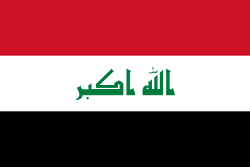 Flag of Iraq with the Takbir written on it
 -
 Flag of Saudi Arabia with the Shahada written on it
 -
 Flag of Afghanistan with the Shahada written on it
 -
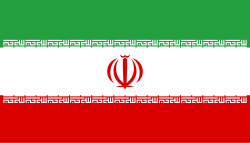 Flag of Iran with the Takbir written on it


See also
[edit]References
[edit]- ^ "Allah". Random House Webster's Unabridged Dictionary.
- ^ "Allah". Oxford Learner's Dictionaries.
- ^ "Definition of ALLAH". www.merriam-webster.com. 18 March 2024. Retrieved 8 April 2024.
- ^ "God". Islam: Empire of Faith. PBS. Archived from the original on 27 March 2014. Retrieved 18 December 2010.
- ^ "Islam and Christianity", Encyclopedia of Christianity (2001): Arabic-speaking Christians and Jews also refer to God as Allāh.
- ^ Gardet, L. "Allah". In Bearman, P.; Bianquis, Th.; Bosworth, C.E.; van Donzel, E.; Heinrichs, W.P. (eds.). Encyclopaedia of Islam Online. Brill Online. Retrieved 2 May 2007.
- ^ Merriam-Webster. "Allah". Merriam-Webster. Archived from the original on 20 April 2014. Retrieved 25 February 2012.
- ^ Zeki Saritoprak (2006). "Allah". In Oliver Leaman (ed.). The Qur'an: An Encyclopedia. Routledge. p. 34. ISBN 978-0-415-32639-1.
- ^ Vincent J. Cornell (2005). "God: God in Islam". In Lindsay Jones (ed.). Encyclopedia of Religion. Vol. 5 (2nd ed.). MacMillan Reference USA. p. 724.
- ^ a b c d Christian Julien Robin (2012). Arabia and Ethiopia. In The Oxford Handbook of Late Antiquity. OUP USA. pp. 304–305. ISBN 978-0-19-533693-1.
- ^ a b Anthony S. Mercatante & James R. Dow (2004). "Allah". The Facts on File Encyclopedia of World Mythology and Legend. Facts on File. p. 53. ISBN 978-1-4381-2685-2.
- ^ a b c d e f "Allah." Encyclopædia Britannica. 2007. Encyclopædia Britannica
- ^ a b c d Encyclopedia of the Modern Middle East and North Africa, Allah
- ^ Willis Barnstone, Marvin Meyer The Gnostic Bible: Revised and Expanded Edition Shambhala Publications 2009 ISBN 978-0-8348-2414-0 page 531
- ^ Carl Skutsch (2005). Encyclopedia of the World's Minorities. Routledge. p. 480.
- ^ a b c D.B. Macdonald. Encyclopedia of Islam, 2nd ed, Brill. "Ilah", Vol. 3, p. 1093.
- ^ Sinai, Nicholas (2019). Rain-Giver, Bone-Breaker, Score-Settler: Allāh in Pre-Quranic Poetry. Atlanta, GA: American Oriental Society. p. 7. ISBN 978-1-948488-25-9.
- ^ Al-Jallad 2025, p. 2.
- ^ Al-Jallad 2025, p. 3–4.
- ^ Gerhard Böwering. Encyclopedia of the Quran, Brill, 2002. Vol. 2, p. 318
- ^ Reynolds, Gabriel Said (2020). Allah: God in the Qur'an. New Haven: Yale university press. p. 14. ISBN 978-0-300-24658-2.
- ^ Sinai, Nicholas (2019). Rain-Giver, Bone-Breaker, Score-Settler: Allāh in Pre-Quranic Poetry. Atlanta, GA: American Oriental Society. p. 8. ISBN 978-1-948488-25-9.
- ^ Kiltz, David. "The Relationship between Arabic Allāh and Syriac Allāha." Der Islam 88.1 (2012): 47.
- ^ Ibrahim, Zakyi. "To Use 'God' or 'Allah'?". American Journal of Islam and Society 26.4 (2009): v.
- ^ ibn ʿUmar al-Baydawi, ʿAbd Allah (2016). The Lights Of Revelation And The Secrets Of Interpretation. Translated by Haddad, Gibril Fouad. Beacon Books and Media Limited. ISBN 978-0-9926335-7-8.
- ^ Columbia Encyclopaedia says: Derived from an old Semitic root referring to the Divine and used in the Canaanite El, the Mesopotamian ilu, and the biblical Elohim and Eloah, the word Allah is used by all Arabic-speaking Muslims, Christians, Jews, and other monotheists.
- ^ The Comprehensive Aramaic Lexicon – Entry for ʼlh Archived 18 October 2013 at the Wayback Machine
- ^ Hitti, Philip Khouri (1970). History of the Arabs. Palgrave Macmillan. pp. 100–101.
- ^ Marshall G. S. Hodgson, The Venture of Islam: Conscience and History in a World Civilization, University of Chicago Press, p. 156
- ^ a b M. A. Kugener, "Nouvelle Note Sur L'Inscription Trilingue De Zébed", Rivista Degli Studi Orientali, pp. 577-586.
- ^ Adolf Grohmann, Arabische Paläographie II: Das Schriftwesen und die Lapidarschrift (1971), Wien: Hermann Böhlaus Nochfolger, Page: 6-8
- ^ Beatrice Gruendler, The Development of the Arabic Scripts: From the Nabatean Era to the First Islamic Century according to Dated Texts (1993), Atlanta: Scholars Press, Page:
- ^ James Bellamy, "Two Pre-Islamic Arabic Inscriptions Revised: Jabal Ramm and Umm al-Jimal", Journal of the American Oriental Society, 108/3 (1988) pp. 372–378 (translation of the inscription) "This was set up by colleagues/friends of ʿUlayh, the son of ʿUbaydah, secretary/adviser of the cohort Augusta Secunda Philadelphiana; may he go mad/crazy who effaces it."
- ^ Enno Littmann, Arabic Inscriptions (Leiden, 1949)
- ^ Daniels, Peter T. (2014). The Type and Spread of Arabic Script.
- ^ Irfan Shahîd, Byzantium and the Arabs in the Fourth Century, Dumbarton Oaks Trustees for Harvard University-Washington DC, page 418.
- ^ Irfan Shahîd, Byzantium and the Arabs in the Fourth Century, Dumbarton Oaks Trustees for Harvard University-Washington DC, Page: 452
- ^ A. Amin and A. Harun, Sharh Diwan Al-Hamasa (Cairo, 1951), Vol. 1, Pages: 478-480
- ^ Al-Marzubani, Mu'jam Ash-Shu'araa, Page: 302
- ^ IslamKotob. Tafsir Ibn Kathir all 10 volumes. IslamKotob.
- ^ a b L. Gardet, Allah, Encyclopaedia of Islam, ed. by Sir H.A.R. Gibb
- ^ Zeki Saritopak, Allah, The Qu'ran: An Encyclopedia, ed. by Oliver Leaman, p. 34
- ^ a b Gerhard Böwering, God and his Attributes, Encyclopedia of the Qur'an, ed. by Jane Dammen McAuliffe
- ^ a b Jonathan Porter Berkey (2003). The Formation of Islam: Religion and Society in the Near East, 600-1800. Cambridge University Press. p. 42. ISBN 978-0-521-58813-3.
- ^ Daniel C. Peterson (26 February 2007). Muhammad, Prophet of God. Wm. B. Eerdmans Publishing. p. 21. ISBN 978-0-8028-0754-0.
- ^ a b Francis E. Peters (1994). Muhammad and the Origins of Islam. SUNY Press. p. 107. ISBN 978-0-7914-1875-8.
- ^ Irving M. Zeitlin (19 March 2007). The Historical Muhammad. Polity. p. 33. ISBN 978-0-7456-3999-4.
- ^ The Treasury of literature, Sect. 437
- ^ The Beginning of History, Volume 3, Sect.10
- ^ The Collection of the Speeches of Arabs, volume 1, section 75
- ^ a b Böwering, Gerhard, God and His Attributes, Encyclopaedia of the Qurʼān, Brill, 2007.
- ^ F.E. Peters, Islam, p.4, Princeton University Press, 2003
- ^ a b c d e Thomas, Kenneth J. "Allah in Translations of the Bible." The Bible Translator 52.3 (2001): 301-306.
- ^ a b c Ibrahim, Zakyi. "To Use "God" or "Allah"?." American Journal of Islam and Society 26.4 (2009): i-vii.
- ^ a b Bentley, David (September 1999). The 99 Beautiful Names for God for All the People of the Book. William Carey Library. ISBN 978-0-87808-299-5.
- ^ Murata, Sachiko (1992). The Tao of Islam: a sourcebook on gender relationships in Islamic thought. Albany NY USA: SUNY. ISBN 978-0-7914-0914-5.
- ^ "The Quranic Arabic Corpus - Translation". corpus.quran.com. Retrieved 11 April 2021.
- ^ "112. Surah Al-Ikhlaas or At-Tauhid – NobleQuran.com". Retrieved 11 April 2021.
- ^ "The Quranic Arabic Corpus - Translation". corpus.quran.com. Retrieved 30 March 2021.
- ^ "The Quranic Arabic Corpus - Translation". corpus.quran.com. Retrieved 30 March 2021.
- ^ "Surah Al-Baqarah - Ayatul Kursi". Quran.com. Retrieved 24 February 2025.
- ^ Arabic script in Unicode symbol for a Quran verse, U+06DD, page 3, Proposal for additional Unicode characters
- ^ Sale, G AlKoran
- ^ Carl W. Ernst, Bruce B. Lawrence, Sufi Martyrs of Love: The Chishti Order in South Asia and Beyond, Macmillan, p. 29
- ^ Andreas Görke and Johanna Pink Tafsir and Islamic Intellectual History Exploring the Boundaries of a Genre Oxford University Press in association with The Institute of Ismaili Studies London ISBN 978-0-19-870206-1 p. 478
- ^ Gary S. Gregg, The Middle East: A Cultural Psychology, Oxford University Press, p.30
- ^ Carolyn Fluehr-Lobban, Islamic Society in Practice, University Press of Florida, p. 24
- ^ M. Mukarram Ahmed, Muzaffar Husain Syed, Encyclopaedia of Islam, Anmol Publications PVT. LTD, p. 144
- ^ Lewis, Bernard; Holt, P. M.; Holt, Peter R.; Lambton, Ann Katherine Swynford (1977). The Cambridge history of Islam. Cambridge, Eng: University Press. p. 32. ISBN 978-0-521-29135-4.
- ^ a b Thomas E. Burman, Religious Polemic and the Intellectual History of the Mozarabs, Brill, 1994, p. 103
- ^ "How do you pronounce "Allah" (الله) correctly?". ARABIC for NERDS. 16 June 2018. Archived from the original on 17 June 2018. Retrieved 16 June 2018.
- ^ William Montgomery Watt, Islam and Christianity today: A Contribution to Dialogue, Routledge, 1983, p.45
- ^ "ojalá". Diccionario de la lengua española (in Spanish) (23.6 electronic ed.). Real Academia Española - ASALE. 2022. Retrieved 24 April 2023.
- ^ Islam in Luce López Baralt, Spanish Literature: From the Middle Ages to the Present, Brill, 1992, p.25
- ^ F. E. Peters, The Monotheists: Jews, Christians, and Muslims in Conflict and Competition, Princeton University Press, p.12
- ^ Example: Usage of the word "Allah" from Matthew 22:32 in Indonesian bible versions (parallel view) as old as 1733 Archived 19 October 2013 at the Wayback Machine
- ^ The Indonesian Language: Its History and Role in Modern Society Sneddon, James M.; University of New South Wales Press; 2004
- ^ The History of Christianity in India from the Commencement of the Christian Era: Hough, James; Adamant Media Corporation; 2001
- ^ Wiltens, Caspar; Heurnius, Justus (1650). Justus Heurnius, Albert Ruyl, Caspar Wiltens. "Vocabularium ofte Woordenboeck nae ordre van den alphabeth, in 't Duytsch en Maleys". 1650:65. Archived from the original on 22 October 2013. Retrieved 14 January 2014.
- ^
But compare:
Milkias, Paulos (2011). "Ge'ez Literature (Religious)". Ethiopia. Africa in Focus. Santa Barbara, California: ABC-CLIO. p. 299. ISBN 978-1-59884-257-9. Retrieved 15 February 2018.
Monasticism played a key role in the Ethiopian literary movement. The Bible was translated during the time of the Nine Saints in the early sixth century [...].
- ^ Barton, John (2002–12). The Biblical World, Oxford, UK: Routledge. ISBN 978-0-415-27574-3.
- ^ North, Eric McCoy; Eugene Albert Nida ((2nd Edition) 1972). The Book of a Thousand Tongues, London: United Bible Societies.
- ^ "Sejarah Alkitab Indonesia / Albert Conelisz Ruyl". sejarah.sabda.org.
- ^ "Encyclopædia Britannica: Albert Cornelius Ruyl". Britannica.com. Archived from the original on 19 October 2013. Retrieved 14 January 2014.
- ^ Roughneen, Simon (14 October 2013). "No more 'Allah' for Christians, Malaysian court says". The Christian Science Monitor. Retrieved 14 October 2013.
- ^ "BBC News - More than 300 Bibles are confiscated in Malaysia". BBC. 2 January 2014. Archived from the original on 25 January 2014. Retrieved 14 January 2014.
- ^ a b "Catholic priest should respect court: Mahathir". Daily Express. 9 January 2014. Archived from the original on 10 January 2014. Retrieved 10 January 2014.
- ^ Jane Moh; Peter Sibon (29 March 2014). "Worship without hindrance". The Borneo Post. Archived from the original on 29 March 2014. Retrieved 29 March 2014.
- ^ a b c Idris Jala (24 February 2014). "The 'Allah'/Bible issue, 10-point solution is key to managing the polarity". The Star. Retrieved 25 June 2014.
- ^ Sikhs target of 'Allah' attack, Julia Zappei, 14 January 2010, The New Zealand Herald. Accessed on line 15 January 2014.
- ^ Malaysia court rules non-Muslims can't use 'Allah', 14 October 2013, The New Zealand Herald. Accessed on line 15 January 2014.
- ^ Malaysia's Islamic authorities seize Bibles as Allah row deepens, Niluksi Koswanage, 2 January 2014, Reuters. Accessed on line 15 January 2014. [1]
- ^ "Bahasa Malaysia Bibles: The Cabinet's 10-point solution". 25 January 2014.
- ^ "Najib: 10-point resolution on Allah issue subject to Federal, state laws". The Star. 24 January 2014. Retrieved 25 June 2014.
- ^ "Zebed Inscription: A Pre-Islamic Trilingual Inscription In Greek, Syriac & Arabic From 512 CE". Islamic Awareness. 17 March 2005.
- ^
- Arabic fonts and Mac OS X Archived 10 March 2008 at the Wayback Machine
- Programs for Arabic in Mac OS X Archived 6 October 2013 at the Wayback Machine
- ^ "Scheherazade New". SIL International. Retrieved 4 February 2022.
- ^ Unicode of Allah https://unicodeplus.com/U+FDF2
- ^ UnicodeThe Unicode Consortium. FAQ - Middle East Scripts Archived 1 October 2013 at the Wayback Machine
- ^ "Unicode Standard 5.0, p.479, 492" (PDF). Archived from the original (PDF) on 28 April 2014. Retrieved 14 January 2014.
- ^ Farsi Unicode
General and cited references
[edit]- Al-Jallad, Ahmad (2025). "Ancient Allah: An Epigraphic Reconstruction". Journal of Semitic Studies: 1–56.
- Nasr, Seyyed Hossein; Dagli, C.K.; Dakake, Maria Massi; Lumbard, J.E.B.; Rustom, M., eds. (2015). The Study Quran: A New Translation and Commentary. Harper Collins. ISBN 978-0-06-222762-1.
- The Unicode Consortium, Unicode Standard 5.0, Addison-Wesley, 2006, ISBN 978-0-321-48091-0, About the Unicode Standard Version 5.0 Book
Further reading
[edit]Online
[edit]- Allah Qur'ān, in Encyclopædia Britannica Online, by Asma Afsaruddin, Brian Duignan, Thinley
External links
[edit] Media from Commons
 Quotations from Wikiquote
 Data from Wikidata


- Names of Allah with Meaning on Website, Flash, and Mobile Phone Software
- Concept of God (Allah) in Islam
- The Concept of Allāh According to the Qur'an by Abdul Mannan Omar
- Allah, the Unique Name of God
- Typography
Islam topics | |||||||||||||
|---|---|---|---|---|---|---|---|---|---|---|---|---|---|
| |||||||||||||
| |||||||||||||
| |||||||||||||
| |||||||||||||

| International | |
|---|---|
| Other | |

Allah
View on GrokipediaLinguistic and Etymological Origins
Etymology and Derivation
The word Allāh (Arabic: ٱللَّٰهُ) is derived from the contraction of the Arabic phrase al-ilāh (الإله), where al- is the definite article "the" and ilāh means "deity" or "god," literally rendering "the God" or "the deity."[2] This contraction occurred through the assimilation of the l sound in al- to the initial l of ilāh, with the glottal stop (hamza) in ilāh dropping in pronunciation, a common phonological process in Arabic known as idgham (assimilation).[8] The resulting form Allāh functions as a proper name rather than a generic noun, distinct from the inflectable ilāh used for gods in general, and its earliest attestations appear in pre-Islamic Arabic contexts as a title for a supreme creator deity.[9] Linguistically, Allāh traces to the Proto-Semitic root ʾil-, denoting divinity or power, shared across Semitic languages.[8] Cognates include Aramaic ʾAlāhā (ܐܠܗܐ), used in Syriac Christian texts for God; Hebrew ʾĒl (אֵל) and ʾĔlōhīm (אֱלֹהִים), referring to God or gods; Ugaritic ʾil; and Akkadian ilu.[2] These derivations reflect a common Northwest Semitic heritage, where the root evolved to signify a singular, transcendent divine entity in Arabic usage, though pre-Islamic Arabs applied Allāh alongside polytheistic deities as a high god figure.[4] Debates persist among linguists regarding the exact mechanism: while the al-ilāh contraction is the dominant theory supported by comparative Semitics, some argue Allāh entered Arabic directly as a loan from Aramaic ʾalāhā via Christian or Jewish Aramaic speakers in the Arabian Peninsula, bypassing full contraction.[9] Epigraphic evidence, such as Nabataean and South Arabian inscriptions from the 1st century CE onward, attests forms akin to Allāh as a divine name, predating Islam by centuries and confirming its non-exclusive Islamic origin. Alternative folk etymologies, like deriving it from alaha ("to worship," implying "the worshipped one"), lack robust philological support and appear in later theological interpretations rather than historical linguistics.[10]Pre-Islamic Linguistic Evidence
Pre-Islamic inscriptions in North Arabian scripts, such as Safaitic, provide the earliest linguistic attestation of Allāh as a proper name for a high deity among nomadic Arabs in the Syro-Jordanian Ḥarrah region, dating from the 1st century BCE to the 4th century CE. These graffiti, numbering in the thousands, often invoke Allāh (lh or ʾl-lh in epigraphic form) alongside other deities, portraying it as a remote creator associated with light and opposition to death and darkness, as seen in a Safaitic text requesting Allāh to "let there be light" against existential threats. Scholarly analysis by epigraphist Ahmad Al-Jallad reconstructs Allāh's mythology from such carvings, confirming its worship across pre-Islamic Arabia, though texts prior to recent finds offered limited theological detail.[11] The Zabad inscription from northern Syria, dated to 512 CE, exemplifies transitional usage in a Christian context, commencing with b-سمʾ al-ʾlh ("in the name of al-ilāh"), where al-ilāh ("the deity") functions as a descriptor for God amid benefactions by Arabic-speaking Christians. This trilingual (Greek, Syriac, Arabic) text over a martyrium door reflects al-ilāh as a reverential formula, bridging Semitic cognates like Syriac Alāhā with emerging Arabic proper nomenclature, and predates Islamic standardization by over a century. Similarly, the Dumat al-Jandal inscription circa 548 CE employs al-ilāh in a theophoric phrase, indicating its role as a divine epithet among pre-Islamic Arabs influenced by monotheistic communities.[13][14] Theophoric names incorporating Allāh, such as ʿbd-ʾlh ("servant of Allāh"), appear in pre-Islamic onomastics across Nabataean and Safaitic corpora, evidencing its integration into personal nomenclature as early as the 1st century CE, distinct from generic ilāh ("god"). While polytheistic invocations pair Allāh with figures like Allāt or al-Uzzā, epigraphic patterns suggest a hierarchical supremacy, with Allāh invoked for cosmic intervention rather than local concerns. Concrete material evidence remains sparse relative to later Islamic texts, but these linguistic traces affirm Allāh as a pre-existing Arabic term for the paramount deity, not coined by Muhammad.[15][16]Aramaic and Semitic Roots
The word Allāh in Arabic originates from the contraction of al-ilāh ("the deity"), where ilāh derives from the Proto-Semitic root ʾil-, denoting "god" or "deity," a term attested across ancient Semitic languages including Akkadian ilu, Ugaritic ʾil, and Phoenician ʾl.[17] This root, reconstructed from comparative linguistics of Northwest and East Semitic inscriptions dating to the 2nd millennium BCE, such as those from Ebla and Ugarit, represents a generic descriptor for divine beings rather than a proper name, evolving into specific forms for the supreme god in later traditions.[18] In Aramaic, a Northwest Semitic language closely related to Arabic and spoken widely in the Near East from the 10th century BCE onward, the cognate term is ʾilāh or ʾalāhā (ܐܠܗܐ in Syriac script, pronounced approximately "a-LAA-ha"), used for "God" in biblical and liturgical texts, as seen in the Aramaic portions of the Book of Daniel (e.g., Daniel 2:47, rendering ʾĕlāh for the divine).[19] This form parallels Allāh phonetically and morphologically, with the Aramaic emphatic state ʾilāhā mirroring the Arabic definite article assimilation, reflecting shared Proto-Semitic morphology where the root ʾ-l-h or ʾ-l extends the basic ʾil- to emphasize singularity or uniqueness.[20] Linguistic evidence from Syriac Christian texts, such as the Peshitta translation of the Bible completed by the 5th century CE, consistently employs Alāhā for the Hebrew ʾĕlōhīm, underscoring the term's pre-Islamic continuity in monotheistic Aramaic-speaking communities adjacent to Arabia.[9] Comparative Semitic studies highlight that while Allāh incorporates the Arabic definite article al-, its core aligns with Aramaic Alāhā without implying direct borrowing; instead, both descend independently from the common ancestral root, as confirmed by reconstructed Proto-Semitic paradigms avoiding anachronistic derivations like Arabic-to-Aramaic influence given Aramaic's earlier attestation in epigraphy.[21] This etymological linkage, supported by phonological correspondences (e.g., retention of the laryngeal ḥ in emphatic forms), demonstrates Allāh's embedding in a millennia-old Semitic divine nomenclature, distinct from later theological accretions.[22]Historical Development
Pre-Islamic Arabia
In pre-Islamic Arabia, during the period known as Jahiliyyah spanning roughly the 5th to 7th centuries CE, polytheistic practices predominated among Arab tribes, yet Allah was widely recognized as the supreme creator deity presiding over a pantheon of lesser gods, goddesses, and spirits. Tribes invoked Allah in oaths and poetry as the ultimate arbiter of fate, rain, and victory, viewing him as distant yet sovereign, with lesser deities serving as intercessors rather than equals.[23][24] This henotheistic framework is evidenced in pre-Islamic Arabic poetry, where poets like Zuhayr ibn Abi Sulma (ca. 520–609 CE) praised Allah as the "Lord of the Kaaba" and controller of human affairs, distinct from idol worship.[24] Archaeological inscriptions provide direct attestation of Allah's veneration. North Arabian graffiti in Safaitic and Hismaic scripts from the 1st to 4th centuries CE mention Allah alongside invocations for protection or curses, portraying him as a high god associated with creation and light, as in an early inscription linking him to cosmic origins far from Mecca.[25] A late 2nd-century CE inscription explicitly references Allah without shared shrines for other deities, indicating localized monolatrous worship.[26] Proto-Arabic inscriptions from the mid-6th century CE, such as one from al-Jawf, blend Christian elements with Allah's name, suggesting continuity in usage among Arabic-speaking communities before Islam's emergence.[27] In Mecca, the Quraysh tribe—dominant by the late 6th century CE—associated the Kaaba with Allah as its "Lord," though the sanctuary housed up to 360 idols, including Hubal as a prominent effigy for divination and oaths. Following their victory in the Battle of Fijar (ca. 565 CE), the Quraysh adopted the title ahl Allah ("people of Allah"), reflecting his elevated status amid pilgrimage rituals that mixed supplications to him with offerings to subordinate entities like al-Lat, al-Uzza, and Manat, whom polytheists regarded as his "daughters."[28] Names like Abdullah (servant of Allah), borne by Muhammad's father in the late 6th century CE, underscore Allah's pre-Islamic prominence among Quraysh elites. This pre-Islamic conception of Allah emphasized his transcendence and role in natural phenomena, such as sending rain or determining tribal success, but lacked exclusive worship, as Arabs sought mediation through idols and sacred stones for proximate needs.[23] Scholarly analysis of these sources highlights Allah's distinction from lunar or astral deities claimed in some polemical accounts, with epigraphic evidence favoring a creator-god profile rooted in Semitic traditions rather than syncretic paganism.[25][29]Early Islamic Period
In the early Islamic period, spanning the prophethood of Muhammad from 610 CE to the establishment of the Umayyad Caliphate around 661 CE, the concept of Allah crystallized through Quranic revelations as the singular, transcendent creator and sovereign of the universe, rejecting pre-Islamic associations of partners or progeny with Him. The first revelation in 610 CE in the Cave of Hira commanded Muhammad to "Recite in the name of your Lord who created," positioning Allah as the originator of humanity from a clot of blood and emphasizing His creative agency without intermediaries.[30] Subsequent Meccan surahs, revealed between 610 and 622 CE amid opposition from polytheistic tribes, repeatedly affirmed Allah's oneness (tawhid), as in Surah Al-Ikhlas (Quran 112): "Say: He is Allah, the One and Only; Allah, the Eternal, Absolute; He begetteth not, nor is He begotten; And there is none like unto Him," directly countering claims of divine daughters like al-Lat, al-Uzza, and Manat attributed to Allah in pre-Islamic lore. This doctrinal shift enforced exclusive worship, prohibiting intercession by lesser beings and framing Allah as the "Lord of the Worlds" (Rabb al-Alamin), a title underscoring universal dominion over creation in six days, including heavens, earth, and what lies between.[30][31] Quranic theology portrayed Allah with attributes of mercy (rahman and rahim, invoked in nearly every surah's opening), justice, and omniscience, while early Medinan revelations post-622 CE integrated communal practices like the five daily prayers directed solely to Allah, redirecting the Kaaba from idolatrous veneration to monotheistic focus.[31] Hadith attributed to Muhammad, such as those in Sahih Bukhari, depict Allah's primordial existence before creation: "First of all, there was nothing but Allah, and (then He created His Throne). His throne was over the water," aligning with Quranic cosmogony and reinforcing anthropomorphic restraint by avoiding physical form while ascribing actions like writing destinies in a heavenly book.[32] These traditions, orally transmitted initially and later compiled, supported the rejection of corporealism, though some early narrations suggest interpretive flexibility later formalized in theological schools. The Rashidun Caliphs (632–661 CE), succeeding Muhammad, upheld this framework during rapid expansions into Byzantine and Sasanian territories, where Allah was proclaimed as the God of Abraham, Moses, and Jesus, sans trinitarian divisions, fostering conversions through military and missionary efforts without altering core attributes.[33] Scholarly analyses note that while the Quran's 2,698 invocations of Allah dwarf other names like "Lord" (al-Rabb, 980 times), this emphasis served to unify disparate Arabian tribes under a non-tribal deity, though academic debates persist on whether early understandings incorporated residual Semitic influences or purely revelatory innovation.[31]Medieval and Modern Usage
In medieval Islamic scholarship, the term Allah served as the definitive proper name for the monotheistic deity in theological, philosophical, and mystical texts, emphasizing attributes like absolute unity (tawhid) and transcendence. Theologians of the Ash'arite school, founded by Abu al-Hasan al-Ash'ari (d. 936 CE), employed Allah to articulate a defense against Mu'tazilite rationalism, positing that divine attributes—such as speech and knowledge—are eternal realities subsisting in Allah's essence without compromising unity, as evidenced in al-Ash'ari's Kitab al-Luma'. This framework influenced subsequent kalam (speculative theology), where Allah denoted a being whose will overrides secondary causes, countering Aristotelian influences.[34] Philosophers integrated Allah into metaphysical systems; Ibn Sina (Avicenna, 980–1037 CE) described Allah as wajib al-wujud (Necessary Existent), whose self-subsistent essence necessitates the emanation of intellects and the universe in a hierarchical chain, without temporal creation, as detailed in his Al-Shifa'. This view portrayed Allah's knowledge as encompassing universals rather than particulars, sparking debates on divine omniscience. Al-Ghazali (1058–1111 CE) critiqued this in Tahafut al-Falasifa (Incoherence of the Philosophers), arguing that emanation implies necessity over volition, violating Quranic depictions of Allah's free acts like creating the world in six days; he advocated occasionalism, where Allah directly sustains every event, rendering natural laws illusory.[34] Such discourses solidified Allah's usage as a referent for an omnipotent, willful entity beyond rational deduction alone.[34] In Sufi traditions, medieval authors like al-Ghazali in Ihya' Ulum al-Din (Revival of Religious Sciences, c. 1106 CE) invoked Allah in practices of remembrance (dhikr) and spiritual ascent, portraying divine nearness through love and annihilation of self (fana), while warning against pantheistic conflations.[35] This mystical dimension expanded Allah's literary role in poetry and hagiography, as in Jalaluddin Rumi's Masnavi (13th century), where Allah symbolizes the beloved whose attributes manifest in creation yet remain inscrutable. In the modern period (post-18th century), Allah retains its centrality in Islamic orthodoxy, appearing in foundational creeds like the Shahada and over 2,700 Quranic mentions, with usage standardized in global liturgy, education, and media. Reformists such as Muhammad Abduh (1849–1905) reaffirmed Allah's rational compatibility with science, interpreting attributes like omnipotence as harmonious with causality, countering colonial-era secularism while upholding scriptural primacy over medieval philosophy.[34] Salafi movements, revived by Muhammad ibn Abd al-Wahhab (1703–1792), emphasize literal adherence to early sources, rejecting interpretive liberties (ta'wil) in Allah's names to preserve transcendence, influencing Saudi curricula and Wahhabi theology that views anthropomorphism as innovation (bid'ah).[36] Legal controversies highlight contested exclusivity; in Malaysia, a 1986 government directive barred non-Muslims from using Allah in publications to prevent doctrinal confusion, upheld by a 2014 appeals court ruling (4–1) that Allah denotes the Islamic deity with specific attributes like indivisibility, citing 10 Quranic verses and risks to Muslim youth amid rising conversions.[37] [38] This reflects broader modern assertions in some jurisdictions that Allah encapsulates tawhid-exclusive theology, distinct from trinitarian concepts, though linguistically derived from al-ilah (the deity).[8] In digital and political spheres, Allah features in state symbols (e.g., Saudi flag's Shahada since 1973) and Islamist rhetoric, underscoring its role in identity amid globalization.[37]Theological Attributes in Islam
Core Concept of Tawhid
Tawhid, derived from the Arabic root wahhada meaning "to make one" or "to unify," constitutes the foundational doctrine of Islamic theology, asserting the absolute oneness and uniqueness of Allah as the sole deity worthy of worship, devoid of partners, offspring, or equals. This concept permeates the Quran, with Surah Al-Ikhlas (112:1-4) encapsulating it succinctly: "Say, 'He is Allah, [who is] One, Allah, the Eternal Refuge. He neither begets nor is born, Nor is there to Him any equivalent.'"[39] Tawhid rejects any form of division in divine essence, action, or authority, positioning it as the antithesis to polytheism and associationism (shirk), which the Quran deems the gravest sin, unforgivable if unrepented (Quran 4:48).[40] Theological expositions divide Tawhid into three interconnected categories to delineate its implications. Tawhid al-Rububiyyah affirms Allah's exclusive lordship over creation, sustenance, and control of the universe, recognizing Him as the sole originator, provider, and sovereign without intermediaries in these domains (Quran 2:255).[41] Tawhid al-Uluhiyyah mandates directing all acts of worship—such as prayer, supplication, and sacrifice—exclusively to Allah, prohibiting devotion to idols, saints, or other entities as observed in pre-Islamic Arabian practices.[42] Tawhid al-Asma wa al-Sifat requires affirming Allah's names and attributes as revealed in the Quran and authentic prophetic traditions, without anthropomorphism, negation, or analogy, such as His being the All-Knowing (Alim) and Most Merciful (Rahman) in their transcendent sense (Quran 7:180).[43] This tripartite framework underscores Tawhid's causal primacy in Islamic worldview, where deviation constitutes shirk, undermining monotheistic purity and leading to existential fragmentation. Quranic verses repeatedly warn against shirk's nullification of righteous deeds (Quran 39:65), emphasizing Tawhid's role in orienting human purpose toward singular divine submission. Scholarly consensus, as in classical texts like Ibn Taymiyyah's works, holds that incomplete Tawhid—such as affirming lordship while venerating intermediaries—invalidates faith, reflecting empirical observations of polytheistic dilutions in Abrahamic traditions.[44][45]The 99 Names and Attributes
In Islamic theology, the 99 Names of Allah, referred to as Al-Asma al-Husna (the Most Beautiful Names), represent specific attributes and qualities ascribed to God as revealed in the Quran and authenticated hadiths.[46] These names encapsulate divine essence, emphasizing uniqueness (tawhid) and serving as a framework for believers to comprehend and invoke Allah's nature without anthropomorphism. The Quran states, "And to Allah belong the best names, so invoke Him by them," (Quran 7:180), underscoring their role in worship and supplication.[47] A foundational hadith narrated by Abu Huraira reports the Prophet Muhammad stating, "Allah has ninety-nine names, one-hundred minus one; and he who memorized them all by heart will enter Paradise. Verily, Allah is Witr (One) and loves Al-Witr (i.e., odd numbers)." This narration appears in Sahih al-Bukhari (hadith 7392) and is graded authentic (sahih), though scholars interpret "memorized" or "knows" (ahsa-ha) as encompassing not mere rote learning but understanding, reflection, and application in conduct, as isolated memorization alone does not guarantee salvation absent faith and deeds.[47][48][49] The compilation of these names draws from Quranic verses—approximately 80% directly referenced—and prophetic traditions, with no single canonical list in the Quran itself; variations exist across early sources like those of al-Tirmidhi and Ibn Majah, but a standard enumeration emerged through scholarly consensus (ijma).[46] They are grouped thematically: names of majesty (jalal), such as Al-Qadir (The All-Powerful) and Al-Aziz (The Mighty); names of beauty (jamal), like Ar-Rahman (The Most Gracious) and Al-Ghafur (The All-Forgiving); and essential attributes affirming eternity and self-sufficiency, such as Al-Awwal (The First) and Al-Akhir (The Last). Recitation of these names is prescribed in daily prayers (salah) and dhikr, believed to foster spiritual proximity and protection, as per traditions linking specific names to outcomes like relief from distress (Al-Fattah, The Opener).[50]| Name (Arabic) | Transliteration | Meaning | Quranic Reference Example |
|---|---|---|---|
| الرَّحْمَٰنُ | Ar-Rahman | The Most Gracious | Quran 1:1 |
| الرَّحِيمُ | Ar-Rahim | The Most Merciful | Quran 1:3 |
| الْمَلِكُ | Al-Malik | The Sovereign | Quran 59:23 |
| الْقُدُّوسُ | Al-Quddus | The Most Holy | Quran 59:23 |
| السَّلَامُ | As-Salam | The Source of Peace | Quran 59:23 |
Relationship to Creation and Prophecy
In Islamic theology, Allah is affirmed as the sole originator and sustainer of the universe, creating all existence through his divine command without pre-existing material. The Quran states, "Originator of the heavens and the earth. When He decrees a matter, He only says to it, 'Be,' and it is," emphasizing creation ex nihilo as an act of willful decree rather than mechanistic process. This is reiterated in descriptions of Allah as Al-Khaliq (The Creator), who fashions the cosmos, heavens, earth, and all life forms in measured stages, such as forming humans from clay and stages of embryonic development before perfecting them. Such accounts underscore Allah's absolute sovereignty over creation, where contingency of the universe—its fine-tuned constants and origin from a singular point—serves as rational signs (ayat) pointing to a purposeful intelligent cause, though Islamic doctrine prioritizes revelatory knowledge over empirical deduction alone for affirming the creator.[53] The relationship extends to prophecy as Allah's mechanism for directing creation toward its purpose: recognition of the creator and submission (islam). Prophets are selected humans chosen by Allah to receive revelation (wahy), conveying monotheism, moral guidance, and warnings of accountability, thereby bridging the creator's will with human agency. The Quran describes this chain beginning with Adam, whom Allah created and appointed as the first prophet, through figures like Noah, Abraham, Moses, and Jesus, culminating in Muhammad as the final messenger sealing prophethood.[54] Allah equips prophets with miracles corroborating their message, such as Moses' staff turning to serpent or Muhammad's Quran as an inimitable linguistic proof, to affirm divine authorship amid human free will.[55] This prophetic office presupposes creation's teleology: humans, endowed with intellect and choice, are tested via guidance to worship the creator exclusively, with rejection leading to eschatological judgment.[56] Prophecy thus manifests Allah's attributes of mercy and justice in relation to creation, as revelation addresses humanity's innate disposition (fitrah) toward monotheism, corrupted by forgetfulness or deviation. The final revelation in the Quran integrates creation narratives—e.g., Allah's formation of the universe in six periods—with prophetic imperatives, urging reflection on cosmic order as evidence of the sender's unity and power. While some modern interpreters seek alignments with scientific cosmology, such as expansion of the universe in Quran 51:47, orthodox views maintain that prophecy's veracity rests on internal coherence and fulfilled predictions, like Muhammad's foretellings of Byzantine victory over Persians (Quran 30:2-4), rather than retrofitting empirical data.[57] This framework rejects polytheistic or naturalistic alternatives, positing prophecy as causal extension of creation: the same divine will that initiates existence sustains it through guided prophets to avert existential misdirection.[58]Comparisons with Other Abrahamic Deities
Similarities with Yahweh/Elohim
Both "Allah" and "Elohim" stem from the Proto-Semitic root *ʾil-, denoting deity or godhead, with "Allah" arising as a contraction of Arabic al-ilāh ("the god") and "Elohim" functioning as a plural form of majesty for the singular divine in Hebrew texts.[59][60] This shared linguistic heritage reflects common Northwest Semitic origins, where terms like Aramaic Elāhā and Ugaritic ʾil similarly express the concept of a supreme or generic divinity, predating distinct religious codifications.[61] Theologically, Allah and Yahweh—often titled Elohim in the Hebrew Bible—share core attributes as the singular, eternal creator of the universe, emphasizing absolute oneness (tawhid in Islam, echoed in Deuteronomy 6:4's declaration of Yahweh's uniqueness). Both are portrayed as omnipotent architects of existence, sustaining creation through divine will, as seen in Quranic verses like Surah 2:255 (Ayat al-Kursi) describing Allah's encompassing knowledge and power, paralleling biblical depictions in Isaiah 40:28 of Yahweh as the everlasting God who neither faints nor tires.[62][63] Mercy and justice form another overlap: Allah's names Ar-Rahman (the Most Merciful) and Al-Adl (the Just) align with Yahweh's self-revelation in Exodus 34:6-7 as compassionate, gracious, abounding in steadfast love, yet punishing iniquity, a framework retained in Islamic theology where divine mercy precedes wrath (hadith in Sahih al-Bukhari 7553). Both deities engage humanity through covenantal prophecy, affirming figures like Abraham, Moses, and David as messengers, with the Quran explicitly recognizing the Torah's God (e.g., Surah 5:44) as identical to Allah.[64][65] Transcendence unites them further, positioning the divine as wholly other—unbegotten and uncreated—beyond anthropomorphic limits, though accessible via revelation; this mirrors Elohim's majestic otherness in Genesis 1 and Allah's incomparability in Surah 112. Scholarly analyses of Abrahamic continuity, drawing from textual parallels, substantiate these as derivations from a shared monotheistic substrate originating in second-millennium BCE Semitic traditions.[66][67]Differences from the Christian Trinity
Islamic theology maintains that Allah is absolutely one (tawhid), without partners, divisions, or internal distinctions, in direct opposition to the Christian doctrine of the Trinity, which describes God as one essence subsisting in three co-eternal, co-equal persons: Father, Son, and Holy Spirit.[68] This Islamic insistence on divine singularity precludes any notion of plurality within God, viewing the Trinity as a form of shirk (associating others with Allah), which is the gravest sin.[69] The Quran explicitly condemns the Trinitarian formula, stating: "Those who say, 'Allah is one in a Trinity,' have certainly fallen into disbelief. There is only One God."[70] A core divergence lies in Christology: Islam regards Jesus (Isa) as a human prophet and messenger, not divine or the literal Son of God, rejecting any eternal generation or incarnation as incompatible with Allah's transcendence and uniqueness.[71] The Quran instructs: "Do not say, 'Trinity.' Stop—for your own good. Allah is only One God. Glory be to Him! He is far above having a son!"[71] In contrast, Christian doctrine affirms Jesus' divinity based on New Testament passages such as John 1:1 ("the Word was God") and his role in the Triune baptismal formula (Matthew 28:19).[72] Islamic sources interpret certain Christian sects' veneration of Mary as exacerbating this perceived polytheism, as depicted in Quran 5:116, where Allah questions Jesus about claims of divinity for himself and his mother, which Jesus denies.[73] The Holy Spirit in Islam is typically identified as the angel Jibril (Gabriel), a created being who conveys revelation, rather than a divine person co-equal with the Father and Son.[74] This contrasts with Trinitarian pneumatology, where the Spirit proceeds eternally from the Father (and Son, in Western tradition) and shares the divine nature, as implied in verses like Acts 5:3-4 equating lying to the Spirit with lying to God.[75] Consequently, Islamic soteriology emphasizes submission to Allah's oneness through the Five Pillars, without mediation by a divine Son's atonement, deeming Trinitarian salvation-through-Christ as undermining tawhid.[76] Scholarly analyses note that while both faiths claim monotheism, tawhid's rejection of personal distinctions renders Allah's relationality (e.g., creator-creature) extrinsic, unlike the Trinity's immanent eternal relations among persons.[77]Scholarly Views on Continuity vs. Divergence
Scholars generally agree that the term "Allah" derives linguistically from the Semitic root ʾ-l-h, cognate with Hebrew ʾelōhīm and Aramaic ʾalāhā, referring to a singular high deity in pre-Islamic Arabia as the creator and lord of the Kaaba, invoked in poetry and inscriptions as early as the 5th century CE.[78] This usage persisted among Arabic-speaking Jews and Christians prior to Muhammad's prophethood in 610 CE, who employed "Allah" interchangeably with biblical names for God, indicating continuity in nominal reference to the Abrahamic deity.[79] Pre-Islamic inscriptions, such as those from South Arabia dated to the 4th century BCE, further attest to "Allah" as a supreme, non-anthropomorphic creator distinct from subordinate tribal gods like Hubal or al-Lat.[80] Theological continuity is emphasized by scholars like those analyzing Quranic self-presentation, who note Islam's explicit claims to restore primordial monotheism (tawḥīd), affirming Allah as the God of Abraham, Moses, and Jesus without introducing a novel entity.[81] This view posits that divergences arise from interpretive corruptions in Judaism and Christianity—such as Trinitarianism or anthropomorphism—rather than from Allah's inherent nature, with the Quran (e.g., Surah 29:46) instructing Muslims to affirm shared origins with "People of the Book."[82] However, academic analyses of pre-Islamic poetry reveal Allah's role was often nominal or deistic, with practical worship directed toward intermediaries, suggesting Muhammad's reforms intensified rather than invented strict monotheism.[24] In contrast, divergence-focused scholarship highlights irreconcilable attributes: the biblical Yahweh exhibits relational covenantal love (ḥesed) and triune self-revelation (e.g., Matthew 28:19), absent in the Quran's portrayal of Allah as absolutely transcendent, non-relational, and voluntaristic, where divine will supersedes consistent moral essence.[83] Critics argue this yields a deity incompatible with biblical incarnation or atonement, as Allah's denial of sonship (Quran 112:3) rejects core Christian soteriology, rendering Islamic tawḥīd a unitarian reduction rather than faithful continuity.[84] Evangelical scholars, drawing on patristic distinctions, contend that erroneous conceptions equate to worshiping a different god, akin to Israelite idolatry despite nominal Yahweh claims (Exodus 32).[60] Hybrid positions acknowledge historical-linguistic continuity in referent but theological divergence in essence, as articulated in comparative theology: "yes" semantically, "no" ontologically, since divine identity hinges on self-disclosed attributes rather than etymology alone.[64] This nuance counters both uncritical interfaith equivalency—prevalent in post-Vatican II Catholic scholarship—and polemical rejections, urging evaluation via primary revelation over cultural syncretism.[85] Empirical textual analysis, including Syriac Christian influences on early Arabic Bibles, supports pre-Islamic continuity but underscores Muhammad's abrogation of prior scriptures (Quran 2:106) as a causal break.[86] Such debates persist, with source credibility varying; Western academia often favors continuity to foster dialogue, potentially underweighting doctrinal incompatibilities evident in unredacted biblical and Quranic corpora.[87]Usage Beyond Islam
In Arabic-Speaking Non-Muslims
Arabic-speaking Christians, comprising communities such as Copts in Egypt, Maronites in Lebanon, and Orthodox Christians in Syria and Jordan, routinely use "Allah" as the Arabic term for God in liturgy, prayer, and daily discourse.[88][89] This usage predates Islam, with pre-Islamic Arab Christian inscriptions and texts employing "Allah" to refer to the divine, and it persists in modern Arabic translations of the Bible, where "Allah" renders Hebrew Elohim and Greek Theos.[90] The earliest known full Arabic Bible translation, completed around the 9th century, consistently applies "Allah" for God, a convention maintained in subsequent versions distributed by organizations like the Arabic Bible Outreach Ministry.[90][91] Arabic-speaking Jews, historically present in countries like Iraq, Yemen, and Morocco before mid-20th-century migrations, similarly refer to God as "Allah" in vernacular Arabic speech and writings, including Judaeo-Arabic texts from the medieval period.[92][93] Personal names like "Abdullah" (servant of God) appear among Iraqi Jewish families as early as the 19th century, reflecting this linguistic norm without implying Islamic affiliation.[93] In contemporary contexts, such as among the small remaining Jewish communities in Tunisia or Lebanon, "Allah" functions as the standard Arabic equivalent for the God of the Hebrew Bible, often alongside Hebrew terms like Adonai in formal prayer.[94] This shared terminology arises from "Allah" deriving from the Arabic al-ilah ("the god"), a generic pre-Islamic descriptor for the supreme deity adopted across Abrahamic traditions in Arabic-speaking regions, rather than denoting theological equivalence.[89] Non-Muslims qualify it with Trinitarian or uniquely Jewish attributes to distinguish from Islamic tawhid, but legal restrictions in some Muslim-majority states, such as bans on non-Muslim use in official Arabic publications, have occasionally prompted disputes over linguistic access. Despite such tensions, empirical usage data from linguistic surveys and religious texts confirm "Allah" as the normative term among these groups, underscoring its role as a neutral Arabic lexeme for divinity unbound by creed.[95]As a Loanword in Global Languages
The term "Allah" has been incorporated as a direct loanword from Arabic into numerous non-Arabic languages, particularly in regions of Islamic influence, where it denotes the monotheistic deity due to the liturgical primacy of Arabic in Islam.[96] In Austronesian languages such as Indonesian and Malay, "Allah" entered via historical trade and conversion processes starting from the 13th century, coexisting with native terms like "Tuhan" (Lord) but dominating religious discourse.[97] Indonesian Christians, numbering around 20 million as of early 21st-century estimates, have employed "Allah" in Bible translations and worship for decades without widespread interfaith contention, reflecting pre-colonial Malay Christian usage predating modern sensitivities.[98] In Turkic languages, exemplified by Turkish "Allah," the borrowing occurred during the Islamization of Central Asian and Anatolian populations from the 8th to 15th centuries, supplanting or supplementing indigenous terms like "Tengri." Persian-influenced languages retain "Allah" alongside native "Khoda," with the Arabic form preferred in Quranic recitation and formal theology since the 7th-century Arab conquests.[99] African languages like Swahili adopted "Allah" through coastal Arab-Swahili interactions from the 10th century onward, integrating it into Bantu grammatical structures for Islamic expressions.[100] Contemporary disputes highlight varying acceptance; in Malaysia, a 2013 Federal Court ruling prohibited non-Muslims from using "Allah" in Malay-language publications, citing potential confusion despite historical precedents in Christian texts, a decision upheld to preserve Islamic exclusivity in the national context.[101] Conversely, Indonesia's pluralistic framework permits Christian usage, underscoring how geopolitical and legal factors influence loanword evolution beyond linguistics.[102] These adoptions preserve the term's phonetic and semantic integrity, avoiding translation to maintain theological precision across linguistic boundaries.Contemporary Legal and Cultural Disputes
In Malaysia, a series of court cases since the 1980s have centered on the government's prohibition of non-Muslims using the word "Allah" in Malay-language religious publications, ostensibly to avoid confusing Muslims with Christian doctrine. The Home Ministry's 1986 directive banned the term in non-Islamic contexts, leading to seizures of Bibles and other materials containing it, such as over 5,000 copies impounded in 2008 from the Catholic Herald newspaper.[103] This policy, enforced under the Printing Presses and Publications Act, reflects state efforts to reserve "Allah" exclusively for Islamic usage in the national language, amid claims by authorities that it could incite public disorder or dilute Islamic tenets.[104] A pivotal escalation occurred in 2009 when the High Court ruled in favor of the Catholic Church's Herald, granting permission to use "Allah" in its Malay section, arguing the term predates Islam and appears in pre-Islamic Arabic texts as a generic descriptor for God.[105] This decision was overturned by the Court of Appeal in 2013, which upheld the ban citing national security and public order concerns, a ruling affirmed by the Federal Court in 2014 despite appeals from Christian groups asserting violations of constitutional religious freedom.[106] The controversy intensified cultural divides, prompting protests by Islamist organizations like Perkasa and fatwas from state muftis declaring non-Muslim usage blasphemous, while Christian leaders highlighted historical Christian employment of "Allah" in Arabic and Malay Bibles dating to the 17th century.[107] Renewed litigation in the 2020s yielded mixed outcomes. In March 2021, the High Court quashed the 1986 ban in a case brought by the Sidang Injil Borneo (SIB) church in Sabah, ruling it unconstitutional and discriminatory against indigenous non-Muslim communities, thereby affirming their right to use "Allah" in worship and publications.[103] [108] The Anwar Ibrahim administration in May 2023 declined to appeal this decision, effectively conceding the point, but drew sharp criticism from Muslim NGOs and opposition parties who accused it of undermining Islamic sensitivities and called for legislative overrides.[109] As of 2025, parallel challenges persist, including a 16-year suit by another Sabah church against the ban, underscoring ongoing tensions between federal Islamic policies and minority rights in Borneo states where Christianity predominates among indigenous groups.[110] Beyond Malaysia, cultural frictions arise in Indonesia, where Christians routinely use "Allah" in Indonesian Bibles but face sporadic local disputes, such as 2010s protests against church signs employing the term and debates within evangelical circles over its theological implications.[111] These reflect broader efforts by some Muslim-majority authorities to linguistically segregate religious identities, contrasting with unrestricted usage among Arabic-speaking Christians in the Middle East. In Western contexts, disputes are rarer and non-legal, typically manifesting in academic or polemical debates over translating "Allah" in interfaith dialogues rather than outright prohibitions.[37]Controversies and Criticisms
Claims of Pagan or Lunar Deity Origins
Some critics, particularly from Christian apologetic circles, have claimed that Allah originated as a pagan deity within the polytheistic pantheon of pre-Islamic Arabia, specifically identifying him as a lunar god akin to Hubal or the Mesopotamian Sin. This theory posits that Muhammad repurposed an existing idol from the Kaaba's 360 deities, transforming a tribal moon god into the monotheistic deity of Islam. Proponents cite archaeological finds like Nabatean inscriptions from South Arabia associating "Al-ilah" (the god, basis for Allah) with astral worship, and point to the crescent moon symbol in Islamic iconography—allegedly inherited from pre-Islamic lunar cults—as supporting evidence.[112][113] However, epigraphic evidence from pre-Islamic Hijazi inscriptions, such as those dated to the 5th-6th centuries CE, demonstrates that "aḷḷāh" was invoked as the name of the supreme, creator deity without direct ties to lunar attributes or specific idols. For instance, Safaitic and Hismaic graffiti from northern Arabia, numbering in the thousands, reference Allah in oaths and invocations as a high god distinct from lesser deities, reflecting a henotheistic framework where Allah was acknowledged as transcendent while subordinate beings were venerated locally. No pre-Islamic artifacts link Allah explicitly to moon worship; Hubal, the chief idol in Mecca's Kaaba until its destruction around 630 CE, is sometimes conflated with lunar traits in later interpretations, but contemporary sources distinguish Hubal as a separate entity, possibly a warrior or rain god, not synonymous with Allah.[11][78][114] The lunar god hypothesis traces to archaeologist Hugo Winckler's 1901 speculation linking Allah to ancient Semitic astral deities, later popularized by figures like Robert Morey in the 1990s, but it has been critiqued for methodological flaws, including selective evidence and anachronistic projections of Mesopotamian pantheons onto Arabian contexts. Pre-Islamic Arabic poetry, such as verses by Umayyah ibn Abi al-Salt (died circa 615 CE), portrays Allah as the eternal, uncreated sovereign over fate and creation, predating Islam without pagan qualifiers. The Qur'an itself (e.g., Surah 53:19-23) rebukes Meccans for associating daughters with Allah while affirming his pre-existing recognition as the high god, indicating continuity rather than invention. Scholarly analyses of these texts emphasize that polytheism involved intermediary worship (shirk) alongside Allah's supremacy, not Allah's derivation from a minor pagan figure. The crescent symbol, contrary to claims, emerged in Islamic usage post-8th century under Umayyad and Ottoman influences, unrelated to pre-Islamic deity attributes.[114][24][23] While biases in academic sources—often shaped by secular or sympathetic lenses—may underplay pagan elements to favor narratives of seamless monotheistic evolution, the empirical record from inscriptions and poetry substantiates Allah's role as the Arabs' longstanding creator god, with polytheistic practices representing deviation rather than origin. Claims of strict pagan invention lack corroboration from primary artifacts and rely on interpretive overreach, whereas evidence supports a pre-Islamic conceptual foundation reformed by Islamic aniconism and tawhid.[115][116]Theological Incompatibilities with Christianity
The doctrine of tawhid, or absolute divine oneness, constitutes the foundational incompatibility between the Islamic conception of Allah and the Christian understanding of God, as Islam categorically rejects the Trinity as a form of polytheism (shirk). In Islam, Allah is a singular, indivisible entity without internal distinctions or persons, as articulated in Quran 112:1-4, which declares, "He is Allah, [who is] One, Allah, the Eternal Refuge. He neither begets nor is born, nor is there to Him any equivalent." This unitary monotheism precludes any plurality within the divine essence, viewing the Christian affirmation of one God eternally existing in three co-equal persons—Father, Son, and Holy Spirit—as associating partners with God, a grave sin.[117] In contrast, Christian theology, rooted in passages like Matthew 28:19 and 2 Corinthians 13:14, maintains that the Trinity preserves monotheism while allowing for relationality within God's being, a distinction Islam deems incompatible with true oneness.[118] A further irreconcilable divergence lies in the nature of Jesus Christ, whom Islam regards solely as a human prophet and messenger (rasul), not divine or the eternal Son of God. Quran 5:75 states, "The Messiah, son of Mary, was not but a messenger; [other] messengers have passed on before him," explicitly denying his divinity and incarnation, which Christianity affirms as essential to God's self-revelation (John 1:1, 14). Quran 4:171 reinforces this by warning Christians against saying "three," interpreting the Trinity as elevating Jesus and Mary to divine status—a portrayal critiqued by Christian scholars as a misrepresentation, since orthodox Trinitarianism involves Father, Son, and Spirit, not Mary.[71] This rejection extends to the Islamic denial of Jesus' crucifixion, central to Christian atonement theology; Quran 4:157 asserts that "they did not kill him, nor did they crucify him; but [another] was made to resemble him to them," claiming the event only appeared to occur, undermining the historical and salvific reality affirmed in the New Testament (e.g., 1 Corinthians 15:3-4) and early Christian creeds.[119] Theological incompatibilities also manifest in divergent views of divine attributes and relationality. Islamic theology often portrays Allah through divine voluntarism, where moral goodness derives solely from Allah's arbitrary will rather than an intrinsic, necessary nature—exemplified in the principle that "Allah's pleasure is the standard of the good," allowing for potentially capricious actions unbound by eternal character.[36] Christianity, conversely, depicts God as inherently loving and relational within the Trinity (1 John 4:8), where commands reflect unchanging righteousness, not mere fiat, fostering a personal covenantal bond rather than unilateral submission.[120] This contrast yields opposing soteriologies: salvation in Islam hinges on human submission (islam), monotheistic profession, good deeds outweighing sins, and Allah's discretionary mercy, without inherited original sin or need for vicarious atonement (Quran 23:102-103).[121] Christianity emphasizes justification by grace through faith in Christ's sacrificial death and resurrection alone (Ephesians 2:8-9; Romans 3:23-25), addressing universal sinfulness and imputing divine righteousness, rendering Islamic self-reliant efforts insufficient for bridging the divine-human gulf.[122] These variances preclude theological harmony, as each system deems the other's core tenets heretical.Philosophical Critiques of Divine Voluntarism
Divine voluntarism in Islamic theology, particularly as articulated by the Ash'arite school, posits that moral obligations and the distinction between good and evil derive solely from Allah's arbitrary will and commands, rather than from any independent rational or intrinsic standard.[123] This view, defended by figures like Al-Ash'ari (d. 936 CE) and Al-Ghazali (d. 1111 CE), rejects the Mu'tazilite emphasis on reason's ability to discern inherent moral properties, arguing instead that human intellect cannot apprehend good and bad absent divine revelation.[36] Critics contend this framework renders morality contingent and potentially capricious, as Allah's will could theoretically decree the opposite of observed norms without contradiction.[124] A primary philosophical challenge is the Euthyphro dilemma, adapted to the Islamic context: either Allah commands actions because they are intrinsically good, implying a moral standard transcending His will, or actions are good solely because He commands them, which invites charges of arbitrariness since divine fiat could validate atrocities like injustice or idolatry if willed.[125] Ash'arite responses often affirm the latter while invoking Allah's eternal wisdom and nature to avert pure caprice, yet detractors argue this conflates will with essence, failing to resolve the contingency: if wisdom aligns with current commands, why not future reversals, undermining moral stability?[126] Philosophers like Ibn Rushd (Averroes, d. 1198 CE) critiqued this in his Tahafut al-Tahafut, charging that voluntarism, coupled with occasionalism, severs causation and reason, portraying Allah as an irrational despot whose acts lack necessity, contrary to the rational order evident in nature.[127] Internal Islamic critiques, such as those from the Mu'tazila and later rationalists like Muhammad Iqbal (d. 1938 CE), highlight voluntarism's erosion of ethical autonomy and human accountability: if good and evil hinge only on divine decree, reason becomes superfluous for moral discernment, fostering fatalism where actions lack intrinsic value independent of Allah's momentary willing.[128] This, they argue, conflicts with Qur'anic appeals to rational reflection (e.g., Quran 16:125 urging argument "in the best way") and observable moral intuitions, like the universal revulsion toward gratuitous harm, which suggest pre-revelatory ethical cognition.[129] External modern analyses echo this, noting that voluntarism parallels critiques of divine command theory in ethics, where it struggles against the problem of evil—Allah's creation of deceptive or harmful acts (via occasionalism) appears inconsistent with benevolence unless benevolence itself is redefined as mere power.[130] Such positions, while dominant in Sunni orthodoxy post-11th century, have waned in philosophical favor due to their perceived incompatibility with objective moral realism and empirical causality.[131]References
- https://www.[reddit](/page/Reddit).com/r/AcademicQuran/comments/1kn9jub/new_safaitic_inscription_o_allah_let_there_be/
- https://en.wiktionary.org/wiki/Allah