Recent from talks
Nothing was collected or created yet.
Proverbs 31
View on Wikipedia| Proverbs 31 | |
|---|---|
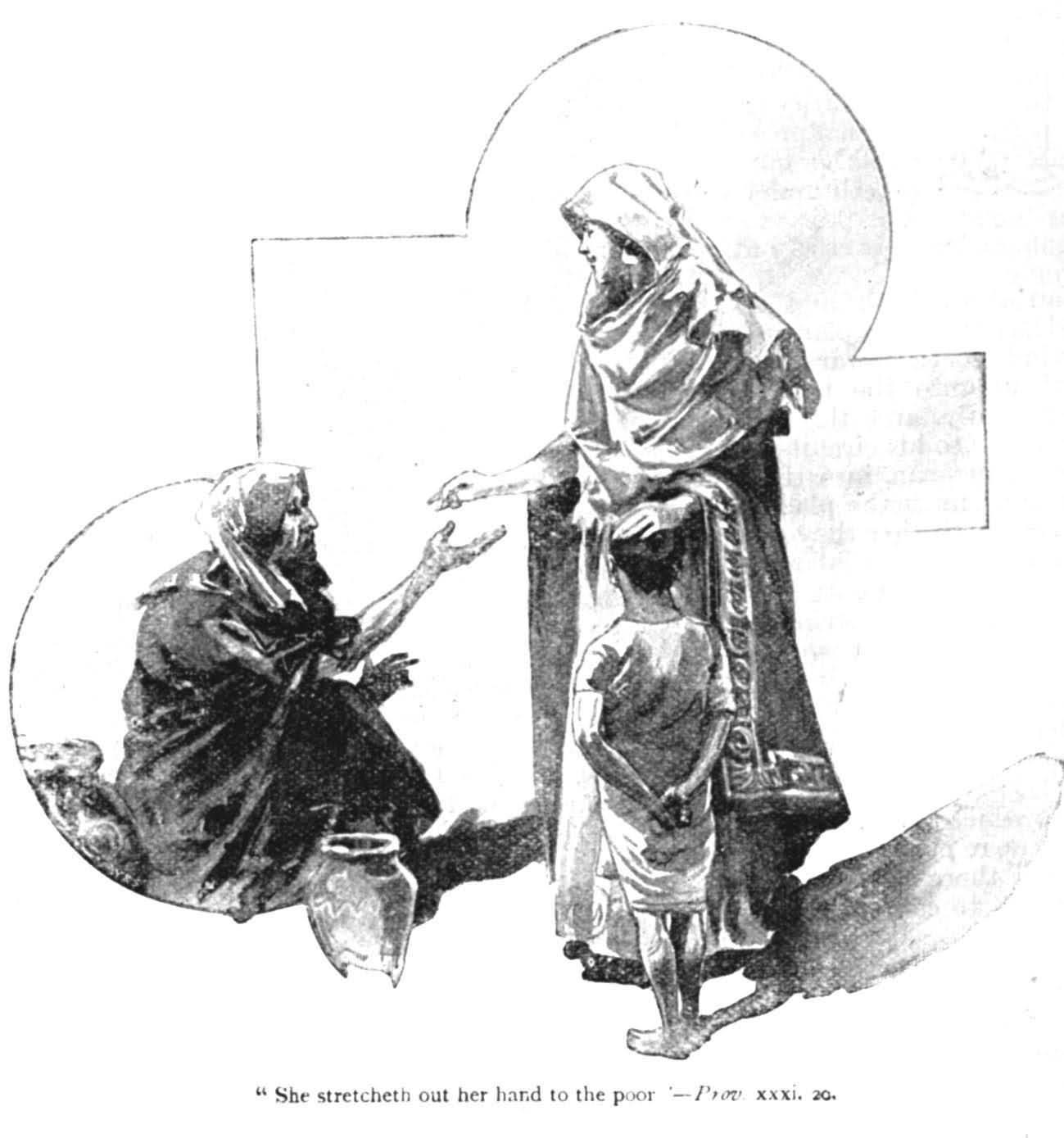
Depiction of Proverbs 31:20, "She stretcheth out her hand to the poor..." | |
| Book | Book of Proverbs |
| Category | Ketuvim |
| Christian Bible part | Old Testament |
| Order in the Christian part | 21 |
Proverbs 31 is the 31st and final chapter of the Book of Proverbs in the Hebrew Bible or the Old Testament of the Christian Bible.[1] Verses 1 to 9 present the advice which King Lemuel's mother gave to him, about how a just king should reign. The remaining verses detail the attributes of a good wife or an ideal woman (verses 10–31). The latter section is also known as Eshet Ḥayil.[2]
Text
[edit]Hebrew
[edit]The following table shows the Hebrew text[3][4] of Proverbs 31 with not only vowels but also [Hebrew cantillation] Trope Symbols included, alongside an English translation based upon the JPS 1917 translation (now in the public domain).
| Verse | Hebrew | English translation (JPS 1917) |
|---|---|---|
| 1 | דִּ֭בְרֵי לְמוּאֵ֣ל מֶ֑לֶךְ מַ֝שָּׂ֗א אֲֽשֶׁר־יִסְּרַ֥תּוּ אִמּֽוֹ׃ | The words of king Lemuel; the burden wherewith his mother corrected him. |
| 2 | מַה־בְּ֭רִי וּמַֽה־בַּר־בִּטְנִ֑י וּ֝מֶ֗ה בַּר־נְדָרָֽי׃ | What, my son? and what, O son of my womb? And what, O son of my vows? |
| 3 | אַל־תִּתֵּ֣ן לַנָּשִׁ֣ים חֵילֶ֑ךָ וּ֝דְרָכֶ֗יךָ לַֽמְח֥וֹת מְלָכִֽין׃ | Give not thy strength unto women, Nor thy ways to that which destroyeth kings. |
| 4 | אַ֤ל לַֽמְלָכִ֨ים ׀ לְֽמוֹאֵ֗ל אַ֣ל לַֽמְלָכִ֣ים שְׁתוֹ־יָ֑יִן וּ֝לְרוֹזְנִ֗ים (או) [אֵ֣י] שֵׁכָֽר׃ | It is not for kings, O Lemuel, it is not for kings to drink wine: Nor for princes to say: ‘Where is strong drink?’ |
| 5 | פֶּן־יִ֭שְׁתֶּה וְיִשְׁכַּ֣ח מְחֻקָּ֑ק וִ֝ישַׁנֶּ֗ה דִּ֣ין כׇּל־בְּנֵי־עֹֽנִי׃ | Lest they drink, and forget that which is decreed, And pervert the justice due to any that is afflicted. |
| 6 | תְּנוּ־שֵׁכָ֥ר לְאוֹבֵ֑ד וְ֝יַ֗יִן לְמָ֣רֵי נָֽפֶשׁ׃ | Give strong drink unto him that is ready to perish, And wine unto the bitter in soul; |
| 7 | יִ֭שְׁתֶּה וְיִשְׁכַּ֣ח רִישׁ֑וֹ וַ֝עֲמָל֗וֹ לֹ֣א יִזְכׇּר־עֽוֹד׃ | Let him drink, and forget his poverty, and remember his misery no more. |
| 8 | פְּתַח־פִּ֥יךָ לְאִלֵּ֑ם אֶל־דִּ֝֗ין כׇּל־בְּנֵ֥י חֲלֽוֹף׃ | Open thy mouth for the dumb, in the cause of all such as are appointed to destruction. |
| 9 | פְּתַח־פִּ֥יךָ שְׁפׇט־צֶ֑דֶק וְ֝דִ֗ין עָנִ֥י וְאֶבְיֽוֹן׃ | Open thy mouth, judge righteously, and plead the cause of the poor and needy. |
| 10 | אֵֽשֶׁת־חַ֭יִל מִ֣י יִמְצָ֑א וְרָחֹ֖ק מִפְּנִינִ֣ים מִכְרָֽהּ׃ | A woman of valour who can find? For her price is far above rubies. |
| 11 | בָּ֣טַח בָּ֭הּ לֵ֣ב בַּעְלָ֑הּ וְ֝שָׁלָ֗ל לֹ֣א יֶחְסָֽר׃ | The heart of her husband doth safely trust in her, and he hath no lack of gain. |
| 12 | גְּמָלַ֣תְהוּ ט֣וֹב וְלֹא־רָ֑ע כֹּ֝֗ל יְמֵ֣י חַיֶּֽיהָ׃ | She doeth him good and not evil all the days of her life. |
| 13 | דָּ֭רְשָׁה צֶ֣מֶר וּפִשְׁתִּ֑ים וַ֝תַּ֗עַשׂ בְּחֵ֣פֶץ כַּפֶּֽיהָ׃ | She seeketh wool and flax, and worketh willingly with her hands. |
| 14 | הָ֭יְתָה כׇּאֳנִיּ֣וֹת סוֹחֵ֑ר מִ֝מֶּרְחָ֗ק תָּבִ֥יא לַחְמָֽהּ׃ | She is like the merchant-ships; she bringeth her food from afar. |
| 15 | וַתָּ֤קׇם ׀ בְּע֬וֹד לַ֗יְלָה וַתִּתֵּ֣ן טֶ֣רֶף לְבֵיתָ֑הּ וְ֝חֹ֗ק לְנַעֲרֹתֶֽיהָ׃ | She riseth also while it is yet night, and giveth food to her household, and a portion to her maidens. |
| 16 | זָֽמְמָ֣ה שָׂ֭דֶה וַתִּקָּחֵ֑הוּ מִפְּרִ֥י כַ֝פֶּ֗יהָ (נטע) [נָ֣טְעָה] כָּֽרֶם׃ | She considereth a field, and buyeth it; with the fruit of her hands she planteth a vineyard. |
| 17 | חָֽגְרָ֣ה בְע֣וֹז מׇתְנֶ֑יהָ וַ֝תְּאַמֵּ֗ץ זְרוֹעֹתֶֽיהָ׃ | She girdeth her loins with strength, And maketh strong her arms. |
| 18 | טָ֭עֲמָה כִּי־ט֣וֹב סַחְרָ֑הּ לֹא־יִכְבֶּ֖ה (בליל) [בַלַּ֣יְלָה] נֵרָֽהּ׃ | She perceiveth that her merchandise is good; Her lamp goeth not out by night. |
| 19 | יָ֭דֶיהָ שִׁלְּחָ֣ה בַכִּישׁ֑וֹר וְ֝כַפֶּ֗יהָ תָּ֣מְכוּ פָֽלֶךְ׃ | She layeth her hands to the distaff, And her hands hold the spindle. |
| 20 | כַּ֭פָּהּ פָּֽרְשָׂ֣ה לֶעָנִ֑י וְ֝יָדֶ֗יהָ שִׁלְּחָ֥ה לָאֶבְיֽוֹן׃ | She stretcheth out her hand to the poor; Yea, she reacheth forth her hands to the needy. |
| 21 | לֹא־תִירָ֣א לְבֵיתָ֣הּ מִשָּׁ֑לֶג כִּ֥י כׇל־בֵּ֝יתָ֗הּ לָבֻ֥שׁ שָׁנִֽים׃ | She is not afraid of the snow for her household; For all her household are clothed with scarlet. |
| 22 | מַרְבַדִּ֥ים עָֽשְׂתָה־לָּ֑הּ שֵׁ֖שׁ וְאַרְגָּמָ֣ן לְבוּשָֽׁהּ׃ | She maketh for herself coverlets; Her clothing is fine linen and purple. |
| 23 | נוֹדָ֣ע בַּשְּׁעָרִ֣ים בַּעְלָ֑הּ בְּ֝שִׁבְתּ֗וֹ עִם־זִקְנֵי־אָֽרֶץ׃ | Her husband is known in the gates, When he sitteth among the elders of the land. |
| 24 | סָדִ֣ין עָ֭שְׂתָה וַתִּמְכֹּ֑ר וַ֝חֲג֗וֹר נָתְנָ֥ה לַֽכְּנַעֲנִֽי׃ | She maketh linen garments and selleth them; And delivereth girdles unto the merchant. |
| 25 | עֹז־וְהָדָ֥ר לְבוּשָׁ֑הּ וַ֝תִּשְׂחַ֗ק לְי֣וֹם אַחֲרֽוֹן׃ | Strength and dignity are her clothing; And she laugheth at the time to come. |
| 26 | פִּ֭יהָ פָּתְחָ֣ה בְחׇכְמָ֑ה וְת֥וֹרַת חֶ֝֗סֶד עַל־לְשׁוֹנָֽהּ׃ | She openeth her mouth with wisdom; And the law of kindness is on her tongue. |
| 27 | צ֭וֹפִיָּה (הילכות) [הֲלִיכ֣וֹת] בֵּיתָ֑הּ וְלֶ֥חֶם עַ֝צְל֗וּת לֹ֣א תֹאכֵֽל׃ | She looketh well to the ways of her household, And eateth not the bread of idleness. |
| 28 | קָ֣מוּ בָ֭נֶיהָ וַֽיְאַשְּׁר֑וּהָ בַּ֝עְלָ֗הּ וַֽיְהַלְלָֽהּ׃ | Her children rise up, and call her blessed; Her husband also, and he praiseth her: |
| 29 | רַבּ֣וֹת בָּ֭נוֹת עָ֣שׂוּ חָ֑יִל וְ֝אַ֗תְּ עָלִ֥ית עַל־כֻּלָּֽנָה׃ | ’Many daughters have done valiantly, But thou excellest them all.’ |
| 30 | שֶׁ֣קֶר הַ֭חֵן וְהֶ֣בֶל הַיֹּ֑פִי אִשָּׁ֥ה יִרְאַת־יְ֝הֹוָ֗ה הִ֣יא תִתְהַלָּֽל׃ | Grace is deceitful, and beauty is vain; But a woman that feareth the LORD, she shall be praised. |
| 31 | תְּנוּ־לָ֭הּ מִפְּרִ֣י יָדֶ֑יהָ וִיהַלְל֖וּהָ בַשְּׁעָרִ֣ים מַֽעֲשֶֽׂיהָ׃ | Give her of the fruit of her hands; And let her works praise her in the gates. |
Some early manuscripts containing the text of this chapter in Hebrew are of the Masoretic Text, which includes the Aleppo Codex (10th century), and Codex Leningradensis (1008).[5]
There is also a translation into Koine Greek known as the Septuagint, made in the last few centuries BC. Extant ancient manuscripts of the Septuagint version include Codex Vaticanus (B; B; 4th century), Codex Sinaiticus (S; BHK: S; 4th century), and Codex Alexandrinus (A; A; 5th century).[6]
The words of Lemuel (31:1–9)
[edit]In this part, an unnamed queen-mother (see "queen mother") gives instruction to her son, King Lemuel, on his duty to administer justice.[2] Using the appeal to his filial respect to a mother and his birth as an answer of a prayer (verse 2, cf. 1 Samuel 1:11), the mother warns the king against sexual promiscuity and drunkenness (verses 3–7).[2] The eighth and ninth verses are an appeal against inequality and injustice.[7][8]
The good wife (31:10–31)
[edit]| Part of a series on |
| Christianity and gender |
|---|
Verses 10–31 of this chapter, also called Eshet Ḥayil (Hebrew: אשת חיל, lit. 'woman of valor'), form a poem in praise of the good wife, a definition of a perfect wife or "ideal woman" in the nation of Israel, who is 'an industrious housewife, a shrewd businesswoman, an enterprising trader, a generous benefactor (verse 20) and a wise teacher (verse 26).[2] This "Woman of Valor" has been described as the personification of wisdom, or in some sense as a description of a particular class of women in Israel, Persia, or in Hellenistic society.[9] Some[who?] see this as a praise directed from the husband to his wife.
It is one of the thirteen alphabetical acrostic poems in the Bible, where each line begins with a successive letter in the Hebrew alphabet.[2] The word חיל (Ḥayil) appears in verses 10 and 29 of the passage, thought as the summary of the good woman's character. Traditionally it has been translated as "virtuous" or "noble". Some scholars have suggested that it rather means "forceful", "mighty", or "valiant", because this word is almost exclusively used in the Tanakh with reference to warfare.[10]
Aberdeen theologian Kenneth Aitken notes that in view of the warnings against women portrayed as dangerous or adulterous in chapters 1 to 9, it is "fitting" that the book ends by "directing the attention of prospective bridegrooms to the ideal wife".[2]
Verse 30
[edit]- Charm is deceitful and beauty is passing,
- But a woman who fears the Lord, she shall be praised.[11]
The key to the woman's industry, acumen, kindness and wisdom lies in her "fear of the LORD".[2]
Uses
[edit]In Jewish tradition, this chapter is customarily sung at the Shabbat dinner, after the liturgical poem Shalom Aleichem and before the Kiddush.[12]
The chapter has been emphasized within the biblical womanhood movement, and a number of books have been published on the "Proverbs 31 woman".[13][14][15][16][17] This emphasis has been subject to criticism in Christian articles.[18][19]
References
[edit]- ^ Halley 1965, p. 273.
- ^ a b c d e f g Aitken 2007, p. 422.
- ^ "Proverbs – Chapter 31". Mechon Mamre.
- ^ "Proverbs 31 - JPS 1917". Sefaria.org.
- ^ Würthwein 1995, pp. 36–37.
- ^ Würthwein 1995, pp. 73–74.
- ^ Proverbs 31:8–9: King James Version
- ^ Brinson, Will (September 26, 2017). "Anthem singer Jordin Sparks has 'Proverbs 31:8–9' on hand for Cowboys vs. Cardinals". CBS Sports. Retrieved 9 October 2017.
- ^ Sandoval, Timothy J., The Discourse of Wealth and Poverty in the Book of Proverbs, ISBN 90-04-14492-7, p. 201.
- ^ God's Word to Women Lesson 78, Katharine Bushnell
- ^ Proverbs 31:30
- ^ Goldstein, Zalman; Fogelman, Chaim. "Eshet Chayil". www.chabad.org. Retrieved 2025-08-21.
- ^ Reid, E. R. (1993). The Proverbs 31 Woman. Destiny Image.
- ^ Kennedy, Nancy (1995). Help! I'm Being Intimidated by the Proverbs 31 Woman!: My Battles with a Role Model Who's Larger Than Life. Multnomah.
- ^ George, Elizabeth (2003). Discovering the Treasures of a Godly Woman: Proverbs 31. Harvest House. ISBN 9780736908184.
- ^ Partow, Donna (2008). Becoming the Woman God Wants Me to Be: A 90-Day Guide to Living the Proverbs 31 Life. Revell.
- ^ Horn, Sarah (2011). My So-Called Life as a Proverbs 31 Wife: A One-Year Experiment… and Its Surprising Results. Harvest House.
- ^ Lodge, Carey (3 January 2015). "How misapplying Proverbs 31 gives us a skewed picture of biblical womanhood". Christian Today. Retrieved 27 July 2015.
- ^ Oquist, Lauren (28 August 2014). "Stop Obsessing About the Proverbs 31 Woman". Relevant. Retrieved 27 July 2015.
Sources
[edit]- Aitken, K. T. (2007). "19. Proverbs". In Barton, John; Muddiman, John (eds.). The Oxford Bible Commentary (first (paperback) ed.). Oxford University Press. pp. 405–422. ISBN 978-0199277186. Retrieved February 6, 2019.
- Halley, Henry H. (1965). Halley's Bible Handbook: an abbreviated Bible commentary (24th (revised) ed.). Zondervan Publishing House. ISBN 0-310-25720-4.
- Würthwein, Ernst (1995). The Text of the Old Testament. Translated by Rhodes, Erroll F. Grand Rapids, MI: Wm. B. Eerdmans. ISBN 0-8028-0788-7. Retrieved January 26, 2019.
External links
[edit]Proverbs 31
View on GrokipediaAuthorship and Historical Context
Composition and Attribution
Proverbs 31 is introduced in verse 1 as "the words of King Lemuel, an oracle that his mother taught him," distinguishing it from the Solomonic attributions in earlier sections of the Book of Proverbs.[6] This maternal framing suggests an oral tradition of wisdom instruction preserved and incorporated into the Israelite collection, contrasting with the predominantly paternal or scribal voices in other ancient Near Eastern royal advisories.[7] The identity of King Lemuel remains debated among scholars, with the name linked to Massa, a northern Arabian tribe descended from Ishmael's son mentioned in Genesis 25:14, implying a non-Israelite origin for this wisdom material.[8] Some ancient rabbinic sources, such as the Babylonian Talmud (Tractate Aboth 5), identify Lemuel pseudonymously with Solomon, potentially to align the text with Israelite monarchy, while others propose figures like Hezekiah or view it as a didactic invention meaning "devoted to God."[9] Modern analyses favor the Massa connection, interpreting the inclusion as evidence of Proverbs compilers drawing from broader Semitic wisdom traditions rather than pseudepigraphy for anonymity.[10] Composition of Proverbs 31 likely occurred as part of the book's post-exilic redaction after 538 BCE, when disparate wisdom sayings from various sources—including foreign elements like Lemuel's—were assembled into a cohesive anthology during the Persian period.[11] Linguistic and thematic features, such as the acrostic structure in verses 10–31, align with late wisdom literature trends, though the core maternal oracle may preserve pre-exilic oral content adapted for royal instruction.[12] Parallels exist in ancient Near Eastern genres, like Egyptian instructions to pharaohs (e.g., warnings against excess in the Teachings of Amenemope), supporting the chapter's function as advisory discourse, albeit uniquely voiced by a queen mother.[10]Cultural Setting in Ancient Near East
In the ancient Near East, patriarchal monarchies predominated, with royal succession often influenced by maternal counsel on governance and personal conduct, as evidenced in wisdom texts where mothers or female figures imparted ethical guidance to heirs, reflecting the intertwined roles of family and state authority.[7] Such dynamics appear in Mesopotamian and Egyptian traditions, where royal women advised sons against excesses like promiscuity and intemperance to ensure stable rule, paralleling the instructional oracle format in Israelite literature.[13] Ancient Israelite society was fundamentally agrarian, centered on household-based production where extended families managed small-scale farming of crops such as wheat, barley, olives, grapes, and figs, supplemented by pastoral herding and localized trade.[14] These oikos units, under patriarchal oversight, integrated textile production, viticulture, and food storage, with labor drawn from family members, indentured servants, and slaves acquired through debt or conquest, fostering ideals of industriousness tied to survival and self-sufficiency.[15] Economic interdependence with neighboring regions for commodities like cedar and metals underscored the value of prudent resource management in household economies.[16] Wisdom literature across the ancient Near East served as a pedagogical tool for elite education, emphasizing moral order, righteous administration, and familial virtues to cultivate leaders capable of just rule amid societal hierarchies.[17] In Israelite contexts, these texts, including proverbs collections, targeted scribal and royal circles, promoting ethical governance through pragmatic sayings on justice, temperance, and diligence, with Proverbs functioning as a culminative exposition of such principles.[18] The core of Proverbs, including chapter 31, drew from pre-exilic oral traditions (prior to the 586 BCE destruction of Jerusalem), rooted in monarchic Judah's courtly and familial wisdom exchanges, which were later redacted in post-exilic periods to reinforce communal ethics and stability under Persian oversight.[12] This adaptation preserved earlier emphases on royal accountability and domestic order while aligning with restored Judah's needs for social cohesion.[19]Textual Structure
Verses 1–9: Maternal Advice to King Lemuel
The oracle of King Lemuel, as recorded in Proverbs 31:1–9, consists of direct maternal counsel delivered to her son regarding the responsibilities of kingship, framed as an inspired utterance (massa', often translated as "oracle" or "burden" in prophetic contexts). This section stands apart from the book's typical gnomic proverbs by presenting personalized instruction from a royal mother, emphasizing ethical conduct essential for just governance.[20] The identity of Lemuel is obscure, with no extrabiblical attestation; scholarly proposals range from a pseudonym for Solomon—making the speaker Bathsheba—to a non-Israelite ruler from the Arabian region of Massa, though these remain speculative without corroborating historical evidence.[21][8] The advice opens with an affectionate address in verse 2, portraying Lemuel as the fulfillment of his mother's prayers and vows, before issuing stark warnings against self-indulgence. In verse 3, she cautions against devoting one's strength to women, observing that such pursuits have historically destroyed kings, a principle echoed in biblical accounts of royal downfall through promiscuity (e.g., Solomon's 700 wives and 300 concubines leading to idolatry in 1 Kings 11:1–8).[22] Verses 4–5 prohibit kings from indulging in wine or strong drink, arguing that alcohol clouds the mind, erodes memory of legal decrees, and perverts justice for the oppressed—a causal link rooted in the need for unimpaired discernment in rule.[4] Verses 6–7 qualify this by allowing wine for the dying or anguished to numb poverty and sorrow, distinguishing temperate royal restraint from compassionate provision for the suffering.[23] The passage concludes in verses 8–9 with a mandate for vocal advocacy: to "open your mouth" for the mute and destitute, judge with righteousness, and defend the poor and needy, underscoring a king's duty to champion the voiceless against exploitation.[24] This thematic core—prioritizing sobriety, sexual self-control, and equitable justice over personal excess—aligns with the broader wisdom tradition's focus on causal consequences of moral choices in leadership, where impaired rulers inevitably fail the vulnerable.[25] Unlike the impersonal aphorisms dominating Proverbs, this maternal voice employs urgent, relational rhetoric to instill enduring principles of righteous authority.[26]Verses 10–31: The Acrostic on the Eshet Chayil
Verses 10–31 form a poetic unit concluding the Book of Proverbs, structured as an alphabetic acrostic comprising 22 lines, with each verse commencing with the successive letter of the Hebrew alphabet from aleph to tav.[27] This form emphasizes completeness and memorability, praising the eshet chayil, or "woman of valor," depicted as an exemplar of practical wisdom through industriousness, foresight, and moral integrity.[28] The poem opens by questioning the rarity of such a woman, whose worth surpasses rubies, and portrays her as a reliable partner who enriches her husband's life without harm.[29] The eshet chayil demonstrates economic acumen and physical vigor: she selects wool and flax, works willingly with her hands (v. 13), rises while it is still night to provide food for her household and portions for her maidens (v. 15), evaluates a field and purchases it with profits, then plants a vineyard (v. 16), and engages in trade by making linen garments and belts for merchants (v. 24).[30] Her lamp does not go out by night, signaling vigilance in assessing profitable ventures (v. 18), and she girds her loins with strength while extending her hand to the poor and needy (v. 20). These actions reflect proactive resource management and generosity, extending beyond domestic duties to commercial enterprise.[29] Further attributes include her preparation of fine clothing for her family against cold weather (v. 21), oversight of household affairs without idleness (v. 27), and verbal wisdom: she speaks with instruction on her tongue, infused with the teaching of kindness (v. 26). Clothed in strength and dignity, she laughs at the future without fear (v. 25). Her influence elevates her husband, who sits among elders of the land (v. 23), underscoring the reciprocal honor in her role.[30] The poem culminates in communal recognition: her children and husband arise to bless her, affirming she exceeds all others (vv. 28–29), yet true praise derives not from charm or beauty—which are fleeting—but from fear of the Lord (v. 30). Her works ultimately proclaim her in the gates (v. 31). As an encomium, this acrostic idealizes embodied wisdom in a capable wife, serving didactic purposes rather than depicting a specific historical figure.[28][30]Linguistic Features
Hebrew Original and Key Translations
The Hebrew text of Proverbs 31 derives from the Masoretic Text (MT), a standardized vocalized version compiled between the 7th and 10th centuries CE, which exhibits high stability for this chapter due to its poetic form and minimal textual variants in surviving manuscripts. The core phrase opening verses 10–31, ʾēšet ḥayil (אשת חיל), combines ʾēšet ("woman" or "wife") with ḥayil ("strength," "valor," or "might"), connoting a figure of capability, resourcefulness, and prowess in action, as ḥayil elsewhere describes military or economic power (e.g., Ruth 3:11; Proverbs 12:4).[31][32] In verse 30, yirʾat YHWH (יראת יהוה), "fear of the LORD," anchors the praise, using yārēʾ in the sense of reverent awe as the foundational quality, distinct from superficial charm or beauty.[33] The Septuagint (LXX), a Greek translation from the 3rd–2nd centuries BCE, preserves Proverbs 31:10–31 with relative fidelity to the MT but includes minor expansions, rephrasings, and recensional differences, such as interpretive glosses or alignments with perceived Hebrew Vorlagen; for instance, the LXX occasionally amplifies descriptive elements in verses 10–31 without altering the overall structure, reflecting an earlier Hebrew textual tradition.[34] Scholars note that while Proverbs as a whole shows more LXX-MT divergences (e.g., chapter rearrangements), the "woman of valor" pericope evidences stability, with variants primarily in wording rather than omission or addition of verses.[35] Translating verses 13–19 presents challenges in conveying economic and physical vigor without domestic anachronisms: ṣemer wəpištim (wool and flax, v. 13) implies sourcing raw materials for production; kənō kə-sōḥēr bəyām (she brings her food from afar like merchant ships, v. 14) evokes commercial procurement; šākal səʿādim (considers a field and buys it, v. 16), nāṭəʿāh kərāmāh (plants a vineyard, v. 15), and ḥāḡōrāh ḥāyilāh wəʾāzərāh zərōʿōtayim (girds her loins with strength and makes her arms strong, v. 17) depict entrepreneurial initiative, trade, agriculture, and manual labor, requiring terms that highlight agency over idealized homemaking.[36] English renderings of ʾēšet ḥayil vary: the 1611 King James Version (KJV) uses "virtuous woman," prioritizing moral rectitude; the 1978 New International Version (NIV) opts for "wife of noble character," balancing ethics with esteem; the 2001 English Standard Version (ESV) employs "excellent wife," stressing superiority in competence.[37][38][39] These reflect evolving emphases, with modern versions leaning toward connotations of strength to align with ḥayil's semantic range beyond passive virtue.[40]| Translation | Proverbs 31:10 Rendering |
|---|---|
| KJV (1611) | "Who can find a virtuous woman?" |
| NIV (2011) | "A wife of noble character who can find?" |
| ESV (2016) | "An excellent wife who can find?" |

