


Community hub
Recent from talks
Contribute something
Nothing was collected or created yet.
Peper Harow
View on Wikipedia
Peper Harow is a rural village and civil parish in southwest Surrey close to the town of Godalming. It was a noted early cricket venue. Its easternmost fields are in part given up to the A3 trunk road.
Key Information


Location and history
[edit]The name "Peper Harow" is very unusual and comes from Old English Pipers Hear(g) perhaps meaning, approximately "The pagan stone altar of the pipers"; however, hearg can also be haeg meaning more prosaically hedged enclosure (of the pipers), or even hay meadow. Pipers might mean musicians, or sandpipers (the green sandpiper and wood sandpiper are migrants to marsh and swampy ground – as this is).
There is also a possibility that the name Peper Harow is derived from the Saxon piþa har hleow, meaning the old pith refuge pith being used for making tallow lights. The Burghal Hideage records 'Eashing' as one of the forts, however the forts are not necessarily in the locations recorded or the locations have moved. The most likely location for this fort is at Warren Hill in the parish of Peper Harow, and its size fits the expected size of this fort. [3]
Peper Harow appears in the Domesday Book of 1086 as Pipereherge. It was held by Girard (Gerard) from Walter, son of Othere. Its domesday assets were: 3 hides. It had 3 ploughs, 1 mill worth 15s, 7 acres (2.8 ha) of meadow. It rendered £5 per year to its feudal overlords. Later documented forms are: Pipereherge (11th century); Piperinges (13th century); Pyperhaghe (14th century).[4]
In the graveyard of St. Nicholas's Church (dating to 1301) is an ancient yew tree which has been dated to being 800 years old which could stand on the site of an old pagan site.[citation needed] Close to Peper Harow at Bonville Hanger Wood is a Holy well called Bonfield Spring that is also thought to have held pre-Christian religious significance.[citation needed]
- Descent of the manor
Denzil Holles (who had no issue) died in 1694, and the manor reverted to John, Duke of Newcastle, his male heir who sold it in February 1699 – 1700 to Philip Frowde, who in 1713 sold it to Alan Brodrick, who was elevated to the Viscountcy of Midleton.
In 1725, this Viscount Midleton was 'expected to reside [in the manor] shortly, and was patron (sponsor) of the church, whose son died 1747. In the son's time his first cousin Vice-Admiral Thomas Brodrick also lived at the estate. George Brodrick, the third viscount died holding it in 1765. He was succeeded by his son George, created Baron Brodrick of Peper Harow in the Peerage of the United Kingdom, who died 1836. His son George Alan was succeeded in 1848 by his cousin Charles, grandson of the third viscount, who died in 1863. The manor passed to his brother, the Very Rev. W J Brodrick, who dying in 1870 was succeeded by his son William, appointed (for the year term) Lord Lieutenant of Surrey. This Viscount Midleton died in 1907, and was succeeded by his eldest son.[4] George Broderick, (who married Rene Ray), was the eldest son of five children born to St John Brodrick, 1st Earl of Midleton by his first wife, Lady Hilda Charteris.
- 21st-century history
St. Nicholas's church was almost destroyed by fire in December 2007.[5] The yew was unharmed and the church has been restored. Parts of the village are privately owned with restricted access.
Cricket
[edit]
Cricket has long been played here, with evidence of rules and matches dating to 1727.[6] Alan Brodrick, 2nd Viscount Midleton was a cricket patron and one match against a side organised by Charles Lennox, 2nd Duke of Richmond is believed to have taken place at Peper Harow in the 1727 English cricket season.[7]
Other activities
[edit]During the Second World War, Peper Harow was used as a holding area for Canadian Forces.[8] Part of the park not in the parish is used annually for point-to-point horse racing.[9][10]
Peper Harow House
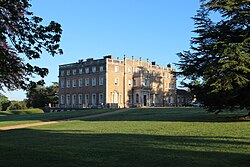
[edit]Peper Harow House was built by Sir William Chambers for George Brodrick, 3rd Viscount Midleton in 1765. Still incomplete when the 3rd Viscount died (in 1765), it was completed by his son after he came of age. It is a Grade I listed building.[11] Lancelot 'Capability' Brown landscaped the park in 1762–3, and many fine trees remain from this time. Particularly notable are the Lebanon Cedar. According to 'A History of the County of Surrey' published in 1911, the park and grounds at Peper Harow contained some fine timber at that time, notably the cedars of Lebanon, which were put in as seedlings from pots in 1735.[12]

The ancient Somerset Bridge crosses the River Wey and connects Peper Harow with nearby Elstead.
The house was owned by the Midleton family until 1944 when it was sold to property developers. It, and the entire village, is now owned by a trust.[citation needed]
Demography and housing
[edit]| Output area | Detached | Semi-detached | Terraced | Flats and apartments | Caravans/temporary/mobile homes | shared between households[1] |
|---|---|---|---|---|---|---|
| (Civil Parish) | 31 | 24 | 8 | 4 | 0 | 0 |
The average level of accommodation in the region composed of detached houses was 28%, the average that was apartments was 22.6%.
| Output area | Population | Households | % Owned outright | % Owned with a loan | hectares[1] |
|---|---|---|---|---|---|
| (Civil Parish) | 185 | 67 | 43.3% | 37.3% | 534 |
The proportion of households in the civil parish who owned their home outright compares to the regional average of 35.1%. The proportion who owned their home with a loan compares to the regional average of 32.5%. The remaining % is made up of rented dwellings (plus a negligible % of households living rent-free).
References
[edit]- ^ a b c Key Statistics; Quick Statistics: Population Density United Kingdom Census 2011 Office for National Statistics Retrieved 21 November 2013
- ^ "Location of Godalming and Ash". parliament.uk. July 2024. Retrieved 4 April 2025.
- ^ English Village names Saxonhistory.co.uk
- ^ a b H.E. Malden, ed. (1911). "Parishes: Peper Harow". A History of the County of Surrey: Volume 3. Institute of Historical Research. Retrieved 2 December 2013.
- ^ Church information Peperharow.info
- ^ Marshall, pp.45–48.
- ^ McCann, pp.6–7.
- ^ People's War Archived 26 April 2010 at the Wayback Machine
- ^ Bramley Historical Society (25 July 2005). "Tanks give way to bicycles". BBC.
- ^ "Election Maps".
- ^ Historic England. "Peper Harow Park (1435898)". National Heritage List for England. Retrieved 22 January 2018.
- ^ "Parishes: Peper Harow | British History Online".
Bibliography
[edit]- Birley, Derek (1999). A Social History of English Cricket. Aurum.
- McCann, Tim (2004). Sussex Cricket in the Eighteenth Century. Sussex Record Society.
- Marshall, John (1961). The Duke who was Cricket. Muller.
External links
[edit]

Peper Harow
View on GrokipediaGeography and Location
Location and Administrative Details
Peper Harow is a civil parish situated in the southwest of Surrey, England, approximately 3 miles west of the town of Godalming and adjacent to the A3 trunk road, providing convenient access to London and Portsmouth.[8][1] Its central point is referenced at OS grid SU935441 (latitude 51.1885°N, longitude 0.6635°W).[1] Administratively, Peper Harow forms a civil parish within the Waverley District and falls under the Godalming and Ash parliamentary constituency, established following the 2023 boundary review and first contested in the 2024 general election.[7] The parish boundaries border those of Elstead to the north, Shackleford to the east, Milford to the southeast, and Thursley to the southwest.[9] The parish encompasses an area of approximately 5.34 km² (1,320 acres or 534 hectares), characterized by a rural landscape along the River Wey.[10] Public transport access is limited, with the nearest railway station located in Godalming, approximately 3 miles away, serving lines to London Waterloo and Portsmouth Harbour.[8] The area features sparse public roads, emphasizing its secluded, estate-dominated setting within the Surrey Hills Area of Outstanding Natural Beauty.[11]Physical Features and Environment
Peper Harow is characterized by a rural, wooded landscape situated within the Surrey Hills Area of Outstanding Natural Beauty (AONB), encompassing gently rolling parkland, meadows, and ancient woodland. The area slopes southward toward the floodplain of the nearby River Wey, which forms a sinuous lake within the estate and supports riparian vegetation including alders and oaks along its banks. Clumps of mature trees, such as oaks, London planes, copper beeches, and pines, punctuate the 150-hectare parkland, contributing to its picturesque and ecologically diverse setting.[4][12] Designated as a Conservation Area in 1981 by Waverley Borough Council, Peper Harow is protected for its historical and natural beauty, with special planning controls requiring permission for any developments or demolitions that could impact its character. This status, combined with its location in the AONB, ensures minimal alterations to the landscape, preserving features like the mid-18th-century park designed by Lancelot 'Capability' Brown. As a private residential estate, public access is restricted, limiting intrusions and maintaining the area's tranquility and integrity.[13][14][12] Notable natural elements include an ancient male yew tree (Taxus baccata) in the churchyard of St Nicholas Church, estimated at around 600 years old based on early 20th-century assessments, with a girth of approximately 23 feet near the ground and a split, hollow trunk featuring multiple stout limbs. Additionally, two surviving Lebanon cedars (Cedrus libani) in the pleasure grounds west of Peper Harow House were planted around 1735, representing some of the earliest introductions of this species to Britain and exemplifying the estate's long tradition of arboreal heritage.[15][4] As part of the broader Surrey countryside, Peper Harow plays a role in supporting regional biodiversity through its varied habitats, including parkland meadows that foster wildflowers and insects, ancient woodland that provides habitat for birds and mammals, and the River Wey's influence enhancing wetland species diversity. The area's conserved status has prevented major developments as of 2025, allowing natural processes to sustain ecological balance within the Surrey Hills AONB framework.[4][16]History
Origins and Early Records
The name Peper Harow originates from Old English Pipere hearh, recorded as Pipereherge in the Domesday Book, and is interpreted as "the heathen temple of the Pipers" or "Pippera's heathen temple," indicating possible pre-Christian significance linked to a pagan shrine or stone altar.[17] This etymology suggests the area may have served as a site of early worship, with "hearg" denoting a temple or holy place in Anglo-Saxon usage.[18] Peper Harow first appears in documented records in the Domesday Book of 1086, where it is described as a settlement in the hundred of Godalming, Surrey.[19] It was held by the under-tenant Girard from the tenant-in-chief Walter son of Other, with a population of 7 households comprising 4 villagers and 3 cottagers.[19] The manor encompassed 3 hides, supporting 3 ploughlands (2 held in demesne and 1 by the men), 7 acres of meadow, and 1 mill valued at 15 shillings annually; its total annual render was £5, an increase from £1 10s. in 1066.[19] In the early medieval period, Peper Harow functioned as a rural agricultural settlement typical of Anglo-Saxon manors in Surrey, centered on arable cultivation, pasturage, and milling to support local communities.[20] The place-name's reference to a "hearg" points to potential archaeological interest in prehistoric or pre-Christian features, such as high-land shrines or temples, though no definitive structures have been identified.[17] Pre-17th-century developments are sparsely recorded, reflecting the manor's evolution from a modest hamlet into a more defined estate under early Norman lords, with limited evidence of expansion beyond basic agrarian activities until later medieval ownership shifts.[20] The estate passed through the de Windsor family, descendants of Walter son of Other, into the 15th century, setting the stage for subsequent manor descents.[20]Manor Ownership and Development
In the late 17th century, the manor of Peper Harow was owned by the Holles family; Denzil Holles (grandson of the acquirer) died in 1694 without issue, leading to its reversion to his relative, John, Duke of Newcastle.[21] The duke sold the estate in February 1699–1700 to Philip Frowde, a prominent figure who served as Postmaster-General under Queen Anne.[21] Frowde held the property until 1713, when he transferred it to Alan Brodrick, 1st Viscount Midleton, whose family had amassed wealth through legal and political roles in Ireland.[22] The Brodrick family, later elevated to earls, retained ownership for over two centuries, shaping the estate through successive generations of viscounts and earls.[2] Key developments under the Brodricks transformed the manor significantly. In 1757–1758, Lancelot 'Capability' Brown was commissioned to landscape the park, introducing sweeping lawns, strategic tree plantings—including surviving cedars from earlier efforts—and river enhancements to create a picturesque, naturalistic setting.[4] Shortly thereafter, in 1765, George Brodrick, 3rd Viscount Midleton, demolished the existing manor house and initiated construction of a new neoclassical residence designed by Sir William Chambers, though Brodrick died that same year before its completion; his son oversaw its finishing around 1775.[4] These projects marked a shift from the estate's primarily agricultural use, with enclosed fields and farms, to a designed landscape park that emphasized grandeur and seclusion, incorporating architectural follies and bounded views.[2] The evolved estate, encompassing approximately 370 acres (150 hectares) of parkland by the 19th century, received formal recognition in modern times. Peper Harow House was designated a Grade I listed building in 1960 for its architectural merit, while the surrounding park was added to the Register of Historic Parks and Gardens at Grade II in 2016 by Historic England, acknowledging its intact Brown-designed features and historical significance.[23][4] Following the death of William St. John Fremantle Brodrick, 1st Earl of Midleton, in 1942, the Viscounts Midleton sold the estate in 1944 to a trust, which has since preserved its private character amid partial dispersal of assets.[2]Modern History and Events
During the Second World War, Peper Harow played a key role in Allied preparations, with the estate requisitioned by the Canadian Army as a headquarters in the later years of the conflict.[2] Thousands of Canadian troops were billeted across the area, utilizing local woodlands and facilities for training and assembly ahead of the D-Day landings.[2] Peper Harow House specifically served as the headquarters for the Canadian Ordnance Corps, where logistical planning for the Normandy invasion was coordinated.[5] Following the war, the estate was sold in 1944 and acquired by a charitable trust in 1947 for residential and educational purposes, converting Peper Harow House into a school for young people with emotional and behavioral challenges.[24] The trust maintained ownership, preserving the site's privacy as a residential enclave while prioritizing environmental conservation and limited public access.[4] This stewardship has ensured the estate's seclusion, with the house damaged by fire in 1989 and later adapted into private flats in the late 1990s.[5] A significant incident in the parish's modern history occurred on Christmas Eve 2007, when St Nicholas's Church was ravaged by a fire that broke out in the early hours after a crowded carol service.[25] Approximately 50 firefighters battled the blaze, which severely damaged the nave and caused the bell to crash through the structure, nearly destroying the 14th-century Grade II listed building.[26] Restoration efforts, led by architectural firm Purcell, were completed by 2011, fully reinstating the church's historical features.[27] Ongoing maintenance by the parish supports its structural integrity and cultural role.[28] Into the 21st century, Peper Harow has remained a tranquil rural parish with no major infrastructural or developmental changes reported as of 2025.[2] The community sustains its low-key character, occasionally opening landmarks to the public through initiatives like Heritage Open Days, including a September 2025 event at St Nicholas's Church highlighting its post-fire restoration.[29]Notable Landmarks and Buildings
Peper Harow House and Estate
Peper Harow House is a neoclassical country house constructed between 1765 and 1775 to designs by the architect Sir William Chambers for George Brodrick, 3rd Viscount Midleton.[23] The building, executed in brick with stucco facing in an Italianate style, features a symmetrical facade with a central pedimented portico supported by Ionic columns, reflecting Chambers' emphasis on classical proportions and restraint.[23] It holds Grade I listed status due to its architectural significance and intact interiors, including a hall with fielded-panel doors framed in egg-and-dart molding, drawing directly from Chambers' influential designs for public commissions like Somerset House.[23] Later additions, such as a porch in 1843 and a top floor in 1913, were made by subsequent Viscounts Midleton, but the core structure remains a prime example of mid-18th-century neoclassicism.[30] The surrounding estate encompasses approximately 150 hectares of mid-18th-century parkland, redesigned by landscape architect Lancelot 'Capability' Brown in the 1750s to create a naturalistic setting integrated with the River Wey.[4] Key features include serpentine lakes formed by damming the river, a ha-ha separating the park from formal gardens, and ornamental elements such as the Bath House temple and the Grade II-listed Oxenford Bridge dating to around 1813.[4] The landscape is further enhanced by mature plantings, notably Lebanon cedars introduced in 1735 on the lawns and hills like Jackman's Hill and Mount Sion, which contribute to the estate's picturesque quality and seamless blend with the broader parish boundaries.[4] This parkland design, paid for in installments totaling £450 between 1757 and 1758, exemplifies Brown's approach to undulating terrain, water features, and strategic tree groupings for visual harmony.[4] The estate's total area once exceeded 1,300 acres, incorporating farmland and woodlands that supported its self-sufficiency.[30] Historically, Peper Harow House served as the principal family seat for the Viscounts Midleton from 1713 until 1944, hosting aristocratic social gatherings and recreational activities on the estate grounds.[30] As of 2025, the house and estate are owned and privately maintained by the Peper Harow Estate Trust, with the mansion converted into luxury apartments since the late 1990s while preserving its heritage features.[31] The property remains closed to the general public to respect resident privacy, though portions are occasionally let for private events such as weddings or corporate functions.[32]St Nicholas's Church
St Nicholas's Church, the parish church of Peper Harow, traces its origins to the 12th century, with the south nave wall and chancel constructed during that period in Early English style.[33] It has functioned as the local place of worship since before 1301, serving the small rural community through baptisms, weddings, and burials, including ceremonies for prominent manor families such as the Brodricks.[34][6] The west tower was added in 1826, followed by a north aisle and mortuary chapel in 1847, designed by the Gothic Revival architect A.W.N. Pugin, who remodelled elements like the 12th-century chancel arch to evoke a medieval aesthetic.[33] A south porch was constructed in 1877, completing the church's basic layout of nave, chancel, and tower.[33] The building is constructed of coursed sandstone with clunch dressings, featuring a battlemented tower and a mix of Early English and Decorated architectural styles, augmented by Pugin's Victorian Gothic contributions such as grey marble columns, a Caen stone reredos inscribed with Gothic scripts, and neo-classical memorials.[33] Notable interior features include monuments to the Brodrick family, lords of the Peper Harow manor, such as the grey marble stele to Thomas Brodrick (d. 1745) with a crowning urn and the tomb to George, 4th Viscount Middleton (d. 1836) by sculptor Henry Westmacott.[33][6] The churchyard holds an ancient male yew tree, first recorded in 1903 as a "fine old yew," with a 1936 estimate placing its age at around 600 years; girth measurements from 1958 (26 feet 6 inches at 2 feet 6 inches) confirm its antiquity, though it shows signs of poor vigor following 1987 storm damage.[15] The church endured a devastating fire on Christmas Eve 2007, which destroyed the nave and north aisle roofs and damaged internal surfaces, but the yew tree remained unharmed.[27] Restoration, completed in 2011 by Purcell Architecture, conserved original fabric like the chancel arch and bells while repairing Pugin's designs, ensuring the survival of historical elements.[27][33] As of 2025, St Nicholas's Church continues as an active place of worship for local residents, with services held every Sunday and a monthly family service, alongside seasonal events like Harvest Festival.[6] It is maintained by the Churches Heritage Trust, established in 1995 to preserve the site alongside nearby St Mary's in Shackleford, and opens occasionally to the public, including guided tours during Heritage Open Days.[6][29] The church holds Grade II* listed status for its architectural and historical significance.[33]Culture and Community Activities
Cricket Heritage
Peper Harow holds a distinguished place in the early history of cricket as one of the sport's earliest documented venues in Surrey. Records indicate that cricket was played on the Peper Harow estate starting in 1727, during a period when the game was gaining traction among the English gentry as both recreation and wagering activity.[35][31] A pivotal event that year was a match between a team assembled by Alan Brodrick, 2nd Viscount Midleton, and one led by Charles Lennox, 2nd Duke of Richmond, contested in July on the estate grounds. This encounter, involving 12 players per side, is notable as the first for which written rules—the "Articles of Agreement"—were drafted to govern play and resolve potential disputes over stakes. The 16-article document, concluded on July 11, 1727, covered aspects such as pitch dimensions, batting order, and umpire decisions, laying foundational principles for cricket's codification.[36][37][38] The Brodrick family, as owners of the Peper Harow manor, emerged as influential patrons of cricket in the 18th century, hosting informal matches and local contests on their estate to foster the sport among rural communities. Their support reflected broader aristocratic involvement that propelled cricket's growth, with Peper Harow serving as a hub for such gatherings in Surrey. This patronage helped integrate cricket into village life, blending social interaction with competitive play.[39][31] As one of Surrey's earliest recorded cricket sites, Peper Harow contributed significantly to the sport's evolution in rural England by providing a stable venue for rule experimentation and elite participation. The 1727 agreements influenced subsequent developments, including the 1744 Laws of Cricket, underscoring the venue's role in transitioning cricket from ad hoc games to a structured pursuit.[35][36] Today, Peper Harow's cricket heritage endures primarily through historical interest, with no active use of the original estate grounds for play as the area remains a private residential park. The Peper Harow Cricket Club, while tracing its founding to 1727, operates independently on a leased village ground adjacent to a local farm, focusing on contemporary local league competitions rather than estate-based traditions.[40][41]Other Traditions and Events
Peper Harow hosts an annual point-to-point horse racing event organized by the Surrey Union Hunt, held on the parkland of the Peper Harow Estate in mid-May each year. The 2025 edition took place on Saturday, May 17, with gates opening at 11:00 a.m. and races commencing at 2:00 p.m., featuring amateur steeplechase competitions over a sharp, right-handed course.[42][43] This family-oriented day includes a hound parade at 12:45 p.m., trade stands, fairground amusements, food and drink options, and picnicking areas, attracting crowds to the Oxenford Farm location off Elstead Road.[42] Admission is £15 in advance or £20 on the day, with free entry for children under 16 and accommodations for disabled visitors.[42] Historically, social gatherings at the manor were tied to its ownership by the Viscounts Midleton, who used Peper Harow House for high-profile entertaining. In 1920, William St. John Fremantle, 1st Earl of Midleton, hosted political figures including Lord Curzon, Arthur Balfour, and Winston Churchill at the estate.[2] During World War II, the house served as headquarters for the Canadian Army, with thousands of troops billeted in southwest Surrey and fortified gun emplacements constructed along nearby river banks, some of which remain visible today.[2] Post-war traditions emphasize limited public access due to the estate's private residential status, with the point-to-point racing serving as the primary recurring event to foster local community engagement while maintaining resident privacy.[2] The parish also features periodic church-hosted community activities at St Nicholas Church, such as Elevenses gatherings, Remembrance Sunday services, and seasonal events like Christmas tree festivals in collaboration with neighboring parishes. As of November 2025, there are no regular markets or large-scale public festivals documented in Peper Harow beyond the annual point-to-point fixture.[44] The estate grounds, detailed further in the Peper Harow House and Estate section, support such events on a selective basis.Demographics and Housing
Population Trends
According to the 2011 Census, Peper Harow had a population of 185 residents, which rose to 297 by the 2021 Census, marking a 60% increase over the decade.[45] This growth reflects an annual change rate of 4.9% between 2011 and 2021, driven by factors such as rural appeal and proximity to urban centers in Surrey.[45] The parish's population density stood at 55.59 inhabitants per square kilometer in 2021, across its 5.342 km² area, underscoring its sparse, rural character.[45] In terms of composition from the 2021 Census, there were 137 males and 157 females, comprising 120 households.[45][46] The demographic profile features an aging population, with a mean age of 41.6 years, consistent with broader trends in rural Surrey where over 20% of residents are aged 65 and older. The age structure shows 21.5% under 16, 61.3% aged 16-64, and 17.2% aged 65 and over. Ethnically, 92.9% identified as White, 3.7% Asian, and the remainder other groups.[10][47][46] Historically, Peper Harow experienced steady population decline typical of rural Surrey until the mid-20th century, amid urbanization and agricultural shifts that prompted out-migration to cities; the population stood at 195 in 2001 before dipping to 185 in 2011, followed by stabilization and recent upturn.[45][48] No official projections exist for 2025 specifically, but the population is expected to remain stable, constrained by the private nature of the Peper Harow estate, which limits new development and housing expansion.[49]Housing Characteristics
Peper Harow's housing stock, as recorded in the 2011 Census, consisted of 67 households, reflecting its status as a small rural parish. The composition included 31 detached houses (46.3%), 24 semi-detached properties (35.8%), 8 terraced houses (11.9%), and 4 flats (6.0%), with a predominance of larger, standalone homes typical of high-value rural estates.[50] These dwellings are largely period properties associated with the historic Peper Harow Estate, emphasizing spacious, traditional architecture over modern developments. Tenure patterns in 2011 showed strong home ownership, with 82.1% of households (55) owning their homes outright or with a mortgage; private renting accounted for 16.4% (11 households), while social rented housing was minimal at 1.5% (1 household).[50] By the 2021 Census, the number of households had risen to 120, with population growth to 297 indicating sustained demand, though detailed tenure breakdowns at the parish level remain limited; patterns suggest continued dominance of ownership and low social housing provision, consistent with the area's private estate management.[45][46] Housing quality and access are shaped by the parish's location within the Surrey Hills Area of Outstanding Natural Beauty (AONB) and its designation as a conservation area, which restricts new builds and mandates adherence to strict maintenance guidelines to preserve the landscape and historic character.[51] There is no public housing stock, with all properties privately owned or rented, contributing to limited affordability and an emphasis on estate-managed upkeep. Average property values in Peper Harow significantly exceed Surrey's county average of approximately £587,000 as of September 2025, with recent sales in the estate often reaching £2.75 million or more, underscoring the premium rural market.[52][53]References
- https://en.wikisource.org/wiki/Surrey_Archaeological_Collections/Volume_7/Notes_on_the_local_history_of_Peper_Harow