Hubbry Logo
Perry, OhioPerry, OhioMain
Open search
Perry, Ohio
Community hub
Perry, Ohio
logo
8 pages, 0 posts
0 subscribers
Be the first to start a discussion here.
Perry, Ohio
Perry, Ohio
from Wikipedia

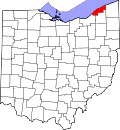
Perry is a village in Lake County, Ohio, United States. The population was 1,602 at the 2020 census.

Key Information

History

[edit]
Commodore Oliver Hazard Perry

It is named in honor of Commodore Oliver Hazard Perry to commemorate his victory over the British fleet at the Battle of Lake Erie in September 1813.[5] The battle was a turning point in the western theater during the War of 1812. Perry is known for its public schools, whose recent construction was influenced by the nearby Perry Nuclear Generating Station.

Geography

[edit]

According to the United States Census Bureau, the village has a total area of 2.18 square miles (5.65 km2), all land.[6]

Demographics

[edit]
Historical population
CensusPop.Note
1880170
1920473
193060227.3%
19406457.1%
19506653.1%
196088533.1%
19709173.6%
19809614.8%
19901,0125.3%
20001,19518.1%
20101,66339.2%
20201,602−3.7%
U.S. Decennial Census[7]

2010 census

[edit]

As of the census[8] of 2010, there were 1,663 people, 593 households, and 456 families living in the village. The population density was 762.8 inhabitants per square mile (294.5/km2). There were 630 housing units at an average density of 289.0 per square mile (111.6/km2). The racial makeup of the village was 96.1% White, 0.8% African American, 1.4% Asian, 0.6% from other races, and 1.1% from two or more races. Hispanic or Latino of any race were 2.6% of the population.

There were 593 households, of which 40.3% had children under the age of 18 living with them, 60.7% were married couples living together, 12.0% had a female householder with no husband present, 4.2% had a male householder with no wife present, and 23.1% were non-families. 20.4% of all households were made up of individuals, and 8.5% had someone living alone who was 65 years of age or older. The average household size was 2.78 and the average family size was 3.21.

The median age in the village was 39.9 years. 28.8% of residents were under the age of 18; 6.7% were between the ages of 18 and 24; 23.8% were from 25 to 44; 30.2% were from 45 to 64; and 10.6% were 65 years of age or older. The gender makeup of the village was 49.6% male and 50.4% female.

2000 census

[edit]

As of the census[4] of 2000, there were 1,195 people, 426 households, and 325 families living in the village. The population density was 548.2 inhabitants per square mile (211.7/km2). There were 438 housing units at an average density of 200.9 per square mile (77.6/km2). The racial makeup of the village was 98.41% White, 0.08% African American, 0.17% Native American, 0.67% Asian, 0.25% from other races, and 0.42% from two or more races. Hispanic or Latino of any race were 0.42% of the population. 20.7% were of German, 16.0% Italian, 12.9% English, 10.5% Irish and 6.0% American ancestry according to Census 2000.

There were 426 households, out of which 42.0% had children under the age of 18 living with them, 64.1% were married couples living together, 8.7% had a female householder with no husband present, and 23.7% were non-families. 20.0% of all households were made up of individuals, and 7.5% had someone living alone who was 65 years of age or older. The average household size was 2.81 and the average family size was 3.24.

In the village, the population was spread out, with 30.3% under the age of 18, 6.2% from 18 to 24, 29.9% from 25 to 44, 24.5% from 45 to 64, and 9.1% who were 65 years of age or older. The median age was 38 years. For every 100 females there were 94.3 males. For every 100 females age 18 and over, there were 91.9 males.

The median income for a household in the village was $52,955, and the median income for a family was $58,281. Males had a median income of $41,898 versus $28,672 for females. The per capita income for the village was $22,078. About 1.5% of families and 2.7% of the population were below the poverty line, including 2.6% of those under age 18 and 1.9% of those age 65 or over.

Government

[edit]

Perry village has an elected mayor and council form of government.

Perry is served by the Perry Public Schools.

In 2005, the Perry Public Library loaned more than 245,000 items to its 8,000 cardholders. Total holdings are over 52,000 volumes with over 275 periodical subscriptions.[9]

Notable people

[edit]

References

[edit]
[edit]
Revisions and contributorsEdit on WikipediaRead on Wikipedia
from Grokipedia
Perry is a small village in Lake County, northeastern , , incorporated in 1913 from a portion of Perry Township. Named after Commodore Oliver Hazard Perry for his 1813 victory in the during the , the village covers about 2 square miles and serves primarily as a . As of the , Perry had a population of 1,602 residents. The 2024 population estimate was 1,601, with projections for 2025 at 1,600, reflecting a stable but slightly declining trend. The village is located at latitude 41.76° N and longitude 81.14° W, approximately 3 miles south of and near the city of Painesville, the . With a median age of 36.9 years in 2023 and a high homeownership rate of about 90%, Perry features a middle-class demographic, boasting a of $97,969 that year. The local economy is supported by the nearby Perry Nuclear Power Plant, residential character, and small businesses including convenience stores, a , and antique shops, with proximity to recreational areas including parks, walking trails, and beaches. Perry shares municipal services with Perry Township, including the Perry Joint Fire Department and police resources, while residents attend the Perry Local School District and have access to the Perry Public Library and a community fitness center. Notable natural attractions nearby include Lake Erie Bluffs and Lakeshore Reservation, offering opportunities for outdoor activities like hiking and birdwatching along the lakeshore. The village maintains a quiet, semi-rural character while benefiting from its location in the metropolitan area.

History

Founding and Settlement

Perry Township, located in , was formally organized on July 1, 1815, as part of the , specifically designated as township No. 11 in the seventh range. The area was named in honor of Commodore Oliver Hazard Perry, the naval hero who secured a decisive American victory over the British fleet at the on September 10, 1813, during the War of 1812. This naming reflected the regional admiration for Perry's contributions to the nation's defense and the strategic importance of in the conflict. European-American settlement in the region began in the early 1800s, with pioneers drawn to the fertile lands of the Western Reserve for farming opportunities. The first recorded settler was Ezra Beebe, a Revolutionary War veteran, who arrived in 1808 near the Grand River and built a home there before his death in 1813. Subsequent arrivals included families such as the Sinclairs, with Joseph and Greenleaf Sinclair settling around 1828 on the North Ridge, contributing to land acquisition through purchases from the Connecticut Land Company. These early pioneers cleared forested areas for homesteads, establishing basic infrastructure like log cabins that doubled as the site's first schoolhouse and by the summer and winter of 1815, respectively. David Allen further advanced community development by constructing the township's first frame building, a on South Ridge Road (now State Route 84). The early economy of Perry Township centered on , leveraging the area's well-drained soils and temperate climate to cultivate crops and raise . Key figures like the Beebe and Sinclair families played pivotal roles in and initial farming operations, while small-scale industries such as mills and operations supported the agrarian base. The proximity to enhanced settlement by enabling the shipment of local resources, like from nearby bogs, through Fairport Harbor, fostering connections with broader markets. A portion of Perry Township was later incorporated as the Village of Perry on June 2, 1913, following a petition signed by approximately 80 electors and presented to the Lake County Commissioners, marking the formal establishment of the village government.

Industrial and Modern Development

In the early 20th century, Perry, Ohio, experienced modest industrial growth influenced by its proximity to Cleveland's burgeoning manufacturing sector and access to rail transportation. The village's economy, rooted in agriculture, began diversifying with establishments like the Imperial Merchandise Company, which merchandised tires, jar rings, paper products, and glassware, alongside an existing iron foundry that processed local bog ore into pig iron for cast-iron goods such as stoves. These industries benefited from Perry's location in Lake County, part of the broader industrial corridor extending from Cleveland, where iron, steel, and machinery production drove regional expansion. By the 1910s, the village's incorporation in 1913 facilitated business concentration along Main Street near the railroads, supporting trade and small-scale manufacturing that complemented Cleveland's larger factories. During , Perry and surrounding Lake County contributed to 's wartime industrial surge, with local facilities adapting to produce goods for the amid statewide contracts exceeding $15 billion, primarily funneled to Cleveland-area industries. suburbanization accelerated in the and , as returning veterans and economic prosperity led to a shift from farmland to residential and commercial development in Perry Township. in the area reflected broader trends, with households increasing and agricultural land converting to suburbs, supported by new infrastructure like highways connecting to . This era marked Perry's transition from rural outpost to a commuter community, though industrial activity remained secondary to regional influences. The construction of the Perry Nuclear Power Plant in nearby North Perry, beginning in 1974 and culminating in its commercial opening in November 1987, represented a pivotal industrial milestone that spurred economic booms but also ignited community debates. Developed by Electric Illuminating Company at a cost of $7.4 billion (2018 dollars), the plant's 1,300-megawatt promised jobs for approximately 700 workers and generated significant tax revenues, initially boosting local schools, fire departments, and public services. However, the project faced opposition from citizens' groups concerned about safety, cost overruns—from an initial $632 million estimate in 1971—and environmental risks near , leading to lawsuits and delays that fueled statewide skepticism toward nuclear expansion in . Shutdown threats emerged in March 2018 when plant owner Solutions announced closure by 2021 due to economic unviability following , prompting fears of job losses and reduced local funding. In response, Ohio's House Bill 6, enacted in July 2019, provided a $1.05 billion over seven years—funded by a new charge on utility customers—to subsidize and the nearby Davis-Besse plant, allocating $150 million annually to nuclear operations while scaling back standards. This legislation averted immediate closure but drew criticism for its ties to a subsequent scandal involving executives. In May 2025, the U.S. issued a final supporting renewal for an additional 20 years, finding no significant adverse impacts. The renewed operating was issued on July 7, 2025, extending operations through 2046. The nuclear facility continues to play a key role in funding Perry's public services through property taxes. A radioactive spill reported in December 2024 highlighted ongoing operational challenges at the plant. According to a voluntary disclosure by operator Vistra Corp., approximately 78.5 gallons of water contaminated with cobalt-60 and manganese-54 had leaked from a poorly sealed storage cask since January 2024, prompted by rainwater overflow into a storm drain. The incident, contained on-site with no detected off-site releases, prompted enhanced monitoring of a nearby stream and relocation of the cask, with the Nuclear Regulatory Commission confirming no risks to public health or the environment. Locally, it reignited debates over safety protocols and the plant's reliability, amid broader scrutiny following the 2019 bailout scandal.

Geography

Physical Characteristics

Perry, Ohio, is situated at coordinates 41°45′49″N 81°08′35″W. According to the U.S. Census Bureau, the village encompasses a total land area of 2.18 square miles (5.65 km²), all land, as of 2010. The village's elevation averages 699 feet (213 m) above sea level, characterized by gently rolling terrain formed by glacial plains typical of Lake County. This landscape results from Pleistocene glacial deposits, including till, outwash, and lacustrine sediments that overlie bedrock, creating low-permeability soils with variable drainage. Located approximately 3 miles south of , Perry's proximity to the lake influences its soil composition through glacial lake sediments and exposes the area to occasional flooding risks from lake-effect storms and heavy precipitation. Environmental concerns in the region include potential impacts from nearby industrial activities, such as radionuclide spills at the adjacent Perry Nuclear Power Plant; the U.S. renewed the plant's operating license in July 2025 to continue through 2046, with ongoing monitoring of any soil and subsurface water contamination. The gently rolling terrain facilitates both agricultural use and residential expansion by providing stable, well-drained slopes for development.

Location and Transportation

Perry is situated in the northern portion of , approximately 35 miles northeast of , placing it within the broader metropolitan area. The village is near the southern shore of , with its boundaries directly adjacent to Perry Township and in close proximity to the neighboring village of North Perry. This strategic location has historically facilitated settlement and development, influenced by early transportation corridors that evolved into modern roadways. Access to Perry is primarily through major state and federal highways, including , a vital east-west corridor connecting the village to surrounding communities and commerce routes, and Ohio State Route 528, which provides essential north-south connectivity. These routes support daily commuting and regional travel, with ongoing improvements by the enhancing safety and capacity along U.S. 20 near Perry. The village is also conveniently located minutes from Interstate 90 and State Route 2, further integrating it into the transportation network. Public transit services in Perry are limited, with the Laketran Regional Transit Authority offering bus routes and dial-a-ride options across Lake County, though coverage in the village itself is sparse, leading to heavy reliance on personal vehicles among residents. For air travel, Perry benefits from proximity to several regional airports, including Willoughby Lost Nation Municipal Airport approximately 19 miles to the west and about 49 miles southwest; Burke Lakefront Airport, a facility, lies roughly 32 miles southwest. Additionally, ports, such as those in and Ashtabula, contribute to regional logistics by handling and supporting industrial supply chains, indirectly benefiting Perry's connectivity without direct village access.

Demographics

Population Overview

The population of Perry, , has experienced modest growth and recent stabilization, reflecting its position as a small suburban village in Lake County. According to U.S. data, the village recorded 1,195 residents in 2000, increasing to 1,663 by 2010—a 39.2% rise that highlighted a period of expansion driven by regional economic opportunities. By the 2020 census, the population had declined slightly to 1,602, and the 2024 estimate is 1,601, indicating an annual decline rate of -0.06% in recent years. Post-World War II population influxes contributed significantly to Perry's early growth, with annual rates reaching 2.9% between 1950 and 1960 as families moved to the area amid broader in . This trend was supported by industrial developments in Lake County, which attracted workers and fostered community expansion. More recently, the presence of major industrial facilities, including the Perry Nuclear Power Plant, has helped stabilize population levels by providing steady employment, though broader economic shifts have led to the slight downturn observed since 2010. In terms of density, Perry's 2020 figure of 706 people per underscores its rural-suburban character, higher than the state average of 288 per but lower than Lake County's 1,016 per . This positioning reflects Perry's blend of residential appeal and proximity to urban centers like , contributing to its appeal for commuters while maintaining a smaller-scale feel compared to denser county hubs. The recorded a of 1,602 for Perry village, with 593 households and an average household size of 2.70. Of these households, 40.3% included children under 18 years old, reflecting a family-oriented structure. The median age was 36.9 years as of 2023, indicating a relatively mature demographic with a balance between working-age adults and families. In the 2010 Census, Perry's population stood at 1,663 residents across 593 households. Approximately 28.8% of the population was under 18 years old, underscoring a higher proportion of young families compared to later censuses. Foreign-born residents comprised a low share overall, consistent with broader rural Ohio patterns. The 2000 Census reported 1,195 residents in 426 households, marking an 18.1% population increase from the 1990 figure of 1,012. This growth period saw expanding household formation, primarily driven by single-family units as the village developed post-industrial roots. Over the decades, Perry has experienced shifts in household composition, with a rise in single-family homes from the early amid suburban expansion, though recent censuses show stabilization. The trended downward from 2010 to 2020, alongside a slight decrease in household numbers, signaling consolidation in structures. An aging is evident, as Lake County's median age reached 44.0 years by 2023, influencing Perry's demographics through longer-term residency and lower birth rates. Overall is projected to continue modestly.

Socioeconomic Characteristics

Perry, Ohio, exhibits a predominantly population, reflecting its historical settlement patterns in rural Lake County. According to the , the racial composition of the village was 90.5% , 0.6% or African American, 1.0% Asian, 4.3% two or more races, and 3.1% or Latino (of any race). The also maintains a low level of ethnic diversity, with foreign-born individuals at 1.47% as of 2023 estimates from the . Economically, Perry's residents have seen steady income growth over the past two decades, indicative of a stable suburban-rural . The median household income was $52,955 in 2000, rising to $97,969 by 2023 based on updated estimates. The poverty rate hovers around 8-10%, underscoring a relatively low incidence of economic hardship compared to broader trends. Educational attainment in Perry remains strong, with 92% of residents aged 25 and older holding a or higher as of 2023. About 25% have attained a or higher, supporting a skilled local workforce. Additionally, 99% of the consists of U.S. citizens, highlighting the community's stable and low-immigration character.

Government and Administration

Local Government Structure

Perry Village, Ohio, operates under a mayor-council form of government, a common structure for municipalities where the acts as the chief executive and the council serves as the legislative body. The enforces village ordinances, supervises administrative operations, and appoints department heads subject to council approval. As of 2025, James A. Gessic serves as , elected to a four-year term from 2023 to 2027. The village council comprises six elected members, responsible for enacting , adopting budgets, and providing oversight on fiscal and matters. Council members serve staggered four-year terms, with elections typically occurring in odd-numbered years for three or four seats to maintain continuity. Recent political developments include the November 4, 2025, , in which challengers Pamela Jenkins, Brian Farley, and Curtis Curd secured seats, alongside incumbent Elias Coss, reflecting active community participation in local . Incorporated on June 2, 1913, following a petition signed by approximately 80 electors in the growing trade area of Perry Township, the village has evolved its governance framework over time. A key ordinance update in May 2024 authorized temporary compensation for the mayor's inspection duties, compensating for expanded responsibilities in administration amid development pressures. The village's operations are partly funded by property taxes from major local taxpayers, including the Perry Nuclear Power Plant.

Public Services

The Perry Joint Fire District provides and to both the Village of Perry and Perry Township in . Established as a full-service department, it employs full-time staff, including Dominic Chiappone, along with part-time and volunteer personnel to ensure 24/7 coverage. Services include fire suppression, paramedic response, operations, inspections, and investigations, responding to an average of several hundred calls annually. The Perry Village Police Department provides services to the village, operating 24/7 with 5 full-time and 18 part-time officers. Office hours are Monday through Friday, 8:00 a.m. to 4:00 p.m. In October 2025, the village approved a five-year with the Lake County Sheriff's Office Central Communications Center for police dispatching services. For non-emergencies, contact 440-259-5004; emergencies dial 911. Utilities in Perry are managed at the county level for water and sewer, with electricity supplied by regional providers. The Lake County Department of Utilities operates the Water Division, sourcing potable water from via the East Sub-District's Bacon Road Water Treatment Facility, which serves Perry with a capacity of 9 million gallons per day, and the Sanitary Sewer Division, treating wastewater at facilities like the Madison Wastewater Treatment Plant with a 5 million gallons per day capacity. Electricity is provided by The Illuminating Company (a subsidiary), which completed significant grid enhancements post-2020, including substation modernizations, automated reclosing devices, and over 25,000 smart meters installed by 2022, directly benefiting Perry residents among 35,000 customers in the area to improve reliability and . The village oversees coordination of these services to ensure efficient delivery and compliance with local needs. Emergency management in Perry emphasizes preparedness for incidents at the nearby Perry Nuclear Power Plant, with protocols established in the following the plant's 1987 commercial operation. Coordinated by the Lake County Emergency Management Agency (EMA) in partnership with state, federal, and neighboring county agencies, the plans include a 10-mile emergency planning zone around the plant, featuring outdoor sirens for alerts and protective actions such as sheltering in place or evacuation via designated routes. These measures were updated in the 2025-2026 Emergency Preparedness Information brochure, incorporating modern communication tools and special needs registries to enhance response effectiveness for radiation-related risks.

Economy

Key Employment Sectors

Perry's economy is anchored by a diverse set of employment sectors, with comprising approximately 30% of jobs in 2023, reflecting the region's industrial heritage and proximity to Cleveland's manufacturing hub. Utilities and energy are significant, driven by the nearby Perry Nuclear Power Plant that provides stable, high-wage positions for some residents. accounts for about 13% of , while retail makes up 14%, supporting community needs through medical services and local trade that sustain daily economic activity. The unemployment rate was 3.4% in Lake County in 2023, indicative of a resilient job market, though many residents commute to for white-collar opportunities in , , and . This commuting pattern underscores Perry's role as a bedroom community within the broader economy, with overall economic stability bolstered by major employers in and . Complementing these dominant sectors is a notable presence of small businesses, such as independent shops and eateries that cater to locals and visitors near . Limited persists, primarily in nursery and greenhouse production, with minor production like corn and soybeans and small-scale . Labor force participation reached 67% in 2023, with an average commute time of 26 minutes, primarily by , facilitating access to jobs both locally and in nearby urban centers.

Impact of Perry Nuclear Power Plant

The Perry Nuclear Power Plant, located in the adjacent village of North Perry, serves as a major economic driver for the village of Perry, , by providing direct employment to over 800 workers as of 2025, including approximately 600 full-time staff and more than 200 permanent contractors. These positions offer high-wage opportunities, with average annual salaries for nuclear power reactor operators exceeding $92,000, contributing to elevated household incomes and local spending in the region. During biennial refueling outages, the plant temporarily employs an additional 800 to 1,200 technicians, further stimulating short-term economic activity through increased demand for lodging, dining, and services. The plant generates substantial tax revenue for local entities, including Perry Local Schools, the Perry Joint Fire District, and Lake County government, with contributions historically totaling over $300 million in personal and real property taxes since operations began in 1987. As of 2017, these taxes amounted to millions annually, funding approximately 25% of the Perry Local Schools' budget and enabling reduced property tax rates for residents while supporting public services like fire protection and education. For instance, in 2017, the plant's public utility taxes alone provided $3.6 million to the school district, alongside $2.2 million in property taxes, helping to stabilize local finances and avoid service cuts. Since its commercial operation in 1987, the plant has produced ripple effects that have boosted housing values and spurred business growth in , with annual local purchases exceeding $60 million and supporting sectors like retail and hospitality. However, shutdown fears in 2018, when owner announced plans to close the facility by 2021 due to economic pressures, prompted community campaigns and advocacy efforts by local leaders and residents to preserve jobs and revenue streams. As of 2025, the plant continues operations following the U.S. Nuclear Regulatory Commission's renewal of its operating in July, extending authorization through 2046 and securing ongoing economic benefits. This renewal mitigates prior uncertainties, though challenges persist, such as the economic costs associated with a 2024 spill of approximately 78 gallons of contaminated water, which required remediation efforts reported to the NRC.

Education

Public Schools

The Perry Local serves the village and of in , operating a K-12 public education system across three main schools: Perry Elementary School for grades K-5, Perry Middle School for grades 6-8, and Perry High School for grades 9-12, along with a preschool program. These schools are situated on a shared campus, fostering integrated educational experiences. As of the 2024 school year, the district enrolls approximately 1,483 students, with a student-teacher ratio of about 17:1. The district demonstrates strong academic performance, earning a 4-star rating in achievement on the Ohio Department of Education's 2023-2024 , indicating student proficiency levels above state averages in key subjects. For instance, 61% of students are proficient in math and 70% in reading, surpassing 's statewide benchmarks of around 52% and 59%, respectively. The high school rate stands at 95%, with 5-star ratings in both and progress components, reflecting effective support for student advancement. Additionally, the district maintains robust STEM programs, including a dedicated high school STEM department offering co-taught courses in , , and , as well as STEM activities that emphasize hands-on innovation. Funding for the district relies heavily on property and personal taxes from the adjacent Perry Nuclear Power Plant, which accounts for nearly 25% of annual revenue and has historically eliminated the need for additional local tax levies, resulting in low millage rates. This financial model, supported by the plant's operations since 1987, enables investments in facilities, such as recent roof replacements at Perry High School and the construction of new elementary buildings completed around 2022. The affluent community surrounding the district further bolsters educational outcomes through active parental involvement and resources.

Public Library

The Perry Public Library, established on February 22, 1929, in Perry Township with its main branch located in the village of Perry, serves as a key community resource for Lake County residents. Founded through the efforts of local women led by Mrs. Emma West, it began operations in two rooms of the Champion Home using donated books and has since grown into a vital hub for and information access, supported by township funding, levies, and its membership in the CLEVNET consortium. The maintains a substantial collection of print and multimedia materials, including over 49,000 volumes, alongside movies, , and magazines available through CLEVNET interlibrary loans. In 2024, it recorded 116,430 physical circulations and 42,527 digital item loans, totaling 158,957 transactions, reflecting strong community engagement in a service population of approximately 9,000 residents. With an annual budget of $1,156,500 funded in part by a 0.75-mill levy generating $265,000, the library employs 7 full-time and 19 part-time staff to manage these resources and operations. Core services include interlibrary loans via CLEVNET, homebound delivery in partnership with Perry Service Learning, and meeting rooms for community groups. The library offers diverse programs such as children's story times with crafts and instruments for ages 3-5, all-ages events like guest speakers and book clubs, and summer reading challenges themed around topics like "Color Our World" to promote literacy. Special accommodations for educators, including 9-week teacher loans of materials, support classroom needs without overlapping school curricula. Post-2020 expansions have emphasized digital access, with e-books, audiobooks, and streaming services available through platforms like OverDrive, Kanopy, and Hoopla, alongside databases for research and Wi-Fi hotspots for public use. These enhancements, integrated into the library's online catalog, enable remote borrowing and have contributed to the rise in digital circulations observed in recent years.

Community Life

Parks and Recreation

Perry, Ohio, offers a variety of public recreational spaces managed primarily by the Perry Township and local recreation districts, emphasizing outdoor activities and community gatherings. The Perry Area Joint Recreation District operates facilities including sports fields for , , and volleyball, along with that support youth and family engagement. These amenities are complemented by the Perry Township Park, a 50-acre site on the shores of featuring ball diamonds, basketball and tennis courts, a children's , areas, and a ramp accessible to residents. Access to Lake Erie is facilitated through township-managed beaches and parks, such as the Perry Township Park directly on the lakeshore and the nearby Bluffs Metropark, approximately 5 miles from Perry Village, providing sandy beaches, fishing piers, and boating opportunities. Hiking and walking paths are available along the Grand River at sites like Blair Ridge Park and Blair Landing, offering short trails for scenic views, , and light exercise in the floodplain and valley areas. The Perry Area Joint Recreation District coordinates youth sports leagues, including , , and programs for local children, fostering community involvement through school partnerships and volunteer support. Community events, such as summer concerts at the Perry and seasonal festivals like the Fall Fest with , enhance social . Maintenance of these facilities is funded through Perry and village budgets, with volunteer efforts also supporting sites like Lee Lydic in Perry Village. Walking trails across parks like Townline in North Perry Village promote , contributing to active lifestyles among the area's approximately 1,900 residents.

Notable Residents

Perry, Ohio, has produced several individuals who have achieved recognition in politics, public service, entertainment, and sports. William Boyd Allison, born on March 2, 1829, in Perry, was a prominent who served as a U.S. Representative from from 1863 to 1871 and as a U.S. Senator from from 1873 until his death in 1908, becoming one of the longest-serving senators in U.S. history at the time. After studying law and moving to in 1857, Allison played a key role in Republican Party politics, chairing the Senate Finance Committee and influencing and currency legislation during the . Ann C. Whitman, born in 1908 in , rose to national prominence as the personal secretary to President from 1953 to 1961, handling sensitive correspondence and serving as a gatekeeper during his administration. She later held the same role for New York Governor Nelson A. Rockefeller from 1962 to 1970, contributing to administrative efficiency in both high-profile offices before her death in 1991. In the realm of entertainment, Tammy Pescatelli, born on May 15, 1969, in Ashtabula and raised in Perry, and a graduate of Perry High School, has built a career as a stand-up and actress, appearing on shows like and releasing specials such as Finding the Funny on . Drawing from her Italian-American upbringing in the area, she has performed internationally and hosted her own podcast, blending humor with personal anecdotes from her roots. Several athletes from Perry have made marks in professional sports. Brandon Staley, born on December 10, 1982, in Perry and a Perry High School alumnus, served as head coach of the from 2021 to 2023 before becoming for the in 2025, known for his innovative defensive schemes in the . Luke Farrell, raised in Perry and a Perry High School graduate, played college football at before being drafted by the in 2021; he currently serves as a for the , contributing to their playoff runs. Anthony Kukwa, born on October 30, 1992, in Perry and also a Perry High School product, signed with the Houston Texans as a in 2020 after playing at , providing specialized support in special teams. Historically, Hugh Mosher, born on January 29, 1819, in Perry, gained enduring fame as the model for the fifer in Archibald Willard's iconic 1876 painting The Spirit of '76, which depicts Revolutionary War musicians and has become a symbol of American patriotism. A Civil War veteran who served as fifer major in the 43rd Ohio Volunteer Infantry, Mosher's likeness captured the spirit of endurance that resonated nationally. In local civic life, Pamela Jenkins, a longtime Perry resident, ran as a Democratic candidate for Perry Village Council in the November 4, 2025, , earning 194 votes—the highest among candidates—and was elected to the council, highlighting community involvement through her campaign focused on village services and resident engagement.

References

Add your contribution
Related Hubs
User Avatar
No comments yet.