Hubbry Logo
Pet RockPet RockMain
Open search
Pet Rock
Community hub
Pet Rock
logo
8 pages, 0 posts
0 subscribers
Be the first to start a discussion here.
Pet Rock
Pet Rock
from Wikipedia
Pet Rock
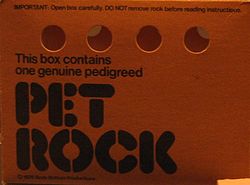
The Pet Rock "Pet Carrier", which doubled as its packaging
TypeCollectible toy
Invented byGary Dahl
CountryUnited States
Availability1975–present
MaterialsRock

Pet Rock is a collectible toy made in 1975 by advertising executive Gary Dahl. They are rocks packaged in custom cardboard boxes[1] complete with ventilation holes and straw bedding imitating a pet carrier.[2]

History

[edit]

Gary Dahl came up with the idea in a bar while listening to his friends complain about their pets; this gave him the idea for the perfect "pet": a rock.[2] A rock would not need to be fed, walked, bathed, or groomed, and it would not die, become sick, or be disobedient. Dahl said that they were to be the perfect pets and joked about it with his friends before producing Pet Rocks as toys in 1975.[3]

Lacking the capital to launch the product, Dahl convinced some colleagues to invest in it.[4][failed verification] He purchased the actual rocks from Mexican beaches for less than a penny each.[4]

The Pet Rock was introduced in August 1975 at a San Francisco trade show, and Dahl was then swarmed by orders from retailers.[4] The fad lasted about six months, ending after a short increase in sales during the Christmas season of December 1975. Although by February 1976 they were discounted due to lower sales,[citation needed] Dahl sold nearly 1.5 million Pet Rocks for just under $4 each during the initial release, turning 95 cents profit on each unit,[4] and became a millionaire.[5][6][7]

In 2022, the toy company Super Impulse purchased the rights to the Pet Rock, reviving the brand.[8] In the 2020s, Pet Rocks grew in popularity in South Korea as tools for meditation or venting out frustrations. Members of K-pop groups such as Seventeen and Enhypen post about their Pet Rocks online.[9]

A24 produced an official licensed Pet Rock as a tie-in for the film Everything Everywhere All at Once. This version of the Pet Rock has a pair of googly eyes attached in reference to a scene from that film. Also included are the straw bedding and instructions of the original, and a new version of the ventilated box printed with scenery from the film.[10][11][12]

Legacy

[edit]

The Pet Rock has had a lasting impact on popular culture. The character Zoe from Sesame Street owns a pet rock called Rocco. A video of Elmo from Sesame Street shouting at Rocco went viral in early 2022.[13]

In the film Minions: The Rise of Gru, the character Otto acquires a Pet Rock. He trades the zodiac stone for it, an integral point of the plot.[14] To promote the film, Sabec Limited released an official Pet Rock video game for Nintendo Switch.[15] A Funko Pop depicting Otto with his Pet Rock was also released.[16]

The video game Magic: The Gathering Arena features a Pet Rock named Dwayne.[17]

During the travels of the Perseverance rover on Mars, NASA scientists had observed around Sol 341 (February 4, 2022) that a small rock had dropped into one of its wheels. The rock was visible from one of the hazard avoidance cameras, and was determined not to be harmful to the rover's mission. The rock has since stayed on Perseverance's wheel for around 427 sols (439 days) as the rover traveled over 6 miles (9.7 km) on the Martian surface. NASA deemed that Perseverance had adopted a pet rock for its journey.[18][19][20] Later the rover picked up another pet rock named "Dwayne".[21]

See also

[edit]

References

[edit]
[edit]
Revisions and contributorsEdit on WikipediaRead on Wikipedia
from Grokipedia
The Pet Rock is a novelty invented in 1975 by American advertising executive Gary Dahl, consisting of a smooth, ordinary stone sourced from Rosarito Beach in , , and marketed as a low-maintenance "pet" that requires no feeding, walking, or cleaning. Each Pet Rock was packaged in a ventilated resembling a pet carrier, lined with straw, and accompanied by a 32-page filled with satirical instructions for "training" the rock, such as teaching it to sit, stay, and roll over. Dahl conceived the idea during a 1975 conversation with friends at a bar in , where they lamented the responsibilities of real pets and joked about rocks as ideal companions that "do nothing but be rocks." He sourced the stones for about a each from a local builder's supply and retailed them for $3.95, yielding a profit of approximately $0.95 per unit after packaging costs. Launched just before the 1975 season, the product exploded in popularity through clever marketing, including media appearances and ads emphasizing its absurdity as the ultimate hassle-free pet for busy Americans. The fad peaked rapidly, with approximately 1.5 million Pet Rocks sold within the first six months, generating approximately $5.9 million in revenue (equivalent to about $36 million in 2025 dollars) and turning Dahl into a almost overnight. Sales declined sharply by early 1976 as the novelty wore off, leading to discounted prices and the product's discontinuation later that year, though it briefly revived with merchandise like T-shirts and a Bicentennial edition. The Pet Rock exemplified consumer culture, capturing post-Watergate cynicism through humor and becoming a benchmark for viral fads that prioritize branding over utility.

Invention and Development

Origin of the Concept

Gary Dahl, an executive and freelance copywriter based in , is credited with inventing the Pet Rock as a in the mid-1970s. Working in the creative industry, Dahl had experience crafting persuasive messages for various clients, which later informed his approach to promoting unconventional products. The concept originated during a casual in a Los Gatos bar in 1975, where Dahl and his friends discussed the responsibilities and frustrations of caring for real pets, such as dogs and cats that required feeding, walking, and grooming. In response, Dahl humorously proposed that a simple rock would serve as the ideal "pet," free from any maintenance needs like veterinary care or exercise. This offhand remark, initially intended as amid the era's post-Vietnam cynicism, captured the absurdity of consumer desires for hassle-free companionship. Dahl soon recognized the satirical idea's potential as a marketable novelty, prompting him to take concrete steps toward commercialization in spring 1975. He filed for and obtained a trademark for "Pet Rock" and founded Rock Bottom Productions as his company to oversee the product's development and distribution. This move transformed the barroom jest into a structured business venture, leveraging Dahl's advertising expertise to position the item as a tongue-in-cheek alternative to traditional pets.

Product Creation and Packaging

The Pet Rock was created using smooth, gray stones sourced from Rosarito Beach in , , which were acquired from a local builders' supply company for less than one cent each. These ordinary beach rocks, selected for their rounded shape and lack of sharp edges, formed the core of the , emphasizing its simplicity as a low-maintenance "pet." The product was packaged in a custom-designed cardboard box resembling a pet carrier, complete with ventilation holes punched into the sides to mimic air holes for a live animal. Inside, the rock rested on a bed of to simulate , enhancing the humorous without adding functional complexity. This packaging transformed the plain stone into a ready-to-gift item, with the box's sturdy construction allowing it to double as a carrying case. A key element was the inclusion of a 32-page instruction manual titled The Care and Training of Your Pet Rock, authored by inventor Gary Dahl over two weeks. The booklet provided guidance on pet ownership, such as health tips like monitoring for "rock rot" (a fictional ailment treated by exposure to ) and training commands; for instance, to teach "Sit," one simply places the rock on a flat surface and issues the command, rewarding compliance with praise since the rock remains stationary by nature. No additional physical accessories like eyes or stickers were part of the original design, keeping the focus on the rock's unadorned form. For the initial production, the Pet Rocks were hand-assembled in Dahl's garage. This small-scale, DIY approach allowed for quick prototyping and testing the concept at local events before scaling up.

Marketing and Commercialization

Launch and Promotion Strategies

The Pet Rock made its debut at the Gift Show in August 1975, where inventor Gary Dahl showcased the to retailers and quickly secured orders, including 1,000 units from . This initial exposure highlighted the product's appeal as a low-maintenance alternative to traditional pets, setting the stage for broader . Dahl positioned the launch to capitalize on the holiday gift season, timing the rollout to align with impulse buying trends. Pricing was strategically set to encourage quick purchases, with a wholesale price of $2 per unit to retailers and a suggested retail price of $3.95, making it an affordable gift that evoked the era's satirical take on . Promotion relied heavily on media outreach, with press releases crafted by Dahl framing the Pet Rock as a humorous critique of pet ownership responsibilities and excessive , which drew features in major outlets like , Time, and . These stories amplified the product's novelty, turning it into a national without substantial budgets. Advertising emphasized the rock's effortless nature through witty taglines such as "no feeding, no walking, no vet bills," often displayed alongside in-store setups resembling pet shop cages to enhance the comedic effect. The accompanying care manual, with tongue-in-cheek instructions on training the rock, further reinforced this humorous angle. By October 1975, Dahl had forged partnerships with novelty stores and holiday gift shops, including Bloomingdale's, enabling nationwide distribution and rapid scaling of availability.

Sales Performance and Distribution

The Pet Rock achieved extraordinary commercial success during its brief run, with over 1.5 million units sold in the last six months of 1975 alone. These sales resulted in approximately $5.9 million in total retail revenue, transforming his novelty idea into a multimillion-dollar enterprise almost overnight. The product's high profitability stemmed from low production costs (with rocks sourced for less than a each), yielding about 95 cents in profit per unit sold. This margin allowed Dahl to amass over $1 million in personal earnings during the peak period. Distribution expanded rapidly across the following initial orders from high-end retailers, beginning with purchasing 1,000 units shortly after the product's debut at the San Francisco Gift Show in August 1975. By the holiday season, the Pet Rock was available in thousands of independent stores and major chains such as and , fueled by widespread media attention that briefly referenced in promotional contexts. At its height during the 1975 season, daily sales reached up to 100,000 units, underscoring the fad's explosive but short-lived demand. While primarily a domestic , international distribution was limited but included availability in , where the product gained some traction as evidenced by contemporary media coverage, and select markets in . These overseas efforts did not match U.S. volumes, contributing modestly to overall sales before the waned by early 1976.

Cultural and Social Impact

Representation in Media and Pop Culture

The Pet Rock has been frequently referenced in television and film as an emblem of 1970s absurdity and consumer whimsy. On , the character Zoe's pet rock named was introduced in 1999, portraying the inanimate object as a lively companion in Zoe's imagination that interacts with other characters like . In the 1999 film , the invention is cited as an example of a simple idea yielding massive success, with a character remarking on the creator's fortune from marketing a rock as a pet. Similarly, the animated series includes subtle nods, such as a protest sign demanding the return of a "pet rock," underscoring its enduring cultural resonance. The fad has also featured in 1970s nostalgia documentaries and compilations, such as ABC News retrospectives highlighting its role in post-Watergate humor and . In literature, the Pet Rock is chronicled in books on American fads, like those exploring 20th-century novelties, where it exemplifies satirical over utility. Original 1975 Pet Rock kits have achieved collectible status, with well-preserved examples including the cardboard box, straw bedding, and instruction manual fetching $20 to $100 on online marketplaces like , depending on condition and completeness. Modern reproductions, often sold as nostalgic replicas, maintain the original packaging design to appeal to retro enthusiasts. The Pet Rock's concept has inspired parodies in , mirroring its own promotion of everyday objects as luxury items, and it resurfaces in online memes during 2020s nostalgia waves for pop culture. These digital revivals often juxtapose the fad's simplicity against contemporary trends, emphasizing its timeless absurdity. It has also appeared in recent media, such as the 2022 animated Minions: The Rise of Gru. An annual National Pet Rock Day, inspired by the 1975 phenomenon, is celebrated on the first Sunday in September to honor low-maintenance "pets" and inventive humor, though unofficial events tied to Gary Dahl have occurred sporadically since the early . The Pet Rock emerged as a reflection of the post-Watergate era's cynicism, offering consumers a form of ironic humor amid widespread disillusionment with institutions and authority. In the mid-1970s, following the and the , Americans sought escapist, low-stakes entertainment that poked fun at societal seriousness, and the Pet Rock—marketed as the "perfect pet" requiring no care—provided just that in a simple, absurd package. This alignment with a desire for uncomplicated, satirical relief helped propel the item into a national phenomenon, influencing how novelty products could tap into cultural moods for quick market success. The Pet Rock served as a catalyst for the broader novelty pet trend in the , inspiring a wave of whimsical, low-maintenance "pets" that emphasized humor over utility. By packaging ordinary rocks with accessories like a "" and a humorous training manual, it demonstrated how everyday objects could be reimagined as commodified companions, paving the way for other gag-oriented items. This shift encouraged manufacturers to explore ironic, accessory-driven novelties, extending the concept to themed variations that built on the Pet Rock's blueprint of absurdity and accessibility. Its surge in popularity particularly boosted holiday gifting patterns, turning the Pet Rock into a staple impulse buy for seasonal novelty seekers and reshaping retail approaches to fad-driven . During the 1975 season, demand skyrocketed, with retailers reporting up to 100,000 units sold daily as consumers snapped up the $3.95 items for gifts and stocking stuffers, contributing to over 1.5 million total in mere months. This frenzy highlighted the potential of short-term trends to drive impulse purchases in gift categories, prompting stores to stockpile and promote seasonal absurdities more aggressively to capitalize on holiday urgency. As a piece of , the Pet Rock underscored the absurdity of during a period of economic uncertainty, including and the , by commodifying something inherently worthless and exposing the era's penchant for superficial pet ownership. It satirized the trend of treating pets as status symbols or emotional crutches, revealing how economic pressures could fuel demand for inexpensive, ironic alternatives to real companionship. The product's success illustrated the malleability of perceived value in consumer culture, where marketing could transform a free rock into a must-have amid broader societal . Exemplifying the fleeting nature of fads, the Pet Rock's boom lasted approximately six months—from its August 1975 launch to early 1976—contrasting sharply with enduring brands and demonstrating how novelty items can achieve explosive but temporary market dominance. While it generated millions in revenue quickly, sales plummeted post-holidays, underscoring the challenges of sustaining hype-driven trends against long-term loyalty.

Decline and Legacy

End of the Fad

The Pet Rock fad, which had seen explosive sales exceeding 1.5 million units during its peak in late 1975, experienced a sharp decline by early 1976 due to market oversaturation from copycat products and the inherent lack of repeat purchases for a novelty item. Retailers responded by initiating clearance sales and discounting the $3.95 product to offload excess inventory. As demand evaporated, production came to a halt, with factories shutting down and remaining unsold rocks returned to suppliers. Gary Dahl, who had earned approximately $15 million in total sales from the venture, encountered financial strain from a filed by his George Coakley, who sought a greater share of the profits; Dahl settled the , which forced him to pay a significant portion of the profits. Minor legal challenges also emerged over trademark infringements by imitators, though these did not significantly prolong the product's viability. By March 1976, six months after the August 1975 launch, the fad had conclusively ended, leaving behind stacks of unsold inventory and a brief but intense chapter in consumer history.

Long-Term Business and Cultural Significance

The Pet Rock is often cited as an example in discussions of , exploitation, and low-cost , illustrating the rapid of a simple product packaged with clever branding. Educators use it to demonstrate how humor and timing can drive consumer demand, emphasizing Dahl's strategy of turning an everyday object into a perceived novelty without significant upfront . After the initial Pet Rock boom, creator Gary Dahl returned to his career in advertising as a copywriter and executive, later authoring the book Advertising for Dummies in 2001, which provided practical guidance on advertising strategies for beginners. The Pet Rock endures as a symbol of and consumer absurdity, representing the era's embrace of ironic, low-effort fads in American pop culture. It has been featured in exhibits on historical fads at institutions like National Museum of Play, highlighting its role in toy and novelty history. In the , the Pet Rock has inspired parallels to digital fads, such as NFT projects like EtherRocks, which mimic its "absurd investment" model by selling virtual images of rocks for thousands of dollars on platforms. Gary Dahl died on March 23, 2015, at the age of 78 from in ; obituaries across major publications universally highlighted the Pet Rock as his defining achievement and a landmark in marketing history.

References

Add your contribution
Related Hubs
User Avatar
No comments yet.