Hubbry Logo
PhaonPhaonMain
Open search
Phaon
Community hub
Phaon
logo
8 pages, 0 posts
0 subscribers
Be the first to start a discussion here.
Phaon
Phaon
from Wikipedia
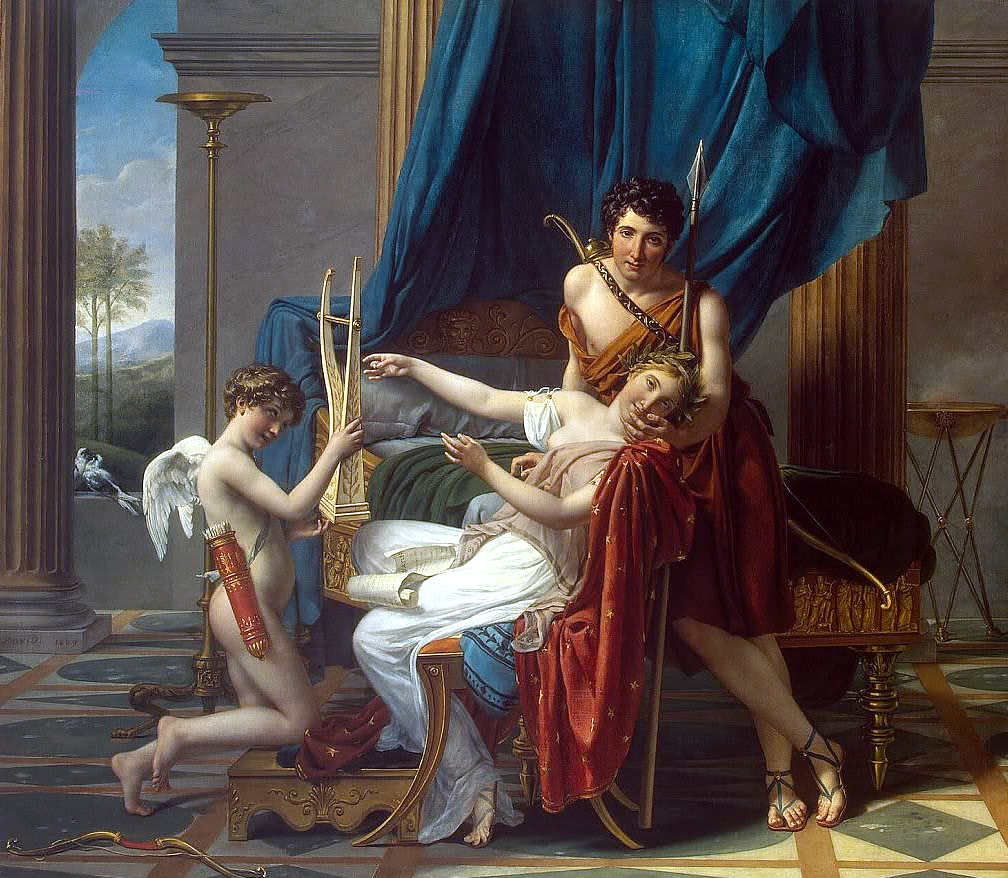
Sappho, Phaon, and Cupid. Jacques-Louis David, 1809

Phaon (Ancient Greek: Φάων; gen.: Φάωνος) was a boatman of Mytilene in Lesbos in Greek mythology. He was old and ugly when Aphrodite came to his boat. She put on the guise of a crone. Phaon ferried her over to Asia Minor and accepted no payment for doing so. In return, she gave him a box of ointment. When he rubbed it on himself, he became young and beautiful. Many were captivated by his beauty.

According to Athenian Theater, Sappho fell in love with him. He lay with her but soon grew to resent her and devalue her. Sappho was so distraught with his rejection that she threw herself into the sea under the superstition that she would be either cured of her love, or drowned.[1] She was drowned. Aelian says that Phaon was killed by a man whom he was cuckolding.

Aside from Aelian, Phaon's story is told by Ovid and Lucian. He is also mentioned by Plautus in Miles Gloriosus as being one of only two men in the whole world, who "ever had the luck to be so passionately loved by a woman" (Act 3).

This article incorporates text from the public domain 1848 edition of Lemprière's Classical Dictionary.

References

[edit]
[edit]
Revisions and contributorsEdit on WikipediaRead on Wikipedia
from Grokipedia
Phaon is a figure in , portrayed as an elderly ferryman from on the island of who was transformed into a beautiful young man by the goddess after he graciously transported her across the strait disguised as a , refusing any fare. This act of kindness earned him and divine favor, with anointing him with a magical ointment that restored his vigor and attractiveness, drawing parallels to her beloved by hiding him among lettuces to protect him from harm. In later traditions, Phaon became the object of unrequited love for the poet , who, rejected by him, is said to have leapt to her death from the White Rock of Leukas in despair, a motif symbolizing themes of transformation, love, and the boundaries between in . His story, preserved in fragments of Sappho's poetry (F 211 V) and comedic references by (F 258 K), underscores solar and fertility associations linked to 's cult, portraying Phaon as a paredrus or divine companion of the goddess. Ancient accounts, including those by in his and , further elaborate on Phaon's role, emphasizing his exceptional beauty as one of the few mortals deemed surpassingly handsome, even inspiring artistic depictions such as the red-figure where rewards him by granting him the Demonassa.

Greek Mythology

Encounter with Aphrodite

In , Phaon was depicted as an elderly and unattractive boatman who operated a service across the narrow between the island of and the nearby mainland of Asia Minor, close to the city of . This role positioned him as a humble figure reliant on fares from wealthy passengers. One day, , the goddess of and beauty, approached Phaon in disguise as a frail old woman claiming poverty and requesting free passage. Touched by her apparent need, Phaon ferried her across without demanding payment, demonstrating his kindness. Upon reaching the other side, Aphrodite revealed her divine identity and, in gratitude for his generosity, anointed him with a magical ointment that transformed the aged ferryman into a youthful and strikingly handsome man endowed with radiant beauty. This metamorphosis underscored Aphrodite's dominion over love, desire, and physical allure, rewarding mortal with rejuvenation. The transformation narrative highlights recurring motifs in Aphrodite's lore, where she intervenes to alter human forms to inspire passion, as seen in her associations with beauty and erotic transformation across traditions. This event later drew the infatuation of the poet , captivated by Phaon's newfound allure.

Association with Sappho

In tradition, , the renowned lyric poet from , is depicted as having developed an intense, unrequited passion for Phaon, a figure portrayed as an ideal male beloved that contrasted sharply with her typical focus on female muses in her surviving poetry. This legendary attraction marked a narrative shift in perceptions of Sappho's erotic themes, from homoerotic longing toward women to heterosexual desire, though no direct evidence of such a romance appears in her own verses. The myth likely emerged in the late fourth century BCE, reflecting later cultural interpretations of her life and work rather than historical fact. Central to this association is the story of Sappho's despair leading her to leap from the White Rock, a prominent cliff on the island of Leukas, as an act of purification to cure her or, in some accounts, as suicide due to rejection. This ritualistic jump was part of an established cult practice at Cape Leukas, where devotees sought relief from erotic torment, a tradition said to have originated with leaping for . The earliest literary reference to Sappho's involvement appears in a fragment from Menander's Leukadia (F 258 K-A), where she is described as diving from the rock out of love for Phaon, indicating the tale's familiarity by the early third century BCE. Additional allusions occur in earlier works, such as Cratinus's (F 330 K-A) and Hellenistic sources like (F 478 Pf.) and (13.69d-e), underscoring the myth's integration into Greek literary culture. The tied Phaon's allure to Sappho's poetic inspiration, suggesting his catalyzed a thematic in her imagined oeuvre, though scholars emphasize this as a post-classical fabrication to align her legacy with broader Greek motifs of love and mortality. Geographer (10.2.9) describes the Leukas ritual in the context of Aphrodite's worship, linking it to Lesbos's cultural milieu, where Sappho's erotic poetry celebrated communal pleasures and devotion to the goddess of love. This association reinforced Lesbos's reputation as a hub for such themes, with Sappho's verses often performed in sympotic settings that blurred personal and mythic boundaries. Variations in the myth highlight Phaon's explicit rejection of or his mere indifference, with some accounts predating Attic comedy and possibly stemming from oral traditions around her death circa 570 BCE. While no surviving comedies directly feature both characters together, the narrative's persistence in rhetorical and dramatic contexts by the fourth century BCE illustrates its role in shaping Sappho's enduring image as a tragic lover.

Literary Depictions

In Ovid's Heroides

Ovid's is a collection of fictional epistles purportedly written by mythical women to their absent lovers, showcasing the poet's innovative use of the epistolary form to explore themes of abandonment and desire. Epistle 15, known as the Epistula Sapphus, presents a letter from the lyric poet to , influenced by 's amatory poetry. In this work, Ovid invents a narrative where Sappho, traditionally associated with the myth of a ferryman transformed into a handsome youth by , confesses her overwhelming passion for Phaon after his departure to . The letter unfolds through key themes of Sappho's confession of , her abandonment of familial duties and past affections, and desperate pleas for Phaon's return. Sappho admits that her heart, once divided among many admirers including the "Lesbian maids," now burns solely for Phaon, declaring, "I burn – as burns the fruitful acre when its harvests are ablaze," to convey the consuming nature of her desire. She laments neglecting her daughter and brother amid her grief, underscoring the total disruption of her life: "I have left my daughter, left my brother; you alone I ." Her pleas intensify as she begs, "O hither come; sail back again, O beauteous one, to my embrace!" emphasizing her vulnerability and hope for reconciliation. Ovid depicts Phaon as a silent, aloof figure whose absence amplifies his allure, symbolizing unattainable beauty in contrast to Sappho's vocal anguish. Phaon receives no direct voice, existing only through Sappho's idealized recollections, such as comparisons to Apollo and Bacchus: "You have beauty, and your years are apt for life’s delights; / Phoebus himself were not more fair, nor he who tames the vine." This portrayal heightens the , positioning Phaon as the catalyst for Sappho's emotional unraveling without agency of his own. Ovid employs vivid poetic devices, including fire imagery for passion and natural metaphors for turmoil, to immerse in Sappho's perspective. The "shining" allure of Phaon evokes radiant , while Sappho's disordered appearance—tears like "drops of " and unkempt —mirrors her inner chaos, culminating in her contemplation of the Leucadian leap: "nor from it fear to leap!" These elements underscore her desperation, as she weighs against reunion, transforming personal into universal . Composed in the late 1st century BCE, likely between 25 and 16 BCE as part of Ovid's early poetic output, 15 reflects the Augustan era's interest in mythological reinvention and female subjectivity. This epistle profoundly influenced later interpretations of the -Phaon myth, mythologizing Sappho as a tragic lover and shaping her reception in and beyond by blending historical poet with fictional heroine.

In Other Ancient Sources

In Hellenistic and Roman sources, Phaon appears as a favored lover of , often paralleled with in protective myths. Ancient sources, such as ' Deipnosophistae, drawing on earlier comic traditions, record that the poet Cratinus (5th century BCE) described hiding Phaon in "fair lettuce-beds" to shield him from danger, evoking the goddess's concealment of the infant in similar foliage for safety. This motif underscores Phaon's role as a youthful paramour under divine protection, a theme echoed in later rationalizing accounts like Palaephatus's On Unbelievable Things, where transforms the aged ferryman into a beautiful as reward for his kindness. In ancient comedy, Phaon features in allusions to Sappho's legendary passion and . Menander's lost play Leukadia (The Woman from Leucas, ca. 300 BCE) dramatizes the motif of Sappho's leap from the Leucadian cliff due to for Phaon, as preserved in Strabo's (10.2.9), which quotes Menander's fragment: "Down from the white rock / The ancient writers made you / First to leap for love of Phaon." This comedic treatment likely drew on circulating Hellenistic legends, portraying Phaon as the catalyst for Sappho's dramatic end rather than a fully fleshed character. Roman scholiastic commentary further links Phaon to 's favors and the Leucadian ritual. In his 4th-century CE commentary on Virgil's (3.279), Servius explains the promontory of Leucate as a site for therapeutic leaps to cure love-sickness, citing Sappho's jump for Phaon as the origin; he adds that granted Phaon an of , transforming him from a wrinkled old man into a handsome youth after he ferried her gratis, thereby attracting Sappho's fatal desire. This account synthesizes earlier Greek traditions, emphasizing the ritual's apotropaic function in expelling erotic madness. No surviving fragments of Sappho's (ca. 6th century BCE) directly name Phaon, suggesting the association may stem from later interpolations or local Lesbos oral traditions rather than her own verses. Scholars note possible ties to archaic fertility cults on , where worship involved themes of transformation and divine-human unions, but no epigraphic or archaeological evidence explicitly connects Phaon to such rites or cliff-jumping practices on the island. The Leucadian leap itself, however, attests to broader Greek rituals for love-cures, potentially influencing the myth's development. Debates persist among classicists on Phaon's origins as a folkloric figure predating literary , possibly rooted in pre-Hellenistic folklore about a divine ferryman or Adonis-like youth, later retrofitted to Sappho's biography in and scholia to explain her "." This view contrasts with interpretations seeing Phaon as a Hellenistic construct, absent from early sources and amplified in Roman-era syntheses like Ovid's, to romanticize Sappho's legacy.

Etymology and Interpretations

Name Origin

The name Phaon (Ancient Greek: Φάων, genitive Φάωνος) derives from the root φάω (phaō), meaning "to shine" or "give light," closely related to φάος (phaos), denoting "light" or "radiance." This etymological connection underscores the figure's mythic transformation into a youthful, luminous beauty, evoking brightness in ancient Greek linguistic traditions. The name appears in the genitive form Phaonos in Greek sources, such as the Byzantine Suda lexicon (entry sigma 108), which references Phaon of Mytilene in connection with Sappho's legendary leap from the Leukas cliff. In Ovid's Latin Heroides 15, Sappho addresses her unrequited love to Phaon (using the Latin form of the name), and in the Byzantine Suda lexicon (entry sigma 108), which references Phaon of Mytilene in connection with Sappho's legendary leap from the Leukas cliff. These usages preserve the name as a proper noun tied to Lesbos, without variation in form across the sources. The name shares its "phao-" root with other mythic figures, such as (Φαέθων), the "shining" son of , but Phaon remains distinct as a unique proper name limited to this ferryman , lacking the associations of its counterpart. In the Aeolic dialect of , Phaōn functions as the local equivalent of the Ionic phaethōn ("shining"), aligning with the island's poetic and mythic heritage. Historical records from , including epigraphic evidence compiled in databases like the Lexicon of Greek Personal Names, yield no attestations of Phaon as a common among individuals during the archaic or classical periods, confirming its status as an exclusively mythic designation.

Symbolic Meanings

In , Phaon symbolizes transient beauty and the ephemeral nature of divine favor, as exemplified by his transformation from an aged, unattractive ferryman into a youthful paragon of handsomeness through Aphrodite's intervention. This motif underscores the fragility of mortal allure, granted only briefly by the goddess of love before its inevitable loss, much like the short-lived bloom in . Scholars interpret Phaon's as an etiological narrative explaining the Leucadian leap, a associated with the White Rock of Leukas, where lovers sought from unrequited passion; Sappho's purported dive for Phaon thus projects her poetic persona onto Aphrodite's cosmic pursuits of mortal beloveds. The tale also parallels , another of Aphrodite's lovers, through the lettuce-hiding motif, which evokes agricultural cycles of growth, harvest, and decay in fertility cults, where quick-wilting "Gardens of Adonis" represented vegetative transience and renewal. Gender dynamics in the Phaon narrative highlight a reversal of traditional roles, positioning the male figure as the rare, pursued object of desire within the Sapphic tradition, which predominantly celebrates female homoerotic bonds; this anomaly likely served to rationalize perceived shifts toward heterosexual themes in later attributions to Sappho's oeuvre. Twentieth-century analyses, such as those by classicists like , frame Phaon as emblematic of romantic tragedy, with the myth's suicidal climax symbolizing the destructive intensity of eros, while modern queer scholarship views it as a constructed to Sappho's identity, potentially invented to impose heterosexual norms on her legacy. Scholarly consensus holds that Phaon is a fictional construct, emerging in Hellenistic or later periods rather than reflecting historical reality, as no contemporary evidence links him to the archaic poet.

References

Add your contribution
Related Hubs
User Avatar
No comments yet.