


Community hub
Recent from talks
Contribute something
Nothing was collected or created yet.
Phlox stolonifera
View on Wikipedia
| Phlox stolonifera | |
|---|---|

| |
Scientific classification 
| |
| Kingdom: | Plantae |
| Clade: | Tracheophytes |
| Clade: | Angiosperms |
| Clade: | Eudicots |
| Clade: | Asterids |
| Order: | Ericales |
| Family: | Polemoniaceae |
| Genus: | Phlox |
| Species: | P. stolonifera
|
| Binomial name | |
| Phlox stolonifera Sims 1802
| |
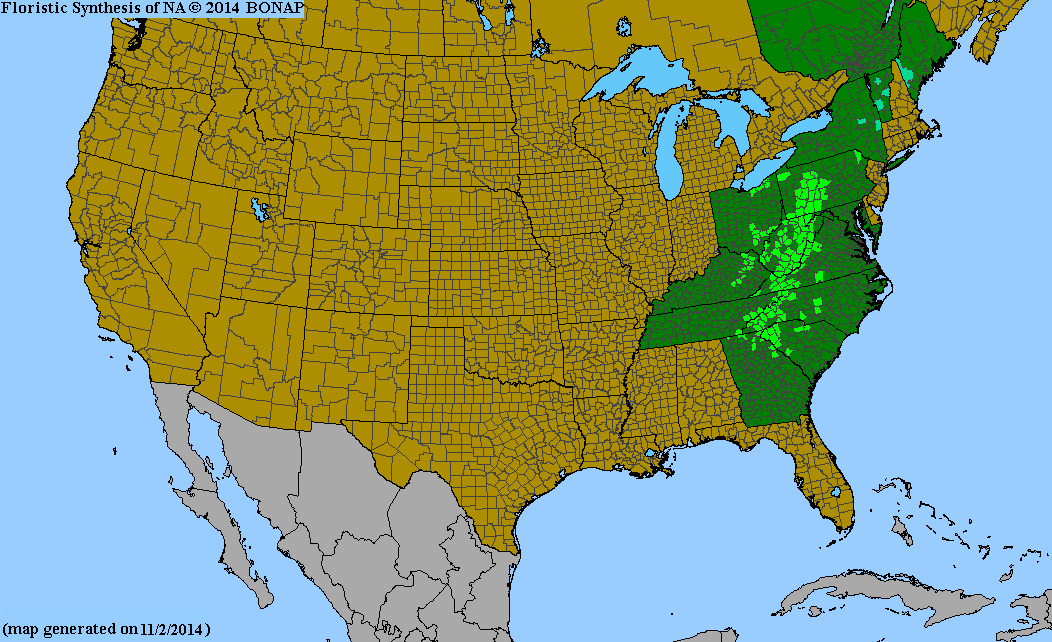
Phlox stolonifera (creeping phlox or moss phlox) is a species of flowering plant in the family Polemoniaceae. It is a perennial herbaceous plant that is native to the eastern United States.[1] It occurs in woodlands and stream banks[1] in the vicinity of the Appalachian Mountains from Pennsylvania south to northern Georgia. Naturalized populations occur as far north as Québec, Canada.[2]
Its flowers are pale purple, pink, or white, 2–2.5 cm (0.79–0.98 in) in diameter, with a five-lobed corolla and yellow stamens, which are borne on stems that are 15–25 cm (6–10 in) tall. They lack the central band of color that is present in the flowers of the related Phlox subulata.[3]
The leaves are ovate. Those on creeping stems are 3–4.5 cm (1.2–1.8 in) long and 1.8 cm (0.71 in) broad, while those on the erect flowering stems are smaller, 2 cm (1 in) long.[3]
The Latin specific epithet stolonifera means having stolons or rooting runners.[1]
Characteristics
[edit]The creeping phlox flowers typically have 5 petals, but there could also be 6 or 7 petals. They range from pale blue and violet to purple and vibrant.
Uses
[edit]Creeping Phlox is widely used as a groundcover. Its trailing growth habit and dense mat-like foliage help suppress weed growth and prevent soil erosion on slopes or in areas where grass may not thrive.
Gallery
[edit]-
 Large patch of phlox
 -
 Creeping stems at edge of patch
 -
 Patch of Creeping phlox


References
[edit]- ^ a b c "Phlox stolonifera - Plant Finder". www.missouribotanicalgarden.org. Retrieved 2021-11-11.
- ^ Biota of North America Program 2014 county distribution map
- ^ a b Sims, John. 1802. Curtis's botanical magazine, plate 563 and preceding unnumbered textual page full-page color illustration, description, and commentary.
External links
[edit]
- Discover Life, University of Georgia (includes distribution map)
- North Carolina State University
.jpeg) | This Polemoniaceae article is a stub. You can help Wikipedia by adding missing information. |
Phlox stolonifera
View on GrokipediaDescription
Morphology
Phlox stolonifera is a low-growing, mat-forming perennial herbaceous plant in the Polemoniaceae family, characterized by its spreading habit through creeping stolons that create dense foliage mats up to 7.6 cm (3 inches) tall, with upright flowering stems reaching 15–30 cm (6–12 inches) in height. The stems are primarily creeping and vegetative on the lower portions, forming loose colonies, while fertile stems are erect and arise from the mat to support inflorescences; these stems have a circular cross-section and are pubescent between nodes. The overall form is semi-evergreen, with a medium texture and rapid growth rate, allowing it to spread indefinitely via stolons.[1][4][5] Leaves are simple and oppositely arranged, with two per node, exhibiting shapes ranging from ovate and oblong to lanceolate, obovate, or spatulate; they feature entire margins, a leathery texture, and a deep green color, often with a fuzzy underside. On creeping stolons, leaves measure 2.5–7.6 cm (1–3 inches) long and up to 2.5 cm (1 inch) wide, while those on flowering stems are narrower and shorter, approximately 1.9 cm (0.75 inches) long; the leaves lack hairs on the upper surface and are sessile or short-petiolate. This leaf structure contributes to the plant's evergreen appearance in milder climates.[1][4] Flowers are arranged in loose, terminal cymes and are salverform, consisting of a slender tube flaring into five flat, rounded, petal-like lobes; each flower is 2–2.5 cm (0.75–1 inch) in diameter, radially symmetrical, and typically pale lavender, pink, purple, or white, with yellow stamens and sometimes a purple-red eye at the throat. Blooming occurs from April through June, with the fragrant blossoms emerging above the foliage in clusters. Unlike related species such as Phlox subulata, P. stolonifera flowers generally lack a prominent central color band.[1][4][5] The fruit is a small, dry capsule with three locules that dehisces when mature, containing numerous tiny seeds; however, vegetative spread via stolons is the primary mode of propagation, making fruit production less emphasized in the plant's lifecycle.[4][5]Growth habit
Phlox stolonifera is a herbaceous perennial that forms loose mats of semi-evergreen foliage, with leaves persisting through mild winters but dying back in harsh conditions.[5] The plant's lifecycle involves active vegetative growth during spring and summer, followed by a period of dormancy in winter, allowing it to regrow from rootstocks and stolons each year.[1] The species spreads primarily via horizontal stolons, which are above-ground leafy stems that root at the nodes, enabling rapid colonization and formation of dense mats.[1] Individual plants typically achieve a spread of 23–46 cm (9–18 inches), though colonies can expand indefinitely in suitable habitats, creating extensive ground covers up to 1.5 feet wide or more per mature specimen.[3] Flowering occurs from April through June, after which fertile stems may die back, while vegetative stolons continue to propagate the plant.[1] Maturity is reached in 2–3 years, at which point the plant establishes full coverage through stolon rooting and branching.[1] In optimal conditions, P. stolonifera is a long-lived perennial due to its robust nature.[1] It exhibits adaptations for persistence, such as tolerance to partial burial by leaf litter, which protects crowns and stolons in woodland environments.[1]Taxonomy
Classification
Phlox stolonifera belongs to the family Polemoniaceae, commonly known as the phlox family, within the order Ericales in the class Magnoliopsida.[6] The genus Phlox encompasses approximately 65 species, primarily native to North America, and P. stolonifera is classified in subgenus Phlox and section Phlox, characterized by perennial herbs with soft deciduous leaves and long styles.[7] This infrageneric position highlights its stoloniferous growth habit, which sets it apart from more upright species in the genus.[8] The species was first described as Phlox stolonifera by John Sims in 1802, based on material published in Curtis's Botanical Magazine, and the basionym has remained unchanged since its valid publication.[6] No synonyms are widely recognized in current taxonomic treatments, though P. stolonifera is sometimes confused with Phlox subulata due to superficial similarities in their low-growing, mat-forming habits and shared common names like creeping phlox or moss phlox.[4] Within the genus, P. stolonifera is most closely related to other eastern North American species such as Phlox divaricata (woodland phlox) and Phlox bifida, all belonging to an eastern clade of standing phlox.[8] Recent phylogenomic analyses place P. stolonifera as basal within this clade, diverging early from long-styled ancestors, while P. divaricata occupies a derived position in a monophyletic short-styled subgroup; these relationships reflect broader evolutionary patterns in Polemoniaceae, where eastern lineages have diversified in temperate woodland habitats.[9]Etymology
The genus name Phlox originates from the Ancient Greek word phlox, meaning "flame," a reference to the vivid colors of the flowers in various species, as coined by Carl Linnaeus in his Species Plantarum in 1753.[10][11] The specific epithet stolonifera is derived from New Latin, combining the Latin stolo (genitive stolonis), meaning "a shoot, sucker, or stolon," with -fera, from Latin -fer meaning "bearing" or "producing," thus describing the plant's characteristic production of creeping stolons or runners.[12][13] This epithet was proposed by John Sims in 1802 to highlight the species' prostrate, rooting growth habit.[6] Common names for Phlox stolonifera include creeping phlox, reflecting its spreading, ground-covering form via stolons, and moss phlox, alluding to the dense, mat-like appearance of its foliage, despite no relation to true mosses.[1][14] The name woodland phlox is also occasionally applied, emphasizing its native woodland habitat.[5] The species was first formally described by John Sims in Curtis's Botanical Magazine (volume 16, plate 563) in 1802, based on living plants collected in Georgia, United States, by the plant collector John Fraser during his expeditions in the late 18th century; these specimens were introduced to cultivation in Europe around 1801.[6] The description notes the trivial name as apt for its trailing habit, akin to other stoloniferous plants like Ajuga reptans.Distribution and habitat
Native range
Phlox stolonifera is native to the eastern United States, where it is primarily distributed in the Appalachian Mountains and adjacent Piedmont regions. Its range extends from Pennsylvania and southern Ohio southward through West Virginia, Maryland, Kentucky, Virginia, North Carolina, Tennessee, South Carolina, Georgia, and Alabama.[5][15] The species occurs in diverse topographic settings within this region, from low-elevation Piedmont woodlands to mid-elevation mountain foothills and ridges, spanning approximately 1,000 kilometers in a north-south direction along the Appalachian chain.[5][1] Beyond its native range, P. stolonifera has become naturalized in southern Québec, Canada, and introduced in parts of New England such as Maine, New York, and Vermont, where populations likely originated from ornamental plantings that escaped cultivation.[4][5]Environmental preferences
Phlox stolonifera thrives in the understory of deciduous woodlands, forest edges, and along stream banks, where it forms mats in humus-rich, loamy soils typical of these temperate forest ecosystems.[3][5] This species is adapted to the shaded, moist conditions of these habitats, contributing to ground cover in areas with dappled light filtering through the canopy.[4] The plant prefers moist, well-drained soils high in organic matter, with a slightly acidic to neutral pH ranging from 5.5 to 7.0, though it can tolerate clay soils if drainage is adequate and avoids waterlogging.[1][3] In terms of light, it excels in partial shade to dappled sunlight, such as beneath a forest canopy, but can adapt to full sun in cooler climates where excessive heat is not a factor.[5][1] Suited to temperate climates in USDA hardiness zones 5 through 9, P. stolonifera requires vernalization with approximately 1,000 to 1,500 chilling hours (equivalent to 6–8 weeks of cold exposure) to promote optimal spring blooming.[16] Once established, it demonstrates drought tolerance while favoring consistent moisture to maintain vigor.[1] In its native understory, it often grows alongside ferns, trilliums, and hepatica, but remains sensitive to competition from invasive species such as garlic mustard, which can disrupt its habitat.[17][18]Ecology
Reproduction and pollination
Phlox stolonifera is an early spring bloomer, typically flowering from April to June, with inflorescences bearing numerous flowers.[19] The flowers, which feature tubular corollas as described in its morphology, provide nectar to attract pollinators during this period.[1] The species is entomophilous, relying primarily on insect pollination, with bees, butterflies, and hummingbirds serving as key vectors due to the nectar-rich blooms.[20][1] Seed production in P. stolonifera is limited, as the plant is self-incompatible and requires cross-pollination for fertilization.[21][22] Each capsule yields few viable seeds, which are primarily dispersed by gravity. In natural settings, there is low reliance on sexual reproduction via seeds, with recruitment often minimal compared to clonal expansion.[22] Vegetative reproduction dominates the species' spread through stolons, which root at nodes to form extensive mats.[1] This asexual mode, aligned with its trailing growth habit, promotes genetic uniformity within clones while allowing occasional sexual events to introduce diversity.[23] Overall fertility emphasizes high clonal fidelity, with sexual reproduction occurring sporadically to sustain genetic variation; no apomixis has been reported in the species.[21]Biotic interactions
Phlox stolonifera serves as a key early-season nectar source for native pollinators, including bees, butterflies, and hummingbirds, thereby supporting biodiversity in spring woodlands.[1] Its fragrant, tubular flowers attract insects with long proboscises, such as swallowtail butterflies and day-flying sphinx moths, as well as hummingbirds.[24][23] It also serves as a host plant for larvae of certain Lepidoptera species.[21] The plant experiences moderate herbivory pressure from deer and rabbits, though it shows some tolerance; cottontail rabbits in particular may browse foliage and new growth.[1] It is susceptible to pests like spider mites in hot, dry conditions and slugs in overly moist sites.[1][23] Diseases include powdery mildew, which thrives in humid environments and can be mitigated by ensuring good air circulation and deadheading spent flowers; fungal root rots, such as black root rot and Phytophthora blight, occur in wet soils with poor drainage.[1][23] Through its stoloniferous growth, P. stolonifera forms loose, spreading mats that suppress weed establishment by occupying space in the understory.[24] However, it can be outcompeted by invasive species like Japanese stiltgrass (Microstegium vimineum), which displaces native groundcovers in disturbed woodlands.[25] The plant's mat-forming habit also contributes to erosion control along slopes and stream banks by stabilizing soil.[1][23] Globally, Phlox stolonifera is ranked as Apparently Secure (G4) by NatureServe, indicating low risk of extinction, though it faces vulnerability (S3) in some states like Georgia and Kentucky due to habitat alterations.[26] Local populations may decline from habitat fragmentation in eastern North American forests, but the species overall supports ecosystem health by enhancing pollinator resources.[23]Cultivation
Growing requirements
Phlox stolonifera thrives in sites with partial shade to full sun, though it performs best with morning sun and afternoon shade to mimic its native woodland edges, making it suitable for slopes, rock gardens, or borders.[27][5] It tolerates full shade but may exhibit reduced flowering in deep shade, while excessive full sun can lead to poor performance without adequate moisture.[5] For soil preparation, incorporate compost or organic matter to create humus-rich, well-drained conditions that retain moisture without waterlogging; the preferred pH range is 5.5 to 7.0, encompassing slightly acidic to neutral soils.[1][27] Mulching with leaf litter helps suppress weeds, conserve humidity, and maintain soil temperature, enhancing its mat-forming growth habit.[27] Watering should keep the soil consistently moist during the first year to establish roots, after which the plant becomes moderately drought-tolerant, requiring supplemental irrigation only during prolonged dry spells.[5] Maintenance involves applying a balanced, slow-release fertilizer sparingly in spring to avoid excessive foliage at the expense of blooms, and dividing clumps every 3 to 4 years in early spring to rejuvenate vigor and control spread.[27] This species is hardy in USDA zones 5 to 9, with optimal performance in temperate climates where winter protection from excessive wetness—such as improved drainage or raised beds—is provided to prevent root issues.[3][1] It shows good resistance to deer and rabbits, though netting may be necessary in areas of high browsing pressure.[1] Common issues include powdery mildew in humid summers, which can be mitigated by ensuring good air circulation and cutting back stems after flowering; overwatering leads to root rot, so well-drained sites are essential.[27] Slugs may pose problems in overly moist conditions, and spider mites can appear in hot, dry weather, but overall, it is low-maintenance in suitable humid, temperate regions.[5]Propagation methods
Phlox stolonifera is primarily propagated vegetatively through division, which involves digging up established clumps in early spring or fall and separating the rooted stolons for immediate replanting. This method leverages the plant's natural stoloniferous growth habit, allowing for rapid establishment of new plants in moist, well-drained soil. Division is favored for its simplicity and high reliability in maintaining genetic uniformity, particularly in home gardens.[1] Stem cuttings provide another effective vegetative approach, typically taken as 5-10 cm softwood tips from new growth in late spring or early summer. The cuttings are prepared by removing lower leaves and inserting them into a moist medium such as sand or perlite, optionally treated with rooting hormone, under high humidity conditions like mist. Roots generally form within 2-4 weeks, after which the young plants can be transplanted once established. This technique is straightforward and yields quick results without the need for specialized equipment.[5][28] Seed propagation is possible but less common due to slower maturation; seeds are collected after blooming and benefit from cold stratification at approximately 4°C for 30-60 days to mimic natural overwintering. Stratified seeds are then sown in spring in a sterile, well-draining medium. However, seedlings may take 1-2 years to reach flowering, making this method more suitable for commercial production than immediate garden use.[5][29] All propagation methods achieve optimal success when performed in early spring to avoid summer heat stress, using sterile media to prevent fungal issues like damping-off, and providing consistent moisture during rooting or germination phases.[28][1]Notable cultivars
Phlox stolonifera cultivars are primarily selections from wild populations native to the Appalachian Mountains, where the species thrives in wooded areas and along stream banks from Pennsylvania to Georgia. These selections emphasize enhanced flower color, vigorous spreading habit, and adaptability to shaded garden conditions, without documented hybridization with other Phlox species. Breeders and nurseries have focused on traits like dense mat formation and prolonged bloom periods to suit ornamental use as groundcovers.[3][1] One prominent cultivar is 'Home Fires', known for its bright pink to magenta flowers that form loose clusters on upright stems rising 6 to 10 inches above the foliage. This vigorous selection creates a dense, semi-evergreen mat spreading 18 to 24 inches wide, making it ideal for woodland groundcover, and it performed as a top pink variety in shade trials due to its robust growth and profuse mid-spring blooms.[30][31] 'Sherwood Purple' stands out for its fragrant, vivid purple-blue flowers in few-flowered cymes, blooming from April to May on stems up to 12 inches tall, while the creeping foliage forms a low mat just 2 to 6 inches high that spreads 1 to 2 feet annually. Selected for its shade tolerance and dense coverage, it excels in partial to full shade and has earned high ratings in performance trials for maintaining foliage vigor.[32][33][34] The 'Blue Ridge' cultivar features soft lavender-blue flowers over evergreen to semi-evergreen foliage, growing compactly to 6 to 10 inches tall and spreading effectively in shaded or partly shaded sites. Named after its native Appalachian range, it suits rock gardens and borders, providing early spring color with a fine-textured mat that attracts pollinators.[35][36][37] 'Fran's Purple' offers rich purple-lilac blooms from April to July on 8-inch stems, forming a vigorous, dense mat that spreads 1 to 2 feet per year and resists sparse growth in shade. As a top performer in comparative trials, it highlights deep green leaves and extended flowering, enhancing its value for naturalizing in woodland settings.[38][39][40] 'Vivien', a recent selection from Yancey County, North Carolina, in the Appalachians, displays mauvy lavender flowers in mid-March on 6-inch stems, with exceptional vigor allowing it to cover up to 5 feet wide without invasiveness. Named after horticulturist Vivien Phillips, it represents focused breeding for rapid woodland coverage and early-season appeal.[41]References
- https://en.wiktionary.org/wiki/Stolonifera