Recent from talks
Nothing was collected or created yet.
Hohner Pianet
View on WikipediaThis article has multiple issues. Please help improve it or discuss these issues on the talk page. (Learn how and when to remove these messages)
|
| Hohner Pianet | |
|---|---|
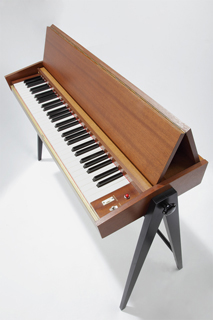
![]() Pianet N (Version II) | |
| Manufacturer | Hohner |
| Dates | 1962 - 1983[1] |
| Technical specifications | |
| Polyphony | Full |
| Synthesis type | Electromechanical |
| Input/output | |
| Keyboard | 60 or 61 keys |
The Hohner Pianet is a type of electro-mechanical piano built by the Hohner company of Trossingen, West Germany and designed by Ernst Zacharias. The Pianet was a variant of his earlier reed-based Hohner electric piano, the Cembalet, which, like the Pianet, was intended for home use. Hohner offered both keyboards in their range until 1968. The Pianet production consisted of two distinctly different mechanism groups with characteristically different sound. The first group, lasting from introduction to 1977, had ground stainless steel reeds, a pick-up using variable capacitance, and leather-faced activation pads. The second group from 1977 until the end of production used rolled spring-steel reeds, electro-magnetic pick-ups, and moulded silicone rubber activation pads.
Features
[edit]The Hohner Pianet is an electro-mechanical instrument, and needs to be connected to an amplifier to produce an audible sound. It had 61 keys ranging from F1 to F6 (43.6 Hz – 1396.9 Hz).[2] Later models had 60 keys, missing the top F.[3] Each key is a single lever element pivoted on a fulcrum point with a spring to return it to the rest position. The key is extended at the rear so that a pad can be mounted over a tuned spring steel reed.[4] This pad adheres to the reed when at rest, and lifts and releases the reed causing it to vibrate when the key is depressed.[5] The vibration of the reed is converted to an electrical signal by a pick-up. The resulting sound has a complex mixture of harmonics when the reed is first struck, which later reduces to a cleaner sustained tone.[4]
Early Pianets feature a knee lever volume control.[2] The early 1960s Pianets (Pianet, Pianet C, Pianet CH, and Pianet N) featured lids which opened in an upright 'V' to form a music stand. This feature was introduced on Cembalets and became common to both instruments.[6] The C and N models were equipped with a vibrato circuit operated by a switch mounted next to the keyboard. The N models used a variable-resistance volume pedal cabled to a socket on the rear of the keyboard.
History
[edit]1960s
[edit]The Pianet evolved from the earlier Cembalet, introduced in 1958. Both instruments were designed by Ernst Zacharias.[5] Zacharias became interested in keyboard instruments such as the clavichord, harpsichord and organ as a teenager, and studied electrical engineering at the University of Kiel. He began working for Hohner in 1954 after meeting designer Siegfried Mager.[7]

The Pianet evolved through a number of model changes. These included both self-amplified versions and versions that required the use of an external amplifier and speaker. The most popular model, the Pianet N (denoting "natural wood finish"), evolved through two different specifications. The N had side-mounted ‘inverted-V’ legs, and could be equipped with an optional 12-watt valve amplifier, the Amplifier CP, which mounted below the unit in front of the player's knees.[5]
The Pianet soon found popularity with music groups of the 1960s, including the Beatles, the Zombies and Manfred Mann.[2] This led to Hohner to producing the Combo Pianet model in 1972. It was designed for the performing musician, without legs, and intended to be placed on top of another instrument.[8]
1970s
[edit]
In 1977, Hohner began producing the second group of models and ceased production of the Pianet N and Combo Pianet. The second group had two models, the Pianet T and M, and a hybrid version combined with a Clavinet, the Pianet/Clavinet Duo. These featured a change in design from electrostatic pick-ups and leather and foam pads to electromagnetic pick-ups (like the Rhodes piano) and silicone rubber pads. The reeds were also changed from the ground finish of the earlier type to a smooth milled finish, making them incompatible with earlier models.[3][9]
The new range of Pianets had a mellower sound than earlier models. While it could not lend it itself well to rock music, it was aligned more with musical tastes of the time, such as the sound of a Rhodes through a chorus pedal. It was advertised as being practical and portable, but this was misleading as it did not have an inbuilt amplifier or speakers.[3] The M model, designed for home use, was built with a wooden veneer console case with internal speakers, while the T model was vinyl covered and designed for live performance. Subsequently, Hohner produced the Pianet/Clavinet Duo model which combined a Hohner Clavinet (essentially an electric clavichord) with the Pianet T in one instrument, with an integrated preamp that allowed the player to combine the two sounds.[3] Production ceased around 1983.[3]
Models
[edit]During the production life, the case, mechanical features and electronics changed with developments in electronics, cheaper manufacturing, and fashion.[10] These were coordinated with Cembalet production changes from the C models onward.[11] Specific manufacturing dates are difficult because of undated sales figures and a lack of consistent worldwide availability.
Pianet
[edit]Approximate manufacturing span 1962–1963[12]
The Pianet has a case side profile with a taper towards the front. It has tapered cylindrical wooden legs that mount to the underside of the case. It has a gold hammertone painted aluminum fascia panel below the keys.[12] This panel also performs the key-leveling function. The keys are injection-moulded plastic. The word 'Pianet' appears in gold facing upward on the left hand end of the music support ledge. The ledge includes a routed recess for the bottom of the music. It has a valve pre-amplifier and a knee lever for volume control.
Pianet C & CH
[edit]Approximate manufacturing span 1963–1965[12]
The Pianet C has a case side profile with a taper towards the front. It has tapered cylindrical wooden legs that mount to the underside of the case. It has a gold hammertone painted aluminum fascia panel below the keys with a lock fitted centrally. This panel also performs the key-leveling function. The keys are injection-moulded plastic.[citation needed]
The word 'Pianet CH' appears in gold facing upward on the left hand end of the music support ledge.[12] The ledge includes a routed recess for the bottom of the music. It has a transistorised pre-amplifier, a knee lever for volume control and optional vibrato effect.
Pianet L & LB
[edit]Approximate manufacturing span 1963–1968
The Pianet L has a stepped rectangular case side profile with no lid. It has straight black tubular steel legs that mount to the underside of the case. It has a black painted aluminum fascia panel below the keys. This panel also performs the key-leveling function. The keys are injection-moulded plastic. It has a transistorised pre-amplifier and amplifier and a knee lever for volume control. It plays through two small internal speakers or through an external amplifier. Available as model L – mains voltage, and model LB – powered by 5 'D' batteries.
Pianet N
[edit]Approximate manufacturing span 1965–1968
The "N" stands for "nautral wood finish".[5] has a case profile with a taper towards the front. It has tapered rectangular cross-section legs forming an inverted 'V' that mount to the ends of the case and are secured by a large, threaded knob. The legs are wood-grain to match the case. The legs are braced by a gold cross-bar towards the base of the rear legs.[citation needed]
The instrument has a folding top that prevents the keys from being damage while the instrument is not in use, and also acts as a music stand.[5] This panel also performs the key-leveling function. The keys are injection-moulded plastic. The word 'Pianet N' appears in gold facing forward on the left-hand face of the music support ledge. It has a transistorised pre-amplifier and a floor pedal volume control. An optional amplifier, the Amplifier CP, was available which mounted underneath the keyboard between the legs. It is a 12-watt valve amplifier with two inbuilt speakers and two inputs, one for the keyboard and one for a record player. Vibrato effect is standard.[citation needed]
Pianet N Console
[edit]This variant can be seen on the cover of a Hohner demonstration record for the Pianet. It has an upper case profile with a taper towards the front. It has a gold hammertone painted aluminum fascia panel below the keys with a lock fitted centrally. The keys are injection-moulded plastic. It stands on two shaped panel legs joined by a modesty panel. There is a piano-like volume pedal fixed on a timber extension from the modesty panel. The optional amplifier unit available for the N model is mounted underneath the keyboard between the legs. Vibrato effect is standard.
Pianet N II
[edit]Approximate manufacturing span 1968–1977
The Pianet N (second variant) has a case side-profile with a taper towards the front. It has tapered rectangular cross-section legs forming an inverted 'V' that mount to the ends of the case and are secured by a large threaded knob. The legs are satin black. The legs are braced by a black cross bar towards the base of the rear legs. It has a gold hammertone painted aluminum fascia panel below the keys with a lock fitted centrally. This panel also performs the key-leveling function. The keys are injection-moulded plastic. The word 'Pianet N' appears in gold facing forward on the left hand face of the music support ledge. It has a transistorised pre-amplifier and a floor pedal volume control. Vibrato effect is standard.
Combo Pianet
[edit]Approximate manufacturing span 1972–1977
The Combo Pianet has a rectangular case side-profile and no lid. There are no legs or leg mounting points. Four grey rubber feet are fitted to the underside of the case. It has a gold hammertone painted aluminum fascia panel below the keys. This panel also performs the key-leveling function. The keys are injection-moulded plastic. The words 'Combo Pianet' are screen printed in black on the left end of the fascia. It has a transistorised pre-amplifier and a volume control knob is fitted at the left end of the keyboard.
Pianet T
[edit]Approximate manufacturing span 1977–1983

The Pianet T introduced a very innovative electro-mechanical system where by vibrating reeds are plucked by plastic suction pads (patented by NASA). The Pianet T does not require electrical power. The vibrations are converted into electrical energy via an electro-magnetic pick-up. The reeds immediately become damped on release of the keys.

The Pianet T has a rectangular case profile with rounded corners and a hinged integral lid with central handle. With the lid latched closed the instrument forms its own carry case. The body of the case is covered with black vinyl leathercloth and the ends are padded with vinyl-skinned urethane foam. There are no legs supplied as standard. An optional stand can be fixed to threaded mounting points on the ends of the case. The keys are injection-moulded plastic over pressed metal frames. The words 'Pianet T' are screen printed in silver on the rear of the case and on the inside surface of the lid.
Pianet M
[edit]Approximate manufacturing span 1977–1983
The Pianet M has the Pianet T mechanism built into a rectilinear wood grain console case. There is no lid over the keys. Sitting above the box that holds the playing mechanism is an amplifier housing with a sloped front face and two player facing cloth speaker-grills. An acrylic music rest slots into the top of this housing. The leg panels are wood-grained boards finished with a timber foot and joined by a horizontal wood grained panel. The word 'Hohner' is printed in gold centrally above the keys. The model 'Pianet – M' is printed on the amplifier cover panel at the rear. Built in Hohner Modulator, another invention of Ernst Zacharias.
Pianet/Clavinet Duo
[edit]Approximate manufacturing span 1978–1983
This hybrid model uses a black case in the style of a Clavinet E7. The Duo has a rectangular case profile with rounded corners and a removable lid to protect the keys and control surface for transport. Samples can be found with both versions of the name: Pianet Clavinet Duo and Clavinet Pianet Duo. The control panels at the left hand end of the instrument include keyboard splits and mixtures of the two instruments as well as normal Clavinet mixture controls.
Users
[edit]Early Pianets were used on a number of hit recordings from the 1960s and 1970s, including "She's Not There" by The Zombies; "Louie Louie" by The Kingsmen; "I Am the Walrus", "Getting Better", "The Night Before", "Tell Me What You See", "You Like Me Too Much" by The Beatles; "This Guy's in Love With You" by Herb Alpert; "These Eyes" by The Guess Who. In the glam rock era, the Pianet was used by Bryan Ferry on the first few Roxy Music albums, for instance featuring prominently in their hit "Editions of You". It was a staple of the "classic lineup" sound of Curved Air (1970–1972), featuring prominently on their first 3 albums, played by both guitarist/keyboardist Francis Monkman and violinist Darryl Way. The 1972–74 lineup of progressive rock pioneers King Crimson used a pair of Pianets in live performance, played both by the group's violinist David Cross, and the guitarist, Robert Fripp[1]. Genesis keyboardist Tony Banks used the Pianet prominently in the group's early career, as a lead instrument through a homemade fuzz box.[13]
Fleetwood Mac's Christine McVie was a noted proponent of the Pianet N and Combo Pianet for live use. In an article written by Bob Doerschuk in the October 1980 issue of Contemporary Keyboard she outlined why she preferred the sound of the 1960s Pianets live and why she eventually replaced them with other keyboards.
The Pianet is enjoying a renaissance (e.g. Bugge Wesseltoft's Change) due to its unique sound and the availability of new pads for the earlier models, most of which had been reduced to unplayability due to pad decay. It is also popular as a substitute for the Fender Rhodes or Wurlitzer electric piano, which has a related reed-based mechanism for generating sound but is typically much heavier, requires more maintenance than the Pianet, and is overall more expensive.
Restoration issues
[edit]Following the end of production, replacement parts for Pianets became progressively harder to find because they were no longer being supported by Hohner. The principal problem was the activation pads for 1960s-manufactured models, which used a Urethane foam damper behind the leather surface. This decomposed with age, making the pads unusable. Hohner intended the pads to be a service-replaceable item (like the strings of a guitar), and sold spares while the instrument was in production. After the supply ran out, restorers and players had to create their own pads.[14]
The second group of Pianets, the T and M, used silicone rubber for their pads. They have aged extremely well and are still functional in most keyboards, as of 2012. The silicone pads of the T & M are not suitable for the 1960s Pianets. Their adhesion properties don't suit the ground reeds of the first group of instruments, and they produce a static discharge that is amplified by the capacitive pick-up of the instrument. In the 2000s, a number of businesses took up the servicing and maintenance of vintage keyboards, so pads suitable for both groups of Pianets are now available.[citation needed]
The mechanical structure of keys, pivot rail, reeds, reed bar and pick-up are the same in the 1960s Pianets from the "Mk.1" and C to the Combo, so spares to get a Pianet working can come from most models. While the electronics differ from model to model, they can be exchanged if the aim is to make a keyboard playable rather than to restore it.[citation needed]
References
[edit]- ^ Lenhoff & Robertson 2019, pp. 136, 139, 140.
- ^ a b c Lenhoff & Robertson 2019, p. 124.
- ^ a b c d e Lenhoff & Robertson 2019, p. 140.
- ^ a b Lenhoff & Robertson 2019, p. 123.
- ^ a b c d e Vail 2000, p. 271.
- ^ Lenhoff & Robertson 2019, pp. 123, 125.
- ^ Lenhoff & Robertson 2019, pp. 134, 136.
- ^ Vail 2000, p. 272.
- ^ Vail 2000, p. 273.
- ^ Lenhoff & Robertson 2019, p. 126.
- ^ Lenhoff & Robertson 2019, p. 144.
- ^ a b c d Lenhoff & Robertson 2019, p. 138.
- ^ Genesis (2007). Genesis : Chapter and Verse. p. 96. ISBN 978-0-312-37956-8.
- ^ Lenhoff & Robertson 2019, p. 145.
- "Robert Fripp's Diary: Tuesday, 15th September 1998". Archived from the original on 13 October 2014.
Bibliography
[edit]- Lenhoff, Alan; Robertson, David (2019). Classic Keys: Keyboard sounds that launched rock music. University of North Texas Press. ISBN 978-1-57441-776-0.
- Vail, Mark (2000). Vintage Synthesizers : Pioneering Designers, Groundbreaking Instruments, Collecting Tips, Mutants of Technology. Backbeat Books. ISBN 978-0-87930-603-8.
External links
[edit]- [dead link]Pressed+metal 2003/228/1 Electric keyboard, Hohner Pianet, timber / metal / plastic, designed by Ernst Zacharias, made by Hohner AG, West Germany, 1962–1970 Powerhouse Museum, Sydney, Australia
- Detail pictures of a Pianet T and a Cembalet.
- Manufacturer's replacement pads for all Pianets
- Manufacturer's replica replacement pads for group one 1960s Pianets C, L, N (versions I & II), Combo Pianet.
- [dead link]Contemporary Keyboard (10/1980), Christine McVie Archived 2016-03-12 at the Wayback Machine
Hohner Pianet
View on GrokipediaDesign and Technology
Operating Mechanism
The Hohner Pianet was invented and designed by Ernst Zacharias at the Hohner company in Trossingen, West Germany, evolving directly from his earlier Cembalet model introduced in 1958, which employed rubber plectra to pluck metal reeds for sound generation.[1][8] Zacharias adapted the Cembalet's reed-based principles for the Pianet to create a more piano-like instrument intended for home and portable use, emphasizing simplicity and electro-mechanical efficiency.[1] The core mechanism centers on a key action where each of the 60 or 61 keys—spanning a range from F1 to F6 (approximately 43.6 Hz to 1396.9 Hz) or E6 in some variants—activates a dedicated reed, enabling full polyphony without note-stealing limitations common in some electronic keyboards.[3][9] Sound production begins when a key depression causes a lever to lift an adhesive pad away from a tuned metal reed to which it adheres at rest, thereby releasing the reed to vibrate freely at its fundamental frequency.[1][10][11] Early 1960s models utilized ground stainless steel reeds paired with urethane foam pads faced with leather, which provided the necessary stickiness through surface contact and a soft damping layer to minimize mechanical noise.[1][12] By the 1970s, refinements shifted to spring-steel or mild steel reeds with molded silicone rubber pads, enhancing durability and altering the pluck dynamics for a slightly mellower response while maintaining the adhesive release principle.[1][13] The vibrating reeds generate an electrical signal via dedicated pickups, with all Pianet models requiring external amplification due to their passive design, outputting a low-level signal similar to an electric guitar.[14] Models produced from 1962 to 1977 employed capacitive electrostatic pickups, where reed oscillation varies the capacitance between the reed and a fixed electrode to produce the signal.[1] From 1977 to 1983, the design transitioned to individual electromagnetic pickups per reed, using coils to detect magnetic field changes from the vibrating mild steel reeds, which allowed for better tonal control and reduced crosstalk.[1] This evolution in pickup technology contributed to the instrument's versatility across musical genres while preserving its characteristic intimate, bell-like timbre when amplified.[1]Sound Characteristics
The Hohner Pianet produces a distinctive electro-mechanical tone derived from its reed-based mechanism, with variations across models reflecting differences in pickup technology and pad materials. Early models, such as the Pianet N series, utilize electrostatic (capacitive) pickups and leather pads to pluck metal reeds, resulting in a colorful and gritty timbre rich in complex overtones and harmonics that evoke a bell-like quality with a harp-like plucked attack.[5][15] This raw, passive sound lacks built-in effects like tremolo, relying instead on the inherent resonance of the reeds for its character, which can range from bright and percussive to warmly textured depending on playing dynamics.[5] In contrast, later models like the Pianet T employ electromagnetic pickups and molded silicone rubber pads, yielding a cleaner, more sustained, and mellower tone with reduced grit and a rounder overall profile.[5][3] This evolution produces a darker, plummy attack and dreamy sustain that some describe as a hybrid between the Rhodes' warmth and the Wurlitzer's reed punch, though with notably less aggressive initial bite and a more chime-oriented resonance.[16] The absence of onboard processing in most variants underscores the instrument's emphasis on unadulterated acoustic-electric conversion, where subtle nuances in reed vibration contribute to its organic, somewhat reedy depth.[15] As a fully passive design without internal amplification, the Pianet's output requires external amplification to achieve optimal volume and clarity, often revealing fine details in its harmonic content when paired with suitable gear.[3] This dependency can enhance the chime-like highs and mellow lows but may introduce noise if the signal chain is suboptimal, highlighting the instrument's sensitivity to setup for faithful reproduction of its unique sonic identity.[5]Controls and Specifications
Early models of the Hohner Pianet, such as the original and the C/CH variants, incorporated a knee lever for volume control, enabling dynamic adjustment during performance without interrupting play.[17] Later models shifted to foot pedals or rotary knobs for volume management, improving accessibility for stage use.[18] Optional vibrato circuits were included in certain models like the Pianet C and CH, allowing users to add subtle pitch modulation via a dedicated switch or control.[19] The Pianet series generally featured 60 to 61 full-sized keys, covering a five-octave range from F to F.[20] Portable models weighed between approximately 15 and 25 kg, balancing compactness with durability for transport.[21] Power requirements were typically mains voltage, though the LB variant supported battery operation using five D-cell batteries for enhanced portability.[22] Case construction evolved from tapered fiberglass shells in early designs to wood or vinyl-covered wooden enclosures in later ones, with dimensions optimized for mobility—often around 93 cm wide, 38 cm deep, and 9 cm high for models like the T.[20] Most Pianet models required connection to an external amplifier for output, though variants like the L integrated a preamplifier, amplifier, and two internal speakers for standalone use.[23]History
Development in the 1960s
The Hohner Pianet was introduced in 1962 as a successor to the company's earlier Cembalet electric piano, both designed by Ernst Zacharias and manufactured by Hohner AG in Trossingen, West Germany.[24][1] This electro-mechanical instrument evolved the Cembalet's reed-based mechanism by incorporating adhesive pads to pluck metal reeds, producing a distinctive chime-like tone suitable for home and ensemble use.[24] Key innovations in the 1960s included the adoption of transistor pre-amplifiers, which replaced earlier valve-based amplification for greater reliability and reduced size, aligning with the era's shift toward solid-state electronics.[1] Some variants introduced basic internal amplification options and headphone outputs, though most models relied on electrostatic pickups for signal generation.[8] These advancements made the Pianet more portable than traditional acoustic pianos, weighing approximately 20 kg (44 lbs) and fitting into a suitcase-like case, which facilitated its rapid adoption by 1960s rock and pop bands seeking versatile, on-stage keyboards.[25] The Pianet gained swift popularity among British Invasion and similar groups, appearing on recordings like The Zombies' "She's Not There" (1964) and The Beatles' tracks from the Help! era (1965), due to its unique, bell-toned sound that cut through guitar-heavy mixes.[24][1] Positioned as an affordable alternative to full-sized pianos, it appealed to amateur musicians and professionals alike, with growing demand in Europe and emerging export markets.[26] Early challenges included the necessity for external amplifiers in most models, as initial designs lacked robust internal speakers, limiting onstage volume without additional gear.[27] Distribution was initially concentrated in Europe, with slower penetration into North America until endorsements by high-profile bands boosted international sales later in the decade.[8] Additionally, the silicone-impregnated adhesive pads, while innovative, began deteriorating after a few years, causing inconsistent playability and requiring maintenance.[24]Production in the 1970s and 1980s
In the 1970s, Hohner continued to refine the Pianet line, building on the electrostatic designs of the 1960s by introducing passive electronics and molded silicone rubber activation pads starting in 1977. These changes, implemented in models like the Pianet T, replaced earlier leather-faced pads and variable capacitance pickups with electromagnetic pickups and rolled spring-steel reeds, resulting in more reliable operation and a mellower tone profile. The silicone pads created suction to pluck the reeds, reducing maintenance issues associated with adhesive degradation while maintaining the instrument's characteristic chime-like sound.[3][13][1] To adapt to the demands of live performance amid growing competition from portable synthesizers, Hohner introduced combo and hybrid designs in the early 1970s. The Combo Pianet, launched in 1972, offered a compact five-octave version optimized for stage use, while the 1978 Pianet/Clavinet Duo integrated Pianet mechanisms with the more percussive Clavinet E7 in a single enclosure, allowing players to blend or split sounds via fader controls. These innovations aimed to provide versatile, portable alternatives to bulkier electro-mechanical pianos, though they could not fully counter the versatility of emerging analog synthesizers like the Minimoog. Production of the Duo ran until 1982.[1][28] By the late 1970s, Pianet production began to decline as electronic keyboards and digital synthesizers gained dominance, offering greater tonal flexibility and reliability without mechanical wear. Hohner ceased manufacturing around 1983, marking the end of the Pianet line after two decades. Instruments were produced in significant quantities—estimated in the thousands overall—primarily for export to key markets like the United States and United Kingdom, where Hohner's distribution network supported sales to professional musicians and bands.[1][13] Economic pressures also influenced priorities, as Hohner diversified into more commercially successful products like the Clavinet, which outsold the Pianet and captured a larger share of the funk and rock markets in the 1970s. This shift in focus, combined with the broader industry transition to solid-state electronics, limited further investment in the Pianet series.[1]Models
Pianet (1962–1963)
The Hohner Pianet, introduced in 1962, marked the debut of the company's line of electro-mechanical pianos, designed by Ernst Zacharias as a more advanced successor to the earlier Cembalet model intended for home use. This original model featured a polyphonic keyboard spanning 61 notes, employing an innovative action where keys lifted arms fitted with leather-faced sticky pads (impregnated with silicone oil) that contacted and released tuned metal reeds to initiate vibration. The reeds, made of ground stainless steel, were positioned under variable capacitance pickups that converted the mechanical oscillations into electrical signals, producing a distinctive electro-mechanical sound without the need for traditional piano strings or hammers. Weighing approximately 20 kg, the instrument was designed for portability, appealing to touring musicians despite its requirement for an external amplifier as it lacked built-in speakers.[29][24][3] The Pianet's construction emphasized durability and simplicity, with a stable tuning provided by its all-metal reed assembly, which resisted the pitch fluctuations common in some contemporary electric keyboards. Its keys were covered in leather for a smooth feel, though the overall touch response was lighter and less dynamic than acoustic pianos or later electric models. Production of this initial variant was limited in scope, focusing on professional applications where its compact form factor allowed integration into ensemble setups, such as early rock and pop bands seeking an alternative to bulkier organs or pianos. The instrument's signal path included a basic pre-amplifier stage to boost the low-level output from the capacitive pickups before sending it to an external system.[29][3][30] Sonically, the original Pianet delivered a reedy, percussive timbre with a harp-like plucked attack, characterized by its metallic brightness and quick decay, which lent itself well to rhythmic accompaniment in 1960s rock ensembles. This tone arose from the reeds' rapid excitation and the capacitive sensing method, which emphasized higher harmonics without the warmth of hammer-struck tines found in competitors like the Fender Rhodes. While not velocity-sensitive in the modern sense, the model's consistent output and clean articulation made it a reliable choice for live performances, influencing its adoption among session players during the British Invasion era.[15][3]Pianet C and CH (1963–1965)
The Pianet C and CH models, manufactured from 1963 to 1965, marked Hohner's initial refinements to the original Pianet design, emphasizing enhanced electronic stability while preserving the core electro-mechanical principles. These variants maintained the functionalist case profile with a tapered front and cylindrical wooden legs, alongside the same reed activation mechanism using silicone-oiled, foam-backed leather pads to indirectly vibrate tuned metal reeds via electrostatic pickups.[31][1] A key upgrade in the Pianet C was the shift to a transistor pre-amplifier, supplanting the valve-based amplification of the predecessor for improved reliability, reduced heat generation, and greater portability without sacrificing the instrument's compact form.[31][1] The CH variant built on this foundation by incorporating an optional vibrato circuit—essentially an optical tremolo effect controlled via a keyboard-adjacent switch—allowing performers to introduce subtle pitch modulation for added expressiveness.[31] Both models retained the knee lever for dynamic volume control and operated without batteries, relying on external amplification.[1] Sonically, these instruments delivered a robust attack with short sustain, evoking the timbre of a fingertip-plucked guitar, though the transistor circuitry yielded harmonics slightly warmer than the original Pianet's brighter valve-driven tone, aligning the overall character more closely with contemporary Wurlitzer models.[31][1] The refined pickup sensitivity improved signal consistency across the 61-note keyboard, minimizing dynamic limitations inherent to the pad-based actuation while supporting home and stage use. Production emphasized mass scalability in Trossingen, West Germany, to address rising demand in the mid-1960s keyboard market.[1] Like earlier iterations, long-term maintenance often involves addressing pad degradation from silicone evaporation, though the transistor design mitigated some electronic vulnerabilities.[1]Pianet L and LB (1963–1968)
The Pianet L and LB models, manufactured from 1963 to 1968, represented Hohner's push toward self-contained electro-mechanical pianos optimized for live performances, integrating amplification directly into the instrument to bypass the need for external equipment. Designed by Ernst Zacharias in Trossingen, Germany, these variants built on the reed-based technology of earlier Pianets while prioritizing onstage reliability for touring musicians.[1] Sharing the core operating mechanism with the contemporaneous C and CH models—where leather-faced sticky pads (impregnated with silicone oil) contact and release tuned metal reeds to generate sound via electrostatic pickups—the L and LB added a built-in 12-watt valve amplifier and two internal speakers for immediate playback. The L operated on mains power, while the LB incorporated battery operation with five D-cell batteries for enhanced mobility in remote or unpowered venues. Housed in a compact, rectangular suitcase-style case with deployable legs, the L weighed approximately 20 kg, balancing portability with the added bulk of its combo amp setup.[1][29] These models gained traction among British Invasion acts for their roadworthy design, with the Zombies employing a Pianet on their 1964 single "She's Not There" and the Beatles featuring it on tracks from the 1965 album Help!, such as "The Night Before". However, the integrated speakers contributed to a heftier profile compared to later, lighter Pianet iterations, diminishing their studio appeal by the late 1960s as amplified alternatives like the Rhodes gained prominence.[1][29]Pianet N Series (1965–1977)
The Pianet N, introduced in 1965 and designed by Ernst Zacharias, marked a refinement in Hohner's electro-mechanical piano line with a timber and metal finish suitable for stage and studio use.[8] This model employed a mechanism in which key strikes activated levers fitted with sticky pads that lifted and released tuned metal reeds, allowing them to vibrate freely and produce a powerful, versatile tone capable of cutting through dense mixes in genres like funk, soul, and rock.[8] The reeds' vibrations were captured by electrostatic (variable capacitance) pickups for amplification, requiring connection to an external amp or the optional underbelly Amplifier CP, a 12-watt valve unit with built-in speakers.[32] A console variant, the Pianet N Console, offered a larger footprint with an integrated stand, making it ideal for home or semi-professional settings, and included an option for internal amplification to enhance convenience without external setups.[33] Shared across the series were 61 keys spanning a full five octaves, along with volume control via a dedicated pedal and vibrato effects adjustable through onboard trimmers.[34] The N II, launched in 1968, introduced minor updates including refined key action for better playability and compatibility with the Amplifier CP as an external accessory, extending production through 1977 with incremental reliability enhancements like improved electronics while retaining the core reed mechanism.[35] These models emphasized durability for touring musicians, evolving from earlier portable designs by prioritizing aesthetic appeal and console-style stability over battery operation.[18]Combo Pianet (1972–1977)
The Hohner Combo Pianet, produced from 1972 to 1977, represented a portable evolution in the Pianet line, tailored for stage performers seeking modular setups. Lacking legs and featuring a compact suitcase-style case, it weighed around 16 kg, facilitating easy transport and stacking atop other Hohner keyboards like the Clavinet for combined live performances. This legless design emphasized practicality for progressive rock ensembles, where space and mobility were essential during the 1970s touring era.[36][37] At its core, the Combo Pianet employed the standard mechanism from the N II model, using adhesive pads to pluck metal reeds for sound generation, with subtle touch sensitivity influencing volume and timbre. Enhanced output jacks allowed direct integration into amplification chains or stacking configurations without additional adapters, supporting seamless connections in multi-instrument rigs. Production was limited to approximately 1,500 units, reflecting its niche appeal to professional musicians requiring reliable, on-stage versatility.[38][27] Controls on the Combo Pianet included a standard foot volume pedal for dynamic expression, with optional vibrato circuitry available for added modulation. Its tone was notably brighter than earlier standalone models, achieved through pickup optimizations that favored clarity in live mixing environments, cutting through dense band arrangements with a wiry, percussive edge suited to rock and fusion genres. No built-in amplifier was present, necessitating external PA systems, which aligned with its passive, performer-focused ethos.[17]Pianet T (1977–1983)
The Hohner Pianet T, introduced in 1977, represented a shift toward greater portability in the company's electric piano lineup, featuring a compact design housed in a black vinyl-covered case with a hinged lid and carrying handle. It spanned 61 keys, utilizing spring-steel reeds that were plucked by silicone rubber pads attached to the key mechanisms, producing a mellow, organic tone characteristic of reed-based instruments. Electromagnetic pickups captured the reed vibrations, converting them into an electrical signal without any active amplification.[14][5][39] Unlike earlier models that relied on capacitive sensing or required power for internal electronics, the Pianet T operated entirely passively, with no onboard power supply or controls, allowing direct connection to an external amplifier via a single 1/4-inch output jack. This simplification contributed to its low-noise, clean output and emphasized its suitability for travel and stage use, weighing approximately 19 kg for easy transport. Production continued until 1983, making it one of the final iterations in Hohner's Pianet series.[39][40][14] A key innovation in the Pianet T was the use of silicone pads, which offered greater durability and resistance to degradation compared to the leather-faced pads of prior models, though the spring-steel reeds remained susceptible to rust over time, often requiring periodic cleaning for optimal performance. Volume and tone adjustments were handled externally, aligning with its minimalist philosophy and appealing to musicians seeking a straightforward, reliable instrument for live and studio applications.[5][41][42]Pianet M (1977–1983)
The Hohner Pianet M, produced from 1977 to 1983, was a console-style electro-mechanical piano designed primarily for home and studio environments. It incorporated the passive mechanism of the contemporaneous Pianet T model but added a built-in pre-amplifier and two internal speakers, housed in a rectilinear wood grain console case without a lid, making it suitable for fixed installations rather than portability.[43][44][45] This model featured 61 keys spanning five octaves, with electromagnetic passive pickups capturing vibrations from tuned metal reeds activated by durable silicone pads, which contributed to its characteristic mellow and warm tone. Controls were straightforward, including knob-based adjustments for volume and tone, along with a built-in "Modulator" effects unit providing optional tremolo for added expressiveness. The instrument's sound was well-balanced for recording applications, offering a round, dynamic quality often compared to other electric pianos of the era.[46][44][47] Production of the Pianet M ran concurrently with the Pianet T but in much smaller quantities, estimated at around 1,000 units, reflecting its niche appeal in a market shifting toward more versatile synthesizers. Its relative rarity today stems from limited manufacturing focused on home users seeking an amplified, self-contained electric piano experience.[47][43]Pianet/Clavinet Duo (1978–1983)
The Hohner Pianet/Clavinet Duo, produced from 1978 to 1983, represented the final hybrid model in Hohner's electro-mechanical keyboard lineup, integrating the Pianet and Clavinet mechanisms into a single compact unit to offer expanded sonic possibilities for performers. This instrument featured a split 61-key keyboard (F to E), with the lower section dedicated to the Clavinet and the upper to the Pianet, allowing for simultaneous or independent play across the two sound sources while sharing a common amplifier and wooden case for portability. Designed primarily for multi-instrumentalists seeking to reduce stage clutter, the Duo weighed approximately 35 kg, making it heavier than standalone Pianet models but more manageable than separate Clavinet and Pianet setups.[48][1][49] The Pianet section employed the T-series mechanism, utilizing tuned steel reeds vibrated by foam-padded activators and captured via electromagnetic wound pickups for a chime-like, warm tone, distinct from earlier capacitance-based models. In contrast, the Clavinet portion retained its characteristic string-plucking action, where keys triggered rubber-tipped hammers to strike and release strings against metal anvils, producing a bright, percussive bite through dedicated electromagnetic pickups. Both sections powered by a 9V battery for the pickups, the design enabled switchable voicing options primarily through the Clavinet's filter controls, though the Pianet offered a more fixed timbre with subtle variations via overall level adjustment.[1][28][49] Controls were segregated for each section, including individual volume sliders (0 to 5 levels) for balancing output, with the Clavinet featuring six rocker switches for tonal shaping—Brilliant, Treble, Middle, Soft, and AB/CD configurations for pickup phasing and filtering. Additional features included a damper pedal input, output jacks for separate Pianet, Clavinet, or combined signals, and a footswitch option for toggling between split mode (lower Clavinet/upper Pianet) and layered full-keyboard operation. Production was limited, with the model considered rare today due to its short run, culminating in 1983 as Hohner phased out electro-mechanical instruments in favor of digital alternatives.[49][50][48] The Duo's tonal versatility arose from blending the Pianet's ethereal, bell-toned resonance with the Clavinet's sharp, funky attack, enabling everything from subtle harmonic layers to aggressive rhythmic comping suitable for funk, jazz, and rock performances. This integration provided a self-contained solution for keyboardists, though the shared mechanics occasionally introduced minor action inconsistencies compared to individual instruments.[1][28][49]Cultural Impact
Notable Users
The Beatles incorporated the Hohner Pianet N into their 1967 recording of "I Am the Walrus," where its distinctive metallic timbre contributed to the track's experimental soundscape.[1] Rod Argent of The Zombies prominently featured an early model Hohner Pianet on the band's 1964 debut single "She's Not There," employing its biting, reedy tone for the song's iconic keyboard riff and solo.[51] Bryan Ferry of Roxy Music utilized the Hohner Pianet on the band's self-titled 1972 debut album, providing rhythmic and harmonic foundations across several tracks.[52] In the 1970s, King Crimson's Robert Fripp played the Hohner Pianet on the 1974 album Red, layering its electric piano tones with guitars and Mellotron for the band's evolving progressive sound.[53] David Cross, the group's violinist, also employed the instrument in live performances and studio work during this period, often processing it through effects for textural depth.[54] Genesis keyboardist Tony Banks relied on the Hohner Pianet N in the band's early 1970s setup, using it as a portable electric piano alternative before transitioning to other models like the RMI.[55] Christine McVie of Fleetwood Mac extensively favored the Hohner Pianet N and later the Combo Pianet from the late 1960s through the 1970s, valuing their compact design and blues-inflected tones for both studio recordings and live performances.[1]Influence on Music
The Hohner Pianet emerged as a key instrument during the 1960s British Invasion, where its bright, chime-like tone added harmonic depth to guitar-centric rock ensembles. British bands like The Zombies incorporated the Pianet to enhance their pop-rock sound, with keyboardist Rod Argent employing the model on the 1964 hit "She's Not There," contributing to the track's jangly keyboard riff that defined early Invasion-era accessibility.[56] As the decade progressed into psychedelia, the Pianet's ethereal timbre provided experimental texture; as played by John Lennon on The Beatles' 1967 recording "I Am the Walrus," layering its plucked-reed resonance to evoke hallucinatory atmospheres amid orchestral chaos.[30] This versatility helped the instrument bridge straightforward rock with more avant-garde expressions, influencing how British acts integrated keyboards into psychedelic experimentation. In the 1970s, the Pianet found prominence in progressive rock and jazz fusion, where its compact design and tonal clarity supported intricate, multi-layered compositions. Progressive pioneers King Crimson deployed dual Pianets in their 1972–1974 lineup, with violinist David Cross playing the instrument live and in studio to augment violin and Mellotron textures, as heard in overdubbed fuzz-enhanced parts on the 1975 live album USA.[57] Similarly, in jazz fusion, Soft Machine's Mike Ratledge paired the Pianet with effects pedals during recordings like the 1970 album Third, creating swirling, distorted overlays that blended improvisation with rock structures and expanded the genre's sonic palette.[58] These applications highlighted the Pianet's role in studio production, where it enabled dense, effects-processed arrangements that pushed boundaries in prog and fusion. Performers leveraged specific techniques to maximize the Pianet's expressive potential, particularly its mechanical features. Early models like the Pianet L featured a knee lever for volume control, allowing musicians to execute fluid dynamic swells—rising from subtle whispers to bold accents—without interrupting hand position, a method that suited the instrument's fixed-velocity action in live and recording contexts.[11] The Pianet's passive, low-level output further facilitated direct connection to guitar amplifiers, infusing performances with natural overdrive and grit, akin to electric guitar tone, which amplified its percussive edge in rock bands.[59] Compared to contemporaries like the Fender Rhodes and Wurlitzer electric pianos, the Pianet's sound generation—via adhesive pads plucking steel reeds—delivered a drier, more percussive bite with inherent bell-toned harmonics, offering a distinct alternative to the Rhodes' sustained, vibraphone-like resonance or the Wurlitzer's barkier, hammered attack.[60] This unique timbre provided ensembles with a cleaner, less bass-heavy keyboard option, carving a niche in mixed instrumentation where subtlety and chime enhanced rather than dominated arrangements. The Pianet's widespread adoption across genres underscored its lasting impact on electro-mechanical keyboard evolution, inspiring hybrid designs that combined piano-like actions with amplified pickups, as seen in Hohner's later Pianet/Clavinet Duo, which merged its reed mechanism with clavinet strings for expanded timbral versatility.[61] Its emphasis on portable, effects-friendly electro-mechanical innovation encouraged competitors to develop similar reed-plucked systems, contributing to the broader shift toward versatile stage and studio keyboards in the late 20th century.Restoration and Maintenance
Common Issues
In the 1960s models, such as the Pianet L and LB produced from 1963 to 1968, a primary mechanical issue arises from the deterioration of urethane foam pads behind leather faces, which often results in sticky keys that fail to return properly or silent keys due to incomplete contact with the reeds.[62][63] These pads, integral to the electrostatic pickup system, degrade over time, leading to inconsistent capacitance and reduced output. Additionally, corrosion on the capacitive pickups and reeds exacerbates the problem, causing uneven tone and signal loss as oxidation builds up on the metal surfaces.[64] For pre-1977 models like the Pianet N series (1965–1977) and Combo Pianet (1972–1977), which use leather-faced pads impregnated with silicone oil, reed rust is a frequent concern, often stemming from residue left by the oil that attracts moisture and promotes oxidation.[65][66] This rust can diminish vibrational efficiency, resulting in weak or muffled notes, particularly in humid environments. For post-1977 models like the Pianet T (1977–1983) and M (1977–1983), which use moulded silicone rubber pads, similar rust issues arise from silicone residue. Capacitive pickup issues, such as inconsistent capacitance, are common in pre-1977 models due to pad degradation. Electromagnetic coil failures occur in post-1977 designs, typically manifesting as sudden loss of volume across multiple notes due to winding degradation or connection faults.[67] Across all eras, dust accumulation in the key action mechanism is a universal problem, leading to sluggish response and intermittent sticking as particles interfere with pad movement and reed oscillation.[42] Integrated amplifier models, including the L and M, commonly exhibit hum or buzz, often from ground loops or unshielded internals that pick up electromagnetic interference.[59][63] Electrically, pre-1977 amplifiers suffer from transistor failures, where heat and age cause breakdowns in the signal path, resulting in distorted or absent output.[68] In the battery-powered LB variant, compartment corrosion from leaked electrolytes is prevalent, potentially shorting circuits and requiring thorough cleaning to restore functionality.[69] Aesthetically, the N series experiences veneer cracking due to wood drying and environmental stress, compromising the cabinet's structural integrity over decades.[70] Similarly, the T model's vinyl covering tends to peel, especially at edges exposed to handling or moisture, leading to cosmetic deterioration.[71]Repair Techniques
Repairing a Hohner Pianet requires careful handling to preserve its delicate mechanical and electrical components, often involving disassembly of the action and electronics. Technicians recommend working in a clean, static-free environment and using anti-static tools to prevent damage to vintage wiring and pickups. Reproduction parts, such as replacement sticky pads from suppliers like Ken Rich Sound Services, are available for models including the Pianet N and T to facilitate restoration.[72][71] For pad replacement in 1960s and pre-1977 models such as the Pianet N, modern urethane or silicone-based replicas are commonly used to restore the sticky contact mechanism, ensuring compatibility with the original rubber collars or leather faces. The process begins by removing deteriorated pads from the key shafts, cleaning residues with isopropyl alcohol and Q-tips, then adhering new narrow-gap rubber tape (approximately 3/8-inch thick) to the collars using weatherstrip adhesive, followed by layering lambskin saturated with high-viscosity silicone oil (100,000–200,000 centistokes) or dielectric grease for adhesion and tone. After a 16-hour soak, excess lubricant is wiped off, and pads are reinstalled, aligning with original positions for even contact. Silicone swaps enhance longevity over original foam, reducing stickiness failures in humid conditions. For post-1977 models like the Pianet T, direct replacement with moulded silicone rubber pads is recommended.[42] Reed cleaning addresses rust and debris accumulation, which can dull tone and cause uneven volume. Apply isopropyl alcohol with a swab to remove dirt, followed by gentle polishing with fine steel wool (000 grade) or 1200-grit sandpaper to eliminate light rust without altering the reed's magnetic properties or tuning. Avoid aggressive polishing, as it can thin the metal and lead to detuning; instead, vacuum residues immediately after to prevent re-corrosion. For prevention, a light application of chemical bluing or phosphoric acid treatment converts oxide to phosphate, recreating a protective layer.[42][74] For models with electromagnetic pickups, such as the Pianet T and M, pickup servicing focuses on the coils, which can degrade from age or mishandling. Use a multimeter to check continuity and realign the pickup gap by gently bending the assembly for balanced output across keys, ensuring 1-2 mm clearance from reeds. If coils are broken, rewinding involves carefully unwinding damaged sections, soldering repairs, and re-magnetizing reeds with 20-30 strokes of a strong neodymium magnet to restore signal strength. Test unplugged for even response before reassembly. For pre-1977 models with electrostatic pickups (e.g., Pianet N), check and clean capacitive plates for corrosion and ensure proper pad contact to maintain capacitance.[75][42] Action lubrication maintains smooth key travel and pad engagement. Apply light machine oil sparingly to key pivots and shafts after cleaning with isopropyl alcohol, avoiding over-application that could attract dust or migrate to reeds. For deeper maintenance, full disassembly allows compressed air and fine brushes to clear debris, followed by silicone-based lubricant on plastic actuators in models like the Pianet T to reduce squeaks without affecting electromagnetic function.[76][42] Amp restoration in transistor-equipped models, such as the Combo Pianet, prioritizes capacitor replacement to eliminate hum and restore clarity. Identify and swap electrolytic capacitors with modern low-noise equivalents (e.g., Wima or Nichicon film types) using the schematic for values, soldering carefully to avoid overheating components. Perform safety checks on vintage wiring, insulating exposed leads with heat-shrink tubing and verifying ground connections to prevent shocks or shorts. Post-replacement, bias adjustments ensure stable output.[71][77]Legacy
Vintage Appeal
The vintage Hohner Pianet holds significant appeal among collectors and musicians as of November 2025, driven by its unique electro-mechanical sound and historical significance in rock and pop music. Restored units typically command market prices between $900 and $1,800 USD as of mid-2025, depending on model, condition, and provenance, with the portable Pianet T particularly sought after for its lightweight design and suitability for live performances.[39][78] For instance, well-maintained Pianet T models from the late 1970s often list around $1,200 to $1,500 on specialized marketplaces, reflecting demand from enthusiasts valuing its compact form factor over bulkier predecessors.[79] Collector communities play a vital role in sustaining interest, with active online forums like the Electric Piano Forum providing spaces for discussions on acquisition, maintenance, and trading.[80] Complementing these are dedicated Facebook groups, such as the Hohner Clavinet & Pianet Restoration Page, where members exchange parts, share restoration tips, and organize informal meetups for instrument evaluations.[81] Rarity further enhances the Pianet's allure; hybrid models like the Pianet/Clavinet Duo command premiums, often exceeding $1,500 due to their limited production run and dual functionality, while 1960s models such as the Pianet N are prized for their association with The Beatles, notably featured on tracks like "I Am the Walrus" and "The Night Before."[82][18] Preservation efforts underscore the instrument's enduring cultural value, with demonstrations and showcases at vintage synthesizer fairs like those hosted by organizations such as the Vintage Synthesizer Museum, where Pianets are highlighted for their role in mid-20th-century music innovation.[83] Condition grading standards, often adapted from general vintage keyboard guidelines, emphasize factors like pad integrity and pickup functionality to assess playability and authenticity during sales and events.[65] However, challenges persist due to the scarcity of original parts, such as sticky pads and reeds, which has spurred the development of aftermarket solutions from specialists like Clavinet.com and Ken Rich Sound Services, offering upgrade kits and reproduction components to keep instruments operational.[71][84] These innovations allow collectors to maintain vintage integrity without compromising functionality, though they can add 20-30% to restoration costs.Modern Emulations and Reproductions
In the digital era, the Hohner Pianet's distinctive electromagnetic tone has been preserved through high-fidelity sampling and modeling in software plugins, allowing producers to access its characteristic pad-plucked reed sound without maintaining vintage hardware. Spectrasonics' Keyscape virtual instrument library includes a meticulously sampled Hohner Pianet T, capturing its compact design and mellow timbre from the late 1970s, complete with variations like tremolo and phaser effects derived from the original instrument.[85] Similarly, free sample packs on Pianobook provide accessible emulations, such as the Hohner Pianet T pack with direct injection recordings emphasizing its clean, bell-like overtones, and the Anne-Marie Hohner T pack featuring multi-microphone captures of mechanical releases for added nuance in digital audio workstations (DAWs).[86][87] The Martinic Pianet T plugin offers a modeled emulation of the instrument, replicating its passive electronics and delicate timbre for use in modern productions.[7] Hardware keyboards have integrated Pianet emulations via legacy samples to extend its presence in live performance setups. The Nord Stage series can incorporate Hohner Pianet N samples from the Nord Sample Library (historically added around 2012, with availability varying and possibly archived as of 2025), replicating the gritty, reed-based articulation suitable for stage use.[88] These implementations draw on multisampled sources to evoke the Pianet's electromagnetic pluck, blending seamlessly with other electric piano sounds in professional rigs. Advanced software libraries, particularly for Native Instruments' Kontakt platform, employ multi-velocity layering to replicate the Pianet's subtle pad mechanics and reed vibrations. Purgatory Creek Soundware's Pianet N library uses extensive velocity samples to model the instrument's dynamic response and foam-pad interaction, providing producers with authentic tonal shifts from soft attacks to brighter releases.[89] Other Kontakt offerings, like Soundiron's Clavi Twin '78, combine Pianet samples with Clavinet elements in a duo format, incorporating round-robin variations to capture the pluck's natural inconsistencies for realistic playback in DAWs.[90] As of November 2025, Hohner has not pursued official reissues of the Pianet line, leaving its legacy to digital recreations and aftermarket enhancements. Boutique modifications, such as upgraded sticky pad sets from specialists like Ken Rich Sound Services, focus on replacing degraded foam components with durable alternatives to sustain playability in surviving vintage units, often using silicone-infused materials for reliable reed adhesion without altering the core sound.[72] Contemporary indie and retro producers frequently employ Pianet emulations in DAWs to achieve lo-fi, nostalgic aesthetics, layering the instrument's warm, intimate tone over modern beats and synths in genres like bedroom pop and synthwave. These virtual recreations enable accessible integration into home studios, where the Pianet's subtle harmonics add organic texture to electronic productions without the maintenance demands of analog originals.[91]References
- https://www.[instructables](/page/Instructables).com/How-to-rebuild-the-sticky-pads-for-a-Hohner-Pianet/

