



Community hub
Recent from talks
Contribute something
Nothing was collected or created yet.
Plummer model
View on WikipediaThe Plummer model or Plummer sphere is a density law that was first used by H. C. Plummer to fit observations of globular clusters.[1] It is now often used as toy model in N-body simulations of stellar systems.
Description of the model
[edit]
The Plummer 3-dimensional density profile is given by where is the total mass of the cluster, and a is the Plummer radius, a scale parameter that sets the size of the cluster core. The corresponding potential is where G is Newton's gravitational constant. The velocity dispersion is


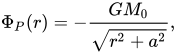
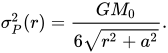
The isotropic distribution function reads if , and otherwise, where is the specific energy.




Properties
[edit]The mass enclosed within radius is given by


Many other properties of the Plummer model are described in Herwig Dejonghe's comprehensive article.[2]
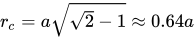
Core radius , where the surface density drops to half its central value, is at .[3]

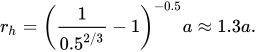
Virial radius is .
The 2D surface density is: and hence the 2D projected mass profile is:


In astronomy, it is convenient to define 2D half-mass radius which is the radius where the 2D projected mass profile is half of the total mass: .

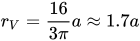
For the Plummer profile: .

The escape velocity at any point is

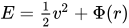
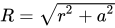
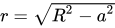
For bound orbits, the radial turning points of the orbit is characterized by specific energy and specific angular momentum are given by the positive roots of the cubic equation where , so that . This equation has three real roots for : two positive and one negative, given that , where is the specific angular momentum for a circular orbit for the same energy. Here can be calculated from single real root of the discriminant of the cubic equation, which is itself another cubic equation where underlined parameters are dimensionless in Henon units defined as , , and .








Applications
[edit]The Plummer model comes closest to representing the observed density profiles of star clusters[citation needed], although the rapid falloff of the density at large radii () is not a good description of these systems.

The behavior of the density near the center does not match observations of elliptical galaxies, which typically exhibit a diverging central density.
The ease with which the Plummer sphere can be realized as a Monte-Carlo model has made it a favorite choice of N-body experimenters, in spite of the model's lack of realism.[4]
References
[edit]- ^ Plummer, H. C. (1911), On the problem of distribution in globular star clusters, Mon. Not. R. Astron. Soc. 71, 460.
- ^ Dejonghe, H. (1987), A completely analytical family of anisotropic Plummer models. Mon. Not. R. Astron. Soc. 224, 13.
- ^ Sloane, N. J. A. (ed.). "Sequence A154747 (Decimal expansion of sqrt(sqrt(2) - 1), the radius vector of the point of bisection of the arc of the unit lemniscate (x^2 + y^2)^2 = x^2 - y^2 in the first quadrant.)". The On-Line Encyclopedia of Integer Sequences. OEIS Foundation.
- ^ Aarseth, S. J., Henon, M. and Wielen, R. (1974), A comparison of numerical methods for the study of star cluster dynamics. Astronomy and Astrophysics 37 183.
Plummer model
View on Grokipediawhere is the total mass of the system, is the radial distance from the center, and is the Plummer radius, a scale length that sets the size of the dense core (typically on the order of parsecs for globular clusters).[2] This formula yields a constant central density and an asymptotic behavior of at large radii , ensuring finite total mass while avoiding singularities at the center.[2] The corresponding gravitational potential is
which is derived from Poisson's equation under the assumption of an isotropic phase-space distribution function that depends solely on the binding energy, consistent with the ergodic theorem for collisionless systems.[3][2] Widely adopted for its mathematical tractability, the Plummer model serves as an initial condition in N-body simulations of star cluster evolution and has been extended to anisotropic variants, hypervirial families, and even cosmological contexts like embedding clusters in expanding universes.[3][4] Despite its simplicity, it approximates real globular clusters reasonably well but is less suitable for extended systems like elliptical galaxies due to the rapid outer density fall-off.[3] Modern applications include analyses of dynamical friction in dark matter halos and projections for dwarf spheroidal galaxies, highlighting its enduring utility in theoretical and computational astrophysics.[5][6]